REVIEW 3 major objections 4 minor 76 references
Predicting Animation Skeletons for 3D Articulated Models via Volumetric Nets
T0 review · 3 major / 4 minor · reviewed 2026-08-14 · deepseek-v4-flash
Pith's one-line read A neural network predicts animation skeletons for any 3D character from geometry alone, without templates or class labels.
desk verdict First learning-based, template-free animation skeleton prediction, solid on its own repository test, but the generic cross-category claim is untested due to single-source evaluation and a density-channel confound. read the letter →
The pith
A machine-rendered reading of the paper's core claim, the machinery that carries it, and where it could break.
The reading
What carries the argument
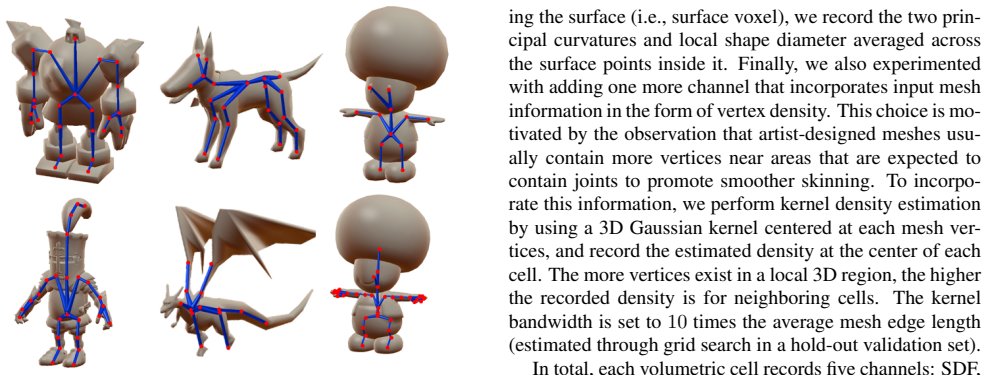
The load-bearing mechanism is a stack of four 3D hourglass modules—encoder-decoder blocks that downsample to a compact code, then upsample with skip connections to preserve local detail—operating on an $88\times 88\times 88$ volumetric grid with five channels: signed distance function, two principal surface curvatures, local shape diameter, and local vertex density. Each hourglass outputs a pair of probability maps, one for joints and one for bones, and each successive module refines the previous pair. Joint candidates are extracted by soft non-maximum suppression, then connected by Prim's minimum spanning tree using summed negative log bone probabilities as edge costs, which prefers short edges that run through predicted bone voxels and penalizes edges exiting the shape.
What would settle it
Take the same trained architecture and evaluate it on artist-rigged characters collected from a different source, or on procedurally generated characters with known ground-truth skeletons. If the joint Chamfer distance rises markedly above the reported 4.6% or the matching rate falls well below 62.1%, the paper's generalization claim is not as broad as stated.
Extended reading notes
Core claim
The paper's central claim is that a static 3D mesh of an articulated character contains enough cues to locate its animation joints and bones, and that these are best learned jointly rather than by fitting a fixed skeleton. The network outputs voxel-wise probabilities for joints and for bones; the bone map is not decorative, because the connectivity of the skeleton is obtained by a minimum spanning tree whose edge costs are sums of negative log bone probabilities, so predicted bones actively determine which joints get connected. On a test set of artist-rigged characters, the paper reports a symmetrized joint Chamfer distance of 4.6% of the shape's longest axis, compared with 5.7% for an L1-medial skeleton baseline and 7.4% for a template-fitting baseline, and a predicted-joint matching rate of 62.1% against 47.9% and 55.8%. The authors also claim a user-controllable level of detail: a single parameter conditions the network to include or omit small parts such as fingers.
Load-bearing premise
The method assumes the mined collection of artist-rigged characters is representative of animation skeletons in general, so that conventions in that collection carry over to unseen characters from other sources.
Editorial extensions
If this is right
- A single trained model can rig humanoids, quadrupeds, birds, fish, robots, and fictional characters without class labels or per-category templates.
- Changing one granularity parameter at test time yields a coarser or finer skeleton, so a rig can be adapted to whether small parts like fingers and ears matter.
- The bone probability map is load-bearing for connectivity: the paper's ablation shows that replacing it with Euclidean edge costs lowers the predicted-joint matching rate from 62.1% to 57.8%.
- Because skeleton extraction always returns a minimum spanning tree rooted near the shape centroid, the output is a tree-structured hierarchy suitable for animation pipelines.
Reading between the lines
- Editorial inference: because the network learns from geometric cues rather than class labels, the same architecture may also predict usable skeletons for non-character articulated objects, such as mechanical assemblies, though the paper evaluates only characters.
- Editorial inference: the vertex-density channel could act as a shortcut specific to the dataset's artist meshes, which tend to have denser tessellation near joints; testing on re-meshed or uniformly sampled inputs would reveal how much the method relies on that cue.
- Editorial inference: the minimum spanning tree post-process is a likely next bottleneck; replacing it with a learned connectivity head could fix the incorrect shoulder connections the paper notes for its four-armed test character.
Signed reviews
Editorial analysis
A structured set of objections, weighed in public.
Referee Report
Summary. The paper presents a supervised learning method that predicts animation skeletons for arbitrary 3D articulated characters. The input mesh is converted into an 88×88×88 volumetric grid with five channels (signed distance function, two principal curvatures, local shape diameter, and local vertex density), and a stack of four 3D hourglass modules outputs joint and bone probability maps. Skeletal joints are extracted by soft non-maximum suppression, and edges are connected by a minimum spanning tree whose edge costs are driven by the predicted bone probabilities; a scalar input parameter controls skeleton granularity. The authors also contribute a dataset of 3,193 artist-rigged characters from Models Resource, split into 80% training, 10% hold-out validation, and 10% testing, and evaluate the method against Pinocchio and L1-medial skeleton extraction using four metrics (CD-joint, CD-joint2bone, MR-pred, MR-ref). The method achieves the best value on all four metrics, and the appendix reports ablations on the number of hourglass modules, input feature channels, granularity control, and the MST cost.
Significance. The strengths of the paper are real: it formulates the problem as cross-category, variable-topology skeleton prediction rather than class-specific pose estimation, and the evaluation is carried out with four complementary metrics. The appendix ablations are a particular asset; they are run on the same split with the same tuning protocol and support the design choices of four hourglass modules, the geometric feature channels, the granularity control, and the bone-probability-driven connectivity. The reported margins over the two baselines are consistent across all four metrics, not just a single favorable measure. If the result holds up to additional scrutiny, the dataset and the volumetric method would be useful to the graphics and vision communities. The principal qualification is external validity: all quantitative evidence comes from a single repository of rigged characters, and the vertex-density channel, which the appendix shows to be an important contributor, is a signal specific to artist-created meshes.
major comments (3)
- [Section 4 (Input Shape Representation); Appendix Table 3] The paper's own limitation statement in Section 4 says that for input meshes with near-uniform vertex density (e.g., reconstructed or re-meshed ones), the vertex-density channel 'is not expected to be useful.' Appendix Table 3 shows that this channel is nonetheless a substantial driver of the reported accuracy: going from SDF-only to all five channels changes MR-ref from 56.0% to 68.3% and CD-joint from 5.2% to 4.6%, and the SDF-only model's MR-ref (56.0%) falls below the L1-median baseline (63.2%). Because the abstract and the introduction claim a generic predictor of animation skeletons, the manuscript needs an experiment that removes or neutralizes the density channel at test time (e.g., re-meshing test characters to near-uniform vertex density, or dropping the channel and retraining), with the four metrics reported for that case. Without such an experiment, the central claim is not established for the reconstructed/re-meshed inputs that the paper itself identifies as a relevant scenario.
- [Section 5 (Dataset, Splits); Section 6 (Table 1); Section 7 (Conclusion)] Training and test characters are both drawn from Models Resource, so the reference skeletons share that repository's rigging conventions, and the evaluation only tests generalization to held-out models from the same source. The conclusion (Section 7) lists the 88^3 resolution and the MST connectivity as limitations but does not mention this distribution shift, even though the paper frames the method as a 'generic, cross-category model' (Sections 1 and 7). To support the headline claim, the authors should evaluate on an external corpus of rigged characters (another repository or a small set of professionally rigged models) or at least run a leave-whole-category-out experiment. This is the single largest gap between the abstract's claim and the evidence in the paper.
- [Section 6 (Quantitative evaluation, Table 1)] All four metrics are reported as point estimates averaged over the 319-model test split, with no confidence intervals, no significance tests, and no per-category breakdown. The claim that the output skeletons are 'much more similar' to human-created ones rests on margins such as CD-joint 4.6% vs. 5.7% and MR-pred 62.1% vs. 47.9%; the paper does not show that these margins are stable across categories (e.g., fish and robots, where Pinocchio's pre-defined templates are structurally disadvantaged) or across models with different joint counts. Please report per-category results and a paired significance test (e.g., Wilcoxon signed-rank) across test shapes for the main comparisons.
minor comments (4)
- [Section 5 (Training objective)] The cross-entropy equations for joints and bones contain a typographical error: 'P̂j(v) log(Pj(v) − (1−P̂j(v)) log(1−Pj(v))' should presumably read 'P̂j(v) log Pj(v) + (1−P̂j(v)) log(1−Pj(v))'; the same issue appears in the bone loss Lb.
- [Appendix, Table 4] The column header 'MR-pref' should be 'MR-ref'.
- [Section 6 (Quantitative evaluation measures)] The sentence 'Ideally, both CD-joint2bone and CD-joint2bone should be low' repeats the same metric twice; the second occurrence should presumably be CD-joint. In the same section, 'the highest marching rates' should read 'the highest matching rates.'
- [Section 4 (Skeleton extraction)] The justification of the sum-based edge cost states that 'the shorter edge will be preferred,' but since the sum grows with segment length, the preference for short edges holds only when the per-voxel bone probabilities along the two candidates are comparable; stating this explicitly would make the design rationale clearer.
Circularity Check
No significant circularity: the method is a supervised learning benchmark whose predictions are evaluated against held-out artist-created skeletons, with no fitted quantity renamed as a prediction.
full rationale
The paper's derivation chain is an empirical learning pipeline, not a mathematical derivation. The network is trained on artist-rigged characters with a cross-entropy loss against joint/bone heatmaps (Eq. 1) and evaluated on a disjoint 10% test split using Chamfer distances and matching rates against reference skeletons (Section 6). The target maps are generated from the reference skeletons, and the input channels (SDF, curvature, shape diameter, vertex density) are computed from geometry; no input channel is defined in terms of the target skeleton, so there is no self-definitional reduction. There are no load-bearing self-citations or imported uniqueness theorems. The paper itself states in Section 4 that for input meshes with near-uniform vertex density (e.g., reconstructed or re-meshed ones), the density channel is not expected to be useful; this is an admitted generalization/external-validity limitation, not circularity, because it does not make the test-time prediction equal to the training label by construction. Likewise, training and test data coming from the same online repository weakens cross-corpus generalization claims but does not reduce the reported comparison to a fit of the evaluation metric. Hence no enumerated circularity pattern is present.
Assumptions & free parameters
free parameters (7)
- Soft-NMS decay sigma =
4.5 voxels
- Soft-NMS probability threshold =
0.013
- Default granularity parameter =
0.02
- Vertex density kernel bandwidth =
10 times average mesh edge length
- Target heatmap variance for joints and bones =
unit variance, tuned via grid search
- Augmentation scaling range =
0.5 to 1.5 per axis
- Augmentation rotation range =
30 to 50 degrees
assumptions (5)
- domain assumption Animation skeletons can be predicted from static geometry alone.
- domain assumption Artist-created skeletons in the Models Resource dataset are valid ground truth for animation skeletons.
- domain assumption The desired output skeleton is a tree rooted near the shape centroid.
- domain assumption Input meshes are consistently oriented and grounded.
- domain assumption A volumetric resolution of 88^3 is sufficient to capture the joints that matter.
Cite this review
Pith. "Pith review of Predicting Animation Skeletons for 3D Articulated Models via Volumetric Nets." pith.science (2026). https://pith.science/paper/SRVSF234
@misc{pith2026190808506,
  author       = {Pith},
  title        = {Pith review of: Predicting Animation Skeletons for 3D Articulated Models via Volumetric Nets},
  year         = {2026},
  howpublished = {\url{https://pith.science/paper/SRVSF234}},
  note         = {Machine review of arXiv:1908.08506}
}
read the original abstract
We present a learning method for predicting animation skeletons for input 3D models of articulated characters. In contrast to previous approaches that fit pre-defined skeleton templates or predict fixed sets of joints, our method produces an animation skeleton tailored for the structure and geometry of the input 3D model. Our architecture is based on a stack of hourglass modules trained on a large dataset of 3D rigged characters mined from the web. It operates on the volumetric representation of the input 3D shapes augmented with geometric shape features that provide additional cues for joint and bone locations. Our method also enables intuitive user control of the level-of-detail for the output skeleton. Our evaluation demonstrates that our approach predicts animation skeletons that are much more similar to the ones created by humans compared to several alternatives and baselines.
Figures


Figures from the paper (5 more)


Reference graph
Works this paper leans on
-
[1]
N. Amenta and M. Bern. Surface reconstruction by voronoi filtering. In Proc. SGC, 1998
work page 1998
-
[2]
D. Attali and A. Montanvert. Computing and simplifying 2d and 3d continuous skeletons. Comput. Vis. Image Underst., 67(3), 1997
work page 1997
-
[3]
I. Baran and J. Popovi ´c. Automatic rigging and animation of 3d characters. ACM Trans. Graph., 26(3), 2007
work page 2007
-
[4]
H. Blum. Biological shape and visual science (part i). Jour- nal of Theoretical Biology, 38(2), 1973
work page 1973
- [5]
-
[6]
D. Boscaini, J. Masci, E. Rodol, and M. M. Bronstein. Learn- ing Shape Correspondence with Anisotropic Convolutional Neural Networks. In Proc. NIPS, 2016
work page 2016
-
[7]
R. Boulic and R. Mas. Interactive computer animation. chap- ter Hierarchical Kinematic Behaviors for Complex Articu- lated Figures. 1996
work page 1996
-
[8]
M. M. Bronstein, J. Bruna, Y . LeCun, A. Szlam, and P. Van- dergheynst. Geometric deep learning: Going beyond eu- clidean data. IEEE Signal Processing Magazine , 34(4), 2017
work page 2017
Show all 76 references
-
[9]
J. Cao, A. Tagliasacchi, M. Olson, H. Zhang, and Z. Su. Point cloud skeletons via laplacian based contraction. In Proc. SMI, 2010
2010
-
[10]
Z. Cao, T. Simon, S.-E. Wei, and Y . Sheikh. Realtime multi- person 2d pose estimation using part affinity fields. Proc. CVPR, 2017
2017
-
[11]
A. Dai, C. R. Qi, and M. Nießner. Shape completion us- ing 3d-encoder-predictor cnns and shape synthesis. In Proc. CVPR, 2017
2017
-
[12]
S. J. Dickinson, A. Leonardis, B. Schiele, and M. J. Tarr.Ob- ject Categorization: Computer and Human Vision Perspec- tives. 2009
2009
-
[13]
P. F. Felzenszwalb and D. P. Huttenlocher. Pictorial struc- tures for object recognition. Int. J. Comput. Vision , 61(1), 2005
2005
-
[14]
L. Ge, Z. Ren, Y . Li, Z. Xue, Y . Wang, J. Cai, and J. Yuan. 3d hand shape and pose estimation from a single rgb image. In Proc. CVPR, 2019
2019
-
[15]
L. Ge, Z. Ren, and J. Yuan. Point-to-point regression point- net for 3d hand pose estimation. In Proc. ECCV, 2018
2018
-
[16]
Girshick, J
R. Girshick, J. Shotton, P. Kohli, A. Criminisi, and A. Fitzgibbon. Efficient regression of general-activity hu- man poses from depth images. In Proc. ICCV, 2011
2011
-
[17]
Goldfeather and V
J. Goldfeather and V . Interrante. A novel cubic-order algo- rithm for approximating principal direction vectors. ACM Trans. Graph., 23(1), 2004
2004
-
[18]
Hameiri and I
E. Hameiri and I. Shimshoni. Estimating the principal curva- tures and the darboux frame from real 3-d range data. IEEE Trans. Systems, Man, and Cybernetics, Part B (Cybernetics), 33(4), 2003
2003
-
[19]
Haque, B
A. Haque, B. Peng, Z. Luo, A. Alahi, S. Yeung, and F. Li. Towards viewpoint invariant 3d human pose estimation. In Proc. ECCV, 2016
2016
-
[20]
Huang, A
F. Huang, A. Zeng, M. Liu, J. Qin, and Q. Xu. Structure- aware 3d hourglass network for hand pose estimation from single depth image. In Proc. BMVC, 2018
2018
-
[21]
Huang, S
H. Huang, S. Wu, D. Cohen-Or, M. Gong, H. Zhang, G. Li, and B. Chen. L1-medial skeleton of point cloud.ACM Trans. Graph., 32(4), 2013
2013
-
[22]
W. Ke, J. Chen, J. Jiao, G. Zhao, and Q. Ye. SRN: side- output residual network for object symmetry detection in the wild. In Proc. CVPR, 2017
2017
-
[23]
T. S. H. Lee, S. Fidler, and S. Dickinson. Detecting curved symmetric parts using a deformable disc model. In Proc. ICCV, 2013
2013
-
[24]
Levinshtein, C
A. Levinshtein, C. Sminchisescu, and S. Dickinson. Multi- scale symmetric part detection and grouping. Int. J. Comput. Vision, 104(2), 2013
2013
-
[25]
Lindeberg
T. Lindeberg. Edge detection and ridge detection with auto- matic scale selection. In Proc. CVPR, 1996
1996
-
[26]
Lindeberg
T. Lindeberg. Scale selection properties of generalized scale- space interest point detectors. Journal of Mathematical Imaging and Vision, 46(2), Jun 2013
2013
-
[27]
C. Liu, W. Ke, F. Qin, and Q. Ye. Linear span network for object skeleton detection. In Proc. ECCV, 2018
2018
-
[28]
L. Liu, Y . Zheng, D. Tang, Y . Yuan, C. Fan, and K. Zhou. Neuroskinning: Automatic skin binding for production char- acters with deep graph networks. ACM Trans. Graphics, to appear, 2019
2019
-
[29]
T.-L. Liu, D. Geiger, and A. L. Yuille. Segmenting by seek- ing the symmetry axis. In Proc. ICPR, 1998
1998
-
[30]
Lo Presti and M
L. Lo Presti and M. La Cascia. 3d skeleton-based human action classification. Pattern Recogn., 53, 2016
2016
-
[31]
Magnenat-Thalmann, R
N. Magnenat-Thalmann, R. Laperri `ere, and D. Thalmann. Joint-dependent local deformations for hand animation and object grasping. In Proc. Graphics Interface ’88, 1988
1988
-
[32]
Marr and H
D. Marr and H. K. Nishihara. Representation and recogni- tion of the spatial organization of three-dimensional shapes. Royal Society of London. Series B, Containing papers of a Biological character, 200, 1978
1978
-
[33]
Martinez, R
J. Martinez, R. Hossain, J. Romero, and J. J. Little. A simple yet effective baseline for 3d human pose estimation. InProc. ICCV, 2017
2017
-
[34]
Masci, D
J. Masci, D. Boscaini, M. Bronstein, and P. Vandergheynst. Geodesic convolutional neural networks on riemannian man- ifolds. In Proc. ICCV, 2015
2015
-
[35]
Maturana and S
D. Maturana and S. Scherer. V oxNet: A 3D Convolutional Neural Network for Real-Time Object Recognition. InIROS, 2015
2015
-
[36]
Monti, D
F. Monti, D. Boscaini, J. Masci, E. Rodola, J. Svoboda, and M. M. Bronstein. Geometric deep learning on graphs and manifolds using mixture model CNNs. In Proc. CVPR) , 2017
2017
-
[37]
G. Moon, J. Y . Chang, and K. M. Lee. V2v-posenet: V oxel- to-voxel prediction network for accurate 3d hand and human pose estimation from a single depth map. In Proc. CVPR, 2018
2018
-
[38]
Moreno-Noguer
F. Moreno-Noguer. 3d human pose estimation from a single image via distance matrix regression. In Proc. CVPR, 2017
2017
-
[39]
Nedzved, S
A. Nedzved, S. Ablameyko, and S. Uchida. Gray-scale thin- ning by using a pseudo-distance map. In Proc. ICPR, 2006
2006
-
[40]
Newell, K
A. Newell, K. Yang, and J. Deng. Stacked hourglass net- works for human pose estimation. In Proc. ECCV, 2016
2016
-
[41]
Pavlakos, X
G. Pavlakos, X. Zhou, K. G. Derpanis, and K. Daniilidis. Coarse-to-fine volumetric prediction for single-image 3d hu- man pose. In Proc. CVPR, 2017
2017
-
[42]
X. Peng, Z. Tang, F. Yang, R. S. Feris, and D. Metaxas. Jointly optimize data augmentation and network training: Adversarial data augmentation in human pose estimation. In Proc. CVPR, 2018
2018
-
[43]
Pereira, D
T. Pereira, D. Aldarondo, L. Willmore, M. Kislin, S. Wang, M. Murthy, and J. W. Shaevitz. Fast animal pose estimation using deep neural networks. Nature Methods, 2019
2019
-
[44]
R. C. Prim. Shortest connection networks and some general- izations. The Bell Systems Technical Journal, 36(6), 1957
1957
-
[45]
Z. Ren, J. Yuan, J. Meng, and Z. Zhang. Robust part-based hand gesture recognition using kinect sensor. IEEE Trans. Multimedia, 15(5), 2013
2013
-
[46]
Resource
V . Resource. The models resource, https://www.models- resource.com/, 2019
2019
-
[47]
Riegler, A
G. Riegler, A. O. Ulusoys, and A. Geiger. Octnet: Learning deep 3D representations at high resolutions. In Proc. CVPR, 2017
2017
-
[48]
Rogez and C
G. Rogez and C. Schmid. Mocap-guided data augmentation for 3d pose estimation in the wild. In Proc. NIPS, 2016
2016
-
[49]
P. K. Saha, G. Borgefors, and G. Sanniti di Baja. A survey on skeletonization algorithms and their applications. Pattern Recogn. Lett., 76, 2016
2016
-
[50]
Sarafianos, B
N. Sarafianos, B. Boteanu, B. Ionescu, and I. Kakadiaris. 3d human pose estimation: A review of the literature and anal- ysis of covariates. Comput. Vis. Image Underst., 09 2016
2016
-
[51]
J. A. Sethian. A fast marching level set method for mono- tonically advancing fronts. In Proc. Natl. Acad. Sci., 1995
1995
-
[52]
Shapira, A
L. Shapira, A. Shamir, and D. Cohen-Or. Consistent mesh partitioning and skeletonisation using the shape diameter function. Vis. Comput., 24(4), 2008
2008
-
[53]
W. Shen, K. Zhao, Y . Jiang, Y . Wang, X. Bai, and A. Yuille. Deepskeleton: Learning multi-task scale-associated deep side outputs for object skeleton extraction in natural images. IEEE Trans. Image Processing, 26(11), 2017
2017
-
[54]
W. Shen, K. Zhao, Y . Jiang, Y . Wang, Z. Zhang, and X. Bai. Object skeleton extraction in natural images by fusing scale- associated deep side outputs. Proc. CVPR, 2016
2016
-
[55]
H. J. Shin, J. Lee, S. Y . Shin, and M. Gleicher. Com- puter puppetry: An importance-based approach. ACM Trans. Graph., 20(2), 2001
2001
-
[56]
Shotton, A
J. Shotton, A. Fitzgibbon, M. Cook, T. Sharp, M. Finoc- chio, R. Moore, A. Kipman, and A. Blake. Real-time human pose recognition in parts from single depth images. In Proc. CVPR, 2011
2011
-
[57]
Siddiqi, S
K. Siddiqi, S. Bouix, A. Tannenbaum, and S. W. Zucker. Hamilton-jacobi skeletons. Int. J. Comput. Vision , 48(3), 2002
2002
-
[58]
Siddiqi, A
K. Siddiqi, A. Shokoufandeh, S. J. Dickinson, and S. W. Zucker. Shock graphs and shape matching. Int. J. Comput. Vision, 35(1), 1999
1999
-
[59]
Tagliasacchi, T
A. Tagliasacchi, T. Delame, M. Spagnuolo, N. Amenta, and A. Telea. 3D Skeletons: A State-of-the-Art Report. Com- puter Graphics Forum, 2016
2016
-
[60]
Tagliasacchi, H
A. Tagliasacchi, H. Zhang, and D. Cohen-Or. Curve skeleton extraction from incomplete point cloud.ACM Trans. Graph., 28(3), 2009
2009
-
[61]
Tekin, P
B. Tekin, P. M´arquez-Neila, M. Salzmann, and P. Fua. Learn- ing to fuse 2d and 3d image cues for monocular body pose estimation. In Proc. ICCV, 2017
2017
-
[62]
Tsogkas and S
S. Tsogkas and S. Dickinson. Amat: Medial axis transform for natural images. In Proc. ICCV, 2017
2017
-
[63]
C. Wan, T. Probst, L. Van Gool, and A. Yao. Dense 3d re- gression for hand pose estimation. In Proc. CVPR, 2018
2018
-
[64]
C. Wan, T. Probst, L. Van Gool, and A. Yao. Self-supervised 3d hand pose estimation through training by fitting. In Proc. CVPR, 2019
2019
-
[65]
P.-S. Wang, Y . Liu, Y .-X. Guo, C.-Y . Sun, and X. Tong. O- CNN: Octree-based convolutional neural networks for 3D shape analysis. ACM Trans. Graph., 36(4), 2017
2017
-
[66]
Wang, C.-Y
P.-S. Wang, C.-Y . Sun, Y . Liu, and X. Tong. Adaptive o-cnn: A patch-based deep representation of 3d shapes.ACM Trans. Graph., 37(6), 2018
2018
-
[67]
Y . Wang, Y . Xu, S. Tsogkas, X. Bai, S. J. Dickinson, and K. Siddiqi. Deepflux for skeletons in the wild. In Proc. CVPR, 2019
2019
-
[68]
S. Wei, V . Ramakrishna, T. Kanade, and Y . Sheikh. Convo- lutional pose machines. In Proc. CVPR, 2016
2016
-
[69]
Z. Wu, S. Song, A. Khosla, F. Yu, L. Zhang, X. Tang, and J. Xiao. 3d shapenets: A deep representation for volumetric shapes. In Proc. CVPR, 2015
2015
-
[70]
C. Xu, L. N. Govindarajan, Y . Zhang, and L. Cheng. Lie-x: Depth image based articulated object pose estimation, track- ing, and action recognition on lie groups. Int. J. Comput. Vision, 123(3), 2017
2017
-
[71]
K. Yin, H. Huang, D. Cohen-Or, and H. Zhang. P2p-net: Bidirectional point displacement net for shape transform. ACM Trans. Graphics, 37(4), 2018
2018
-
[72]
A segmentation-free approach for skeletonization of gray-scale images via anisotropic vector diffusion
Zeyun Yu and Chandrajit Bajaj. A segmentation-free approach for skeletonization of gray-scale images via anisotropic vector diffusion. In Proc. CVPR, 2004
2004
-
[73]
Zhang and I
Q. Zhang and I. Couloigner. Accurate centerline detection and line width estimation of thick lines using the radon trans- form. IEEE Trans. Image Processing, 16(2), 2007
2007
-
[74]
K. Zhao, W. Shen, S. Gao, D. Li, and M.-M. Cheng. Hi- fi: Hierarchical feature integration for skeleton detection. In Proc. IJCAI, 2018
2018
-
[75]
X. Zhou, Q. Huang, X. Sun, X. Xue, and Y . Wei. Towards 3d human pose estimation in the wild: A weakly-supervised approach. In Proc. ICCV, Oct 2017
2017
-
[76]
Zhu and A
S. Zhu and A. Yuille. Forms: A flexible object recognition and modeling system. Int. J. Comput. Vision, 20, 1996. Appendix: Supplementary Material Ablation Study. Here we present evaluation of alternative choices for our method. All the variants are trained in the same split an...
1996
Reviewed August 14, 2026 · model on record in the stance chip above.
Discussion (0). Continue with ORCID to comment.