REVIEW 4 major objections 4 minor 36 references
Navigation of a Quadratic Potential with Ellipsoidal Obstacles
T0 review · 4 major / 4 minor · reviewed 2026-08-14 · deepseek-v4-flash
Pith's one-line read This paper claims that a Hessian-corrected gradient flow navigates a convex quadratic potential around arbitrarily flat ellipsoidal obstacles from any free-space start.
desk verdict A simple and appealing correction to RK navigation dynamics, but the main theorem is unproven: the proof leans on a conjectured critical point and an unproved cycle argument. read the letter →
The pith
A machine-rendered reading of the paper's core claim, the machinery that carries it, and where it could break.
The reading
What carries the argument
The load-bearing object is the curvature-corrected navigation flow (22). It is a gradient-like dynamical system in which each repulsive obstacle term is weighted by the omitted product $\bar\beta_i(x)$ and points from the ellipsoid center $x_i$, while the attractive term points from the goal $x^*$. The argument around it uses a global Lyapunov function $V(x)=\frac12\|x-x^*\|^2$, a per-obstacle Lyapunov function $V_i(x)=\frac12(x-x^*)^\top\nabla^2\beta_i(x)(x-x^*)$, and the repulsion zone $B_i^k(\delta)$, the thin region where the candidate Lyapunov functions fail to decrease. The key mechanism is that increasing $k$ shrinks the repulsion zones into $\varepsilon$-balls around obstacles, within which the flow points away from obstacle centers, forcing escape.
What would settle it
Simulate (22) with large $k$ on a symmetric two-obstacle world with the target between the obstacles, and numerically solve $\dot x=0$ over each repulsion zone $\partial B_i^k$; finding a second critical point or a stable node inside any repulsion zone would disprove Lemma 3. Separately, place several obstacles exactly equidistant from the target in a ring and test whether any trajectory under exact arithmetic revisits the same obstacle repeatedly, which would disprove the finite-visit claim.
Extended reading notes
Core claim
The central claim is Theorem 1: for $f_0(x)=(x-x^*)^\top Q(x-x^*)$ and ellipsoidal obstacles $\beta_i(x)=\frac12(x-x_i)^\top A_i(x-x_i)-\frac12 r_i^2$, there is a finite threshold $K$ such that for all $k>K$ the flow $\dot x=-\beta(x)(x-x^*)+\frac{f_0(x)}{k}\sum_i \bar\beta_i(x)(x-x_i)$ keeps every free-space trajectory inside the free space and sends it to $x^*$. The flow is obtained by replacing $\nabla f_0$ and $\nabla\beta_i$ with Hessian-inverse products, which reduce to relative-position vectors; this recreates the dynamics of a spherical world without assuming the world is spherical. The proof splits the state space: far from obstacles a global Lyapunov function decreases; near each obstacle local Lyapunov functions define a repulsion zone that the agent leaves; and a graph-ordering argument limits the number of obstacles visited. The theorem is stated for every initial free-space position, though the proof's local lemmas establish escape only up to a measure-zero set, a gap the paper does not reconcile.
Load-bearing premise
The proof's load-bearing premise is that each repulsion zone has exactly one critical point, an unstable saddle near the line through $x^*$ and $x_i$, and that cycles are escaped because infinite looping would force crossing an obstacle center; both are asserted rather than proven, one explicitly as a conjecture, and the convergence claim collapses if either fails.
Editorial extensions
If this is right
- If Theorem 1 is correct, the eccentricity restriction on Rimon-Koditschek navigation disappears for quadratic costs and ellipsoidal obstacles: condition (10) no longer needs to hold.
- Implementation requires only relative positions and distances to the goal and obstacle centers, because the Hessian corrections collapse into $x-x^*$ and $x-x_i$.
- The threshold $K$ is finite and independent of the starting point, so one gain setting works for all initial conditions in a given ellipsoidal world.
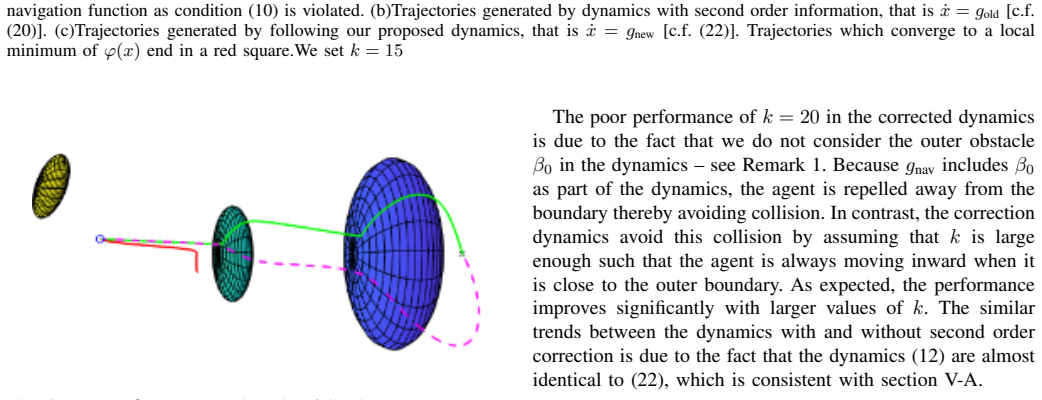
- The simulations show that success rates stay above 95 percent for $k=60$ as the obstacle count grows, while uncorrected navigation degrades; the theorem explains this by removing the old curvature condition.
Reading between the lines
- The same flow should extend to disjoint strictly convex obstacles by locally replacing each obstacle with an inscribed ellipsoid or a quadratic barrier, at the cost of reintroducing shape estimation.
- The no-second-order-information feature is special to quadratic potentials and ellipsoidal barriers; for a general strongly convex potential, $\nabla^2 f_0^{-1}\nabla f_0$ is not $x-x^*$, so the simplification would not survive without curvature measurements.
- The proof's measure-zero caveat predicts that non-converging initial conditions, if they exist, lie on stable manifolds of repulsion-zone saddles; a numerical search initialized exactly on those manifolds could test whether the 'every initial position' form of Theorem 1 is actually necessary.
Signed reviews
Editorial analysis
A structured set of objections, weighed in public.
Referee Report
Summary. The paper proposes a modified gradient flow (Eq. 22) for navigating a point agent in a convex quadratic potential toward its minimizer while avoiding disjoint ellipsoidal obstacles. The modification applies a Hessian-inspired correction to the Rimon-Koditschek dynamics so that the agent only needs relative positions and distances, not curvature estimates. Theorem 1 claims that for a sufficiently large gain k the flow stays in the free space and converges to the target from every initial condition. The proof introduces global and local Lyapunov functions, a repulsion zone near each obstacle, and lemmas about escape from that zone and finite obstacle visits, followed by numerical comparisons with the uncorrected and second-order-corrected dynamics.
Significance. If Theorem 1 were established, the result would be practically significant: it would remove the eccentricity restriction (10) that limits Rimon-Koditschek navigation functions, and it would achieve this with a simple dynamics that does not require second-order information about the obstacles or the potential. The numerical experiments, especially the success-rate comparison as obstacle count increases, support the plausibility of the claim. However, the proof as written contains load-bearing gaps: a central lemma is justified by an explicit conjecture, and the finite-visit argument for cyclic configurations is asserted rather than proved. The paper is therefore not currently a rigorous proof of its main theorem.
major comments (4)
- [Appendix C (Lemma 3)] The proof of Lemma 3 begins with the sentence 'We conjecture that the saddle point on the border of the repulsion zone will be close to the point xs' satisfying (44), and the subsequent analysis only shows that such a point, if it exists, is unstable. It is never shown that a point satisfying (44) lies on ∂B_i^k, that it is a critical point of the restricted flow, or that no other critical point exists on that boundary. The passage beginning 'What is left to show is that there is no other critical point' is followed by an appeal to Lemma 2 and a maximum over K_i^γ, not by a derivation that rules out other critical points. Since Lemma 3 is essential for the claim that the agent escapes the repulsion zone, Theorem 1 is not established by the arguments given.
- [Section IV-B] The finite-visit argument for cyclic configurations is asserted without proof. The text states that 'For cycles to exist, it must be that the obstacles are equidistant from the objective' and that an infinite loop 'requires it to cross the center of the obstacle,' but neither statement is derived from the dynamics. Lemma 2 only establishes that a particular normal component of the velocity is positive when (x−xi) is not aligned with (x−x*); it does not imply the geometric claims about cycle structure or obstacle centers. Consequently, the conclusion that the agent visits only finitely many obstacles is unsupported, and this conclusion is needed for the convergence part of Theorem 1.
- [Theorem 1 and abstract] Theorem 1 states convergence from every initial condition x0, while the abstract limits the claim to 'almost every initial position (up to a set of measure one)' and the proof text in Section IV-A says 'Lemmas 2 and 3 guarantee that the agent will exit the repulsion zone for almost every initial position.' These are materially different statements. The universal quantification in Theorem 1 is stronger than anything the proof establishes, so either the theorem must be weakened or the measure-zero caveat must be eliminated in the proof.
- [Appendix A (Lemma 1)] The proof of Lemma 1 derives, on the border of the repulsion zone, an expression that vanishes, but the lemma claims strict decrease in the interior and constancy on the boundary. The text says 'We have shown that the local Lyapunov function candidate is strictly negative except for on the border of the repulsion zone,' yet the displayed calculation only handles the boundary case. The interior strictness follows informally from the inequality in (33), but this step is not written out, and the notational shift between Vi in (31), V_i in (40), and the tilde function in (35) makes the argument harder to verify.
minor comments (4)
- [Section IV, after Eq. (26)] There is a typo in 'the numerator on the right hand since of (26)': 'since' should be 'side.'
- [Appendix D, Eq. (56)] In the proof of Lemma 4, the text refers to 'the functions f0(x), B(x), and β(x) are continuous,' but B(x) is not defined in this paper and does not appear in the expression being bounded; the factor is sum_i \barβ_i(x), so the reference to B(x) appears to be a remnant from the second-order dynamics.
- [Reference [31]] Reference [31] has the same title and author list as the present manuscript and appears to be an unpublished companion or prior version; the paper should state its status and clarify how the present result differs from it, especially since the introduction compares the proposed dynamics with those of [31].
- [Section V-B] The word 'centeres' should be 'centers' in 'The centeres are then chosen.'
Circularity Check
No circularity: the proposed flow (22) is an independently stated ansatz whose proof uses Lyapunov arguments, not its own conclusion; the paper's real weaknesses are proof gaps, not self-reference.
full rationale
The central claim, Theorem 1, is not derived from its own conclusion. The dynamics (22) are constructed from Hessian-inverse corrections in (13)-(16), motivated by spherical worlds, but the convergence proof proceeds through independent Lyapunov candidates V, Vi, and V~i and through Lemmas 1-4. The global and local Lyapunov arguments do not assume the trajectory converges; they derive monotonicity conditions and then study the repulsion zone. The self-citation [31], which carries the same title and authors, is used only as a comparison baseline for the second-order dynamics gold and as a remark on its limitations; it is not the source of Theorem 1's proof. The numerical experiments are simulations of the proposed dynamics, not fitted predictions of the theorem. The paper does contain serious non-circularity problems: Lemma 3's proof begins with 'We conjecture that the saddle point on the border of the repulsion zone will be close to' and then never establishes uniqueness of the critical point on ∂B_i^k, and Section IV-B asserts without proof that cycles force the agent to cross obstacle centers. These are omitted proofs or unsupported assertions, which affect correctness, but they are not cases where a prediction reduces to its inputs by construction. No fitted parameter is renamed as a prediction, no uniqueness theorem is imported from the authors' prior work, and no known result is merely relabeled. Accordingly, the circularity score is 0.
Assumptions & free parameters
free parameters (1)
- k (navigation gain) =
not specified; simulations use 15, 20, 40, 60
assumptions (4)
- domain assumption Assumption 1: target x* and initial condition x(0) lie in the free space F
- domain assumption Assumption 2: obstacles O_i are pairwise disjoint
- ad hoc to paper Uniqueness of the critical point on the repulsion-zone boundary (Lemma 3)
- ad hoc to paper Finite obstacle visits in cyclic graphs (Section IV-B)
Cite this review
Pith. "Pith review of Navigation of a Quadratic Potential with Ellipsoidal Obstacles." pith.science (2026). https://pith.science/paper/CZNRTKRU
@misc{pith2026190808509,
  author       = {Pith},
  title        = {Pith review of: Navigation of a Quadratic Potential with Ellipsoidal Obstacles},
  year         = {2026},
  howpublished = {\url{https://pith.science/paper/CZNRTKRU}},
  note         = {Machine review of arXiv:1908.08509}
}
read the original abstract
Given a convex quadratic potential of which its minimum is the agent's goal and a Euclidean space populated with ellipsoidal obstacles, one can construct a Rimon-Koditschek (RK) artificial potential to navigate. Its negative gradient attracts the agent toward the goal and repels the agent away from the boundary of the obstacles. This is a popular approach to navigation problems since it can be implemented with local spatial information that is acquired during operation time. However, navigation is only successful in situations where the obstacles are not too eccentric (flat). This paper proposes a modification to gradient dynamics that allows successful navigation of an environment with a quadratic cost and ellipsoidal obstacles regardless of their eccentricity. This is accomplished by altering gradient dynamics with a Hessian correction that is intended to imitate worlds with spherical obstacles in which RK potentials are known to work. The resulting dynamics simplify by the quadratic form of the obstacles. Convergence to the goal and obstacle avoidance is established from almost every initial position (up to a set of measure one) in the free space, with mild conditions on the location of the target. Results are corroborated empirically with numerical simulations.
Figures


Figures from the paper (4 more)



Reference graph
Works this paper leans on
-
[31]
Navigation of a quadratic potential with ellipsoidal obstacles
H. Kumar, S. Paternain, and A. Ribeiro, “Navigation of a quadratic potential with ellipsoidal obstacles.”
-
[1]
Motion strategies for surveillance.,
S. Bhattacharya, S. Candido, and S. Hutchinson, “Motion strategies for surveillance.,” in Robotics: Science and Systems , 2007
work page 2007
-
[2]
A team of robotic agents for surveillance,
P. E. Rybski, S. A. Stoeter, M. D. Erickson, M. Gini, D. F. Hougen, and N. Papanikolopoulos, “A team of robotic agents for surveillance,” in Proceedings of the fourth international conference on autonomous agents, pp. 9–16, ACM, 2000
work page 2000
-
[3]
R. R. Murphy, S. Tadokoro, D. Nardi, A. Jacoff, P. Fiorini, H. Choset, and A. M. Erkmen, “Search and rescue robotics,” in Springer handbook of robotics, pp. 1151–1173, Springer, 2008
work page 2008
-
[4]
Distributed search and rescue with robot and sensor teams,
G. Kantor, S. Singh, R. Peterson, D. Rus, A. Das, V . Kumar, G. Pereira, and J. Spletzer, “Distributed search and rescue with robot and sensor teams,” in Field and Service Robotics , pp. 529–538, Springer, 2003
work page 2003
-
[5]
S. M. LaValle, Planning algorithms. Cambridge university press, 2006
2006
-
[6]
I-bug: An intensity-based bug algorithm,
K. Taylor and S. M. LaValle, “I-bug: An intensity-based bug algorithm,” in Robotics and Automation, 2009. ICRA’09. IEEE International Con- ference on, pp. 3981–3986, IEEE, 2009
work page 2009
-
[7]
Performance comparison of bug navigation algorithms,
J. Ng and T. Br ¨aunl, “Performance comparison of bug navigation algorithms,” Journal of Intelligent and Robotic Systems , vol. 50, no. 1, pp. 73–84, 2007
work page 2007
Show all 36 references
-
[8]
A formal basis for the heuristic determination of minimum cost paths,
P. E. Hart, N. J. Nilsson, and B. Raphael, “A formal basis for the heuristic determination of minimum cost paths,” IEEE transactions on Systems Science and Cybernetics , vol. 4, no. 2, pp. 100–107, 1968
1968
-
[9]
Rapidly-exploring random trees: A new tool for path planning,
S. M. LaValle, “Rapidly-exploring random trees: A new tool for path planning,” 1998
1998
-
[10]
Path planning with modified a star algorithm for a mobile robot,
F. Ducho ˇn, A. Babinec, M. Kajan, P. Be ˇno, M. Florek, T. Fico, and L. Juri ˇsica, “Path planning with modified a star algorithm for a mobile robot,” Procedia Engineering, vol. 96, pp. 59–69, 2014
2014
-
[11]
Fast replanning for navigation in unknown terrain,
S. Koenig and M. Likhachev, “Fast replanning for navigation in unknown terrain,” IEEE Transactions on Robotics , vol. 21, no. 3, pp. 354–363, 2005
2005
-
[12]
On the complexity of admissible search algorithms,
A. Martelli, “On the complexity of admissible search algorithms,” Artificial Intelligence, vol. 8, no. 1, pp. 1–13, 1977
1977
-
[13]
Global path planning using artificial potential fields,
C. W. Warren, “Global path planning using artificial potential fields,” in Proceedings, 1989 International Conference on Robotics and Automa- tion, pp. 316–321, Ieee, 1989
1989
-
[14]
Robot navigation functions on manifolds with boundary,
D. E. Koditschek and E. Rimon, “Robot navigation functions on manifolds with boundary,” Advances in applied mathematics , vol. 11, no. 4, pp. 412–442, 1990
1990
-
[15]
Exact robot navigation using artificial potential functions,
E. Rimon and D. E. Koditschek, “Exact robot navigation using artificial potential functions,” IEEE Transactions on robotics and automation , vol. 8, no. 5, pp. 501–518, 1992
1992
-
[16]
The navigation transformation,
S. G. Loizou, “The navigation transformation,” IEEE Transactions on Robotics, vol. 33, no. 6, pp. 1516–1523, 2017
2017
-
[17]
Prescribed time scale robot navigation,
C. Vrohidis, P. Vlantis, C. P. Bechlioulis, and K. J. Kyriakopoulos, “Prescribed time scale robot navigation,”IEEE Robotics and Automation Letters, vol. 3, no. 2, pp. 1191–1198, 2018
2018
-
[18]
Formation stabilization of multiple agents using decentralized navigation functions.,
H. G. Tanner and A. Kumar, “Formation stabilization of multiple agents using decentralized navigation functions.,” in Robotics: Science and systems, vol. 1, pp. 49–56, Boston, 2005
2005
-
[19]
Communication-aware target tracking using navigation functions-centralized case,
A. Ghaffarkhah and Y . Mostofi, “Communication-aware target tracking using navigation functions-centralized case,” in 2009 Second Interna- tional Conference on Robot Communication and Coordination , pp. 1–8, IEEE, 2009
2009
-
[20]
Navigation functions for every- where partially sufficiently curved worlds,
I. F. Filippidis and K. J. Kyriakopoulos, “Navigation functions for every- where partially sufficiently curved worlds,” in Robotics and Automation (ICRA), 2012 IEEE International Conference on , pp. 2115–2120, IEEE, 2012
2012
-
[21]
Navigation functions for convex potentials in a space with convex obstacles,
S. Paternain, D. E. Koditschek, and A. Ribeiro, “Navigation functions for convex potentials in a space with convex obstacles,” IEEE Transactions on Automatic Control , vol. 63, no. 9, pp. 2944–2959, 2018
2018
-
[22]
The construction of analytic diffeo- morphisms for exact robot navigation on star worlds,
E. Rimon and D. E. Koditschek, “The construction of analytic diffeo- morphisms for exact robot navigation on star worlds,” Transactions of the American Mathematical Society , vol. 327, no. 1, pp. 71–116, 1991
1991
-
[23]
The navigation transformation: Point worlds, time ab- stractions and towards tuning-free navigation,
S. G. Loizou, “The navigation transformation: Point worlds, time ab- stractions and towards tuning-free navigation,” in 2011 19th Mediter- ranean Conference on Control & Automation (MED) , pp. 303–308, IEEE, 2011
2011
-
[24]
Navigation functions in topologically complex 3-d workspaces,
S. G. Loizou, “Navigation functions in topologically complex 3-d workspaces,” in 2012 American Control Conference (ACC) , pp. 4861– 4866, IEEE, 2012
2012
-
[25]
Locally com- putable navigation functions for sphere worlds,
G. Lionis, X. Papageorgiou, and K. J. Kyriakopoulos, “Locally com- putable navigation functions for sphere worlds,” in Proceedings 2007 IEEE International Conference on Robotics and Automation , pp. 1998– 2003, IEEE, 2007
2007
-
[26]
Towards lo- cally computable polynomial navigation functions for convex obstacle workspaces,
G. Lionis, X. Papageorgiou, and K. J. Kyriakopoulos, “Towards lo- cally computable polynomial navigation functions for convex obstacle workspaces,” in Robotics and Automation, 2008. ICRA 2008. IEEE International Conference on , pp. 3725–3730, IEEE, 2008
2008
-
[27]
Stochastic artificial potentials for online safe navigation,
S. Paternain and A. Ribeiro, “Stochastic artificial potentials for online safe navigation,” arXiv preprint arXiv:1701.00033 , 2016
2016 arXiv
-
[28]
Exact robot navigation using power diagrams,
O. Arslan and D. E. Koditschek, “Exact robot navigation using power diagrams,” in 2016 IEEE International Conference on Robotics and Automation (ICRA), pp. 1–8, IEEE, 2016
2016
-
[29]
Sensor-based reactive navigation in unknown convex sphere worlds,
O. Arslan and D. E. Koditschek, “Sensor-based reactive navigation in unknown convex sphere worlds,” The International Journal of Robotics Research, p. 0278364918796267, 2016
2016
-
[30]
Boyd and L
S. Boyd and L. Vandenberghe, Convex optimization. Cambridge univer- sity press, 2004
2004
-
[32]
Adjustable navigation functions for unknown sphere worlds,
I. Filippidis and K. J. Kyriakopoulos, “Adjustable navigation functions for unknown sphere worlds,” in Decision and Control and European Control Conference (CDC-ECC), 2011 50th IEEE Conference on , pp. 4276–4281, IEEE, 2011
2011
-
[33]
Least squares ellipsoid specific fitting,
Q. Li and J. G. Griffiths, “Least squares ellipsoid specific fitting,” in null, p. 335, IEEE, 2004
2004
-
[34]
Direct least square fitting of ellipses,
A. Fitzgibbon, M. Pilu, and R. B. Fisher, “Direct least square fitting of ellipses,” IEEE Transactions on pattern analysis and machine intelli- gence, vol. 21, no. 5, pp. 476–480, 1999
1999
-
[35]
Automatic assembly planning and control via potential functions,
L. L. Whitcomb and D. E. Koditschek, “Automatic assembly planning and control via potential functions,” in Intelligent Robots and Sys- tems’ 91. ’Intelligence for Mechanical Systems, Proceedings IROS’91. IEEE/RSJ International Workshop on , pp. 17–23, IEEE, 1991
1991
-
[36]
Toward the automatic control of robot assembly tasks via potential functions: The case of 2-d sphere assemblies,
L. L. Whitcomb, D. E. Koditschek, and J. B. Cabrera, “Toward the automatic control of robot assembly tasks via potential functions: The case of 2-d sphere assemblies,” in Robotics and Automation, 1992. Proceedings., 1992 IEEE International Conference on , pp. 2186–2191, IEEE, ...
1992
Reviewed August 14, 2026 · model on record in the stance chip above.
Discussion (0). Continue with ORCID to comment.