REVIEW 3 major objections 6 minor 45 references
Compositional Video Prediction
T0 review · 3 major / 6 minor · reviewed 2026-08-14 · deepseek-v4-flash
Pith's one-line read This paper claims that predicting future frames by modeling scene entities and a single trajectory-level latent variable yields realistic stochastic video prediction from one image.
desk verdict A genuinely useful compositional architecture for stochastic video prediction, but the headline claim about the global latent runs ahead of the best-of-100 evidence. read the letter →
The pith
A machine-rendered reading of the paper's core claim, the machinery that carries it, and where it could break.
The reading
What carries the argument
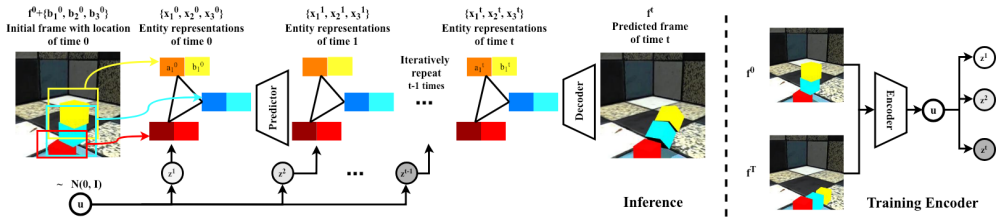
The central mechanism is the pair of factored representations and the global trajectory latent. Each entity is a tuple of a 2D location and a 32-dimensional appearance vector; the predictor evolves these tuples through four rounds of message passing in a graph (fully connected for objects, a skeleton for human joints). A one-layer LSTM converts a single sampled latent $u$ into per-timestep conditions $z_t$, so all timesteps are correlated through one draw. The decoder decodes a normalized spatial feature and a soft mask per entity, warps both to image coordinates via a Spatial Transformer Network, and composites them over background features by weighted averaging, resolving overlap with the masks. This machinery is what allows the model to reason about interactions, generalize to different numbers of entities, and sample coherent futures.
What would settle it
Run the trained model on a video of a single block rotating about its center with no translation: if the appearance feature is orientation-blind, the composed frames will blur or smear the block's faces. A complementary check on diversity: record the 100 sampled futures without cherry-picking; if the set collapses to a single trajectory, the global latent carries no ambiguity, and if the best-of-100 score is high while the average is near-identical across samples, the evaluation protocol hides the collapse.
Extended reading notes
Core claim
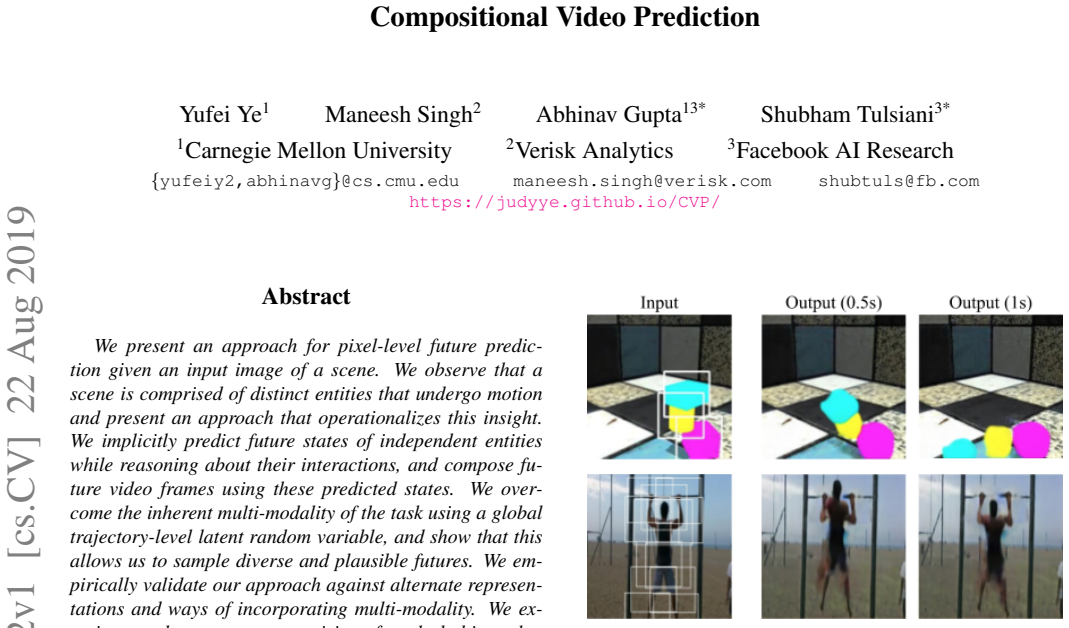
The central claim is that a scene can be factorized into entities—each represented as a 2D location and a learned appearance feature—and that predicting forward in this factored space, then decoding back to pixels, gives better stochastic video prediction than predicting frames directly. The predictor is a graph neural network that passes messages between entities so that motion depends on the configuration of neighbors (for example, whether a block will fall depends on the blocks around it). The decoder warps per-entity appearance features and soft visibility masks to their predicted locations and blends them over background features extracted from the initial frame, which lets it handle occlusions and newly visible background. Ambiguity is resolved by a global latent variable that is drawn once per video and expanded through an LSTM into per-timestep conditions, so that all frames of a sample share one coherent future. The paper shows on ShapeStacks and Penn Action that this composition outperforms alternatives and that the global latent produces consistent yet diverse sample trajectories.
Load-bearing premise
The method assumes every scene can be fully captured by a fixed set of entities, each described by a 2D location and a 32-dimensional appearance vector, and that composing decoded features from these entities over the initial frame reconstructs a realistic future frame — so any appearance change the feature cannot encode (orientation, deformation, self-occlusion) degrades the composition.
Editorial extensions
If this is right
- A single global latent draw produces trajectories that stay consistent across time, whereas independent per-timestep sampling drifts or switches between futures partway through a clip.
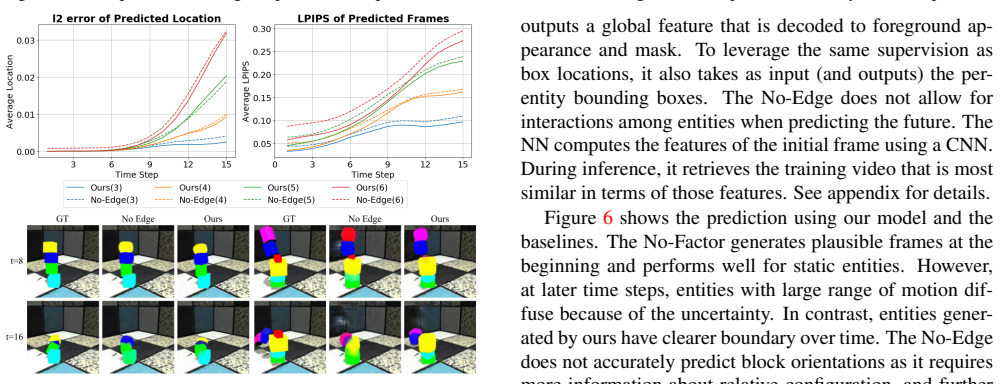
- Entity-level factorization lets the model predict scenes with more entities than seen in training; the paper shows reasonable generalization from 3-block training to 4-, 5-, and 6-block test towers.
- The learned decoder's soft masks act as unsupervised instance segmentations, which could be reused for other tasks such as object discovery or scene editing.
- Because entity locations are the only supervision the predictor needs per frame, replacing manual annotations with an off-the-shelf pose detector at both train and test time yields competitive results, suggesting the method tolerates noisy entity localization.
Reading between the lines
- A natural extension, unstated by the paper, is to condition or edit the global latent $u$ directly to steer the future—choosing the direction a tower topples or the activity a person performs—turning the predictor into a controllable video generator.
- The appearance feature is 32-dimensional and orientation-blind; a stress test with objects that rotate significantly (rather than merely toppling) would reveal whether the decoder or the feature must take on pose information.
- The best-of-100 evaluation rewards coverage rather than diversity; measuring the spread or calibration of samples without cherry-picking would test whether the latent's diversity is usable.
- The decomposition into entities is assumed given; the model itself does not discover entities. Marrying this predictor with an unsupervised entity-discovery module would point toward prediction without any location supervision.
Signed reviews
Editorial analysis
A structured set of objections, weighed in public.
Referee Report
Summary. The paper proposes a compositional approach to stochastic video prediction from a single annotated image. The scene is decomposed into entities, each represented by a 2D location and a 32-dimensional appearance feature. A graph neural network predictor propagates these representations through time, conditioned on per-timestep latent variables z_t that are derived deterministically from a single global trajectory-level latent u via an LSTM. A learned decoder warps per-entity appearance features and soft masks to the predicted locations and composes them with background features to render future frames. The model is trained by maximizing a variational lower bound with an auxiliary location loss and an auto-encoding decoder loss. Experiments on ShapeStacks and Penn Action compare the approach against frame-level, non-interaction, per-timestep-latent, and pose-based baselines, reporting location error and LPIPS under a best-of-100 sampling protocol.
Significance. If the empirical claims are confirmed, the paper makes a useful contribution: it demonstrates that explicit entity factorization with a global trajectory-level latent can yield competitive stochastic video prediction on both synthetic and real domains, and the decoder design (late fusion of warped entity features with soft masks) is a clean, reusable component. The paper deserves credit for testing multiple baselines and ablations, for examining generalization to different numbers of entities, and for showing robustness to detected rather than annotated keypoints. The main weakness is that the evaluation protocol (best-of-100 selection) and the train-with-ground-truth-latent decoder ablation do not fully support the paper's central claims about realism and the advantage of the global latent over per-timestep latents.
major comments (3)
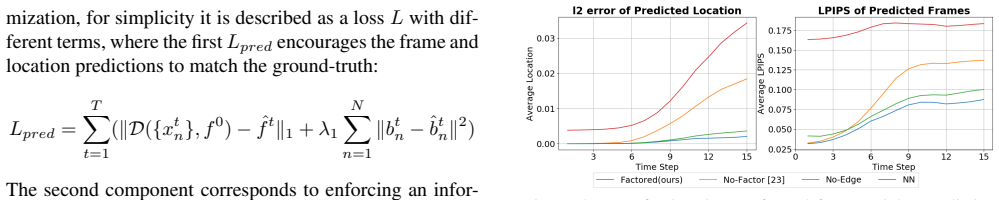
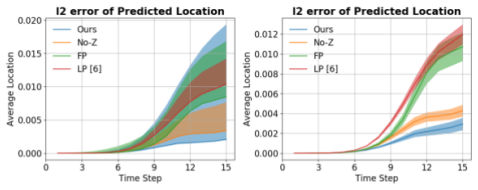
- [Section 4.1, Evaluation Metrics; Figures 5, 10, 14] The central claim that the global trajectory-level latent produces 'more realistic predictions' than per-timestep latents (Section 1) rests on best-of-100 curves and on qualitative examples selected as the best LPIPS sample. Best-of-N error is a lower envelope and does not measure the quality of a typical or randomly drawn sample; a model whose posterior is broad but mostly poor can score well on best-of-100. The paper does not report mean or median errors over the 100 samples in the main comparisons (Figure 15 reports sigma only for ShapeStacks location error and only for the proposed model). Please report average/median sample quality (or another proper stochastic metric such as a diversity-accuracy curve) for all methods, and state whether the qualitative 'best' selections are representative of typical outputs.
- [Section 4.2, Primitive Decoder] The decoder ablation is performed with 'the latent u encoded by the ground truth videos,' i.e., conditioned on the actual future. This protocol turns the decoder comparison into a reconstruction/auto-encoding test rather than a prediction test, so the conclusion that late fusion is the best composition strategy for generating future frames is not supported by the presented evidence. Please re-run the decoder comparison under the inference-time protocol (sampled u from the prior, predicted entity representations) or explicitly justify why conditioning on the ground truth does not change the relative ordering.
- [Section 4, Figures 5-14] Quantitative comparisons are presented as curves without error bars or significance tests over the test set or over random seeds. Given that the differences between the proposed model and baselines (e.g., Figures 10 and 14) appear modest at several time steps, error bars are needed to establish that the reported advantages are not within noise. Additionally, the claim in Section 4.3 that using detected keypoints is 'competitive' with annotated keypoints is only supported qualitatively (Figure 12); please provide the quantitative comparison.
minor comments (6)
- [Appendix A, Entity Predictor] In the e->v message passing step, the equation reads 'v^{(l+1)}_i = f^{(l)}_{v->e}[POOL[e^{(l)}_{i,j}|(i,j)]]', but the function should likely be f^{(l)}_{e->v}; please fix this typo.
- [Section 3.1, Entity Predictor] After the final interaction block, the text says 'the final block outputs predictions for the entity features for the next timestep {x_t_n}N_n=1', but the notation should be {x^{t+1}_n} to be consistent with the surrounding equations.
- [Section 3.2, Eq. (2)] The symbol '⊕' is used in the composition equation without being defined; it appears to denote elementwise addition, and should be stated explicitly.
- [Section 3.4, Training Objective] The sentence 'We will release our code for reproducibility' is a promise that is not fulfilled in the submitted manuscript; either provide a code link or soften the statement.
- [Figure 15 / Appendix D] Figure 15 is only discussed in Appendix D; its sigma curves would be more informative if referenced in Section 4.2 when discussing sample diversity, and ideally for all compared methods.
- [Section 4.2, Figure 6] The qualitative discussion references 'later time steps' for the No-Factor baseline, but the time steps are not clearly annotated in Figure 6; consider labeling the visualized frames with the corresponding time indices.
Circularity Check
No central circularity: the main comparison samples from the prior and matches baselines under the same protocol; the only self-referential step is the decoder ablation, which visibly conditions on the ground-truth future latent.
-
fitted input called prediction
[Sec. 4.1 Evaluation Metrics; Sec. 4.2 Primitive Decoder]
"When we ablate non-stochastic modules (e.g. decoders), we use the mean u predicted by the latent encoder (after seeing the 'ground-truth' video). ... Note the latent u is encoded by the ground truth videos."
In the primitive-decoder ablation, the latent u is produced by the trained encoder from the ground-truth future (q(u|f0, f̂T)), and the decoder is trained with Ldec to reconstruct exactly that future from ground-truth entity features. Evaluating decoder variants with this u therefore measures autoencoding/reconstruction capacity with an oracle summary of the target, not single-image future prediction. The paper is transparent about this, and the step is used only to select the decoder fusion level; the central stochastic-prediction claim is not reduced by this choice.
full rationale
The paper makes no formal derivation that reduces to its inputs; it is an empirical architecture and representation paper. The central comparison (global trajectory-level latent vs per-timestep latents) is evaluated by sampling 100 latents from the prior for all models and recording best errors, so the proposed model does not receive the ground-truth future at inference in the main experiments. Best-of-100 evaluation is a limitation for claims about typical-sample realism and diversity, but it is not circular because the samples are drawn from the model prior and the same protocol is applied to baselines. The only self-referential element is the decoder ablation, which uses the latent encoder's mean conditioned on the ground-truth video; the paper explicitly flags this ('Note the latent u is encoded by the ground truth videos') and uses it only to compare fusion architectures, not to establish the headline prediction claim. Self-citations to prior work involving co-authors (e.g., Pose-Knows) are used as baselines, not as load-bearing justification. Accordingly, no significant circularity is present beyond the limited decoder-ablation step, and the appropriate score is 2.
Assumptions & free parameters
free parameters (5)
- lambda_1 =
100
- lambda_2 =
1e-3
- latent_dim =
8
- appearance_dim =
32
- entity_region_size =
70
assumptions (5)
- domain assumption The training objective in Section 3.4 is treated as a valid variational lower bound on the log-likelihood of the future frames, even though the implemented loss is a weighted sum of reconstruction, autoencoding, and KL terms, and the decoder output is not a normalized likelihood.
- domain assumption At test time, entity locations are available either from ground-truth annotations or from an off-the-shelf detector, and the model is robust to noise in these locations.
- domain assumption A fixed-size appearance vector (32 dims) and a 2D location are sufficient to represent an entity's state, and the graph predictor can propagate this state over time, including rotations, deformations, and interactions.
- domain assumption The graph structure used for message passing, fully connected for ShapeStacks and skeleton for Penn Action, accurately reflects the interaction patterns among entities.
- domain assumption The evaluation metrics, LPIPS and location MSE with best-of-100 sampling, are valid proxies for video prediction quality.
Cite this review
Pith. "Pith review of Compositional Video Prediction." pith.science (2026). https://pith.science/paper/LV4STQXS
@misc{pith2026190808522,
  author       = {Pith},
  title        = {Pith review of: Compositional Video Prediction},
  year         = {2026},
  howpublished = {\url{https://pith.science/paper/LV4STQXS}},
  note         = {Machine review of arXiv:1908.08522}
}
read the original abstract
We present an approach for pixel-level future prediction given an input image of a scene. We observe that a scene is comprised of distinct entities that undergo motion and present an approach that operationalizes this insight. We implicitly predict future states of independent entities while reasoning about their interactions, and compose future video frames using these predicted states. We overcome the inherent multi-modality of the task using a global trajectory-level latent random variable, and show that this allows us to sample diverse and plausible futures. We empirically validate our approach against alternate representations and ways of incorporating multi-modality. We examine two datasets, one comprising of stacked objects that may fall, and the other containing videos of humans performing activities in a gym, and show that our approach allows realistic stochastic video prediction across these diverse settings. See https://judyye.github.io/CVP/ for video predictions.
Figures

Figures from the paper (9 more)




Reference graph
Works this paper leans on
-
[1]
Stochastic variational video prediction
Mohammad Babaeizadeh, Chelsea Finn, Dumitru Erhan, Roy H Campbell, and Sergey Levine. Stochastic variational video prediction. ICLR, 2017. 2
work page 2017
-
[2]
Interaction networks for learning about objects, relations and physics
Peter Battaglia, Razvan Pascanu, Matthew Lai, Danilo Jimenez Rezende, et al. Interaction networks for learning about objects, relations and physics. In NeurIPS, 2016. 2, 3
work page 2016
-
[3]
Relational inductive biases, deep learn- ing, and graph networks
Peter W Battaglia, Jessica B Hamrick, Victor Bapst, Al- varo Sanchez-Gonzalez, Vinicius Zambaldi, Mateusz Ma- linowski, Andrea Tacchetti, David Raposo, Adam Santoro, Ryan Faulkner, et al. Relational inductive biases, deep learn- ing, and graph networks. arXiv preprint arXiv:1806.01261 ,
-
[4]
A compositional object-based ap- proach to learning physical dynamics
Michael B Chang, Tomer Ullman, Antonio Torralba, and Joshua B Tenenbaum. A compositional object-based ap- proach to learning physical dynamics. ICLR, 2016. 2, 8
work page 2016
-
[5]
Video imagination from a single image with transformation gener- ation
Baoyang Chen, Wenmin Wang, and Jinzhuo Wang. Video imagination from a single image with transformation gener- ation. In ACMMM Workshop, 2017. 2
work page 2017
-
[6]
Stochastic video generation with a learned prior
Emily Denton and Rob Fergus. Stochastic video generation with a learned prior. In ICML, 2018. 2, 5, 7
work page 2018
-
[7]
Unsupervised learning of disentangled representations from video
Emily L Denton et al. Unsupervised learning of disentangled representations from video. In NeurIPS, 2017. 2
work page 2017
-
[8]
RMPE: Regional multi-person pose estimation
Hao-Shu Fang, Shuqin Xie, Yu-Wing Tai, and Cewu Lu. RMPE: Regional multi-person pose estimation. In ICCV,
Show all 45 references
-
[9]
Unsuper- vised learning for physical interaction through video predic- tion
Chelsea Finn, Ian Goodfellow, and Sergey Levine. Unsuper- vised learning for physical interaction through video predic- tion. In NeurIPS, 2016. 2
2016
-
[10]
Learning visual predictive models of physics for playing billiards
Katerina Fragkiadaki, Pulkit Agrawal, Sergey Levine, and Jitendra Malik. Learning visual predictive models of physics for playing billiards. ICLR, 2015. 2
2015
-
[11]
Motion prediction under multimodality with conditional stochastic networks
Katerina Fragkiadaki, Jonathan Huang, Alex Alemi, Sud- heendra Vijayanarasimhan, Susanna Ricco, and Rahul Sukthankar. Motion prediction under multimodality with conditional stochastic networks. arXiv preprint arXiv:1705.02082, 2017. 2
2017 arXiv
-
[12]
Generative adversarial nets
Ian Goodfellow, Jean Pouget-Abadie, Mehdi Mirza, Bing Xu, David Warde-Farley, Sherjil Ozair, Aaron Courville, and Yoshua Bengio. Generative adversarial nets. In NeurIPS,
-
[13]
Shapestacks: Learning vision-based physical in- tuition for generalised object stacking
Oliver Groth, Fabian Fuchs, Ingmar Posner, and Andrea Vedaldi. Shapestacks: Learning vision-based physical in- tuition for generalised object stacking. ECCV, 2018. 2, 5
2018
-
[14]
Deep residual learning for image recognition
Kaiming He, Xiangyu Zhang, Shaoqing Ren, and Jian Sun. Deep residual learning for image recognition. In CVPR,
-
[15]
Learning to decompose and disentangle representations for video prediction
Jun-Ting Hsieh, Bingbin Liu, De-An Huang, Li Fei-Fei, and Juan Carlos Niebles. Learning to decompose and disentangle representations for video prediction. NeurIPS, 2018. 2, 8
2018
-
[16]
Approximate maxent inverse optimal control and its application for mental simulation of human interactions
De-An Huang, Amir-massoud Farahmand, Kris M Kitani, and James Andrew Bagnell. Approximate maxent inverse optimal control and its application for mental simulation of human interactions. In AAAI, 2015. 2
2015
-
[17]
Spatial transformer networks
Max Jaderberg, Karen Simonyan, Andrew Zisserman, et al. Spatial transformer networks. In NeurIPS, 2015. 4
2015
-
[18]
Dynamic filter networks
Xu Jia, Bert De Brabandere, Tinne Tuytelaars, and Luc V Gool. Dynamic filter networks. In NeurIPS, 2016. 2
2016
-
[19]
3d reasoning from blocks to stability
Zhaoyin Jia, Andrew C Gallagher, Ashutosh Saxena, and Tsuhan Chen. 3d reasoning from blocks to stability. IEEE transactions on pattern analysis and machine intelligence ,
-
[20]
Auto-encoding varia- tional bayes
Diederik P Kingma and Max Welling. Auto-encoding varia- tional bayes. ICLR, 2014. 2, 3
2014
-
[21]
Neural relational inference for interacting systems
Thomas Kipf, Ethan Fetaya, Kuan-Chieh Wang, Max Welling, and Richard Zemel. Neural relational inference for interacting systems. ICML, 2019. 2, 3
2019
-
[22]
Activity forecasting
Kris M Kitani, Brian D Ziebart, James Andrew Bagnell, and Martial Hebert. Activity forecasting. In ECCV, 2012. 2
2012
-
[23]
Learning physical intuition of block towers by example
Adam Lerer, Sam Gross, and Rob Fergus. Learning physical intuition of block towers by example. ICML, 2016. 2, 5, 6
2016
-
[24]
To fall or not to fall: A visual approach to physical stability prediction
Wenbin Li, Seyedmajid Azimi, Ale ˇs Leonardis, and Mario Fritz. To fall or not to fall: A visual approach to physical stability prediction. arXiv preprint arXiv:1604.00066, 2016. 2
2016 arXiv
-
[25]
Visual stability prediction and its application to manipulation
Wenbin Li, Ale ˇs Leonardis, and Mario Fritz. Visual stability prediction and its application to manipulation. AAAI, 2016. 2
2016
-
[26]
Video frame synthesis using deep voxel flow
Ziwei Liu, Raymond A Yeh, Xiaoou Tang, Yiming Liu, and Aseem Agarwala. Video frame synthesis using deep voxel flow. In ICCV, 2017. 2
2017
-
[27]
Deep multi-scale video prediction beyond mean square error
Michael Mathieu, Camille Couprie, and Yann LeCun. Deep multi-scale video prediction beyond mean square error. ICLR, 2016. 2
2016
-
[28]
A simple neural network module for relational reason- ing
Adam Santoro, David Raposo, David G Barrett, Mateusz Malinowski, Razvan Pascanu, Peter Battaglia, and Tim Lilli- crap. A simple neural network module for relational reason- ing. In NeurIPS, 2017. 2
2017
-
[29]
Mujoco: A physics engine for model-based control
Emanuel Todorov, Tom Erez, and Yuval Tassa. Mujoco: A physics engine for model-based control. In IROS, 2012. 11
2012
-
[30]
Learning spatiotemporal features with 3d convolutional networks
Du Tran, Lubomir Bourdev, Rob Fergus, Lorenzo Torresani, and Manohar Paluri. Learning spatiotemporal features with 3d convolutional networks. In ICCV, 2015. 8, 11
2015
-
[31]
Mocogan: Decomposing motion and content for video generation
Sergey Tulyakov, Ming-Yu Liu, Xiaodong Yang, and Jan Kautz. Mocogan: Decomposing motion and content for video generation. CVPR, 2017. 2
2017
-
[32]
Decomposing motion and content for nat- ural video sequence prediction
Ruben Villegas, Jimei Yang, Seunghoon Hong, Xunyu Lin, and Honglak Lee. Decomposing motion and content for nat- ural video sequence prediction. ICLR, 2017. 2
2017
-
[33]
Learning to generate long- term future via hierarchical prediction
Ruben Villegas, Jimei Yang, Yuliang Zou, Sungryull Sohn, Xunyu Lin, and Honglak Lee. Learning to generate long- term future via hierarchical prediction. ICML, 2017. 2
2017
-
[34]
Generating videos with scene dynamics
Carl V ondrick, Hamed Pirsiavash, and Antonio Torralba. Generating videos with scene dynamics. In NeurIPS, 2016. 2
2016
-
[35]
An uncertain future: Forecasting from static images using variational autoencoders
Jacob Walker, Carl Doersch, Abhinav Gupta, and Martial Hebert. An uncertain future: Forecasting from static images using variational autoencoders. In ECCV, 2016. 2
2016
-
[36]
The pose knows: Video forecasting by generating pose futures
Jacob Walker, Kenneth Marino, Abhinav Gupta, and Martial Hebert. The pose knows: Video forecasting by generating pose futures. In ICCV, 2017. 2, 5, 8, 11
2017
-
[37]
High-resolution image syn- thesis and semantic manipulation with conditional gans
Ting-Chun Wang, Ming-Yu Liu, Jun-Yan Zhu, Andrew Tao, Jan Kautz, and Bryan Catanzaro. High-resolution image syn- thesis and semantic manipulation with conditional gans. In CVPR, 2018. 11
2018
-
[38]
Visual in- teraction networks
Nicholas Watters, Andrea Tacchetti, Theophane Weber, Raz- van Pascanu, Peter Battaglia, and Daniel Zoran. Visual in- teraction networks. arXiv preprint arXiv:1706.01433, 2017. 2
2017 arXiv
-
[39]
Physics 101: Learning physi- cal object properties from unlabeled videos
Jiajun Wu, Joseph J Lim, Hongyi Zhang, Joshua B Tenen- baum, and William T Freeman. Physics 101: Learning physi- cal object properties from unlabeled videos. InBMVC, 2016. 2
2016
-
[40]
Visual dynamics: Probabilistic future frame synthesis via cross convolutional networks
Tianfan Xue, Jiajun Wu, Katherine Bouman, and Bill Free- man. Visual dynamics: Probabilistic future frame synthesis via cross convolutional networks. In NeurIPS, 2016. 2
2016
-
[41]
MT-V AE: learning motion transformations to generate multimodal human dynamics
Xinchen Yan, Akash Rastogi, Ruben Villegas, Kalyan Sunkavalli, Eli Shechtman, Sunil Hadap, Ersin Yumer, and Honglak Lee. MT-V AE: learning motion transformations to generate multimodal human dynamics. In ECCV, 2018. 2
2018
-
[42]
Interpretable intuitive physics model
Tian Ye, Xiaolong Wang, James Davidson, and Abhinav Gupta. Interpretable intuitive physics model. ECCV, 2018. 2
2018
-
[43]
The unreasonable effectiveness of deep features as a perceptual metric
Richard Zhang, Phillip Isola, Alexei A Efros, Eli Shechtman, and Oliver Wang. The unreasonable effectiveness of deep features as a perceptual metric. In CVPR, 2018. 5
2018
-
[44]
From actemes to action: A strongly-supervised repre- sentation for detailed action understanding
Weiyu Zhang, Menglong Zhu, and Konstantinos G Derpa- nis. From actemes to action: A strongly-supervised repre- sentation for detailed action understanding. In ICCV, 2013. 5 A. Architecture Details Entity Predictor . Our predictor leverages the graph neu- ral network family, wh...
2013
-
[45]
|u| =|zt| = 8
The dimensionality of latent is 8, i.e. |u| =|zt| = 8 . Location feature is represented as the center of entities|b| = 2, appearance feature|a| = 32. The region of each entity is set to a large enough fixed width and height to cover the entity,d = 70 in all of our experiment. A...
Reviewed August 14, 2026 · model on record in the stance chip above.
Discussion (0). Continue with ORCID to comment.