REVIEW 5 major objections 4 minor 50 references
Estimation of singly-transiting K2 planet periods with Gaia parallaxes
T0 review · 5 major / 4 minor · reviewed 2026-08-14 · deepseek-v4-flash
Pith's one-line read Using Gaia parallaxes to anchor stellar densities cuts single-transit planet period uncertainty threefold.
desk verdict Useful methods paper with a real validation framework; the headline 15% period precision is conditional on circular orbits and does not hold for a large fraction of the sample. read the letter →
The pith
A machine-rendered reading of the paper's core claim, the machinery that carries it, and where it could break.
The reading
What carries the argument
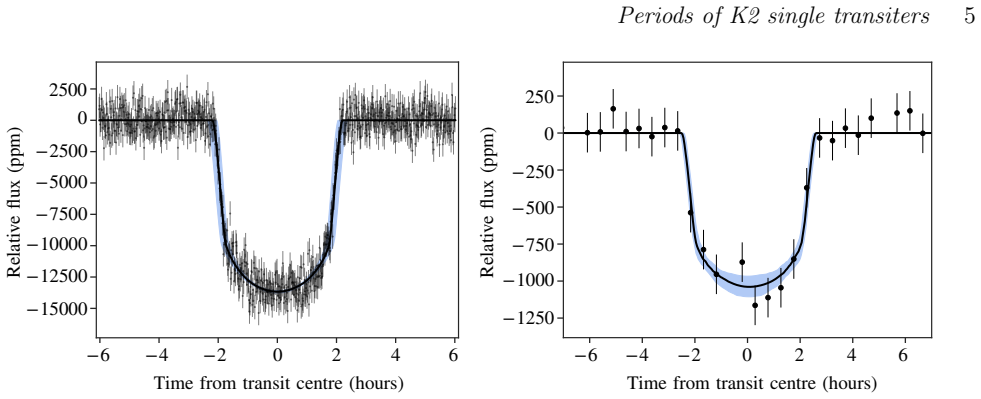
The central identity is Kepler's third law written for transiting planets, $P^2 = \frac{3\pi}{G}\left(\frac{a}{R_*}\right)^3 \rho_*^{-1}$, which converts a transit-shape measurement of the normalized semi-major axis $a/R_*$ and an independent stellar density $\rho_*$ into the orbital period $P$. The paper couples this with a pipeline that measures $\rho_*$ from the Gaia parallax distance, SED fits to APASS/2MASS/WISE photometry using BT-Settl-CIFIST models, and Yonsei-Yale isochrone mass/age estimation; it then fits each single transit with a nested-sampling code that treats eccentricity, limb darkening, and Gaussian-process detrending simultaneously. The analysis shows that the posterior uncertainty in $a/R_*$ --- controlled by how well ingress and egress are sampled --- is the dominant driver of $\sigma_P/P$ in the validation sample, while the input $\rho_*$ uncertainty is not.
What would settle it
Watch for a second transit of any of the twelve targets. If future data place their periods outside the 1$\sigma$ credibility bands given here, the accuracy claim fails; EPIC 211311380f is a sharp test, since the paper's modal period around 600 days sits well above the roughly 360-day period allowed by dynamical simulations from follow-up observations. A more direct check would be to test the four host stars where the Gaia-derived densities disagree with Osborn et al. (2016) using high-resolution spectroscopy and see which stellar density is correct.
Extended reading notes
Core claim
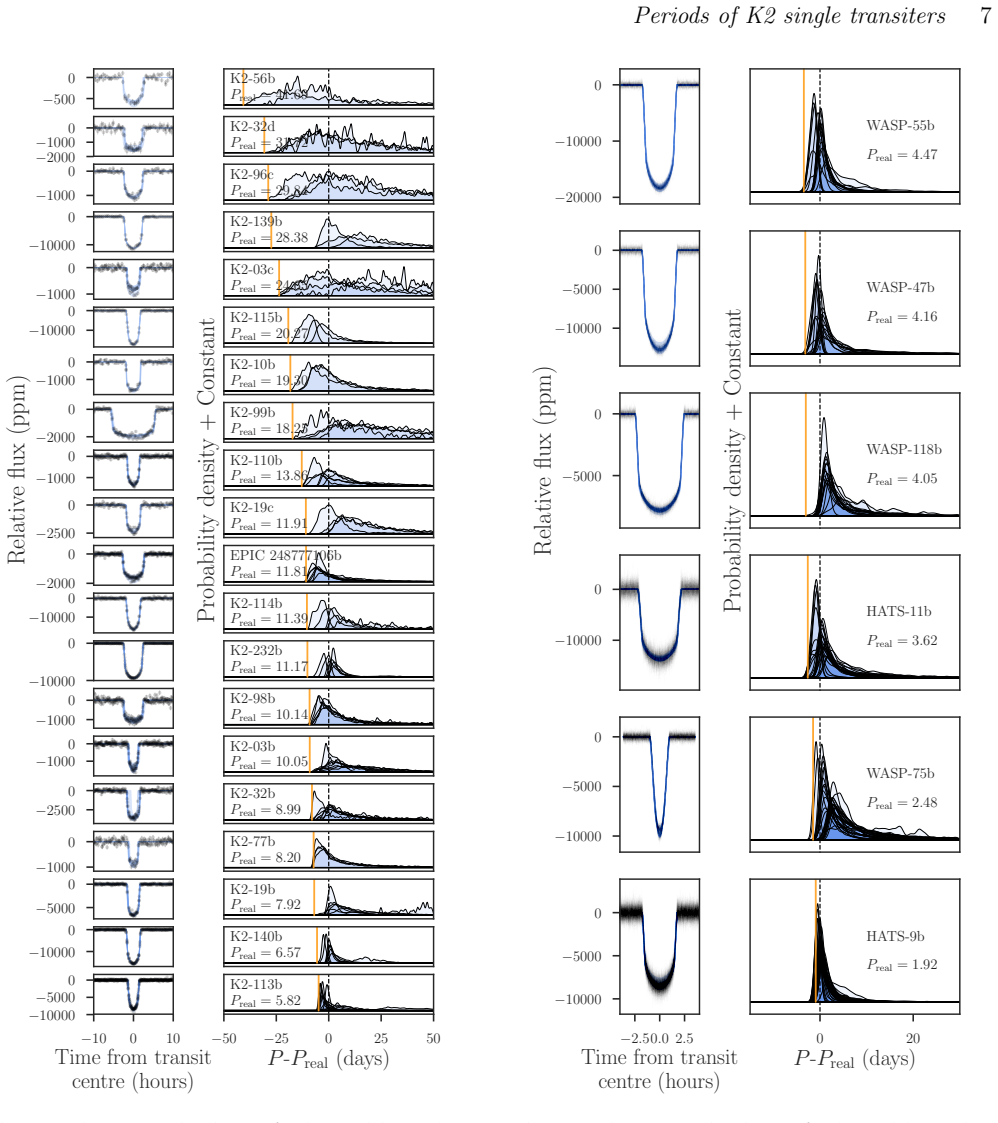
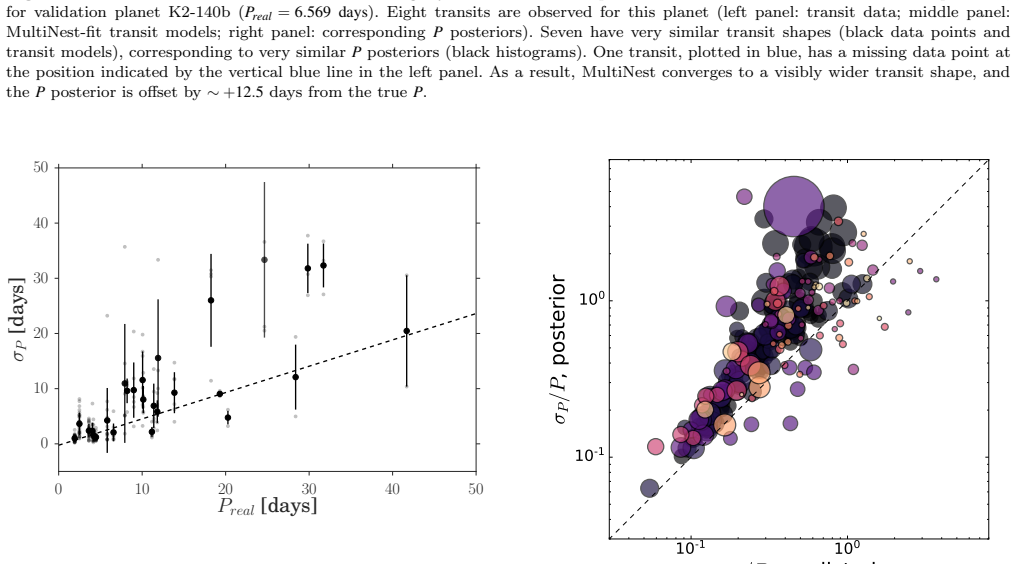
The paper's central claim is that a stellar bulk density $\rho_*$ derived from a Gaia parallax, broadband photometry, and isochrone fitting is a reliable and powerful prior for single-transit period inference. Feeding that prior into a transit model and applying it to K2 long-cadence light curves yields period posteriors for true single transiters with fractional uncertainties of $94^{+87}_{-58}\%$ when eccentricity is a free parameter and $15^{+30}_{-6}\%$ when $e=0$ is assumed, compared with typical $\sim 50\%$ uncertainties in previous single-transit catalogues. The accuracy of the density prior is established by comparing densities computed this way to asteroseismic values for a sample of stars; the two agree with no significant bias. On 27 validation planets with known periods, treating each observed transit as a single transit recovers the true period whenever ingress and egress are well sampled in the data, and fails dramatically (as with K2-140b) when an in-transit point is missing. The paper therefore concludes that single-transit period estimation is limited by the precision with which the transit shape gives $a/R_*$, not by the stellar density uncertainty.
Load-bearing premise
The twelve true single transits are assumed to be well sampled during ingress and egress, with no missing or corrupted in-transit points that would bias the transit shape and therefore the inferred period.
Editorial extensions
If this is right
- The threefold precision gain under $e=0$ means that any independent eccentricity constraint would make single-transit period estimates dramatically sharper.
- Because $\sigma_{a/R_*}$ dominates, single-transit surveys with shorter-cadence photometry or sharper limb-darkening priors should yield proportionally better period posteriors.
- The K2-140b failure mode implies that single-transit catalogs should flag transits with missing or corrupted ingress/egress points, as these can shift the period by more than 3$\sigma$.
- The same Gaia-based density prior is directly applicable to future TESS single transiters, where it should help realize the predicted gains in long-period planet yield.
Reading between the lines
- Since the paper shows $\sigma_{a/R_*}$ drives $\sigma_P$, jointly fitting multiple transiting planets of the same star should tighten $a/R_*$ more than any further improvement in stellar density precision; this is a natural next test.
- An immediate extension would be to repeat the validation on TESS 2-minute cadence data for known multi-transit systems, treating each transit as single; the short-cadence results in this paper suggest fractional period uncertainties could shrink well below 15 percent.
- The paper's caution about the baseline-informed K18 prior on long-cadence data suggests that such priors may be usable on high-cadence TESS light curves, where the transit model has more information to resist being overwhelmed; this is worth testing.
- The four Osborn et al. (2016) disagreements indicate that archival catalogs of single-transit periods may be sensitive to stellar model assumptions; a uniform re-derivation of host star densities from Gaia parallaxes would be a worthwhile population-level check.
Signed reviews
Editorial analysis
A structured set of objections, weighed in public.
Referee Report
Summary. The paper presents a method for constraining the orbital periods of singly-transiting K2 planets by combining Gaia DR2 parallaxes with broadband photometry and Yonsei-Yale isochrones to estimate stellar densities, then using those density estimates as priors in single-transit light-curve fits. The method is validated by fitting individual transits of 27 planets with known periods as if they were single transits, and is then applied to 12 true single transiters. With eccentricity free, the reported fractional period uncertainty over the true single transiters is 94+87/-58%; with eccentricity fixed to zero, the reported value is 15+30/-6%. The paper also discusses choices of period prior, the Kipping (2018) prior, and the impact of missing or outlier in-transit data points.
Significance. If the headline precision claim held, the method would be a useful contribution to the long-period planet yield of K2 and TESS, where single-transit events are expected in large numbers. The paper has real strengths: it releases a public fitting code ('single'), it validates stellar densities against an independent asteroseismic sample, it is unusually transparent about limitations such as underestimated stellar-density uncertainties and failures of the e=0 model, and it does not use known periods as inputs in the period inference. However, the central quantitative claim that the method yields a roughly threefold improvement over previous work rests on the e=0 assumption, which the paper itself shows fails for a large fraction of the sample; the validation data also show poor period recovery for the longer-period, eccentric systems that are the target population. These issues substantially temper the significance of the claimed improvement.
major comments (5)
- [Abstract and §4] The headline fractional period uncertainty of 15+30/-6% is reported in the abstract and conclusions without stating that it is conditional on fixing eccentricity to zero and that this assumption is rejected for a substantial subset of the sample. In the final paragraph of §4.2 the authors state that four of the targets (EPIC 201892470b, EPIC 204634789b, EPIC 228801451d, EPIC 248045685b) have high modal eccentricity and that good fits cannot be achieved with e=0. The abstract presents the 15% figure as if it applied to the true single transiters generally, while the e-free result for the same sample is 94+87/-58%. The comparison to previous work should either restrict the e=0 claim explicitly to the targets for which circular fits are adequate, or should be dropped from the abstract; otherwise the headline is misleading.
- [§2.1 and §2.2] The asteroseismic comparison in §2.1 finds an extra scatter of sigma_extra = 0.0313 g/cm3, roughly equal to the mean quoted density uncertainty, and concludes that the error bars are underestimated by approximately a factor of two. However, §2.2 states that the split-normal prior on rho* is constructed from the uncertainties 'derived from the procedure described in 2.1' and gives no indication that sigma_extra was added in quadrature before the transit fits. If this extra uncertainty is not propagated into the period posteriors, the quoted period uncertainties are understated. The authors should state explicitly whether sigma_extra was included in the prior used for the fits, and if not, rerun or rescale the affected results.
- [§3.1 and Table 1] The validation section concludes that the method is robust 'as long as the individual transits we fit are well-sampled during ingress and egress,' but the long-cadence validation results in Table 1 show poor and biased period recovery for several planets in exactly the longer-period regime that motivates the paper. For example, K2-56b (P_known = 41.686 d) gives P_fit = 5.4+50.0/-0.6 d, K2-03c (P_known = 24.649 d) gives P_fit = 4.2+80.0/-0.6 d, and K2-32d (P_known = 31.719 d) gives P_fit = 9.1+60.0/-0.7 d. These posteriors are not centered near the true periods despite the transits being presumably well-sampled; a quantitative accuracy criterion or a dedicated long-period validation subset is needed before the robust claim can be supported.
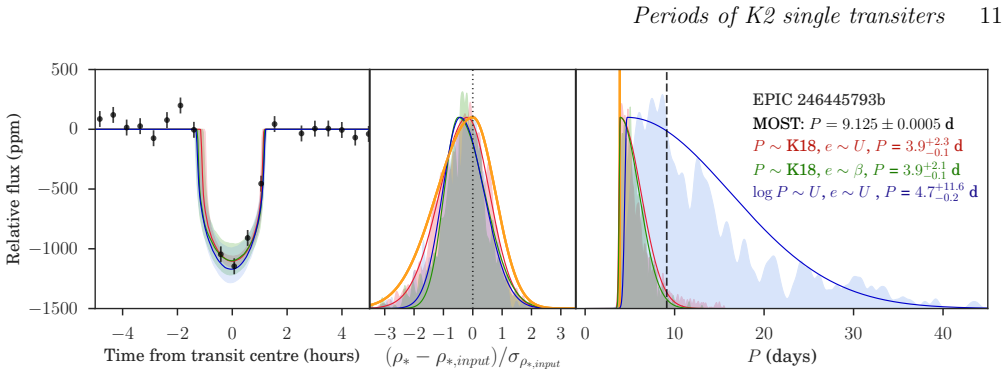
- [§4.1 and §4.2] The paper rejects the Kipping (2018) prior for the true single transiters because validation fits with an arbitrary Pmin converge to P = Pmin, yet this is the prior that formally accounts for the single-transit selection effect. The failure on the validation sample is expected, since those transits are not true singles and the arbitrary Pmin is not physically meaningful. For the true singles, the paper shows in §4.1 that the K18 prior gives posteriors inconsistent with independently known periods for EPIC 246445793b and EPIC 211311380f, which suggests that the 12-parameter model is too flexible to be constrained by the long-cadence data under a strong prior. This undercuts the authors' stated reason for preferring the log-uniform prior, because the log-uniform prior is not the observationally motivated choice for true singles. The choice of period prior needs a stronger justification or an explicit sensitivity analysis.
- [§3.1, §4, Table 2] The manuscript contains an internal inconsistency about the number of true single transiters: §3.1 refers to 'the nine true single transits discussed in section 4,' §4 says 'twelve single transits,' Table 2 lists twelve targets, and §4.2 refers to 'four of our nine single transit fits.' Because the 15% e=0 statistic may depend on which targets are included, this mismatch must be resolved and the denominator of the reported fractional uncertainties must be stated unambiguously.
minor comments (4)
- [§4.1] The text refers to 'Equation 2.2' for the definition of Pmin, but the equation is numbered (6) in the manuscript; the cross-reference should be corrected.
- [Figure 1] The axis labels in Figure 1 appear garbled, with the density axis labels and the residual panel labels partly duplicated or missing ('rho_gaia+YY' and 'rho_aste' are misspelled or truncated). The figure should be regenerated with clean labels.
- [§2.2 and Tables 1-2] Posterior distributions are summarized by fitting split-normal distributions, but many posteriors (e.g., those for EPIC 201892470b and EPIC 211311380f) are strongly asymmetric and possibly bimodal; a short discussion of whether split-normal summary statistics are representative, or a plot of representative posteriors in the main text, would improve interpretability.
- [§3.1] The claim that 'The nine true single transits discussed in section 4 are well-sampled during ingress and egress' is asserted without a quantitative criterion. In light of the demonstrated sensitivity to missing in-transit points for K2-140b and K2-32b, the authors should specify how many long-cadence data points fall within ingress and egress for each target, or provide a comparable metric.
Circularity Check
No significant circularity: Gaia-based stellar density priors are independent inputs, and the single-transit period posteriors are genuine model outputs rather than re-statements of fitted constants.
full rationale
The paper's derivation chain is self-contained and anchored to external benchmarks. Stellar densities are constructed from Gaia DR2 parallaxes, public broadband photometry, and BT-Settl/Yonsei-Yale stellar models (Section 2.1), then validated against independent asteroseismic densities (Figure 1) with a Bayesian evidence test for residual bias. The single-transit period inference follows Kepler's third law, P^2 = (3pi/G)(a/R*)^3 rho*^-1, with P, e, omega, b, Rp/R*, rho*, q, and t0 as free parameters in a MultiNest fit (Section 2.2). For the 27 validation planets, the known period is used only as a comparison quantity; the paper explicitly states it is 'not used in our inference in any way' (Section 3). The e=0 result is conditional on an explicitly stated model assumption: the paper simultaneously reports the e-free uncertainty of 94%, and flags the four targets for which e=0 fits fail (Section 4.2), so the headline 15% figure is not a hidden fit presented as a prediction. Self-citations (Brahm et al. 2018a,b; Espinoza & Jordan 2015, 2016; Sandford & Kipping 2017) supply methodological context or are re-derived and validated here; none is used as a uniqueness theorem or to forbid alternative models. No equation in the paper reduces to its own input, and the period posteriors are not statistically forced by the stellar density fit alone; the limiting factor is the transit-shape constraint on a/R*, which is an empirical data product. The paper is therefore not circular in any of the enumerated senses.
Assumptions & free parameters
free parameters (7)
- AV (extinction) =
not reported, uniform prior [0,1]
- R* (stellar radius) =
not reported, uniform prior [0.1,100] R_sun
- M* (stellar mass) =
not reported, uniform prior [0.4,4.5] M_sun
- Age* =
not reported, uniform prior [0.05,4.5] Gyr
- Period prior bounds =
Pmin from baseline, Pmax=10000 days
- Eccentricity prior =
uniform [0,1] or Beta(0.867,3.03); e=0 in fixed-e fits
- GP hyperparameters =
not reported
assumptions (9)
- standard math Kepler's third law relates orbital period to stellar density and normalized semi-major axis (Eq. 1).
- domain assumption BT-Settl-CIFIST SED models accurately represent the stellar spectra used in SED fitting.
- domain assumption Yonsei-Yale isochrones accurately map stellar mass and age to radius and effective temperature.
- standard math The Cardelli et al. (1989) reddening law applies to the observed sightlines.
- domain assumption The batman transit model with a linear limb-darkening law and Kipping (2010) resampling accurately describes the observed light curves.
- domain assumption The Gaussian process detrending removes stellar activity without biasing the transit shape.
- domain assumption Bailer-Jones et al. (2018) distance estimates from Gaia parallax are reliable.
- ad hoc to paper The log-uniform period prior between Pmin and 10000 days is appropriate for true single transiters.
- domain assumption The single transiters are single planets on Keplerian orbits with no significant blending or contamination.
Cite this review
Pith. "Pith review of Estimation of singly-transiting K2 planet periods with Gaia parallaxes." pith.science (2026). https://pith.science/paper/W6ARIT62
@misc{pith2026190808548,
  author       = {Pith},
  title        = {Pith review of: Estimation of singly-transiting K2 planet periods with Gaia parallaxes},
  year         = {2026},
  howpublished = {\url{https://pith.science/paper/W6ARIT62}},
  note         = {Machine review of arXiv:1908.08548}
}
abstract
When a planet is only observed to transit once, direct measurement of its period is impossible. It is possible, however, to constrain the periods of single transiters, and this is desirable as they are likely to represent the cold and far extremes of the planet population observed by any particular survey. Improving the accuracy with which the period of single transiters can be constrained is therefore critical to enhance the long-period planet yield of surveys. Here, we combine Gaia parallaxes with stellar models and broad-band photometry to estimate the stellar densities of K2 planet host stars, then use that stellar density information to model individual planet transits and infer the posterior period distribution. We show that the densities we infer are reliable by comparing with densities derived through asteroseismology, and apply our method to 27 validation planets of known (directly measured) period, treating each transit as if it were the only one, as well as to 12 true single transiters. When we treat eccentricity as a free parameter, we achieve a fractional period uncertainty over the true single transits of $94^{+87}_{-58}\%$, and when we fix $e=0$, we achieve fractional period uncertainty $15^{+30}_{-6}\%$, a roughly threefold improvement over typical period uncertainties of previous studies.
Figures

Figures from the paper (6 more)




Reference graph
Works this paper leans on
-
[1]
Bailer-Jones C. A. L., Rybizki J., Fouesneau M., Mantelet G., Andrae R., 2018, preprint, http://adsabs.harvard.edu/abs/2018arXiv180410121B ( @eprint arXiv 1804.10121 )
arXiv 2018
-
[2]
Baraffe I., Homeier D., Allard F., Chabrier G., 2015, @doi [ ] 10.1051/0004-6361/201425481 , http://adsabs.harvard.edu/abs/2015A
-
[3]
Becker J. C., et al., 2019, @doi [ ] 10.3847/1538-3881/aaf0a2 , https://ui.adsabs.harvard.edu/\#abs/2019AJ....157...19B 157, 19
-
[4]
Brahm R., et al., 2018a, preprint, http://adsabs.harvard.edu/abs/2018arXiv180604073B ( @eprint arXiv 1806.04073 )
-
[5]
Brahm R., et al., 2018b, @doi [ ] 10.1093/mnras/sty795 , http://adsabs.harvard.edu/abs/2018MNRAS.477.2572B 477, 2572
-
[6]
Buchner J., et al., 2014, @doi [ ] 10.1051/0004-6361/201322971 , http://adsabs.harvard.edu/abs/2014A
-
[7]
Cardelli J. A., Clayton G. C., Mathis J. S., 1989, @doi [ ] 10.1086/167900 , http://adsabs.harvard.edu/abs/1989ApJ...345..245C 345, 245
doi:10.1086/167900 1989
-
[8]
Crossfield I. J. M., et al., 2018, @doi [The Astrophysical Journal Supplement Series] 10.3847/1538-4365/aae155 , https://ui.adsabs.harvard.edu/\#abs/2018ApJS..239....5C 239, 5
Show all 50 references
-
[9]
Espinoza N., 2018, @doi [Research Notes of the American Astronomical Society] 10.3847/2515-5172/aaef38 , https://ui.adsabs.harvard.edu/\#abs/2018RNAAS...2d.209E 2, 209
2018 doi
-
[10]
Espinoza N., Jord \'a n A., 2015, @doi [ ] 10.1093/mnras/stv744 , http://adsabs.harvard.edu/abs/2015MNRAS.450.1879E 450, 1879
2015 doi
-
[11]
Espinoza N., Jord \'a n A., 2016, @doi [ ] 10.1093/mnras/stw224 , http://adsabs.harvard.edu/abs/2016MNRAS.457.3573E 457, 3573
2016 doi
-
[12]
P., Bridges M., 2009, @doi [ ] 10.1111/j.1365-2966.2009.14548.x , http://adsabs.harvard.edu/abs/2009MNRAS.398.1601F 398, 1601
Feroz F., Hobson M. P., Bridges M., 2009, @doi [ ] 10.1111/j.1365-2966.2009.14548.x , http://adsabs.harvard.edu/abs/2009MNRAS.398.1601F 398, 1601
2009
-
[13]
W., Lang D., Goodman J., 2013, @doi [ ] 10.1086/670067 , http://adsabs.harvard.edu/abs/2013PASP..125..306F 125, 306
Foreman-Mackey D., Hogg D. W., Lang D., Goodman J., 2013, @doi [ ] 10.1086/670067 , http://adsabs.harvard.edu/abs/2013PASP..125..306F 125, 306
2013 doi
-
[14]
Foreman-Mackey D., Hoyer S., Bernhard J., Angus R., 2014, George: George (V0.2.0) , @doi 10.5281/zenodo.11989
2014 doi
-
[15]
D., Hogg D
Foreman-Mackey D., Morton T. D., Hogg D. W., Agol E., Sch \"o lkopf B., 2016, @doi [ ] 10.3847/0004-6256/152/6/206 , https://ui.adsabs.harvard.edu/#abs/2016AJ....152..206F 152, 206
2016 doi
-
[16]
Gaia Collaboration Brown A. G. A., Vallenari A., Prusti T., de Bruijne J. H. J., Babusiaux C., Bailer-Jones C. A. L., 2018, preprint, https://ui.adsabs.harvard.edu/#abs/2018arXiv180409365G p. arXiv:1804.09365 ( @eprint arXiv 1804.09365 )
2018 arXiv
-
[17]
Giles H. A. C., et al., 2018, @doi [ ] 10.1051/0004-6361/201833569 , https://ui.adsabs.harvard.edu/\#abs/2018A&A...615L..13G 615, L13
2018 doi
-
[18]
K., et al., 2016, @doi [ ] 10.3847/0004-6256/152/6/185 , http://adsabs.harvard.edu/abs/2016AJ....152..185G 152, 185
Grunblatt S. K., et al., 2016, @doi [ ] 10.3847/0004-6256/152/6/185 , http://adsabs.harvard.edu/abs/2016AJ....152..185G 152, 185
2016 doi
-
[19]
K., et al., 2017, @doi [ ] 10.3847/1538-3881/aa932d , http://adsabs.harvard.edu/abs/2017AJ....154..254G 154, 254
Grunblatt S. K., et al., 2017, @doi [ ] 10.3847/1538-3881/aa932d , http://adsabs.harvard.edu/abs/2017AJ....154..254G 154, 254
2017 doi
-
[20]
A., Welch D
Henden A. A., Welch D. L., Terrell D., Levine S. E., 2009, in American Astronomical Society Meeting Abstracts \#214. p. 669
2009
-
[21]
X., et al., 2018, preprint, http://adsabs.harvard.edu/abs/2018arXiv180711129H ( @eprint arXiv 1807.11129 )
Huang C. X., et al., 2018, preprint, http://adsabs.harvard.edu/abs/2018arXiv180711129H ( @eprint arXiv 1807.11129 )
2018 arXiv
-
[22]
Huber D., et al., 2013, @doi [ ] 10.1088/0004-637X/767/2/127 , https://ui.adsabs.harvard.edu/#abs/2013ApJ...767..127H 767, 127
2013 doi
-
[23]
I., et al., 2017, preprint, http://adsabs.harvard.edu/abs/2017arXiv170700779J ( @eprint arXiv 1707.00779 )
Jones M. I., et al., 2017, preprint, http://adsabs.harvard.edu/abs/2017arXiv170700779J ( @eprint arXiv 1707.00779 )
2017 arXiv
-
[24]
M., 2010, @doi [ ] 10.1111/j.1365-2966.2010.17242.x , http://adsabs.harvard.edu/abs/2010MNRAS.408.1758K 408, 1758
Kipping D. M., 2010, @doi [ ] 10.1111/j.1365-2966.2010.17242.x , http://adsabs.harvard.edu/abs/2010MNRAS.408.1758K 408, 1758
2010
-
[25]
M., 2013, @doi [ ] 10.1093/mnrasl/slt075 , https://ui.adsabs.harvard.edu/abs/2013MNRAS.434L..51K 434, L51
Kipping D. M., 2013, @doi [ ] 10.1093/mnrasl/slt075 , https://ui.adsabs.harvard.edu/abs/2013MNRAS.434L..51K 434, L51
2013 doi
-
[26]
Kipping D., 2018, @doi [Research Notes of the American Astronomical Society] 10.3847/2515-5172/aaf50c , https://ui.adsabs.harvard.edu/\#abs/2018RNAAS...2d.223K 2, 223
2018 doi
-
[27]
M., et al., 2016, @doi [ ] 10.3847/0004-637X/820/2/112 , https://ui.adsabs.harvard.edu/#abs/2016ApJ...820..112K 820, 112
Kipping D. M., et al., 2016, @doi [ ] 10.3847/0004-637X/820/2/112 , https://ui.adsabs.harvard.edu/#abs/2016ApJ...820..112K 820, 112
2016 doi
-
[28]
Kreidberg L., 2015, @doi [ ] 10.1086/683602 , http://adsabs.harvard.edu/abs/2015PASP..127.1161K 127, 1161
2015 doi
-
[29]
M., Jacobs T
LaCourse D. M., Jacobs T. L., 2018, @doi [Research Notes of the American Astronomical Society] 10.3847/2515-5172/aaad61 , https://ui.adsabs.harvard.edu/#abs/2018RNAAS...2a..28L 2, 28
2018 doi
-
[30]
Luger R., Agol E., Kruse E., Barnes R., Becker A., Foreman-Mackey D., Deming D., 2016, @doi [ ] 10.3847/0004-6256/152/4/100 , https://ui.adsabs.harvard.edu/abs/2016AJ....152..100L 152, 100
2016 doi
-
[31]
Mathur S., et al., 2017, @doi [The Astrophysical Journal Supplement Series] 10.3847/1538-4365/229/2/30 , https://ui.adsabs.harvard.edu/#abs/2017ApJS..229...30M 229, 30
2017 doi
-
[32]
P., et al., 2016, @doi [ ] 10.1093/mnras/stw137 , https://ui.adsabs.harvard.edu/#abs/2016MNRAS.457.2273O 457, 2273
Osborn H. P., et al., 2016, @doi [ ] 10.1093/mnras/stw137 , https://ui.adsabs.harvard.edu/#abs/2016MNRAS.457.2273O 457, 2273
2016 doi
-
[33]
Penoyre Z., in prep., Research Notes of the American Astronomical Society
-
[34]
R., et al., 2015, @doi [Journal of Astronomical Telescopes, Instruments, and Systems] 10.1117/1.JATIS.1.1.014003 , https://ui.adsabs.harvard.edu/#abs/2015JATIS...1a4003R 1, 014003
Ricker G. R., et al., 2015, @doi [Journal of Astronomical Telescopes, Instruments, and Systems] 10.1117/1.JATIS.1.1.014003 , https://ui.adsabs.harvard.edu/#abs/2015JATIS...1a4003R 1, 014003
2015 doi
-
[35]
Sandford E., Kipping D., 2017, @doi [ ] 10.3847/1538-3881/aa94bf , https://ui.adsabs.harvard.edu/#abs/2017AJ....154..228S 154, 228
2017 doi
-
[36]
Santerne A., et al., 2018, @doi [Nature Astronomy] 10.1038/s41550-018-0420-5 , https://ui.adsabs.harvard.edu/\#abs/2018NatAs...2..393S 2, 393
2018 doi
-
[37]
Seager S., Mall \'e n-Ornelas G., 2003, @doi [ ] 10.1086/346105 , http://adsabs.harvard.edu/abs/2003ApJ...585.1038S 585, 1038
2003 doi
-
[38]
Silva Aguirre V., et al., 2015, @doi [ ] 10.1093/mnras/stv1388 , http://adsabs.harvard.edu/abs/2015MNRAS.452.2127S 452, 2127
2015 doi
-
[39]
Silva Aguirre V., et al., 2017, @doi [ ] 10.3847/1538-4357/835/2/173 , https://ui.adsabs.harvard.edu/#abs/2017ApJ...835..173S 835, 173
2017 doi
-
[40]
F., et al., 2006, @doi [ ] 10.1086/498708 , http://adsabs.harvard.edu/abs/2006AJ....131.1163S 131, 1163
Skrutskie M. F., et al., 2006, @doi [ ] 10.1086/498708 , http://adsabs.harvard.edu/abs/2006AJ....131.1163S 131, 1163
2006 doi
-
[41]
Uehara S., Kawahara H., Masuda K., Yamada S., Aizawa M., 2016, @doi [ ] 10.3847/0004-637X/822/1/2 , https://ui.adsabs.harvard.edu/#abs/2016ApJ...822....2U 822, 2
2016 doi
-
[42]
Vanderburg A., et al., 2015, @doi [ ] 10.1088/0004-637X/800/1/59 , https://ui.adsabs.harvard.edu/\#abs/2015ApJ...800...59V 800, 59
2015 doi
-
[43]
Vanderburg A., et al., 2016, @doi [ ] 10.3847/2041-8205/827/1/L10 , https://ui.adsabs.harvard.edu/abs/2016ApJ...827L..10V 827, L10
2016 doi
-
[44]
Vanderburg A., et al., 2018, @doi [ ] 10.3847/1538-3881/aac894 , https://ui.adsabs.harvard.edu/\#abs/2018AJ....156...46V 156, 46
2018 doi
-
[45]
S., 2018, preprint, https://ui.adsabs.harvard.edu/#abs/2018arXiv180500956V p
Villanueva Steven J., Dragomir D., Gaudi B. S., 2018, preprint, https://ui.adsabs.harvard.edu/#abs/2018arXiv180500956V p. arXiv:1805.00956 ( @eprint arXiv 1805.00956 )
2018 arXiv
-
[46]
Wang J., et al., 2015, @doi [ ] 10.1088/0004-637X/815/2/127 , https://ui.adsabs.harvard.edu/#abs/2015ApJ...815..127W 815, 127
2015 doi
-
[47]
N., 2010, preprint, http://adsabs.harvard.edu/abs/2010arXiv1001.2010W ( @eprint arXiv 1001.2010 )
Winn J. N., 2010, preprint, http://adsabs.harvard.edu/abs/2010arXiv1001.2010W ( @eprint arXiv 1001.2010 )
2010 arXiv
-
[48]
L., et al., 2010, @doi [ ] 10.1088/0004-6256/140/6/1868 , http://adsabs.harvard.edu/abs/2010AJ....140.1868W 140, 1868
Wright E. L., et al., 2010, @doi [ ] 10.1088/0004-6256/140/6/1868 , http://adsabs.harvard.edu/abs/2010AJ....140.1868W 140, 1868
2010 doi
-
[49]
C., Gaudi B
Yee J. C., Gaudi B. S., 2008, @doi [ ] 10.1086/592038 , https://ui.adsabs.harvard.edu/#abs/2008ApJ...688..616Y 688, 616
2008 doi
-
[50]
H., Lejeune T., Barnes S., 2001, @doi [ ] 10.1086/321795 , http://adsabs.harvard.edu/abs/2001ApJS..136..417Y 136, 417
Yi S., Demarque P., Kim Y.-C., Lee Y.-W., Ree C. H., Lejeune T., Barnes S., 2001, @doi [ ] 10.1086/321795 , http://adsabs.harvard.edu/abs/2001ApJS..136..417Y 136, 417
2001 doi
Reviewed August 14, 2026 · model on record in the stance chip above.
Discussion (0). Continue with ORCID to comment.