REVIEW 4 major objections 6 minor 1 cited by
Simulation of Quantum Many-Body Systems on Amazon Cloud
T0 review · 4 major / 6 minor · reviewed 2026-08-14 · deepseek-v4-flash
Pith's one-line read The paper claims exact tensor-network contractions for 2D quantum spin lattices can run efficiently on a single large-memory cloud instance, using a geometry-aware quadrant contraction heuristic that beats row contraction and a generic…
desk verdict A modest but genuinely useful benchmark study; the 'viable alternative to supercomputers' claim is unsupported by the data, but the quadrant-contraction comparison is worth a referee's time. read the letter →
The pith
A machine-rendered reading of the paper's core claim, the machinery that carries it, and where it could break.
The reading
What carries the argument
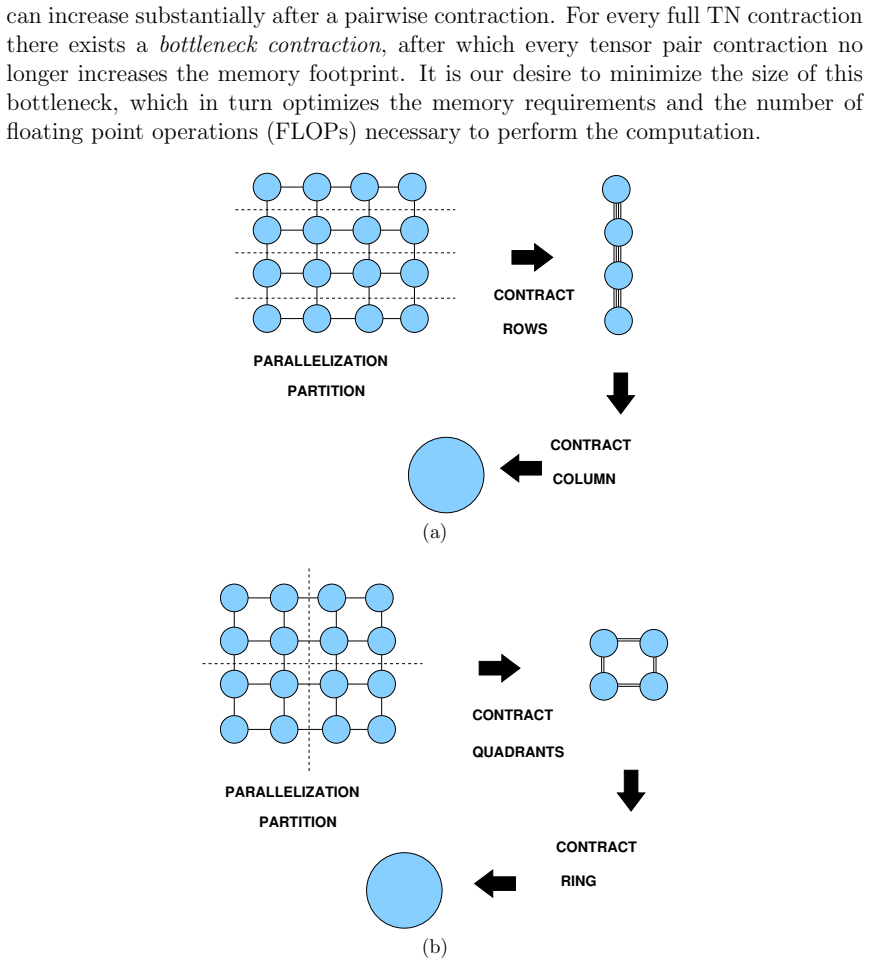
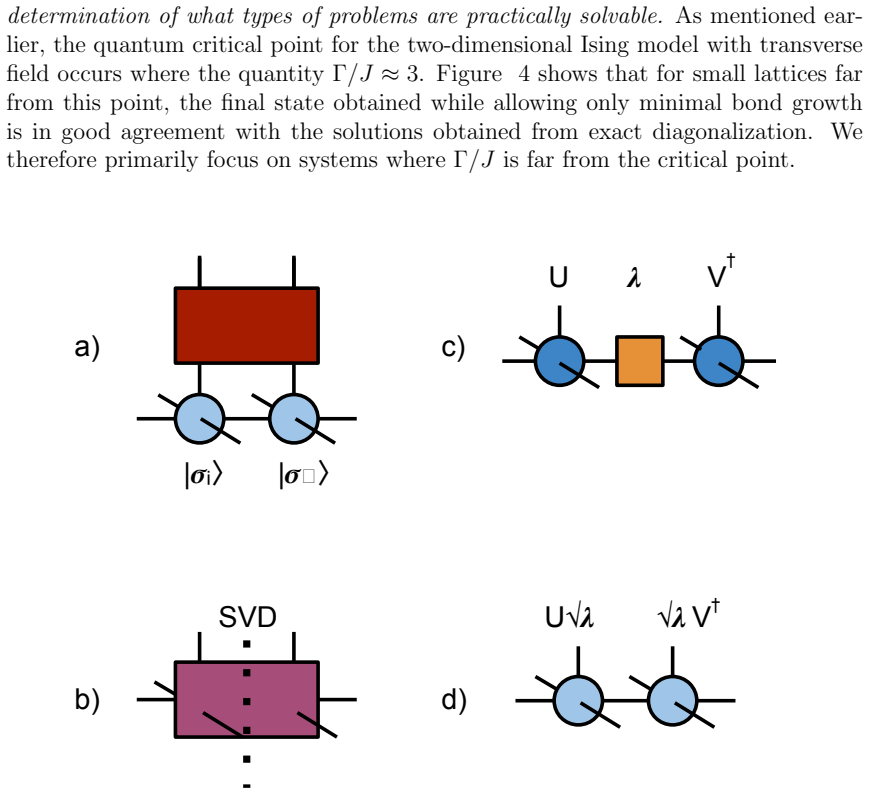
The load-bearing object is the bottleneck contraction: the single pairwise contraction in a full tensor-network contraction that yields the largest intermediate tensor, whose dimension obeys $d(B)=d(A_1)d(A_2)/d(x)$, where $x$ is the shared index set. The paper's heuristic is to pick a contraction order that minimizes this bottleneck and to partition the lattice along the geometry—four quadrants for a square lattice—so each quadrant contracts independently and meets at a central ring, holding inter-process communication to four messages. The second mechanism is imaginary-time evolution with Trotter-Suzuki splitting and singular-value truncation, which keeps bond dimensions tractable and makes expectation-value calculations, the dominant runtime cost, the main beneficiary of the optimized contraction.
What would settle it
A direct test would run the same imaginary-time evolution workloads, namely $L=12,\chi=2$ and the near-critical $L=6$ and $L=8$, $\chi=4$ cases, on a supercomputer or low-latency cluster and compare wall-clock time and dollar cost; if the supercomputer completes them faster and cheaper, the viability conclusion fails. A narrower test isolates the mechanism: check whether the number of inter-process messages stays at four as $L$ grows in the quadrant scheme; if it grows with lattice size, the stated communication bound is wrong.
Extended reading notes
Core claim
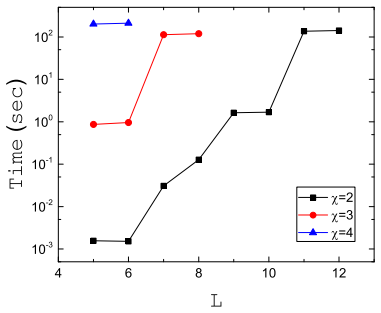
For a square lattice of tensors of linear size $L$ with uniform bond dimension $\chi$, contracting row by row forces each intermediate to carry $\chi^L$ elements; contracting from all four edges toward the center leaves a ring of tensors whose largest elements are $\chi^{L/2}$. Because the bottleneck tensor sets peak memory and a dominant share of floating-point operations, the quadrant order is cheaper in both, and because the four quarters are contracted in parallel before a final ring contraction, only four messages pass between processes no matter what $L$ is. The paper implements this inside an imaginary-time evolution (second-order Trotter-Suzuki) algorithm for the Ising model with a transverse field, truncating bond dimensions by singular-value truncation with relative cutoff $\epsilon=0.01$. On the tested square lattices, the quadrant scheme outperforms row contraction and a cyclic-distribution tensor library for $5\leq L\leq 10$ at $\chi=2$, reaches $L=12$ at $\chi=2$ and $L=6$ at $\chi=4$ on its chosen large-memory instance, and reproduces the qualitative picture of a $\Gamma/J\approx 3$ phase transition; the paper takes this as evidence that cloud instances are a viable alternative to supercomputers for exact tensor-network contraction away from critical points.
Load-bearing premise
The conclusion that cloud computing is a viable alternative to supercomputers assumes that a single large-memory cloud instance is a fair representative of 'cloud computing,' and it is never checked against an actual supercomputer run, so the comparison is inferred from completion rather than measured.
Editorial extensions
If this is right
- Exact tensor-network contraction for square-lattice spin systems moves from supercomputers to single large-memory cloud nodes when bond dimensions are modest, because the geometry-specific partitioning avoids distributing individual tensors across processors.
- Peak memory drops from $\chi^L$ to $\chi^{L/2}$ for a square lattice, so larger system sizes become feasible for a fixed memory budget, for example $L=12$ at $\chi=2$ on the test instance.
- Communication stays at four inter-process messages regardless of lattice size, so the quadrant scheme should scale to larger $L$ without an increase in messages as long as the final ring fits in cache.
- The heuristic generalizes to other planar geometries by choosing the order that minimizes the bottleneck and partitioning around the resulting ring of tensors, which the paper states as its extension to multiple geometries.
- Because expectation-value computations dominate the runtime of imaginary-time evolution, the optimized contraction reduces total wall-clock time for ground-state calculations more than the raw contraction benchmark alone suggests.
Reading between the lines
- The paper's viability conclusion is inferred from one fat node; a quantitative extension it leaves implicit is a direct wall-clock and dollar-cost comparison against a supercomputer on the same lattice sizes and bond dimensions.
- If the bottleneck-minimization principle is the real content, it connects to the known hardness of optimal contraction-order search: the heuristic is a cheap geometry-based stand-in, and hybrid schemes that combine cyclic tensor distribution with geometry partitioning could be tested on non-square geometries.
- The four-message bound suggests a testable scaling law: on geometries where the minimal bottleneck ring has fewer than four parts, such as triangular or hexagonal lattices, the communication advantage could be even larger; the paper does not test this.
- Near the critical point $\Gamma/J=3$, bond dimensions grow and the exact method saturates at $L=6$ with $\chi=4$, with only qualitative agreement to earlier tree tensor network results, so the 'viable' regime is limited to low-entanglement systems unless environment approximations are introduced.
Editorial analysis
A structured set of objections, weighed in public.
Referee Report
Summary. The paper addresses parallel tensor-network contraction for two-dimensional quantum lattice models. It introduces a contraction-order heuristic: choose the ordering that minimizes the largest intermediate ('bottleneck') tensor and partition the lattice according to its geometry; for square lattices this yields a quadrant scheme whose communication cost is a constant number of messages, compared with row-wise contraction or CTF-style cyclic partitioning. The algorithm is used for imaginary-time evolution of the transverse-field Ising model on AWS EC2 x1.32xlarge instances (1952 GiB DRAM), with performance comparisons against row contraction and the Cyclops Tensor Framework for L=5–10 with bond dimension χ=2, and ITE runs up to L=8 near Γ=3. The authors conclude that cloud computing is a viable alternative to supercomputers for this class of simulations.
Significance. The bottleneck-minimization heuristic is a sensible and potentially useful contribution: the quadrant scheme's constant-message communication profile is a concrete, plausible advantage over row-wise contraction for planar lattices, and the paper includes detailed profiling, multiple algorithm comparisons, and honest statements of limitations (e.g., the fixed χ=4 causing deviations at 6×6). Validation against independent references (exact diagonalization for small lattices, tree tensor networks of Tagliacozzo et al.) means the physical-validity claims are not circular. However, the central comparative claim about cloud versus supercomputers is not supported by the evidence, the 'exact' terminology is misleading for an approximate ITE pipeline, and the performance measurements lack sufficient methodological detail for reproduction. With revisions, the core algorithmic contribution could be publishable.
major comments (4)
- [Abstract and Sec. 7] The central claim that 'cloud computing is a viable alternative to supercomputers' is a comparative performance/cost claim, but the paper provides no supercomputer baseline, no cost model, and no communication-latency comparison. All benchmarks run on a single AWS x1.32xlarge instance described in Sec. 6, and Sec. 7 itself concedes that 'supercomputers ... are still the best and often the only option' for such codes. The reported 12.5 h (L=6, Γ=3) and 293.3 h (L=8, Γ=3) runtimes on one fat node do not by themselves establish viability relative to an HPC system. Please either add a direct comparison (same ITE workload on an HPC allocation) with a cost estimate, or revise the abstract and conclusions to claim feasibility on a single large-memory cloud instance rather than equivalence or alternative status.
- [Abstract, Sec. 1, and Sec. 6] The phrase 'exact computation of TN contractions' and the statement in Sec. 1 of a 'heuristic for parallel TN contractions without approximations' are inconsistent with the numerical method used. The ground-state algorithm is imaginary-time evolution with second-order Trotter–Suzuki splitting (Eq. 13), a singular-value cutoff ε=0.01, and a maximal bond dimension χ=4 (Sec. 6); Sec. 7 attributes observed deviations at 6×6 to this fixed χ. Trotterization and SVD truncation are approximations, so the contribution should be described as an exact contraction routine applied within an approximate tensor-network algorithm.
- [Sec. 6, Figs. 10–11] The physical validation is only qualitative. The text states that the computed observables are 'not in exact agreement' with the TTN results and hypothesizes that larger bond dimensions are needed, without quantifying the discrepancy or estimating the truncation error introduced by ε and χ. Fig. 4 validates only 2×2 and 3×3 lattices with χ=2. Because the performance runs are the basis of the cloud-viability claim, the accuracy of the runs at L=6 and L=8 near Γ=3 should be assessed, for example by showing convergence of the observables as χ is increased or by comparison with an independent method at the same sizes; otherwise the reader cannot tell whether the reported runtimes correspond to reliable simulations.
- [Sec. 6, Fig. 6] The comparison with the Cyclops Tensor Framework lacks the experimental detail needed to interpret the performance claim. The paper does not state the CTF version, the number of MPI processes and threads per configuration, the tensor-distribution parameters, the BLAS library used by each scheme, or the number of repeated runs and the variance of the timings. Without this methodology, the reported speedups of quadrant over row and over CTF cannot be reproduced or independently assessed. Please add a measurement-methodology paragraph covering hardware, software versions, process mapping, repetitions, and error bars, and consider making the benchmark code available.
minor comments (6)
- [Sec. 6, first paragraph] The instance type is called 'X1.32x large' here but 'x1.32x large' elsewhere; also 'Elastic Compute Cluster' should be 'Elastic Compute Cloud'.
- [Secs. 4, 5, and 7] There are several typos: 'storaga memtory' (Sec. 4), 'the and two-spin correlation' (Sec. 5), and 'advocated fro Big Data' (Sec. 7) should be 'storage memory', 'the two-spin correlation', and 'advocated for Big Data'.
- [Sec. 4, Eq. (10)] Bond dimensions are written 'χ_i' in the text but simply 'χ' elsewhere; please define whether the bond dimension can vary per bond and state the convention used for the uniform-χ benchmarks.
- [Secs. 4 and 5] The order of corner, edge, and bulk tensors is given as 2, 3, and 4 in Sec. 4, but as 2, 3, and 5 in Sec. 5 (the latter apparently counting the physical index). Please state explicitly whether the physical index is included in these reported orders.
- [Sec. 6, Figs. 10–11] The text defines Mx and Czz but the surrounding discussion also refers to 'Mz'; align the notation used in the captions, axis labels, and body text.
- [General] The paper does not include a data or code availability statement; for a computational benchmark paper, providing a repository link or at least a clear statement would greatly aid reproducibility.
Circularity Check
No significant circularity: the paper's central claims are empirical benchmark results, its contraction heuristic is an a priori optimization rule tested against independent methods, and its physics checks use external exact-diagonalization and tree-tensor-network references.
full rationale
The derivation chain is not circular. The bottleneck-minimization rule in Sec. 4 ('given a TN geometry, select the order which minimizes the bottleneck contraction size...') is an assumed heuristic, not a parameter fitted to the timing data; the row-contraction, quadrant-contraction, and CTF timings in Fig. 6 are direct measurements that could in principle have contradicted the heuristic. The memory and communication results in Fig. 7 are likewise measured quantities. Physical validation is against independent external results: exact diagonalization for small lattices (Fig. 4) and tree tensor network data of Tagliacozzo et al. [40] (Figs. 10-11). The paper also states its own limitation explicitly, noting a deviation at 6x6 near Gamma/J=3 due to fixed bond dimension chi=4, which supports that the benchmarks are not manufactured to agree. The only self-citation is Marinescu's Cloud Computing textbook [28], cited alongside Kanev et al. for background on warehouse-scale computer costs; it is not load-bearing for the central claim. The main weakness is the abstract's 'viable alternative to supercomputers' claim, which lacks a direct supercomputer baseline and cost comparison; however, an unsupported comparative conclusion is an evidence/sufficiency issue, not a circular derivation. No step satisfies the quoted reduction standard for circularity.
Assumptions & free parameters
free parameters (4)
- Singular value cutoff epsilon =
0.01
- Imaginary time step delta_tau =
3/100 for Gamma=1, 3/75 for L=6 Gamma=3, 4/250 for L=8 Gamma=3
- Total imaginary time tau =
3 for most runs; unspecified for Gamma=3 runs
- Maximum bond dimension chi =
2 and 4
assumptions (5)
- domain assumption For gapped 2D quantum systems, bond dimensions are polynomially bounded, making PEPS representations compact.
- standard math The second-order Trotter-Suzuki decomposition is accurate for small delta_tau.
- domain assumption Truncating singular values with lambda_k/lambda_1 >= epsilon yields converged ground-state observables.
- domain assumption Minimizing the largest intermediate tensor (the bottleneck) is the primary determinant of runtime and memory.
- domain assumption Storing the largest matrix in L3 cache is the binding constraint and a good design target.
Cite this review
Pith. "Pith review of Simulation of Quantum Many-Body Systems on Amazon Cloud." pith.science (2026). https://pith.science/paper/IZEPWH5D
@misc{pith2026190808553,
  author       = {Pith},
  title        = {Pith review of: Simulation of Quantum Many-Body Systems on Amazon Cloud},
  year         = {2026},
  howpublished = {\url{https://pith.science/paper/IZEPWH5D}},
  note         = {Machine review of arXiv:1908.08553}
}
read the original abstract
Quantum many-body systems (QMBs) are some of the most challenging physical systems to simulate numerically. Methods involving approximations for tensor network (TN) contractions have proven to be viable alternatives to algorithms such as quantum Monte Carlo or simulated annealing. However, these methods are cumbersome, difficult to implement, and often have significant limitations in their accuracy and efficiency when considering systems in more than one dimension. In this paper, we explore the exact computation of TN contractions on two-dimensional geometries and present a heuristic improvement of TN contraction that reduces the computing time, the amount of memory, and the communication time. We run our algorithm for the Ising model using memory optimized x1.32x large instances on Amazon Web Services (AWS) Elastic Compute Cloud (EC2). Our results show that cloud computing is a viable alternative to supercomputers for this class of scientific applications.
Figures

Figures from the paper (8 more)




Forward citations
Cited by 1 Pith paper
-
Carving-width and contraction trees for tensor networks
The authors formalize tensor-network contraction orders as contraction trees, link the space and time bottlenecks to carving-width and treewidth, and show experimentally that a Ratcatcher-based planner produces near-o...
Reference graph
Works this paper leans on
-
[1]
H. Bruus and K. Flensberg. Many-body Quantum Theory in Condensed Matter Physics. Copenhagen, 2002
work page 2002
-
[2]
D. Bernholdt A. Bibireata V. Choppella D. Cociorva X. Gao R. Harrison S. Hirata S. Krishnamoorthy S. Krishnan C. Lam Q. Lu M. Nooijen R. Pitzer J. Ramanujam P. Sadayappan G. Baumgartner, A. Auer and A. Sibiryakov. Synthesis of high-performance parallel programs for a class of ab initio quantum chemistry models. In Proceed. IEEE, volume 93, page 276, 2005
work page 2005
- [3]
-
[4]
S. Ghosh P. Ghosh, J.R. Hammond and B. Chapman. High performance com- puting systems: Performance modeling, benchmarking and simulation in: Lec- ture notes in computer science (lncs). 8551:281–294, 2014
work page 2014
-
[5]
D. E. Bernholdt A. Bibireata V. Choppella D. Cociorva X. Gao R. Harrison S. Krishnamoorthy S. Krishnan C.-C. Lam Q. Lu M. Nooijen R. Pitzer J. Ramanu- jam P. Sadayappan A. A. Auer, G. Baumgartner and A. Sibiryakov. Automatic code generation for many-body electronic structure methods: the tensor con- traction engine. Mol. Phys., 104:211–228, 2005
work page 2005
-
[6]
F. Verstraete and J. I. Cirac. Renormalization algorithms for quantum many- body systems in two and higher dimensions, 2004. arXiv:cond-mat/0407066
arXiv 2004
-
[7]
D. Cociorva C.-C. Lam J. Ramanujam R. Harrison M. Noolijen G. Baumgartner, D. E. Bernholdt and P. Sadayappan. A performance optimization framework 22 for compilation of tensor contraction expressions into parallel programs. In Pro- ceedings of 16th International Parallel and Distributed Processing Symposium , page 33, 2002
work page 2002
-
[8]
D. Cociorva R. Harrison S. Hirata C.-C. Lam M. Nooijen R. Pitzer J. Ramanu- jam G. Baumgartner, D. E. Bernholdt and P. Sadayappan. A high-level approach to synthesis of high-performance codes for quantum chemistry. In Proceedings of the 2002 ACM/IEEE Conference on Supercomputing , page 5, 2002
work page 2002
Show all 41 references
-
[9]
Buerschaper M
O. Buerschaper M. Aguado M. Troyer R. N. C. Pfeifer, P. Corboz and G. Vidal. Simulation of anyons with tensor network algorithms. Phys. Rev. B, 82:115126, 2010
2010
-
[10]
J. I. Cirac F. Verstraete and V. Murg. Matrix product states, projected entan- gled pair states, and variational renormalization group methods for quantum spin systems. Adv. Phys., 57:143, 2008
2008
-
[11]
G. Vidal. Class of quantum many-body states can be efficiently simulated. Phys. Rev. Lett., 101:110501, 2008
2008
-
[12]
Sadayappan C.-C
P. Sadayappan C.-C. Lam and R. Wenger. On optimizing a class of multi- dimensional loops with reduction for parallel execution. Parallel Process. Lett., 7:157, 1997
1997
-
[13]
Verstraete N
F. Verstraete N. Schuch, M. M. Wolf and J. I. Cirac. Computational complexity of projected entangled pair states. Phys. Rev. Lett., 80:094403, 2007
2007
-
[14]
Orus and G
R. Orus and G. Vidal. Simulation of two-dimensional quantum systems on an infinite lattice revisited: Corner transfer matrix for tensor contraction. Phys. Rev. B, 80:094403, 2009
2009
-
[15]
Levin Z.-C
M. Levin Z.-C. Gu and X.-G. Wen. Tensor-entanglement renormalization group approach as a unified method for symmetry breaking and topological phase transitions. Phys. Rev. B , 78:205116, 2008
2008
-
[16]
Levin and C
M. Levin and C. P. Nave. Tensor renormalization group approach to two- dimensional classical lattice models. Phys. Rev. Lett., 99:120601, 2007
2007
-
[17]
Q. N. Chen Z. Y. Weng Z. Y. Xie, H. C. Jiang and T. Xiang. Second renormal- ization of tensor-network states. Phys. Rev. Lett., 103:160601, 2009. 23
2009
-
[18]
R. Somma D. Poulin A. Qarry and F. Verstraete. Quantum simulation of time- dependent hamiltonians and the convenient illusion of hilbert space. Phys. Rev. Lett., 106:170501, 2011
2011
-
[19]
Cramer J
M. Cramer J. Eisert and M. B. Plenio. Area laws for the entanglement entropy. Rev. Mod. Phys., 82:277, 2010
2010
-
[20]
B. S. Baker. Approximation algorithms for np-complete problems on planar graphs. Journal of the ACM , 41:153–180, 1994
1994
-
[21]
Raghavachari S
B. Raghavachari S. Khuller and N. Young. Designing multicommodity flow trees, 2002
2002
-
[22]
Leighton and S
T. Leighton and S. Rao. Multicommodity max-flow min-cut theorems and their use in designing approximation algorithms. Journal of the ACM , 46:787–832, 1999
1999
-
[23]
P. D. Seymour and R. Thomas. Call routing and the rat catcher. Combinatorica, 14:217–241, 1994
1994
-
[24]
Williams K
S. Williams K. Z. Ibrahim, E. Epifanovsky and A. I. Krylov. Cross-scale ef- ficient tensor contractions for coupled cluster computations through multiple programming model backends. J. Parall. and Distrib. Comput. , 106:92–105, 2017
2017
-
[25]
I. L. Markov and Y. Shi. Simulating quantum computation by contracting tensor networks. SIAM J. Comput. , 38:963–981, 2008
2008
-
[26]
Hammond E
J. Hammond E. Solomonik, D. Matthews and J. Demmel. Cyclops tensor frame- work: reducing communication and eliminating load imbalance in massively parallel contractions. Technical report, 2012
2012
-
[27]
Hazelwood P
K. Hazelwood P. Ranganathan T. Moseley G-Y.Wei S. Kanev, J. P. Darago and D. Brooks. Profiling a warehouse–scale computer. In Proceedings of the 42nd Annual Int. Sym. Computer Architecture, ISCA , pages 158–169, 2015
2015
-
[28]
D. C. Marinescu. Cloud Computing; Theory and Practice . Morgan Kaufmann, San Francisco, CA, 2 edition, 2017
2017
-
[29]
D.R. Kent. New Quantum Monte Carlo Algorithms to Efficiently Utilize Mas- sively Parallel Computers . PhD thesis, California Institute of Technology, Pasadena, CA, 2004. 24
2004
-
[30]
Stoudenmire and S.R
E.M. Stoudenmire and S.R. White. Real-space parallel density matrix renor- malization group. Phys. Rev. B. , 87:155137, 2013
2013
-
[31]
D. S. Steiger T. H¨ aner. 0.5 petabyte simulation of a 45-qubit quantum circuit,
-
[32]
R. B. Stinchcombe. Ising model in a transverse field. i. basic theory. J. Phys. C: Solid State Phys. , 6:2459, 1973
1973
-
[33]
S. Sachdev. Quantum Phase Transitions . Cambridge University Press, Cam- bridge, U.K., 2011
2011
-
[34]
du Croo deJongh and J
M. du Croo deJongh and J. van Leeuwen. Critical behavior of the two- dimensional ising model in a transverse-field: A density-matrix renormalization calculation. Phys. Rev. B , 57:8494–8500, 1998
1998
-
[35]
M.M. Wolf D. Perez-Garcia, F. Verstraete and J. I. Cirac. Matrix product state representations. Quantum Inf. Comput. , 7:401, 2006
2006
-
[36]
G. Vidal F. Verstraete J. Jordan, R. Orus and J. I. Cirac. Classical simulation of infinite-size quantum lattice systems in two spatial dimensions. Phys. Rev. Lett., 79:250602, 2008
2008
-
[37]
Verstraete V
F. Verstraete V. Murg and J. I. Cirac. Variational study of hard-core bosons in a two-dimensional optical lattice using projected entangled pair states. Phys. Rev. A, 75:033605, 2007
2007
-
[38]
M. Suzuki. Generalized trotter’s formula and systematic approximants of expo- nential operators and inner derivations with applications to many-body prob- lems. Commun. Math. Phys. , 51:183–190, 1976
1976
-
[39]
Z. Xianyi. Openblas, 2017
2017
-
[40]
Evenbly L
G. Evenbly L. Tagliacozzo and G. Vidal. Simulation of two-dimensional quantum systems using a tree tensor network that exploits the entropic area-law. Phys. Rev. B., 80:235127, 2009
2009
-
[41]
Haegeman R
J. Haegeman R. N. C. Pfeifer and F. Verstraete. Faster identification of optimal contraction sequences for tensor networks. Phys. Rev. E , 90:033315, 2014. 25
2014
Reviewed August 14, 2026 · model on record in the stance chip above.
Discussion (0). Continue with ORCID to comment.