REVIEW 2 major objections 6 minor 17 references
Dimension reduction in vertex-weighted exponential random graphs
T0 review · 2 major / 6 minor · reviewed 2026-08-14 · deepseek-v4-flash
Pith's one-line read Vertex-weighted random graph models reduce to block-vector mixtures
desk verdict Solid extension of Eldan–Gross to vertex-weighted ERGMs, but the triangle-case collapse claim rests on an unproved two-block ansatz and needs fixing. read the letter →
The pith
A machine-rendered reading of the paper's core claim, the machinery that carries it, and where it could break.
The reading
What carries the argument
The load-bearing object is the fixed-point map $\Phi(X)=(1_n+\tanh(\nabla f(X)))/2$ on $[0,1]^n$, where $\nabla f$ is the discrete gradient of the Hamiltonian. The paper shows via gradient-complexity bounds and a Johnson-Lindenstrauss projection that the set $\mathcal{X}^f$ of near fixed points of $\Phi$ carries almost all mixture mass, that each near fixed point is close to a block vector (a vector taking only a fixed number of distinct values) with $O_\delta(1)$ communities, and that under positivity or small-weight conditions $\Phi$ is contracting toward a single constant vector. In the triangle case the machinery is a two-block symmetric reduction of the fixed-point equations plus Lambert-$W$ estimates that pin down how the block values collapse to zero.
What would settle it
Run Newton iteration or a homotopy continuation for the fixed-point equation of the triangle Hamiltonian at $n=6$ and $n=8$ with large positive weight $\alpha$ (say $10^4$ to $10^6$), starting from many random initial vectors in $[0,1]^n$ that are not of the two-block symmetric form; if any computed solution has positive $\ell^1$ distance from the zero vector as $\alpha$ grows, the triangle-case conclusion fails, while if all solutions found collapse to zero the ansatz-based conclusion is supported but not proven.
Extended reading notes
Core claim
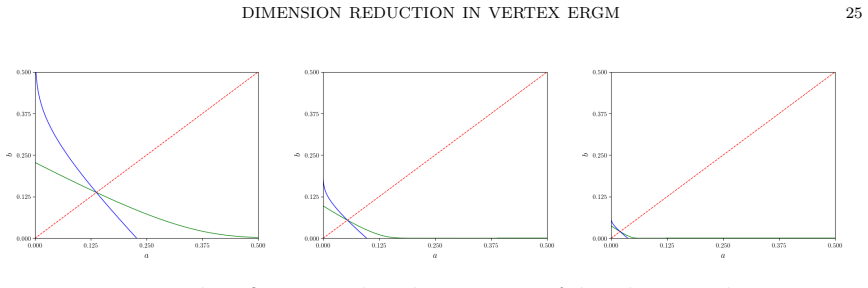
For Hamiltonians of the form $f(X)=\log(p/(1-p))\|X\|_1 + \sum_q \alpha_q n^{1-m_q}\sum_{i_1\ne\cdots\ne i_{m_q}} X_{i_1}\cdots X_{i_{m_q}}$, the random vertex-weight vector $X_n^f$ is a $(\rho, 80C_\alpha^{1/4}n^{-1/8})$-mixture, with $\rho$ putting mass at least $1-80C_\alpha^{1/4}n^{-1/8}$ on the set $\mathcal{X}^f$ of near fixed points of $X=(1_n+\tanh(\nabla f(X)))/2$ (Theorem 4.1). Every $X\in\mathcal{X}^f$ is within $\delta n + 5000C_\alpha^2 n^{7/8}$ in $\ell^1$-norm of a block vector with at most $C_\delta$ communities (Theorem 4.4), giving Corollary 4.5: the model couples in expectation within $\delta n$ to $G(n,\rho)$ supported on such block vectors. With all $\alpha_q\ge 0$ and a unique attractive fixed point $x$ of the scalar map $\phi_\alpha$, every near solution is within $\varepsilon n + O(n^{7/8})$ of the constant vector $x1_n$ (Theorem 4.7); with small weights $J_\alpha<1$ the same conclusion holds with an explicit $n^{7/8}$ rate (Theorem 4.9). For the triangle Hamiltonian, under a two-block symmetric ansatz, the fixed-point equations reduce to a pair of scalar equations, and as the triangle weight diverges the solutions $a,b$ tend to $0$, with polynomial upper and exponential lower decay rates (Lemmas 5.1 and 5.2); in the $n\to\infty$ limit the only solution is the constant vector, which tends to the zero vector.
Load-bearing premise
The triangle-case conclusion assumes that a solution to the fixed-point equation has the two-block symmetric form (first $n/2$ entries equal to $a$, rest equal to $b$), stated after Equation 5.2; if non-symmetric or multi-block solutions exist, the claim that the only solution tends to zero is not proved.
Editorial extensions
If this is right
- An $n$-vertex vertex-weighted ERGM with a clique-counting Hamiltonian can be summarized by a constant number of community weights; the $\ell^1$ error is $o(n)$, so dimension reduction is asymptotically lossless.
- Under positive clique weights with a unique scalar fixed point, the model is within $o(n)$ of a constant-weight configuration $x1_n$, so it behaves like a weighted Erdős–Rényi model with a single edge probability.
- Under the small-weight condition $J_\alpha<1$, the approach to the constant vector is quantitative: every near fixed point lies within $O(n^{7/8})$ of $x1_n$.
- For the triangle-only Hamiltonian with diverging triangle weight, the vertex-weighted model concentrates on the empty configuration instead of developing the nontrivial two-community structure of the unweighted edge-triangle ERGM.
- The sparse example with $p=n^{-d}$ and $\alpha\approx\log n$ shows the bounds remain meaningful when the graph is sparse, as long as $p\gtrsim n^{-1/8}$; in that regime the model couples to $G(n,p)$ with expected $\ell^1$ error $o(np)$.
Reading between the lines
- The same fixed-point-plus-projection argument would likely apply to Hamiltonians that are symmetric functions of vertex weights other than clique counts, since the proof uses only Lipschitz and gradient-complexity bounds; a testable extension is to degree-based or two-star weighted Hamiltonians.
- The contrast with the unweighted triangle ERGM suggests vertex weights themselves may suppress symmetry breaking; one could test this by adding a tiny vertex-weight field to the unweighted edge-triangle model and checking whether the two-community phase disappears.
- Remark 1's explicit $cn^{15/16}$ rate in the positive-weight regime suggests that distributional limit theorems for clique counts might be provable in this near-$G(n,p)$ regime; this is an extrapolation beyond the paper's statements.
- Because the triangle-case conclusion rests on the two-block symmetric ansatz, a natural next step is a numerical or rigorous search for non-symmetric fixed points; if any exist at large weight, the zero-vector conclusion would need qualification.
Signed reviews
Editorial analysis
A structured set of objections, weighed in public.
Referee Report
Summary. The paper studies vertex-weighted exponential random graph models on n vertices, where the Hamiltonian is a weighted sum of normalized products of vertex weights (clique counts) plus a log-odds term that absorbs the Bernoulli distribution of the vertex weights. Using the Eldan-Gross decomposition as a black box, the authors bound the gradient complexity and Lipschitz constants of such Hamiltonians and derive a mixture approximation whose support lies on near fixed points of the vector equation X=(1+tanh(∇f(X)))/2. They then prove that near fixed points are close to block vectors with a number of communities independent of n (Theorem 4.4, Corollary 4.5), that for nonnegative weights satisfying a contraction condition the near fixed points are close to a unique constant vector (Theorem 4.7), and that for sufficiently small weights in either direction the fixed-point map is a contraction with an explicit n^{7/8} error (Theorem 4.9). The last section analyzes the triangle-only Hamiltonian under a two-block symmetric ansatz and claims that for large n the only solution is the constant vector, which approaches zero as the triangle weight diverges.
Significance. If the main structural results are correct, this is a useful vertex-weighted analogue of the Eldan-Gross and Chatterjee-Diaconis theory, with the added benefit of working in the finer 1-norm and covering sparse regimes such as Example 4.8. The paper's strengths include explicit, parameter-independent bounds on D(f), L1, and L2 in Section 3, a clean adaptation of the Johnson-Lindenstrauss block approximation in Theorem 4.4, and parameter-explicit error rates in Theorems 4.7 and 4.9 with no fitted constants. The triangle section is the main weakness: its headline conclusion is not supported as stated, because the two-block ansatz is assumed rather than derived, and the passage to the n→∞ limit does not establish uniqueness for finite large n.
major comments (2)
- [Section 5, paragraph after Eq. (5.2)] The paper assumes a solution of the fixed-point equation X=(1+tanh(∇f(X)))/2 of the form (a,...,a,b,...,b) with exactly n/2 entries of each type, and all subsequent claims about the triangle case—including the statement that for large n only the constant solution exists—are confined to this ansatz. No proof is given that every solution, or every relevant near-fixed point produced by Theorem 4.1, has this form. The model is exchangeable, so the solution set is permutation-invariant, but permutation invariance does not force equal-size two-block structure; non-symmetric two-block solutions with unequal block sizes, multi-block solutions, and non-block vectors are not analyzed. Theorem 4.4 only asserts closeness to some block vector whose number of communities may be large and depends on δ, so it cannot justify the two-block reduction. This gap is load-bearing because the abstract's claim that the solution approaches the zero vector as the triangle weight diverges to -∞ rests entirely on this ansatz.
- [Section 5, paragraph after Lemmas 5.1 and 5.2] The inference 'Taking the limit of n in Equations 5.3 and 5.4 yields ... Thus, for n large enough, the only solution to this system is given by the constant solution a=b' is not valid as written. A system of equations that converges to a limiting system with a unique solution can have additional solutions for every finite n that converge to the limiting solution; ruling this out requires a quantitative separation of roots or a uniform monotonicity/continuity argument. The order of limits is also ambiguous because the eventual claim involves both n→∞ and α→∞. Without this step, even within the two-block ansatz the conclusion that only the constant solution exists for large n is unproved.
minor comments (6)
- [Section 5, first paragraph] The phrase 'Without loss of generality, take n even' is inaccurate: the subsequent two-block assumption with exactly n/2 entries per block is not a consequence of parity, and the odd-n variant should be stated explicitly.
- [Section 4, proof of Theorem 4.4] The block vector Xq is stated to have at most (1+4/δ)^{2(k+1)} communities, but since each Xq_j is an inner product of a single net point uq with one of the net points vq_j, the bound |T|=(1+4/δ)^{k+1} values already suffices; the square is harmless but should be corrected for accuracy.
- [Section 5, before Eqs. (5.3)-(5.4)] The text says that 'for simplicity' it considers equations for α>0 after assimilating the factor 3 inside α; this sign and factor change from the Hamiltonian in Eq. (5.1) should be written out explicitly, so the reader can verify that α→∞ in Eqs. (5.3)-(5.4) corresponds to α→-∞ in Eq. (5.1).
- [Theorem 4.7 and Remark 1] The notation log_{Dα} ε is used without defining the convention for the fractional base Dα<1; since the logarithm is decreasing in the base, this is a common source of sign errors. Please spell out the definition and the resulting exponent explicitly.
- [Corollary 4.5] The proof sketch does not explain how the n^{7/8} term from Theorem 4.4 is absorbed to obtain the claimed δn bound for every n, including small n; a one-sentence argument (for example, choosing Cδ to cover the finite initial segment and then using the n^{7/8} term for large n) would remove ambiguity.
- [Throughout] There are several typographical slips, including 'distribtions' in reference [7], 'Morever' at the end of Section 2.1, and missing spaces in 'Erdős-Rényi'; these should be corrected in revision.
Circularity Check
No significant circularity: the paper's derived claims rest on explicit bounds, a transparent external decomposition theorem, and an object-of-study fixed-point equation; no fitted input is relabeled as a prediction.
full rationale
The derivation chain is non-circular. The main structural input is Theorem 3.1, imported transparently from Eldan and Gross ([7]); the paper's contribution is to verify the hypotheses for vertex-weighted Hamiltonians by bounding D, L1, and L2 in Lemmas 3.2 through 3.4, and then to apply the theorem. The near-fixed-point set Xf in (4.2) is defined from that decomposition bound, so Theorem 4.1 is an application of the imported theorem rather than a restatement of its own conclusion. Theorem 4.4's block-vector approximation is proved through Johnson-Lindenstrauss projections, a delta-net, and triangle-inequality estimates; it does not assume the block-vector conclusion. Theorems 4.7 and 4.9 prove uniqueness of the constant fixed point under explicit hypotheses (positive weights with a unique scalar fixed point and D_alpha < 1, or a contraction constant J_alpha < 1); the constant vector is derived as the unique solution, not postulated as the target. Section 5's triangle analysis does contain an explicit two-block equal-size ansatz before Equation (5.2), and the statement that 'the only solution to this system is given by the constant solution a=b' refers to that two-equation system in the n-to-infinity limit; whether the ansatz is exhaustive is a completeness and correctness concern, not a reduction of the result to its own assumptions. The self-citations in the paper ([6] and [17]) are contextual references to prior work and carry no load in the proofs. No parameter is fitted to a subset of data and then called a prediction, and no external uniqueness theorem is invoked in a way that makes the argument depend on a self-citation. Thus no circular step meeting the evidentiary standard is present.
Assumptions & free parameters
assumptions (5)
- standard math Theorem 9 of Eldan-Gross (2018): a mean-field Gibbs distribution over the hypercube is a mixture of product measures with most mass on near fixed points of X = (1+tanh(∇f(X)))/2.
- standard math Johnson-Lindenstrauss projection bounds (Dasgupta-Gupta, Theorem 2.1 of [5]) and inner-product preservation (Lemma 30 of Eldan-Gross [8]).
- standard math Lemma 33 of Eldan-Gross [8] on uniqueness of the scalar fixed point 1-2a=tanh(αa^2/2).
- domain assumption Vertex weights are independent Bernoulli(p) and the Hamiltonian is of the form (2.1): a weighted sum of normalized products of vertex weights plus log(p/(1-p))||X||_1.
- ad hoc to paper There is a solution to the triangle fixed-point equation of the two-block form (a,...,a,b,...,b) with first n/2 entries a and second n/2 entries b.
Cite this review
Pith. "Pith review of Dimension reduction in vertex-weighted exponential random graphs." pith.science (2026). https://pith.science/paper/J3FSK6G6
@misc{pith2026190808565,
  author       = {Pith},
  title        = {Pith review of: Dimension reduction in vertex-weighted exponential random graphs},
  year         = {2026},
  howpublished = {\url{https://pith.science/paper/J3FSK6G6}},
  note         = {Machine review of arXiv:1908.08565}
}
read the original abstract
We investigate the behavior of vertex-weighted exponential random graphs. We show that vertex-weighted exponential random graphs with edge weights induced by products of independent vertex weights are approximate mixtures of graphs whose vertex weight vector is a near fixed point of a certain vector equation. For graphs with Hamiltonians counting cliques, it is demonstrated that, under appropriate conditions, every solution to this equation is close to a block vector with a small number of communities. We prove that for the cases of positive weights and small weights in the Hamiltonian in particular, the vector equation has a unique solution. Lastly, the behavior of vertex-weighted exponential random graphs counting triangles is studied in detail and the solution to the vector equation is shown to approach the zero vector as the weight diverges to negative infinity for sufficiently large networks.
Figures

Reference graph
Works this paper leans on
-
[1]
Bhamidi, S., Bresler, G., Sly, A.: Mixing time of exponential random graphs. Ann. Appl. Probab. 21: 2146-2170 (2011)
work page 2011
-
[2]
Chatterjee, S., Diaconis, P.: Estimating and understanding exponential random graph models. Ann. Statist. 41: 2428-2461 (2013)
work page 2013
-
[3]
Corless, R.M., Gonnet, G.H., Hare, D.E.G., Jeffrey, D.J., Knuth, D.E.: On the Lambert W function. Adv. Comput. Math. 5: 329-359 (1996)
work page 1996
-
[4]
Cranmer, S.J., Desmarais, B.A.: Inferential network analysis with exponential random graph models. Pol. Anal. 19: 66-86 (2011)
work page 2011
-
[5]
Random Structures Algorithms 22: 60-65 (2003)
Dasgupta, S., Gupta, A.: An elementary proof of a theorem of Johnson and Lindenstrauss. Random Structures Algorithms 22: 60-65 (2003)
work page 2003
-
[6]
DeMuse, R., Easlick, T., Yin, M.: Mixing time of vertex-weighted exponential random graphs. J. Comput. Appl. Math. 362: 443-459 (2019)
work page 2019
- [7]
-
[8]
Eldan, R., Gross, R.: Exponential random graphs behave like mixtures of stochastic block models. Ann. Appl. Probab. 28: 3698-3735 (2018)
work page 2018
Show all 17 references
-
[9]
Fienberg, S.E.: Introduction to papers on the modeling and analysis of network data. Ann. Appl. Statist. 4: 1-4 (2010)
2010
-
[10]
Fienberg, S.E.: Introduction to papers on the modeling and analysis of network data II. Ann. Appl. Statist. 4: 533-534 (2010)
2010
-
[11]
Gilbert, E.N.: Random graphs. Ann. Math. Statist. 30: 1141-1144 (1959)
1959
-
[12]
Hoorfar, A., Hassani, M.: Inequalities on the Lambert W function and hyperpower function. J. Inequal. Pure Appl. Math. 9: 1-5 (2008)
2008
-
[13]
In: Bramoull´ e, Y., Galeotti, A., Rogers, B
Jackson, M.: The past and future of network analysis in economics. In: Bramoull´ e, Y., Galeotti, A., Rogers, B. (eds.) The Oxford Handbook on the Economics of Networks. 10.1093/oxfordhb/ 9780199948277.013.2 Oxford University Press, Oxford, UK (2016)
2016 doi
-
[14]
Krioukov, D.: Clustering implies geometry in networks. Phys. Rev. Lett. 116: 208302 (2016)
2016
-
[15]
American Mathematical Society , Providence, USA (2012)
Lov´ asz, L.: Large Networks and Graph Limits. American Mathematical Society , Providence, USA (2012)
2012
-
[16]
Springer- Verlag New York Inc
Milman, V.D., Schechtman, G.: Asymptotic Theory of Finite Dimensional Normed Spaces. Springer- Verlag New York Inc. , New York, USA (1986). DIMENSION REDUCTION IN VERTEX ERGM 27
1986
-
[17]
arXiv: 1607.04084 (2016)
Yin, M.: Phase transitions in edge-weighted exponential random graphs. arXiv: 1607.04084 (2016). Department of Mathematics, University of Denver, Denver, CO 80208, USA E-mail address: ryan.demuse@du.edu E-mail address: mei.yin@du.edu
2016 arXiv
Reviewed August 14, 2026 · model on record in the stance chip above.
Discussion (0). Continue with ORCID to comment.