REVIEW 3 major objections 5 minor 6 references
Composite stacks for reliable > 17 T trapped fields in bulk superconductor magnets
T0 review · 3 major / 5 minor · reviewed 2026-08-14 · deepseek-v4-flash
Pith's one-line read A laminated stack of GdBCO-Ag bulk superconductor and stainless steel trapped 17.6 T at 22.5 K, survived a second magnetization, and points toward reproducible bulk magnets above 20 T.
desk verdict A real but n=1 experimental advance: one laminated composite stack trapped 16.8 T then 17.6 T, yet the paper's 'reliable' claim outruns the data. read the letter →
The pith
A machine-rendered reading of the paper's core claim, the machinery that carries it, and where it could break.
The reading
What carries the argument
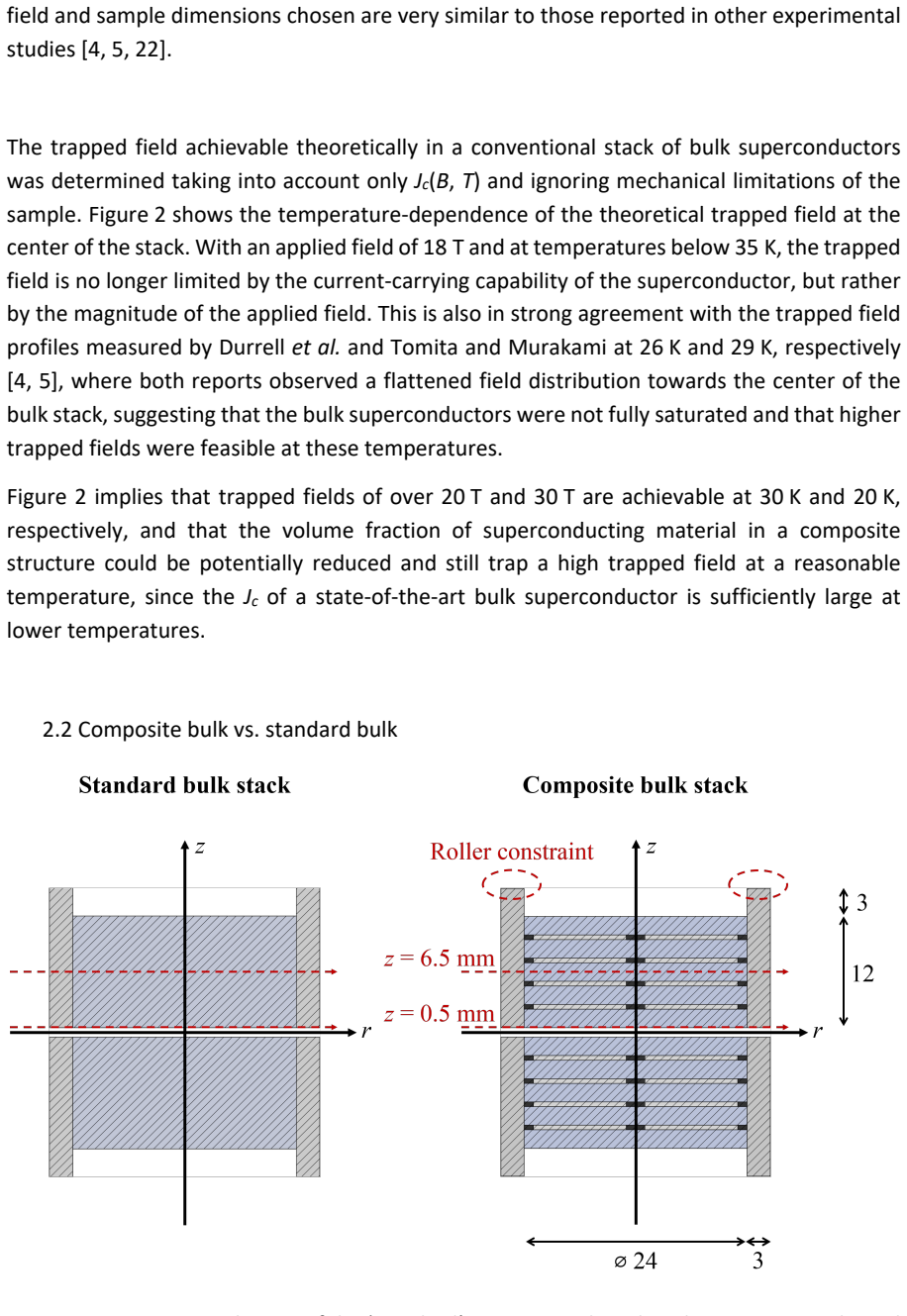
The load-bearing element is the composite laminate: a bulk superconductor sawed into five slices with four 0.51 mm stainless steel disks in between, bonded with epoxy, then machined and surrounded by a stainless steel ring shrink-fit at 300 °C. This does three jobs at once: the steel in compression puts the superconductor layers into a compressive thermal prestress, the high-fracture-toughness disks arrest any crack that starts in one layer, and the steel adds heat capacity and conductivity that quench flux-jump hotspots. The simulations couple magnetic-field, heat-transfer, and solid-mechanics equations to give the stress reduction, using the critical-current data extended to 20 T by a standard extrapolation.
What would settle it
Fabricate at least three composite stacks with the same lamination recipe, field-cool each in 18 T below 30 K, and re-magnetize the survivors; if fewer than two of the three trap above 17 T or if the success rate matches the one-in-three survival of the standard stacks cited in the paper, the claim that lamination makes >17 T reliable is contradicted.
Extended reading notes
Core claim
The central discovery is that a laminated composite structure—bulk GdBCO-Ag slices glued between stainless steel discs and enclosed by a shrink-fit ring—can sustain the Lorentz-force stresses and flux-jump heating of repeated 18 T field-cooled magnetizations at cryogenic temperatures. Finite-element simulations show the laminations convert the tensile hoop stress in the superconductor from a peak near 111 MPa (above the measured splitting strength of roughly 34 MPa) to about 27 MPa, while adding a compressive prestress on cooling. The stack trapped 16.8 T at 26 K and, in a second run, 17.6 T at 22.5 K, with the field profile and flux creep recorded. The authors argue this is the first demonstration that a deliberately reinforced composite stack can reach record-class trapped fields on its first attempt and be magnetized again, evidence that the statistical failure of standard bulks is not intrinsic.
Load-bearing premise
The reliability claim rests on a single specimen: the paper's own text notes 'Despite being the only stack of this structure that was measured,' and no batch of identical composite stacks was built to show the design narrows the run-to-run spread seen in standard stacks.
Editorial extensions
If this is right
- Trapped fields above 17 T no longer require a single lucky sample: the first composite stack built by this technique reached 17.6 T, so in the authors' view the reinforcement itself, not sample selection, carried the record performance.
- Repeated magnetization becomes plausible: the same stack trapped 16.8 T at 26 K and 17.6 T at 22.5 K without mechanical or thermal failure on either run.
- The stress margin is quantified: simulations put the peak hoop stress in the superconductor at about 27 MPa, below the measured splitting tensile strength of roughly 34 MPa, whereas an unreinforced stack would reach about 111 MPa.
- Fields beyond 20 T are projected: with state-of-the-art critical current density and an 18 T applied field, the model indicates trapped fields above 20 T at 30 K and above 30 T at 20 K are within reach.
- The composite occupies a middle ground between all-bulk magnets and tape stacks: it reaches record-class fields at 22.5 K, warmer than the 8 K needed by the 17.7 T tape stack, while gaining mechanical and thermal stability from its steel fraction.
Reading between the lines
- If the design's reliability holds across a batch, the next bottleneck becomes the magnet that supplies the applied field: the 18 T limit of the present facility caps the trapped field, so testing in a 20+ T background magnet would be the direct way to probe the projected >20 T regime.
- Because the simulations suggest the superconducting volume fraction can be reduced without losing trapped field at low temperature, the same lamination approach could be tuned to make larger-diameter magnets with less expensive superconductor, at the cost of a sharper field profile.
- A batch study of, say, three to five identical composite stacks would turn the paper's reliability claim into a quantitative statistic; without it, the design remains a single successful demonstration.
Signed reviews
Editorial analysis
A structured set of objections, weighed in public.
Referee Report
Summary. The paper reports the field-cooled magnetization of a stack of two Ag-doped GdBa2Cu3O7-delta bulk superconductor composites, each reinforced with stainless-steel laminations and a shrink-fit stainless-steel ring. The stack sequentially trapped 16.8 T at 26 K and then 17.6 T at 22.5 K, surviving both magnetization runs. Finite-element simulations in Section 2 predict that the composite geometry reduces peak hoop stress compared with a standard two-disc stack, and the authors argue that with state-of-the-art Jc(B,T) values, trapped fields above 20 T should be attainable using such reinforcement. The work is positioned as a route toward reliable high-field bulk superconducting magnets.
Significance. The experimental result is a genuine advance: a single composite stack trapped fields comparable to the highest reported values (16.8 T and then 17.6 T) and survived a second magnetization, whereas prior high-field stacks often failed on re-magnetization. The direct Hall-sensor measurements at five radial positions, the clear description of the fabrication route, and the availability of data via an institutional repository are strengths. The simulations provide a plausible mechanism for the improved robustness, and the comparison with the Durrell et al. variability is informative. However, the central 'reliability' claim rests on a single sample, and the stress-model assumptions are idealized relative to the actual epoxy-bonded assembly, so the generalization to 'reliable >17 T' is not yet established.
major comments (3)
- [Section 4 and Conclusions] The central reliability claim, stated in the title, abstract, Section 4, and Conclusions, is supported by only one composite stack. The manuscript itself states, 'Despite being the only stack of this structure that was measured, it was able to survive two high-field magnetization tests...' This is an explicit admission of n=1. The comparison with Durrell et al. shows that nominally identical standard stacks varied from 10 T to 17.6 T, but no batch of composite stacks was fabricated or tested to demonstrate that the new design reduces that variability. In addition, the two GdBCO-Ag slices were pre-selected based on high 77 K trapped fields (0.99 T and 1.01 T), so the success could in part reflect superior starting material. The reliability claim should be reframed as a demonstration on a single unit, or supported by additional stacks.
- [Section 2.2, paragraph beginning 'There is continuity of displacements...'] The finite-element prediction that the composite reduces the maximum hoop stress from 111 MPa to 27 MPa assumes perfect continuity of displacements across every interface, which is the default COMSOL boundary condition. The actual assembly uses Stycast 2850 FT epoxy, a compliant adhesive, between the GdBCO-Ag slices and the stainless-steel laminates. The assumed ideal stress transfer is unlikely to hold exactly in the presence of a finite-thickness epoxy layer, so the predicted stress reduction and the associated mechanism for reliability may be optimistic. Please quantify the effect of a compliant interface layer or otherwise justify the assumption.
- [Section 2.1 and Figure 2] The projection of trapped fields over 20 T rests on Jc(B,T) data measured for fields up to 6 T and extended to 20 T using the Jirsa equation. This is a substantial extrapolation, and the paper does not provide experimental validation of the extrapolated Jc values in the 10-20 T range. While the measured 16.8 T and 17.6 T values are consistent with the model, they do not validate the extrapolation at higher fields. The >20 T statement should be clearly labeled as a projection based on an untested extrapolation, not a demonstrated capability.
minor comments (5)
- [Section 3.2] No calibration uncertainty or sensor accuracy is reported for the Hall sensors. A brief statement of the calibration method and the resulting uncertainty in the reported 16.8 T and 17.6 T values would strengthen the quantitative claims.
- [Section 4, Figure 5(d)] The asymmetry in the field profile at r = ±7.5 mm (a difference of 2.5 T) is mentioned as possibly due to sensor misalignment or Jc asymmetry. Given the magnitude of the difference, a brief discussion of potential systematic effects on the central-field value would be helpful.
- [Abstract and first paragraph of Introduction] The phrase 'principle barriers' should read 'principal barriers' (a spelling error). Similar wording appears in the Introduction.
- [Figure 2 caption] The caption appears incomplete: it ends with 'The applied' and does not finish the sentence. Please complete the caption text.
- [References [16] and [17]] The text cites Morita et al. 2017 for ring-shaped bulk magnets and references [16] and [17]. Please verify that these references correspond to the correct Morita publications and consistently cite the author's first initial (K. Morita vs M. Morita).
Circularity Check
No circularity: the trapped fields are measured directly, and the supporting simulations use independently characterized Jc(B,T) data and literature material properties rather than fitting to the reported result.
full rationale
The paper's central result is an experimental measurement: a two-sample GdBCO-Ag composite stack trapped 16.8 T at 26 K and then 17.6 T at 22.5 K after field-cooled magnetization. This is not derived from a model whose output is defined by its input; it is a direct Hall-sensor measurement. The finite-element simulations in Section 2 use Jc(B,T) measured on a representative GdBCO-Ag specimen for fields up to 6 T and extend it to 20 T via the Jirsa equation, together with literature values for elastic and thermal properties listed in the Appendix. Nothing in the simulation is fitted to the 16.8 T or 17.6 T results, so the comparison between simulated stress reduction and experimental survival is a genuine prediction check rather than a circular reduction. The self-citations to refs [18]-[20] supply the modeling framework and Jc interpolation, but those are parameter-free inputs with stated assumptions, not the paper's headline claim; hence they do not make the argument circular. The paper itself flags the main limitation in Section 4: 'Despite being the only stack of this structure that was measured, it was able to survive two high-field magnetization tests...' This n=1 limitation undercuts the word 'reliable' in the title, and the >20 T projection inherits uncertainty from the Jc extrapolation and from the assumed 'continuity of displacements across every interface' despite the use of Stycast epoxy. Those are correctness and generalization risks, not cases where a prediction is equivalent to its inputs by construction. The derivation chain is therefore self-contained with respect to the measured trapped field claims.
Assumptions & free parameters
assumptions (4)
- domain assumption The Jc(B,T) characteristics measured on a representative GdBCO-Ag specimen up to 6 T, extended to 20 T using the Jirsa equation, represent the properties of the actual stack layers.
- domain assumption Perfect mechanical connection with continuity of displacements across all interfaces, the COMSOL default, models the real epoxy/steel/bulk interfaces.
- ad hoc to paper One successfully magnetized composite stack is representative of the reliability of the technique.
- domain assumption Literature values for Young's modulus, Poisson's ratio, and thermal expansion cited in the Appendix apply at the operating temperatures near 22-30 K.
Cite this review
Pith. "Pith review of Composite stacks for reliable > 17 T trapped fields in bulk superconductor magnets." pith.science (2026). https://pith.science/paper/UY4TVYRD
@misc{pith2026190808614,
  author       = {Pith},
  title        = {Pith review of: Composite stacks for reliable > 17 T trapped fields in bulk superconductor magnets},
  year         = {2026},
  howpublished = {\url{https://pith.science/paper/UY4TVYRD}},
  note         = {Machine review of arXiv:1908.08614}
}
read the original abstract
Trapped fields of over 20 T are, in principle, achievable in bulk, single-grain high temperature cuprate superconductors. The principle barriers to realizing such performance are, firstly, the large tensile stresses that develop during the magnetization of such trapped-field magnets as a result of the Lorentz force, which lead to brittle fracture of these ceramic-like materials at high fields and, secondly, catastrophic thermal instabilities as a result of flux movement during magnetization. Moreover, for a batch of samples nominally fabricated identically, the statistical nature of the failure mechanism means the best performance (i.e. trapped fields of over 17 T) cannot be attained reliably. The magnetization process, particularly to higher fields, also often damages the samples such that they cannot repeatedly trap high fields following subsequent magnetization. In this study, we report the sequential trapping of magnetic fields of ~ 17 T, achieving 16.8 T at 26 K initially and 17.6 T at 22.5 K subsequently, in a stack of two Ag-doped GdBa2Cu3O7-{\delta} bulk superconductor composites of diameter 24 mm reinforced with (1) stainless-steel laminations, and (2) shrink-fit stainless steel rings. A trapped field of 17.6 T is, in fact, comparable with the highest trapped fields reported to date for bulk superconducting magnets of any mechanical and chemical composition, and this was achieved using the first composite stack to be fabricated by this technique.
Figures

Reference graph
Works this paper leans on
-
[1]
Introduction The (RE)Ba2Cu3O7-δ family of bulk high temperature superconductors [or (RE)BCO; where RE = rare earth element or yttrium] can be used as trapped-field magnets [1–3] with superior performance compared with conventional hard ferromagnets. Trapped fields of just over 17 T are achievable by bulk superconductors, which is around an order of magnit...
work page 2003
-
[2]
Numerical simulations 2.1 Field-trapping potential To design and assess appropriate reinforcement arrangements, two-dimensional (2D) axisymmetric finite-element models, implemented in the commercial finite element software package COMSOL Multiphysics, were used to study the field-trapping potential and mechanical stability of different bulk superconductor...
-
[3]
Experimental details 3.1 Sample fabrication and mechanical reinforcement Single-grain, Ag-doped GdBa2Cu3O7-δ bulk superconductor samples (GdBCO-Ag), ~ 25 mm in diameter and ~ 10 mm in thickness, were fabricated by top seeded melt growth, as described in detail elsewhere [25]. To ensure they were single grains, each sample was magnetized with an applied fi...
-
[4]
Results and discussion Figure 5. (a) Magnitude of the trapped field measured at the center of the two-sample composite stack at 26 K as the external applied field was ramped-down. (b) Trapped field profiles measured at various temperatures as the sample stack was warmed slowly at a rate of approximately 1 K/min. The field measured by the central Hall sens...
-
[5]
Bulk high temperature superconductors for magnet applićations,
Conclusions We have demonstrated the sequential high-field magnetization of a stack of two Ag-doped GdBa2Cu3O7-δ bulk superconductor composites of diameter 24 mm, formed by sandwiching layers of high-strength and high-stiffness stainless steel in-between layers of bulk superconductor. The aim of these post-melt-processing treatments was to increase the st...
-
[16]
Development of New Reinforcement Method and 10T Magnetization of QMG Magnet,
K. Morita, H. Teshima, and S. Nariki, “Development of New Reinforcement Method and 10T Magnetization of QMG Magnet,” Nippon Steel Sumitomo Met. Tech. Rep., vol. No. 117, 2017. [17] M. Morita, “History and recent progress of QMGTM and QMG bulk magnets,” in Journal of Physics: Conference Series, 2018, vol. 1054, no. 1, p. 12046. [18] M. D. Ainslie et al., “...
work page 2017
Reviewed August 14, 2026 · model on record in the stance chip above.
Discussion (0). Continue with ORCID to comment.