REVIEW 3 major objections 4 minor 65 references
Damping enhancement in coherent ferrite/insulating-paramagnet bilayers
T0 review · 3 major / 4 minor · reviewed 2026-08-14 · deepseek-v4-flash
Pith's one-line read An interfacial layer of chemical disorder, not spin pumping, triples damping in ferrite/paramagnet bilayers.
desk verdict Solid experiment with a real, reproducible result, but the chemical-disorder attribution is underdetermined because interfacial spin pumping into the paramagnet is not excluded. read the letter →
The pith
A machine-rendered reading of the paper's core claim, the machinery that carries it, and where it could break.
The reading
What carries the argument
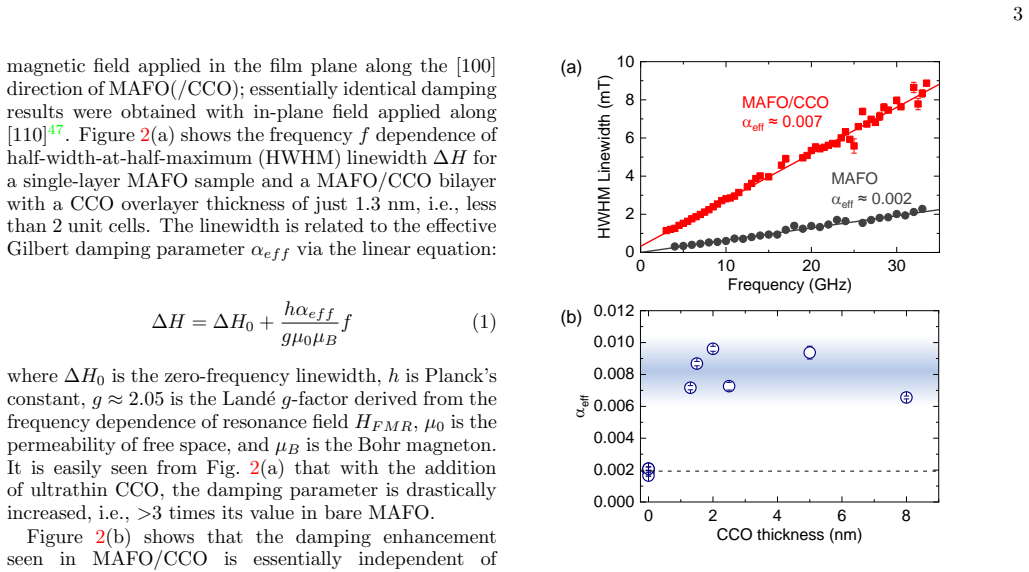
The quantitative core is the ferromagnetic-resonance linewidth relation $\Delta H = \Delta H_0 + \frac{h \alpha_{\rm eff}}{g \mu_0 \mu_B} f$, which turns the slope of half-width-at-half-maximum linewidth versus frequency into an effective Gilbert damping parameter. Two depth-resolved probes carry the mechanistic argument: polarized neutron reflectometry separates nuclear and magnetic profiles to reveal the intermixed, magnetically suppressed interface, and element-specific X-ray magnetic circular dichroism rules out a proximity-induced moment in the overlayer. The decisive comparison is the thickness independence of $\Delta\alpha_{\rm eff}$, which localizes the dissipation to the interface, together with a normalization $\Delta\alpha_{\rm eff} \propto 1/(M_s t_m)$ that places the oxide-interface result on the same footing as spin-pumping measurements.
What would settle it
Repeat the FMR measurements over a wider frequency range and at several in-plane field angles; if the linewidth is not strictly linear in frequency or shows angle dependence, part of the claimed interfacial spin-scattering enhancement is actually two-magnon broadening. Alternatively, grow the bilayer with a deliberately sharper interface, for example by lower-temperature deposition, and check whether the more-than-threefold damping increase disappears.
Extended reading notes
Core claim
On the paper's own terms, the finding is that the effective Gilbert damping parameter $\alpha_{\rm eff}$ of a 15-nm epitaxial MgAl$_{1/2}$Fe$_{3/2}$O$_4$ film rises from roughly $0.002$ to $0.007$ when a paramagnetic CoCr$_2$O$_4$ cap is added, and the enhancement does not depend on the cap thickness between 1.3 and 8 nm. Polarized neutron reflectometry yields no evidence of proximity-induced magnetization in the CCO, instead showing a magnetically dead, chemically intermixed region about one spinel unit cell thick at the interface, and X-ray absorption and magnetic circular dichroism show no Co or Cr moment and no change in Fe cation chemistry. The authors therefore attribute the damping increase to spin scattering by the ultrathin disordered layer, and they show that the size of the effect is comparable to or greater than damping increases reported for YIG/Pt and related ferrite/heavy-metal bilayers when normalized for magnetization and magnetic thickness.
Load-bearing premise
The analysis assumes the measured FMR linewidth is exactly linear in frequency with a zero-frequency intercept, so any frequency-dependent broadening from two-magnon scattering or inhomogeneous effects would be absorbed into the fitted slope and could inflate the apparent Gilbert damping parameter.
Editorial extensions
If this is right
- A disordered layer of about one spinel unit cell is sufficient to triple damping, so maintaining ultralow damping in oxide heterostructures requires unit-cell-level interface control.
- The thickness independence and the absence of proximity magnetism rule out spin pumping into the paramagnet, showing that interfacial spin scattering alone can rival the damping enhancement of heavy-metal spin sinks.
- For ferrite/metal bilayers, the result cautions that a chemically disordered interface can mimic spin-pumping signatures, so $\Delta\alpha_{\rm eff}$ should not be attributed solely to spin-mixing conductance.
- Growth routes that sharpen the interface, such as molecular beam epitaxy, are expected to recover low damping and would benefit all-oxide magnonic devices.
- The same intermixed region that suppresses interfacial magnetization also enhances spin scattering, suggesting a common microscopic origin for the magnetic dead layer and the damping increase.
Reading between the lines
- If chemical disorder is the cause, post-growth annealing of the bilayers should re-distribute or remove the intermixed cations and thereby change $\Delta\alpha_{\rm eff}$, a testable prediction the paper does not explicitly draw.
- Angle-resolved FMR data at higher frequencies could separate the two-magnon contribution from the linear Gilbert term, testing whether the measured enhancement is genuinely frequency-independent Gilbert damping.
- The comparable magnitude to heavy-metal spin pumping suggests that thin ferrite layers in magnon valves or spin-orbit-torque devices may be more sensitive to interface quality than to the bulk properties of the adjacent oxide.
Editorial analysis
A structured set of objections, weighed in public.
Referee Report
Summary. The manuscript reports that a coherent epitaxial interface between a 15-nm-thick MgAl-ferrite (MAFO) film and a paramagnetic CoCr2O4 (CCO) overlayer increases the effective Gilbert damping by more than a factor of three, independent of CCO thickness in the 1.3–8 nm range. Through polarized neutron reflectometry and X-ray magnetic circular dichroism, the authors show the absence of static proximity-induced magnetization in CCO and identify an intermixed, chemically disordered interfacial layer about one unit cell thick. They attribute the damping enhancement to spin scattering from this chemical disorder rather than to spin pumping or proximity magnetism, and compare the magnitude with ferrite/metal bilayers.
Significance. If the attribution holds, the paper makes a strong case that interfacial chemical disorder, not just spin-pumping into a metallic or ordered magnetic layer, can be the dominant source of damping enhancement in all-oxide ferrite heterostructures. The experiments are carefully controlled, including cleaning and heating control runs, and the combination of FMR, PNR, and element-specific XMCD is convincing for the structural and static magnetic picture. The normalization of literature Δα values to the same Ms and tm is a useful quantitative context. The central causal claim, however, relies on the exclusion of alternative dynamic interfacial mechanisms, and that exclusion is not complete.
major comments (3)
- [Section III and Discussion] The exclusion of spin pumping is incomplete. The manuscript only considers proximity-induced magnetization and bulk spin absorption as alternative mechanisms, but interfacial spin pumping into the paramagnetic Co2+/Cr3+ moments of CCO (the 'paramagnetic spin pumping' regime of Ref. 28) is not evaluated. This mechanism is interface-limited and does not require a static induced moment, so the PNR upper limit of 7 emu/cc and the null XMCD signals in Section IV are not probative. The thickness independence of the enhancement is also consistent with an interface-limited spin sink. The claim that the enhancement is due to chemical disorder 'rather than spin pumping' is therefore underdetermined. Please either add a control experiment with a nonmagnetic isostructural overlayer, or soften the causal attribution and state that a paramagnetic spin-pumping contribution cannot be excluded.
- [Eq. (1) and Section V] The extraction of α_eff from Eq. (1) assumes a strictly linear HWHM linewidth with a zero-frequency intercept. Any frequency-dependent contribution from two-magnon scattering or inhomogeneous broadening is folded into the fitted slope. The authors themselves propose in Section V that magnetic roughness may lead to a two-magnon-like mechanism, which would not be a pure Gilbert term. The paper should clarify whether the observed enhancement reflects the intrinsic Gilbert term or the slope of an effective linewidth that mixes multiple mechanisms, and whether the comparison with spin-pumping literature, which assumes Gilbert-like damping, is appropriate.
- [Section IV] The identification of the interfacial layer as chemically disordered relies on the PNR model, which includes parameters for interfacial roughness and magnetization suppression. The extracted intermixing length of 0.9–1.35 nm is suggestive, but the conclusion that the layer is chemically disordered rather than simply magnetically dead would be corroborated by direct chemical profiling, for example high-resolution STEM-EELS. This does not undermine the damping measurement, but it adds uncertainty to the attribution of the mechanism.
minor comments (4)
- [Figure 2(b)] The error bars on α_eff are not defined in the text or caption; please specify the statistical uncertainty and the number of repeated measurements.
- [References] Reference 8 contains a typo: 'seudomorphic' should be 'pseudomorphic'.
- [Section IV] The 'BUMPS python package' is mentioned without a version or citation; please provide a reference or a persistent identifier for the software.
- [Section V] The normalization of Δα_eff from the literature in Fig. 5 assumes a 1/(Ms tm) scaling; the text should state explicitly that this is an approximation and how deviations would affect the comparison.
Circularity Check
No circularity found: measured damping enhancement, independent structural/magnetic depth profiling, and literature comparison are self-contained.
full rationale
The paper's central claim is an experimental observation: FMR linewidth measurements show that alpha_eff increases by a factor >3 when MAFO is capped with CCO, independent of CCO thickness. The alpha_eff values are obtained from a standard linear fit of HWHM linewidth versus frequency (Eq. 1), which is an external, established definition rather than an input constructed from the target conclusion. The attribution to interfacial chemical disorder is supported by independent depth-resolved measurements: PNR shows a ~1-nm intermixed/chemically disordered region and suppressed interfacial magnetization, XA shows no substantial Fe oxidation-state change, and XMCD/PNR show no static proximity-induced Co/Cr moment. These are independent observations, not fits to the damping enhancement. The paper explicitly leaves open that two-magnon scattering could contribute, showing the interpretation is not forced by the analysis. Self-citations (e.g., Refs. 16, 18, 54, 61) are used for growth conditions, prior MAFO properties, surface roughness, and literature comparison of damping enhancements; none carries the load of the central attribution, and the comparison to YIG/Pt, MAFO/Pt, and MAFO/W uses external published values. The skeptical concern that interfacial spin pumping into paramagnetic CCO is not fully excluded is a question of underdetermination of the causal mechanism, not circular reasoning: no equation in the paper defines the damping enhancement in terms of the measured disorder, nor is any fitted parameter renamed as a prediction. The derivation chain is therefore self-contained, and the score is 0.
Assumptions & free parameters
free parameters (2)
- MAFO/CCO interfacial roughness (PNR fit) =
1.35(5) nm
- Proximity magnetization upper limit in CCO (MCMC fit) =
7 emu/cc
assumptions (3)
- domain assumption Eq. (1): HWHM linewidth is linear in frequency with intercept DeltaH0
- domain assumption PNR model assumes a layered structure with uniform layers and roughness
- domain assumption CCO is paramagnetic at 300 K with T_C = 97 K
Cite this review
Pith. "Pith review of Damping enhancement in coherent ferrite/insulating-paramagnet bilayers." pith.science (2026). https://pith.science/paper/72E5HCKG
@misc{pith2026190808629,
  author       = {Pith},
  title        = {Pith review of: Damping enhancement in coherent ferrite/insulating-paramagnet bilayers},
  year         = {2026},
  howpublished = {\url{https://pith.science/paper/72E5HCKG}},
  note         = {Machine review of arXiv:1908.08629}
}
abstract
High-quality epitaxial ferrites, such as low-damping MgAl-ferrite (MAFO), are promising nanoscale building blocks for all-oxide heterostructures driven by pure spin current. However, the impact of oxide interfaces on spin dynamics in such heterostructures remains an open question. Here, we investigate the spin dynamics and chemical and magnetic depth profiles of 15-nm-thick MAFO coherently interfaced with an isostructural $\approx$1-8-nm-thick overlayer of paramagnetic CoCr$_2$O$_4$ (CCO) as an all-oxide model system. Compared to MAFO without an overlayer, effective Gilbert damping in MAFO/CCO is enhanced by a factor of $>$3, irrespective of the CCO overlayer thickness. We attribute this damping enhancement to spin scattering at the $\sim$1-nm-thick chemically disordered layer at the MAFO/CCO interface, rather than spin pumping or proximity-induced magnetism. Our results indicate that damping in ferrite-based heterostructures is strongly influenced by interfacial chemical disorder, even if the thickness of the disordered layer is a small fraction of the ferrite thickness.
Figures


Figures from the paper (2 more)


Reference graph
Works this paper leans on
-
[1]
A. Hoffmann and S. D. Bader, Opportunities at the Frontiers of Spintronics, Phys. Rev. Appl. 4 , 047001 (2015)
work page 2015
-
[2]
A. V. Chumak, V. I. Vasyuchka, A. A. Serga, and B. Hillebrands, Magnon spintronics, Nat. Phys. 11 , 453 (2015)
work page 2015
-
[3]
O. d'Allivy Kelly, A. Anane, R. Bernard, J. Ben Youssef , C. Hahn, A. H. Molpeceres, C. CarreÌteÌro, E. Jacquet, C. Deranlot, P. Bortolotti, R. Lebourgeois, J.-C. Mage, G. de Loubens, O. Klein, V. Cros, and A. Fert, Inverse spin Hall effect in nanometer-thick yttrium iron garnet/Pt system, Appl. Phys. Lett. 103 , 082408 (2013)
work page 2013
-
[4]
C. Du, H. Wang, P. C. Hammel, and F. Yang, Y _3 Fe _5 O _ 12 spin pumping for quantitative understanding of pure spin transport and spin Hall effect in a broad range of materials, J. Appl. Phys. 117 , 172603 (2015)
work page 2015
- [5]
-
[6]
M. C. Onbasli, A. Kehlberger, D. H. Kim, G. Jakob, M. Kl \" a ui, A. V. Chumak, B. Hillebrands, and C. A. Ross, Pulsed laser deposition of epitaxial yttrium iron garnet films with low Gilbert damping and bulk-like magnetization, APL Mater. 2 , 106102 (2014)
work page 2014
-
[7]
J. Lustikova, Y. Shiomi, Z. Qiu, T. Kikkawa, R. Iguchi, K. Uchida, and E. Saitoh, Spin current generation from sputtered Y _3 Fe _5 O _ 12 films J. Appl. Phys. 116 , 153902 (2014)
work page 2014
-
[8]
B. M. Howe, S. Emori, H.-M. Jeon, T. M. Oxholm, J. G. Jones, K. Mahalingam, Y. Zhuang, N. X. Sun, and G. J. Brown, seudomorphic Yttrium Iron Garnet Thin Films With Low Damping and Inhomogeneous Linewidth Broadening, IEEE Magn. Lett. 6 , 3500504 (2015)
work page 2015
Show all 65 references
-
[9]
C. Tang, M. Aldosary, Z. Jiang, H. Chang, B. Madon, K. Chan, M. Wu, J. E. Garay, and J. Shi, Exquisite growth control and magnetic properties of yttrium iron garnet thin films, Appl. Phys. Lett. 108 , 102403 (2016)
2016
-
[10]
Hauser, T
C. Hauser, T. Richter, N. Homonnay, C. Eisenschmidt, M. Qaid, H. Deniz, D. Hesse, M. Sawicki, S. G. Ebbinghaus, and G. Schmidt, Yttrium Iron Garnet Thin Films with Very Low Damping Obtained by Recrystallization of Amorphous Material, Sci. Rep. 6 , 20827 (2016)
2016
-
[11]
Talalaevskij, M
A. Talalaevskij, M. Decker, J. Stigloher, A. Mitra, H. S. K \" o rner, O. Cespedes, C. H. Back, and B. J. Hickey, Magnetic properties of spin waves in thin yttrium iron garnet films, Phys. Rev. B 95 , 064409 (2017)
2017
-
[12]
Heinrich, C
B. Heinrich, C. Burrowes, E. Montoya, B. Kardasz, E. Girt, Y.-Y. Song, Y. Sun, and M. Wu, Spin Pumping at the Magnetic Insulator (YIG)/Normal Metal (Au) Interfaces, Phys. Rev. Lett. 107 , 066604 (2011)
2011
-
[13]
M. B. Jungfleisch, A. V. Chumak, A. Kehlberger, V. Lauer, D. H. Kim, M. C. Onbasli, C. A. Ross, M. Kl \" a ui, and B. Hillebrands, Thickness and power dependence of the spin-pumping effect in Y _3 Fe _5 O _ 12 /Pt heterostructures measured by the inverse spin Hall effect, Phys...
2015
-
[14]
H. Zhou, X. Fan, L. Ma, L. Cui, C. Jia, S. Zhou, Y. S. Gui, C.-M. Hu, and D. Xue, Spin pumping in the nonlinear dynamic regime of a Pt/Y3Fe5O12 heterostructure, Appl. Phys. Lett. 108 , 192408 (2016)
2016
-
[15]
Holanda, O
J. Holanda, O. Alves Santos , R. L. Rodr \' i guez-Su \' a rez, A. Azevedo, and S. M. Rezende, Simultaneous spin pumping and spin Seebeck experiments with thermal control of the magnetic damping in bilayers of yttrium iron garnet and heavy metals: YIG/Pt and YIG/IrMn, Phys. Re...
2017
-
[16]
Emori, B
S. Emori, B. Gray, H.-M. Jeon, J. Peoples, M. Schmitt, K. Mahalingam, M. Hill, M. Mcconney, M. Gray, U. Alaan, A. Bornstein, P. Shafer, A. N'Diaye, E. Arenholz, G. Haugstad, K.-Y. Meng, F. Yang, D. Li, S. Mahat, D. Cahill, P. Dhagat, A. Jander, N. Sun, Y. Suzuki, and B. Howe, ...
2017
-
[17]
A. V. Singh, B. Khodadadi, J. B. Mohammadi, S. Keshavarz, T. Mewes, D. S. Negi, R. Datta, Z. Galazka, R. Uecker, and A. Gupta, Bulk Single Crystal-Like Structural and Magnetic Characteristics of Epitaxial Spinel Ferrite Thin Films with Elimination of Antiphase Boundaries, Adv....
2017
-
[18]
Emori, D
S. Emori, D. Yi, S. Crossley, J. J. Wisser, P. P. Balakrishnan, P. Shafer, C. Klewe, A. T. N'Diaye, B. T. Urwin, K. Mahalingam, B. M. Howe, H. Y. Hwang, E. Arenholz, and Y. Suzuki, Ultralow Damping in Nanometer-Thick Epitaxial Spinel Ferrite Thin Films, Nano Lett. 18 , 4273 (2018)
2018
-
[19]
Ramesh and N
R. Ramesh and N. A. Spaldin, Multiferroics: progress and prospects in thin films, Nat. Mater. 6 , 21 (2007)
2007
-
[20]
Zubko, S
P. Zubko, S. Gariglio, M. Gabay, P. Ghosez, and J.-M. Triscone, Interface Physics in Complex Oxide Heterostructures, Annu. Rev. Condens. Matter Phys. 2 , 141 (2011)
2011
-
[21]
H. Y. Hwang, Y. Iwasa, M. Kawasaki, B. Keimer, N. Nagaosa, and Y. Tokura, Emergent phenomena at oxide interfaces, Nat. Mater. 11 , 103 (2012)
2012
-
[22]
Varignon, L
J. Varignon, L. Vila, A. Barth \' e l \' e my, and M. Bibes, A new spin for oxide interfaces, Nat. Phys. 14 , 322 (2018)
2018
-
[23]
Sinova, S
J. Sinova, S. O. Valenzuela, J. Wunderlich, C. H. Back, and T. Jungwirth, Spin Hall effects, Rev. Mod. Phys. 87 , 1213 (2015)
2015
-
[24]
Tserkovnyak, A
Y. Tserkovnyak, A. Brataas, and G. E. W. Bauer, Spin pumping and magnetization dynamics in metallic multilayers, Phys. Rev. B 66 , 224403 (2002)
2002
-
[25]
Emori, A
S. Emori, A. Matyushov, H.-M. Jeon, C. J. Babroski, T. Nan, A. M. Belkessam, J. G. Jones, M. E. McConney, G. J. Brown, B. M. Howe, and N. X. Sun, Spin-orbit torque and spin pumping in YIG/Pt with interfacial insertion layers, Appl. Phys. Lett. 112 , 182406 (2018)
2018
-
[26]
H. Wang, C. Du, P. C. Hammel, and F. Yang, Antiferromagnonic Spin Transport from Y _3 Fe _5 O _ 12 into NiO, Phys. Rev. Lett. 113 , 097202 (2014)
2014
-
[27]
C. Hahn, G. de Loubens, V. V. Naletov, J. Ben Youssef , O. Klein, and M. Viret, Conduction of spin currents through insulating antiferromagnetic oxides, Europhys. Lett. 108 , 57005 (2014)
2014
-
[28]
Shiomi and E
Y. Shiomi and E. Saitoh, Paramagnetic Spin Pumping, Phys. Rev. Lett. 113 , 266602 (2014)
2014
-
[29]
Moriyama, S
T. Moriyama, S. Takei, M. Nagata, Y. Yoshimura, N. Matsuzaki, T. Terashima, Y. Tserkovnyak, and T. Ono, Anti-damping spin transfer torque through epitaxial nickel oxide, Appl. Phys. Lett. 106 , 162406 (2015)
2015
-
[30]
Takei, T
S. Takei, T. Moriyama, T. Ono, and Y. Tserkovnyak, Antiferromagnet-mediated spin transfer between a metal and a ferromagnet, Phys. Rev. B 92 , 020409(R) (2015)
2015
-
[31]
Z. Qiu, J. Li, D. Hou, E. Arenholz, A. T. N'Diaye, A. Tan, K.-i. Uchida, K. Sato, S. Okamoto, Y. Tserkovnyak, Z. Q. Qiu, and E. Saitoh, Spin-current probe for phase transition in an insulator, Nat. Commun. 7 , 12670 (2016)
2016
-
[32]
Prakash, J
A. Prakash, J. Brangham, F. Yang, and J. P. Heremans, Spin Seebeck effect through antiferromagnetic NiO, Phys. Rev. B 94 , 014427 (2016)
2016
-
[33]
W. Lin, K. Chen, S. Zhang, and C. L. Chien, Enhancement of Thermally Injected Spin Current through an Antiferromagnetic Insulator, Phys. Rev. Lett. 116 , 186601 (2016)
2016
-
[34]
Khymyn, I
R. Khymyn, I. Lisenkov, V. S. Tiberkevich, A. N. Slavin, and B. A. Ivanov, Transformation of spin current by antiferromagnetic insulators, Phys. Rev. B 93 , 224421 (2016)
2016
-
[35]
S. M. Rezende, R. L. Rodr \' i guez-Su \' a rez, and A. Azevedo, Diffusive magnonic spin transport in antiferromagnetic insulators, Phys. Rev. B 93 , 054412 (2016)
2016
-
[36]
Okamoto, Spin injection and spin transport in paramagnetic insulators, Phys
S. Okamoto, Spin injection and spin transport in paramagnetic insulators, Phys. Rev. B 93 , 064421 (2016)
2016
-
[37]
H. Wu, L. Huang, C. Fang, B. S. Yang, C. H. Wan, G. Q. Yu, J. F. Feng, H. X. Wei, and X. F. Han, Magnon Valve Effect between Two Magnetic Insulators, Phys. Rev. Lett. 120 , 097205 (2018)
2018
-
[38]
Cramer, F
J. Cramer, F. Fuhrmann, U. Ritzmann, V. Gall, T. Niizeki, R. Ramos, Z. Qiu, D. Hou, T. Kikkawa, J. Sinova, U. Nowak, E. Saitoh, and M. Kl \" a ui, Spin transport across antiferromagnets induced by the spin Seebeck effect, Nat. Commun. 9 , 1089 (2018)
2018
-
[39]
C. Y. Guo, C. H. Wan, X. Wang, C. Fang, P. Tang, W. J. Kong, M. K. Zhao, L. N. Jiang, B. S. Tao, G. Q. Yu, and X. F. Han, Magnon valves based on YIG/NiO/YIG all-insulating magnon junctions, Phys. Rev. B 98 , 134426 (2018)
2018
-
[40]
Z. Qiu, D. Hou, J. Barker, K. Yamamoto, O. Gomonay, and E. Saitoh, Spin colossal magnetoresistance in an antiferromagnetic insulator, Nat. Mater. 17 , 577 (2018)
2018
-
[41]
J. A. Heuver, A. Scaramucci, Y. Blickenstorfer, S. Matzen, N. A. Spaldin, C. Ederer, and B. Noheda, Strain-induced magnetic anisotropy in epitaxial thin films of the spinel CoCr _2 O _4 , Phys. Rev. B 92 , 214429 (2015)
2015
-
[42]
Menyuk, A
N. Menyuk, A. Wold, D. Rogers, and K. Dwight, Magnetic Transitions in Cubic Spinels , in Proc. Seventh Conf. Magn. Magn. Mater. , pp. 1144--1145, Springer US, Boston, MA, 1962
1962
-
[43]
D. T. Margulies, F. T. Parker, M. L. Rudee, F. E. Spada, J. N. Chapman, P. R. Aitchison, and A. E. Berkowitz, Origin of the Anomalous Magnetic Behavior in Single Crystal Fe _3 O _4 Films, Phys. Rev. Lett. 79 , 5162 (1997)
1997
-
[44]
F. C. Voogt, T. T. M. Palstra, L. Niesen, O. C. Rogojanu, M. A. James, and T. Hibma, Superparamagnetic behavior of structural domains in epitaxial ultrathin magnetite films, Phys. Rev. B 57 , R8107 (1998)
1998
-
[45]
Hibma, F
T. Hibma, F. C. Voogt, L. Niesen, P. A. A. van der Heijden, W. J. M. de Jonge, J. J. T. M. Donkers, and P. J. van der Zaag, Anti-phase domains and magnetism in epitaxial magnetite layers, J. Appl. Phys. 85 , 5291 (1999)
1999
-
[46]
Suzuki, Epitaxial Spinel Ferrite Thin Films, Annu
Y. Suzuki, Epitaxial Spinel Ferrite Thin Films, Annu. Rev. Mater. Res. 31 , 265 (2001)
2001
-
[47]
We could not perform broadband FMR with out-of-plane field because of the large effective magnetization of 1.5 T, including the contribution from large magntoelastic easy-plane anisotropy Emori2018a, Emori2017 , which prevented us from saturating the film out of plane with our...
-
[48]
Ikebuchi, T
T. Ikebuchi, T. Moriyama, H. Mizuno, K. Oda, and T. Ono, Spin current transmission in polycrystalline NiO films, Appl. Phys. Express 11 , 073003 (2018)
2018
-
[49]
Caminale, A
M. Caminale, A. Ghosh, S. Auffret, U. Ebels, K. Ollefs, F. Wilhelm, A. Rogalev, and W. E. Bailey, Spin pumping damping and magnetic proximity effect in Pd and Pt spin-sink layers, Phys. Rev. B 94 , 014414 (2016)
2016
-
[50]
Chopdekar, M
R. Chopdekar, M. Liberati, Y. Takamura, L. Kourkoutis, J. Bettinger, B. Nelson-Cheeseman, E. Arenholz, A. Doran, A. Scholl, D. Muller, and Y. Suzuki, Magnetism at spinel thin film interfaces probed through soft X-ray spectroscopy techniques, J. Magn. Magn. Mater. 322 , 2915 (2010)
2010
-
[51]
G. F. Dionne, The Magnetoelastic Ion: Friend and Foe to Microwaves, IEEE Trans. Magn. 47 , 272 (2011)
2011
-
[52]
L. Zhu, D. C. Ralph, and R. A. Buhrman, Effective Spin-Mixing Conductance of Heavy-Metal–Ferromagnet Interfaces, Phys. Rev. Lett. 123 , 057203 (2019)
2019
-
[53]
Kirby, P
B. Kirby, P. Kienzle, B. Maranville, N. Berk, J. Krycka, F. Heinrich, and C. Majkrzak, Phase-sensitive specular neutron reflectometry for imaging the nanometer scale composition depth profile of thin-film materials, Curr. Opin. Colloid Interface Sci. 17 , 44 (2012)
2012
-
[54]
J. J. Wisser, S. Emori, L. Riddiford, A. Altman, P. Li, K. Mahalingam, B. T. Urwin, B. M. Howe, M. R. Page, A. J. Grutter, B. J. Kirby, and Y. Suzuki, Ultrathin interfacial layer with suppressed room temperature magnetization in magnesium aluminum ferrite thin films, Appl. Phy...
2019
-
[55]
A. R. Ball, H. Fredrikze, D. M. Lind, R. M. Wolf, P. J. H. Bloemen, M. Th. Rekveldt, and P. J. van der Zaag, Polarized neutron reflectometry studies of magnetic oxidic Fe _3 O _4 /NiO and Fe _3 O _4 /CoO multilayers, Phys. B Condens. Matter 221 , 388 (1996)
1996
-
[56]
A. R. Ball, A. J. G. Leenaers, P. J. van der Zaag, K. A. Shaw, B. Singer, D. M. Lind, H. Fredrikze, and M. Rekveldt, Polarized neutron reflectometry study of an exchange biased Fe _3 O _4 /NiO multilayer, Appl. Phys. Lett. 69 , 1489 (1996)
1996
-
[57]
P. A. A. van der Heijden, P. J. H. Bloemen, J. M. Gaines, J. T. W. M. van Eemeren, R. M. Wolf, P. J. van der Zaag, and W. J. M. de Jonge, Magnetic interface anisotropy of MBE-grown ultra-thin (001) Fe _3 O _4 layers, J. Magn. Magn. Mater. 159 , L293 (1996)
1996
-
[58]
C. F. Chang, Z. Hu, S. Klein, X. H. Liu, R. Sutarto, A. Tanaka, J. C. Cezar, N. B. Brookes, H.-J. Lin, H. H. Hsieh, C. T. Chen, A. D. Rata, and L. H. Tjeng, Dynamic Atomic Reconstruction: How Fe _3 O _4 Thin Films Evade Polar Catastrophe for Epitaxy, Phys. Rev. X 6 , 041011 (2016)
2016
-
[59]
Y. Sun, H. Chang, M. Kabatek, Y.-Y. Song, Z. Wang, M. Jantz, W. Schneider, M. Wu, E. Montoya, B. Kardasz, B. Heinrich, S. G. E. te Velthuis, H. Schultheiss, and A. Hoffmann, Damping in Yttrium Iron Garnet Nanoscale Films Capped by Platinum, Phys. Rev. Lett. 111 , 106601 (2013)
2013
-
[60]
H. L. Wang, C. H. Du, Y. Pu, R. Adur, P. C. Hammel, and F. Y. Yang, Scaling of Spin Hall Angle in 3d, 4d, and 5d Metals from Y _3 Fe _5 O _ 12 /Metal Spin Pumping, Phys. Rev. Lett. 112 , 197201 (2014)
2014
-
[61]
L. J. Riddiford, J. J. Wisser, S. Emori, P. Li, D. Roy, E. Cogulu, O. van 't Erve , Y. Deng, S. X. Wang, B. T. Jonker, A. D. Kent, and Y. Suzuki, Efficient spin current generation in low-damping Mg(Al, Fe) _2 O _4 thin films, Appl. Phys. Lett. 115 , 122401 (2019)
2019
-
[62]
P. J. van der Zaag, P. J. H. Bloemen, J. M. Gaines, R. M. Wolf, P. A. A. van der Heijden, R. J. M. van de Veerdonk, and W. J. M. de Jonge, On the construction of an Fe _3 O _4 -based all-oxide spin valve, J. Magn. Magn. Mater. 211 , 301 (2000)
2000
-
[63]
L. M. B. Alldredge, R. V. Chopdekar, B. B. Nelson-Cheeseman, and Y. Suzuki, Spin-polarized conduction in oxide magnetic tunnel junctions with magnetic and nonmagnetic insulating barrier layers, Appl. Phys. Lett. 89 , 182504 (2006)
2006
-
[64]
Kado, Large room-temperature inverse magnetoresistance in tunnel junctions with a Fe _3 O _4 electrode, Appl
T. Kado, Large room-temperature inverse magnetoresistance in tunnel junctions with a Fe _3 O _4 electrode, Appl. Phys. Lett. 92 , 092502 (2008)
2008
-
[65]
Nagahama, Y
T. Nagahama, Y. Matsuda, K. Tate, T. Kawai, N. Takahashi, S. Hiratani, Y. Watanabe, T. Yanase, and T. Shimada, Magnetic properties of epitaxial Fe _3 O _4 films with various crystal orientations and tunnel magnetoresistance effect at room temperature, Appl. Phys. Lett. 105 , 1...
2014
Reviewed August 14, 2026 · model on record in the stance chip above.
Discussion (0). Continue with ORCID to comment.