REVIEW 6 minor 29 references
Observation of a quantum phase from classical rotation of a single spin
T0 review · 0 major / 6 minor · reviewed 2026-08-14 · deepseek-v4-flash
Pith's one-line read Physical rotation of a diamond directly shifts the quantum phase of a single NV electron spin, accumulating nonlinearly and measurable by spin-echo interferometry.
desk verdict First direct measurement of a rotation-induced quantum phase on a single spin, with a clean model and strong internal controls; the main gap is missing raw data and a wobble estimate. read the letter →
The pith
A machine-rendered reading of the paper's core claim, the machinery that carries it, and where it could break.
The reading
What carries the argument
The central object is the effective microwave phase $\varphi_{\mathrm{eff}}$, the azimuthal angle of the microwave drive in the rotating frame of the NV spin, defined as the argument of the complex off-diagonal matrix element of the interaction Hamiltonian after the rotating-wave approximation. It carries the physical rotation angle $\varphi = \omega_{\mathrm{rot}} t$ into each quantum gate: every microwave pulse rotates the spin about an axis whose azimuth is $\varphi_{\mathrm{eff}}$. When the microwave polarization is tilted by $\theta_{\mathrm{mw}} \neq 0$, $\varphi_{\mathrm{eff}}$ is a nonlinear function of $\varphi$, and a spin-echo sequence cancels the linear part exactly as it cancels a static magnetic field; the residual $\delta\varphi$ is what the experiment measures.
What would settle it
Measure spin-echo fringes over a full range of starting rotation angles and microwave tilt angles and compare the fitted phase shift $\delta\varphi$ with the rigid-rotation model reconstructed from stationary Rabi measurements; a systematic mismatch, or an independent stroboscopic measurement of the diamond orientation resolving 3.33 kHz motion, would reveal wobble or slip that breaks the model.
Extended reading notes
Core claim
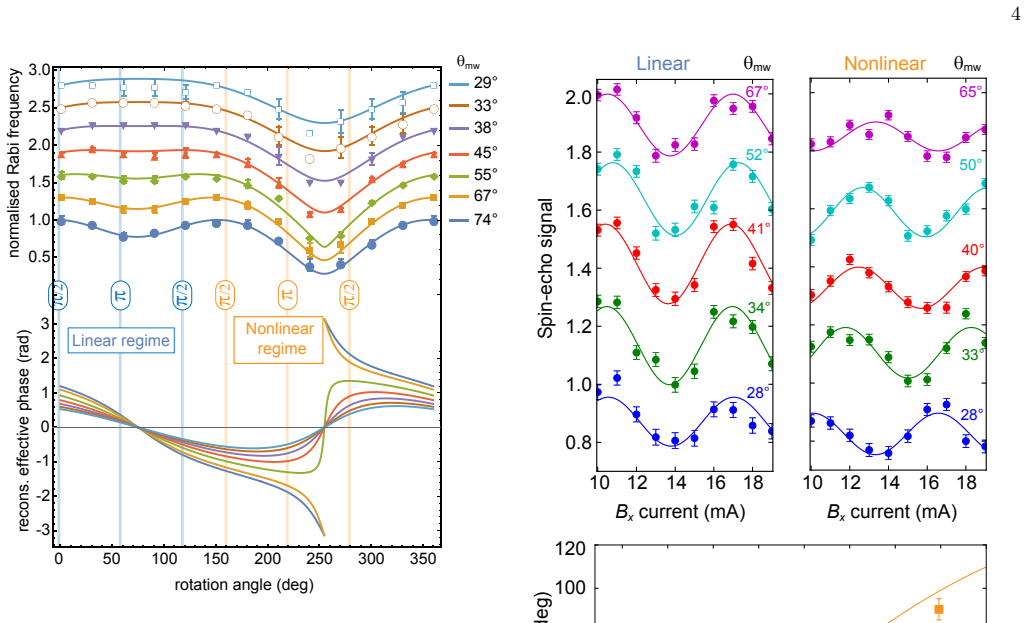
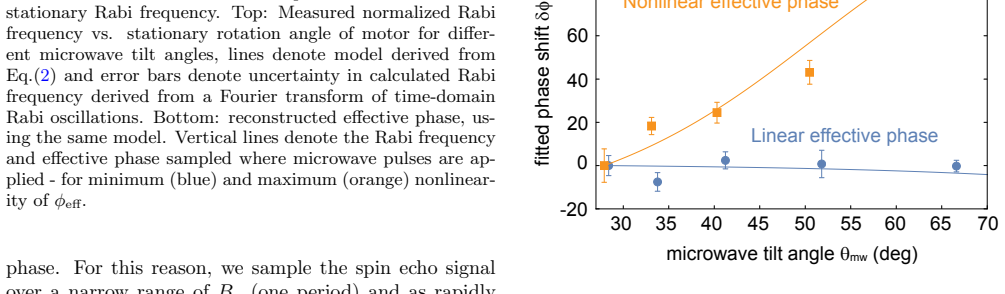
The central claim is that physical rotation of the host diamond changes the phase of the NV electron spin directly, through the phase of the microwave drive in the rotating NV frame, and that this phase can be separated from magnetic shifts because it accumulates nonlinearly. After transforming into the NV frame and applying the rotating-wave approximation, the off-diagonal coupling has the form $H_I^{(i,j)} = \Omega_0 e^{-i\varphi_0}(\cos\theta_{\mathrm{NV}}\cos\varphi\sin\theta_{\mathrm{mw}} - \cos\theta_{\mathrm{mw}}\sin\theta_{\mathrm{NV}} + i\sin\theta_{\mathrm{mw}}\sin\varphi)/2$, so the microwave drive direction has azimuth $\varphi_{\mathrm{eff}} = \mathrm{Arg}(H_I^{(i,j)})$. For a microwave tilt angle $\theta_{\mathrm{mw}} \neq 0$, $\varphi_{\mathrm{eff}}$ advances nonlinearly with rotation angle $\varphi = \omega_{\mathrm{rot}} t$. In a spin-echo sequence the linear part of this advance cancels, leaving the spin population proportional to $\cos 2\delta\varphi$, where $\delta\varphi = \varphi_{\mathrm{eff}}(\tau)/2 - \varphi_{\mathrm{eff}}(\tau/2)$. The measured spin-echo fringe phase shift as a function of $\theta_{\mathrm{mw}}$ matches the model built from stationary Rabi-frequency measurements, supporting the claim that the observed phase is set by physical rotation alone.
Load-bearing premise
The measurement assumes the diamond rotates rigidly about the fixed motor axis at the stated rate, with no wobble, slip, or precession, so the NV's instantaneous orientation always matches the model used to reconstruct the effective phase.
Editorial extensions
If this is right
- A single electron spin can detect physical rotation at 3.33 kHz through a phase shift, with no magnetic-field gradient and no auxiliary spin involved.
- Spin-echo interferometry cancels linear phase drift from magnetic fields and temperature, so the rotation-induced nonlinear phase can be read out in a noisy room-temperature environment.
- The strength and sign of the rotation-induced phase are set by the microwave tilt angle $\theta_{\mathrm{mw}}$, giving a control knob for the effective microwave phase during a pulse sequence.
- The same readout principle applies to any spin whose quantization axis is not fixed in the lab, including proposed spin-based rotation sensors and trapped nanoparticles containing spins.
Reading between the lines
- An implication the authors leave implicit: the nonlinearity of $\varphi_{\mathrm{eff}}$ should be generic, so any spin with a fixed crystal axis driven by a tilted oscillating field while being rotated should show an analogous nonlinearly accumulating phase; other color centers or donor-bound electron spins are natural search targets.
- A neighbouring problem this connects to is multi-axis rotation: in a levitated nanodiamond tumbling in a fluid or trap, the effective phase trajectory would be more complex than $\varphi_{\mathrm{eff}}(t)$, but the same spin-echo contrast mechanism could in principle track rotational diffusion on quantum timescales.
- A testable extension would be to vary the spin-echo duration $\tau$ at fixed rotation speed and check that the measured $\delta\varphi$ follows the predicted $\varphi_{\mathrm{eff}}(\tau)$; this would distinguish rotational phase from any residual magnetic or temperature effect that also depends on total interrogation time.
Signed reviews
Editorial analysis
A structured set of objections, weighed in public.
Referee Report
Summary. The authors report an experiment on a single nitrogen-vacancy (NV) center in a diamond spinning at 3.33 kHz, and they measure a phase shift in spin-echo fringes that depends on the tilt angle of the microwave field. They derive an effective microwave phase φ_eff from a rotating-frame transformation under the rotating-wave approximation, calibrate the model against stationary Rabi-oscillation data using one free azimuthal offset, and compare the rotating spin-echo fringe phases with a parameter-free prediction of δφ = φ_eff(τ)/2 − φ_eff(τ/2). The central claim is that the electron-spin quantum phase is set directly by physical rotation, without transduction through magnetic fields or ancillary spins, and that the nonlinear accumulation of this phase is detected via spin-echo interferometry.
Significance. If the result holds, it demonstrates a fundamental connection between classical rotation and quantum phase in a single spin, and it provides a measurement strategy for rotation sensing with spin qubits. The paper's strongest feature is the internal control: a 'linear' starting configuration in which the model predicts δφ ≈ 0 for all microwave tilt angles, and a 'nonlinear' configuration at the same tilt angles where a large phase shift appears. This comparison rules out several mundane artifacts such as a tilt-dependent microwave phase or pulse-area errors. The model is independently calibrated from stationary Rabi data, with only one free azimuthal calibration angle, so the rotating-data comparison is not a fit to the effect being claimed. The main limitations are presentation-related: the referenced Supplementary Material is not included in the arXiv version, and some key formulas are asserted without derivation.
minor comments (6)
- [Section 2, Eq. (3)] The derivation of the spin-echo signal formula δφ = φ_eff(τ)/2 − φ_eff(τ/2) is not shown, and the statement that a linearly varying φ_eff is cancelled by spin echo would benefit from a short explicit calculation. The factor of 2 and the sign are not obvious from the text, and this relation is central to the comparison between data and model.
- [Section 3] The text repeatedly references a Supplementary Material for details on magnetic-field drift and error analysis, but the arXiv v1 does not contain this material. Since the error bars in Fig. 3 are essential for the claim of agreement, the supplementary analysis should be included or a summary should be given in the main text.
- [Setup, Fig. 1] The assumption of rigid rotation about a fixed axis with no wobble or slip is not discussed. A sentence justifying this assumption using the motor mount and the stationary Rabi calibration would help the reader assess whether mechanical imperfections could mimic the observed phase shifts.
- [Section 2, Eq. (2)] The notation B_mw = φ_hat uses the same symbol φ for the azimuthal coordinate, which is confusing. A different symbol for the unit vector, e.g., e_φ, would improve clarity.
- [Fig. 2] The claim that the model 'reproduces' the stationary Rabi data would be strengthened by reporting a goodness-of-fit statistic or showing residuals. The current figure shows agreement by eye only.
- [Section 3, fitting] The fit function is written as cos^2(2π f0 − δφ) with f0 called the average fringe frequency, but f0 appears to have units of inverse magnetic-field current rather than frequency. Clarifying the notation would avoid confusion for readers who expect f0 in Hz.
Circularity Check
No significant circularity: the rotation-induced phase is a parameter-free prediction from Eq. (2), calibrated by stationary Rabi data rather than by the rotating fringe phases.
full rationale
The derivation chain is self-contained. Equation (2) is a standard rotating-frame calculation for a tilted microwave field in the rotating NV frame, and phi_eff is defined as the argument of the off-diagonal matrix element, not as an input. The only fitted parameter, the calibration between the absolute NV azimuthal orientation and the arbitrary motor park angle, is obtained from stationary Rabi-frequency measurements (Fig. 2, top) and does not encode the rotating spin-echo fringe phases shown in Fig. 3. The predicted delta_phi versus theta_mw is therefore not forced by the measured fringe phase. Moreover, the fringe-phase extraction uses a common average fringe frequency f0 that contains no theta_mw dependence, so the theta_mw trend in delta_phi is a genuine prediction rather than a renamed fit. The linear-regime configuration serves as an internal control: the model predicts delta_phi approximately zero at all theta_mw, while the nonlinear configuration shows the predicted growth, ruling out a trivial calibration artifact. Prior same-group references are cited for experimental configuration and for magnetic-field up-conversion effects, but the central phase claim does not rest on those citations; it follows from Eq. (2) and the stationary calibration. No circular step can be exhibited, so the score is 0.
Assumptions & free parameters
free parameters (2)
- Azimuthal calibration between NV axis and motor park angle =
Not stated numerically; fixed by fitting stationary Rabi data
- Average fringe frequency f0 =
Not stated numerically; fitted to cosine spin-echo fringes
assumptions (3)
- domain assumption The rotating-wave approximation is valid: only slowly varying off-diagonal terms of the interaction Hamiltonian are kept in Eq. (1), and counter-rotating terms are neglected.
- domain assumption The diamond and NV axis rotate rigidly about a fixed lab axis z, with phi = omega_rot t and no wobble or slip; the NV tilt is theta_NV = 54.7 degrees.
- ad hoc to paper The microwave field from the straight wire is purely azimuthal, B_mw = phi_hat, so the tilt angle theta_mw is set by the wire position relative to the rotation axis.
Cite this review
Pith. "Pith review of Observation of a quantum phase from classical rotation of a single spin." pith.science (2026). https://pith.science/paper/A4QY4POG
@misc{pith2026190808682,
  author       = {Pith},
  title        = {Pith review of: Observation of a quantum phase from classical rotation of a single spin},
  year         = {2026},
  howpublished = {\url{https://pith.science/paper/A4QY4POG}},
  note         = {Machine review of arXiv:1908.08682}
}
read the original abstract
The theory of angular momentum connects physical rotations and quantum spins together at a fundamental level. Physical rotation of a quantum system will therefore affect fundamental quantum operations, such as spin rotations in projective Hilbert space, but these effects are subtle and experimentally challenging to observe due to the fragility of quantum coherence. Here we report a measurement of a single-electron-spin phase shift arising directly from physical rotation, without transduction through magnetic fields or ancillary spins. This phase shift is observed by measuring the phase difference between a microwave driving field and a rotating two-level electron spin system, and can accumulate nonlinearly in time. We detect the nonlinear phase using spin-echo interferometry of a single nitrogen-vacancy qubit in a diamond rotating at 200,000rpm. Our measurements demonstrate the fundamental connections between spin, physical rotation and quantum phase, and will be applicable in schemes where the rotational degree of freedom of a quantum system is not fixed, such as spin-based rotation sensors and trapped nanoparticles containing spins.
Figures

Reference graph
Works this paper leans on
-
[1]
M. W. Doherty, N. B. Manson, P. Delaney, F. Jelezko, J. Wrachtrup, and L. C. L. Hollenberg, Physics Reports The nitrogen-vacancy colour centre in diamond, 528, 1 (2013)
work page 2013
-
[2]
Schirhagl, K
R. Schirhagl, K. Chang, M. Loretz, and C. L. Degen, Annual Review of Physical Chemistry 65, 83 (2014)
2014
-
[3]
A. A. Wood, E. Lilette, Y. Y. Fein, N. Tomek, L. P. McGuinness, L. C. L. Hollenberg, R. E. Scholten, and A. M. Martin, Science Advances 4, eaar7691 (2018)
work page 2018
-
[4]
G. Balasubramanian, P. Neumann, D. Twitchen, M. Markham, R. Kolesov, N. Mizuochi, J. Isoya, J. Achard, J. Beck, J. Tissler, V. Jacques, P. R. Hem- mer, F. Jelezko, and J. Wrachtrup, Nat Mater 8, 383 (2009)
work page 2009
-
[5]
A. A. Wood, E. Lilette, Y. Y. Fein, V. S. Perunicic, L. C. L. Hollenberg, R. E. Scholten, and A. M. Mar- tin, Nature Physics 13, nphys4221 (2017)
work page 2017
-
[6]
A. A. Wood, A. G. Aeppli, E. Lilette, Y. Y. Fein, A. Stacey, L. C. L. Hollenberg, R. E. Scholten, and A. M. Martin, Phys. Rev. B 98, 174114 (2018)
work page 2018
- [7]
- [8]
Show all 29 references
-
[9]
Maclaurin, M
D. Maclaurin, M. W. Doherty, L. C. L. Hollenberg, and A. M. Martin, Phys. Rev. Lett. 108, 240403 (2012)
2012
-
[10]
M. P. Ledbetter, K. Jensen, R. Fischer, A. Jarmola, and D. Budker, Phys. Rev. A 86, 052116 (2012)
2012
-
[11]
X. Song, L. Wang, F. Feng, L. Lou, W. Diao, and C. Duan, Journal of Applied Physics 123, 114301 (2018)
2018
-
[12]
M. V. Berry, Proceedings of the Royal Society of Lon- don A: Mathematical, Physical and Engineering Sciences 392, 45 (1984)
1984
-
[13]
Ajoy and P
A. Ajoy and P. Cappellaro, Phys. Rev. A 86, 062104 (2012)
2012
-
[14]
C. G. Yale, F. J. Heremans, B. B. Zhou, A. Auer, G. Burkard, and D. D. Awschalom, Nature Photonics 10, 184 (2016)
2016
-
[15]
Zhang, N
K. Zhang, N. M. Nusran, B. R. Slezak, and M. V. G. Dutt, New J. Phys. 18, 053029 (2016)
2016
-
[16]
K. Arai, J. Lee, C. Belthangady, D. R. Glenn, H. Zhang, and R. L. Walsworth, Nature Communications 9, 4996 (2018)
2018
-
[17]
P. J. Leek, J. M. Fink, A. Blais, R. Bianchetti, M. Gppl, J. M. Gambetta, D. I. Schuster, L. Frunzio, R. J. Schoelkopf, and A. Wallraff, Science 318, 1889 (2007)
2007
-
[18]
Suter, G
D. Suter, G. C. Chingas, R. A. Harris, and A. Pines, Molecular Physics 61, 1327 (1987)
1987
-
[19]
Jaskula, K
J.-C. Jaskula, K. Saha, A. Ajoy, D. Twitchen, M. Markham, and P. Cappellaro, Phys. Rev. Applied 11, 054010 (2019)
2019
-
[20]
L. P. McGuinness, Y. Yan, A. Stacey, D. A. Simp- son, L. T. Hall, D. Maclaurin, S. Prawer, P. Mulvaney, J. Wrachtrup, F. Caruso, R. E. Scholten, and L. C. L. Hollenberg, Nat Nano 6, 358 (2011)
2011
-
[21]
Maclaurin, L
D. Maclaurin, L. T. Hall, A. M. Martin, and L. C. L. Hollenberg, New J. Phys. 15, 013041 (2013)
2013
-
[22]
Yoshinari, Z
Y. Yoshinari, Z. Kalay, and Y. Harada, Phys. Rev. B 88, 235206 (2013)
2013
-
[23]
V. R. Horowitz, B. J. Alemn, D. J. Christle, A. N. Cle- land, and D. D. Awschalom, PNAS 109, 13493 (2012)
2012
-
[24]
T. M. Hoang, Y. Ma, J. Ahn, J. Bang, F. Robicheaux, Z.- Q. Yin, and T. Li, Phys. Rev. Lett. 117, 123604 (2016)
2016
-
[25]
Delord, L
T. Delord, L. Nicolas, L. Schwab, and G. H´ etet, New J. Phys. 19, 033031 (2017)
2017
-
[26]
Delord, P
T. Delord, P. Huillery, L. Schwab, L. Nicolas, L. Lecordier, and G. H´ etet, Phys. Rev. Lett.121, 053602 (2018)
2018
-
[27]
Delord, L
T. Delord, L. Nicolas, Y. Chassagneux, and G. H´ etet, Phys. Rev. A 96, 063810 (2017)
2017
-
[28]
B. A. Stickler, B. Papendell, S. Kuhn, B. Schrinski, J. Millen, M. Arndt, and K. Hornberger, New J. Phys. 20, 122001 (2018)
2018
-
[29]
Delord, P
T. Delord, P. Huillery, L. Nicolas, and G. H´ etet, arXiv:1905.11509 [cond-mat, physics:quant-ph] (2019), arXiv: 1905.11509
2019 arXiv
Reviewed August 14, 2026 · model on record in the stance chip above.
Discussion (0). Continue with ORCID to comment.