REVIEW 4 minor 33 references
Generation and control of frequency dependent squeezing via EPR entanglement
T0 review · 0 major / 4 minor · reviewed 2026-08-14 · deepseek-v4-flash
Pith's one-line read This paper demonstrates that frequency-dependent squeezed vacuum can be generated with EPR-entangled fields, using a detuned test cavity to rotate the idler quadrature and a coherent locking field for stable control, offering a…
desk verdict First experimental proof-of-principle of EPR-based frequency-dependent squeezing; the detuning-dependent cancellation control makes the central claim credible, with limitations honestly stated. read the letter →
The pith
A machine-rendered reading of the paper's core claim, the machinery that carries it, and where it could break.
The reading
What carries the argument
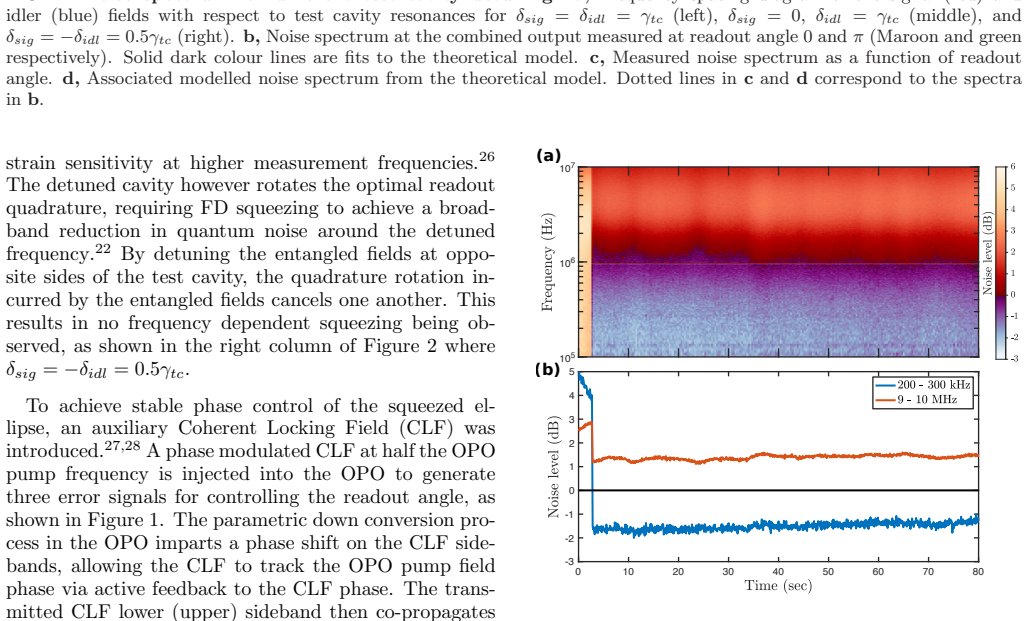
The load-bearing element is the reflection transfer matrix of the detuned test cavity. In the two-quadrature basis, this matrix has off-diagonal terms proportional to the detuning parameter $\Delta_{\gamma_{tc}}$ and to the cavity susceptibility $\chi_c$, so an input quadrature couples into the orthogonal output quadrature with a frequency-dependent strength. By making the idler field experience this rotation while the signal does not, and then electronically combining the two homodyne readouts, the experiment turns the correlated EPR sidebands into a squeezed state whose squeezing angle rotates with frequency. The control mechanism is the phase-modulated coherent locking field injected into the OPO, which generates error signals that lock both the pump phase and the two local-oscillator phases.
What would settle it
Lock both signal and idler fields onto the test cavity resonance ($\delta_{sig}=\delta_{idl}=0$) and repeat the combined measurement: the model predicts no frequency-dependent quadrature rotation, so any residual FD-shaped spectrum would indicate that electronic or other unbalanced effects, not the detuned cavity, are generating the apparent rotation. A second check is to introduce a calibrated frequency-dependent electronic phase into one homodyne readout while the cavity detuning is zero; if the apparent FD squeezing tracks this injected phase, the readout combination alone can mimic the effect.
Extended reading notes
Core claim
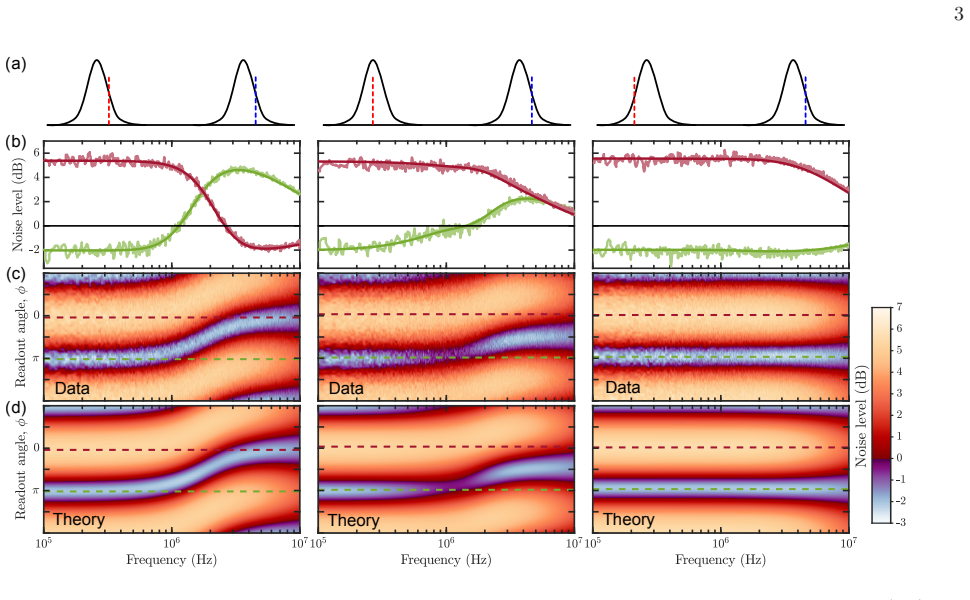
The central claim is that FD squeezing can be generated and controlled through EPR entanglement plus conditional measurement. In the experiment, an optical parametric oscillator produces signal and idler vacuum fields at frequencies separated by 851 MHz. The signal is resonant with a 0.5 m test cavity while the idler is detuned by roughly one cavity linewidth; the detuned reflection rotates the idler quadrature by an amount that depends on measurement frequency. The two reflected fields are separated by a mode cleaner, measured by independent homodyne detectors, and recombined electronically. The combined spectrum exhibits the expected quadrature rotation: when both fields are detuned equally the whole state rotates to the orthogonal quadrature near the cavity linewidth; when only the idler is detuned, the conditional readout produces a frequency-dependent squeezing angle; and when the detunings are opposite, the rotations cancel and no FD squeezing appears. The demonstration includes a coherent locking field that locks the readout angle, holding the squeezing angle stable for about 80 seconds before slow drift. The authors conclude the technique is a feasible, scalable route to FD squeezing for gravitational-wave detectors, avoiding a separate filter cavity at the price of a factor-of-two signal-to-noise reduction.
Load-bearing premise
The conclusion depends on the assumption that the detuned test cavity is the only thing making the squeezing direction change with frequency, and that the electronics that combine the two measurements do not themselves add a frequency-dependent imbalance that mimics the effect.
Editorial extensions
If this is right
- Gravitational-wave detectors could obtain broadband squeezing-angle rotation by using the signal-recycling cavity or another existing resonator as the filter element, deleting the separate filter cavity and its length stabilization.
- The coherent-locking-field control scheme should transfer to a kilometre-scale interferometer, since the locking reference tracks the OPO pump phase rather than relying on a cavity with a 50 Hz linewidth.
- Increasing the photodiode quantum efficiency above 80% and reducing mode-matching loss would directly convert the observed 2 dB into much deeper frequency-dependent squeezing, according to the paper's loss model.
- Operating with opposite-sign detunings cancels the quadrature rotation, which the paper shows can be used to avoid unwanted rotation in detuned signal-recycling interferometers.
- The factor-of-two signal-to-noise penalty relative to filter-cavity schemes is the design trade-off; the paper's demonstration makes this trade explicit for detector planning.
Reading between the lines
- The passive equal-power electronic recombination is not the optimal Wiener filter described in the proposal, so the full broadband quantum-noise reduction predicted for a detector would require a frequency-dependent weighting of the idler readout; the tabletop result validates the mechanism, not the complete gain.
- The conditional-measurement idea is general: the same signal-idler separation and recombination could synthesize user-specified quadrature-frequency responses in other precision measurements, such as optomechanical or atomic sensors, by choosing the digital filter that combines the readouts.
- Because the observed depth is dominated by known loss, a straightforward upgrade path is to use high-efficiency photodiodes and cavity impedance-matching; the model's quantitative predictions at higher pump power would be a direct test.
- The mode cleaner's role as a frequency-selective beamsplitter could be replaced by a fully digital separation if the two fields are detected together, but this is an engineering extension not pursued in the paper.
Signed reviews
Editorial analysis
A structured set of objections, weighed in public.
Referee Report
Summary. The manuscript reports an experimental demonstration of frequency-dependent (FD) squeezed vacuum generation using Einstein-Podolsky-Rosen (EPR) entangled fields produced by a non-degenerate optical parametric oscillator (OPO). The signal and idler fields are reflected from a detuned test cavity, spatially separated by a mode cleaner, detected by two balanced homodyne detectors, and electronically recombined. The measured combined noise spectra show frequency-dependent quadrature rotation consistent with the theoretical model for different cavity detunings, including a cancellation case (δsig = -δidl = 0.5γtc) where the FD feature disappears. The authors also demonstrate a coherent locking field (CLF) control scheme that stabilizes the squeezing angle. The total detection loss is estimated from the data to be 47 ± 4% and cross-checked with a power-dependent measurement to be 49 ± 2%.
Significance. If the result holds, the experiment validates a filter-cavity-free method for generating frequency-dependent squeezing, which is of direct interest for future gravitational-wave detectors. The paper's strengths include a complete quantum Langevin model in the Supplementary Material, an independent cross-check of the loss estimate, a detuning-cancellation control that argues against frequency-dependent electronic artifacts, and a scalable locking scheme. The observed squeezing depth of about 2 dB is modest, but it is sufficient to demonstrate the frequency-dependent rotation, which is the central claim.
minor comments (4)
- [Fig. 2] The measured noise spectra in Fig. 2 are shown without error bars, and the method used to calibrate the shot-noise level and to subtract electronic dark noise is not described in the main text; please add error bars and a brief calibration description so the reader can assess the significance of the 2 dB squeezing feature.
- [Main text, measurement description] The paper states that the signal and idler local oscillator powers are 'tuned to ensure that the readouts are combined equally,' but it does not describe how this equal-gain combination was verified; please add a sentence explaining the verification method (e.g., a known coherent signal or a calibration of the electronic combiner).
- [Methods, Eq. (1)] Equation (1) is presented as the noise variance 'scaled to the combined shot noise limit,' but the connection to the factor-of-two normalization used in Eqs. (15)-(16) of the Supplementary Material is not explicit; please clarify that the variance is normalized to the sum of the two individual shot-noise levels.
- [Main text, paragraph after Fig. 1] The sentence 'The two homodyne readouts are combined passively with an electronic combiner' does not specify whether the combination is a sum or a difference of the two photocurrents; please state this explicitly, as the sign convention affects the interpretation of the squeezing angle.
Circularity Check
No circularity: the FD-squeezing demonstration is an experiment compared against a standard quantum-optics model, with only the loss parameter fitted.
full rationale
The central claim is experimental: FD squeezed vacuum is generated by combining EPR-correlated signal and idler fields after reflection from a detuned test cavity. The theoretical model (Eqs. 2-23) is derived from the standard quantum Langevin and input-output formalism, not from fitting the target spectra. The frequency-dependent quadrature rotation enters through the independently measured cavity detuning in Ttc (Eq. 21), whose off-diagonal terms vanish for zero detuning and are not free parameters tuned to reproduce the data. The measured spectra in Fig. 2 are compared with this model; the only fitted quantity is the total detection loss (49 ± 2% in Methods, 47 ± 4% for the Fig. 2 fit), which sets the overall squeezing depth but cannot generate the rotational line shape. The right column of Fig. 2 provides a detuning-dependent control: equal-and-opposite detunings cancel the FD rotation, whereas a fixed electronic imbalance would persist, so the observed FD feature tracks the cavity response rather than an unlocked fit. The CLF locking derivation in Sec. IV is a standard phase-error-signal calculation and does not assume the FD effect. No load-bearing step reduces by construction to its own input, and no self-citation chain is used to force the conclusion.
Assumptions & free parameters
free parameters (1)
- total detection loss l =
0.49 +/- 0.02 (49%)
assumptions (4)
- standard math Quantum Langevin equations and input-output formalism describe the OPO (Collett-Gardiner).
- domain assumption OPO operates below threshold with no pump depletion, giving two-mode squeezed vacuum output.
- domain assumption The detuned test cavity is modeled by a single-mode cavity with quadrature rotation transfer matrix Ttc.
- domain assumption Vacuum noise inputs and a single lumped detection efficiency l account for all losses.
Cite this review
Pith. "Pith review of Generation and control of frequency dependent squeezing via EPR entanglement." pith.science (2026). https://pith.science/paper/RQ23XY7C
@misc{pith2026190808685,
  author       = {Pith},
  title        = {Pith review of: Generation and control of frequency dependent squeezing via EPR entanglement},
  year         = {2026},
  howpublished = {\url{https://pith.science/paper/RQ23XY7C}},
  note         = {Machine review of arXiv:1908.08685}
}
read the original abstract
The Standard Quantum Limit (SQL) in interferometric displacement measurement imposes a restriction on the precision of the measurement due to its quantum back-action noise. This limit can be surpassed over a broad frequency band by injecting squeezed vacuum states with a frequency dependent (FD) quadrature angle into the measurement system. Here, we demonstrate the generation of FD squeezed vacuum states by utilizing Einstein-Podolsky-Rosen (EPR) entangled states. The frequency dependence of the squeezed state can be tuned by conditionally filtering the measurement once the two entangled fields are detected. A stable control scheme for the method is demonstrated which can be implemented in future gravitational-wave detectors to improve their astronomical reach.
Figures

Reference graph
Works this paper leans on
-
[1]
author Braginsky, V. B. title Classical and quantum restrictions on the detection of weak disturbances of a macroscopic oscillator . journal Sov. J. Exp. Theor. Phys. volume 26 , pages 831 ( year 1968 )
work page 1968
-
[2]
author Kimble, H. J. , author Levin, Y. , author Matsko, A. B. , author Thorne, K. S. & author Vyatchanin, S. P. title Conversion of conventional gravitational-wave interferometers into quantum nondemolition interferometers by modifying their input and/or output optics . journal Phys. Rev. D volume 65 , pages 022002 ( year 2001 )
work page 2001
-
[3]
author The LIGO Scientific Collaboration. title Advanced LIGO . journal Classical and Quantum Gravity volume 32 , pages 074001 ( year 2015 )
work page 2015
-
[4]
title Advanced Virgo: a second-generation interferometric gravitational wave detector
author The VIRGO Collaboration. title Advanced Virgo: a second-generation interferometric gravitational wave detector . journal Classical and Quantum Gravity volume 32 , pages 024001 ( year 2015 )
work page 2015
-
[5]
author The LIGO Scientific Collaboration. & author VIRGO Collaboration title GW170817: Observation of gravitational waves from a binary neutron star inspiral . journal Phys. Rev. Lett. volume 119 , pages 161101 ( year 2017 )
work page 2017
-
[6]
title Multi-messenger observations of a binary neutron star merger
author GROND, SALT Group, OzGrav,CAASTROs, DFN, DES, INTEGRAL, Virgo, Insight-HXMT, MAXI Team, J-GEM, RATIR, ATLAS, IceCube,LWA, ePESSTO, GRAWITA, RIMAS, SKA South Africa/MeerKAT, H.E.S.S., Fermi Large Area Telescope, 1M2HTeam, IKI-GW Follow-up, Fermi GBM, Pi of Sky, DWF (Deeper Wider Faster Program), MASTER, AstroSatCadmium Zinc Telluride Imager Team, Sw...
work page 2017
-
[7]
author Caves, C. M. title Quantum-mechanical noise in an interferometer . journal Phys. Rev. D volume 23 , pages 1693--1708 ( year 1981 )
work page 1981
-
[8]
author Aspelmeyer, M. , author Kippenberg, T. J. & author Marquardt, F. title Cavity optomechanics . journal Rev. Mod. Phys. volume 86 , pages 1391--1452 ( year 2014 )
work page 2014
Show all 33 references
-
[9]
author Wade, A. R. et al. title Optomechanical design and construction of a vacuum-compatible optical parametric oscillator for generation of squeezed light . journal Review of Scientific Instruments volume 87 , pages 063104 ( year 2016 )
2016
-
[10]
, author Mehmet, M
author Vahlbruch, H. , author Mehmet, M. , author Danzmann, K. & author Schnabel, R. title Detection of 15 dB squeezed states of light and their application for the absolute calibration of photoelectric quantum efficiency . journal Phys. Rev. Lett. volume 117 , pages 110801 ( ...
2016
-
[11]
author Oelker, E. et al. title Ultra-low phase noise squeezed vacuum source for gravitational wave detectors . journal Optica volume 3 , pages 682--685 ( year 2016 )
2016
-
[12]
author Grote, H. et al. title First long-term application of squeezed states of light in a gravitational-wave observatory . journal Phys. Rev. Lett. volume 110 , pages 181101 ( year 2013 )
2013
-
[13]
title Enhanced sensitivity of the ligo gravitational wave detector by using squeezed states of light
author The LIGO Scientific Collaboration . title Enhanced sensitivity of the ligo gravitational wave detector by using squeezed states of light . journal Nature Photonics volume 7 , pages 613--619 ( year 2013 )
2013
-
[14]
author Mikhailov, E. E. , author Goda, K. , author Corbitt, T. & author Mavalvala, N. title Frequency-dependent squeeze-amplitude attenuation and squeeze-angle rotation by electromagnetically induced transparency for gravitational-wave interferometers . journal Phys. Rev. A vo...
2006
-
[15]
author Ma, Y. et al. title Narrowing the filter-cavity bandwidth in gravitational-wave detectors via optomechanical interaction . journal Phys. Rev. Lett. volume 113 , pages 151102 ( year 2014 )
2014
-
[16]
, author Miller, J
author Kwee, P. , author Miller, J. , author Isogai, T. , author Barsotti, L. & author Evans, M. title Decoherence and degradation of squeezed states in quantum filter cavities . journal Phys. Rev. D volume 90 , pages 062006 ( year 2014 )
2014
-
[17]
, author Barsotti, L
author Evans, M. , author Barsotti, L. , author Kwee, P. , author Harms, J. & author Miao, H. title Realistic filter cavities for advanced gravitational wave detectors . journal Phys. Rev. D volume 88 , pages 022002 ( year 2013 )
2013
-
[18]
author Oelker, E. et al. title Audio-band frequency-dependent squeezing for gravitational-wave detectors . journal Phys. Rev. Lett. volume 116 , pages 041102 ( year 2016 )
2016
-
[19]
author Chelkowski, S. et al. title Experimental characterization of frequency-dependent squeezed light . journal Phys. Rev. A volume 71 , pages 013806 ( year 2005 )
2005
-
[20]
author Capocasa, E. et al. title Estimation of losses in a 300 m filter cavity and quantum noise reduction in the kagra gravitational-wave detector . journal Phys. Rev. D volume 93 , pages 082004 ( year 2016 )
2016
-
[21]
author Ma, Y. et al. title Proposal for gravitational-wave detection beyond the standard quantum limit through EPR entanglement . journal Nature Physics volume 13 , pages 776--780 ( year 2017 )
2017
-
[22]
author Brown, D. D. et al. title Broadband sensitivity enhancement of detuned dual-recycled michelson interferometers with epr entanglement . journal Phys. Rev. D volume 96 , pages 062003 ( year 2017 )
2017
-
[23]
, author Samblowski, A
author Hage, B. , author Samblowski, A. & author Schnabel, R. title Towards einstein-podolsky-rosen quantum channel multiplexing . journal Phys. Rev. A volume 81 , pages 062301 ( year 2010 )
2010
-
[24]
title Einstein-podolsky-rosen sideband entanglement in broadband squeezed light
author Zhang, J. title Einstein-podolsky-rosen sideband entanglement in broadband squeezed light . journal Phys. Rev. A volume 67 , pages 054302 ( year 2003 )
2003
-
[25]
, author Jin, Y
author Li, W. , author Jin, Y. , author Yu, X. & author Zhang, J. title Enhanced detection of a low-frequency signal by using broad squeezed light and a bichromatic local oscillator . journal Phys. Rev. A volume 96 , pages 023808 ( year 2017 )
2017
-
[26]
& author Chen, Y
author Buonanno, A. & author Chen, Y. title Quantum noise in second generation, signal-recycled laser interferometric gravitational-wave detectors . journal Phys. Rev. D volume 64 , pages 042006 ( year 2001 )
2001
-
[27]
author Vahlbruch, H. et al. title Coherent control of vacuum squeezing in the gravitational-wave detection band . journal Phys. Rev. Lett. volume 97 , pages 011101 ( year 2006 )
2006
-
[28]
author Chua, S. S. Y. et al. title Backscatter tolerant squeezed light source for advanced gravitational-wave detectors . journal Opt. Lett. volume 36 , pages 4680--4682 ( year 2011 )
2011
-
[29]
, author Yukawa, M
author Takeno, Y. , author Yukawa, M. , author Yonezawa, H. & author Furusawa, A. title Observation of -9 dB quadrature squeezing with improvement of phase stability in homodyne measurement . journal Opt. Express volume 15 , pages 4321--4327 ( year 2007 )
2007
-
[30]
B. Hage, A. Samblowski, and R. Schnabel, ``Towards einstein-podolsky-rosen quantum channel multiplexing,'' Phys. Rev. A , vol. 81, p. 062301, Jun 2010
2010
-
[31]
R. W. P. Drever, J. L. Hall, F. V. Kowalski, J. Hough, G. M. Ford, A. J. Munley, and H. Ward, ``Laser phase and frequency stabilization using an optical resonator,'' Applied Physics B , vol. 31, no. 2, pp. 97--105, 1983
1983
-
[32]
M. J. Collett and C. W. Gardiner, ``Squeezing of intracavity and traveling-wave light fields produced in parametric amplification,'' Phys. Rev. A , vol. 30, pp. 1386--1391, Sep 1984
1984
-
[33]
C. W. Gardiner and M. J. Collett, ``Input and output in damped quantum systems: Quantum stochastic differential equations and the master equation,'' Phys. Rev. A , vol. 31, pp. 3761--3774, Jun 1985
1985
Reviewed August 14, 2026 · model on record in the stance chip above.
Discussion (0). Continue with ORCID to comment.