REVIEW 3 major objections 7 minor 65 references
The fulcrum wavelength of young stellar objects -- the case of LRLL 31
T0 review · 3 major / 7 minor · reviewed 2026-08-14 · deepseek-v4-flash
Pith's one-line read This paper argues that see-saw mid-infrared variability in young stars comes from a variable-height inner rim, and that a single fulcrum wavelength appears only for highly inclined discs, with the pivot set mainly by the flaring exponent β.
desk verdict A clean mid-IR see-saw pivot in a YSO requires a near-edge-on sightline and the pivot wavelength is set mainly by the disc's vertical density profile; worth a careful referee, though the pivot detection is by eye. read the letter →
The pith
A machine-rendered reading of the paper's core claim, the machinery that carries it, and where it could break.
The reading
What carries the argument
The load-bearing object is the puffed, optically thick inner rim of the accretion disc at the dust sublimation radius, modelled with a Gaussian bump on the scale height $H_{\mathrm{rim}}(R)=h(R)[1+H_{\mathrm{puff}}\exp(-((R-R_{\mathrm{rim}})/R_L)^2)]$ (Eq. 8). As $H_{\mathrm{puff}}$ varies, the rim alternately adds short-wavelength wall emission and shadows the outer disc, producing the see-saw. The second piece of machinery is the parametric density law $\rho(R,z)=\rho_0(1-\sqrt{R_\star/R})(R_\star/R)^\alpha \exp(-\tfrac{1}{2}[z/h(R)]^2)$ with scale height $h(R)=h_0(R/R_\star)^\beta$; the vertical flaring exponent $\beta$ is the control parameter that moves the fulcrum, because it sets how quickly the disc rises out of the rim's shadow. The inclination sweep completes the mechanism: only when the line of sight intersects the rim and disc (i≳74°) does the photospheric contribution drop out fast enough to leave one clean pivot rather than a family of crossings.
What would settle it
Directly measure the inclination of a see-saw variable by resolving its disc (e.g. with ALMA or scattered-light imaging) and check whether every object with a clean fulcrum sits above about 70°—a fulcrum seen in a disc known to be near face-on would refute the claim. Alternatively, measure β from resolved images of a sample of see-saw variables and test the predicted ordering: λf>10 μm should occur only for β<1.2.
Extended reading notes
Core claim
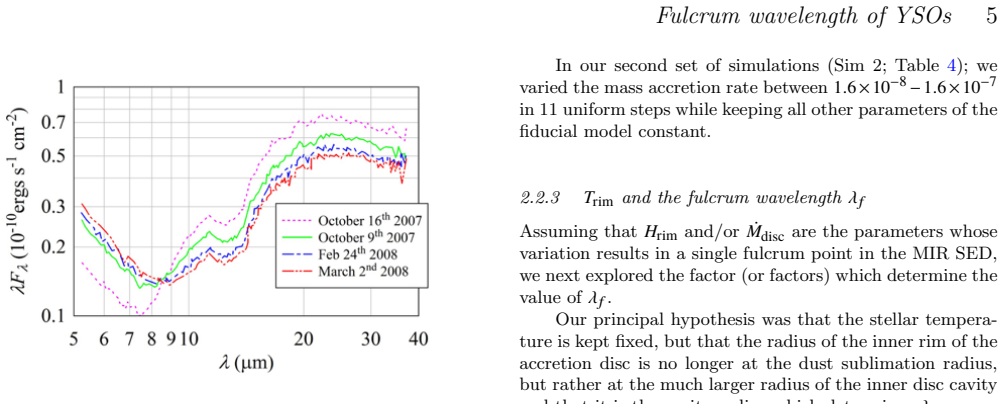
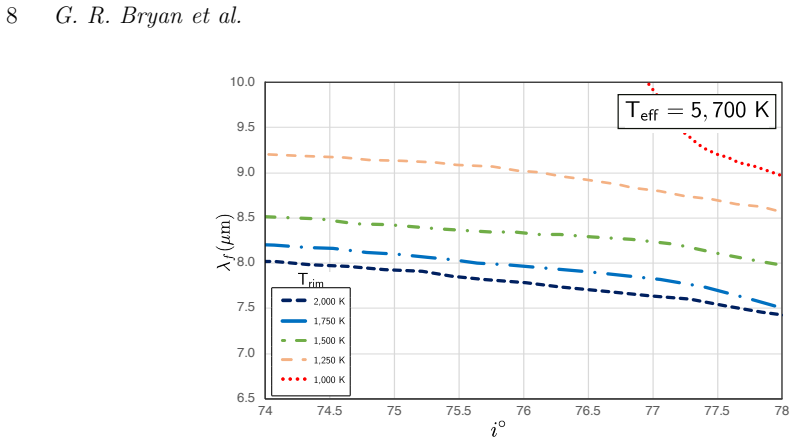
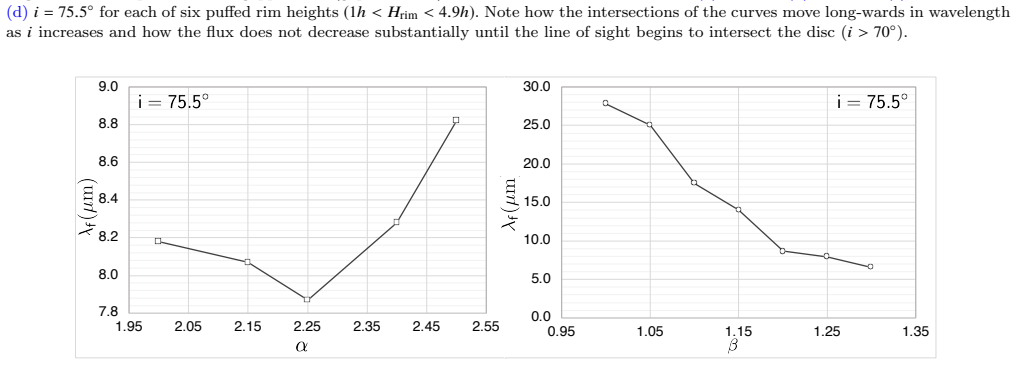
On the paper's own terms, the discovery is a two-part causal link. First, the see-saw SED variability seen in objects like LRLL 31 is the shadow play of a puffed, optically thick inner rim: as the rim height grows, it intercepts more stellar light, radiates more short-wavelength flux, and casts a longer shadow that chills the outer disc, so the long-wavelength flux drops. Second, a single fulcrum wavelength λf is not a generic property of that mechanism—it emerges only for inclinations where the line of sight grazes or cuts through the disc surface, around 74°–82° in the models, and it disappears at low inclination where the varying curves cross over a band of wavelengths instead. Parametrically varying the inner rim radius, the radial density exponent α, and the vertical density exponent β, the paper finds that λf responds most strongly to β: for β<1.2 the fulcrum sits beyond the 10 μm silicate feature, while more flared discs pivot at shorter wavelengths. The observed λf≈8.5 μm for LRLL 31 is reproduced with a gapped disc at i≈75.5° and β=1.25, and the paper concludes that accretion-rate changes alone cannot produce the see-saw.
Load-bearing premise
The model assumes the see-saw is caused by an optically thick, axisymmetric inner rim whose height changes while every other disc property stays fixed, and that LRLL 31 really is viewed at i>70°; if the variability comes from a non-axisymmetric cloud, a warp, or accretion-heating changes, or if the inclination is lower, the predicted fulcrum diagnostics need not hold.
Editorial extensions
If this is right
- A single clean fulcrum wavelength in a YSO mid-infrared SED becomes a practical marker for a nearly edge-on disc, since low-inclination models produce no unique pivot.
- The measured λf can be read as a flaring diagnostic: a pivot beyond 10 μm implies a flatter disc with β<1.2, while a pivot near 7–8 μm implies a more flared disc.
- Accretion-rate variability, although present in LRLL 31, cannot by itself generate see-saw SED changes; monitoring programs should look for rim-height changes instead.
- The presence or absence of an inner gap of order 1–15 au hardly moves the pivot (about 0.2 μm), so the fulcrum constrains the inner rim and flaring, not gap structure.
- If disc inclinations are roughly isotropic, only about 10% of similar classical T Tauri stars should display a fulcrum—those seen in the narrow 74°–82° window.
Reading between the lines
- A natural extension is to use λf as a quick-look orientation and flaring classifier for large mid-infrared variability surveys, before expensive imaging resolves the disc.
- If the axisymmetric-rim picture is right, see-saw variables whose pivots lie longward of 10 μm should, when resolved in scattered light, show systematically flatter disc profiles than those pivoting shortward of 10 μm.
- The model also predicts that non-axisymmetric occulters (clouds, warps, companions) should blur or destroy the single pivot, so the sharpness of λf could be used to discriminate occulter geometry.
- Polarimetric monitoring during a see-saw cycle would give an independent test: if the rim height is the driver, polarization should modulate as the line of sight passes through denser disc material at high inclination.
Signed reviews
Editorial analysis
A structured set of objections, weighed in public.
Referee Report
Summary. The paper uses Monte Carlo radiative transfer simulations (Hochunk3D) of the pre-transition disc of LRLL 31 to study the conditions under which the mid-infrared SED of a young stellar object exhibits a single 'fulcrum wavelength' λf, about which the flux pivots as the height of the optically thick inner rim changes. Varying the rim height, disc inclination, accretion rate, inner rim temperature/radius, radial density exponent α, vertical density exponent β, and the presence of a 1–15 au gap, the authors find that a single λf appears only for disc inclinations above roughly 70° when the line of sight grazes or intersects the disc; that λf is most sensitive to β, with flatter discs (β<1.2) placing λf beyond the 10 μm silicate feature; and that the observed λf≈8.5 μm of LRLL 31 can be approximately reproduced.
Significance. The paper addresses a previously open question—what determines the existence and position of a single see-saw pivot in YSO SEDs—and offers a falsifiable diagnostic: detection of a clean mid-infrared fulcrum indicates a nearly edge-on disc, and its wavelength constrains the vertical density profile. Strengths include the use of a parametric radiative transfer code with parameters anchored in the literature, an emergent (not fitted) λf, and a broad parameter sweep. The central claims are plausible and interesting; however, the lack of a quantitative fulcrum definition and the reliance on a single inclination for the β-sensitivity claim currently leave the main conclusions under-supported.
major comments (3)
- [§3.1, §2.2 (Figs 3–5, 10)] The identification of a 'single fulcrum wavelength' is done by eye; no quantitative criterion (e.g., a tolerance on the scatter of pairwise SED intersections, or a fitting procedure) is specified, so the threshold i≈70–74° between 'no fulcrum' and 'fulcrum' is arbitrary. Because conclusions (i) and (vi) are statements about a family of SEDs sharing one intersection point, please define λf operationally and apply the definition uniformly to all runs.
- [§3.5, Fig. 11(b)] The claim that λf is most strongly influenced by β is based on simulations at a single inclination i=75.5°, and the extreme grid point β=1.0 yields λf≈28 μm with no demonstration that a single, well-defined fulcrum actually exists there. Please show λf(β) for several inclinations, include the scatter or uncertainty in the inferred λf, and address how the noise noted for i>82° in §3.1 is handled.
- [§2 (Eqs 1, 2, 8) and §4.1] The high-inclination requirement is derived under the assumption that the variability is caused by an axisymmetric, optically thick inner rim of variable height. The paper states this assumption but does not discuss how the diagnostic would change if the occulter were non-axisymmetric (e.g., a magnetospheric warp or an azimuthally confined cloud) or if accretion-heating variations contributed. Since the conclusion 'a fulcrum only occurs for high inclinations' is the paper's headline new claim, please add a discussion of the model-dependence and, if feasible, test a non-axisymmetric perturbation to bound the applicability.
minor comments (7)
- [§2.1] The text 'We, however, adopt a lower value of M⋆ = 0.01 M⊙' should be 'Mdisc = 0.01 M⊙', since M⋆ is already given as the stellar mass 1.6 M⊙.
- [§3.3] The sentence 'as one increases the temperature of the inner rim, λf .' is incomplete; presumably λf decreases.
- [Fig. 7 caption] The caption says λf is shown 'as a function of Trim', but the plotted axis appears to be inclination; please clarify the caption and axes.
- [§4.1] The estimated fraction f = 82°−74°/82° should be written as (82°−74°)/82° to avoid ambiguity.
- [Table 4, Sim. 4] The entry '14.0 0 0 0' is difficult to parse; state explicitly that a single gap width δR=14 au was used.
- [§4.2] The sentence 'The YSO's SED can be approximately decomposed...' contains garbled text ('cˆa˘A´Zs'); fix the encoding.
- [Conclusion (ii)] The upper bound i<85° is inconsistent with the statement in §3.1 that simulations become noisy above i≈82°; qualify the upper limit accordingly.
Circularity Check
No significant circularity: the fulcrum-wavelength results are emergent outputs of radiative-transfer simulations with literature-based inputs; the only self-citation is non-load-bearing.
full rationale
The paper does not derive lambda_f from a fitted constant or define it in terms of a parameter being predicted. The parametric study varies H_puff, inclination, accretion rate, inner rim temperature, gap width, alpha, and beta, and then identifies lambda_f as the crossing point of the computed SED family; the observed lambda_f = 8.5 um is used only as a comparison value (Section 3.4), and the gap width is taken from Espaillat et al. (2012) and Pinilla et al. (2014), not fit to lambda_f. The central claims -- that a single fulcrum appears only for i > 70 deg and that lambda_f is most sensitive to beta -- are emergent outputs of the Monte Carlo radiative transfer, not restatements of the assumed geometry. The only self-citation is Liffman et al. (2019), used for R_trunc and B_star values in Table 2; R_trunc is not varied in the simulations and does not enter the lambda_f or inclination conclusions, so it is not load-bearing. The absence of a quantitative algorithm for identifying a 'single' fulcrum is a methodological caveat about the visual classification of crossing points, not a circularity: the classification is applied to simulation output rather than imposed as an input.
Assumptions & free parameters
free parameters (7)
- β (vertical density exponent) =
1.25 fiducial; varied 1.0 to 1.30
- α (radial density exponent) =
2.25 fiducial; varied 2.0 to 2.5
- H_puff (inner rim puffing scale factor) =
0.0 to 6.5 in 10 increments
- Trim / Rrim (inner rim temperature and radius) =
1,000 to 2,000 K (fiducial 1,500 K)
- Mdisc (total disc mass) =
0.01 M_sun
- δR (disc gap width) =
0 au fiducial; 14 au in gap model
- Mdot (disc accretion rate) =
1.6e-8 M_sun/yr fiducial; varied to 1.6e-7 M_sun/yr
assumptions (5)
- domain assumption The occulter is an optically thick, axisymmetric inner rim whose height varies while all other disc properties stay fixed.
- domain assumption The disc density follows the parametric form ρ(R,z) with scale height h(R) ∝ R^β (Eqs. 1 and 2).
- domain assumption The inner rim sits at the dust sublimation radius with Tsub = 1,500 K, using Eq. 5 for Rsub.
- domain assumption The central star is a blackbody at Teff = 5,700 K and the disc is passively heated.
- domain assumption LRLL 31's disc is highly inclined, i > 70°, with the line of sight intersecting the disc.
Cite this review
Pith. "Pith review of The fulcrum wavelength of young stellar objects -- the case of LRLL 31." pith.science (2026). https://pith.science/paper/53ZF5LF6
@misc{pith2026190808703,
  author       = {Pith},
  title        = {Pith review of: The fulcrum wavelength of young stellar objects -- the case of LRLL 31},
  year         = {2026},
  howpublished = {\url{https://pith.science/paper/53ZF5LF6}},
  note         = {Machine review of arXiv:1908.08703}
}
abstract
A small subset of young stellar objects (YSOs) exhibit "see-saw" temporal variations in their mid-infrared SED; as the flux short-ward of a fulcrum wavelength ($\lambda_{f}$) increases the flux long-wards of this wavelength decreases (and vice-versa) over timescales of weeks to years. While previous studies have shown that an opaque, axisymmetric occulter of variable height can cause this behaviour in the SED of these objects, the conditions under which a single $\lambda_{f}$ occurs have not previously been determined, nor the factors determining its value. Using radiative transfer modelling, we conduct a parametric study of the exemplar of this class, LRLL 31 to explore this phenomenon, and confirm that the cause of this flux variation is likely due to the change in height of the optically thick inner rim of the accretion disc at the dust sublimation radius, or some other phenomenon which results in a similar appearance. We also determine that a fulcrum wavelength only occurs for high inclinations, where the line of sight intersects the accretion disc. Accepting that the disc of LRLL 31 is highly inclined, the inner rim radius, radial and vertical density profiles are independently varied to gauge what effect this had on $\lambda_{f}$ and its position relative to the silicate feature near $10 \mu$m. While $\lambda_{f}$ is a function of each of these parameters, it is found to be most strongly dependent on the vertical density exponent $\beta$. All other factors being held constant, only for flatter discs ($\beta < 1.2$) did we find a $\lambda_{f}$ beyond the silicate feature.
Figures


Figures from the paper (7 more)




Reference graph
Works this paper leans on
-
[1]
ALMA Partnership et al., 2015, @doi [ ] 10.1088/2041-8205/808/1/L3 , https://ui.adsabs.harvard.edu/#abs/2015ApJ...808L...3A 808, L3
-
[2]
\'A brah \'a m P., et al., 2009, @doi [ ] 10.1038/nature08004 , https://ui.adsabs.harvard.edu/abs/2009Natur.459..224A 459, 224
-
[4]
Alexander R. D., Clarke C. J., Pringle J. E., 2006b, @doi [ ] 10.1111/j.1365-2966.2006.10294.x , https://ui.adsabs.harvard.edu/#abs/2006MNRAS.369..229A 369, 229
arXiv 2006
-
[5]
Andrews S. M., Wilner D. J., Hughes A. M., Qi C., Dullemond C. P., 2009, @doi [ ] 10.1088/0004-637X/700/2/1502 , https://ui.adsabs.harvard.edu/abs/2009ApJ...700.1502A 700, 1502
-
[6]
Andrews S. M., Wilner D. J., Hughes A. M., Qi C., Dullemond C. P., 2010, @doi [ ] 10.1088/0004-637X/723/2/1241 , https://ui.adsabs.harvard.edu/abs/2010ApJ...723.1241A 723, 1241
-
[7]
Ansdell M., Gaidos E., Williams J. P., Kennedy G., Wyatt M. C., LaCourse D. M., Jacobs T. L., Mann A. W., 2016a, @doi [ ] 10.1093/mnrasl/slw140 , http://adsabs.harvard.edu/abs/2016MNRAS.462L.101A 462, L101
-
[8]
Ansdell M., et al., 2016b, @doi [ ] 10.3847/0004-637X/828/1/46 , http://adsabs.harvard.edu/abs/2016ApJ...828...46A 828, 46
-
[9]
Avenhaus H., et al., 2018, @doi [ ] 10.3847/1538-4357/aab846 , https://ui.adsabs.harvard.edu/#abs/2018ApJ...863...44A 863, 44
Show all 65 references
-
[10]
Beckwith S. V. W., Sargent A. I., 1991, @doi [ ] 10.1086/170646 , https://ui.adsabs.harvard.edu/\#abs/1991ApJ...381..250B 381, 250
1991 doi
-
[11]
Beckwith S. V. W., Sargent A. I., Chini R. S., Guesten R., 1990, @doi [ ] 10.1086/115385 , https://ui.adsabs.harvard.edu/#abs/1990AJ.....99..924B 99, 924
1990 doi
-
[12]
Bouvier J., et al., 1999, , https://ui.adsabs.harvard.edu/#abs/1999A&A...349..619B 349, 619
1999
-
[13]
Bouvier J., Alencar S. H. P., Harries T. J., Johns- Krull C. M., Romanova M. M., 2007, in Reipurth B., Jewitt D., Keil K., eds, Protostars and Planets V. p. 479 ( @eprint arXiv astro-ph/0603498 )
2007 arXiv
-
[14]
I., Goldreich P., 1997, @doi [ ] 10.1086/304869 , http://adsabs.harvard.edu/abs/1997ApJ...490..368C 490, 368
Chiang E. I., Goldreich P., 1997, @doi [ ] 10.1086/304869 , http://adsabs.harvard.edu/abs/1997ApJ...490..368C 490, 368
1997 doi
-
[15]
M., et al., 2014, @doi [ ] 10.1088/0004-6256/147/4/82 , https://ui.adsabs.harvard.edu/#abs/2014AJ....147...82C 147, 82
Cody A. M., et al., 2014, @doi [ ] 10.1088/0004-6256/147/4/82 , https://ui.adsabs.harvard.edu/#abs/2014AJ....147...82C 147, 82
2014 doi
-
[16]
F., Hogerheijde M
Crapsi A., van Dishoeck E. F., Hogerheijde M. R., Pontoppidan K. M., Dullemond C. P., 2008, @doi [ ] 10.1051/0004-6361:20078589 , https://ui.adsabs.harvard.edu/#abs/2008A&A...486..245C 486, 245
2008 doi
-
[17]
D'Alessio P., Cant \"o J., Calvet N., Lizano S., 1998, @doi [ ] 10.1086/305702 , https://ui.adsabs.harvard.edu/#abs/1998ApJ...500..411D 500, 411
1998 doi
-
[18]
D'Alessio P., Calvet N., Hartmann L., Lizano S., Cant \'o J., 1999, @doi [ ] 10.1086/308103 , https://ui.adsabs.harvard.edu/\#abs/1999ApJ...527..893D 527, 893
1999 doi
-
[19]
D'Alessio P., Calvet N., Hartmann L., 2001, @doi [ ] 10.1086/320655 , https://ui.adsabs.harvard.edu/\#abs/2001ApJ...553..321D 553, 321
2001 doi
-
[20]
Dong R., 2015, @doi [ ] 10.1088/0004-637X/810/1/6 , https://ui.adsabs.harvard.edu/abs/2015ApJ...810....6D 810, 6
2015 doi
-
[21]
P., Dominik C., 2004, @doi [ ] 10.1051/0004-6361:20031768 , https://ui.adsabs.harvard.edu/#abs/2004A&A...417..159D 417, 159
Dullemond C. P., Dominik C., 2004, @doi [ ] 10.1051/0004-6361:20031768 , https://ui.adsabs.harvard.edu/#abs/2004A&A...417..159D 417, 159
2004 doi
-
[22]
Dullemond C., Monnier J., 2010, @doi [ ] 10.1146/annurev-astro-081309-130932 , 48, 205
2010 doi
-
[23]
P., Dominik C., Natta A., 2001, @doi [ ] 10.1086/323057 , https://ui.adsabs.harvard.edu/#abs/2001ApJ...560..957D 560, 957
Dullemond C. P., Dominik C., Natta A., 2001, @doi [ ] 10.1086/323057 , https://ui.adsabs.harvard.edu/#abs/2001ApJ...560..957D 560, 957
2001 doi
-
[24]
Espaillat C., et al., 2010, @doi [ ] 10.1088/0004-637X/717/1/441 , http://adsabs.harvard.edu/abs/2010ApJ...717..441E 717, 441
2010 doi
-
[25]
M., Muzerolle J., 2011, @doi [ ] 10.1088/0004-637X/728/1/49 , http://adsabs.harvard.edu/abs/2011ApJ...728...49E 728, 49
Espaillat C., Furlan E., D'Alessio P., Sargent B., Nagel E., Calvet N., Watson D. M., Muzerolle J., 2011, @doi [ ] 10.1088/0004-637X/728/1/49 , http://adsabs.harvard.edu/abs/2011ApJ...728...49E 728, 49
2011 doi
-
[26]
Espaillat C., et al., 2012, @doi [ ] 10.1088/0004-637X/747/2/103 , http://adsabs.harvard.edu/abs/2012ApJ...747..103E 747, 103
2012 doi
-
[27]
M., Muzerolle J., 2010, @doi [ ] 10.1088/0004-637X/719/2/1733 , https://ui.adsabs.harvard.edu/#abs/2010ApJ...719.1733F 719, 1733
Flaherty K. M., Muzerolle J., 2010, @doi [ ] 10.1088/0004-637X/719/2/1733 , https://ui.adsabs.harvard.edu/#abs/2010ApJ...719.1733F 719, 1733
2010 doi
-
[28]
M., Muzerolle J., Rieke G., Gutermuth R., Balog Z., Herbst W., Megeath S
Flaherty K. M., Muzerolle J., Rieke G., Gutermuth R., Balog Z., Herbst W., Megeath S. T., Kun M., 2011, @doi [ ] 10.1088/0004-637X/732/2/83 , http://adsabs.harvard.edu/abs/2011ApJ...732...83F 732, 83
2011 doi
-
[29]
M., Muzerolle J., Rieke G., Gutermuth R., Balog Z., Herbst W., Megeath S
Flaherty K. M., Muzerolle J., Rieke G., Gutermuth R., Balog Z., Herbst W., Megeath S. T., Kun M., 2012, @doi [ ] 10.1088/0004-637X/748/1/71 , https://ui.adsabs.harvard.edu/#abs/2012ApJ...748...71F 748, 71
2012 doi
-
[30]
M., DeMarchi L., Muzerolle J., Balog Z., Herbst W., Megeath S
Flaherty K. M., DeMarchi L., Muzerolle J., Balog Z., Herbst W., Megeath S. T., Furlan E., Gutermuth R., 2016, @doi [ ] 10.3847/1538-4357/833/1/104 , https://ui.adsabs.harvard.edu/#abs/2016ApJ...833..104F 833, 104
2016 doi
-
[31]
arXiv:1906.06910
Garufi A., et al., 2019, arXiv e-prints, https://ui.adsabs.harvard.edu/abs/2019arXiv190606910G p. arXiv:1906.06910
2019 arXiv
-
[32]
Hayashi C., 1981, @doi [Progress of Theoretical Physics Supplement] 10.1143/PTPS.70.35 , https://ui.adsabs.harvard.edu/\#abs/1981PThPS..70...35H 70, 35
1981 doi
-
[33]
M., Wilner D
Hughes A. M., Wilner D. J., Qi C., Hogerheijde M. R., 2008, @doi [ ] 10.1086/586730 , https://ui.adsabs.harvard.edu/abs/2008ApJ...678.1119H 678, 1119
2008 doi
-
[34]
J., Kraus A
Ireland M. J., Kraus A. L., 2008, @doi [ ] 10.1086/588216 , https://ui.adsabs.harvard.edu/#abs/2008ApJ...678L..59I 678, L59
2008 doi
-
[35]
Isella A., Natta A., 2005, @doi [ ] 10.1051/0004-6361:20052773 , https://ui.adsabs.harvard.edu/#abs/2005A&A...438..899I 438, 899
2005 doi
-
[36]
J., Hartmann L., 1987, @doi [ ] 10.1086/165866 , http://adsabs.harvard.edu/abs/1987ApJ...323..714K 323, 714
Kenyon S. J., Hartmann L., 1987, @doi [ ] 10.1086/165866 , http://adsabs.harvard.edu/abs/1987ApJ...323..714K 323, 714
1987 doi
-
[37]
J., Hartmann L., 1995, @doi [ ] 10.1086/192235 , https://ui.adsabs.harvard.edu/#abs/1995ApJS..101..117K 101, 117
Kenyon S. J., Hartmann L., 1995, @doi [ ] 10.1086/192235 , https://ui.adsabs.harvard.edu/#abs/1995ApJS..101..117K 101, 117
1995 doi
-
[38]
G., Hendry P
Kim S.-H., Martin P. G., Hendry P. D., 1994, @doi [ ] 10.1086/173714 , http://adsabs.harvard.edu/abs/1994ApJ...422..164K 422, 164
1994 doi
-
[39]
M., Ercolano B., Dale J., Teixeira P
Koepferl C. M., Ercolano B., Dale J., Teixeira P. S., Ratzka T., Spezzi L., 2013, @doi [ ] 10.1093/mnras/sts276 , https://ui.adsabs.harvard.edu/#abs/2013MNRAS.428.3327K 428, 3327
2013 doi
-
[40]
E., 2000, in Mannings V., Boss A
Konigl A., Pudritz R. E., 2000, in Mannings V., Boss A. P., Russell S. S., eds, Protostars and Planets IV. p. 759 ( @eprint arXiv astro-ph/9903168 )
2000 arXiv
-
[41]
K \"o nigl A., Salmeron R., Wardle M., 2010, @doi [ ] 10.1111/j.1365-2966.2009.15664.x , http://adsabs.harvard.edu/abs/2010MNRAS.401..479K 401, 479
2010
-
[42]
Kreplin A., Madlener D., Chen L., Weigelt G., Kraus S., Grinin V., Tambovtseva L., Kishimoto M., 2016, @doi [ ] 10.1051/0004-6361/201628281 , https://ui.adsabs.harvard.edu/\#abs/2016A&A...590A..96K 590, A96
2016 doi
-
[43]
Lagage P.-O., et al., 2006, @doi [Science] 10.1126/science.1131436 , https://ui.adsabs.harvard.edu/\#abs/2006Sci...314..621L 314, 621
2006 doi
-
[44]
Lai D., Zhang H., 2008, , 683, 949
2008
-
[45]
D., Papaloizou J
Larwood J. D., Papaloizou J. C. B., 1997, @doi [ ] 10.1093/mnras/285.2.288 , https://ui.adsabs.harvard.edu/#abs/1997MNRAS.285..288L 285, 288
1997 doi
-
[46]
Liffman K., Maddison S., Bryan G., 2019, Infrared Variability due to Magnetic Pressure Driven Jets, Dust Ejection and Quasi-Puffed-Up Inner Rims , submitted to MNRAS
2019
-
[47]
L., Stauffer J
Luhman K. L., Stauffer J. R., Muench A. A., Rieke G. H., Lada E. A., Bouvier J., Lada C. J., 2003, @doi [ ] 10.1086/376594 , https://ui.adsabs.harvard.edu/#abs/2003ApJ...593.1093L 593, 1093
2003 doi
-
[48]
E., 1974, @doi [ ] 10.1093/mnras/168.3.603 , http://adsabs.harvard.edu/abs/1974MNRAS.168..603L 168, 603
Lynden-Bell D., Pringle J. E., 1974, @doi [ ] 10.1093/mnras/168.3.603 , http://adsabs.harvard.edu/abs/1974MNRAS.168..603L 168, 603
1974 doi
-
[49]
Mac \' as E., et al., 2018, @doi [ ] 10.3847/1538-4357/aad811 , https://ui.adsabs.harvard.edu/#abs/2018ApJ...865...37M 865, 37
2018 doi
-
[50]
Morales-Calder \'o n M., et al., 2011, @doi [ ] 10.1088/0004-637X/733/1/50 , https://ui.adsabs.harvard.edu/#abs/2011ApJ...733...50M 733, 50
2011 doi
-
[51]
Muzerolle J., Hartmann L., Calvet N., 1998, @doi [ ] 10.1086/300636 , https://ui.adsabs.harvard.edu/\#abs/1998AJ....116.2965M 116, 2965
1998 doi
-
[52]
Muzerolle J., et al., 2009, @doi [ ] 10.1088/0004-637X/704/1/L15 , https://ui.adsabs.harvard.edu/abs/2009ApJ...704L..15M 704, L15
2009 doi
-
[53]
P., Mannings V., 2001, @doi [ ] 10.1051/0004-6361:20010334 , https://ui.adsabs.harvard.edu/#abs/2001A&A...371..186N 371, 186
Natta A., Prusti T., Neri R., Wooden D., Grinin V. P., Mannings V., 2001, @doi [ ] 10.1051/0004-6361:20010334 , https://ui.adsabs.harvard.edu/#abs/2001A&A...371..186N 371, 186
2001 doi
-
[54]
Pinilla P., et al., 2014, @doi [ ] 10.1051/0004-6361/201323322 , https://ui.adsabs.harvard.edu/\#abs/2014A&A...564A..51P 564, A51
2014 doi
-
[55]
E., 1981, @doi [ ] 10.1146/annurev.aa.19.090181.001033 , https://ui.adsabs.harvard.edu/abs/1981ARA&A..19..137P 19, 137
Pringle J. E., 1981, @doi [ ] 10.1146/annurev.aa.19.090181.001033 , https://ui.adsabs.harvard.edu/abs/1981ARA&A..19..137P 19, 137
1981
-
[56]
Ragland S., et al., 2012, @doi [ ] 10.1088/0004-637x/746/2/126 , 746, 126
2012 doi
-
[57]
M., et al., 2015, @doi [ ] 10.1088/0004-6256/150/6/175 , https://ui.adsabs.harvard.edu/#abs/2015AJ....150..175R 150, 175
Rebull L. M., et al., 2015, @doi [ ] 10.1088/0004-6256/150/6/175 , https://ui.adsabs.harvard.edu/#abs/2015AJ....150..175R 150, 175
2015 doi
-
[58]
J., 1977, @doi [ ] 10.1007/BF00642464 , http://adsabs.harvard.edu/abs/1977Ap
Weidenschilling S. J., 1977, @doi [ ] 10.1007/BF00642464 , http://adsabs.harvard.edu/abs/1977Ap
1977 doi
-
[59]
A., Wood K., Bjorkman J
Whitney B. A., Wood K., Bjorkman J. E., Wolff M. J., 2003a, @doi [ ] 10.1086/375415 , https://ui.adsabs.harvard.edu/abs/2003ApJ...591.1049W 591, 1049
-
[61]
A., Wood K., Bjorkman J
Whitney B. A., Wood K., Bjorkman J. E., Cohen M., 2003c, @doi [ ] 10.1086/379068 , https://ui.adsabs.harvard.edu/abs/2003ApJ...598.1079W 598, 1079
-
[62]
A., Indebetouw R., Bjorkman J
Whitney B. A., Indebetouw R., Bjorkman J. E., Wood K., 2004, @doi [ ] 10.1086/425608 , https://ui.adsabs.harvard.edu/\#abs/2004ApJ...617.1177W 617, 1177
2004 doi
-
[63]
A., Robitaille T
Whitney B. A., Robitaille T. P., Bjorkman J. E., Dong R., Wolff M. J., Wood K., Honor J., 2013, @doi [The Astrophysical Journal Supplement Series] 10.1088/0067-0049/207/2/30 , https://ui.adsabs.harvard.edu/abs/2013ApJS..207...30W 207, 30
2013 doi
-
[64]
G., et al., 2017, @doi [ ] 10.3847/1538-4357/aa9981 , https://ui.adsabs.harvard.edu/#abs/2017ApJ...851...56W 851, 56
Wolff S. G., et al., 2017, @doi [ ] 10.3847/1538-4357/aa9981 , https://ui.adsabs.harvard.edu/#abs/2017ApJ...851...56W 851, 56
2017 doi
-
[65]
J., Bjorkman J
Wood K., Wolff M. J., Bjorkman J. E., Whitney B., 2002, @doi [ ] 10.1086/324285 , http://adsabs.harvard.edu/abs/2002ApJ...564..887W 564, 887
2002 doi
-
[66]
di Folco E., Dutrey A., Chesneau O., Wolf S., Schegerer A., Leinert C., Lopez B., 2009, @doi [ ] 10.1051/0004-6361/200809902 , https://ui.adsabs.harvard.edu/\#abs/2009A&A...500.1065D 500, 1065
2009 doi
-
[67]
P., Dominik C., 2005, @doi [ ] 10.1051/0004-6361:20042252 , https://ui.adsabs.harvard.edu/abs/2005A&A...441..563V 441, 563
van Boekel R., Dullemond C. P., Dominik C., 2005, @doi [ ] 10.1051/0004-6361:20042252 , https://ui.adsabs.harvard.edu/abs/2005A&A...441..563V 441, 563
2005 doi
Reviewed August 14, 2026 · model on record in the stance chip above.
Discussion (0). Continue with ORCID to comment.