REVIEW 5 major objections 4 minor 18 references
Lessons from fitting the lowest order energy independent chiral based $\bar{K}N$ potential to experimental data
T0 review · 5 major / 4 minor · reviewed 2026-08-14 · deepseek-v4-flash
Pith's one-line read A lowest-order chiral antikaon-nucleon potential cannot simultaneously reproduce the $\Lambda(1405)$ pole and the kaonic-hydrogen $1s$ level shift at their measured values.
desk verdict A transparent fitting study of a simple WT-type KbarN potential that shows a real tension inside its own model class, but the one-pole conclusion about the physical Λ(1405) outruns the evidence—the paper itself admits the model's limits. read the letter →
The pith
A machine-rendered reading of the paper's core claim, the machinery that carries it, and where it could break.
The reading
What carries the argument
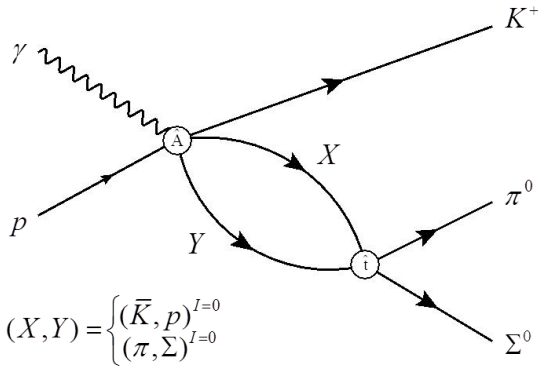
The central object is a five-channel, energy-independent, non-relativistic separable potential of the form $\langle k_i|V_{ij}|k_j\rangle = \lambda_{ij}\big(g_{iA}(k_i)g_{jB}(k_j)+g_{iB}(k_i)g_{jA}(k_j)\big)$, with form factors $g_{iA}(k_i)=\big(\beta_i^2/(\beta_i^2+k_i^2)\big)^2$, $g_{iB}(k_i)=g_{iA}(k_i)\big(m_i+k_i^2/(2\mu_i)\big)$, and couplings $\lambda_{ij}=-c_{ij}/(64\pi^3 F_iF_j)\sqrt{m_i m_j}$. The channels are $[\bar K N]_{I=0,1}$, $[\Sigma\pi]_{I=0,1}$, and $[\Lambda\pi]_{I=1}$. It is the lowest-order Weinberg-Tomozawa term of chiral SU(3) meson-baryon dynamics implemented without energy dependence, with seven adjustable parameters: two meson decay constants $F_{\bar K}$, $F_\pi$ and five range parameters $\beta_i$. The argument is carried by a $\chi^2$ fitting procedure (with a per-data-set weighting that balances discrete observables and cross sections) applied to different data combinations; the pole position of the $I=0$ quasi-bound state and the predicted $1s$ level shift are then tracked together, revealing the tension. For the photoproduction data, a two-step reaction model with an integrated non-relativistic propagator and the half-off-shell $t$-matrix of the same potential is used, with two complex constants per intermediate channel fitted to the $\pi^0\Sigma^0$ missing-mass spectra.
What would settle it
A single fit with a next-to-leading-order chiral potential (or a relativistic off-shell treatment) that reproduces both the $\Lambda(1405)$ pole near $1405-25i$ MeV and the kaonic-hydrogen level shift $\Delta E=283-271i$ eV with a $\chi^2$ comparable to the best classical fit would falsify the claim that the tension is inherent to low-order chiral descriptions; conversely, if every extension of the same data set preserves the tension, the single-pole conclusion is strengthened.
Extended reading notes
Core claim
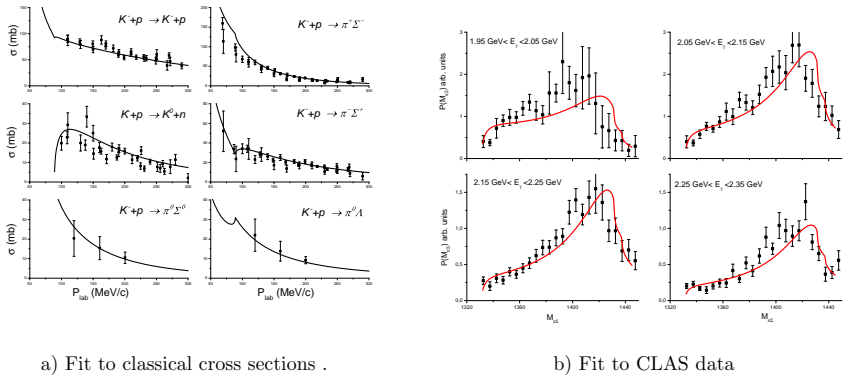
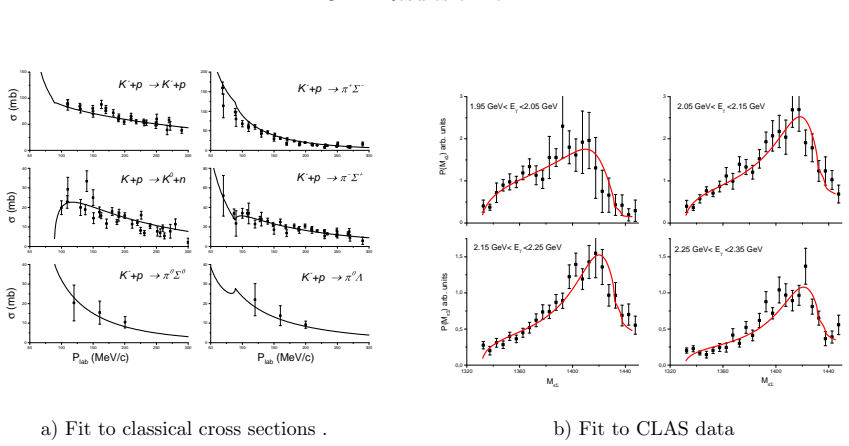
The core claim is that, within this class of potentials, the $\Lambda(1405)$ pole and the $K^-p$ $1s$ atomic level shift resist simultaneous reproduction at their experimental positions. Fitting only the classical low-energy data yields a good two-body description with the pole at $E_A=1422-20i$ MeV and a predicted level shift $\Delta E_A=392-232i$ eV, whose real part lies far outside the measured value of $283\pm36-(271\pm46)i$ eV. Adding the measured level shift to the fit brings its real part near experiment but moves the pole to $1440-27i$ MeV, above the threshold, which the photoproduction line shapes exclude. Fits that pin the pole near the widely quoted resonance value worsen $\chi^2$ by more than 100-150% relative to the best classical fit. The author therefore concludes that the physically observed $\Lambda(1405)$ should be identified with a single pole in the complex energy plane, and that the appearance of a second pole is a model-dependent artifact of certain chiral unitary realizations, even appearing in relativistic off-shell treatments at very different positions.
Load-bearing premise
The load-bearing assumption is that this specific seven-parameter potential class faithfully represents the antikaon-nucleon dynamics near threshold; if the class is too restrictive, the demonstrated tension and the single-pole conclusion are properties of the model rather than of the physical system.
Editorial extensions
If this is right
- A potential of this class fitted only to the classical low-energy two-body data cannot be trusted for the kaonic-hydrogen level shift; its prediction of Re$\Delta E \approx 392$ eV is far outside the measured $283\pm36$ eV.
- Adding the measured kaonic-hydrogen level shift to the fit moves the resonance pole above the $K^-p$ threshold, which is excluded by the photoproduction line shapes; therefore fits of this class must choose which constraint to violate.
- A compromise fit with an artificial pole constraint at about $1425-25i$ MeV reproduces both the classical data and the level shift acceptably and is recommended by the author as the practical potential for few-body kaonic-nuclear calculations.
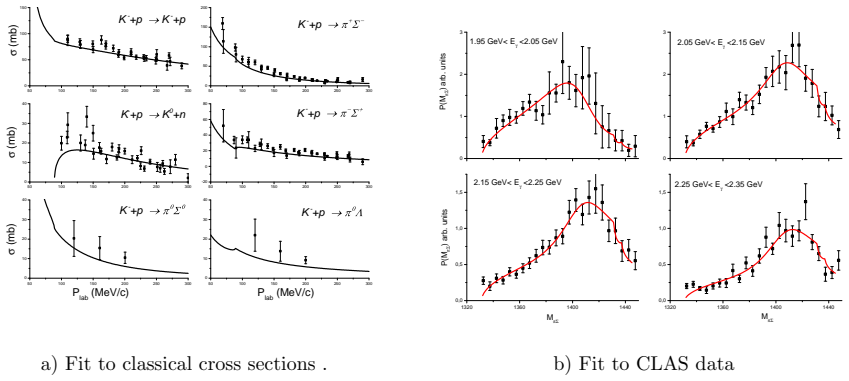
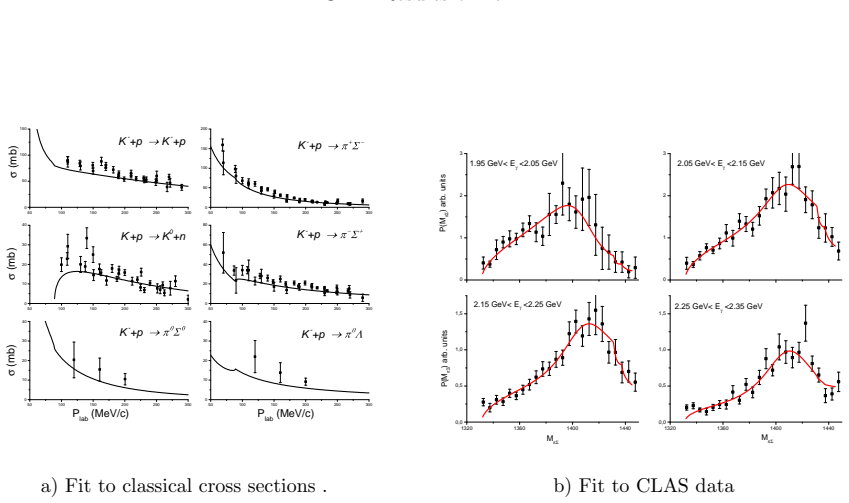
- Pinning the pole to the widely quoted value of $\Lambda(1405)$ degrades the fit to the classical data by more than 100-150%, indicating that strong antikaon-nucleon binding is not compatible with the existing two-body data.
- The photoproduction $\pi^0\Sigma^0$ line shapes can be reproduced even by potentials that fail the classical data, so line-shape fitting alone cannot discriminate between one-pole and two-pole content of the resonance.
Reading between the lines
- If this tension is generic to all lowest-order Weinberg-Tomozawa potentials, then the common practice of imposing the widely quoted $\Lambda(1405)$ parameters as two-body pole constraints in chiral models is questionable; the pole extracted from production line shapes is not necessarily the same object as the two-body amplitude pole.
- The single-pole conclusion is conditional on the model class; a next-to-leading-order or fully relativistic treatment with more parameters might fit all data simultaneously, which would mean the resistance is a truncation artifact rather than a physical property.
- The same fitting strategy, varying data subsets and watching where poles move, could be applied to other coupled-channel systems to expose data-set incompatibilities before drawing physics conclusions from a global fit.
- A direct experimental discriminator would be a precise measurement of the $\pi^0\Sigma^0$ line shape at higher photon energies combined with a model-independent extraction of the pole, since the present fits only used the lowest four photoproduction energy bins because of the non-relativistic approximation.
Signed reviews
Editorial analysis
A structured set of objections, weighed in public.
Referee Report
Summary. The paper fits a seven-parameter, energy-independent, non-relativistic, separable potential based on the lowest-order Weinberg-Tomozawa term (Eqs. (1)-(3)) to various combinations of three data sets: classical K^-p cross sections and threshold branching ratios, the SIDDHARTA kaonic-hydrogen 1s level shift, and an imposed Lambda(1405) pole position or CLAS photoproduction line shapes. Five fits (A-E) are reported. Fit A (classical data) gives a Lambda(1405) pole at 1422-20i MeV and Delta_E = 392-232i eV; adding Delta_E moves the pole to 1440-27i MeV (fit B); a compromise fit C imposes a pole at 1425 +/- 5 - (25 +/- 5)i MeV; fits D and E pin the pole near the PDG value and yield substantially worse chi^2. The paper concludes that the Lambda(1405) and the kaonic-hydrogen shift resist simultaneous reproduction within this potential class, that strong antikaon-nucleon binding is incompatible with the classical data, and that the physical Lambda(1405) corresponds to a single pole, with the second pole of relativistic chiral models being model-dependent.
Significance. If the central claim were established, the paper would provide an important caution about fitting simple antikaon-nucleon potentials and about the interpretation of the two-pole structure. The descriptive results are clearly presented: Tables I and II and the figures support the reported pole positions, Delta_E values, and chi^2 trends, and the distinction between quantities fitted and predicted in fits A-C is a useful methodological lesson. The paper also makes a fair point that line-shape fits alone cannot pin down the pole if production amplitudes are fitted freely. However, as discussed in the major comments, the step from this single, lowest-order, non-relativistic model class to a general statement about the physical Lambda(1405) is not supported by the evidence presented.
major comments (5)
- [Section III (after Table I)] The manuscript states that acceptable reproduction of Delta_E 'could be achieved only by adding next order terms to the lowest order WT one' (citing Ref. [10]). Since all fits A-E are restricted to the lowest-order Weinberg-Tomozawa class of Eqs. (1)-(3), the failure of fits B, D, and E to reproduce Delta_E while keeping the Lambda(1405) pole near the PDG value is an expected NLO deficiency of this model family, not a demonstrated property of the data. The conclusion in Section VI that the contradiction is 'probably characteristic for most of the class b) potentials' is therefore unproven; a test within a model that includes NLO terms would be needed to support it.
- [Section V] The paper concedes that the one-pole claim 'is most likely restricted to the non-relativistic case' and then immediately asserts that 'the physically observed Lambda(1405) state can be associated with a single pole in the complex energy plane.' The latter statement goes beyond the evidence presented: the fits in this paper only explore one non-relativistic potential family, and the single-pole conclusion rests on Ref. [17] rather than on the present analysis. The model-dependent and model-independent conclusions should be clearly separated.
- [Table I and Section III] No uncertainties are quoted for the fitted pole positions or Delta_E values in Table I. This is critical because the text reports that 'the fits do not produce sharp minima' and that small parameter changes lead to other slightly worse local minima. Without a chi^2-error analysis or bootstrap, the claim that fits D and E are 'more than 100-150% worse' is not statistically meaningful, and the supposed incompatibility between the Lambda(1405) pole and the SIDDHARTA shift is not quantified.
- [Eq. (4)] The chi^2 definition of Eq. (4) is not the standard total chi^2/dof; it is a weighted average of per-dataset reduced chi-squares. This choice can under- or over-weight datasets depending on n_k and can change the ranking of fits A-E. The paper should justify this definition and confirm that the qualitative conclusions survive with a standard chi^2.
- [Section IV, Eq. (10)] The CLAS comparison introduces two complex production constants fitted independently for each gamma-energy bin (three real parameters after the overall phase). With this freedom, the reaction model can absorb much of the theoretical error, so the statement that fit B is 'unambiguously ruled out' by the CLAS data is too strong. The stability of the CLAS fit conclusions under variations of the production amplitudes should be demonstrated.
minor comments (4)
- [Throughout] There are several typographical errors, including 'ideed' in Section V, 'wich' in Section V, 'scattaring' in Ref. [9], and 'Constrains' in Ref. [13]; these should be corrected.
- [Figures 1-5] The figure captions do not specify which data points and curves correspond to which quantity or which of the fits (A-E) is shown in each panel beyond the caption text; adding explicit panel labels and legends would improve readability.
- [Section IV] The paper does not report the fitted values of the complex production constants or the achieved chi^2 for the CLAS fits; providing these would allow the reader to judge the quality of the CLAS comparison more quantitatively.
- [Section II] The text says the potential contains seven adjustable parameters, but the CLAS fit of Section IV adds more; the manuscript should state clearly that the CLAS comparison is not a parameter-free validation of the potential.
Circularity Check
No significant circularity: the fits use external data, and the reported tensions are genuine predictions of the model rather than re-fitted inputs.
full rationale
The paper's load-bearing results come from fitting a seven-parameter potential to specified external data sets and then computing quantities that were excluded from each fit. In fit A, the Λ(1405) pole position and the SIDDHARTA shift are outputs, not inputs; in fit B, the pole position is the output after the shift is added; fits D and E deliberately impose the PDG pole position as an additional datum and demonstrate the resulting deterioration of χ2. None of these outputs is identical by construction to a fitted parameter. The one-pole physical conclusion is not derived from the model alone: the paper cites the independent Anisovich analysis [17] as external support and explicitly qualifies that the one-pole statement 'is most likely restricted to the non-relativistic case', acknowledging that relativistic calculations can produce two poles. Self-citations [4,5] introduce the potential under study, but the potential is explicitly defined in Eqs. (1)-(3) and its properties are re-evaluated here; no load-bearing uniqueness theorem is imported. The main caveat is model restrictiveness (lowest-order WT, energy-independent, non-relativistic), which the paper itself states when noting that acceptable reproduction of ΔE 'could be achieved only by adding next order terms'. That is a correctness risk, not a circular reduction. Therefore no circular step can be exhibited with the specific reduction required by the rules.
Assumptions & free parameters
free parameters (4)
- F_K (kaon decay constant) =
113-120 MeV across fits A-E
- F_pi (pion decay constant) =
62.8-117 MeV across fits A-E
- beta_1..beta_5 (range/cutoff parameters) =
214-1357 MeV, see Table II
- CLAS production amplitudes =
3 fitted constants per energy bin, not tabulated
assumptions (4)
- domain assumption The lowest-order Weinberg-Tomozawa term of the chiral SU(3) Lagrangian, implemented as a separable energy-independent potential (Eqs. 1-3), adequately describes low-energy KN interactions.
- domain assumption Non-relativistic kinematics is valid for KN channels near threshold and for the low-energy part of the CLAS photoproduction spectra.
- domain assumption In the two-step CLAS model, the k-dependence of the production amplitude A can be neglected, reducing it to a fitted complex constant.
- ad hoc to paper PDG resonance parameters deduced from observed line shapes can be imposed as constraints on the two-body pole position.
Cite this review
Pith. "Pith review of Lessons from fitting the lowest order energy independent chiral based $\bar{K}N$ potential to experimental data." pith.science (2026). https://pith.science/paper/AC36MTOC
@misc{pith2026190808730,
  author       = {Pith},
  title        = {Pith review of: Lessons from fitting the lowest order energy independent chiral based $\barKN$ potential to experimental data},
  year         = {2026},
  howpublished = {\url{https://pith.science/paper/AC36MTOC}},
  note         = {Machine review of arXiv:1908.08730}
}
abstract
It is shown, that fitting parameters of a $\bar{K}N$ interaction model to different sets of experimental data can lead to physical conclusions which might provide a deeper insight into the physics of this multichannel system. The available experimental data are divided into three parts: the "classical" set consisting of the low-energy $K^-p$ cross sections and the threshold branching ratios, the SIDDHARTA $1s$ level shift in kaonic hydrogen and the CLAS photoproduction data. We have fitted the parameters of the potential to different combinations of these data. We found, that the two poles corresponding to the $I=0$ nuclear quasi-bound state ($\Lam$) and to the $K^-p$ $1s$ atomic level seem to resist to their simultaneous reproduction at the right place, though a more or less satisfactory compromise can be achieved. Potentials with the $\Lam$ pole pinned down close to the PDG value fail to reproduce the classical two-body data with an acceptable accuracy. We also added comments on two papers criticizing the potential used in the fits.
Figures

Figures from the paper (3 more)
Reference graph
Works this paper leans on
-
[10]
Y. Ikeda et al. , Chiral SU(3) theory of antikaonnucleon interactions with improved threshold constraints, Nucl. Phys. A 881,98(2012)
work page 2012
-
[17]
A. V. Anisovich et al., Hyperon III: K−p – πΣ coupled-channel dynamics in the Λ(1405) mass region, Eur. Phys. J. A 56,139(2020)
work page 2020
-
[1]
Mai, Status of the Λ(1405), Few-Body Syst
M. Mai, Status of the Λ(1405), Few-Body Syst. 59,61(2018)
work page 2018
-
[2]
Y.Kamiya et al., Antikaonnucleon interaction and Λ(1405) in chiral SU(3) dynamics, Nucl. Phys. A 954,41(2016)
work page 2016
-
[3]
A. Cieply et al., On the pole content of coupled channels chiral approaches used for the ¯KN system, Nucl. Phys. A 954,17(2016)
work page 2016
-
[4]
R´ evai, Are the chiral based ¯KN potentials really energy-dependent?, Few-Body Syst
J. R´ evai, Are the chiral based ¯KN potentials really energy-dependent?, Few-Body Syst. 59,49(2018)
work page 2018
-
[5]
J. R´ evai, Energy Dependence of the¯KN interaction and the two-pole structure of the Λ(1405) – are they real?, N. A. Orr et al. (eds.), Recent Progress in Few-Body Physics,Springer Pro- ceedings in Physics 238,p. 947, Springer Nature Swityerland AG,2020
work page 2020
-
[6]
Z.-H. Guo, J. A. Oller, Meson-baryon reactions with with strangeness -1 within a chiral framework, Phys. Rev. C 87, 035202(2013)
work page 2013
Show all 18 references
-
[7]
Tovee et al., Some properties of the charged Σ hyperons, Nucl
D.N. Tovee et al., Some properties of the charged Σ hyperons, Nucl. Phys. B 33, 493 (1971) R.J. Nowak et al., Charged Σ hyperon production by K− meson interactions at rest, Nucl. Phys. B 139, 61 (1978) M. Sakitt et al., Low-energy K−-meson interactions in hydrogen, Phys. Rev. ...
1971
-
[8]
Bazzi et al
M. Bazzi et al. (SIDDHARTA Collaboration), A new measurement of kaonic hydrogen X-rays, 15 Phys. Lett. B 704,113(2011)
2011
-
[9]
Borasoy, U.-G
B. Borasoy, U.-G. Meissner, R. Nissler, K−p scattaring length from scattering experiments, Phys. Rev. C 74,055201(2006)
2006
-
[11]
Moriya et al.(CLAS Collaboration), Measurement of the πΣ photoproduction line shapes near the Λ(1405), Phys
K. Moriya et al.(CLAS Collaboration), Measurement of the πΣ photoproduction line shapes near the Λ(1405), Phys. Rev. C 87,035206(2013)
2013
-
[12]
Roca and E
L. Roca and E. Oset, Λ(1405) poles obtained form π0Σ0 photoproduction data, Phys. Rev. C 87,055201(2013)
2013
-
[13]
Mai, U.-G
M. Mai, U.-G. Meissner, Constrains on the chiral unitary ¯KN amplitude from πΣK+ photo- production data, Eur. Phys.J. A 51,30(2015)
2015
-
[14]
S. X. Nakamura and D. Jido, Lambda (1405) photoproduction based on the chiral unitary model, Progr. Theor. Exp. Phys. 2014,023D01
2014
-
[15]
Morimatsu and K
O. Morimatsu and K. Yamada, Renormalization of the unitarized Weinberg-Tomozawa in- teraction without on-shell factorization and I = 0 ¯KN−πΣ coupled channels, Phys.Rev. C 100,023201(2019)
2019
-
[16]
Bruns and A
P.C. Bruns and A. Cieply, Importance of chiral constraints for the pole content of the ¯KN scattering amplitude, Nucl. Phys. A 996,121702(2020)
2020
-
[18]
Meissner and T
U-G. Meissner and T. Hyodo, 101.Pole structure in the Λ(1405) region, M. Tanabashi et al. (Particle Data Group), Phys. Rev. D 98, 030001 (2018) and 2019 update 16
2018
Reviewed August 14, 2026 · model on record in the stance chip above.
Discussion (0). Continue with ORCID to comment.