REVIEW 3 major objections 4 minor 113 references
Water vapor detection in the transmission spectra of HD 209458 b with the CARMENES NIR channel
T0 review · 3 major / 4 minor · reviewed 2026-08-14 · deepseek-v4-flash
Pith's one-line read Water vapor is detected in the hot Jupiter HD 209458 b by extracting thousands of Doppler-shifted spectral lines, giving a signal-to-noise ratio of 6.4 and a significance of 8.1 sigma.
desk verdict First individual 1.0 micron water vapor detection in HD 209458 b is plausible but the significance is optimistically reported, mainly due to SYSREM iteration tuning on 5x injected signals and no grid-wide false-alarm correction. read the letter →
The pith
A machine-rendered reading of the paper's core claim, the machinery that carries it, and where it could break.
The reading
What carries the argument
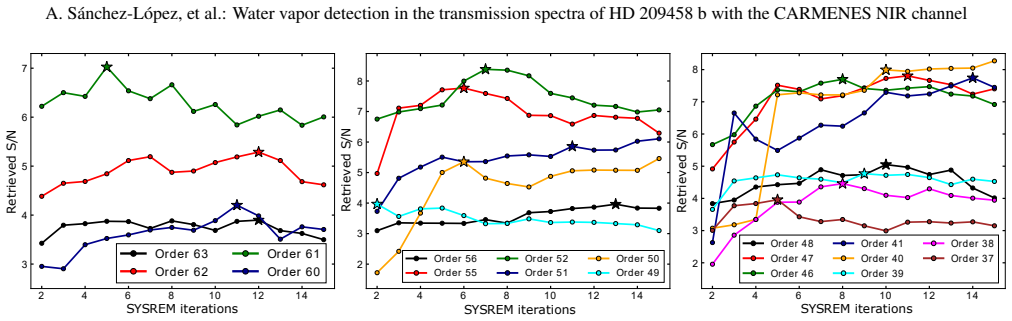
The central machinery is cross-correlating high-resolution residual spectra with a synthetic transmission model after removing telluric and stellar lines with SYSREM, a principal component analysis algorithm. During transit the planet's orbital motion Doppler-shifts its absorption lines by tens of km s$^{-1}$, while telluric and stellar features stay nearly fixed, so the static components can be subtracted and the planetary signal, spread over thousands of weak lines, is accumulated into a single cross-correlation function. The number of SYSREM iterations per spectral order is chosen by injecting a model planetary signal at five times (in some orders ten to twelve times) nominal strength and keeping the iteration count that maximizes the recovered cross-correlation peak. The transmission templates are line-by-line models computed with a radiative transfer code using a previously retrieved pressure-temperature profile and assumed molecular abundances.
What would settle it
Re-observe a transit of HD 209458 b with the same instrument under stable, dry conditions; if the detection is real, the 1.15 and 1.4 $\mu$m bands should reproduce the water signal at the same $K_\mathrm{P}$ and blueshift, and injection-recovery tests at one times the nominal planetary strength should recover the signal at the chosen SYSREM iteration without being absorbed.
Extended reading notes
Core claim
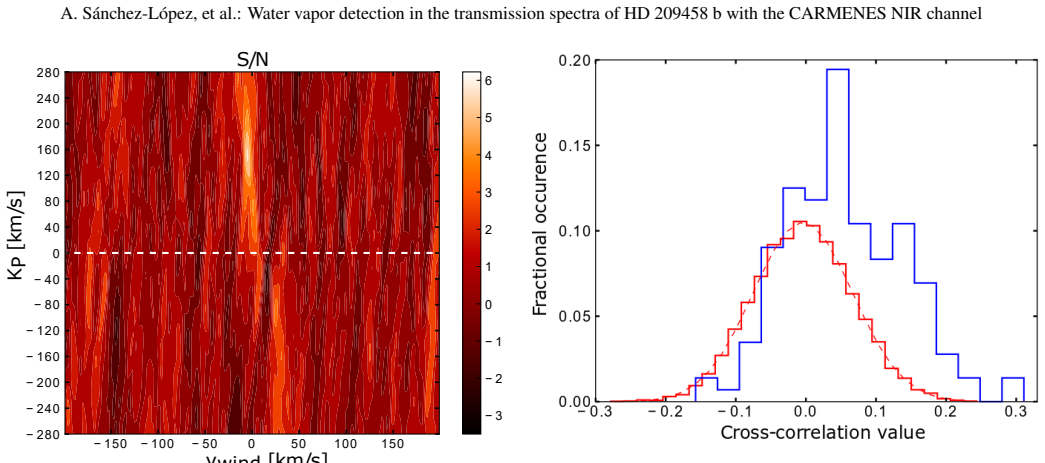
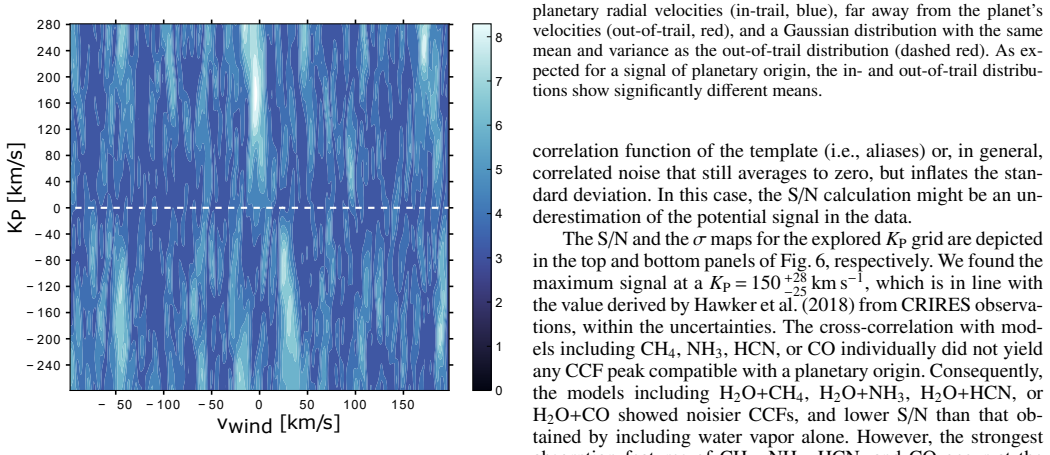
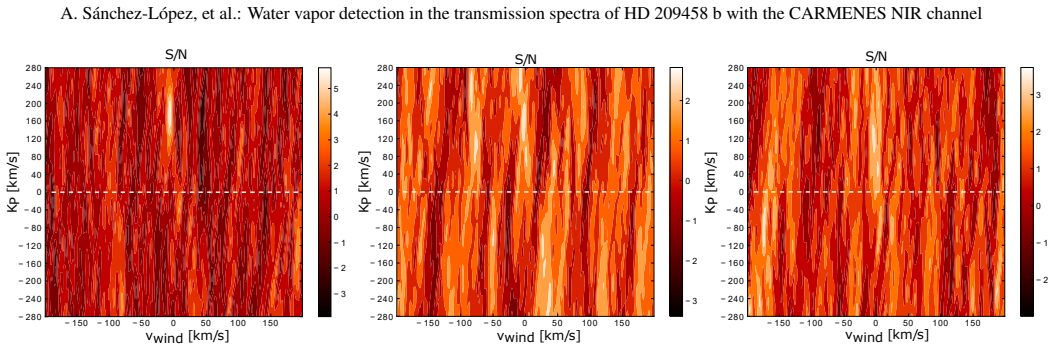
The authors detect H$_2$O in the transmission spectrum of HD 209458 b with a maximum S/N of 6.4 and a $\sigma$-value of 8.1 when all useful NIR spectral orders are combined. The cross-correlation peak appears at a planetary orbital velocity amplitude $K_\mathrm{P} = 150^{+28}_{-25}$ km s$^{-1}$, consistent with the expected value, and is blueshifted by $-5.2^{+2.6}_{-1.3}$ km s$^{-1}$, which they interpret as day-to-night winds at the terminator. In the multi-band analysis, the 1.0 $\mu$m band alone gives S/N 5.8, the 1.15 $\mu$m band gives only a hint at S/N 2.8, and the 1.4 $\mu$m band yields no conclusive signal. The authors argue that the weaker-than-expected signals from the two stronger bands reflect unfavorable observing conditions, including a sudden drop in precipitable water vapor, high airmass, and falling per-pixel S/N, rather than the absence of water. They also reanalyze CARMENES data of HD 189733 b with the same procedure and find water there mainly in the 1.15 and 1.4 $\mu$m bands, which supports the picture of stronger aerosol extinction in HD 189733 b.
Load-bearing premise
The analysis assumes that the real, much weaker planetary water signal survives the SYSREM telluric and stellar subtraction at the same iteration counts that maximize recovery of an artificially injected signal five to twelve times stronger.
Editorial extensions
If this is right
- If the detection is correct, water vapor is present in the terminator atmosphere of HD 209458 b, adding a high-resolution near-infrared confirmation to previous space-based measurements.
- The 1.0 $\mu$m band is demonstrated as a usable ground-based window for detecting water in hot Jupiters, the bluest such band detected individually to date.
- The $-5.2$ km s$^{-1}$ blueshift of the combined signal indicates day-to-night winds at the terminator, consistent with global circulation model predictions for this highly irradiated planet.
- The different band-by-band behavior of HD 209458 b and HD 189733 b supports the interpretation that HD 189733 b has stronger aerosol or haze extinction near 1 $\mu$m.
- The non-detections in the stronger 1.15 and 1.4 $\mu$m bands are attributed to the unstable observing conditions of that night, implying that stable, higher-S/N re-observations should recover water in those bands as well.
Reading between the lines
- A direct test of the detection would be a second transit observation under stable and dry conditions; the 1.15 and 1.4 $\mu$m bands should then show independent water signals at the same $K_\mathrm{P}$ and blueshift if the interpretation is right.
- The same iteration-optimization and cross-correlation pipeline could be applied to archived spectra of other hot Jupiters to see whether the 1.0 $\mu$m band routinely detects water, turning the relative strength of the 1.0 and 1.4 $\mu$m bands into a haze diagnostic.
- Because the iteration count is tuned on an injected signal several times stronger than the real one, a cross-check with injections at one times the nominal strength, or with an independent telluric-removal method, would clarify whether the reported significance depends on that assumption.
Signed reviews
Editorial analysis
A structured set of objections, weighed in public.
Referee Report
Summary. The paper analyzes CARMENES near-infrared high-resolution transit spectroscopy of HD 209458 b, searching for water vapor by removing telluric and stellar lines with SYSREM and cross-correlating the residuals with atmospheric transmission models. It reports an H2O detection with maximum S/N of 6.4 and a Welch t-test sigma of 8.1, a net blueshift of -5.2 km/s interpreted as day-to-night winds, and a multi-band analysis claiming a S/N of 5.8 detection from the 1.0 micron band individually, hints from the 1.15 micron band, and no conclusive signal from the nominally stronger 1.4 micron band. The paper also reanalyzes CARMENES data of HD 189733 b with the same pipeline to support a qualitative comparison of haze levels.
Significance. If the detection holds, this would be the first individual detection of H2O from the 1.0 micron band in an exoplanet and would extend the high-resolution cross-correlation technique to a bluer spectral region. The consistent reanalysis of the HD 189733 b dataset is a useful comparative element, and the paper is otherwise careful about data reduction, masking, and the variable precipitable water vapor conditions. However, the central claim is currently not fully established because the SYSREM iteration count is optimized on injected signals without verifying survival of the real 1x signal, and because the reported significance is the maximum of a two-dimensional search without a trial correction. These issues are fixable and do not by themselves invalidate the interpretation, but they require additional analysis before the detection claim is secure.
major comments (3)
- [Section 3.1, Fig. 4] The number of SYSREM iterations per spectral order is chosen by maximizing the recovered S/N of an injected model at 5 times the nominal planetary strength (10-12 times in orders 60, 49, and 38), but the paper does not show that the real, 1x signal survives at those same iteration counts. A 5x-stronger injection can persist at iteration counts where the real signal is already partially fitted and removed by SYSREM, and the iteration count maximizing an injected signal need not coincide with the optimum for the real signal; this is load-bearing because the claim that the CCF peak is not a telluric artifact depends on the adopted iterations. Please add injection-recovery tests at 1x nominal strength for each order, or demonstrate that the recovered CCF significance is stable over a range of iteration counts, and report the fraction of the injected signal recovered at the adopted iterations.
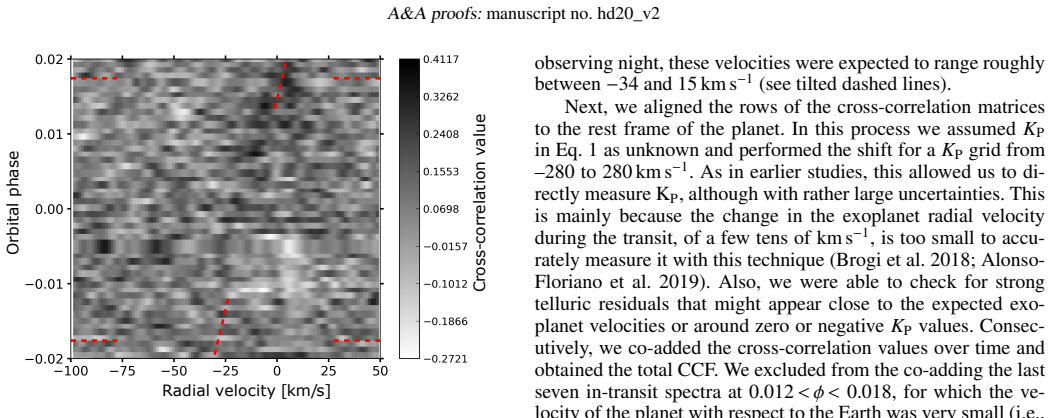
- [Section 4.3, Fig. 6] The quoted S/N of 6.4 and sigma of 8.1 are maxima of a two-dimensional map in KP and vwind, but no correction is made for the number of independent trials in that search. The paper should state the effective number of independent resolution elements in the KP-vwind grid and provide a false-alarm probability, for example from a bootstrap or permutation test that randomizes the in-trail/out-of-trail assignment or uses the negative-KP region as a null distribution. This need is reinforced by the authors' own statement that the Welch t-test may overestimate significance relative to the S/N calculation.
- [Section 5.1, Table 2] The band-by-band pattern - a S/N of 5.8 in the weakest 1.0 micron band, a hint at S/N of 2.8 in the 1.15 micron band, and no conclusive signal in the nominally strongest 1.4 micron band - is the opposite of the expectation stated in the paper and is currently explained only qualitatively by observing conditions. Because the SYSREM iteration counts are tuned on injected signals, this pattern could in part be a selection effect of the iteration tuning. Please demonstrate, via per-band injection-recovery at 1x strength at the adopted iteration counts or an equivalent sensitivity calculation, that the pipeline would have detected a real signal in the 1.15 and 1.4 micron bands at the level expected from the model, or quantify how much systematic removal suppresses those bands.
minor comments (4)
- [Equation (1), Table 1] The symbol for radial velocity is rendered as '3' in several places (e.g., '3sys', '3wind'); please use a standard v symbol and define it in the text.
- [Abstract and Section 5.2] The abstract calls the blueshift a 'firm indication' of day-to-night winds, while Section 5.2 states that the large error bars make the wind measurements fully compatible with previous values; please align the wording with the actual uncertainties.
- [Section 4.2] The CCF velocity step of 1.3 km/s is described as 'calculated by averaging the velocity step-size of the pixels' but it is not stated whether this is the mean over spectral orders or between pixel centers; please specify the exact computation, since it determines the effective number of independent trials discussed in the major comments.
- [Section 4.1] The template is computed with a single P-T profile and a single set of volume mixing ratios from Brogi et al. (2017); because the multi-band interpretation compares observed and expected band strengths, please state whether the main conclusions are robust to plausible variations in these model inputs.
Circularity Check
No significant circularity: template is external and cross-correlation detection is not forced by construction.
full rationale
The detection chain is self-contained against external inputs: the transmission template is computed with KOPRA from HITEMP 2010 line data and the Brogi et al. (2017) P-T profile and VMRs, none of which are fitted to the HD 209458 b CARMENES data presented here. The planetary signal is extracted by cross-correlating SYSREM residuals with this fixed template and assessed with S/N maps and a Welch t-test; a null dataset would not produce the reported CCF peak, and the authors report no CCF peak with CH4, NH3, HCN, or CO templates or with an alternative Molecfit telluric correction, which supports the specificity of the H2O claim. The only model-dependent tuning is the number of SYSREM iterations per order, selected by injecting the model at 5x nominal strength (10-12x in some orders) and keeping the iteration count maximizing the recovered injected CCF. This is a standard pipeline optimization and does not by construction set the amplitude or position of the real-data CCF; it does raise a correctness risk, namely that the 1x real signal might be partially removed at the chosen iteration counts, especially given the surprising band pattern (weakest 1.0 micron band showing the largest signal). That concern belongs to statistical robustness, not circularity. Self-citations to Alonso-Floriano et al. (2019) are methodological or comparative and are not load-bearing for the central detection.
Assumptions & free parameters
free parameters (1)
- SYSREM iteration count per order =
varies per order (e.g., order 63: 3, order 62: 5, order 61: 4, order 60: 8, etc., selected from peaks in Fig. 4)
assumptions (4)
- domain assumption The cross-correlation template computed with KOPRA, using Voigt line shapes and HITEMP/HITRAN line lists, is sufficiently accurate for detection.
- domain assumption The PT profile and VMRs from Brogi et al. (2017) are representative of the planet's atmosphere.
- domain assumption SYSREM removes telluric and stellar features without significantly removing the planetary signal at the chosen iteration counts.
- domain assumption The orbital parameters (KP = 140 km/s from Snellen et al. 2010, ephemeris from Knutson et al. 2007) are correct.
Cite this review
Pith. "Pith review of Water vapor detection in the transmission spectra of HD 209458 b with the CARMENES NIR channel." pith.science (2026). https://pith.science/paper/2RVMQETB
@misc{pith2026190808754,
  author       = {Pith},
  title        = {Pith review of: Water vapor detection in the transmission spectra of HD 209458 b with the CARMENES NIR channel},
  year         = {2026},
  howpublished = {\url{https://pith.science/paper/2RVMQETB}},
  note         = {Machine review of arXiv:1908.08754}
}
abstract
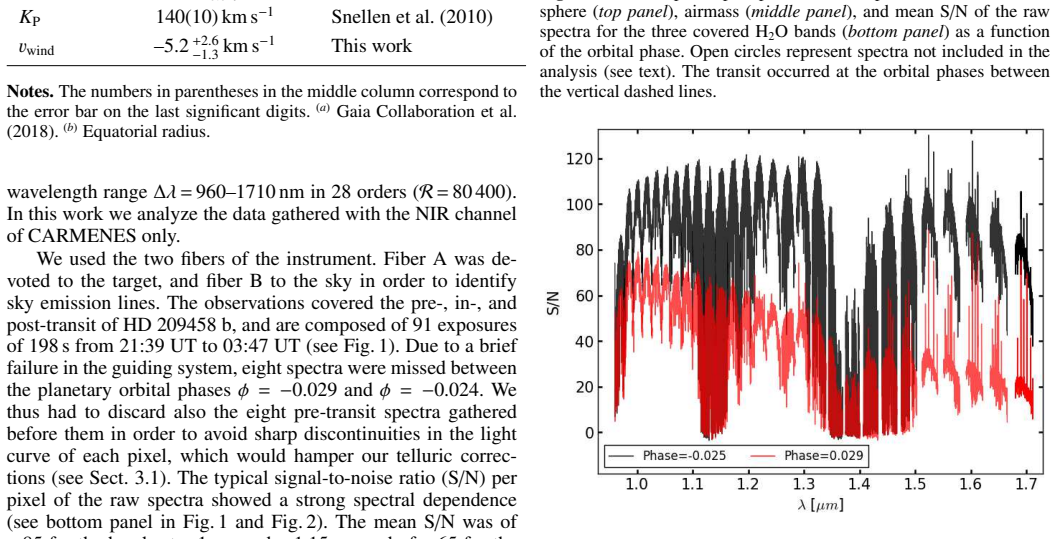
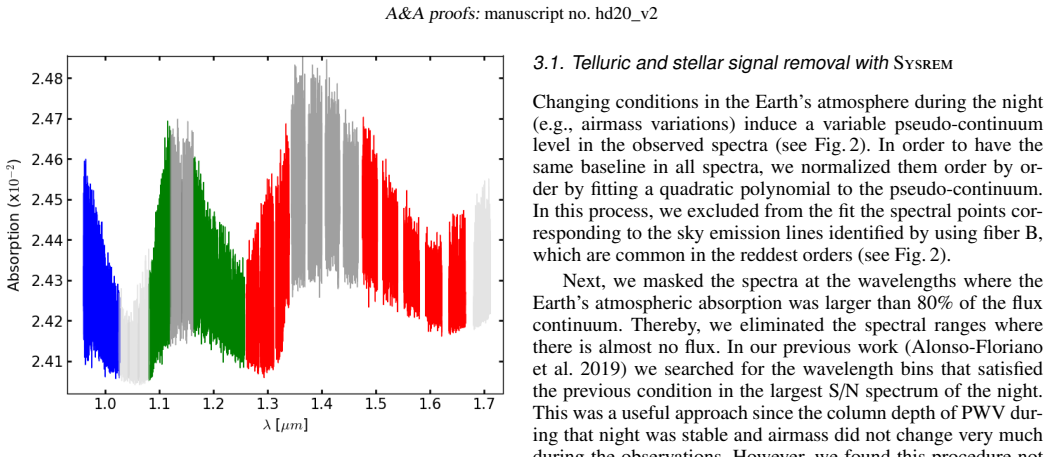
Aims: We aim at detecting H$_2$O in the atmosphere of the hot Jupiter HD 209458 b and perform a multi-band study in the near infrared with CARMENES. Methods: The H$_2$O absorption lines from the planet's atmosphere are Doppler-shifted due to the large change in its radial velocity during transit. This shift is of the order of tens of km s$^{-1}$, whilst the Earth's telluric and the stellar lines can be considered quasi-static. We took advantage of this to remove the telluric and stellar lines using SYSREM, a principal component analysis algorithm. The residual spectra contain the signal from thousands of planetary molecular lines well below the noise level. We retrieve this information by cross-correlating the spectra with models of the atmospheric absorption. Results: We find evidence of H$_2$O in HD 209458 b with a signal-to-noise ratio (S/N) of 6.4. The signal is blueshifted by --5.2 $^{+2.6}_{-1.3}$ km s$^{-1}$, which, despite the error bars, is a firm indication of day-to-night winds at the terminator of this hot Jupiter. Additionally, we performed a multi-band study for the detection of H$_2$O individually from the three NIR bands covered by CARMENES. We detect H$_2$O from its 1.0 $\mu$m band with a S/N of 5.8, and also find hints from the 1.15 $\mu$m band, with a low S/N of 2.8. No clear planetary signal is found from the 1.4 $\mu$m band. Conclusions: Our significant signal from the 1.0 $\mu$m band in HD 209458 b represents the first detection of H$_2$O from this band, the bluest one to date. The unfavorable observational conditions might be the reason for the inconclusive detection from the stronger 1.15 and 1.4 $\mu$m bands. H$_2$O is detected from the 1.0 $\mu$m band in HD 209458 b, but hardly in HD 189733 b, which supports a stronger aerosol extinction in the latter.
Figures

Figures from the paper (7 more)


Reference graph
Works this paper leans on
-
[1]
, " * write output.state after.block = add.period write newline
ENTRY address archiveprefix author booktitle chapter edition editor howpublished institution eprint journal key month note number organization pages publisher school series title type volume year label extra.label sort.label short.list INTEGERS output.state before.all mid.sentence after.sentence after.block FUNCTION init.state.consts #0 'before.all := #1 ...
-
[2]
write newline
" write newline "" before.all 'output.state := FUNCTION n.dashify 't := "" t empty not t #1 #1 substring "-" = t #1 #2 substring "--" = not "--" * t #2 global.max substring 't := t #1 #1 substring "-" = "-" * t #2 global.max substring 't := while if t #1 #1 substring * t #2 global.max substring 't := if while FUNCTION word.in bbl.in " " * FUNCTION format....
-
[3]
J., S\'anchez-L\'opez, A., Snellen, I
Alonso-Floriano, F. J., S\'anchez-L\'opez, A., Snellen, I. A. G., L\'opez-Puertas, M., et al.\ 2019, , 621, A74
2019
-
[4]
B., Knutson, H
Agol, E., Cowan, N. B., Knutson, H. A., et al.\ 2010, , 721, 1861
2010
-
[5]
S., Mayne, N
Amundsen, D. S., Mayne, N. J., Baraffe, I., Manners, J., et al.\ 2016, , 595, A36
2016
-
[6]
L., de Kok, R
Birkby, J. L., de Kok, R. J., Brogi, M., et al.\ 2013, , 436, L35
2013
-
[7]
L., de Kok, R
Birkby, J. L., de Kok, R. J., Brogi, M., Schwarz, H., & Snellen, I. A. G.\ 2017, , 153, 138
2017
-
[8]
Blecic, J., Dobbs-Dixon, I., & Greene, T.\ 2017, , 848, 127
2017
Show all 113 references
-
[9]
2002, , 390, 779
Borysow, A. 2002, , 390, 779
2002
-
[10]
& Frommhold , L
Borysow , A. & Frommhold , L. 1989, , 341, 549
1989
-
[11]
1989, , 336, 495
Borysow, A., Frommhold, L., & Moraldi, M. 1989, , 336, 495
1989
-
[12]
Bouchy, F., Udry, S., Mayor, M., et al.\ 2005, , 444, L15
2005
-
[13]
Bourrier, V., Lecavelier des Etangs, A., Dupuy, H., et al.\ 2013, , 551, A63
2013
-
[14]
Brogi, M., Snellen, I. A. G., de Kok, R. J., et al.\ 2012, , 486, 502
2012
-
[15]
Brogi, M., Snellen, I. A. G., de Kok, R. J., et al.\ 2013, , 767, 27
2013
-
[16]
J., Birkby, J
Brogi, M., de Kok, R. J., Birkby, J. L., Schwarz, H., & Snellen, I. A. G.\ 2014, , 565, A124
2014
-
[17]
J., Albrecht, S., et al.\ 2016, , 817, 106
Brogi, M., de Kok, R. J., Albrecht, S., et al.\ 2016, , 817, 106
2016
-
[18]
Brogi, M., Line, M., Bean, J., D \'e sert, J.-M., & Schwarz, H.\ 2017, , 839, L2
2017
-
[19]
Brogi, M., Giacobbe, P., Guilluy, G., et al.\ 2018, , 615, A16
2018
-
[20]
M.\ 2001, , 553, 1006
Brown, T. M.\ 2001, , 553, 1006
2001
-
[21]
A., Gu \`a rdia, J., L \'o pez del Fresno, M., et al.\ 2016, , 9910, 0E
Caballero, J. A., Gu \`a rdia, J., L \'o pez del Fresno, M., et al.\ 2016, , 9910, 0E
2016
-
[22]
Cabot, S. H. C., Madhusudhan, N., Hawker, G. A., Gandhi, S.,\ 2019, , 482, 4422
2019
-
[23]
W., Korzennik, S
Charbonneau, D., Noyes, R. W., Korzennik, S. G., et al.\ 1999, , 522, L145
1999
-
[24]
M., Latham, D
Charbonneau, D., Brown, T. M., Latham, D. W., & Mayor, M.\ 2000, , 529, 45
2000
-
[25]
M., Noyes, R
Charbonneau, D., Brown, T. M., Noyes, R. W., & Gilliland, R. L.\ 2002, , 568, 377
2002
-
[26]
E., Megeath, S
Charbonneau, D., Allen, L. E., Megeath, S. T., et al.\ 2005, , 626, 523
2005
-
[27]
A., Barman, T., et al.\ 2008, , 686, 1341
Charbonneau, D., Knutson, H. A., Barman, T., et al.\ 2008, , 686, 1341
2008
-
[28]
M., Knutson, H
Crossfield, J. M., Knutson, H. A., Fortney, J., Showman, A. P., Cowan, N. B, Deming, D.\ 2012, , 752, 81
2012
-
[29]
Collier Cameron, A., Horne, K., Penny, A., & James, D.\ 1999, , 402, 751
1999
-
[30]
M., Skrutskie, M
Cutri, R. M., Skrutskie, M. F., van Dyk, S., et al.\ 2003, yCat, 2246
2003
-
[31]
M., Charbonneau, D., Harrington, J., & Richardson, L
Deming, D., Brown, T. M., Charbonneau, D., Harrington, J., & Richardson, L. J.\ 2005, , 622, 1149
2005
-
[32]
J., & Harrington, J.\ 2005, , 434, 740
Deming, D., Seager, S., Richardson, L. J., & Harrington, J.\ 2005, , 434, 740
2005
-
[33]
J.\ 2006, , 644, 560
Deming, D., Harrington, J., Seager, S., & Richardson, L. J.\ 2006, , 644, 560
2006
-
[34]
Deming, D., Wilkins, A., McCullough, P., et al.\ 2013, , 774, 95
2013
-
[35]
J., Brogi, M., Snellen, I
de Kok, R. J., Brogi, M., Snellen, I. A. G., et al.\ 2013, , 554, A82
2013
-
[36]
J., Oliva, E., et al.\ 2014, , 9147, 914719
Follert, R., Dorn, R. J., Oliva, E., et al.\ 2014, , 9147, 914719
2014
-
[37]
Gaia Collaboration, Brown, A. G. A., Vallenari, A., et al.\ 2018, , 616, A1
2018
-
[38]
2011, Icarus, 214, 571
Garc \'i a-Comas, M., L \'o pez-Puertas, M., Funke, B., et al. 2011, Icarus, 214, 571
2011
-
[39]
E., Rothman, L
Gordon, I. E., Rothman, L. S., Hill, C., et al.\ 2017, Journal of Quantitative Spectroscopy and Radiative Transfer, 203, 3
2017
-
[40]
P., Aigrain, S., Pont, F., et al.\ 2012, , 422, 753
Gibson, N. P., Aigrain, S., Pont, F., et al.\ 2012, , 422, 753
2012
-
[41]
J., Burrows, A., Charbonneau, D., et al.\ 2008, , 456, 767
Grillmair, C. J., Burrows, A., Charbonneau, D., et al.\ 2008, , 456, 767
2008
-
[42]
A., Madhusudhan, N., Cabot, S
Hawker, G. A., Madhusudhan, N., Cabot, S. H. C., & Gandhi, S.\ 2018, , 863, L11
2018
-
[43]
Heng, K., & Kitzmann, D.\ 2017, , 470, 2972
2017
-
[44]
W., Marcy, G
Henry, G. W., Marcy, G. W., Butler, P. R., & Vogt, S. S.\ 2000, , 529, 41
2000
-
[45]
W., & Joshua, N
Henry, G. W., & Joshua, N. W.\ 2007, , 135, 1
2007
-
[46]
J., Ehrenreich, D., Heng, K., et al.\ 2018, , 560, 453
Hoeijmakers, H. J., Ehrenreich, D., Heng, K., et al.\ 2018, , 560, 453
2018
-
[47]
B., Fortney, J
Hubbard, W. B., Fortney, J. J., Lunine, J. I., et al.\ 2001, , 560, 413
2001
-
[48]
Kaeufl, H.-U., Ballester, P., Biereichel, P., et al.\ 2004, , 5492, 1218
2004
-
[49]
A., Charbonneau, D., Noyes, R
Knutson, H. A., Charbonneau, D., Noyes, R. W., Brown, T. M., & Gilliland, R. L.\ 2007, , 655, 564
2007
-
[50]
Koen, C., Kilkenny, D., van Wyk, F., Marang, F., 2010, MNRAS, 403, 1949
2010
-
[51]
Lecavelier Des Etangs, A., Pont, F., Vidal-Madjar, A., & Sing, D.\ 2008, , 481, L83
2008
-
[52]
Lecavelier Des Etangs, A., Ehrenreich, D., Vidal-Madjar, A., et al.\ 2010, , 514, A72
2010
-
[53]
J., et al.\ 2012, , 543, L4
Lecavelier des Etangs, A., Bourrier, V., Wheatley, P. J., et al.\ 2012, , 543, L4
2012
-
[54]
N., & Irwin, P
Lee, J.-M., Fletcher, L. N., & Irwin, P. G. J.\ 2012, , 420, 170
2012
-
[55]
L., Yang, H., France, K., et al.\ 2010, , 717, 1291
Linsky, J. L., Yang, H., France, K., et al.\ 2010, , 717, 1291
2010
-
[56]
R., Stevenson, K
Line, M. R., Stevenson, K. B., Bean, J., et al.\ 2016, , 152, 203
2016
-
[57]
C., Johnson, J
Lockwood, A. C., Johnson, J. A., Bender, C. F., et al.\ 2014, , 783, L29
2014
-
[58]
L \'o pez-Puertas M., Monta \ n \'e s-Rodr \' guez, P., Pall\'e, E., et al.\ 2018, , 156, 13
2018
-
[59]
J.\ 2015, , 814, L24
Louden, T., & Wheatley, P. J.\ 2015, , 814, L24
2015
-
[60]
J., & Madhusudhan, N.\ 2017, , 469, 1979
MacDonald, R. J., & Madhusudhan, N.\ 2017, , 469, 1979
2017
-
[61]
R., Deming, D., & Hedges, C.\ 2014, , 791, L9
Madhusudhan, N., Crouzet, N., McCullough, P. R., Deming, D., & Hedges, C.\ 2014, , 791, L9
2014
-
[62]
A., & Kennedy, G
Madhusudhan, N., Amin, M. A., & Kennedy, G. M.\ 2014, , 794, L12
2014
-
[63]
W., et al.\ 2000, , 532, L55--L58
Mazeh, T., Naef, D., Torres, G., Latham, D. W., et al.\ 2000, , 532, L55--L58
2000
-
[64]
Mazeh, T., Tamuz, O., & Zucker, S.\ 2007, Transiting Extrasolar Planets Workshop, 366, 119
2007
-
[65]
Mayor, M., & Queloz, D.\ 1995, , 378, 355
1995
-
[66]
Mayor, M., Pepe, F., Queloz, D., et al.\ 2003, The Messenger, 114, 20
2003
-
[67]
R., Crouzet, N., Deming, D., & Madhusudhan, N.\ 2014, , 791, 55
McCullough, P. R., Crouzet, N., Deming, D., & Madhusudhan, N.\ 2014, , 791, 55
2014
-
[68]
K., Kawahara, H., Masuda, K., et al.\ 2017, , 154, 221
Nugroho, S. K., Kawahara, H., Masuda, K., et al.\ 2017, , 154, 221
2017
-
[69]
Pino, L., Ehrenreich, D., Wyttenbach, A., et al.\ 2018, , 612, A53
2018
-
[70]
Pino, L., Ehrenreich, D., Allart, R., et al.\ 2018, , 619, A3
2018
-
[71]
R., et al.\ 2016, , 832, 131
Piskorz, D., Benneke, B., Crockett, N. R., et al.\ 2016, , 832, 131
2016
-
[72]
R., et al.\ 2017, , 154, 78
Piskorz, D., Benneke, B., Crockett, N. R., et al.\ 2017, , 154, 78
2017
-
[73]
L., Moutou, C., & Charbonneau, D.\ 2008, , 385, 109
Pont, F., Knutson, H., Gilliland, R. L., Moutou, C., & Charbonneau, D.\ 2008, , 385, 109
2008
-
[74]
K., Gibson, N
Pont, F., Sing, D. K., Gibson, N. P., et al.\ 2013, , 432, 2917
2013
-
[75]
J., Caballero, J
Quirrenbach, A., Amado, P. J., Caballero, J. A., et al.\ 2016, , 9908, 12
2016
-
[76]
J., Ribas, I., et al.\ 2018, , 10702, 0W
Quirrenbach, A., Amado, P. J., Ribas, I., et al.\ 2018, , 10702, 0W
2018
-
[77]
Rauscher, E., & Menou, K.\ 2012, , 750, 96
2012
-
[78]
Rauscher, E., & Menou, K.\ 2013, , 764, 103
2013
-
[79]
D., & Koesterke, L.\ 2008, , 673, L87
Redfield, S., Endl, M., Cochran, W. D., & Koesterke, L.\ 2008, , 673, L87
2008
-
[80]
A., et al.\ 2018, , 612, A49
Reiners, A., Zechmeister, M., Caballero, J. A., et al.\ 2018, , 612, A49
2018
-
[81]
Rodler, F., K \"u rster, M., & Henning, T.\ 2008, , 485, 859
2008
-
[82]
Rodler, F., K \"u rster, M., & Henning, T.\ 2010, , 514, A23
2010
-
[83]
Rodler, F., L \'o pez-Morales, M., & Ribas, I.\ 2012, , 753, L25
2012
-
[84]
S., Gordon, I
Rothman, L. S., Gordon, I. E., Barber, R. J., et al. 2010, Journal of Quantitative Spectroscopy and Radiative Transfer, 111, 2139
2010
-
[85]
S., Gordon, I
Rothman, L. S., Gordon, I. E., Babikov, Y., et al. 2013, Journal of Quantitative Spectroscopy and Radiative Transfer, 130, 4
2013
-
[86]
C., Nagel, E., et al.\ 2018, , 620, A97
Salz, M., Czesla, S., Schneider, P. C., Nagel, E., et al.\ 2018, , 620, A97
2018
-
[87]
Schwarz, H., Brogi, M., de Kok, R., Birkby, J., & Snellen, I.\ 2015, , 576, A111
2015
-
[88]
J., et al.\ 2016, , 593, A74
Schwarz, H., Ginski, C., de Kok, R. J., et al.\ 2016, , 593, A74
2016
-
[89]
D.\ 2000, , 537, 916
Seager, S., & Sasselov, D. D.\ 2000, , 537, 916
2000
-
[90]
A., Xu, W., et al.\ 2012, , 8446, 33
Seifert, W., S \'a nchez Carrasco, M. A., Xu, W., et al.\ 2012, , 8446, 33
2012
-
[91]
P., Fortney, J
Showman, A. P., Fortney, J. J., Lewis, N. K., & Shabram, M. 2013, , 762, 1
2013
-
[92]
K., Pont, F., Aigrain, S., et al.\ 2011, , 416, 1443
Sing, D. K., Pont, F., Aigrain, S., et al.\ 2011, , 416, 1443
2011
-
[93]
K., Fortney, J
Sing, D. K., Fortney, J. J., Nikolov, N., et al.\ 2016, , 529, 59
2016
-
[94]
F., Cutri, R
Skrutskie, M. F., Cutri, R. M., Stiening, R., et al.\ 2006, , 131, 1163
2006
-
[95]
2015, , 576, A77
Smette, A., Sana, H., Noll, S., et al. 2015, , 576, A77
2015
-
[96]
Snellen, I. A. G., Albrecht, S., de Mooij, E. J. W., & Le Poole, R. S.\ 2008, , 487, 357
2008
-
[97]
Snellen, I. A. G., de Kok, R. J., de Mooij, E. J. W., & Albrecht, S.\ 2010, , 465, 1049
2010
-
[98]
Southworth, J.\ 2008, , 386, 1644–1666
2008
-
[99]
B.\ 2016, , 817, L16
Stevenson, K. B.\ 2016, , 817, L16
2016
-
[100]
P., von Clarmann, T., Funke, B., et al
Stiller, G. P., von Clarmann, T., Funke, B., et al. 2002, Journal of Quantitative Spectroscopy and Radiative Transfer, 72, 249
2002
-
[101]
St \"u rmer, J., Stahl, O., Schwab, C., et al.\ 2014, , 9151, 52
2014
-
[102]
R., Deroo, P., Griffith, C
Swain, M. R., Deroo, P., Griffith, C. A., et al.\ 2010, , 463, 637
2010
-
[103]
Tamuz, O., Mazeh, T., & Zucker, S.\ 2005, , 356, 1466
2005
-
[104]
O., Deming, D., Burrows, A., & Grillmair, C
Todorov, K. O., Deming, D., Burrows, A., & Grillmair, C. J.\ 2014, , 796, 100
2014
-
[105]
N., & Holman, M
Torres, G., Winn, J. N., & Holman, M. J.\ 2008, , 677, 1324
2008
-
[106]
Triaud, A. H. M. J., Queloz, D., Bouchy, F., et al.\ 2009, , 506, 377
2009
-
[107]
J., Santos, N
Ulmer-Moll, S., Figueira, P., Neal, J. J., Santos, N. C., & Bonnefoy, M.\ 2019, , 621, A79
2019
-
[108]
E., et al.\ 2003, , 422, 143
Vidal-Madjar, A., Lecavelier Des Etangs, A., D\'esert, J.-M., Ballester, G. E., et al.\ 2003, , 422, 143
2003
-
[109]
Vidal-Madjar, A., D\'esert, J.-M., Lecavelier Des Etangs, A., et al.\ 2004, , 604, L69
2004
-
[110]
L.\ 1947, Biometrika, 34, 1-2, 28
Welch, B. L.\ 1947, Biometrika, 34, 1-2, 28
1947
-
[111]
Wyttenbach, A., Ehrenreich, D., Lovis, C., Udry, S., & Pepe, F.\ 2015, , 577, A62
2015
-
[112]
Yan, F., & Henning, T.\ 2018, Nature Astronomy, 2, 714
2018
-
[113]
Zechmeister, M., Anglada-Escud \'e , G., & Reiners, A.\ 2014, , 561, A59
2014
Reviewed August 14, 2026 · model on record in the stance chip above.
Discussion (0). Continue with ORCID to comment.