REVIEW 3 major objections 4 minor 31 references
Comparison of the Helmholtz, Gibbs, and Collective-modes methods to obtain nonaffine elastic constants
T0 review · 3 major / 4 minor · reviewed 2026-08-14 · deepseek-v4-flash
Pith's one-line read This paper shows that the Born–Huang, Lemaitre–Maloney, and collective-mode methods return identical nonaffine elastic constants for unstressed equilibrium crystals.
desk verdict A mostly clean methods-comparison: the reduced-fields formula is useful and the math holds at zero stress, but the abstract overstates the domain. read the letter →
The pith
A machine-rendered reading of the paper's core claim, the machinery that carries it, and where it could break.
The reading
What carries the argument
The load-bearing object is the affine force field $\Xi^\kappa_{I,\mu\nu} = -\partial^2 U/\partial R^\kappa_I \partial \eta_{\mu\nu}$, the force felt by atom $I$ when the cell is strained affinely by a unit strain. Together with the Hessian $H$, it enters the nonaffine correction through the sum over non-zero eigenmodes, $-\frac{1}{V}\sum_{i>d}(\mathbf{e}_i\cdot\boldsymbol{\Xi}_{\mu\nu})(\mathbf{e}_i\cdot\boldsymbol{\Xi}_{\xi\iota})/\lambda_i$. The paper's bridge is the reduced Hessian $\tilde{H}$, formed by deleting rows and columns corresponding to the $d$ translation zero modes, which is invertible and makes the BH minimization condition of Eq. (38) identical to the LM force-balance condition of Eq. (27). This reduced-fields form carries the equivalence: the same quadratic expression emerges from energy minimization, force balance, and the long-wave expansion of the dynamical matrix.
What would settle it
Take a single non-centrosymmetric crystal at zero stress (for example the α-quartz model used in the paper), compute elastic constants by Eq. (36) and by Eq. (39); any difference beyond numerical precision shows the identity is wrong. Then repeat the same pair of computations under increasing hydrostatic pressure: the paper predicts a growing divergence between the methods, so observing no divergence would falsify the zero-stress premise.
Extended reading notes
Core claim
On the paper's own terms, the central discovery is that the affine force field $\boldsymbol{\Xi}$ and the Hessian $H$ of the potential are the shared objects behind all three formalisms, and the nonaffine correction to elastic constants is always the same negative-definite quadratic form. In the LM language it is $C_{\mathrm{NA}} = -(1/V)\sum_{i>d} (\mathbf{e}_i\cdot\boldsymbol{\Xi}_{\mu\nu})(\mathbf{e}_i\cdot\boldsymbol{\Xi}_{\xi\iota})/\lambda_i$, a sum over all non-translational eigenmodes, while in the BH/reduced-fields language it is $C_{\mathrm{NA}} = -(1/V)\tilde{\boldsymbol{\Xi}}^T \tilde{H}^{-1}\tilde{\boldsymbol{\Xi}}$, obtained after deleting the $d$ frozen translation modes. The paper shows these expressions are mathematically identical, and that the long-wavelength acoustic branches of the dynamical matrix reproduce the same tensor through Eq. (25). Consequently, for a lattice in mechanical equilibrium with no internal stress, the linear elastic constants no longer depend on which of the three methods is used.
Load-bearing premise
The central claim collapses if the reference lattice is not stress-free: the derivation drops a term proportional to the bond tensions, relying on the equilibrium condition that those tensions cancel, and the paper itself states that Born–Huang and Lemaitre–Maloney values coincide only in the unstressed case.
Editorial extensions
If this is right
- For any unstressed equilibrium crystal, elastic constants computed from energy minimization, force balance, and phonon dispersion will agree, so the choice among the three methods is a matter of numerical convenience.
- The nonaffine correction can be computed by inverting the reduced Hessian once and contracting with affine force fields, avoiding eigen-decomposition of the full Hessian and the need to discard zero modes.
- Computational studies that sum over all $Nd$ modes, including the $d$ translation modes, overcount the nonaffine correction; the correct sum runs over the $(N-1)d$ non-zero modes.
- If the reference state is prestressed, the small-strain elastic constants from BH and LM no longer coincide; finite-strain corrections of the Birch–Wallace type must be added, so the equivalence is a zero-stress theorem.
Reading between the lines
- The same reduced-Hessian identity should carry over to disordered athermal solids, where inversion symmetry is absent everywhere and nonaffine relaxation is the norm; if so, the expensive normal-mode sum in existing glass elasticity calculations could be replaced by a single inverse of the reduced Hessian.
- A sharp experimental consequence of the zero-stress condition: under uniaxial tension, elastic constants inferred from phonon dispersion and from the static stress–strain slope should drift apart by an amount set by the Birch correction, providing a direct test of where the equivalence breaks.
- One untested extension is finite temperature: replacing $H$ by the ensemble-averaged curvature and $\boldsymbol{\Xi}$ by a fluctuation correlator may preserve a similar identity in the stress-fluctuation formalism, but whether the quadratic form survives thermal averaging is not addressed by the paper.
Signed reviews
Editorial analysis
A structured set of objections, weighed in public.
Referee Report
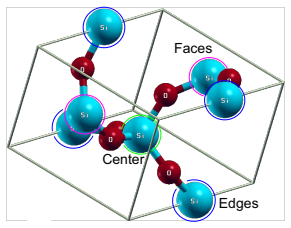
Summary. This paper reviews three approaches to computing nonaffine elastic constants of solids: the Born-Huang (BH) Helmholtz-energy method, the Lemaitre-Maloney (LM) Gibbs-force method, and an acoustic collective-modes route. The authors argue that, in the linear elastic limit and in equilibrium, all three methods must give the same elastic constants, and they support this with explicit 1D chain calculations and with a 3D numerical example for α-quartz. They also introduce a 'reduced fields' formulation, Eq. (39), in which the nonaffine correction is written using an invertible reduced Hessian, and they claim this is equivalent to the LM modal-sum expression, Eq. (36).
Significance. If the equivalence is established under the stated conditions, the paper provides a useful unifying view of apparently different nonaffine-elasticity formalisms and offers a practical reduced-Hessian algorithm that avoids handling zero modes. The 1D two-mass chain derivations are clean and check out: BH, LM, collective modes, and the reduced-field method all yield C = ak/2. The α-quartz check shows internal consistency between the LM and reduced-field routes, though it is based on the same simulation data as the companion paper Cui et al. (2019b). The central limitation is that the equivalence is derived and validated only for an unstressed reference state; the abstract currently states the claim without that qualification.
major comments (3)
- [Abstract and Conclusion] The abstract states that 'in equilibrium' the elastic constants must be the same in all these methods, but the derivation in Section 2.3, Eq. (34), and the Conclusion both restrict the statement to unstressed systems; under prestress, finite-strain (Birch/Wallace) corrections enter and the methods need not coincide. Please qualify the abstract and the Introduction by adding 'at zero internal stress' to the statement of the central claim.
- [Section 3, Eqs. (36) and (39)] The paper asserts that the LM modal-sum expression, Eq. (36), and the reduced-field expression, Eq. (39), 'will produce the same result', but it does not provide a general proof for an arbitrary 3D crystal. The 1D two-mass example verifies the identity, but the general claim requires showing that after fixing the d translational degrees of freedom, H̃^{-1} equals Σ_{i>d} e_i e_i^T / λ_i on the nonzero subspace, and that there are no additional zero modes beyond translations. Please add this derivation or explicitly state the extra assumption about the zero-mode structure.
- [Section 3.2, Table 1] The numerical agreement in Table 1 is obtained using the same simulation data and the same computational procedure as the companion paper Cui et al. (2019b). This confirms mutual consistency between the LM and reduced-field methods, but it does not independently validate the elastic constants against experiment or against an independent implementation. The text should make this distinction explicit.
minor comments (4)
- [Throughout] There are several typographical and stylistic issues: 'Lemaitre-Maloney's theories', 'Strasbourrg', 'Brich', 'or on', and inconsistent capitalization of 'Nonaffine' in the title. A careful proofreading pass is needed.
- [Section 2.3] The inserted paragraph on finite-pressure affine moduli and the Birch correction is important, but it reads as a standalone block. Consider integrating it with the qualification in the Conclusion so that the scope of the equivalence is stated in one place.
- [Section 3.1] For the collective-mode calculation the two masses are explicitly set equal, but Section 3.1 does not clearly state that this is an assumption of the example; please state it in the text and in the caption of Fig. 1(b).
- [Section 3.2, Eq. (51)] The notation n_{μ,max} = αL_μ for the reciprocal-space cutoff would benefit from a brief definition of L_μ as the cell length in direction μ.
Circularity Check
No significant circularity: the BH–LM equivalence is derived analytically; the only self-reliance is that the α-quartz numerical demonstration reuses the authors' companion simulation.
full rationale
The central equivalence is obtained by an explicit, self-contained algebraic derivation, not by fitting or by importing a uniqueness theorem. The reduced-fields expression Eq. (39), C = C_A - (1/V) Ξ̃^T H̃^{-1} Ξ̃, and the LM modal-sum expression Eq. (36), C_NA = -(1/V) Σ_{i>d} (e_i·Ξ)^2/λ_i, are different representations of the same Hessian-inverse object, so their agreement is an identity rather than an independent numerical prediction. The paper itself notes this: 'Comparing CNA in Eq. (39) with the nonaffine correction in the LM method, Eq. (36), we observe that these two objects will produce the same result, although they involve different mathematical expressions.' This is a mathematical consistency check, not circular reasoning. The load-bearing analytical derivation is parameter-free and does not rely on the authors' prior work. The numerical α-quartz values in Table I are taken from the authors' companion paper Cui et al. (2019b), and the reduced-fields check is stated to reproduce those same values; this is a self-citation that weakens external validation of the numerical application, but it is not load-bearing for the central claim. The paper also honestly flags its scope limitation in the conclusion: 'Values obtained using the BH and LM methods only coincide if the system is unstressed.' This means the abstract's unqualified 'in equilibrium' phrasing overstates the proven domain, but an overstated domain is a correctness/scope caveat, not circularity. No fitted parameter is renamed as a prediction, no prior result by the same authors is invoked as the sole justification for the equivalence, and the 1D chain examples are derived from scratch. Overall, the analytical core is self-contained and the circularity score is correspondingly low.
Assumptions & free parameters
free parameters (3)
- Short-range cutoff R_c,sh =
10 Å
- BKS potential parameters and partial charges =
from van Beest et al. (1990) and Carré et al. (2008)
- Ewald summation parameters (σ, R_cut, n_max) =
R_cut = 10 Å; n_max = α L_μ with α = 1/(√2 σ)
assumptions (4)
- domain assumption Pairwise central potential depending on the square of interparticle distance near equilibrium
- domain assumption Zero temperature, athermal, no internal tension, mechanical equilibrium
- domain assumption The Hessian has exactly d zero eigenvalues (global translations), and deleting one particle's d coordinates makes the reduced Hessian invertible
- domain assumption The BKS potential plus Ewald summation adequately models α-quartz, and the companion simulation (Cui et al. 2019b) is correct
Cite this review
Pith. "Pith review of Comparison of the Helmholtz, Gibbs, and Collective-modes methods to obtain nonaffine elastic constants." pith.science (2026). https://pith.science/paper/VPXPBCX4
@misc{pith2026190808758,
  author       = {Pith},
  title        = {Pith review of: Comparison of the Helmholtz, Gibbs, and Collective-modes methods to obtain nonaffine elastic constants},
  year         = {2026},
  howpublished = {\url{https://pith.science/paper/VPXPBCX4}},
  note         = {Machine review of arXiv:1908.08758}
}
read the original abstract
We review and compare the Born-Huang and the Lemaitre-Maloney's theories that lead to analytical expressions for elastic constants, accounting for affine and nonaffine deformations in a lattice. The Born-Huang method is based on Helmholtz energy while the Lemaitre-Maloney's formalism focus on Gibbs force. Although starting from different perspectives, in the linear elastic limit, and in equilibrium, elastic material constants must be the same in all these methods. This is explicitly verified on examples of linear chains, and numerical simulation of a non-centrosymmetric crystal.
Figures

Reference graph
Works this paper leans on
-
[1]
Allen, M. P. and Tildesley, D. J. (2017). Computer Simulation of Liquids: Second Edition . Oxford University Press, Oxford
work page 2017
-
[2]
Birch, F. (1938). The effect of pressure upon the elastic parameters of isotropic solids, according to murnaghan's theory of finite strain. Journal of Applied Physics , 9(4):279--288
work page 1938
-
[3]
Born, M. and Huang, K. (1954). Dynamical Theory of Crystal Lattices . Oxford University Press, Oxford
work page 1954
-
[4]
Carr \' e , A., Horbach, J., Ispas, S., and Kob, W. (2008). New fitting scheme to obtain effective potential from car-parrinello molecular-dynamics simulations: Application to silica. Europhys. Lett. , 82(1):17001
work page 2008
-
[5]
Cui, B., Ruocco, G., and Zaccone, A. (2019a). Theory of elastic constants of athermal amorphous solids with internal stresses. Granul. Matter , 21(3):69
work page 2019
-
[6]
Cui, B., Zaccone, A., and Rodney, D. (2019b). Nonaffine lattice dynamics with the ewald method reveals strongly nonaffine elasticity of -quartz. arXiv preprint arXiv:1908.07982
work page Pith review arXiv 2019
-
[7]
Ewald, P. P. (1921). The calculation of optical and electrostatic grid potential. Ann. Phys. (Leipzig) , 64:253
work page 1921
-
[8]
Hoover, W., Holt, A., and Squire, D. (1969). Adiabatic elastic constants for argon. theory and monte carlo calculations. Physica , 44(3):437 -- 443
work page 1969
Show all 31 references
-
[9]
S., Levine, D., Mason, T
Lacasse, M.-D., Grest, G. S., Levine, D., Mason, T. G., and Weitz, D. A. (1996). Model for the elasticity of compressed emulsions. Phys. Rev. Lett. , 76:3448--3451
1996
-
[10]
Landau, L. D. and Lifshitz, I. M. (1960). Theory of elasticity . Pergamon Press, Oxford
1960
-
[11]
Langer, S. A. and Liu, A. J. (1997). Effect of random packing on stress relaxation in foam. J. Phys. Chem. B , 101(43):8667--8671
1997
-
[12]
and Cai, W
Lee, H. and Cai, W. (2009). Ewald summation for coulomb interactions in a periodic supercell. Lecture notes, Stanford University
2009
-
[13]
and Maloney, C
Lemaitre, A. and Maloney, C. (2006). Sum rules for the quasi-static and visco-elastic response of disordered solids at zero temperature. J. Stat. Phys. , 123:415
2006
-
[14]
Lutsko, J. F. (1988). Stress and elastic constants in anisotropic solids: Molecular dynamics techniques. Journal of Applied Physics , 64(3):1152--1154
1988
-
[15]
Mantisi, B., Tanguy, A., Kermouche, G., and Barthel, E. (2012). Atomistic response of a model silica glass under shear and pressure. Eur. Phys. J. B , 85:304
2012
-
[16]
and Zaccone, A
Milkus, R. and Zaccone, A. (2016). Local inversion-symmetry breaking controls the boson peak in glasses and crystals. Phys. Rev. B , 93:094204
2016
-
[17]
and Roux, S
Radjai, F. and Roux, S. (2002). Turbulentlike fluctuations in quasistatic flow of granular media. Phys. Rev. Lett. , 89:064302
2002
-
[18]
Ray, J. R. (1983). Molecular dynamics equations of motion for systems varying in shape and size. J. Chem. Phys. , 79(10):5128--5130
1983
-
[19]
R., Moody, M
Ray, J. R., Moody, M. C., and Rahman, A. (1985). Molecular dynamics calculation of elastic constants for a crystalline system in equilibrium. Phys. Rev. B , 32:733--735
1985
-
[20]
Ray, J. R. and Rahman, A. (1984). Statistical ensembles and molecular dynamics studies of anisotropic solids. J. Chem. Phys. , 80(9):4423--4428
1984
-
[21]
Squire, D., Holt, A., and Hoover, W. (1969). Isothermal elastic constants for argon. theory and monte carlo calculations. Physica , 42(3):388--397
1969
-
[22]
and Miller, R
Tadmor, E. and Miller, R. (2011). Modeling materials: Continuum, atomistic and multiscale techniques , volume 9780521856980. Cambridge University Press
2011
-
[23]
P., Leonforte, F., and Barrat, J.-L
Tanguy, A., Wittmer, J. P., Leonforte, F., and Barrat, J.-L. (2002). Continuum limit of amorphous elastic bodies: A finite-size study of low-frequency harmonic vibrations. Phys. Rev. B , 66:174205
2002
-
[24]
Toukmaji, A. Y. and Board, J. A. (1996). Ewald summation techniques in perspective: a survey. Comput. Phys. Comm. , 95:73--92
1996
-
[25]
van Beest, B. W. H., Kramer, G. J., and van Santen, R. A. (1990). Force fields for silicas and aluminophosphates based on ab initio calculations. Phys. Rev. Lett. , 64:1955--1958
1990
-
[26]
Wallace, D. C. (1970). Thermoelastic theory of stressed crystals and higher-order elastic constants. volume 25 of Solid State Physics , pages 301 -- 404. Academic Press
1970
-
[27]
Wittmer, J., Xu, H., Benzerara, O., and Baschnagel, J. (2015). Fluctuation-dissipation relation between shear stress relaxation modulus and shear stress autocorrelation function revisited. Molecular Physics , 113(17-18):2881--2893
2015
-
[28]
P., Tanguy, A., Barrat, J.-L., and Lewis, L
Wittmer, J. P., Tanguy, A., Barrat, J.-L., and Lewis, L. (2002). Vibrations of amorphous, nanometric structures: When does continuum theory apply? Europhys. Lett. , 57(3):423--429
2002
-
[29]
P., Xu, H., Poli \' n ska, P., Gillig, C., Helfferich, J., Weysser, F., and Baschnagel, J
Wittmer, J. P., Xu, H., Poli \' n ska, P., Gillig, C., Helfferich, J., Weysser, F., and Baschnagel, J. (2013). Compressibility and pressure correlations in isotropic solids and fluids. The European Physical Journal E , 36(11):131
2013
-
[30]
and Scossa-Romano, E
Zaccone, A. and Scossa-Romano, E. (2011). Approximate analytical description of the nonaffine response of amorphous solids. Phys. Rev. B , 83:184205
2011
-
[31]
and Terentjev, E
Zaccone, A. and Terentjev, E. M. (2013). Disorder-assisted melting and the glass transition in amorphous solids. Phys. Rev. Lett. , 110:178002
2013
Reviewed August 14, 2026 · model on record in the stance chip above.
Discussion (0). Continue with ORCID to comment.