REVIEW 2 major objections 5 minor 28 references
Bayesian Receiver Operating Characteristic Metric for Linear Classifiers
T0 review · 2 major / 5 minor · reviewed 2026-08-14 · deepseek-v4-flash
Pith's one-line read The paper derives a closed-form expression for the posterior expected AUC of any linear binary classifier under Gaussian class-conditional densities with a shared covariance, so classifier quality can be assessed from one training pass…
desk verdict A genuine closed-form Bayesian AUC for Gaussian linear classifiers that is oversold in the abstract; their own MEG result shows the accuracy claim is conditional. read the letter →
The pith
A machine-rendered reading of the paper's core claim, the machinery that carries it, and where it could break.
The reading
What carries the argument
The load-bearing object is the normal-inverse-Wishart conjugate prior on $(\mu_1,\mu_2,\Sigma)$, which keeps the posterior in the same family and makes every integral tractable. The derivation chains three steps: the population AUC of a linear classifier under Gaussian classes is $\Phi(w^T(\mu_2-\mu_1)/\sqrt{2 w^T\Sigma w})$; averaging this Gaussian CDF over the posterior means gives another Gaussian CDF whose argument is a scaled posterior mean difference; and averaging over the inverse-Wishart posterior covariance reduces the remaining integral to a regularized incomplete $\beta$ function. The final identity has the same shape as the Bayesian error estimator the paper extends, but replaces the error-counting step with a $\beta$-function AUC expression.
What would settle it
A direct test: simulate training data from a two-component Gaussian mixture with overlapping components, fit a linear classifier, and compare CBAUC's error against 5-fold cross-validated AUC using a large held-out test set. The paper reports exactly this failure on the MEG data (CBAUC has the largest mean absolute error), so replicating that pattern in a fully synthetic mixture, or showing CBAUC's error exceeds cross-validation in the unequal-covariance Gaussian experiment of Figure 3, would settle that the superiority claim holds only under the model's distributional assumptions.
Extended reading notes
Core claim
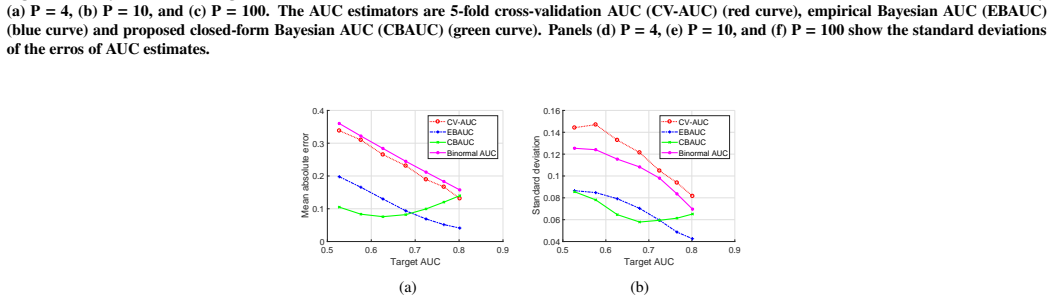
The central claim is that the posterior expectation of the AUC of any linear classifier with weights $w$ has an exact closed form. Under Gaussian class-conditional densities $\mathcal{N}(\mu_1,\Sigma)$ and $\mathcal{N}(\mu_2,\Sigma)$ with a normal-inverse-Wishart prior, the posterior mean of the AUC is $$\mathrm{CBAUC}(w)=\frac12+\frac{\operatorname{sgn}(A^*)}{2}\, I\!\left(\frac{(A^*)^2}{(A^*)^2+w^T S^* w};\,\frac12,\,\frac{\kappa^*-P+1}{2}\right),$$ where $I(x;a,b)$ is the regularized incomplete $\beta$ function, $A^*$ is a scaled posterior mean difference along $w$, and $S^*$, $\kappa^*$ are posterior hyperparameters updated from sample means, sample covariances, and the prior. This makes the full Bayesian integral over means and covariance collapse to a one-line expression, so AUC estimation becomes a single pass over the training data. The paper also shows empirically that, when the distributional assumptions hold, this estimate is more accurate and less variable than 5-fold cross-validated AUC, especially with small training sets.
Load-bearing premise
The load-bearing assumption is that each class is Gaussian and the two classes share the same covariance matrix; the paper's own MEG experiment shows CBAUC becomes the worst estimator when the training data is a mixture of two Gaussians.
Editorial extensions
If this is right
- AUC of a linear classifier can be estimated in one training run; no repeated training on data folds, so evaluation cost drops from multiple fits to a single fit plus a few matrix products.
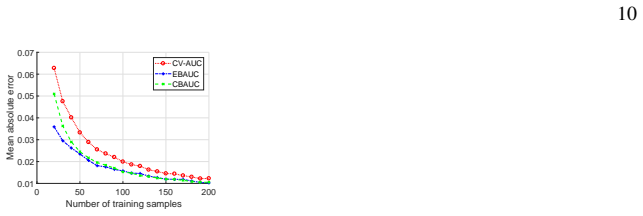
- In small-sample Gaussian settings the estimate has lower mean absolute error and lower variance than 5-fold cross-validated AUC and the empirical Bayesian alternative, making model selection less noisy.
- Because only $w$, the posterior means, and $S^*$ enter the formula, the same expression applies to any linear classifier: linear discriminant, support vector machine, or logistic regression.
- The closed form remains valid in $P\gg N$ regimes because the posterior scale $S^*$ is non-singular even when sample covariances are singular, so the estimator works on high-dimensional data such as the ovarian cancer set.
- CBAUC stays comparatively stable as class imbalance increases, while the counting-based estimators deteriorate at extreme imbalance ratios.
Reading between the lines
- The paper does not pursue it, but the same integral structure should extend to partial AUC or to precision-recall area, since those are also one-dimensional integrals over a Gaussian CDF evaluated along a linear discriminant; a beta-function form may appear there too.
- Because CBAUC is a closed-form and differentiable function of the classifier weights, it could be used directly as an AUC surrogate in hyperparameter search, replacing the costly inner cross-validation loop that currently scores each candidate setting.
- The paper notes the estimator has higher bias but smaller variance than counting methods; an untested corollary is that CBAUC may rank models correctly even when its absolute AUC is overestimated, which would make it especially suited to model selection rather than to reporting absolute performance.
- A natural stress test is to replace the common-covariance assumption with a prior that allows $\Sigma_1\neq\Sigma_2$; the linear classifier is then no longer Bayes-optimal, and it is unclear whether the closed form degrades gracefully or collapses as it does in the MEG mixture.
Signed reviews
Editorial analysis
A structured set of objections, weighed in public.
Referee Report
Summary. The paper introduces CBAUC, a closed-form Bayesian estimator of the area under the ROC curve for linear binary classifiers. The estimator is defined as the posterior expectation of the population AUC, assuming Gaussian class-conditional densities with a common covariance matrix and a normal-inverse-Wishart prior. The main theoretical result, Eq. (14), expresses CBAUC as a regularized incomplete beta function of the posterior mean difference and the posterior scale matrix. Experiments compare CBAUC with 5-fold cross-validated AUC and with an empirical Bayesian AUC estimator on synthetic Gaussian data, an ovarian cancer proteomics dataset (P >> N), and the ICANN 2011 MEG dataset. The synthetic and ovarian experiments are favorable to CBAUC, while the MEG experiment shows CBAUC with the worst mean absolute error, which the authors attribute to a violation of the Gaussian common-covariance assumption.
Significance. The derivation is technically plausible: the algebra in Lemma 1 and the reduction to Eq. (14) via the inverse-Wishart expectation are internally consistent, and the estimator is a genuine single-pass closed-form quantity. The paper's strength is that it supplies an analytic expression for a Bayesian AUC estimate, avoiding sampling or cross-validation, with explicit distributional assumptions. If the result is accepted as a posterior expectation under the stated model, it is a useful contribution for small-sample Gaussian settings and for model selection where variance reduction matters. However, the advertised practical advantage is conditional: the paper's own experiments show that CBAUC is not more accurate when the Gaussian equal-covariance assumption fails, so the significance of the contribution depends on an honest statement of that scope.
major comments (2)
- [Abstract; Section 3.1.3; Section 4] The unqualified claim in the Abstract that CBAUC is 'more accurate than conventional AUC estimators' is contradicted by the paper's own results in Section 3.1.3: in Fig. 6a, CBAUC has the largest mean absolute error of the three estimators for most training-set sizes on the ICANN 2011 MEG data. The authors' explanation (the training set is a mixture of two Gaussians, violating the model assumptions) is reasonable, but it demonstrates that the method's superiority holds only under the Gaussian equal-covariance assumption stated in Section 1. The Abstract and Section 4 should state this qualification explicitly, for example 'under Gaussian class-conditional densities with a common covariance,' rather than presenting CBAUC as unconditionally faster and more accurate.
- [Section 3.1.1, Fig. 3] The unequal-covariance experiment (Sigma_1 != Sigma_2) in Fig. 3 is reported as showing that cross-validation is poorer than the Bayesian approach, but the text does not make clear that CBAUC itself is the most sensitive of the Bayesian estimators to this violation. The conclusion in Section 4 that CBAUC is superior 'provided that prior assumptions hold' should be tied to this specific failure mode. As written, the reader could take the robustness experiment as support for CBAUC when it in fact shows that the advantage is limited to the equal-covariance case.
minor comments (5)
- [Section 2.2, Proposition 1 proof] The definition of A* in the proof has a typo in the denominator: it reads 'nu*_1 + nu*_1' instead of 'nu*_1 + nu*_2', and the reference to 'Eq. (8)' should be 'Eq. (13)'.
- [Section 3.1.3, Fig. 6] Fig. 6b, computed with a hold-out test set within the training set, is not discussed in the text; a sentence interpreting this panel would help the reader understand the experimental protocol and the discrepancy between panels (a) and (b).
- [Section 3.1.3] The assertion that the MEG training set is a mixture of two Gaussians is plausible but is not supported by a quantitative diagnostic; adding, for example, a normality test or a covariance-equality test would strengthen the explanation of why CBAUC fails in this experiment.
- [Section 3.1.1] In the unequal-covariance paragraph, the sentence 'the cross-validation performance is poorer than that of the Bayesian approach' is ambiguous because Fig. 3 compares three estimators; please state explicitly which pairwise differences are being summarized.
- [Abstract; Section 3] The claim that CBAUC is 'faster' than conventional estimators is not quantified anywhere; while the computational advantage is qualitatively clear because cross-validation is avoided, a small timing comparison would make the claim concrete.
Circularity Check
No circularity: CBAUC is a direct posterior expectation under stated Gaussian/NIW assumptions; the paper's self-citations are not load-bearing.
full rationale
The derivation of Eq. (14) is a direct evaluation of the posterior expectation defined in Eq. (3), under the explicitly stated Gaussian class-conditional densities with common covariance and a normal-inverse-Wishart prior. No parameter of the estimator is fitted to the target AUC; the hyperparameters m1,2=0, S=I, nu1,2=0.5, kappa=P+2 are fixed and taken from external prior work [18]. The external lemmas imported from [18] are independent mathematical results, not author self-citations. The only self-citations ([19] and [23]) provide background on multiclass Bayesian error estimation and the MEG feature set; they are not load-bearing for the closed form. The paper's own MEG experiment (Section 3.1.3) reports 'the proposed Bayesian approach has the worst performance among the three estimators,' and the conclusions qualify the accuracy claim to hold only 'as long as the model assumptions are valid.' That is a robustness or correctness limitation, not circularity. Thus the derivation is self-contained relative to its stated assumptions.
Assumptions & free parameters
free parameters (4)
- Prior mean hyperparameters m1, m2 =
0
- Prior scale matrix S =
I
- Prior concentration ν1, ν2 =
0.5
- Prior degrees-of-freedom κ =
P + 2
assumptions (3)
- domain assumption Class-conditional densities are Gaussian with a common covariance matrix.
- domain assumption The prior is normal-inverse-Wishart with hyperparameters m=0, S=I, ν=0.5, κ=P+2.
- standard math The integral identity [18, Lemma E.1] for the expectation of Φ(A/√(w^TΣw)) under an inverse-Wishart.
Cite this review
Pith. "Pith review of Bayesian Receiver Operating Characteristic Metric for Linear Classifiers." pith.science (2026). https://pith.science/paper/WE76B7QK
@misc{pith2026190808771,
  author       = {Pith},
  title        = {Pith review of: Bayesian Receiver Operating Characteristic Metric for Linear Classifiers},
  year         = {2026},
  howpublished = {\url{https://pith.science/paper/WE76B7QK}},
  note         = {Machine review of arXiv:1908.08771}
}
read the original abstract
We propose a novel classifier accuracy metric: the Bayesian Area Under the Receiver Operating Characteristic Curve (CBAUC). The method estimates the area under the ROC curve and is related to the recently proposed Bayesian Error Estimator. The metric can assess the quality of a classifier using only the training dataset without the need for computationally expensive cross-validation. We derive a closed-form solution of the proposed accuracy metric for any linear binary classifier under the Gaussianity assumption, and study the accuracy of the proposed estimator using simulated and real-world data. These experiments confirm that the closed-form CBAUC is both faster and more accurate than conventional AUC estimators.
Figures

Figures from the paper (3 more)


Reference graph
Works this paper leans on
-
[20]
L. A. Dalton, Optimal ROC-based classification and perf ormance analysis under Bayesian uncertainty models, IEEE /ACM Transactions on Computational Biology and Bioinformatics 13 (4) (2016) 719–729. doi:10.1109/TCBB.2015.2465966
arXiv 2016
-
[18]
L. A. Dalton, E. R. Dougherty, Bayesian minimum mean-sq uare error estimation for classification error—part II: The Bayesian MMSE error estimator for linear classification of Gaussian distributions, IEEE Tran s. Signal Process 59 (1) (2011) 130–144
work page 2011
-
[1]
Alpaydin, Introduction to machine learning, MIT pres s, 2014
E. Alpaydin, Introduction to machine learning, MIT pres s, 2014
work page 2014
- [2]
-
[3]
R. O. Duda, P . E. Hart, G. E. Stork, Pattern Classification , 2nd Edition, John Wiley & Sons, Inc., 2001
work page 2001
-
[4]
M. Stone, Cross-validatory choice and assessment of sta tistical predictions, Journal of the royal statistical soc iety. Series B (Methodological) (1974) 111–147
work page 1974
-
[5]
E. R. Dougherty, C. Sima, B. Hanczar, U. M. Braga-Neto, Pe rformance of error estimators for classification, Current B ioinformatics 5 (1) (2010) 53
work page 2010
-
[6]
B. Efron, Bootstrap methods: another look at the jackkni fe, in: Breakthroughs in statistics, Springer, 1992, pp. 56 9–593
work page 1992
Show all 28 references
-
[7]
Efron, Estimating the error rate of a prediction rule: improvement on cross-validation, Journal of the American s tatistical association 78 (382) (1983) 316–331
B. Efron, Estimating the error rate of a prediction rule: improvement on cross-validation, Journal of the American s tatistical association 78 (382) (1983) 316–331
1983
-
[8]
Efron, R
B. Efron, R. Tibshirani, Improvements on cross-validat ion: the .632 + bootstrap method, Journal of the American Statistical Asso ciation 92 (438) (1997) 548–560
1997
-
[9]
Braga-Neto, E
U. Braga-Neto, E. Dougherty, Bolstered error estimatio n, Pattern Recognition 37 (6) (2004) 1267–1281
2004
-
[10]
Glick, Additive estimators for probabilities of cor rect classification, Pattern recognition 10 (3) (1978) 211– 222
N. Glick, Additive estimators for probabilities of cor rect classification, Pattern recognition 10 (3) (1978) 211– 222
1978
-
[11]
Ferri, J
C. Ferri, J. Hern´ andez-Orallo, R. Modroiu, An experimental comparison of performance measures for classificatio n, Pattern Recognition Letters 30 (1) (2009) 27–38
2009
-
[12]
L. A. Jeni, J. F. Cohn, F. De La Torre, Facing imbalanced d ata–recommendations for the use of performance metrics, in : A ffective Computing and Intelligent Interaction (ACII), 2013 Humaine Association Conference o n, IEEE, 2013, pp. 245–251
2013
-
[13]
H. He, E. A. Garcia, Learning from imbalanced data, IEEE Transactions on Knowledge & Data Engineering 21 (9) (2008) 1 263–1284
2008
-
[14]
Cohen, M
G. Cohen, M. Hilario, H. Sax, S. Hugonnet, A. Geissbuhle r, Learning from imbalanced data in surveillance of nosocom ial infection, Artificial intelligence in medicine 37 (1) (2006) 7–18
2006
-
[15]
A. P . Bradley, The use of the area under the roc curve in th e evaluation of machine learning algorithms, Pattern recog nition 30 (7) (1997) 1145–1159
1997
-
[16]
Cortes, M
C. Cortes, M. Mohri, Auc optimization vs. error rate min imization, in: S. Thrun, L. K. Saul, B. Sch¨ olkopf (Eds.), Advances in Neural Information Processing Systems 16, MIT Press, 2004, pp. 313–320
2004
-
[17]
L. A. Dalton, E. R. Dougherty, Bayesian minimum mean-sq uare error estimation for classification error—part I: Defin ition and the Bayesian MMSE error estimator for discrete classification, IEEE Trans. Signal P rocess 59 (1) (2011) 115–129
2011
-
[19]
Huttunen, J
H. Huttunen, J. Tohka, Model selection for linear class ifiers using bayesian error estimation, Pattern Recognitio n 48 (11) (2015) 3739 – 3748. doi:https://doi.org/10.1016/j.patcog.2015.05.005
2015 doi
-
[21]
O. V . Demler, M. J. Pencina, R. B. D’Agostino, Equivalen ce of improvement in area under roc curve and linear discrimi nant analysis coe fficient under assumption of normality, Statistics in medicine 30 (12) (20 11) 1410–1418
-
[22]
Gelman, H
A. Gelman, H. S. Stern, J. B. Carlin, D. B. Dunson, A. V eht ari, D. B. Rubin, Bayesian data analysis, Chapman and Hall /CRC, 2013
2013
-
[23]
Huttunen, T
H. Huttunen, T. Manninen, J.-P . Kauppi, J. Tohka, Mind r eading with regularized multinomial logistic regression, Machine Vision and Applications 24 (6) (2013) 1311–1325
2013
-
[24]
Raudys, V
S. Raudys, V . Pikelis, On dimensionality, sample size, classification error, and complexity of classification algo rithm in pattern recognition, IEEE Transactions on Pattern Analysis and Machine Intelligence (3) (1980) 242 –252
1980
-
[25]
R. Fan, K. Chang, C. Hsieh, X. Wang, C. Lin, Liblinear: A l ibrary for large linear classification, The Journal of Machi ne Learning Research 9 (2008) 1871–1874
2008
-
[26]
Chakraborty, Observer Performance Methods for Diag nostic Imaging, Imaging in Medical Diagnosis and Therapy, C RC Press, 2017
D. Chakraborty, Observer Performance Methods for Diag nostic Imaging, Imaging in Medical Diagnosis and Therapy, C RC Press, 2017
2017
-
[27]
M. S. Pepe, The statistical evaluation of medical tests for classification and prediction, Medicine, 2003
2003
-
[28]
J. Xue, P . Hall, Why does rebalancing class-unbalanced data improve auc for linear discriminant analysis?, IEEE tr ansactions on pattern analysis and machine intelligence 37 (5) (2015) 1109–1112
2015
Reviewed August 14, 2026 · model on record in the stance chip above.
Discussion (0). Continue with ORCID to comment.