REVIEW 2 major objections 5 minor 17 references
On the asymptotic properties of SLOPE
T0 review · 2 major / 5 minor · reviewed 2026-08-14 · deepseek-v4-flash
Pith's one-line read SLOPE can be tuned to drive false discoveries to zero and power to one in high-dimensional Gaussian linear models.
desk verdict Real progress on SLOPE's FDR under random Gaussian designs, but the proof of the key vanishing lemma has a uniformity gap that needs repair before the theorem is established. read the letter →
The pith
A machine-rendered reading of the paper's core claim, the machinery that carries it, and where it could break.
The reading
What carries the argument
The argument rests on three pieces. First, the SLOPE estimator itself, defined by the sorted $\ell^1$ penalty $\sum_{i=1}^p \lambda_i |b|_{(i)}$, which shrinks coefficients both toward zero and toward each other. Second, a support characterization: for any convex differentiable loss, the selected set is exactly described by the condition $T(a)\in H_r$, where $T(a)=U(\hat{b})+a\hat{b}$, $U$ is the gradient of the negative loss, and $H_r$ is a set of vectors whose sorted partial sums compare in a specific way with the $\lambda_i$. Third, a reduction to independence: on a high-probability event $Q = Q_1\cap Q_2\cap Q_3$, where $Q_1$ asserts the support is inside a resolvent set of size $k^*$ with $k^*/p\to0$ and $(k^*)^2\log p/n\to0$, $Q_2$ bounds the $\ell_\infty$ norm of $\Gamma$ by $\gamma = C_q\sqrt{(k^*)^2\log p/n}\,\lambda_{k^*}^{BH}$, and $Q_3$ keeps $\|\epsilon\|_2$ near $\sigma\sqrt{n}$, the event $\{T\in H_r, |T_i|>\lambda_r\}$ is contained in an event depending only on $M$, whose coordinates are conditionally independent Gaussians. This yields the product bound with the factor $(k^*/p)^\delta$ that drives the FDR to zero.
What would settle it
Run the model with $p=n^2$, $k=\sqrt{n}/10$, and the smallest signal exactly at the boundary $2(1+\delta)\sqrt{2\log p}$, and evaluate the FDR via the explicit formula (3.4) or simulation for increasing $n$ (e.g., 200, 400, 800, 1600). If the FDR does not decrease toward zero as $n$ grows while the resolvent-set containment holds, the claimed convergence is false.
Extended reading notes
Core claim
The main theorem states that for the linear model $Y = Xb_0 + \epsilon$ with $X$ having iid $N(0,1/n)$ entries, if $p\to\infty$, $k/p\to0$, $k^2\log p/n\to0$, and $\min_{j:b_0^j\neq0}|b_0^j| > 2\sigma(1+\delta)\sqrt{2\log p}$, then the SLOPE estimator with tuning parameters $\lambda_i = \sigma(1+\delta)\Phi^{-1}(1 - qi/(2p))$ satisfies $\mathrm{FDR}\to0$ and power $\to1$ for any $q\in(0,1)$. The factor $\delta>0$—an arbitrarily small inflation of the BH thresholds—is what drives the FDR to zero; the signal-strength assumption secures power one. The proof reduces the problem to the vector $M = X'\epsilon + b_0$ by showing that on a high-probability event the remainder $\Gamma = (I - X'X)(\hat{b}-b_0)$ is small in $\ell_\infty$ and that the support of the solution is contained in a small deterministic resolvent set, so that false-discovery probabilities factor into independent Gaussian tails.
Load-bearing premise
The entire argument depends on a known high-probability bound that puts the support of the SLOPE solution inside a small deterministic set of size $k^*$, where $k^*/p\to0$ and $(k^*)^2\log p/n\to0$; if that containment fails, both the FDR and power conclusions collapse.
Editorial extensions
If this is right
- SLOPE can simultaneously control false discoveries and achieve full power in sparse high-dimensional regression with random Gaussian designs, without knowing the sparsity level in advance.
- The signal-strength requirement is on the same $\sqrt{2\log p}$ scale as LASSO's support-recovery bound, so SLOPE gains adaptivity in sparsity at no asymptotically higher cost in signal magnitude.
- The FDR bound contains the factor $(k^*/p)^\delta$, which shows any $\delta>0$, however small, suffices to drive FDR to zero; the paper leaves it open whether $\delta$ can be chosen to hit exactly the nominal level $q$.
- The support characterization for a general convex differentiable loss opens a route to analogous FDR and power statements for SLOPE in generalized linear models or Gaussian graphical models.
Reading between the lines
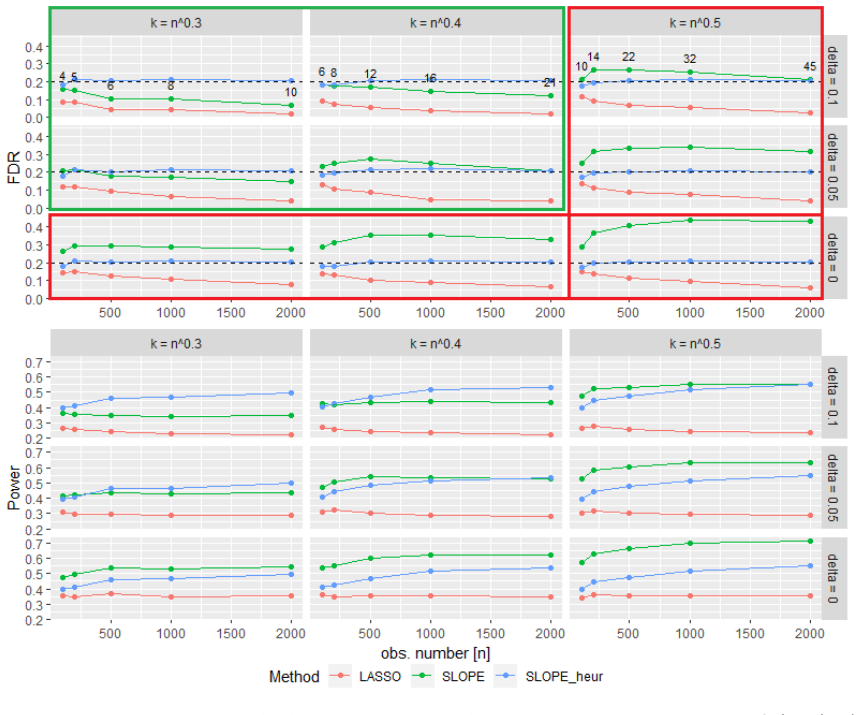
- A natural next step would be to use the exact FDR formula (3.4) to select $\delta$ in practice, trading off a target FDR against power in finite samples; the simulations suggest a heuristic sequence already does this more evenly than the asymptotic choice.
- Because the proof only uses Gaussian concentration of $X'\epsilon$ and singular values of submatrices, the same argument likely extends to independent sub-Gaussian columns; a direct extension would need only to verify the resolvent-set and remainder bounds for such entries.
- The resolvent-set bound is the main bottleneck: if a sharper support-containment result were available, the sparsity condition $k^2\log p/n\to0$ might be relaxed, as the heuristic SLOPE simulations indicate.
- The proof's decomposition into $M$ and $\Gamma$ suggests that the same factorization of FDR into independent Gaussian tails could be used to design data-dependent threshold sequences that control FDR at a prespecified level with high probability rather than only asymptotically.
Signed reviews
Editorial analysis
A structured set of objections, weighed in public.
Referee Report
Summary. The paper studies the asymptotic model-selection properties of SLOPE in high-dimensional linear regression with i.i.d. Gaussian design. The main result, Theorem 2.1, states that if p tends to infinity, k/p tends to 0, k^2 log p / n tends to 0, and all nonzero true coefficients exceed 2 sigma (1+delta) sqrt(2 log p), then SLOPE with the tuning sequence lambda_i(q,delta) = sigma (1+delta) Phi^{-1}(1 - q i/(2p)) has FDR converging to 0 and power converging to 1. The proof uses a general characterization of the SLOPE support in terms of sets H_r (Theorems 3.1 and 3.2), expresses FDR as a sum over the support size r and null coordinates i, and then reduces the problem to Gaussian tail bounds for the vector M = X'epsilon + b0, using a resolvent set and bounds imported from Su and Candes (2016). The paper also reports extensive simulations comparing SLOPE, a heuristic SLOPE, and LASSO.
Significance. If fully established, the result would be a useful extension of the orthogonal-design FDR control of SLOPE to random Gaussian designs, and the general support characterization for convex differentiable losses is of independent interest. The paper builds on substantial external results rather than circularly fitting the target theorem, and the simulation study is extensive and clearly presented. However, the proof as written has a load-bearing uniformity gap in Lemma 3.9 and an unaddressed uniqueness issue in the general support theorems, so the main claims are not yet fully supported.
major comments (2)
- [Section 6, proof of Lemma 3.9 (around (6.12))] The claim immediately before (6.12) that log(p/r)/log p = 1 - log r / log p tends to 1 uniformly for r <= k* is false under the assumptions of Corollary 3.5. Corollary 3.5 only gives k*/p -> 0 and (k*)^2 log p / n -> 0; it does not give log k* / log p -> 0. For example, with p = n^1.2 and k = n^0.4, one has k/p -> 0 and k^2 log p / n -> 0, while Lemma 7.6 permits choosing k* of order k, so log k*/log p is about 1/3 and at r = k* one has log(p/r)/log p about 2/3, not 1. Consequently the displayed inequality (lambda_r - gamma)/(sigma(1 + 1/k*)) > (1 + delta/2) sqrt(2 log p) can fail by a constant factor, and the bound P(|Z|_(r-k-1) > s) is applied with a threshold larger than the true threshold. This invalidates the proof of (6.12), and since (6.12) supplies the vanishing tail term needed for Lemma 3.9 and hence for (3.22), the FDR conclusion of Theorem 2.1 is not established as written. The gap appears repairable by using the r-dependent threshold a_r = (lambda_r - gamma)/(sigma(1 + 1/k*)) and summing (q r/p)^((1+delta/2)^2) P(M^(i) in H^gamma_r), but the argument must be rewritten.
- [Section 3.1, Theorems 3.1 and 3.2 and Corollary 3.3] The support characterization and the FDR formula (3.4) treat the SLOPE estimate as a well-defined random vector, but the optimization problem (3.1) is convex and need not have a unique minimizer when the loss is quadratic with p > n; the argmin set can contain vectors with different supports. No selection rule or uniqueness proof is provided. This matters because R and the indicators {hat b_i != 0}, and hence the FDR expression (3.4)/(3.10) and all subsequent reductions, are not well-defined unless a unique minimizer is specified. The issue is likely fixable, for example by proving uniqueness under the Gaussian design with strictly decreasing lambda or by working with the argmin set, but it is load-bearing and should be addressed before the central claim can be accepted.
minor comments (5)
- [Section 3.3] The sentence 'Due to conditions (7.5), (3.14) and (3.16)' should cite (3.12), (3.14), and (3.16); equation (7.5) appears only in the supplementary material and is not among the conditions established in the main text.
- [Section 6, proof of Lemma 3.9, bound (6.11)] The final displayed bound of (6.11) appears to contain an algebraic slip: the factor ek/p should be ek (without the extra 1/p), since the intended convergence uses k/p^(((1+delta/4)^2)-1) -> 0; please check the displayed inequality.
- [Figure captions 2.3 and 2.4] The captions refer to the parameter alpha, but alpha is only introduced implicitly through k = round(n^alpha); please define alpha explicitly in the caption or in the surrounding text.
- [Equations (6.7)-(6.8)] The notation P(A, Q3 | epsilon) is slightly abusive because Q3 is deterministic conditional on epsilon; writing P(A cap Q3 | epsilon) would be clearer.
- [Proof of Proposition 6.3] The line '|C_i| = |A_i - B_i| > ||A_i| - |B_i||' should have a weak inequality, since equality can occur when A_i and B_i have the same sign.
Circularity Check
No circularity: the derivation is self-contained; the load-bearing support-containment input is imported from external Su and Candès (2016), and self-citations are only background.
full rationale
The central result, Theorem 2.1, is not manufactured from its own conclusions. The tuning sequence lambda_i(q,delta) is defined explicitly in (2.7) with user-chosen constants q and delta; no parameter is fitted to the FDR or power target. The FDR decomposition (3.4) and (3.10) follows from the KKT-type support characterization in Theorems 3.1 and 3.2, which are proved in the supplementary materials from convexity and differentiability rather than assumed. The key sparsity input, Corollary 3.5, is explicitly quoted as following from Lemma 4.4 of Su and Candès (2016), an external result, not from the authors' own prior work. The subsequent bounds (Lemmas 3.6, 3.8, 3.9, 3.10) reduce the problem to Gaussian tail inequalities, concentration of measure, and properties of order statistics, with no step equating the conclusion to an input. Self-citations to Bogdan et al. (2013, 2015) supply background on SLOPE, the orthogonal-design FDR result, and the heuristic comparator sequence used in simulations, but none of these is load-bearing for Theorem 2.1's FDR or power proof. The skeptical objection about the uniformity of log(p/r)/log p in Lemma 3.9 is a mathematical correctness concern about a limit argument, not a circularity pattern: it does not show that the theorem is assumed in its own proof or that a fitted quantity is renamed as a prediction. Therefore the circularity score is 0.
Assumptions & free parameters
free parameters (2)
- delta (penalty inflation margin) =
arbitrary; 0.1 in simulations
- q (nominal FDR level) =
0.2 in simulations
assumptions (5)
- domain assumption Design entries X_ij are iid N(0,1/n).
- domain assumption Sparsity conditions k/p -> 0 and k^2 log p / n -> 0.
- domain assumption Minimum signal strength min |b0_j| > 2 sigma (1+delta) sqrt(2 log p).
- standard math External high-probability bounds from Su and Candes (2016): Lemma 4.4, Lemma A.11, Lemma A.12, Theorem 1.2.
- domain assumption The SLOPE objective has a unique minimizer.
Cite this review
Pith. "Pith review of On the asymptotic properties of SLOPE." pith.science (2026). https://pith.science/paper/POBMOBBB
@misc{pith2026190808791,
  author       = {Pith},
  title        = {Pith review of: On the asymptotic properties of SLOPE},
  year         = {2026},
  howpublished = {\url{https://pith.science/paper/POBMOBBB}},
  note         = {Machine review of arXiv:1908.08791}
}
abstract
Sorted L-One Penalized Estimator (SLOPE) is a relatively new convex optimization procedure for selecting predictors in large data bases. Contrary to LASSO, SLOPE has been proved to be asymptotically minimax in the context of sparse high-dimensional generalized linear models. Additionally, in case when the design matrix is orthogonal, SLOPE with the sequence of tuning parameters $\lambda^{BH}$, corresponding to the sequence of decaying thresholds for the Benjamini-Hochberg multiple testing correction, provably controls False Discovery Rate in the multiple regression model. In this article we provide new asymptotic results on the properties of SLOPE when the elements of the design matrix are iid random variables from the Gaussian distribution. Specifically, we provide the conditions, under which the asymptotic FDR of SLOPE based on the sequence $\lambda^{BH}$ converges to zero and the power converges to 1. We illustrate our theoretical asymptotic results with extensive simulation study. We also provide precise formulas describing FDR of SLOPE under different loss functions, which sets the stage for future results on the model selection properties of SLOPE and its extensions.
Figures


Figures from the paper (2 more)

Reference graph
Works this paper leans on
-
[1]
F. Abramovich and V. Grinshtein. High-dimensional classification by sparse logistic regression. IEEE Transactions on Information Theory, PP, 06 2017. doi:10.1109/TIT.2018.2884963
arXiv 2017
-
[2]
F. Abramovich, Y. Benjamini, D.L. Donoho, and I.M. Johnstone. Adapting to unknown sparsity by controlling the false discovery rate. Ann. Statist., 34 0 (2): 0 584--653, 2006
work page 2006
- [3]
-
[4]
Y. Benjamini and Y. Hochberg. Controlling the false discovery rate: A practical and powerful approach to multiple testing. Journal of the Royal Statistical Society, Series B, 57 0 (1): 0 289--300, 1995
work page 1995
- [5]
- [6]
- [7]
-
[8]
E.J. Cand\`es, M.B. Wakin, and S.P. Boyd. J. Fourier Anal. Appl., 14: 0 877--905, 2008
work page 2008
Show all 17 references
-
[9]
Chen and D
S. Chen and D. Donoho. Basis pursuit. In Proceedings of 1994 28th Asilomar Conference on Signals, Systems and Computers, volume 1, pages 41--44. IEEE, 1994
1994
-
[10]
Frommlet and M
F. Frommlet and M. Bogdan. Some optimality properties of F D R controlling rules under sparsity. Electronic Journal of Statistics, 7: 0 1328--1368, 2013
2013
-
[11]
Jiang, M
W. Jiang, M. Bogdan, J. Josse, B. Miasojedow, and V. an TB Group Rockova. Adaptive bayesian slope--high-dimensional model selection with missing values. arXiv:1909.06631, 2019
1909 arXiv
-
[12]
Neuvial and E
P. Neuvial and E. Roquain. On false discovery rate thresholding for classification under sparsity . Annals of Statistics , 40 : 0 2572--2600 , 2012
2012
-
[13]
Su and E
W. Su and E. Candès. Slope is adaptive to unknown sparsity and asymptotically minimax. Ann. Statist., 44 0 (3): 0 1038--1068, 06 2016. doi:10.1214/15-AOS1397. URL https://doi.org/10.1214/15-AOS1397
2016 doi
-
[14]
W. Su, M. Bogdan, and E.J. Cand\`es. False discoveries occur early on the lasso path. The Annals of Statistics, 45 0 (5): 0 2133--2150, 2017
2017
-
[15]
Tibshirani
R. Tibshirani. Regression shrinkage and selection via the lasso. Journal of the Royal Statistical Society. Series B (Methodological), pages 267--288, 1996
1996
-
[16]
Vershynin
R. Vershynin. Introduction to the non-asymptotic analysis of random matrices, page 210–268. Cambridge University Press, 2012. doi:10.1017/CBO9780511794308.006
2012 doi
-
[17]
H. Zou. The adaptive lasso and its oracle properties. Journal of the American Statistical Association, 101 0 (476): 0 1418--1429, 2006. doi:10.1198/016214506000000735. URL https://doi.org/10.1198/016214506000000735
2006 doi
Reviewed August 14, 2026 · model on record in the stance chip above.
Discussion (0). Continue with ORCID to comment.