REVIEW 4 major objections 5 minor 45 references
DRFN: Deep Recurrent Fusion Network for Single-Image Super-Resolution with Large Factors
T0 review · 4 major / 5 minor · reviewed 2026-08-14 · deepseek-v4-flash
Pith's one-line read The paper claims DRFN sets a new state of the art at 4x and 8x super-resolution by upsampling at the front with learned transposed convolutions and fusing three levels of features.
desk verdict Reasonable incremental SISR architecture with honest ablations, but the 'state-of-the-art' claim is contradicted by the omitted EDSR/DBPN/RCAN comparisons and the x8 baselines are weak. read the letter →
The pith
A machine-rendered reading of the paper's core claim, the machinery that carries it, and where it could break.
The reading
What carries the argument
The load-bearing mechanism is the placement of transposed convolution at the front of the network. A transposed convolution is a learnable upsampling operator, so the input is magnified by a factor of two per step while features are extracted simultaneously; iterating the update $X_{s+1}=F_p(T_{x2}(X_s))$ sets the scale factor. This replaces the usual bicubic pre-interpolation. The second mechanism is the recurrent residual block, a weight-shared block looped ten times with a skip connection, $X_k = F_c(F_{p_b}(F_b(F_{p_a}(F_a(X_{k-1})))))+X_{k-1}$, which enlarges the network's spatial context without multiplying parameters. The third is multi-level fusion: three convolutional layers pull features from different depths of the recurrent mapping, the feature maps are concatenated, and one final convolution reconstructs the HR image, so original and refined features are both available. Training minimizes MSE with SGD, momentum, and gradient clipping.
What would settle it
Recompute the x8 comparisons using the original weights of the compared methods, rather than the retrained versions the paper used, on Set5, Set14, and BSDS100, and rerecord PSNR, SSIM, and IFC. The central claim fails if any of the original baselines matches or beats DRFN on the metrics the paper reports. Separately, an independent re-run of the ablation replacing front transposed convolution with bicubic interpolation would test whether the reported gains really come from learned upsampling; a vanishing gap would undercut the mechanism story.
Extended reading notes
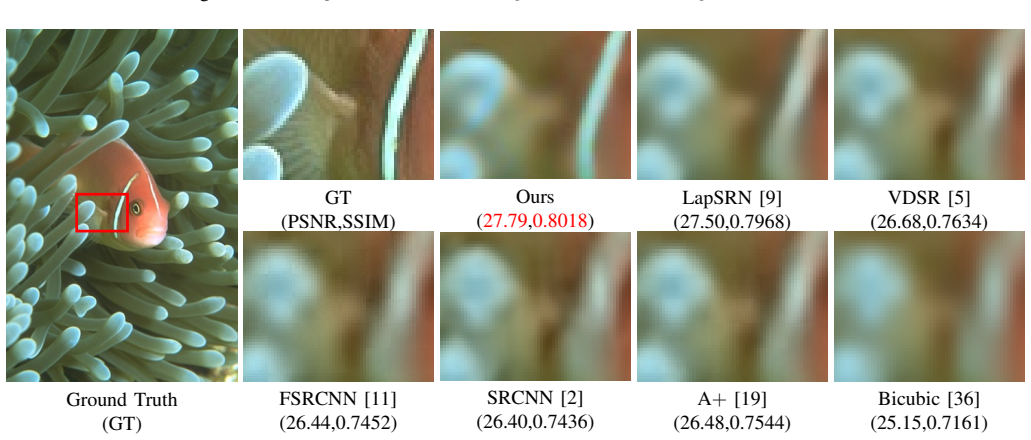
Core claim
The paper's central claim is that DRFN establishes a new state of the art for single-image super-resolution at large scaling factors, specifically 4x and 8x. On the five benchmark sets (Set5, Set14, BSDS100, Urban100, and ImageNet400) the reported PSNR, SSIM, and IFC values place DRFN ahead of bicubic, A+, JOR, SRCNN, FSRCNN, VDSR, and LapSRN at 4x, and ahead of the compared methods at 8x on Set5, Set14, and BSDS100. The claimed reason is architectural rather than simply deeper: transposed convolution at the network entrance jointly extracts and upsamples raw features, recurrent residual blocks refine high-frequency information in the HR feature space with a large receptive field at low parameter cost, and a three-level fusion stage combines complementary features before final reconstruction. The authors also claim that DRFN produces visually cleaner results, with fewer artifacts and sharper texture, while using only about 347,000 parameters.
Load-bearing premise
The x8 comparisons assume the retrained versions of A+, SRCNN, FSRCNN, and VDSR used for evaluation are faithful stand-ins for the original published models; if those retrained baselines are weaker, the reported 8x advantage is an artifact.
Editorial extensions
If this is right
- Extending Eq. 1 by one more transposed-convolution step reaches 12x upscaling without changing the network's design; the authors list 12x as their intended next test.
- The multi-level fusion gains are larger at 8x than at 4x (Set5 PSNR rises from 25.75 to 26.22 dB with one versus three levels at 8x, versus 31.25 to 31.55 dB at 4x), supporting the paper's focus on large factors.
- Weight sharing in the recurrent blocks keeps total parameters near 347,000 while giving the network an effective depth of about 20 recurrent iterations, which the paper shows is more accurate than compared models at similar parameter counts.
- At 2x and 3x the same network also outperforms the compared methods on the reported metrics, indicating the design is not limited to large factors.
Reading between the lines
- Editorial inference: In the ablation numbers, three-level fusion accounts for a larger PSNR change than switching from bicubic pre-upsampling to front transposed convolution (0.30 dB versus 0.14 dB on Set5 at 4x), so fusion is the stronger candidate for carrying the result; the paper does not state this comparison.
- Editorial inference: The 4x PSNR margin over LapSRN on Set5 is only 0.01 dB, while SSIM and IFC margins are larger; the practical significance of the state-of-the-art claim therefore depends on which metric a user cares about.
- Editorial inference: The x8 comparisons were made with retrained versions of A+, SRCNN, FSRCNN, and VDSR, so the reported margins over those baselines are not directly against the original released models; re-running with official weights would test the comparison directly.
- Editorial inference: The front-loaded upsampling and multi-level fusion recipe could plausibly transfer to other restoration tasks with large degradation factors, such as deblurring or denoising, but the paper only lists these as future work.
Signed reviews
Editorial analysis
A structured set of objections, weighed in public.
Referee Report
Summary. The paper proposes DRFN, a deep recurrent fusion network for single-image super-resolution targeting large upscaling factors (×4 and ×8). The architecture places transposed convolution at the front for joint feature extraction and upsampling, applies two recurrent residual blocks with ten cycles for mapping in HR feature space, and fuses three levels of features for final reconstruction. Training uses MSE loss and the model has about 347k parameters. The experiments compare DRFN with A+, JOR, SRCNN, FSRCNN, VDSR, and LapSRN on Set5, Set14, BSDS100, Urban100, and ImageNet400, with ablations on transposed-convolution placement, number of fusion levels, and recurrent cycle count. The paper claims state-of-the-art performance and superiority over existing deep learning methods, particularly for large factors.
Significance. If the empirical claims were fully supported, the design combination of front-end transposed convolution, batch-normalization-free recurrent residual blocks, and multi-level feature fusion would be a useful contribution to efficient large-factor SR, especially given the small parameter count and released source code. However, the significance is currently undercut by an incomplete comparison set that omits several cited state-of-the-art methods, a potentially mismatched evaluation protocol, and small, statistically untested performance margins. The architecture itself is reasonable and the ablations are informative, so the core idea may still be publishable after substantial revision.
major comments (4)
- [Section I, Section II, Section V, Tables I-II] The paper's central claim, stated in Section I and Section V, that DRFN 'significantly outperforms existing deep learning methods' and 'extends quantitative and qualitative SR performance to a new state-of-the-art level' is not supported by the comparison set. Tables I and II include only A+, JOR, SRCNN, FSRCNN, VDSR, and LapSRN, while Section II cites EDSR [7], DRRN [28], and MemNet [29] as relevant deep methods. EDSR, DBPN, and RCAN were published before this submission and report higher numbers on the same benchmarks (e.g., Set5 ×4: EDSR 32.46 dB vs. DRFN 31.55 dB; Set5 ×8: RCAN ≈ 27.31 dB vs. DRFN 26.22 dB). The stated state-of-the-art claim is therefore contradicted by the published record, not merely unverified.
- [Section IV-C, Table II] The ×8 comparisons depend on 'datasets generated by retrained models' of A+, SRCNN, FSRCNN, and VDSR, following LapSRN. The manuscript provides no verification that these retrained models reproduce the published performance of the originals. Since the reported DRFN advantages over LapSRN at ×8 are only 0.06–0.13 dB in PSNR (Table II), even a small degradation of the retrained baselines would erase or invert the gains. The authors should use official released models or report a comparison that does not depend on unverified retraining.
- [Section IV-B, Tables I-II] The manuscript states that original RGB images are converted to grayscale and that training and testing are performed on the 'luminance channel.' Published benchmark numbers for the compared methods are conventionally computed on the Y channel of the original color images, which is not the same as a full grayscale conversion. If DRFN is evaluated on grayscale images while the baseline numbers come from the Y-channel protocol, the quantitative comparisons in Tables I and II are not apples-to-apples. The authors must clarify the exact evaluation pipeline and, ideally, re-run baselines under the identical protocol.
- [Section IV-D, Tables IV-V] The final configuration—three fusion levels and ten recurrent cycles—was selected based on experiments on the same test benchmarks (Set5, Set14, BSDS100) that are later used for the final reported numbers. This selection-on-the-test-set procedure biases the reported results favorably. The authors should either use a separate validation set for model selection or report performance for all configurations so readers can assess the optimism.
minor comments (5)
- [Section IV-D, first paragraph] The phrase 'intended for for large-factor SR problems' contains a duplicated 'for'.
- [Section IV-D, Network depth] The sentence 'We also studies the effect of the cycle times' should use 'studied' instead of 'studies'.
- [Table I, header row] The row label 'LapSRN x2 [9]' has inconsistent spacing compared with other rows such as 'DRFN x2'; please format uniformly.
- [Figure 9 caption] The parenthetical '(the three-level is DRFN ×4)' is awkwardly worded; please rephrase for clarity.
- [Section IV-B, patch generation] The manuscript reports 'approximately 930,000 patches' but does not specify the patch size; adding this detail would improve reproducibility.
Circularity Check
No self-definitional circularity; the main burden is that the final architecture (cycle count and fusion levels) was selected on the same test benchmarks later reported as evidence.
-
fitted input called prediction
[Section IV-D ('Network depth'), Table V]
"The experimental results in Table V show that increasing the number of cycles can boost performance but also increases time consumption. To achieve better results, we chose to cycle 10 times as a benchmark."
The recurrent-block cycle count (10) is a hyperparameter selected by maximizing PSNR on the BSDS100 benchmark (Table V shows 26.67, 27.32, and 27.39 dB for 3, 5, and 10 cycles). The same BSDS100 benchmark is then used in Tables I and II as evidence that DRFN outperforms competitors. Thus the reported performance of the final configuration is the value used to pick the hyperparameter, not an independent prediction; the 'deeper cycle count improves accuracy' finding is in-sample by construction for that benchmark.
-
fitted input called prediction
[Section IV-D ('Multi-level structure'), Table IV]
"The result of the three-level network was best as shown in Table IV."
The number of fusion levels is selected by comparing one-, two-, and three-level variants on Set5, Set14, and BSDS100 (Table IV), and the best-scoring three-level variant becomes the final DRFN. The final model's results on these same datasets are then presented in Tables I and II as validation. The improvement attributed to multi-level fusion is therefore the selection criterion, not an out-of-sample verification. This is a partial circularity: the external competitor numbers and the training data are independent, but the architectural configuration is partly fitted to the test benchmarks.
full rationale
The paper's derivation is empirical rather than formal: DRFN is defined by Eqs. (1)-(3), trained on a fixed 291-image dataset, and evaluated against external methods on standard benchmarks. The method itself is not defined in terms of the reported PSNR values, and there is no uniqueness theorem or load-bearing self-citation; the only self-reference, [26], is a related-work mention and does not support the central claim. The substantive circularity burden is test-set model selection: the cycle count, the number of fusion levels, and to a lesser degree the transposed-convolution placement were chosen after inspecting PSNR on the same Set5/Set14/BSDS100 benchmarks that later appear in the headline comparison tables. This makes the final configuration partly fitted to the reported outcomes, especially at x8 where the claimed margins over LapSRN are only 0.06-0.13 dB. I do not score the omitted EDSR/DBPN/RCAN comparisons or the use of LapSRN's retrained x8 baselines as circularity; those are validity and completeness risks, not reductions of the derivation to its own inputs.
Assumptions & free parameters
free parameters (4)
- Recurrent cycle count =
10
- Number of recurrent residual blocks =
2
- Number of fusion levels =
3
- Convolution feature map width =
64
assumptions (4)
- domain assumption MSE loss is an appropriate training objective for perceptual SR quality.
- domain assumption Bicubic downsampling is the correct degradation model for generating LR training and test images.
- ad hoc to paper The retrained baseline models reproduce the original published baselines' performance.
- domain assumption The five test benchmarks are representative of real-world SR difficulty.
Cite this review
Pith. "Pith review of DRFN: Deep Recurrent Fusion Network for Single-Image Super-Resolution with Large Factors." pith.science (2026). https://pith.science/paper/CZGBSIX7
@misc{pith2026190808837,
  author       = {Pith},
  title        = {Pith review of: DRFN: Deep Recurrent Fusion Network for Single-Image Super-Resolution with Large Factors},
  year         = {2026},
  howpublished = {\url{https://pith.science/paper/CZGBSIX7}},
  note         = {Machine review of arXiv:1908.08837}
}
read the original abstract
Recently, single-image super-resolution has made great progress owing to the development of deep convolutional neural networks (CNNs). The vast majority of CNN-based models use a pre-defined upsampling operator, such as bicubic interpolation, to upscale input low-resolution images to the desired size and learn non-linear mapping between the interpolated image and ground truth high-resolution (HR) image. However, interpolation processing can lead to visual artifacts as details are over-smoothed, particularly when the super-resolution factor is high. In this paper, we propose a Deep Recurrent Fusion Network (DRFN), which utilizes transposed convolution instead of bicubic interpolation for upsampling and integrates different-level features extracted from recurrent residual blocks to reconstruct the final HR images. We adopt a deep recurrence learning strategy and thus have a larger receptive field, which is conducive to reconstructing an image more accurately. Furthermore, we show that the multi-level fusion structure is suitable for dealing with image super-resolution problems. Extensive benchmark evaluations demonstrate that the proposed DRFN performs better than most current deep learning methods in terms of accuracy and visual effects, especially for large-scale images, while using fewer parameters.
Figures


Figures from the paper (7 more)




Reference graph
Works this paper leans on
-
[7]
Enhanced deep residual networks for single image super-resolution,
B. Lim, S. Son, H. Kim, S. Nah, and K. M. Lee, “Enhanced deep residual networks for single image super-resolution,” in IEEE Conference on Computer Vision and Pattern Recognition , July 2017
work page 2017
-
[28]
Image super-resolution via deep recursive residual network,
Y . Tai, J. Yang, and X. Liu, “Image super-resolution via deep recursive residual network,” in Proceedings of the IEEE Conference on Computer Vision and Pattern Recognition , 2017
work page 2017
-
[29]
Memnet: A persistent memory net- work for image restoration,
Y . Tai, J. Yang, X. Liu, and C. Xu, “Memnet: A persistent memory net- work for image restoration,” in Proceedings of International Conference on Computer Vision , 2017
work page 2017
-
[1]
Example-based super- resolution,
W. T. Freeman, T. R. Jones, and E. C. Pasztor, “Example-based super- resolution,” IEEE Computer graphics and Applications , vol. 22, no. 2, pp. 56–65, 2002
work page 2002
-
[2]
Image super-resolution using deep convolutional networks,
C. Dong, C. C. Loy, K. He, and X. Tang, “Image super-resolution using deep convolutional networks,” IEEE transactions on pattern analysis and machine intelligence , vol. 38, no. 2, pp. 295–307, 2016
work page 2016
-
[3]
Fast learning-based single image super- resolution,
N. Kumar and A. Sethi, “Fast learning-based single image super- resolution,” IEEE Transactions on Multimedia , vol. 18, no. 8, pp. 1504– 1515, 2016
work page 2016
-
[4]
Structure-preserving image super-resolution via contextualized multi-task learning,
Y . Shi, K. Wang, C. Chen, L. Xu, and L. Lin, “Structure-preserving image super-resolution via contextualized multi-task learning,” IEEE Transactions on Multimedia , 2017
work page 2017
-
[5]
Accurate image super-resolution using very deep convolutional networks,
J. Kim, J. Kwon Lee, and K. Mu Lee, “Accurate image super-resolution using very deep convolutional networks,” in IEEE Conference on Com- puter Vision and Pattern Recognition , 2016, pp. 1646–1654
work page 2016
Show all 45 references
-
[6]
Deeply-recursive convolutional network for image super-resolution,
J. Kim, J. Kwon Lee, and K. Mu Lee, “Deeply-recursive convolutional network for image super-resolution,” in IEEE Conference on Computer Vision and Pattern Recognition , 2016, pp. 1637–1645
2016
-
[8]
Photo-realistic single image super-resolution using a generative adversarial network,
C. Ledig, L. Theis, F. Huszar, J. Caballero, A. Cunningham, A. Acosta, A. P. Aitken, A. Tejani, J. Totz, Z. Wang et al. , “Photo-realistic single image super-resolution using a generative adversarial network,” IEEE Conference on Computer Vision and Pattern Recognition , pp. 46...
2016
-
[9]
Deep laplacian pyramid networks for fast and accurate super-resolution,
W.-S. Lai, J.-B. Huang, N. Ahuja, and M.-H. Yang, “Deep laplacian pyramid networks for fast and accurate super-resolution,” in IEEE Conference on Computer Vision and Pattern Recognition , 2017
2017
-
[10]
Single image super-resolution from transformed self-exemplars,
J.-B. Huang, A. Singh, and N. Ahuja, “Single image super-resolution from transformed self-exemplars,” in IEEE Conference on Computer Vision and Pattern Recognition , 2015, pp. 5197–5206
2015
-
[11]
Accelerating the super-resolution convolutional neural network,
C. Dong, C. C. Loy, and X. Tang, “Accelerating the super-resolution convolutional neural network,” in European Conference on Computer Vision. Springer, 2016, pp. 391–407
2016
-
[12]
Real-time single image and video super- resolution using an efficient sub-pixel convolutional neural network,
W. Shi, J. Caballero, F. Husz ´ar, J. Totz, A. P. Aitken, R. Bishop, D. Rueckert, and Z. Wang, “Real-time single image and video super- resolution using an efficient sub-pixel convolutional neural network,” in IEEE Conference on Computer Vision and Pattern Recognition , 2016, p...
2016
-
[13]
Lanczos filtering in one and two dimensions,
C. E. Duchon, “Lanczos filtering in one and two dimensions,” Journal of Applied Meteorology , vol. 18, no. 8, pp. 1016–1022, 1979
1979
-
[14]
Soft edge smoothness prior for alpha channel super resolution,
S. Dai, M. Han, W. Xu, Y . Wu, and Y . Gong, “Soft edge smoothness prior for alpha channel super resolution,” in IEEE Conference on Computer Vision and Pattern Recognition . IEEE, 2007, pp. 1–8
2007
-
[15]
Image upsampling via imposed edge statistics,
R. Fattal, “Image upsampling via imposed edge statistics,” in ACM Transactions on Graphics , vol. 26, no. 3. ACM, 2007, p. 95
2007
-
[16]
Nonparametric blind super-resolution,
T. Michaeli and M. Irani, “Nonparametric blind super-resolution,” in IEEE International Conference on Computer Vision , 2013, pp. 945–952
2013
-
[17]
Accurate blur models vs. image priors in single image super-resolution,
N. Efrat, D. Glasner, A. Apartsin, B. Nadler, and A. Levin, “Accurate blur models vs. image priors in single image super-resolution,” in IEEE International Conference on Computer Vision , 2013, pp. 2832–2839
2013
-
[18]
Image super-resolution via sparse representation,
J. Yang, J. Wright, T. S. Huang, and Y . Ma, “Image super-resolution via sparse representation,” IEEE Transactions on Image Processing , vol. 19, no. 11, pp. 2861–2873, 2010
2010
-
[19]
A+: Adjusted anchored neighborhood regression for fast super-resolution,
R. Timofte, V . De Smet, and L. Van Gool, “A+: Adjusted anchored neighborhood regression for fast super-resolution,” in Asian Conference on Computer Vision . Springer, 2014, pp. 111–126
2014
-
[20]
Fast direct super-resolution by simple functions,
C.-Y . Yang and M.-H. Yang, “Fast direct super-resolution by simple functions,” in IEEE International Conference on Computer Vision , 2013, pp. 561–568
2013
-
[21]
Fast and accurate image up- scaling with super-resolution forests,
S. Schulter, C. Leistner, and H. Bischof, “Fast and accurate image up- scaling with super-resolution forests,” in IEEE Conference on Computer Vision and Pattern Recognition , 2015, pp. 3791–3799
2015
-
[22]
Image and video upscaling from local self- examples,
G. Freedman and R. Fattal, “Image and video upscaling from local self- examples,” ACM Transactions on Graphics , vol. 30, no. 2, p. 12, 2011
2011
-
[23]
Super-resolution using sub-band self- similarity,
A. Singh and N. Ahuja, “Super-resolution using sub-band self- similarity,” in Asian Conference on Computer Vision . Springer, 2014, pp. 552–568
2014
-
[24]
Deep network cas- cade for image super-resolution,
Z. Cui, H. Chang, S. Shan, B. Zhong, and X. Chen, “Deep network cas- cade for image super-resolution,” in European Conference on Computer Vision. Springer, 2014, pp. 49–64
2014
-
[25]
Retrieval compensated group structured sparsity for image super-resolution,
J. Liu, W. Yang, X. Zhang, and Z. Guo, “Retrieval compensated group structured sparsity for image super-resolution,” IEEE Transactions on Multimedia, vol. 19, no. 2, pp. 302–316, 2017
2017
-
[26]
Efficient image super-resolution integration,
K. Xu, X. Wang, X. Yang, S. He, Q. Zhang, B. Yin, X. Wei, and R. W. Lau, “Efficient image super-resolution integration,” The Visual Computer, vol. 34, no. 6-8, pp. 1065–1076, 2018
2018
-
[27]
Ccr: Clustering and collaborative representation for fast single image super-resolution,
Y . Zhang, Y . Zhang, J. Zhang, and Q. Dai, “Ccr: Clustering and collaborative representation for fast single image super-resolution,”IEEE Transactions on Multimedia , vol. 18, no. 3, pp. 405–417, 2016. IEEE TRANSACTIONS ON MULTIMEDIA 10
2016
-
[30]
Deep edge guided recurrent residual learning for image super-resolution,
W. Yang, J. Feng, J. Yang, F. Zhao, J. Liu, Z. Guo, and S. Yan, “Deep edge guided recurrent residual learning for image super-resolution,” IEEE Transactions on Image Processing , vol. 26, no. 12, pp. 5895– 5907, 2017
2017
-
[31]
Deep residual learning for image recognition,
K. He, X. Zhang, S. Ren, and J. Sun, “Deep residual learning for image recognition,” inIEEE Conference on Computer Vision and Pattern Recognition, 2016, pp. 770–778
2016
-
[32]
Batch normalization: Accelerating deep network training by reducing internal covariate shift,
S. Ioffe and C. Szegedy, “Batch normalization: Accelerating deep network training by reducing internal covariate shift,” in International Conference on Machine Learning , 2015, pp. 448–456
2015
-
[33]
Deep multi-scale convolu- tional neural network for dynamic scene deblurring,
S. Nah, T. H. Kim, and K. M. Lee, “Deep multi-scale convolu- tional neural network for dynamic scene deblurring,” arXiv preprint arXiv:1612.02177, 2016
2016 arXiv
-
[34]
Caffe: Convolutional architecture for fast feature embedding,
Y . Jia, E. Shelhamer, J. Donahue, S. Karayev, J. Long, R. Girshick, S. Guadarrama, and T. Darrell, “Caffe: Convolutional architecture for fast feature embedding,” in ACM international conference on Multime- dia. ACM, 2014, pp. 675–678
2014
-
[35]
A database of human segmented natural images and its application to evaluating segmentation algorithms and measuring ecological statistics,
D. Martin, C. Fowlkes, D. Tal, and J. Malik, “A database of human segmented natural images and its application to evaluating segmentation algorithms and measuring ecological statistics,” in IEEE International Conference on Computer Vision , vol. 2. IEEE, 2001, pp. 416–423
2001
-
[36]
Bicubic spline interpolation,
C. De Boor, “Bicubic spline interpolation,” Studies in Applied Mathe- matics, vol. 41, no. 1-4, pp. 212–218, 1962
1962
-
[37]
Jointly optimized regressors for image super-resolution,
D. Dai, R. Timofte, and L. Van Gool, “Jointly optimized regressors for image super-resolution,” in Computer Graphics F orum, vol. 34, no. 2. Wiley Online Library, 2015, pp. 95–104
2015
-
[38]
Low- complexity single-image super-resolution based on nonnegative neighbor embedding,
M. Bevilacqua, A. Roumy, C. Guillemot, and M. L. Alberi-Morel, “Low- complexity single-image super-resolution based on nonnegative neighbor embedding,” 2012
2012
-
[39]
On single image scale-up using sparse-representations,
R. Zeyde, M. Elad, and M. Protter, “On single image scale-up using sparse-representations,” in International conference on curves and sur- faces. Springer, 2010, pp. 711–730
2010
-
[40]
Contour detection and hierarchical image segmentation,
P. Arbelaez, M. Maire, C. Fowlkes, and J. Malik, “Contour detection and hierarchical image segmentation,” IEEE transactions on pattern analysis and machine intelligence , vol. 33, no. 5, pp. 898–916, 2011
2011
-
[41]
Imagenet: A large-scale hierarchical image database,
J. Deng, W. Dong, R. Socher, L.-J. Li, K. Li, and L. Fei-Fei, “Imagenet: A large-scale hierarchical image database,” in IEEE Conference on Computer Vision and Pattern Recognition . IEEE, 2009, pp. 248–255
2009
-
[42]
Delving deep into rectifiers: Surpassing human-level performance on imagenet classification,
K. He, X. Zhang, S. Ren, and J. Sun, “Delving deep into rectifiers: Surpassing human-level performance on imagenet classification,” in IEEE International Conference on Computer Vision , 2015, pp. 1026– 1034
2015
-
[43]
Image quality assessment: from error visibility to structural similarity,
Z. Wang, A. C. Bovik, H. R. Sheikh, and E. P. Simoncelli, “Image quality assessment: from error visibility to structural similarity,” IEEE Transactions on Image Processing , vol. 13, no. 4, pp. 600–612, 2004
2004
-
[44]
An information fidelity criterion for image quality assessment using natural scene statistics,
H. R. Sheikh, A. C. Bovik, and G. De Veciana, “An information fidelity criterion for image quality assessment using natural scene statistics,” IEEE Transactions on Image Processing , vol. 14, no. 12, pp. 2117– 2128, 2005
2005
-
[45]
Single-image super-resolution: A benchmark,
C.-Y . Yang, C. Ma, and M.-H. Yang, “Single-image super-resolution: A benchmark,” in European Conference on Computer Vision . Springer, 2014, pp. 372–386. Xin Yang is an Associate Professor in the Depart- ment of Computer Science at Dalian University of Technology, China. Yang...
2014
Reviewed August 14, 2026 · model on record in the stance chip above.
Discussion (0). Continue with ORCID to comment.