REVIEW 2 major objections 6 minor 59 references
Destructive quantum interference in transport through molecules with electron-electron and electron-vibration interactions
T0 review · 2 major / 6 minor · reviewed 2026-08-14 · deepseek-v4-flash
Pith's one-line read By tuning the energy difference between two quasi-degenerate molecular levels, destructive interference can be restored even when molecular vibrations are present, as long as the junction sits in the Kondo regime.
desk verdict A plausible mechanism for restoring destructive interference in the Kondo regime, but the claimed 10^-6 conductance plateau over a wide V/T window rests on an unbenchmarked NCA and should be verified before being cited as a quantitative result. read the letter →
The pith
A machine-rendered reading of the paper's core claim, the machinery that carries it, and where it could break.
The reading
What carries the argument
The central object is SU(4) symmetry of the two-level Anderson model with opposite-parity couplings: for zero vibration coupling and equal lead couplings, a unitary transformation maps the interference model onto the SU(4) impurity Anderson model, in which perfect destructive interference forces the zero-bias conductance to zero. The electron-vibration interaction, treated within the noncrossing approximation for Keldysh Green's functions, breaks this symmetry by renormalizing the level energy and hybridization. The mechanism that restores interference is the approximate emergent SU(4) symmetry at low energies: when the splitting is tuned to the restoring value, the two spectral densities become nearly identical near the Fermi energy and the level occupancies equalize, making the Fermi-liquid conductance expression vanish. This identity explains the symmetric case and also provides the definition of the Kondo temperature used throughout the paper.
What would settle it
A numerically exact calculation of the same two-level Anderson-Holstein model at zero temperature, using a method beyond the noncrossing approximation, should produce a conductance minimum near the restoring splitting; if the minimum is larger than about $10^{-4}$ G0, or if the conductance rises above $10^{-3}$ G0 for bias voltages around half the Kondo temperature, the central claim is false. Alternatively, a break-junction experiment with an odd-occupancy molecule that shows no sharp conductance dip when the molecule is stretched through the restoring splitting would falsify the predicted many-body quantum interference effect transistor.
Extended reading notes
Core claim
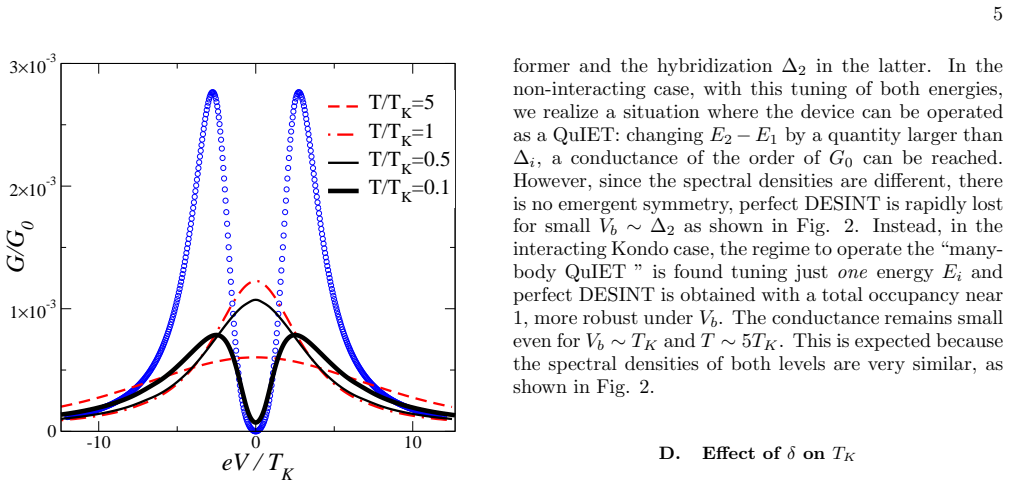
The authors show that in the Kondo regime, the main low-energy effect of electron-vibration coupling is a renormalization of one level's energy and hybridization, which breaks the SU(4) symmetry that protects perfect destructive interference. When the bare level splitting is tuned to a compensating value, the two low-energy spectral densities become almost identical near the Fermi level, so an emergent SU(4) symmetry is approximately restored. At zero temperature the conductance then follows a Fermi-liquid formula that vanishes when the two level occupancies are equal; tuning the splitting to equalize the occupancies restores total destructive interference. The same restoration is found numerically for strongly asymmetric couplings to the leads, where no symmetry argument applies. The resulting conductance remains below $10^{-6}$ G0 for bias voltages and temperatures up to about four times the Kondo temperature, and rises by more than three orders of magnitude when the splitting moves away by more than the Kondo temperature.
Load-bearing premise
The numerical results rely entirely on the noncrossing approximation, which is benchmarked only on simpler models and never on the full Kondo-plus-vibration-plus-interference problem; if that approximation exaggerates how similar the two spectral densities become, the predicted restoration of near-zero conductance could vanish.
Editorial extensions
If this is right
- A molecular transistor based on destructive interference can operate in the Kondo regime with a conductance contrast of more than six orders of magnitude, controlled by a single gate or stretch parameter.
- The restored zero-conductance state survives finite bias and temperature up to a few times the Kondo temperature, making it more robust than its noninteracting counterpart, which loses perfect destructive interference for bias voltages of order the hybridization.
- The effect works for strongly asymmetric lead couplings, a common situation in real molecular junctions, so it is not limited to idealized symmetric contacts.
- Vibrations do not simply destroy interference; at low temperatures their main effect is a renormalization that can be compensated by tuning the level splitting, so quasi-degenerate levels remain useful for quantum interference effect transistors.
- A concrete experimental signature is a sharp dip in the conductance as the level splitting is tuned through the restoring value, with conductance below 10^-6 G0 for bias and temperature up to about four times the Kondo temperature.
Reading between the lines
- If the emergent-symmetry mechanism is generic, similar restoration of destructive interference should occur in other multilevel systems where vibrations renormalize one level more than the others, such as double quantum dots with valley or pseudospin degrees of freedom.
- The equal-occupancy condition suggests a practical experimental protocol: measure the two level occupancies with charge sensing while tuning the splitting, and the zero-conductance point should coincide with equal occupations.
- A testable extension is to include a second phonon mode or a finite vibration lifetime; the restoration may persist only while temperature and bias remain below the vibration energy, so devices would need low-temperature operation.
- The effect might survive a finite rather than infinite Coulomb repulsion, but the paper does not treat that case, so whether the restored zero-conductance window narrows or shifts would require an additional calculation.
Signed reviews
Editorial analysis
A structured set of objections, weighed in public.
Referee Report
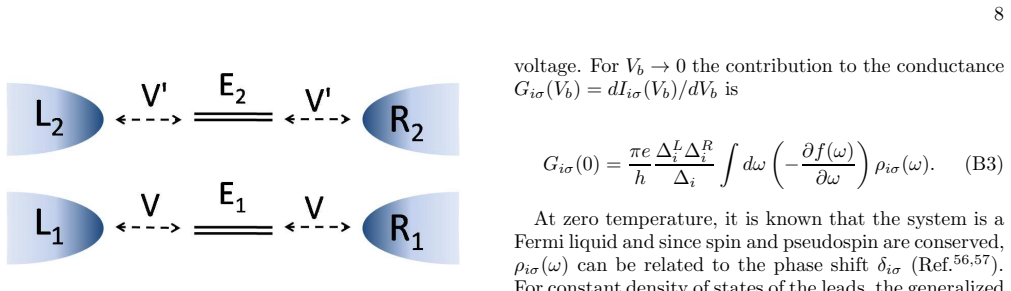
Summary. The manuscript studies resonant transport through a two-orbital molecular junction with opposite-parity levels, infinite Coulomb repulsion, and a Holstein phonon coupled to one level. In the absence of vibrations the model has a zero-bias destructive-interference null at level degeneracy delta=0; the paper shows with the noncrossing approximation (NCA) that the electron-vibration coupling lifts this null, but that tuning the level splitting to a specific value delta_res restores the conductance to values below 10^-6 G0. The restoration is interpreted as the emergence of approximate SU(4) symmetry at low energies, and the authors argue that the restored null is robust over a voltage window |V_b| up to a few T_K and temperatures up to about T_K, for both symmetric and strongly asymmetric lead couplings. Analytic support is given by a Fermi-liquid formula for the zero-temperature conductance and by a unitary transformation that maps the delta=0 interference model to a multi-channel Anderson model; an appendix discusses the relevance to annulene molecules.
Significance. If correct, the central claim is significant: it identifies a many-body mechanism, emergent low-energy SU(4) symmetry, that makes destructive quantum interference robust against both vibrations and moderate bias/temperature, in contrast to the fragile null of noninteracting junctions. The analytic results (Eq. (3), Appendix C, and the symmetry argument for the asymmetric lambda=0 case) are clean and provide a useful foundation. The numerical NCA results are internally consistent, and the comparison with the noninteracting limit is instructive. However, the headline quantitative statements—the 10^-6 conductance floor and the width of the plateau—are produced entirely by NCA for the full model and are not yet benchmarked against an exact or controlled method; the significance of the numerical part is therefore conditional. I do not regard the numerical search for delta_res as circular, because the nontrivial claim is the width of the restored-interference window rather than the existence of a zero, but the paper should state this more explicitly.
major comments (2)
- [II and III.E] Section II states that the transport is calculated within the noncrossing approximation (NCA), and the central quantitative claims in Sections III.C and III.E (G<10^-6 G0 over |eV_b|<4T_K and T<T_K) rest entirely on NCA for the full two-level Anderson-Holstein model. The validation cited in Section II covers only simpler limits: one Kondo level with phonons and two interfering levels without phonons. Because NCA is not a controlled expansion for this model (the symmetry is only SU(2) in the asymmetric case), the absolute depth of the conductance null and the width of the restored-interference plateau are not established. I request an independent check for at least the zero-temperature/zero-bias limit (for example, NRG or a comparable method combined with the Friedel sum rule), or a clear statement of the NCA uncertainty and a corresponding softening of the 10^-6 claim.
- [III.C] The finite-bias robustness of the restored null in the symmetric-leads case is demonstrated in Fig. 3 for a phonon-free model with renormalized parameters (lambda=0, Delta_1=0.941 Delta_2, delta=0.001499), not for the full Hamiltonian (1) at lambda>0. The argument that the full model behaves like this proxy relies on the similarity of the spectral densities in Fig. 2, but the quantitative statement about the plateau is not directly computed for the full model. Please provide direct G(V_b,T) results for the full model at delta=delta_res, or explicitly present Fig. 3 as a proxy and restrict the quantitative claims accordingly.
minor comments (6)
- [Eq. (4)] The integrand notation '(-d[f_L(omega)-f_L(omega)]/d omega)' appears to contain a typo; the second Fermi function should presumably be f_R, and the derivative should be defined with respect to the bias voltage. Please check and correct.
- [III.A] The symbol 'greaterorsimilar' should be a standard inequality (for example, ≳); as printed it is corrupted.
- [Appendix A] The phrase 'the model tales the same form as Eq. (A4)' should read 'takes'.
- [III.E] The sentence 'As shown by the numeric results. this continues to be true' has a punctuation and capitalization error after 'results.'
- [Fig. 1 caption] The sentence about triangles ('Triangles correspond to lambda=0 displaced in delta_res=0.005') is unclear and should explain what is displaced and why.
- [References and Appendix B] There are several typographical errors, including 'references therin' in Ref. 15 and 'explicitely' in Appendix B; these should be corrected.
Circularity Check
δ_res is tuned to the zero-conductance point, so the existence of the restored null is built into the numerical search, but the V/T robustness window is computed and not forced.
-
fitted input called prediction
[Section III B, Fig. 2 and accompanying text]
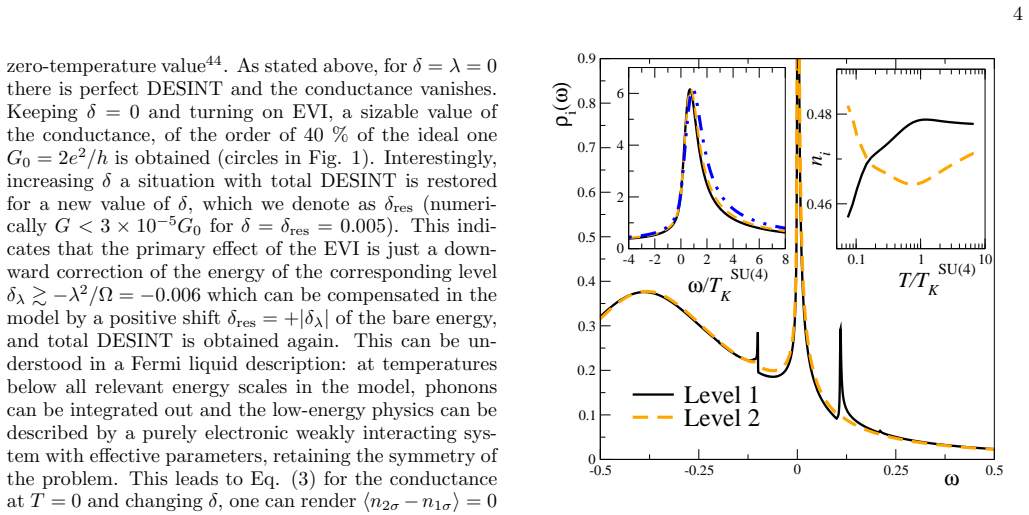
"In Fig. 2 we show both spectral densities ρiσ(ω) for these new parameters and δ = δres = 0.00903 adjusted so that they look very similar near the Fermi energy."
δ_res is chosen by imposing the condition that the two spectral densities look similar, equivalently that the occupations are equal, which makes G(0,0)=0 through Eq. (3). The subsequent statement that the Kondo peaks for both ρiσ(ω) are very similar and recall SU(4) symmetry is therefore a consequence of the adjustment, not an independent prediction. The nontrivial content, namely the width of the low-conductance plateau in Vb and T, is computed at that same δ and is not forced by the adjustment.
-
self definitional
[Section III A, paragraph after Fig. 1]
"a situation with total DESINT is restored for a new value of δ, which we denote as δres (numerically G < 3 × 10⁻⁵G0 for δ = δres = 0.005)."
δres is defined as the value at which G drops below 3×10⁻⁵G0, so reporting that G is below this threshold at δ=δres is a restatement of the definition. The existence of such a value is found by scanning δ rather than derived from the Hamiltonian; the physical content lies in the subsequent robustness window and in the approximate relation δres ≈ λ2/Ω, which are not definitional.
full rationale
The central independent content of the paper is the robustness window: with δ fixed at δ_res, G remains below about 10^-6 G0 for |eVb| < 4TK and T < TK, and changing δ by more than TK increases G by several orders of magnitude. That window is an NCA output, not an input of the calculation. The mild circularity is confined to how δ_res is selected: it is defined as the point where G vanishes or where the two spectral densities are adjusted to look similar, so the existence of that restoring point is built into the search rather than predicted from first principles. This does not collapse the central claim because the nontrivial voltage/temperature plateau is not implied by the equal-occupancy condition alone. The asymmetric-lead result is explicitly admitted by the authors to lack analytic proof ('we could not prove analytically that G(0,0)=0'); this is a correctness/support limitation, not a circularity. The authors' self-citations to prior NCA and SU(4) work are method validation and background; one of the two key references for emergent SU(4) symmetry, Ref. 31, is independent, and the NCA method is checked against experimental scaling of phonon sidebands. The absence of an exact benchmark for the full interference+Kondo+phonon model is a correctness risk, not a circular step. Overall, partial circularity of the δ_res construction lowers the score to 4, but the robustness claim retains substantial independent numerical content.
Assumptions & free parameters
free parameters (3)
- Restoring splitting delta_res (symmetric case, Fig. 1) =
0.005
- Restoring splitting delta_res (reduced hybridization case, Fig. 2) =
0.00903
- Restoring splitting delta_res (asymmetric case, Fig. 5) =
0.007
assumptions (6)
- domain assumption The noncrossing approximation (NCA) is quantitatively reliable for the combined Kondo, electron-vibration, and interference problem.
- domain assumption The on-site Coulomb repulsion U is infinite.
- ad hoc to paper The electron-vibration coupling acts only on level 1.
- domain assumption The conduction bands are flat with energy-independent hybridizations Delta_i.
- domain assumption At zero temperature the system is a Fermi liquid with conserved spin and pseudospin, so the Friedel sum rule applies.
- domain assumption The coupling signs V_L1=V_R1 and V_L2=-V_R2 describe the interference model.
Cite this review
Pith. "Pith review of Destructive quantum interference in transport through molecules with electron-electron and electron-vibration interactions." pith.science (2026). https://pith.science/paper/WAWTAHKM
@misc{pith2026190808894,
  author       = {Pith},
  title        = {Pith review of: Destructive quantum interference in transport through molecules with electron-electron and electron-vibration interactions},
  year         = {2026},
  howpublished = {\url{https://pith.science/paper/WAWTAHKM}},
  note         = {Machine review of arXiv:1908.08894}
}
read the original abstract
We study the transport through a molecular junction exhibiting interference effects. We show that these effects can still be observed in the presence of molecular vibrations if Coulomb repulsion is taken into account. In the Kondo regime, the conductance of the junction can be changed by several orders of magnitude by tuning the levels of the molecule, or displacing a contact between two atoms, from nearly perfect destructive interference to values of the order of 2e 2 /h expected in Kondo systems. We also show that this large conductance change is robust for reasonable temperatures and voltages for symmetric and asymmetric tunnel couplings between the source-drain electrodes and the molecular orbitals. This is relevant for the development of quantum interference effect transistors based on molecular junctions.
Figures

Figures from the paper (4 more)


Reference graph
Works this paper leans on
-
[1]
Aradhya S V and Venkataraman L, 2013 Nature Nanotechnology 8 399
work page 2013
-
[2]
Cuevas J C and Scheer E, 2010 Molecular Electronics: An Introduction to Theory and Experiment (World Scientific, Singapore)
work page 2010
-
[3]
Cardamone D, Stafford C, and Mazumdar S, 2006 Nano Lett. 6 2422
work page 2006
-
[4]
Quantum-Interference-Controlled Molecular Electronics, Ke S-H, Yang W, and Baranger H, 2008 Nano Lett. 8 3257
work page 2008
-
[5]
Begemann G, Darau D, Donarini A, and Grifoni M, 2008 Phys. Rev. B 77 201406(R); 78 089901(E)
work page 2008
-
[6]
Donarini A, Begemann G, and Grifoni M, 2009 Nano Lett. 9 2897
work page 2009
-
[7]
Rinc\' o n J, Hallberg K, Aligia A A, and Ramasesha S, 2009 Phys. Rev. Lett. 103 266807; references therein
work page 2009
-
[8]
Tosi L, Roura-Bas P, and Aligia A A, 2012 J. Phys. Condens. Matter 24 365301; references therein
work page 2012
Show all 59 references
-
[9]
Garner M H, Li H, Chen Y, Su T A, Shangguan Z, Paley D W, Liu T, Ng F, Li H, Xiao S, Nuckolls C, Venkataraman L, and Solomon G C, 2018 Nature 558 415
2018
-
[10]
Li Y, Buerkle M, Li G, Rostamian A, Wang H, Wang Z, Bowler D R, Miyazaki T, Xiang L, Asai Y, Zhou G, and Tao N, 2019 Nat. Mater. 18 357
2019
-
[11]
Bai J, Daaoub A, Sangtarash S, Li X, Tang Y, Zou Q, Sadeghi H, Liu S, Huang X, Tan Z, Liu J, Yang Y, Shi J, M\'esz\'aros G, Chen W, Lambert C, and Hong W, 2019 Nat. Mater. 18 364
2019
-
[12]
van Ruitenbeek J M, 2012 Physics 5 85
2012
-
[13]
Gu\'edon C M, Valkenier H, Markussen T, Thygesen K S, Hummelen J C, and van der Molen S J, 2012 Nature Nanotech. 7 305
2012
-
[14]
Ballmann S, H\"artle R, Coto P B, Elbing M, Mayor M, Bryce M R, Thoss M, and Weber H B, 2012 Phys. Rev. Lett. 109 056801
2012
-
[15]
Yu P, Koci\' c N, Repp J, Siegert B, and Donarini A, 2017 Phys. Rev. Lett. 119 056801; references therin
2017
-
[16]
Hewson A C, The Kondo Problem to Heavy Fermions (Cambridge University Press, Cambridge, England, 1997), ISBN 9780521599474
1997
-
[17]
Cronenwet S M, Oosterkamp T H and Kouwenhoven L P, 1998 Science 281 540
1998
-
[18]
Keller A J, Amasha S, Weymann I, Moca C P, Rau I G, Katine J A, Shtrikman H, Zar\'and G and Goldhaber-Gordon D, 2014 Nat. Phys. 10 145
2014
-
[19]
Liang W, Shores M P, Bockrath M, Long J R, and Park H, 2002 Nature 417 725
2002
-
[20]
Parks J J, Champagne A R, Costi T A, Shum W W, Pasupathy A N, Neuscamman E, Flores-Torres S, Cornaglia P S, Aligia A A, Balseiro C A, Chan G K -L, Abru\ n a H D and Ralph D C, 2010 Science 328 1370
2010
-
[21]
Florens S, Freyn A, Roch N, Wernsdorfer W, Balestro F, Roura-Bas P and Aligia A A, 2011 J. Phys. Condens. Matter 23 243202; references therein
2011
-
[22]
Park H, Park J, Lim A K L, Anderson E H, Alivisatos A P and McEuen P L, 2000 Nature 407 57
2000
-
[23]
Yu L H, Keane Z K, Ciszek J W, Cheng L, Stewart M P, Tour J M, and Natelson D, 2004 Phys. Rev. Lett. 93 266802
2004
-
[24]
Fern\'andez-Torrente I, Franke K J, and Pascual J I, 2008 Phys. Rev. Lett. 101 217203
2008
-
[25]
Rakhmilevitch D, Koryt\'ar R, Bagrets A, Evers F, and Tal O, 2014 Phys. Rev. Lett. 113 236603
2014
-
[26]
Iancu V, Schouteden K, Li Z, and Van Haesendonck C, 2016 Chem. Commun. 52 11359
2016
-
[27]
H\"artle R, Butzin M, Rubio-Pons O, and Thoss M, 2011 Phys. Rev. Lett. 107 046802
2011
-
[28]
H\"artle R, Butzin M, and Thoss M, 2013 Phys. Rev. B 87 085422
2013
-
[29]
Roura-Bas P, Tosi L, Aligia A A, and Hallberg K, 2011 Phys. Rev. B 84 073406
2011
-
[30]
Phys.: Condens
Tosi L, Roura-Bas P, and Aligia A A, 2015 J. Phys.: Condens. Matter 27 335601
2015
-
[31]
Nishikawa Y, Curtin O J, Hewson A C, Crow D J G, and Bauer J, 2016 Phys. Rev. B 93 235115
2016
-
[32]
Roura-Bas P, Tosi L and Aligia A A, 2013 Phys. Rev. B 87 195136; references therein
2013
-
[33]
Roura-Bas P, Tosi L, and Aligia A A, 2016 Phys. Rev. B 93 115139
2016
-
[34]
Cornaglia P S, Ness H, and Grempel D R, 2004 Phys. Rev. Lett. 93 147201
2004
-
[35]
Paaske J and Flensberg K, 2005 Phys. Rev. Lett. 94 176801
2005
-
[36]
Phys.: Condens
Hewson A C and Meyer D, 2002 J. Phys.: Condens. Matter 14 427
2002
-
[37]
Arrachea L and Rozenberg M J, 2005 Phys. Rev. B 72 041301(R)
2005
-
[38]
Cornaglia P S, Usaj G, and Balseiro C A, 2007 Phys. Rev. B 76 241403(R)
2007
-
[39]
Z itko R and Pruschke Th, 2009 Phys. Rev. B 79 085106
2009
-
[40]
Monreal R C and Martin-Rodero A, 2009 Phys. Rev. B 79 115140
2009
-
[41]
Yang K H, Wu Y P, and Zhao Y L, 2010 Europhys. Lett. 89 37008
2010
-
[42]
Wingreen N S and Meir Y, 1994 Phys. Rev. B 49 11040
1994
-
[43]
Hettler M H, Kroha J and Hershfield S, 1998 Phys. Rev. B 58 5649
1998
-
[44]
Roura-Bas P, 2010 Phys. Rev. B 81 155327
2010
-
[45]
Tettamanzi G C, Verduijn J, Lansbergen G P, Blaauboer M, Calder\' o n M J, Aguado R, and Rogge S, 2012 Phys. Rev. Lett. 108 046803
2012
-
[46]
Oguri A, 2005 J. Phys. Soc. Jpn. 74 110; references therein
2005
-
[47]
Aligia A A, 2018 J. Phys. Condens. Matter 30 155304 (2018); references therein
2018
-
[48]
P\'erez Daroca D, Roura-Bas P, and Aligia A A, 2018 Phys. Rev. B 98 245406
2018
-
[49]
Lim J S, Choi M -S, Choi M Y, L\'opez R, and Aguado R, 2006 Phys. Rev. B 74 205119
2006
-
[50]
Tosi L, Roura-Bas P, and Aligia A A, 2012 Physica B 407 3259
2012
-
[51]
Anders F B, Logan D E, Galpin M R, and Finkelstein G, 2008 Phys. Rev. Lett. 100 086809
2008
-
[52]
Then we have calculated only equilibrium properties
For these parameters = 10 and =0.05 , the non-equilibrium calculations turned out to be very cumbersome. Then we have calculated only equilibrium properties. They suffice to show the effects on the EVI on T_K
-
[53]
Khedri A, Costi T A, and Meden V, 2017 Phys. Rev. B 96 195155
2017
-
[54]
Meir Y and Wingreen N S, 1992 Phys. Rev. Lett. 68 2512
1992
-
[55]
Fern\'andez J, Lisandrini F, Roura-Bas P, Gazza C, and Aligia A A, 2018 Phys. Rev. B 97 045144; references therein
2018
-
[56]
Yoshimori A and Zawadowski A, 1982 J. Phys. C 15 5241
1982
-
[57]
Langreth D C, 1966 Phys. Rev. 150 516
1966
-
[58]
Datta S, Electronic transport in mesoscopic systems (Cambridge University Press, Cambridge, England, 2003)
2003
-
[59]
Pustilnik M and Glazman L I, 2001 Phys. Rev. Lett. 87 216601
2001
Reviewed August 14, 2026 · model on record in the stance chip above.
Discussion (0). Continue with ORCID to comment.