REVIEW 4 major objections 4 minor 23 references
Trajectory Prediction by Coupling Scene-LSTM with Human Movement LSTM
T0 review · 4 major / 4 minor · reviewed 2026-08-14 · deepseek-v4-flash
Pith's one-line read Scene-LSTM couples a two-level scene grid of common paths with per-pedestrian LSTM motion to beat social-interaction models on five benchmark datasets.
desk verdict The scene-memory idea is real, but the quantitative story collapses when you notice the same LSTM model is reported as 0.66 and 1.74 ADE across two tables. read the letter →
The pith
A machine-rendered reading of the paper's core claim, the machinery that carries it, and where it could break.
The reading
What carries the argument
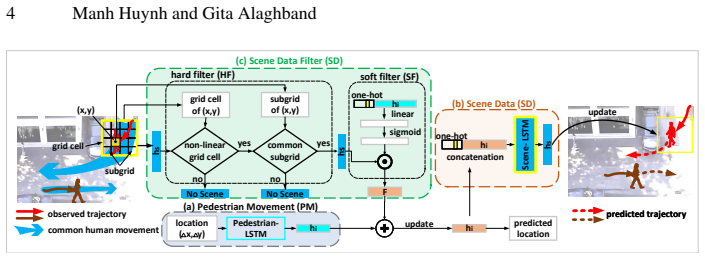
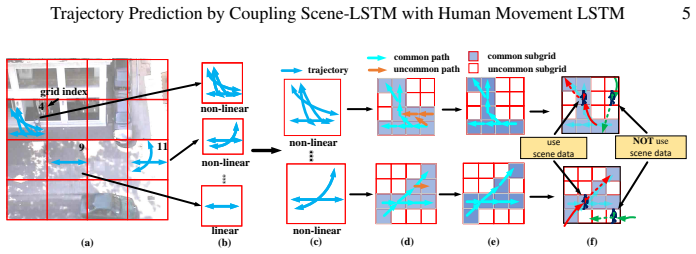
The load-bearing mechanism is the two-level grid paired with the Scene Data Filter. Each grid cell carries a Scene-LSTM whose memory represents how people move through that cell; a cell is labeled linear if all training trajectories inside it are straight, and in linear cells the scene memory is ignored because the Pedestrian-LSTM alone suffices. For non-linear cells, an $m\times m$ subgrid parses each trajectory into subgrid paths, and paths traveled by more than $p=3$ pedestrians define 'common subgrids' that the hard filter treats as trustworthy. A soft filter then gates the selected cell memory with a sigmoid vector derived from the pedestrian's current subgrid and LSTM state, so the scene influence is tuned to the individual's recent behavior. The filtered scene vector is added to the pedestrian hidden state before a bivariate Gaussian is sampled for the next displacement; this coupling is what lets common local motion steer predictions without contaminating them with rare trajectories.
What would settle it
Swap the training and testing halves of each video in Stage 2 (train on the second 50% of frames, test on the first 50%). If the ADE and FDE gains over the Pedestrian-LSTM-only model shrink or disappear, then the hard filter is exploiting the particular half of the video rather than a stable property of the scene.
Extended reading notes
Core claim
The central claim is that a static scene's commonly traveled paths, encoded in a grid of LSTM cells, are sufficient to beat models built on social interaction. Each grid cell's Scene-LSTM is updated with the concatenation of a one-hot vector marking the pedestrian's subgrid position and that pedestrian's LSTM hidden state, so the cell memory accumulates typical local motion. The hard filter classifies each cell as linear or non-linear at preprocessing time; only non-linear cells are kept, their trajectories are parsed into subgrid paths, and only subgrids shared by more than $p=3$ pedestrians count as common. At prediction time, a pedestrian whose current subgrid is common receives the cell's hidden state, and the soft filter element-wise multiplies that state with a sigmoid gate computed from the one-hot location and the pedestrian hidden state, then adds the result into the pedestrian hidden state before sampling the next displacement from a bivariate Gaussian. The authors report that this combined model reduces average ADE from 0.79 to 0.56 meters and FDE from 1.65 to 1.15 meters on the five ETH/UCY sequences, and outperforms the same comparison methods on Town Center, PETS09, and Grand Central.
Load-bearing premise
The load-bearing premise is that the common paths learned from the first half of a video's frames remain valid for the second half, so a pedestrian standing in a common subgrid can safely be steered by that learned path.
Editorial extensions
If this is right
- If the reported gains are real, trajectory prediction in static crowded scenes can rely primarily on scene-specific common paths, reducing the need for expensive social-interaction modeling.
- The two-level grid and hard/soft filtering can be recomputed from raw trajectories alone, so the method should transfer to a new static scene after a short re-training pass on half of the new video's frames.
- The ablation results imply that subgrid granularity is the controlling factor: too coarse a grid merges distinct paths, too fine a grid fragments them, and an 8x8 cell/subgrid split best captures common motion.
- For robotics and tracking applications that require one best-guess trajectory, the model's single sampled prediction with lower FDE means better long-horizon endpoint estimates than the compared single-trajectory baselines.
- On the three additional datasets, the improvements hold at longer horizons (6.4 seconds) as well as shorter ones, so the common-path signal is not only a short-range effect.
Reading between the lines
- A natural stress test is to make the hard filter time-aware: recompute common subgrids over a sliding window, which would let the model follow shifts in crowd flow after events or train arrivals rather than freezing the first half of the video.
- The same grid-plus-filter recipe could be applied to other agents, such as vehicles, cyclists, or warehouse robots, wherever recurring local paths dominate motion; the $p=3$ threshold would become a per-scene hyperparameter.
- The dependency on stage-2 training suggests an implicit test: if the scene memory is trained on a different time of day or on a disjoint set of pedestrians and the gain shrinks, the 'common' paths are partly person-specific rather than purely scene-specific.
- Combining the soft-filtered scene memory with a social pooling layer looks like the natural next architecture; the ablation's NDE numbers suggest the grid-level scene memory and the subgrid-level filter capture complementary parts of the error.
Signed reviews
Editorial analysis
A structured set of objections, weighed in public.
Referee Report
Summary. The paper proposes Scene-LSTM, a trajectory-prediction model that couples a per-pedestrian LSTM (Pedestrian-LSTM) with a scene-level LSTM (Scene-LSTM) operating on a two-level grid. A hard filter decides whether to use scene information based on whether the pedestrian is in a linear grid cell or a common subgrid path, and a soft filter selects the relevant scene memory via an attention-like gating mechanism. The model is evaluated on ETH, UCY, Town Center, PETS09, and Grand Central, reporting lower average ADE and FDE than baselines including Linear, LSTM, Social-LSTM, and SGAN variants. An ablation study isolates the contributions of relative coordinates, scene data, hard filter at grid/subgrid levels, and the soft filter.
Significance. If the quantitative claims are substantiated, the two-level grid scene memory with hard/soft filtering is a simple and interpretable alternative to visual-feature-based scene models, and the additional evaluation on Town Center, PETS09, and Grand Central is a useful generalization check. The paper's strengths include a clear problem formulation, a systematic ablation of PMabs vs PMrel, and explicit consideration of when scene data should or should not be used. However, the reported numerical comparisons are undermined by an internal inconsistency between the LSTM baseline in Table 1 and the identical PMrel model in Table 2, and by the absence of controlled hyperparameter selection, error bars, and significance tests. The central claim of a large improvement therefore is not yet supported as stated.
major comments (4)
- [§5.2, Table 2 vs §5.1, Table 1] PMrel in Table 2 is a per-pedestrian LSTM with relative displacement input and Gaussian output, which is the same model as the LSTM baseline in Table 1. Under the paper's stated protocol ('we apply the same training and testing procedures for all methods'), these numbers should agree or nearly agree, but they differ by 1.08 m ADE (0.66 vs 1.74) and 1.81 m FDE (1.36 vs 3.17). This discrepancy indicates that the Table 1 baselines were either not run under the same two-stage fine-tuning protocol or were taken from prior publications. Since PMrel alone comes within 0.10 ADE and 0.21 FDE of the full Scene-LSTM, the headline improvement from 0.79 to 0.56 ADE cannot be cleanly attributed to the scene-memory mechanism. The authors must rerun all baselines under the identical Stage 1 plus Stage 2 protocol and report consistent numbers.
- [§5.1, §5.4, Figure 5] The grid and subgrid sizes (selected as 8x8 in Figure 5b) and the stage-2 training fraction of 50% are tuned on the same five ETH/UCY videos used for the main results, with no held-out validation split. This selection on the test data can inflate reported gains. Additionally, no error bars, multiple seeds, or significance tests are reported, so the phrase 'significantly outperforms' is not statistically supported. Please fix hyperparameters using a separate validation set or nested cross-validation, and report variance and significance measures.
- [§4, Implementation Details, Hard filter] The hard filter's core decisions depend on unspecified algorithmic criteria: 'a grid cell is characterized as linear if all human trajectories in this grid cell are linear' and 'a common subgrid path is a path between two subgrids commonly travelled by a number of pedestrians greater than p = 3'. No precise definition of linearity (e.g., curvature threshold, number of points, fitting residual) or of how a trajectory is parsed into subgrid paths is provided. These details are load-bearing because they determine which scene data are used at prediction time, and without them the method cannot be reproduced or compared fairly.
- [§5.1, Table 1, NDE results] The average NDE advantage over SGAN-20V-1 (1.00 vs 1.36) is not consistent across sequences: on ETH-Univ Scene-LSTM is worse (1.88 vs 1.55) and on UCY-Zara02 it is also worse (0.93 vs 0.88). The paper acknowledges this qualitatively, but reporting only sequence-level numbers without error bars or significance tests leaves it unclear whether the average difference is meaningful. Per-sequence confidence intervals or a paired test over multiple seeds would clarify this.
minor comments (4)
- [Abstract and author affiliation] The abstract contains 'a pedestrians future locations' missing an apostrophe, and the author affiliation contains 'Univesity' and later 'filer' in the contributions list.
- [§5.4] The reported prediction horizons 'Tpred = 4.8 and 6.4 seconds' are not tied to the observed-frame length or the frame rates of Town Center, PETS09S2, and Grand Central; please specify the number of frames and frame rates for each dataset.
- [Figure 5] The red and blue lines mentioned in the text are not labeled directly in the figure; please add a legend and axis labels so the reader can interpret the grid/subgrid-size experiments.
- [§5, Metrics] The metrics are described as 'mean square error (Euclidean distance)', which is inaccurate because the reported values are average Euclidean distances, not squared errors; please rephrase to 'average Euclidean distance' or 'mean squared Euclidean distance' consistently.
Circularity Check
No meaningful circularity: Scene-LSTM predictions are evaluated on held-out frames, and no equation-level reduction of the reported predictions to fitted inputs or self-citations was found.
full rationale
The paper's derivation is self-contained in the sense required by the circularity check. The Scene-LSTM common-path model is trained on observed frames, and predictions are evaluated on remaining held-out frames. The hard filter's linear/non-linear labels and common subgrids are computed from the training portion of each video only, while the Scene-LSTM and Pedestrian-LSTM parameters are optimized by negative log-likelihood on training trajectories, not on the test trajectories. The two-stage protocol (leave-one-out pretraining followed by 10 epochs on 50% of the target video) is stated explicitly and, according to the paper, applied to all compared methods. The choice of grid and subgrid sizes via the benchmark error curves is a hyperparameter-selection procedure on the same datasets; this raises an overfitting-to-benchmark concern, but it is not an equation-level identity between an input and a reported prediction. The apparent inconsistency between PMrel (0.66 ADE) in Table 2 and the LSTM baseline (1.74 ADE) in Table 1 is a serious reporting or comparison problem, but it concerns whether baseline numbers were obtained under the same protocol, not a reduction of the central claim to its own inputs. No load-bearing self-citation or imported uniqueness theorem was found; the cited prior works are standard baselines and architecture sources, and the claimed improvements are not derived from those citations by construction.
Assumptions & free parameters
free parameters (5)
- grid_size =
8x8
- subgrid_size =
8x8
- common_path_threshold_p =
3
- hidden_state_size =
128
- stage2_training_fraction =
0.5
assumptions (4)
- domain assumption Grid cells with only linear trajectories are not affected by scene structure, so scene data should be ignored for them.
- domain assumption Pedestrians located in a common subgrid tend to follow the common path; scene memory helps them.
- domain assumption Common movement patterns learned from the first 50% of a video remain valid in the remaining 50% used for testing.
- standard math The bivariate Gaussian output distribution and negative log-likelihood loss are appropriate for trajectory prediction.
Cite this review
Pith. "Pith review of Trajectory Prediction by Coupling Scene-LSTM with Human Movement LSTM." pith.science (2026). https://pith.science/paper/2RMQSWAR
@misc{pith2026190808908,
  author       = {Pith},
  title        = {Pith review of: Trajectory Prediction by Coupling Scene-LSTM with Human Movement LSTM},
  year         = {2026},
  howpublished = {\url{https://pith.science/paper/2RMQSWAR}},
  note         = {Machine review of arXiv:1908.08908}
}
read the original abstract
We develop a novel human trajectory prediction system that incorporates the scene information (Scene-LSTM) as well as individual pedestrian movement (Pedestrian-LSTM) trained simultaneously within static crowded scenes. We superimpose a two-level grid structure (grid cells and subgrids) on the scene to encode spatial granularity plus common human movements. The Scene-LSTM captures the commonly traveled paths that can be used to significantly influence the accuracy of human trajectory prediction in local areas (i.e. grid cells). We further design scene data filters, consisting of a hard filter and a soft filter, to select the relevant scene information in a local region when necessary and combine it with Pedestrian-LSTM for forecasting a pedestrian's future locations. The experimental results on several publicly available datasets demonstrate that our method outperforms related works and can produce more accurate predicted trajectories in different scene contexts.
Figures

Figures from the paper (3 more)


Reference graph
Works this paper leans on
-
[1]
In: Proceedings of the IEEE conference on computer vision and pattern recognition
Alahi, A., Goel, K., Ramanathan, V ., Robicquet, A., Fei-Fei, L., Savarese, S.: Social lstm: Human trajectory prediction in crowded spaces. In: Proceedings of the IEEE conference on computer vision and pattern recognition. pp. 961–971 (2016)
work page 2016
-
[2]
In: European Conference on Computer Vision
Ballan, L., Castaldo, F., Alahi, A., Palmieri, F., Savarese, S.: Knowledge transfer for scene- specific motion prediction. In: European Conference on Computer Vision. pp. 697–713. Springer (2016)
work page 2016
-
[3]
In: International Conference on Pattern Recognition
Bartoli, F., Lisanti, G., Ballan, L., Del Bimbo, A.: Context-aware trajectory prediction. In: International Conference on Pattern Recognition. pp. 1941–1946. IEEE (2018)
work page 2018
- [4]
-
[5]
In: Twelfth IEEE International Workshop on Performance Evaluation of Tracking and Surveillance
Ferryman, J., Shahrokni, A.: Pets2009: Dataset and challenge. In: Twelfth IEEE International Workshop on Performance Evaluation of Tracking and Surveillance. pp. 1–6. IEEE (2009) 14 Manh Huynh and Gita Alaghband
work page 2009
-
[6]
In: Advances in neural information processing systems
Goodfellow, I., Pouget-Abadie, J., Mirza, M., Xu, B., Warde-Farley, D., Ozair, S., Courville, A., Bengio, Y .: Generative adversarial nets. In: Advances in neural information processing systems. pp. 2672–2680 (2014)
2014
-
[7]
In: Proceedings of the IEEE Conference on Computer Vision and Pattern Recognition
Gupta, A., Johnson, J., Fei-Fei, L., Savarese, S., Alahi, A.: Social gan: Socially acceptable trajectories with generative adversarial networks. In: Proceedings of the IEEE Conference on Computer Vision and Pattern Recognition. pp. 2255–2264 (2018)
work page 2018
-
[8]
arXiv preprint arXiv:1412.6980 (2014)
Kingma, D.P., Ba, J.: Adam: A method for stochastic optimization. arXiv preprint arXiv:1412.6980 (2014)
arXiv 2014
Show all 23 references
-
[9]
In: 29th IEEE Conference on Decision and Control
Leonard, J.J., Durrant-Whyte, H.F.: Application of multi-target tracking to sonar-based mo- bile robot navigation. In: 29th IEEE Conference on Decision and Control. pp. 3118–3123. IEEE (1990)
1990
-
[10]
In: Computer graphics forum
Lerner, A., Chrysanthou, Y ., Lischinski, D.: Crowds by example. In: Computer graphics forum. vol. 26, pp. 655–664. Wiley Online Library (2007)
2007
-
[11]
In: 2011 IEEE Intelligent Vehicles Symposium (IV)
Levinson, J., Askeland, J., Becker, J., Dolson, J., Held, D., Kammel, S., Kolter, J.Z., Langer, D., Pink, O., Pratt, V ., et al.: Towards fully autonomous driving: Systems and algorithms. In: 2011 IEEE Intelligent Vehicles Symposium (IV). pp. 163–168. IEEE (2011)
2011
-
[12]
In: 2018 15th Conference on Computer and Robot Vision (CRV)
Manh, H., Alaghband, G.: Spatiotemporal ksvd dictionary learning for online multi-target tracking. In: 2018 15th Conference on Computer and Robot Vision (CRV). pp. 150–157. IEEE (2018)
2018
-
[13]
PyTorch: Tensors and dynamic neural net- works in Python with strong GPU acceleration 6 (2017)
Paszke, A., Gross, S., Chintala, S., Chanan, G.: Pytorch: Tensors and dynamic neural net- works in python with strong gpu acceleration. PyTorch: Tensors and dynamic neural net- works in Python with strong GPU acceleration 6 (2017)
2017
-
[14]
In: Computer Vision, 2009 IEEE 12th International Conference on
Pellegrini, S., Ess, A., Schindler, K., Van Gool, L.: You’ll never walk alone: Modeling so- cial behavior for multi-target tracking. In: Computer Vision, 2009 IEEE 12th International Conference on. pp. 261–268. IEEE (2009)
2009
-
[15]
In: European conference on computer vision
Robicquet, A., Sadeghian, A., Alahi, A., Savarese, S.: Learning social etiquette: Human tra- jectory understanding in crowded scenes. In: European conference on computer vision. pp. 549–565. Springer (2016)
2016
-
[16]
In: 2010 IEEE/RSJ International Conference on Intelligent Robots and Systems
Trautman, P., Krause, A.: Unfreezing the robot: Navigation in dense, interacting crowds. In: 2010 IEEE/RSJ International Conference on Intelligent Robots and Systems. pp. 797–803. IEEE (2010)
2010
-
[17]
arXiv preprint arXiv:1705.09436 (2017)
Varshneya, D., Srinivasaraghavan, G.: Human trajectory prediction using spatially aware deep attention models. arXiv preprint arXiv:1705.09436 (2017)
2017 arXiv
-
[18]
In: IEEE International Conference on Robotics and Automation (ICRA)
Vemula, A., Muelling, K., Oh, J.: Social attention: Modeling attention in human crowds. In: IEEE International Conference on Robotics and Automation (ICRA). pp. 1–7. IEEE (2018)
2018
-
[19]
IEEE Transactions on Intelligent Transportation Systems 19(2), 582–597 (2017)
Vivacqua, R.P.D., Bertozzi, M., Cerri, P., Martins, F.N., Vassallo, R.F.: Self-localization based on visual lane marking maps: An accurate low-cost approach for autonomous driv- ing. IEEE Transactions on Intelligent Transportation Systems 19(2), 582–597 (2017)
2017
-
[20]
In: Proceedings of the IEEE Conference on Computer Vision and Pattern Recognition
Xu, Y ., Piao, Z., Gao, S.: Encoding crowd interaction with deep neural network for pedes- trian trajectory prediction. In: Proceedings of the IEEE Conference on Computer Vision and Pattern Recognition. pp. 5275–5284 (2018)
2018
-
[21]
In: 2018 IEEE Winter Conference on Applications of Computer Vision (W ACV)
Xue, H., Huynh, D.Q., Reynolds, M.: Ss-lstm: a hierarchical lstm model for pedestrian tra- jectory prediction. In: 2018 IEEE Winter Conference on Applications of Computer Vision (W ACV). pp. 1186–1194. IEEE (2018)
2018
-
[22]
Yamaguchi, K., Berg, A.C., Ortiz, L.E., Berg, T.L.: Who are you with and where are you going? In: CVPR 2011. pp. 1345–1352. IEEE (2011)
2011
-
[23]
In: 2012 IEEE Conference on Computer Vision and Pattern Recognition
Zhou, B., Wang, X., Tang, X.: Understanding collective crowd behaviors: Learning a mixture model of dynamic pedestrian-agents. In: 2012 IEEE Conference on Computer Vision and Pattern Recognition. pp. 2871–2878. IEEE (2012)
2012
Reviewed August 14, 2026 · model on record in the stance chip above.
Discussion (0). Continue with ORCID to comment.