REVIEW 3 major objections 5 minor 1 cited by
Human activity recognition from skeleton poses
T0 review · 3 major / 5 minor · reviewed 2026-08-14 · deepseek-v4-flash
Pith's one-line read A plain nearest-neighbour classifier on hip-centred mirrored skeleton poses beats three more complex activity-recognition methods in leave-one-subject-out tests.
desk verdict Useful, code-releasing baseline comparison on CAD-60, but the headline accuracy metric is ambiguous and the KNN-vs-gas ranking may not survive a pose-weighted recomputation. read the letter →
The pith
A machine-rendered reading of the paper's core claim, the machinery that carries it, and where it could break.
The reading
What carries the argument
The argument is carried by the preprocessing pipeline and the evaluation protocol rather than by a single theorem. Each skeleton is represented as a vector of $3J$ joint coordinates; centring the pose at the hips removes translation, and concatenating the pose with its mirror image across the X-axis doubles the data and encodes left-right symmetry. An optional further step normalises the skeleton by the neck-to-torso distance. For the gas classifiers, prototype poses are learned and then labelled with a 1-nearest-neighbour rule, while for KNN the full labelled training set is kept. Global accuracy is computed as the mean over scenes of the mean over subjects of the confusion-matrix trace divided by the number of poses, and the paper reports per-scene precision and recall for the winning classifier.
What would settle it
Run GNG and GWR on the same centred-and-mirrored skeleton features under leave-one-subject-out cross-validation with a systematic hyperparameter search over node counts, epochs, thresholds, and sliding-window lengths; if either model exceeds 83.02% global accuracy, the central claim that the simple KNN is the best method fails. A second check would be to repeat the comparison on a larger multi-subject data-set and see whether the KNN margin persists under real unseen-user conditions.
Extended reading notes
Core claim
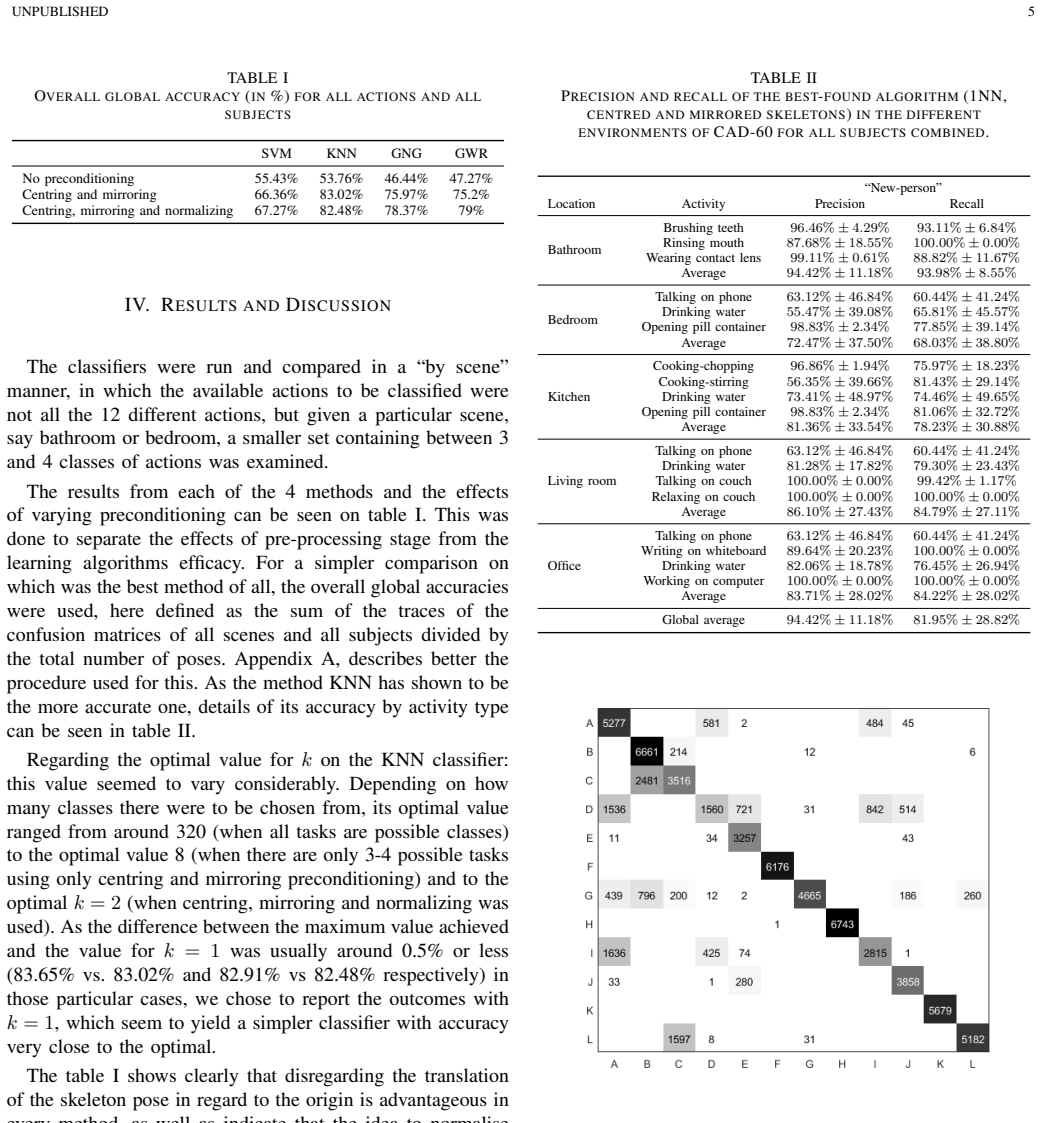
The central discovery is a replication result: under leave-one-subject-out evaluation on the CAD-60 data-set, the 1-nearest-neighbour classifier applied to skeleton poses that are centred at the hips and mirrored across the sagittal plane reaches 83.02% global accuracy. The hierarchical growing-when-required neural gas reaches 79%, the growing neural gas reaches 78.37%, and the support vector machine reaches 67.27% under the same preconditioning, making the simplest method the most accurate. The paper interprets this as evidence of diminishing returns: the added machinery of gas-based prototype learning did not translate into better accuracy in this implementation, so simpler classifiers deserve priority in activity recognition for assistive robotics.
Load-bearing premise
The paper's strongest result depends on the gas classifiers being tested with representative parameters, and the authors state that they tuned them manually and cannot rule out that better-tuned GNG or GWR models would perform much better.
Editorial extensions
If this is right
- A caregiver robot can recognize common indoor activities from a single current skeleton pose, with classification updates possible every 33 ms or faster.
- The best classifier's accuracy drops to 80.36% when all twelve actions are considered together rather than restricted to a scene, so scene context is an important lever for performance.
- Centring skeleton poses at the hips should be a default preprocessing step, since it improved every classifier in the comparison.
- Gas-based classifiers did not justify their tuning cost and stochasticity on this data-set, making simpler pipelines a defensible first choice for similar skeleton-based activity recognition.
- Per-subject variability remains large for some activities, so real deployments should be validated across new users rather than only on average accuracy.
Reading between the lines
- The mirroring step nearly doubles the training set, so an ablation without mirroring would show whether the gain comes from symmetry augmentation or from centring alone.
- The KNN margin may depend on the dense 30 fps sampling of the data-set; testing with temporally subsampled poses would reveal whether single-frame nearest-neighbour still holds its advantage.
- The simplicity argument could be tested on newer data-sets with more joints and larger subject pools, where the noisy 15-joint skeleton representation that KNN tolerates may behave differently.
Signed reviews
Editorial analysis
A structured set of objections, weighed in public.
Referee Report
Summary. The paper compares four classifiers for human activity recognition from Kinect skeleton data on the CAD-60 dataset: SVM, k-nearest neighbors (KNN), and two hierarchical neural gas methods (GNG and GWR). Using a leave-one-subject-out protocol and a by-scene evaluation, the authors report global accuracies under three preprocessing conditions (none, centering and mirroring, and centering plus mirroring plus normalization). Their central empirical claim, stated in the conclusion, is that the simplest method—1NN with centered skeletons—achieves the best overall accuracy (83.02%) on their implementation, outperforming the more complex GWR and GNG approaches. The paper also discusses internal and external validity, acknowledges the limitations of manual hyperparameter tuning and the stochasticity of gas methods, and provides the MATLAB code as a reproducibility artifact.
Significance. If the comparison is valid, the finding that a simple 1NN baseline beats hierarchical neural gas classifiers on CAD-60 under a standard leave-one-subject-out protocol is a useful and potentially cautionary result for the HAR community, where complex learned representations are often assumed to be necessary. The paper's strengths include: (i) the use of a standard evaluation protocol (leave-one-subject-out, by-scene), (ii) explicit reporting of per-class precision/recall with standard deviations and honest discussion of failure cases, (iii) acknowledgment of the tuning asymmetry between methods rather than overselling the gas classifiers, and (iv) release of the code. The conclusion, however, rests entirely on the numeric ranking in Table I, and that ranking is currently undermined by an inconsistency in the definition of the reported accuracy metric and by the acknowledged non-exhaustive tuning of the gas methods. The result is potentially important but needs a more defensible quantitative basis before it can be accepted as stated.
major comments (3)
- [Section IV vs. Appendix A] The definition of the reported global accuracy is inconsistent and this is load-bearing for the central claim. Section IV states that the overall global accuracy is 'the sum of the traces of the confusion matrices of all scenes and all subjects divided by the total number of poses.' Appendix A instead defines A_method as a double average: first over the four subjects via Eq. (3), then over scenes via Eq. (4), with each scene-subject confusion matrix trace normalized by that scene-subject's pose count. These two formulas coincide only if every scene-subject pair contains the same number of poses, which is not the case in CAD-60. If Table I was produced with the Appendix A formula, the headline 83.02% is a macro-average, not the pose-weighted global accuracy described in Section IV, and the ranking in Table I could change when recomputed with the Section IV definition. The authors must recompute Table I with a single, clearly stated formula and report whether the KNN-vs-GWR ordering survives the correct pose-weighted computation.
- [Section III-G and IV-A] The comparison is not yet conclusive because the gas-based methods were not optimized to the same extent as the other classifiers, and the authors explicitly concede this. Section III-G states that GNG 'was not optimised, as the method its implementation is much slower than all others,' and Section IV-A acknowledges that 'we cannot guarantee for some of the models ... that the same algorithms with a few tweaks are not going to perform much better.' Since the paper's conclusion is that simpler methods are preferable to more complex ones, the burden is on showing that the GWR and GNG results are representative of those methods' capabilities. The authors should either (i) provide evidence that the chosen hyperparameters are near the achievable optimum (e.g., a small sensitivity study around the reported values), or (ii) soften the conclusion to a claim about 'these implementations with these settings' rather than about the methods in general.
- [Table I and Section V] The global accuracies in Table I are reported without error bars, confidence intervals, or significance tests, and Table II shows extreme per-class variability (e.g., 55.47% ± 39.08% for drinking water in the bedroom). With only four test subjects, the 3.9-percentage-point gap between 1NN (83.02%) and the best GWR result (79.00%) under the same preprocessing may not be statistically meaningful. The conclusion 'the simple KNN ... gives results that are on our implementation the best accuracy overall' requires at least a paired test across the four folds (e.g., per-subject accuracies for 1NN vs. the best gas variant) to rule out that the ranking is driven by one subject or by stochastic gas training. Reporting per-subject global accuracies would be a minimal, feasible addition.
minor comments (5)
- [Table II] The row 'Global average' in Table II appears to repeat the Bathroom 'Brushing teeth' precision value (94.42% ± 11.18%) instead of an actual global average over all scenes; this should be corrected.
- [Section III-C] There is a typo in Section III-C: 'the skeleton has its mid-sagittal plane passing the origin and its normal vector on X-axis direction' should probably read '... passing through the origin and with its normal vector along the X-axis direction.' The sentence is understandable but should be cleaned up.
- [Section IV] The text refers to 'Fig. 1' (the combined confusion matrix) and describes it, but no figure content is present in the manuscript text; the figure must be included in the submission.
- [Section III-F] The phrase 'an inclusion parameter aT = 1 and nodes = ∞ , the GNG and the GWR would degenerate into a KNN' is unclear without a definition of aT and nodes in that paragraph; a brief explanation of how these parameters control node insertion would help the reader.
- [References] Several references (e.g., [4], [6], [17], [31], [32]) lack complete bibliographic information such as year and page numbers; the reference list should be completed for reproducibility.
Circularity Check
Empirical comparison with no derivation chain; minor self-citation not load-bearing.
full rationale
The paper's central claim is an empirical comparison of classifiers on CAD-60. There is no derivation in which a predicted quantity is defined from its inputs or in which a fitted parameter is renamed as a prediction. The reported accuracies are computed from confusion matrices on held-out subjects, so the ranking is not forced by construction. The one self-citation, [21] (Klein, Štěpánová, and Cangelosi), reports a prior GWR accuracy on the same dataset and is contextual; the current GWR implementation is based on Parisi et al. and Marsland, and the KNN result does not rest on [21]. The acknowledged manual hyperparameter search and the inconsistency between the Section IV definition of overall accuracy (pose-weighted sum of traces) and the Appendix A macro-averaged formula are validity/fairness concerns, not circularity: they do not make the output equal an input by definition. Hence no significant circularity, with only a minor, non-load-bearing self-citation.
Assumptions & free parameters
free parameters (6)
- KNN k =
1 (with observed optimal values of 2, 8, and 320 depending on setup)
- GWR activity threshold aT =
0.995
- GWR maximum nodes =
1000
- GWR epochs =
10
- GNG parameters =
lambda=3, eps_b=0.2, eps_n=0.006, a_max=1, d=0.995
- Sliding window size for gas layers =
3
assumptions (4)
- domain assumption CAD-60 Kinect skeleton joints (15 joint positions) are sufficiently accurate and complete for activity recognition.
- domain assumption Leave-one-subject-out evaluation is a valid proxy for generalization to new users.
- domain assumption Euclidean distance in the 3J-dimensional skeleton pose space is an appropriate similarity measure.
- domain assumption Classifying by scene with only 3-4 possible actions is a valid evaluation setup.
Cite this review
Pith. "Pith review of Human activity recognition from skeleton poses." pith.science (2026). https://pith.science/paper/S6WR4EP5
@misc{pith2026190808928,
  author       = {Pith},
  title        = {Pith review of: Human activity recognition from skeleton poses},
  year         = {2026},
  howpublished = {\url{https://pith.science/paper/S6WR4EP5}},
  note         = {Machine review of arXiv:1908.08928}
}
read the original abstract
Human Action Recognition is an important task of Human Robot Interaction as cooperation between robots and humans requires that artificial agents recognise complex cues from the environment. A promising approach is using trained classifiers to recognise human actions through sequences of skeleton poses extracted from images or RGB-D data from a sensor. However, with many different data-sets focused on slightly different sets of actions and different algorithms it is not clear which strategy produces highest accuracy for indoor activities performed in a home environment. This work discussed, tested and compared classic algorithms, namely, support vector machines and k-nearest neighbours, to 2 similar hierarchical neural gas approaches, the growing when required neural gas and the growing neural gas.
Figures
Forward citations
Cited by 1 Pith paper
-
Context and Symmetry in Auditing: A Case Study of Skeleton Inference in Motion Capture
A new AI auditing method, the contextual audit, treats each measurement modality as provisionally true and is demonstrated on a motion-capture skeleton inference case study.
Reference graph
Works this paper leans on
-
[1]
Self-organizing neural integration of pose-motion features for human action recognition,
G. I. Parisi, C. Weber, and S. Wermter, “Self-organizing neural integration of pose-motion features for human action recognition,” Frontiers in Neurorobotics , vol. 9, Jun. 2015. [Online]. Available: http://journal.frontiersin.org/Article/10.3389/fnbot.2015.00003/abstract
arXiv 2015
-
[2]
A survey of video datasets for human action and activity recognition,
J. M. Chaquet, E. J. Carmona, and A. Fern ´andez-Caballero, “A survey of video datasets for human action and activity recognition,” Computer Vision and Image Understanding , vol. 117, no. 6, pp. 633–659, Jun
-
[3]
RGB-D-based Action Recognition Datasets: A Survey
J. Zhang, W. Li, P. O. Ogunbona, P. Wang, and C. Tang, “RGB- D-based Action Recognition Datasets: A Survey,” arXiv preprint arXiv:1601.05511, 2016. [Online]. Available: http://arxiv.org/abs/1601. 05511
work page Pith review arXiv 2016
-
[4]
Human activities recognition using depth images,
R. Gupta, A. Y .-S. Chia, and D. Rajan, “Human activities recognition using depth images,” in Proceedings of the 21st ACM international conference on Multimedia . ACM, pp. 283–292. [Online]. Available: http://dl.acm.org/citation.cfm?id=2502099
-
[5]
3d human action segmentation and recognition using pose kinetic energy,
J. Shan and S. Akella, “3d human action segmentation and recognition using pose kinetic energy,” in Advanced Robotics and its Social Impacts (ARSO), 2014 IEEE Workshop on . IEEE, pp. 69–75. [Online]. Available: http://ieeexplore.ieee.org/abstract/document/7020983/
-
[6]
D. R. Faria, C. Premebida, and U. Nunes, “A probabilistic approach for human everyday activities recognition using body motion from RGB- d images,” in The 23rd IEEE International Symposium on Robot and Human Interactive Communication , pp. 732–737
-
[7]
A human activity recognition system using skeleton data from RGBD sensors,
E. Cippitelli, S. Gasparrini, E. Gambi, and S. Spinsante, “A human activity recognition system using skeleton data from RGBD sensors,” vol. 2016, pp. 1–14. [Online]. Available: http://www.hindawi.com/ journals/cin/2016/4351435/
work page 2016
-
[8]
OpenPose: Real-time multi-person keypoint detection library for body, face, and hands estimation
“OpenPose: Real-time multi-person keypoint detection library for body, face, and hands estimation.” [Online]. Available: https: //github.com/CMU-Perceptual-Computing-Lab/openpose
Show all 35 references
-
[9]
Falls: Epidemiology, pathophysiology, and relationship to fracture,
S. D. Berry and R. Miller, “Falls: Epidemiology, pathophysiology, and relationship to fracture,” vol. 6, no. 4, pp. 149–154. [Online]. Available: https://www.ncbi.nlm.nih.gov/pmc/articles/PMC2793090/
-
[10]
Epidemiology of falls,
T. Masud and R. O. Morris, “Epidemiology of falls,” Age and ageing , vol. 30, no. suppl 4, pp. 3–7, 2001
2001
-
[11]
Early diagnosis of parkinson’s disease,
A. Gaenslen and D. Berg, “Early diagnosis of parkinson’s disease,” in International Review of Neurobiology , ser. Transcranial Sonography in Movement Disorders, D. Berg and U. Walter, Eds. Academic Press, vol. 90, pp. 81–92, DOI: 10.1016/S0074-7742(10)90006-
-
[12]
Unbiased and mobile gait analysis detects motor impairment in parkinson’s disease,
J. Klucken, J. Barth, P. Kugler, J. Schlachetzki, T. Henze, F. Marxreiter, Z. Kohl, R. Steidl, J. Hornegger, B. Eskofier, and J. Winkler, “Unbiased and mobile gait analysis detects motor impairment in parkinson’s disease,” vol. 8, no. 2, p. e56956. [Online]. Available: http: //...
-
[13]
Available: http://www.sciencedirect.com/science/article/pii/ S0074774210900068
[Online]. Available: http://www.sciencedirect.com/science/article/pii/ S0074774210900068
-
[14]
Di Lenarda, G
A. Di Lenarda, G. Casolo, M. M. Gulizia, N. Aspromonte, S. Scalvini, A. Mortara, G. Alunni, R. P. Ricci, R. Mantovan, G. Russo, G. F. Gensini, and F. Romeo, “The future of telemedicine for the management of heart failure patients: a consensus document of the italian associatio...
-
[15]
L. G. MD and A. I. S. MD, Goldman-Cecil Medicine, 2-Volume Set, 25e (Cecil Textbook of Medicine). Elsevier, 2015. [Online]. Available: https: //www.amazon.com/Goldman-Cecil-Medicine-Set-Cecil-Textbook/ dp/1455750174?SubscriptionId=0JYN1NVW651KCA56C102& tag=techkie-20&linkCode=...
2015
-
[16]
Respiratory applications of telemedicine,
C. B. Cooper, “Respiratory applications of telemedicine,” vol. 64, no. 3, pp. 189–191. [Online]. Available: http://thorax.bmj.com/content/ 64/3/189
-
[17]
Stroke telemedicine,
B. M. Demaerschalk, M. L. Miley, T.-E. J. Kiernan, B. J. Bobrow, D. A. Corday, K. E. Wellik, M. I. Aguilar, T. J. Ingall, D. W. Dodick, K. Brazdys, T. C. Koch, M. P. Ward, and P. C. Richemont, “Stroke telemedicine,” vol. 84, no. 1, pp. 53–64. [Online]. Available: https://www.n...
-
[18]
Unstructured human activity detection from rgbd images,
J. Sung, C. Ponce, B. Selman, and A. Saxena, “Unstructured human activity detection from rgbd images,” in Robotics and Automation (ICRA), 2012 IEEE International Conference on . IEEE, 2012, pp. 842–849. [Online]. Available: http://ieeexplore.ieee.org/abstract/ document/6224591/
2012
-
[19]
Interactive telemedicine: effects on professional practice and health care outcomes,
G. Flodgren, A. Rachas, A. J. Farmer, M. Inzitari, and S. Shepperd, “Interactive telemedicine: effects on professional practice and health care outcomes,” in Cochrane Database of Systematic Reviews . John Wiley & Sons, Ltd. [Online]. Available: http://onlinelibrary.wiley.com/ ...
-
[20]
A human activity recognition system based on dynamic clustering of skeleton data,
Alessandro Manzi, Paolo Dario, and Filippo Cavallo, “A human activity recognition system based on dynamic clustering of skeleton data,” vol. 17, no. 5, p. 1100. [Online]. Available: http://www.mdpi.com/ 1424-8220/17/5/1100
-
[21]
available at: http://pr.cs
Cornell activity dataset (CAD-60) results. available at: http://pr.cs. cornell.edu/humanactivities/results.php accessed in 28 th july 2017. [Online]. Available: http://pr.cs.cornell.edu/humanactivities/results.php
2017
-
[22]
Kinect for Windows Sensor Components and Specifications
“Kinect for Windows Sensor Components and Specifications.” [Online]. Available: https://msdn.microsoft.com/en-us/library/jj131033.aspx
-
[23]
Implementation of a modular growing when required neural gas architecture for recognition of falls,
F. B. Klein, K. ˇStˇep´anov´a, and A. Cangelosi, “Implementation of a modular growing when required neural gas architecture for recognition of falls,” in Neural Information Processing , ser. Lecture Notes in Computer Science, A. Hirose, S. Ozawa, K. Doya, K. Ikeda, M. Lee, and...
2016 doi
-
[24]
Nearest neighbor pattern classification,
T. Cover and P. Hart, “Nearest neighbor pattern classification,” IEEE Transactions on Information Theory , vol. 13, no. 1, pp. 21–27, January 1967
1967
-
[25]
A training algorithm for optimal margin classifiers,
B. E. Boser, I. M. Guyon, and V . N. Vapnik, “A training algorithm for optimal margin classifiers,” in Proceedings of the fifth annual workshop on Computational learning theory . ACM Press, 1992. [Online]. Available: https://doi.org/10.1145/130385.130401
1992
-
[26]
Human action recognition with hierarchical growing neural gas learning,
G. I. Parisi, C. Weber, and S. Wermter, “Human action recognition with hierarchical growing neural gas learning,” in Artificial Neural Networks and Machine Learning–ICANN 2014 . Springer, pp. 89–96. [Online]. Available: http://link.springer.com/chapter/10.1007/ 978-3-319-11179-...
2014
-
[27]
A systematic comparison of supervised classifiers,
D. R. Amancio, C. H. Comin, D. Casanova, G. Travieso, O. M. Bruno, F. A. Rodrigues, and L. d. F. Costa, “A systematic comparison of supervised classifiers,” vol. 9, no. 4, p. e94137. [Online]. Available: http: //journals.plos.org/plosone/article?id=10.1371/journal.pone.0094137
-
[28]
[Online]
Prime sensor TM NITE 1.3 framework programmer’s guide - NITE.pdf. [Online]. Available: http://pr.cs.cornell.edu/humanactivities/data/NITE. pdf
-
[29]
Unsupervised Learning with Growing Neural Gas (GNG) Neural Network - File Exchange - MATLAB Central,
I. Konsoulas, “Unsupervised Learning with Growing Neural Gas (GNG) Neural Network - File Exchange - MATLAB Central,” Sep. 2013. [Online]. Available: http://www.mathworks.com/matlabcentral/fileexchange/ 43665-unsupervised-learning-with-growing-neural-gas--gng--neural-network
2013
-
[30]
A self-organising network that grows when required,
S. Marsland, J. Shapiro, and U. Nehmzow, “A self-organising network that grows when required,” Neural Networks , vol. 15, no. 8, pp. 1041–1058, 2002. [Online]. Available: http://www.sciencedirect.com/ science/article/pii/S0893608002000783
2002
-
[31]
Leg length, body proportion, and health: A review with a note on beauty,
B. Bogin and M. I. Varela-Silva, “Leg length, body proportion, and health: A review with a note on beauty,” vol. 7, no. 3, pp. 1047–1075. [Online]. Available: https://www.ncbi.nlm.nih.gov/pmc/ articles/PMC2872302/
-
[32]
A growing neural gas network learns topologies,
B. Fritzke, “A growing neural gas network learns topologies,” vol. 7, pp. 625–632. [Online]. Available: https://www.cs.swarthmore. edu/∼meeden/DevelopmentalRobotics/fritzke95.ps
-
[33]
Reducing multiclass to binary: A unifying approach for margin classifiers,
E. L. Allwein, R. E. Schapire, and Y . Singer, “Reducing multiclass to binary: A unifying approach for margin classifiers,” vol. 1, pp. 113–141
-
[35]
Unbiased look at dataset bias,
A. Torralba and A. A. Efros, “Unbiased look at dataset bias,” in CVPR 2011, pp. 1521–1528
2011
-
[2013]
Available: http://www.sciencedirect.com/science/article/ pii/S1077314213000295
[Online]. Available: http://www.sciencedirect.com/science/article/ pii/S1077314213000295
Reviewed August 14, 2026 · model on record in the stance chip above.
Discussion (0). Continue with ORCID to comment.