REVIEW 3 major objections 5 minor 56 references
Learning Filter Basis for Convolutional Neural Network Compression
T0 review · 3 major / 5 minor · reviewed 2026-08-14 · deepseek-v4-flash
Pith's one-line read Splitting filters along channels beats whole-filter CNN compression
desk verdict Split-wise filter basis is a real contribution, but the SR compression numbers only count residual blocks—so the 'EDSR to SRResNet' claim doesn't hold as stated. read the letter →
The pith
A machine-rendered reading of the paper's core claim, the machinery that carries it, and where it could break.
The reading
What carries the argument
The central object is split-wise filter-basis decomposition: a $c\times w\times h$ filter tensor is cut into $s$ slices of size $p\times w\times h$ with $c = s \cdot p$, and the resulting $n \cdot s$ slices are written as linear combinations of $m$ shared basis filters. The identity that carries the argument is the compression-rate formula $\Gamma_{\text{split}} = \frac{m}{n s} + \frac{m}{p w h}$, which balances basis storage against coefficient storage; minimizing it yields $s^* = \sqrt{cwh/n}$, the in-between operating point. The second mechanism is convolutional re-implementation: the reconstructed filter convolution equals a convolution of each input split with the basis followed by a $1\times 1$ convolution of the coding coefficients, so no special hardware or custom operator is needed. Basis sharing across layers, residual blocks, or entire networks is a further knob that reduces the $m$ term in the compression ratio.
What would settle it
Take a trained convolutional layer with fixed $c$, $n$, $w$, $h$; keep $m$ fixed, sweep $s$ over divisors of $c$, train each split-wise decomposition to convergence, and measure the resulting reconstruction error or end-to-end accuracy. If the $s$ that minimizes $\Gamma_{\text{split}}$ does not also give the best accuracy at a fixed parameter budget, or if narrow splits require a noticeably larger $m$ to match the error of $s=1$, then Eq. (13) selects parameters rather than accuracy and the paper's trade-off claim would fail.
Extended reading notes
Core claim
The central claim is that every convolutional layer can be approximated as a small learned basis $B$ shared across channel splits plus a $1\times 1$ convolution of coding coefficients $A$, and that the parameter-optimal degree of splitting is neither whole-filter ($s=1$) nor per-channel ($s=c$) but the middle point given by $s^* = \sqrt{cwh/n}$. With $c$ input channels, $n$ output channels, and kernel size $w\times h$, the compression ratio is $\Gamma_{\text{split}} = \frac{m}{n s} + \frac{m}{p w h}$; minimizing it over $s$ with $c = s p$ gives the optimal split. Because the basis has only $p$ input channels, the method can reduce input channels, making narrow networks like DenseNet and $1\times 1$ convolutions compressible, and because convolution is linear, the decomposed operation is implemented exactly as a basis convolution followed by a $1\times 1$ convolution. The paper validates the claim with classification experiments on VGG-16, ResNet-56, and DenseNet-12-40 and super-resolution experiments on SRResNet and EDSR, reporting accuracy and parameter trade-offs favorable against the Factor, Group, K-means, and KSE baselines.
Load-bearing premise
The optimal split count is derived from parameter counts alone: it assumes that a basis of fixed size $m$ represents narrow splits about as accurately as wide ones, so the cheapest split is also the accuracy-preserving one, but the experiments choose $m$ and $p$ per network rather than testing that invariance.
Editorial extensions
If this is right
- Every standard convolution can be replaced by a basis convolution followed by a $1\times 1$ convolution, so the compressed model runs on ordinary deep-learning libraries without custom layers.
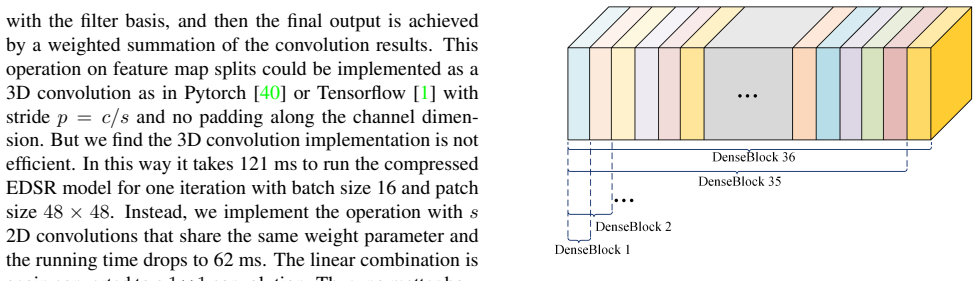
- Layers with many more input channels than output channels, the narrow-network case such as DenseNet, become compressible because splitting reduces the per-basis input channel count.
- $1\times 1$ convolutions fall under the same formula, so bottleneck and transition layers can be compressed instead of being left untouched.
- The compression-rate identity unifies prior decomposition work: $s=1$ is whole-filter decomposition and $s=c$ is channel-wise decomposition, making them boundary cases of one knob.
- Basis sharing within residual blocks, groups, or whole networks multiplies the savings of the split-wise scheme with little additional accuracy loss, as shown in the EDSR and DenseNet results.
Reading between the lines
- Since Eq. (13) reduces to $s^* \approx \sqrt{w \cdot h}$ when $c \approx n$, a no-search rule of thumb follows: try 3-way splits for $3\times 3$ kernels and 5-way splits for $5\times 5$ kernels; the paper's tables are consistent with that region but do not state it as a rule.
- The decomposition is a structured low-rank factorization in which input-channel splits share one basis, which suggests the same ratio-balancing argument could be ported to tensorized architectures or to convolution-like operators in other domains where $w \cdot h$ is replaced by the effective kernel dimension.
- Because $m$ and $s$ are selected manually per network in the experiments, an immediate extension is to treat them as learnable per-layer hyperparameters, using Eq. (13) as initialization or as a regularizer toward the parameter-optimal point.
- The compression is orthogonal to pruning and quantization, so stacking all three on one network should give roughly multiplicative savings; the paper does not test this combination.
Signed reviews
Editorial analysis
A structured set of objections, weighed in public.
Referee Report
Summary. The paper proposes a filter-basis decomposition method for convolutional neural network compression. It splits the 3D filters of a convolution layer along the input channel dimension and represents the resulting p×w×h filter splits as linear combinations of a learned basis set. The authors derive compression-rate formulas for whole-filter, channel-wise, and split-wise decompositions, obtain a closed-form split choice that minimizes the parameter count for a fixed basis size, and show that the decomposition can be implemented as a shared-weight convolution followed by a 1×1 convolution. Experiments are reported on CIFAR-10 image classification (VGG-16, ResNet-56, DenseNet-12-40) and on image super-resolution (SRResNet, EDSR-8-128, EDSR), with comparisons to several filter-decomposition baselines. The paper claims state-of-the-art compression performance in terms of parameter reduction and accuracy preservation.
Significance. The split-wise formulation is a natural generalization that interpolates between whole-filter and channel-wise filter decomposition, and the convolution-equivalence derivation in Section 3.3 is sound. If the experimental claims are confirmed, the method would be a flexible and practical compression tool, particularly for architectures with many 1×1 convolutions or narrow layers. Strengths of the paper include the transparent derivation of the parameter-count formulas (Eqs. 7–13), the practical implementation via shared-weight convolutions, and validation on external benchmarks with publicly released code. However, the central claim of network-level state-of-the-art compression currently rests on per-residual-block parameter accounting, which is not sufficient to establish the advertised model-size reductions. The significance as presented is therefore not yet fully established.
major comments (3)
- [Section 5.1, Tables 1-3] The paper states that 'we report the number of parameters and compression ratio for one residual block since all of the other blocks has the same parameter,' but the surrounding text uses these numbers for network-level conclusions: 'this operating point brings the model size from EDSR level to SRResNet level' and the abstract claims fewer parameters than prior compression baselines. Full-network parameter counts are not reported. EDSR has 32 residual blocks plus uncompressed head, tail, and upsampling convolutions; a per-block count of 17k at the most aggressive setting gives roughly 0.54M parameters for the blocks alone, and the unchanged layers still contribute several million. The reported 'Comp. (%)' values (e.g., 1.5%, 7.6%, 13.9%) are therefore residual-block compression ratios, not whole-network ratios. The 'fewer parameters' and 'EDSR-level to SRResNet-level' claims are not established as stated.
- [Tables 1 and 3, Eq. (12)] The parameter counts in Table 1 appear inconsistent with a per-residual-block interpretation. For EDSR with c=n=256, w=h=3 and two splits, Eq. (12) gives 53,248 parameters for a single 3×3 convolution; a residual block of two such convolutions would have 106,496 parameters. Table 1 reports 53k for m=32 without sharing, which is the per-convolution number. The 'Basis Share' entry of 35k is close to the value obtained by amortizing a network-wide shared basis over 32 residual blocks, rather than by sharing only the two convolutions within a residual block as stated in the text. Please clarify the exact parameter accounting and report full-network parameter totals for the compressed models.
- [Section 3.2, Eq. (13)] The optimization in Eq. (13) minimizes the parameter count for a fixed basis size m. The closed-form split s* is therefore a parameter-count optimum conditional on m, not an accuracy-parameter optimum. The paper does not analyze or measure how the required basis size m varies with the split width p; the experiments tune both m and p per architecture (Tables 7-9). Thus the claim that Eq. (13) identifies the optimal split configuration for compression is stronger than what is demonstrated. This is a limitation rather than an internal error, but it should be acknowledged and ideally tested with a controlled experiment varying s and m independently.
minor comments (5)
- [Table 1 caption] The caption says 'The number of splits p for one convolution is 4,' but in the main text s denotes the number of splits and p the split width; please harmonize the notation.
- [Section 5.1, Table 1] The sentence 'when m = 64 and basis sharing is used, the compressed model only accounts for 9% of the parameters' should read 'without basis sharing' to match the 9.0% entry; the basis-sharing entry for m=64 is 5.9%.
- [Section 3.2, Eqs. (7)-(10)] Equations (9) and (10) repeat Eqs. (7) and (8) verbatim; please remove the duplicate lines.
- [Table 6] The ResNet-56 baseline error for the proposed method is listed as 7.05 in Table 6, while Table 5 uses 6.28 for the same network; the discrepancy should be explained.
- [Section 3.2] The statement 'the optimal group s* ≈ sqrt(w×h)' assumes c≈n and ignores the integrality constraints on s and p; a sentence explaining how non-divisible cases are handled in practice would be helpful.
Circularity Check
No circularity: the filter-basis decomposition, compression-rate formulas, and optimal split derivation are self-contained parameter-count arithmetic, and empirical claims are validated on external benchmarks.
full rationale
The paper's derivation chain is self-contained. Section 3 frames filter decomposition as W ≈ B·A and defines compression rates by direct parameter counting (Eqs. 7–12). The split-wise rate Γ_split = m/(n·s) + m/(p·w·h) is obtained by counting basis and coefficient parameters after splitting c input channels into s groups of size p. Eq. (13) minimizes this expression under c = s·p, giving s* = sqrt(c·w·h/n) and p* = sqrt(n·c/(w·h)); this is pure arithmetic and does not presuppose the experimental conclusion. The accuracy claims rest on training compressed networks on CIFAR-10 and DIV2K and testing on held-out benchmarks (Set5, Set14, B100, Urban100, DIV2K validation), so the central result is not equivalent to an input or fitted parameter. The basis size m and split counts are user-chosen operating points, tuned per network in Tables 7–9; this is standard hyperparameter selection, not a fitted parameter renamed as a prediction. The paper cites some of the authors' own prior work (CARN, 3D appearance super-resolution, the NTIRE dataset paper), but these citations are contextual related-work references and are not load-bearing for the compression method or its evaluation. The per-residual-block parameter reporting noted by the skeptic is a potential correctness or presentation issue about how compression ratios extrapolate to full networks, but it is not a circularity: it does not make any derived claim equivalent to its inputs by construction. Overall, the derivation is independent and the score is 0.
Assumptions & free parameters
free parameters (4)
- basis size m =
16-128 depending on network (e.g., 32 for EDSR, 128 for VGG-16)
- split width p or number of splits s =
p=4 for EDSR (Table 1); s=1, 6, 12 for DenseNet transition layers
- approximation loss weight gamma =
not reported (unknown)
- basis sharing configuration =
network-wise for DenseNet, group-wise for ResNet, block-wise for EDSR
assumptions (4)
- domain assumption Filters in a convolutional layer, when split along the input channel dimension, lie near a low-dimensional linear subspace, so a shared basis of size m can represent all splits with bounded error.
- standard math Convolution is linear, so the convolution with a linear combination of basis filters equals the linear combination of convolutions with each basis filter.
- domain assumption After replacing the original filters with the basis representation, joint fine-tuning with the loss in Eq. (18) recovers most of the lost accuracy.
- domain assumption Minimizing the parameter-count compression rate in Eq. (12) is a sensible proxy for the accuracy-parameter trade-off.
Cite this review
Pith. "Pith review of Learning Filter Basis for Convolutional Neural Network Compression." pith.science (2026). https://pith.science/paper/ZE6XZQYL
@misc{pith2026190808932,
  author       = {Pith},
  title        = {Pith review of: Learning Filter Basis for Convolutional Neural Network Compression},
  year         = {2026},
  howpublished = {\url{https://pith.science/paper/ZE6XZQYL}},
  note         = {Machine review of arXiv:1908.08932}
}
read the original abstract
Convolutional neural networks (CNNs) based solutions have achieved state-of-the-art performances for many computer vision tasks, including classification and super-resolution of images. Usually the success of these methods comes with a cost of millions of parameters due to stacking deep convolutional layers. Moreover, quite a large number of filters are also used for a single convolutional layer, which exaggerates the parameter burden of current methods. Thus, in this paper, we try to reduce the number of parameters of CNNs by learning a basis of the filters in convolutional layers. For the forward pass, the learned basis is used to approximate the original filters and then used as parameters for the convolutional layers. We validate our proposed solution for multiple CNN architectures on image classification and image super-resolution benchmarks and compare favorably to the existing state-of-the-art in terms of reduction of parameters and preservation of accuracy.
Figures


Figures from the paper (7 more)


Reference graph
Works this paper leans on
-
[1]
Tensorflow: A system for large-scale machine learning
Mart ´ın Abadi, Paul Barham, Jianmin Chen, Zhifeng Chen, Andy Davis, Jeffrey Dean, Matthieu Devin, Sanjay Ghe- mawat, Geoffrey Irving, Michael Isard, et al. Tensorflow: A system for large-scale machine learning. In OSDI, vol- ume 16, pages 265–283, 2016. 5
work page 2016
-
[2]
NTIRE 2017 chal- lenge on single image super-resolution: Dataset and study
Eirikur Agustsson and Radu Timofte. NTIRE 2017 chal- lenge on single image super-resolution: Dataset and study. In Proc. CVPRW, July 2017. 6
work page 2017
-
[3]
Learning the num- ber of neurons in deep networks
Jose M Alvarez and Mathieu Salzmann. Learning the num- ber of neurons in deep networks. In Proce. NIPS, pages 2270–2278, 2016. 2
work page 2016
-
[4]
Low-complexity single-image super-resolution based on nonnegative neighbor embedding
Marco Bevilacqua, Aline Roumy, Christine Guillemot, and Marie Line Alberi-Morel. Low-complexity single-image super-resolution based on nonnegative neighbor embedding. In Proc. BMVC, 2012. 6
work page 2012
-
[5]
Compressing neural networks with the hashing trick
Wenlin Chen, James Wilson, Stephen Tyree, Kilian Wein- berger, and Yixin Chen. Compressing neural networks with the hashing trick. In Proc. ICML, pages 2285–2294, 2015. 2
work page 2015
-
[6]
Binaryconnect: Training deep neural networks with binary weights during propagations
Matthieu Courbariaux, Yoshua Bengio, and Jean-Pierre David. Binaryconnect: Training deep neural networks with binary weights during propagations. In Proc. NIPS, pages 3123–3131, 2015. 2
work page 2015
-
[7]
Matthieu Courbariaux, Itay Hubara, Daniel Soudry, Ran El-Yaniv, and Yoshua Bengio. Binarized neural networks: Training deep neural networks with weights and activations constrained to +1 or-1. arXiv preprint arXiv:1602.02830 ,
-
[8]
Eco: Efficient convolution opera- tors for tracking
Martin Danelljan, Goutam Bhat, Fahad Shahbaz Khan, Michael Felsberg, et al. Eco: Efficient convolution opera- tors for tracking. In Proc. ICCV, volume 1, page 7, 2017. 2
work page 2017
Show all 56 references
-
[9]
Exploiting linear structure within con- volutional networks for efficient evaluation
Emily L Denton, Wojciech Zaremba, Joan Bruna, Yann Le- Cun, and Rob Fergus. Exploiting linear structure within con- volutional networks for efficient evaluation. In Proc. NIPS, pages 1269–1277, 2014. 2, 5
2014
-
[10]
Learning a deep convolutional network for image super-resolution
Chao Dong, Chen Change Loy, Kaiming He, and Xiaoou Tang. Learning a deep convolutional network for image super-resolution. In Proc. ECCV, pages 184–199. Springer,
-
[11]
Fast R-CNN
Ross Girshick. Fast R-CNN. In Proc. ICCV, pages 1440– 1448, 2015. 1
2015
-
[12]
Rich feature hierarchies for accurate object detection and semantic segmentation
Ross Girshick, Jeff Donahue, Trevor Darrell, and Jitendra Malik. Rich feature hierarchies for accurate object detection and semantic segmentation. In Proc. CVPR, pages 580–587,
-
[13]
Multi- bin trainable linear unit for fast image restoration networks
Shuhang Gu, Radu Timofte, and Luc Van Gool. Multi- bin trainable linear unit for fast image restoration networks. arXiv preprint arXiv:1807.11389, 2018. 1
2018 arXiv
-
[14]
Deep com- pression: Compressing deep neural networks with pruning, trained quantization and huffman coding
Song Han, Huizi Mao, and William J Dally. Deep com- pression: Compressing deep neural networks with pruning, trained quantization and huffman coding. arXiv preprint arXiv:1510.00149, 2015. 1, 2
2015 arXiv
-
[15]
Learning both weights and connections for efficient neural network
Song Han, Jeff Pool, John Tran, and William Dally. Learning both weights and connections for efficient neural network. In Proc. NIPS, pages 1135–1143, 2015. 1, 2
2015
-
[16]
Deep residual learning for image recognition
Kaiming He, Xiangyu Zhang, Shaoqing Ren, and Jian Sun. Deep residual learning for image recognition. In Proc. CVPR, pages 770–778, 2016. 1, 5, 6, 8, 11
2016
-
[17]
AMC: AutoML for model compression and ac- celeration on mobile devices
Yihui He, Ji Lin, Zhijian Liu, Hanrui Wang, Li-Jia Li, and Song Han. AMC: AutoML for model compression and ac- celeration on mobile devices. In Proc. ECCV, pages 784– 800, 2018. 8
2018
-
[18]
Channel pruning for accelerating very deep neural networks
Yihui He, Xiangyu Zhang, and Jian Sun. Channel pruning for accelerating very deep neural networks. In Proc. ICCV, pages 1389–1397, 2017. 1, 2
2017
-
[19]
Densely connected convolutional net- works
Gao Huang, Zhuang Liu, Laurens van der Maaten, and Kil- ian Q Weinberger. Densely connected convolutional net- works. In Proc. CVPR, pages 2261–2269, 2017. 1, 5, 6, 7, 8, 11
2017
-
[20]
Single image super-resolution from transformed self-exemplars
Jia-Bin Huang, Abhishek Singh, and Narendra Ahuja. Single image super-resolution from transformed self-exemplars. In Proc. CVPR, pages 5197–5206, 2015. 6
2015
-
[21]
Speeding up convolutional neural networks with low rank expansions
Max Jaderberg, Andrea Vedaldi, and Andrew Zisserman. Speeding up convolutional neural networks with low rank expansions. In Proc. BMVC, 2014. 1, 2, 3, 5
2014
-
[22]
Efficient neural network compression
Hyeji Kim, Muhammad Umar Karim Khan, and Chong-Min Kyung. Efficient neural network compression. In Proc. CVPR, June 2019. 8
2019
-
[23]
Accurate image super-resolution using very deep convolutional net- works
Jiwon Kim, Jung Kwon Lee, and Kyoung Mu Lee. Accurate image super-resolution using very deep convolutional net- works. In Proc. CVPR, 2016. 1
2016
-
[24]
Adam: A method for stochastic optimization
Diederik P Kingma and Jimmy Ba. Adam: A method for stochastic optimization. arXiv preprint arXiv:1412.6980 ,
-
[25]
Learning multiple layers of features from tiny images
Alex Krizhevsky and Geoffrey Hinton. Learning multiple layers of features from tiny images. Technical report, Cite- seer, 2009. 6, 8
2009
-
[26]
Imagenet classification with deep convolutional neural net- works
Alex Krizhevsky, Ilya Sutskever, and Geoffrey E Hinton. Imagenet classification with deep convolutional neural net- works. In Proc. NIPS, pages 1097–1105, 2012. 1
2012
-
[27]
Speeding-up convolutional neural networks using fine-tuned cp-decomposition
Vadim Lebedev, Yaroslav Ganin, Maksim Rakhuba, Ivan Os- eledets, and Victor Lempitsky. Speeding-up convolutional neural networks using fine-tuned cp-decomposition. arXiv preprint arXiv:1412.6553, 2014. 2
2014 arXiv
-
[28]
Photo- realistic single image super-resolution using a generative ad- versarial network
Christian Ledig, Lucas Theis, Ferenc Husz´ar, Jose Caballero, Andrew Cunningham, Alejandro Acosta, Andrew Aitken, Alykhan Tejani, Johannes Totz, Zehan Wang, et al. Photo- realistic single image super-resolution using a generative ad- versarial network. In Proc. CVPR, pages 105...
2017
-
[29]
Joint blind motion deblurring and depth estimation of light field
Dongwoo Lee, Haesol Park, In Kyu Park, and Kyoung Mu Lee. Joint blind motion deblurring and depth estimation of light field. In Proc. ECCV, pages 288–303, 2018. 1
2018
-
[30]
Ternary weight networks
Fengfu Li, Bo Zhang, and Bin Liu. Ternary weight networks. arXiv preprint arXiv:1605.04711, 2016. 1
2016 arXiv
-
[31]
CARN: convolutional anchored re- gression network for fast and accurate single image super- resolution
Yawei Li, Eirikur Agustsson, Shuhang Gu, Radu Timofte, and Luc Van Gool. CARN: convolutional anchored re- gression network for fast and accurate single image super- resolution. In Proc. ECCVW , pages 166–181. Springer,
-
[32]
Exploiting kernel sparsity and entropy for inter- pretable CNN compression
Yuchao Li, Shaohui Lin, Baochang Zhang, Jianzhuang Liu, David Doermann, Yongjian Wu, Feiyue Huang, and Ron- grong Ji. Exploiting kernel sparsity and entropy for inter- pretable CNN compression. In Proc. CVPR, 2019. 7, 8
2019
-
[33]
3D appearance super-resolution with deep learning
Yawei Li, Vagia Tsiminaki, Radu Timofte, Marc Pollefeys, and Luc Van Gool. 3D appearance super-resolution with deep learning. In Proc. ICCV, 2019. 1
2019
-
[34]
Enhanced deep residual networks for single image super-resolution
Bee Lim, Sanghyun Son, Heewon Kim, Seungjun Nah, and Kyoung Mu Lee. Enhanced deep residual networks for single image super-resolution. In Proc. CVPRW, pages 1132–1140,
-
[35]
Learning efficient convolutional networks through network slimming
Zhuang Liu, Jianguo Li, Zhiqiang Shen, Gao Huang, Shoumeng Yan, and Changshui Zhang. Learning efficient convolutional networks through network slimming. In Proc. ICCV, pages 2736–2744, 2017. 8
2017
-
[36]
Fully convolutional networks for semantic segmentation
Jonathan Long, Evan Shelhamer, and Trevor Darrell. Fully convolutional networks for semantic segmentation. In Proc. CVPR, pages 3431–3440, 2015. 1
2015
-
[37]
Martin, C
D. Martin, C. Fowlkes, D. Tal, and J. Malik. A database of human segmented natural images and its application to evaluating segmentation algorithms and measuring ecologi- cal statistics. In Proc. ICCV, volume 2, pages 416–423, July
-
[38]
Cascaded projec- tion: End-to-end network compression and acceleration
Breton Minnehan and Andreas Savakis. Cascaded projec- tion: End-to-end network compression and acceleration. In Proc. CVPR, June 2019. 8
2019
-
[39]
Blind image deblurring using dark channel prior
Jinshan Pan, Deqing Sun, Hanspeter Pfister, and Ming- Hsuan Yang. Blind image deblurring using dark channel prior. In Proc. CVPR, pages 1628–1636, 2016. 1
2016
-
[40]
Automatic differentiation in Pytorch
Adam Paszke, Sam Gross, Soumith Chintala, Gregory Chanan, Edward Yang, Zachary DeVito, Zeming Lin, Al- ban Desmaison, Luca Antiga, and Adam Lerer. Automatic differentiation in Pytorch. 2017. 5
2017
-
[41]
Extreme network compression via filter group approximation
Bo Peng, Wenming Tan, Zheyang Li, Shun Zhang, Di Xie, and Shiliang Pu. Extreme network compression via filter group approximation. In Proc. ECCV, pages 300–316, 2018. 1, 2, 3, 7, 8, 11, 13
2018
-
[42]
Xnor-net: Imagenet classification using bi- nary convolutional neural networks
Mohammad Rastegari, Vicente Ordonez, Joseph Redmon, and Ali Farhadi. Xnor-net: Imagenet classification using bi- nary convolutional neural networks. In Proc. ECCV, pages 525–542. Springer, 2016. 1, 2
2016
-
[43]
You only look once: Unified, real-time object de- tection
Joseph Redmon, Santosh Divvala, Ross Girshick, and Ali Farhadi. You only look once: Unified, real-time object de- tection. In Proc. CVPR, pages 779–788, 2016. 1
2016
-
[44]
Faster R-CNN: Towards real-time object detection with re- gion proposal networks
Shaoqing Ren, Kaiming He, Ross Girshick, and Jian Sun. Faster R-CNN: Towards real-time object detection with re- gion proposal networks. In Proc. NIPS, pages 91–99, 2015. 1
2015
-
[45]
Very deep convo- lutional networks for large-scale image recognition
Karen Simonyan and Andrew Zisserman. Very deep convo- lutional networks for large-scale image recognition. arXiv preprint arXiv:1409.1556, 2014. 1, 6, 8, 11
2014 arXiv
-
[46]
Cluster- ing convolutional kernels to compress deep neural networks
Sanghyun Son, Seungjun Nah, and Kyoung Mu Lee. Cluster- ing convolutional kernels to compress deep neural networks. In Proc. ECCV, pages 216–232, 2018. 1, 2, 7, 8
2018
-
[47]
Factorized convolutional neural networks
Min Wang, Baoyuan Liu, and Hassan Foroosh. Factorized convolutional neural networks. In Proc. ICCV, pages 545– 553, 2017. 1, 2, 3, 5, 6, 7, 8, 11, 13
2017
-
[48]
Learning structured sparsity in deep neural networks
Wei Wen, Chunpeng Wu, Yandan Wang, Yiran Chen, and Hai Li. Learning structured sparsity in deep neural networks. In Proc. NIPS, pages 2074–2082, 2016. 2
2016
-
[49]
On sin- gle image scale-up using sparse-representations
Roman Zeyde, Michael Elad, and Matan Protter. On sin- gle image scale-up using sparse-representations. In Interna- tional Conference on Curves and Surfaces , pages 711–730. Springer, 2010. 6
2010
-
[50]
Beyond a gaussian denoiser: residual learning of deep CNN for image denoising
Kai Zhang, Wangmeng Zuo, Yunjin Chen, Deyu Meng, and Lei Zhang. Beyond a gaussian denoiser: residual learning of deep CNN for image denoising. IEEE TIP, 26(7):3142– 3155, 2017. 1
2017
-
[51]
Learning deep cnn denoiser prior for image restoration
Kai Zhang, Wangmeng Zuo, Shuhang Gu, and Lei Zhang. Learning deep cnn denoiser prior for image restoration. In Proc. CVPR, pages 3929–3938, 2017. 1
2017
-
[52]
Deep plug- and-play super-resolution for arbitrary blur kernels
Kai Zhang, Wangmeng Zuo, and Lei Zhang. Deep plug- and-play super-resolution for arbitrary blur kernels. In Proc. CVPR, pages 1671–1681, 2019. 1
2019
-
[53]
Accelerating very deep convolutional networks for classi- fication and detection
Xiangyu Zhang, Jianhua Zou, Kaiming He, and Jian Sun. Accelerating very deep convolutional networks for classi- fication and detection. IEEE TPAMI, 38(10):1943–1955,
1943
-
[54]
Incremental network quantization: Towards lossless cnns with low-precision weights
Aojun Zhou, Anbang Yao, Yiwen Guo, Lin Xu, and Yurong Chen. Incremental network quantization: Towards lossless cnns with low-precision weights. arXiv preprint arXiv:1702.03044, 2017. 1
2017 arXiv
-
[55]
Less is more: Towards compact cnns
Hao Zhou, Jose M Alvarez, and Fatih Porikli. Less is more: Towards compact cnns. In Proc. ECCV , pages 662–677. Springer, 2016. 2
2016
-
[56]
Trained ternary quantization
Chenzhuo Zhu, Song Han, Huizi Mao, and William J Dally. Trained ternary quantization. arXiv preprint arXiv:1612.01064, 2016. 2 A. Compressed Network Configuration The basis configurations of our filter basis learning method for different networks including DenseNet [19], ResNet [...
2016 arXiv
Reviewed August 14, 2026 · model on record in the stance chip above.
Discussion (0). Continue with ORCID to comment.