REVIEW 3 major objections 4 minor 59 references
Background in $\gamma$-ray detectors and carbon beam tests in the Felsenkeller shallow-underground accelerator laboratory
T0 review · 3 major / 4 minor · reviewed 2026-08-14 · deepseek-v4-flash
Pith's one-line read A shallow underground lab can measure the 12C(α,γ)16O reaction with a signal-to-background ratio above 10:1.
desk verdict Useful background characterization for Felsenkeller, but the feasibility claim for 12C(α,γ)16O is computed at 1 MeV, not in the 0.2–0.6 MeV Gamow window, so the headline sensitivity does not follow. read the letter →
The pith
A machine-rendered reading of the paper's core claim, the machinery that carries it, and where it could break.
The reading
What carries the argument
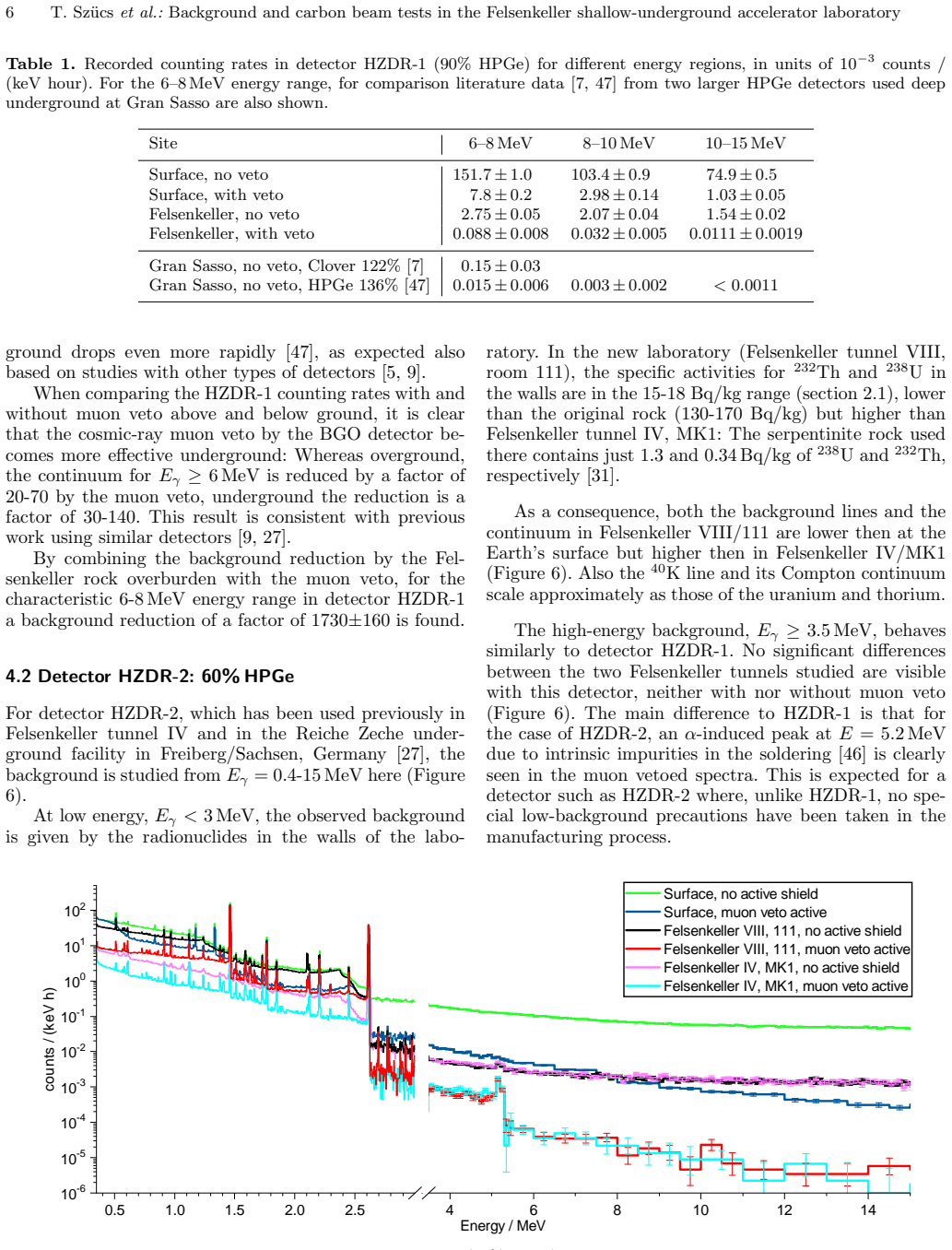
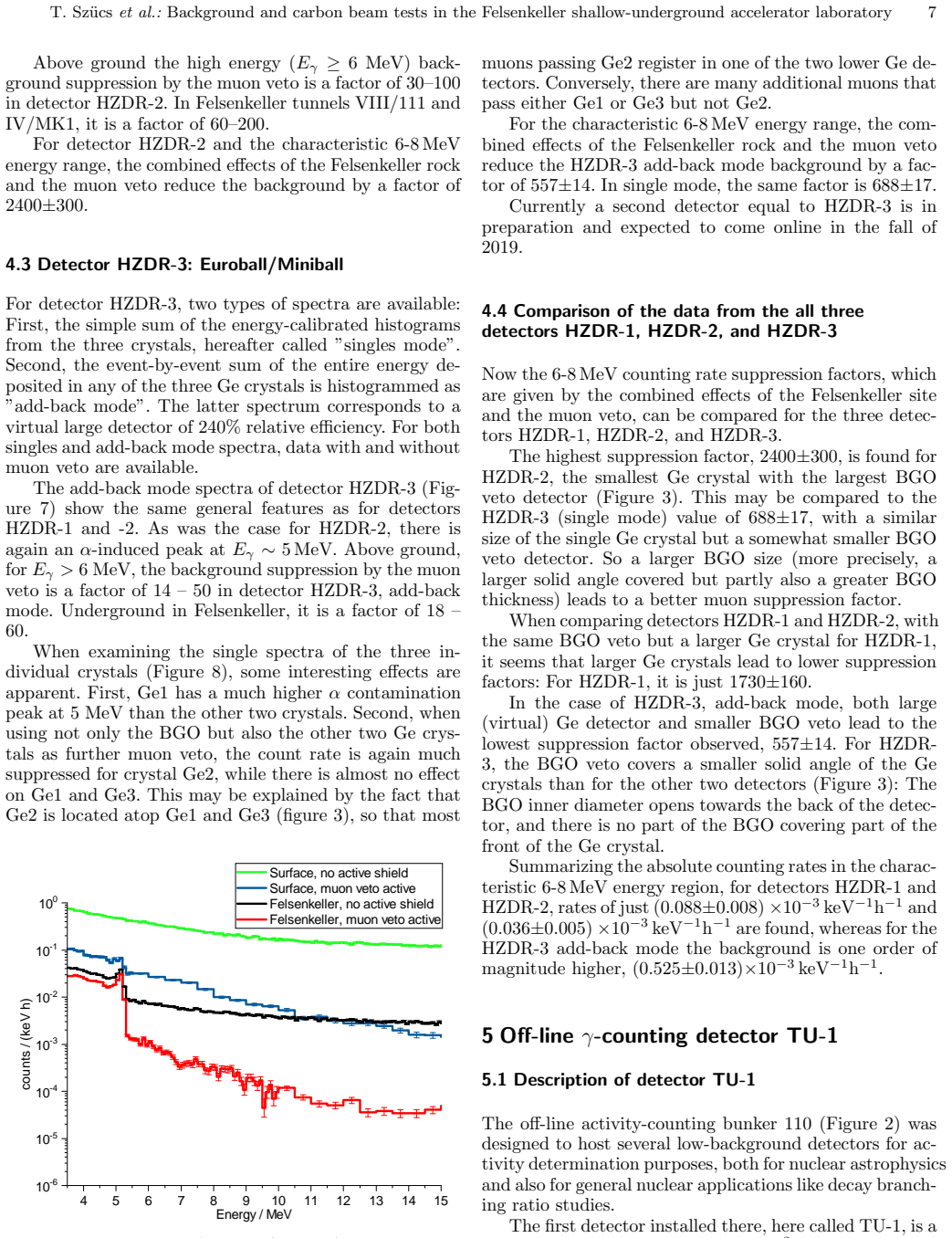
The central mechanism is the two-stage suppression of cosmic-ray backgrounds: the rock overburden cuts the muon flux by roughly a factor of 40, and BGO scintillator shields surrounding each germanium crystal veto the remaining muon-induced events, yielding total suppression factors of 500–2400 in the 6–8 MeV window. The feasibility argument is carried by a concrete rate estimate: using the measured vetoed background, the known detection efficiency of HZDR-1 at 8.2 MeV, a 7.5×$10^{17}$ $cm^{-2}$ helium target (12 keV energy loss), 2000 hours, 50 particle-µA of 12C+, and the NACRE II ground-state S-factor, the paper obtains 21 expected signal counts against 2 background counts.
What would settle it
Run the 12C(α,γ)16O experiment for 2000 hours at the described conditions (50 particle-µA of 12C+, a 7.5×$10^{17}$ $cm^{-2}$ helium target, HZDR-1 detector with active veto) and count events in the 7.5–8.5 MeV window; if the signal-to-background ratio is far below the predicted 21-to-2, or if the in-beam background exceeds the no-beam rate by a large factor, the feasibility claim is refuted.
Extended reading notes
Core claim
The central claim is that, in the new 5 MV underground accelerator laboratory, the combination of a 140 m.w.e. rock overburden (muon flux attenuated by a factor of 40) and BGO escape-suppression shields used as active muon vetoes reduces the cosmic-ray-induced gamma background by factors between 500 and 2400 in the 6–8 MeV region, bringing the vetoed background close to the levels previously seen only in deep underground laboratories. With this background and with the 12C− beam currents of tens of microamperes measured from the cesium sputter source, the authors show for the example of 12C(α,γ)16O that a highly sensitive experiment is feasible, predicting 21 counts from the reaction versus 2 background counts for detector HZDR-1 (and 17 versus 1 for HZDR-2) after 2000 hours at 50 particle-µA.
Load-bearing premise
The feasibility projection assumes the carbon beam intensity can be doubled from the currently measured 21–24 particle-µA to the aimed 50 particle-µA, and that the no-beam background remains representative once beam and target are present; the paper states that a factor of two improvement is still needed.
Editorial extensions
If this is right
- A 2000-hour run on 12C(α,γ)16O at the new shallow underground accelerator can reach a signal-to-background ratio above 10:1 with a single 88% HPGe detector, enough to constrain the disputed S-factor.
- The measured background in the 6–8 MeV region is comparable to deep underground detectors when normalized by volume, so shallow sites with active veto can partially replace deep underground laboratories for high-energy gamma experiments.
- The demonstrated 12C− beam intensity of 70–80 µA from the aluminum cathode holder, sustained over at least six hours, makes multi-week irradiations feasible if a factor-of-two improvement in post-stripping current is achieved.
- The same setup can be applied to other helium and carbon burning reactions, such as 22Ne(α,n)25Mg or 13C(α,n)16O, whose gamma rays fall in the suppressed energy window.
Reading between the lines
- If the required factor-of-two beam improvement is not reached, the 21 expected signal counts would roughly halve, and the 10:1 ratio would degrade proportionally; the feasibility claim hinges on that upgrade.
- The background was measured with beam off; in-beam backgrounds from beam-induced reactions in the target chamber or beam halo could add counts, so the quoted signal-to-background ratio is an upper-bound estimate until an in-beam background run is made.
- The 4:1 ratio for the Euroball/Miniball add-back mode suggests that large multi-crystal arrays, despite their higher intrinsic background, can still be useful if their higher efficiency is needed for weak cascades.
- A future measurement can test the prediction directly by running the experiment at the quoted conditions and comparing observed counts; if the background exceeds the no-beam value, the veto efficiency in-beam would need re-evaluation.
Signed reviews
Editorial analysis
A structured set of objections, weighed in public.
Referee Report
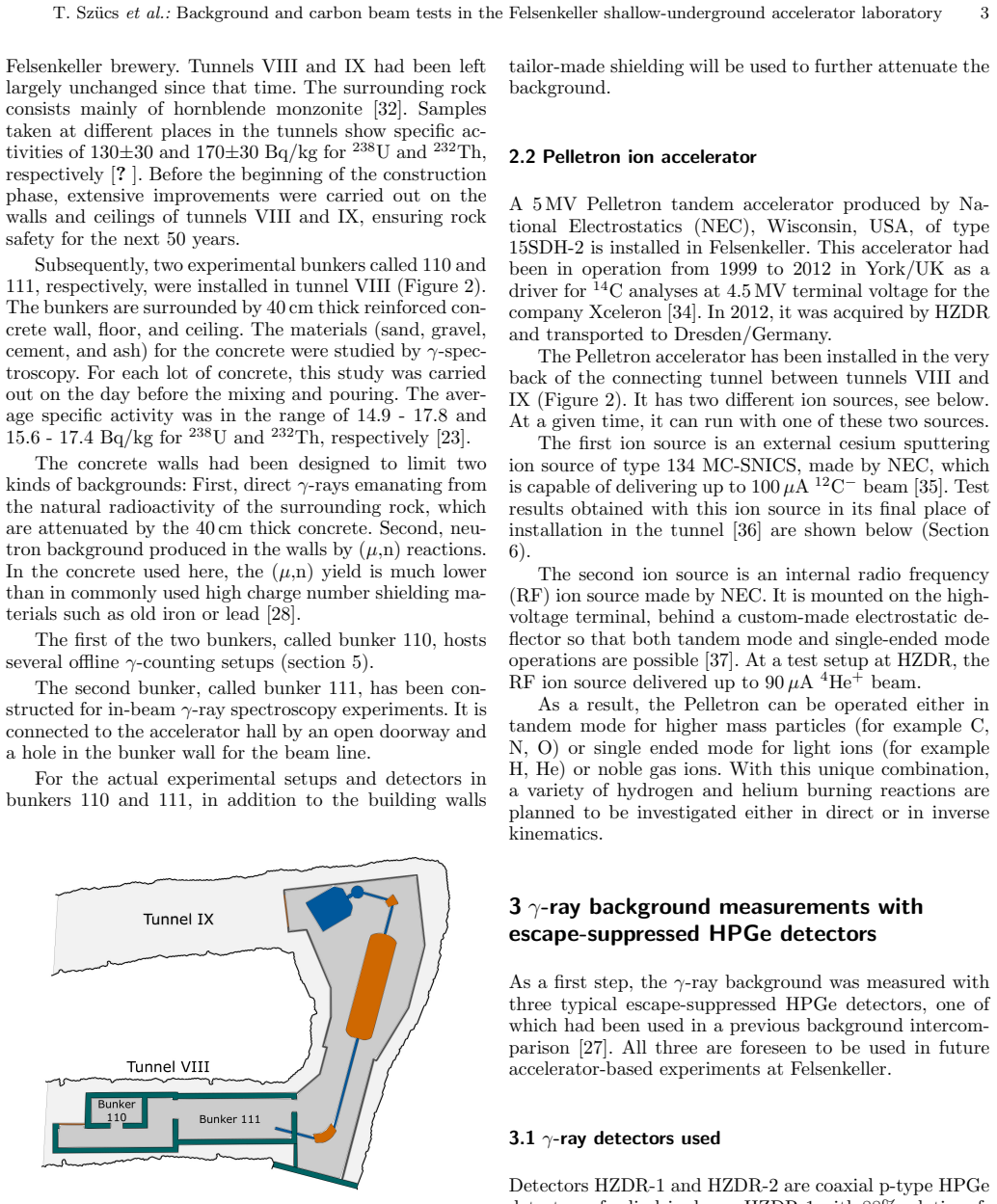
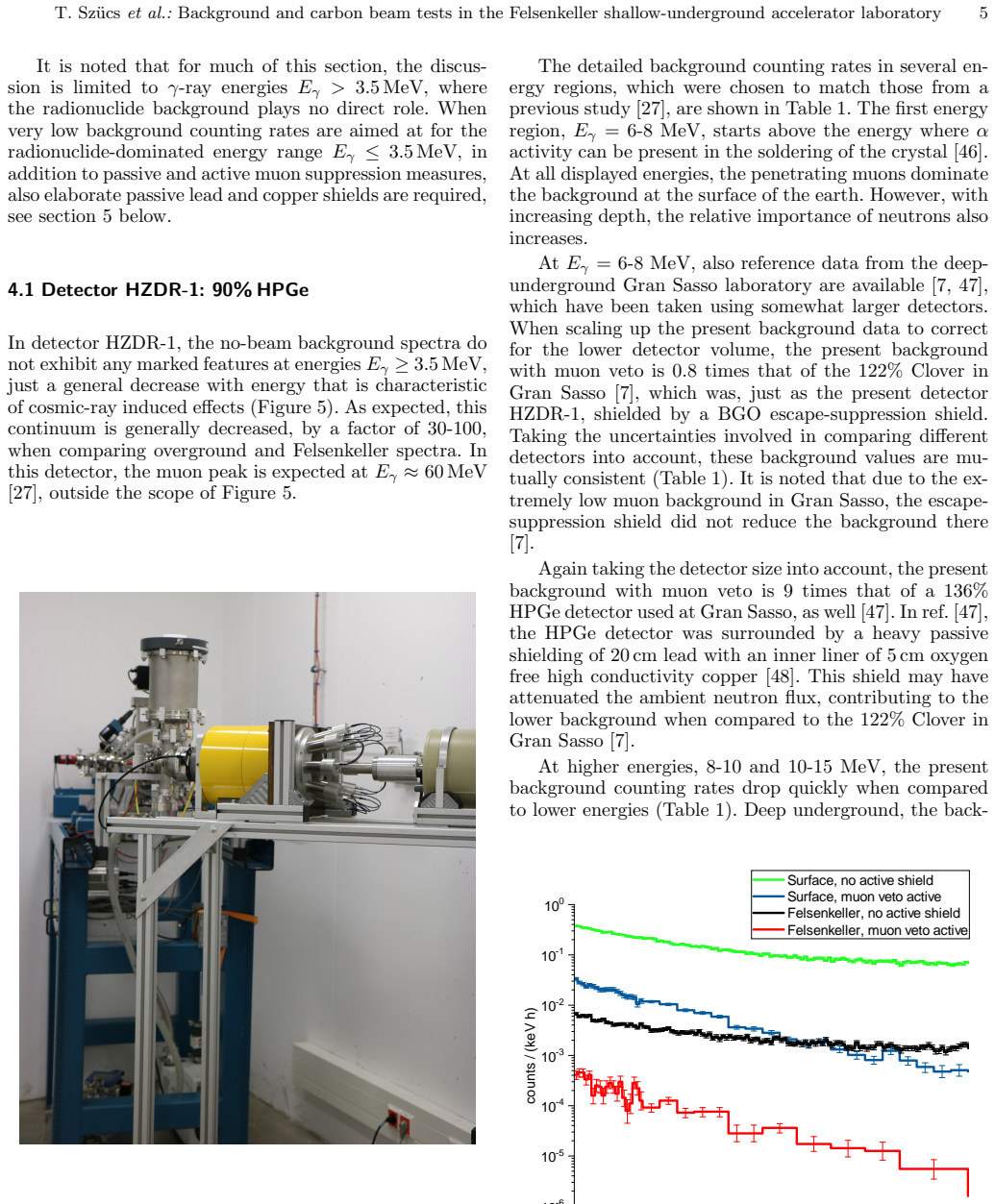
Summary. The paper characterizes the gamma-ray background and carbon beam performance of the new Felsenkeller shallow-underground accelerator laboratory. No-beam backgrounds were measured for 26–66 days with three escape-suppressed HPGe detector systems (HZDR-1, HZDR-2, HZDR-3), with and without BGO muon veto, underground and at the surface; the combined rock overburden and veto reduce the 6–8 MeV counting rate by factors of 500–2400. The paper also reports tests of the cesium sputter ion source in its final underground location, showing tens of microamperes of analyzed 12C− beam over several hours. In an outlook section, these data are used to estimate the feasibility of future in-beam experiments, in particular 12C(α,γ)16O, claiming signal-to-background ratios better than 10:1 for detectors HZDR-1 and HZDR-2 and about 4:1 for HZDR-3.
Significance. The background measurements themselves are a useful, direct contribution: they are counting results with long run times, statistical errors are quoted, and the 500–2400 reduction factors for the 6–8 MeV region are new quantitative information for the shallow-underground community. The beam-current tests are also valuable commissioning data. However, the central feasibility claim in the abstract and Section 8 is not established by the reported numbers: the Section 7 projection is made at center-of-mass energies near 1 MeV rather than in the 0.2–0.6 MeV Gamow window that motivates the study, and it assumes a 50 particle-µA post-accelerator beam that is a factor of two above the measured value. If the paper is revised to present the projection as a high-energy feasibility estimate and to temper the low-energy claim, the measurement sections will stand as a solid experimental characterization.
major comments (3)
- [Section 7, Table 2] The feasibility projection is computed at E_cm ≈ 1 MeV, not at the Gamow energies quoted in the same section. The text states that the Gamow window is roughly E = 0.2–0.6 MeV in the center-of-mass system, but then uses σ_GS ≈ 50 pb 'at E = 1 MeV, near the lowest experimental data point available' to predict 21 reaction counts for HZDR-1. A direct check of the quoted numbers gives 23 counts, confirming that the illustrative calculation uses the 1 MeV cross section. At E_cm = 0.6 MeV the Gamow penetration factor exp(−2πη) is smaller by roughly a factor 1.8×10⁻³ than at 1 MeV, before the S-factor energy dependence, so the expected signal would be of order 0.04 counts in 2000 hours instead of 21 counts, while the background remains about 2 counts. At 0.4 MeV the expected signal is even smaller. Therefore the reported background and beam data do not demonstrate that highly sensitive measurements of 12C(α,γ)16O are possible at the energies where new astrophysical data are needed. This is a load-bearing issue for the abstract's 'very low energy' claim and for the summary sentence in Section 8.
- [Section 6.2] The assumed 50 particle-µA post-accelerator beam is not achieved by the reported measurements. Section 6.2 states that the 70–80 µA of analyzed 12C− current corresponds to 21–24 particle-µA after the assumed 30% stripping fraction, and explicitly says that 'still a factor of two improvement over the initial performance shown here is needed.' The Section 7 projection nevertheless uses 50 µA. With the measured 21–24 particle-µA, the predicted 21 counts for HZDR-1 would drop to about 9 counts against 2 background counts, reducing the claimed 'better than 10:1' ratio to roughly 4:1. The feasibility statement should be either made conditional on the factor-of-two improvement or recomputed with the measured currents.
- [Sections 4 and 7] The background rates used in the feasibility estimate are no-beam background rates, but the actual experiments will run with beam and target in place. No in-beam background measurement is reported. Beam-induced neutrons, target-induced activity, or beam-related gamma rays could increase the counting rate in the 7.5–8.5 MeV window relative to the no-beam values in Table 2. The claim that 'highly sensitive experiments will be possible' assumes that such in-beam backgrounds are negligible or controllable, and this assumption is not supported by data in the manuscript. A caveat to this effect should be added, or the claim should be restricted to the no-beam background conditions actually measured.
minor comments (4)
- [Sections 2.1 and 7] There are several placeholder citations marked '[?]' in the text (e.g., rock specific activities in Section 2.1, the influence of 12C(α,γ)16O on nucleosynthesis in Section 7, and the lowest experimental data point in Section 7). These must be replaced with complete references before publication.
- [Section 6.2, Figure 10] The text states that the aluminum cathode holder operated stably at 70–80 µA while the copper holder showed a slow rise from 18 to 110 µA, but the figure legend and axis labeling make these two curves difficult to distinguish. Please improve the legend contrast or use separate panels.
- [Section 5.2] The TU-1 detector data are described as a 'preliminary configuration' without the final anti-muon veto and inner copper liner. The text says this represents an upper limit on the future background, which is reasonable, but this point should also be stated clearly when the TU-1 results are summarized, so that they are not read as final performance numbers.
- [Section 3.3] The text says the detectors were placed in 'tunnel VIII, bunker 111' but the detector mounting height and the layout are described earlier in Section 2; a cross-reference to Figure 2 or Figure 4 at the first mention would help the reader orient.
Circularity Check
No circularity: the measured background and beam data are direct inputs, and the feasibility estimate rests on independent external cross-section and efficiency data.
full rationale
The paper's central measurements—no-beam gamma-ray background rates and 12C- beam currents—are direct counting results obtained in the new Felsenkeller tunnels, with no free parameters fitted to the claimed feasibility outcome. The Section 7 count-rate projection is an explicit conditional estimate: it combines an assumed 2000 h running time, 50 microampere beam, 7.5e17 cm^-2 helium target, the NACRE II ground-state S-factor, and the published HZDR-1 efficiency from Ref. [41], and compares the resulting reaction counts with the measured background rate from Table 2. None of these inputs is defined in terms of the predicted 21 counts; the arithmetic is transparent and reproducible from the quoted values. The prior works by the same authors (Refs. [9, 23, 24, 27, 28, 36, 41]) are used for context, site characterization, and as data sources, not as load-bearing uniqueness or validity arguments. External benchmarks such as the Gran Sasso background data [7, 47] and the NACRE II compilation [57] provide independent calibration. The paper itself flags its principal limitations, including the statement in Section 6.2 that 'still a factor of two improvement over the initial performance shown here is needed' and the Section 7 caveat that the conclusions depend on the cascade scheme and on checking the veto precondition for each planned experiment. The skeptic's concern that the illustrative 1 MeV cross section is not inside the 0.2-0.6 MeV Gamow window is a scientific validity issue about extrapolation, not a circularity of the derivation. The central claim is therefore self-contained against external benchmarks, and no step reduces by construction to its own inputs.
Assumptions & free parameters
assumptions (5)
- domain assumption The high-energy (E_gamma >= 3.5 MeV) no-beam continuum in HPGe detectors is dominated by cosmic-ray muon induced events, so a BGO anti-coincidence veto removes most of it.
- domain assumption The ground-state S-factor for carbon-12(alpha,gamma)oxygen-16 from the NACRE II compilation [57] is correct for predicting reaction counts.
- domain assumption The gamma detection efficiency curves from Ref. [41] apply at E_gamma = 8.2 MeV for HZDR-1 and HZDR-2, and the HZDR-3 efficiency is 2.7 times that of HZDR-1.
- domain assumption A 30% charge-state fraction of the stripped carbon-12 beam can be assumed to estimate particle microamperes after the accelerator.
- domain assumption The measured no-beam background remains representative when the beam and target are present during future experiments.
Cite this review
Pith. "Pith review of Background in $\gamma$-ray detectors and carbon beam tests in the Felsenkeller shallow-underground accelerator laboratory." pith.science (2026). https://pith.science/paper/AFW5ONSS
@misc{pith2026190808945,
  author       = {Pith},
  title        = {Pith review of: Background in $\gamma$-ray detectors and carbon beam tests in the Felsenkeller shallow-underground accelerator laboratory},
  year         = {2026},
  howpublished = {\url{https://pith.science/paper/AFW5ONSS}},
  note         = {Machine review of arXiv:1908.08945}
}
abstract
The relevant interaction energies for astrophysical radiative capture reactions are very low, much below the repulsive Coulomb barrier. This leads to low cross sections, low counting rates in $\gamma$-ray detectors, and therefore the need to perform such experiments at ion accelerators placed in underground settings, shielded from cosmic rays. Here, the feasibility of such experiments in the new shallow-underground accelerator laboratory in tunnels VIII and IX of the Felsenkeller site in Dresden, Germany, is evaluated. To this end, the no-beam background in three different types of germanium detectors, i.e. a Euroball/Miniball triple cluster and two large monolithic detectors, is measured over periods of 26-66 days. The cosmic-ray induced background is found to be reduced by a factor of 500-2400, by the combined effects of, first, the 140 meters water equivalent overburden attenuating the cosmic muon flux by a factor of 40, and second, scintillation veto detectors gating out most of the remaining muon-induced effects. The new background data are compared to spectra taken with the same detectors at the Earth's surface and at other underground sites. Subsequently, the beam intensity from the cesium sputter ion source installed in Felsenkeller has been studied over periods of several hours. Based on the background and beam intensity data reported here, for the example of the $^{12}$C($\alpha$,$\gamma$)$^{16}$O reaction it is shown that highly sensitive experiments will be possible.
Figures


Figures from the paper (6 more)


Reference graph
Works this paper leans on
- [1]
-
[2]
Activation measurement of the 3He(alpha,gamma)7Be cross section at low energy
D. Bemmerer et al. (LUNA Collaboration), Phys. Rev. Lett. 97, 122502 (2006), nucl-ex/0609013
work page Pith review arXiv 2006
-
[3]
First measurement of the 14N(p,gamma)15O cross section down to 70 keV
A. Lemut et al. (LUNA Collaboration), Phys. Lett. B 634, 483 (2006), nucl-ex/0602012
work page Pith review arXiv 2006
-
[4]
C. Broggini, D. Bemmerer, A. Caciolli, D. Trezzi, Progress in Particle and Nuclear Physics 98, 55 (2018), 1707.07952
work page Pith review arXiv 2018
-
[5]
Feasibility of low energy radiative capture experiments at the LUNA underground accelerator facility
D. Bemmerer et al. (LUNA Collaboration), Eur. Phys. J. A 24, 313 (2005), nucl-ex/0502007
work page Pith review arXiv 2005
-
[6]
Ultra-sensitive in-beam gamma-ray spectroscopy for nuclear astrophysics at LUNA
A. Caciolli et al. (LUNA Collaboration), Eur. Phys. J. A 39, 179 (2009), 0812.3223
work page Pith review arXiv 2009
-
[7]
An actively vetoed Clover gamma-detector for nuclear astrophysics at LUNA
T. Sz¨ ucs et al. (LUNA Collaboration), Eur. Phys. J. A 44, 513 (2010), 1003.6072
work page Pith review arXiv 2010
-
[8]
A. Boeltzig et al., J. Phys. G: Nucl. Part. Phys. 45, 025203 (2018)
work page 2018
Show all 59 references
-
[9]
Sz¨ ucs et al., Eur
T. Sz¨ ucs et al., Eur. Phys. J. A 48, 8 (2012)
2012
-
[10]
Formicola et al
A. Formicola et al. (LUNA Collaboration), Phys. Lett. B 591, 61 (2004), nucl-ex/0312015
2004 arXiv
-
[11]
Anders et al
M. Anders et al. (LUNA Collaboration), Phys. Rev. Lett. 113, 042501 (2014)
2014
-
[12]
Bemmerer et al
D. Bemmerer et al. (LUNA Collaboration), J. Phys. G: Nucl. Part. Phys. 36, 045202 (2009), 0902.0783
2009 arXiv
-
[13]
Caciolli et al., Astron
A. Caciolli et al., Astron. Astrophys. 533, A66 (2011), 1107.4514
2011 arXiv
-
[14]
Scott et al
D.A. Scott et al. (LUNA Collaboration), Phys. Rev. Lett. 109, 202501 (2012), 1210.6529
2012 arXiv
-
[15]
Strieder et al., Physics Letters B 707, 60 (2012), 1112.3313
F. Strieder et al., Physics Letters B 707, 60 (2012), 1112.3313
2012 arXiv
-
[16]
Cavanna et al
F. Cavanna et al. (The LUNA Collaboration), Phys. Rev. Lett. 115, 252501 (2015), 1511.05329
2015 arXiv
-
[17]
Bemmerer et al
D. Bemmerer et al. (LUNA Collaboration), Europhys. Lett. 122, 52001 (2018), 1806.11501 T. Sz¨ ucset al.: Background and carbon beam tests in the Felsenkeller shallow-underground accelerator laboratory 11
2018 arXiv
-
[18]
Ferraro et al
F. Ferraro et al. (LUNA Collaboration), Phys. Rev. Lett. 121 (2018), 1810.01628
2018 arXiv
-
[19]
Bruno et al., Phys
C. Bruno et al., Phys. Lett. B 790, 237 (2019)
2019
-
[20]
Nuclear Physiscs European Collaboration Committee, NuPECC Long Range Plan 2017: Perspectives of Nu- clear Physics (European Science Foundation, 2017), http://www.nupecc.org/pub/lrp17/lrp2017.pdf
2017
-
[21]
Sen et al., Nucl
A. Sen et al., Nucl. Instrum. Meth. B (2019)
2019
-
[22]
Broggini et al., Rivista del Nuovo Cimento 42, 103 (2019), 1902.05262
C. Broggini et al., Rivista del Nuovo Cimento 42, 103 (2019), 1902.05262
2019 arXiv
-
[23]
Bemmerer et al., The new Felsenkeller 5 MV un- derground accelerator, in Solar Neutrinos: Proceedings of the 5th International Solar Neutrino Conference , edited by M
D. Bemmerer et al., The new Felsenkeller 5 MV un- derground accelerator, in Solar Neutrinos: Proceedings of the 5th International Solar Neutrino Conference , edited by M. Meyer, K. Zuber (World Scientific, Sin- gapore, 2019), pp. 249–263, 1810.08201
2019 arXiv
-
[24]
Ludwig et al., Astroparticle Physics 112, 24 (2019), 1904.11501
F. Ludwig et al., Astroparticle Physics 112, 24 (2019), 1904.11501
2019 arXiv
-
[25]
Robertson et al., Underground nuclear astrophysics studies with CASPAR , in EPJ Web of Conferences , edited by W.P
D. Robertson et al., Underground nuclear astrophysics studies with CASPAR , in EPJ Web of Conferences , edited by W.P. Liu et al. (EDP Sciences, 2016), Vol. 109, p. 09002
2016
-
[26]
Liu et al., Progress of Jinping Underground labora- tory for Nuclear Astrophysics (JUNA) , in EPJ Web of Conferences, edited by W.P
W. Liu et al., Progress of Jinping Underground labora- tory for Nuclear Astrophysics (JUNA) , in EPJ Web of Conferences, edited by W.P. Liu et al. (EDP Sciences, 2016), Vol. 109, p. 09001
2016
- [27]
-
[28]
Grieger et al., Phys
M. Grieger et al., Phys. Rev. D (2019), submitted
2019
-
[29]
Helbig, S
W. Helbig, S. Niese, D. Birnstein, Isotopenpraxis Iso- topes in Environmental and Health Studies 20, 60 (1984)
1984
-
[30]
Niese, Appl
S. Niese, Appl. Radiat. Isot. 47, 1109 (1996)
1996
-
[31]
Niese, M
S. Niese, M. K¨ ohler, B. Gleisberg, J. Radioanal. Nucl. Chem. 233, 167 (1998)
1998
-
[32]
P¨ alchen, H
W. P¨ alchen, H. Walter, eds., Geologie von Sach- sen. Geologischer Bau und Entwicklungsgeschichte. (Schweizerbart Science Publishers, Stuttgart, Ger- many, 2008)
2008
-
[33]
Grieger, Master’s thesis, Technische Universit¨ at Dresden (2016)
M. Grieger, Master’s thesis, Technische Universit¨ at Dresden (2016)
2016
-
[34]
Young, S
G.C. Young, S. Corless, C.C. Felgate, P.V. Colthup, Rapid Commun. Mass Spectrom. 22, 4035 (2008)
2008
-
[35]
https://www.pelletron.com/products/mc-snics/
-
[36]
Steckling, Bachelor’s thesis, Technische Universit¨ at Dresden (2019)
J. Steckling, Bachelor’s thesis, Technische Universit¨ at Dresden (2019)
2019
-
[37]
Reinicke, Ph.D
S. Reinicke, Ph.D. thesis, Technische Universit¨ at Dresden (2018)
2018
-
[38]
Gilmore, Practical Gamma-ray Spectrometry (John Wiley & Sons Inc., Chichester, 2008)
G.R. Gilmore, Practical Gamma-ray Spectrometry (John Wiley & Sons Inc., Chichester, 2008)
2008
- [39]
- [40]
- [41]
- [42]
- [43]
-
[44]
Wilhelm et al., Nucl
M. Wilhelm et al., Nucl. Instrum. Meth. A 381, 462 (1996)
1996
-
[45]
Reiter et al., Nucl
P. Reiter et al., Nucl. Phys. A 701, 209 (2002)
2002
-
[46]
Brodzinski, J.H
R.L. Brodzinski, J.H. Reeves, F.T. Avignone, H.S. Mi- ley, Nucl. Instrum. Meth. A 254, 472 (1987)
1987
- [47]
-
[48]
Cavanna et al
F. Cavanna et al. (LUNA Collaboration), Eur. Phys. J. A 50, 179 (2014), 1411.2888
2014 arXiv
-
[49]
K¨ ohler et al., Appl
M. K¨ ohler et al., Appl. Radiat. Isotopes67, 736 (2009)
2009
-
[50]
Laubenstein et al., Appl
M. Laubenstein et al., Appl. Radiat. Isotopes 61, 167 (2004)
2004
-
[51]
Middleton, Nucl
R. Middleton, Nucl. Instrum. Meth. 214, 139 (1983)
1983
-
[52]
Koppitz, Bachelor’s thesis, Technische Universit¨ at Dresden (2017)
M. Koppitz, Bachelor’s thesis, Technische Universit¨ at Dresden (2017)
2017
- [53]
-
[54]
Buchmann, C.A
L.R. Buchmann, C.A. Barnes, Nucl. Phys. A 777, 254 (2006)
2006
- [55]
- [56]
- [57]
-
[58]
Fey, Ph.D
M. Fey, Ph.D. thesis, Universit¨ at Stuttgart (2004)
2004
-
[59]
Depalo et al., Phys
R. Depalo et al., Phys. Rev. C 92, 045807 (2015), 1507.03893 Appendix For reference, the background counting rates in detectors HZDR-3 (Table A1) and HZDR-2 (Table A2) are given in the appendix. For the latter detector, the background at three different locations in Felsenkelle...
2015 arXiv
Reviewed August 14, 2026 · model on record in the stance chip above.
Discussion (0). Continue with ORCID to comment.