REVIEW 3 major objections 5 minor 37 references
Helicity amplitudes in the $\bar{B} \to D^{*} \bar{\nu}_\tau \tau$ decay with $V-A$ breaking in the quark sector
T0 review · 3 major / 5 minor · reviewed 2026-08-14 · deepseek-v4-flash
Pith's one-line read In B→D*τν, the transverse helicity difference, not F_L, probes V−A breaking.
desk verdict Useful, timely suggestion to measure transverse D* helicities in B->D* tau nu; the quantitative case rests on an unquantified form-factor cancellation and ignores the Belle central-value tension. read the letter →
The pith
A machine-rendered reading of the paper's core claim, the machinery that carries it, and where it could break.
The reading
What carries the argument
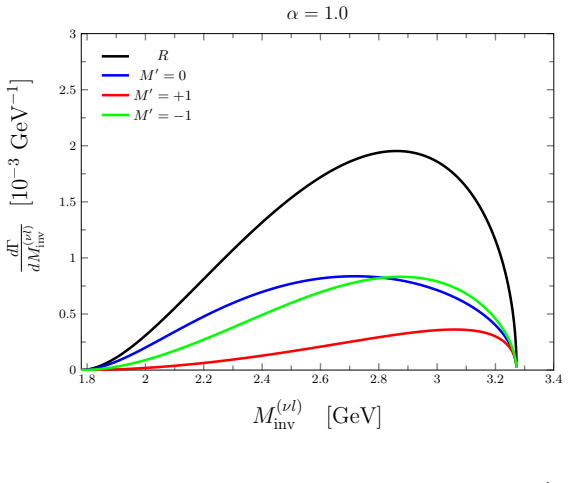
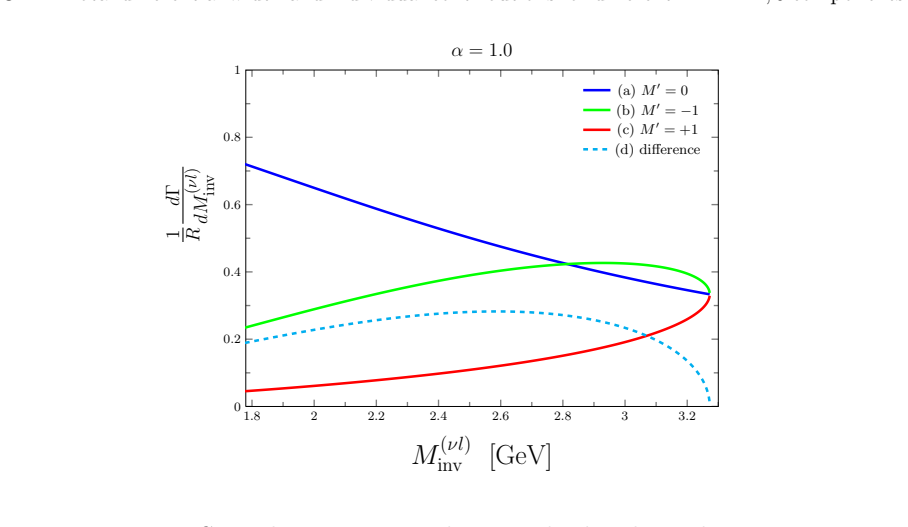
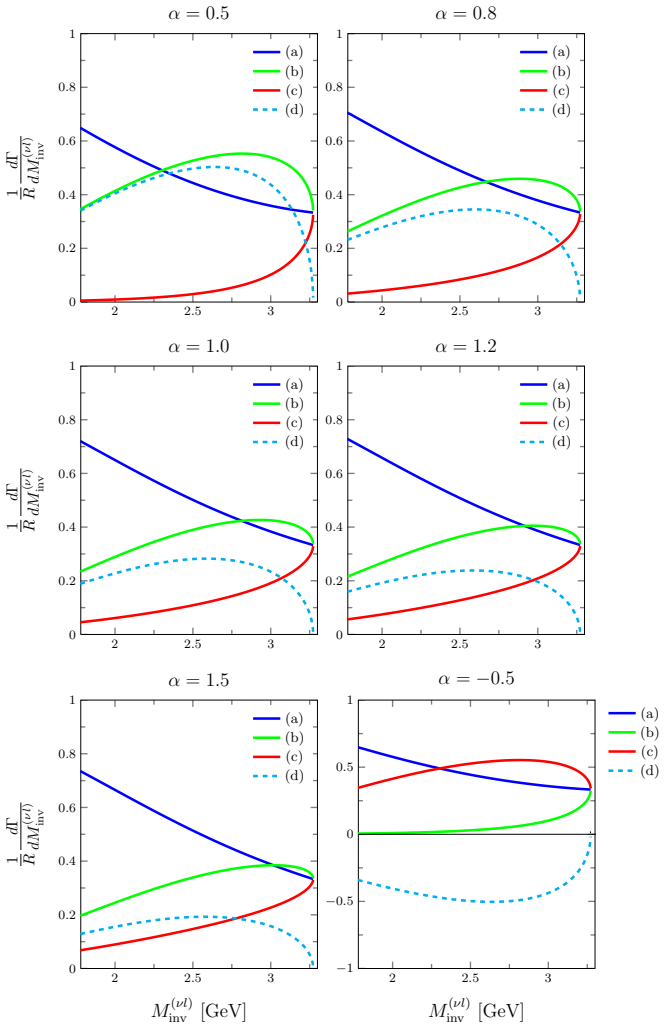
The central object is the generalized quark transition current $Q_\mu = \langle \bar u_c | \gamma_\mu(1-\alpha\gamma_5) | u_b \rangle$, with $\alpha=1$ recovering the Standard Model $V-A$ current. Around it the paper builds helicity amplitudes for the three $D^*$ spin projections $M'=0,\pm1$, evaluated in the $\bar\nu_\tau\tau$ rest frame, using a quark-model mapping of quark momenta to meson momenta consistent with heavy-quark symmetry. Equations (5a)--(5c) give the summed squared amplitudes for each $M'$ in terms of meson wave-function factors $A,B,A',B'$ and the momentum $p$; the sensitive observable is the difference between $M'=-1$ and $M'=+1$, whose expressions carry the $(Bp-B'p)$ term with opposite signs, so the difference changes sign when $\alpha$ changes sign.
What would settle it
A measurement of the normalized $M'=+1$ and $M'=-1$ contributions in $\bar B \to D^* \bar\nu_\tau \tau$ as a function of $M^{(\nu\tau)}_{\rm inv}$ that showed their difference staying flat across the spectrum, or lying far outside the band the model predicts for $\alpha\in[0.8,1.2]$ while $F_L^{D^*}$ varies as predicted, would falsify the claim that this difference is the sensitive probe.
Extended reading notes
Core claim
On its own terms, the paper establishes that in the quark-model treatment of Ref. [30] extended to $\bar B \to D^* \bar\nu_\tau \tau$, the longitudinal polarization fraction $F_L^{D^*}$ is almost flat under changes in the $V-A$ breaking parameter $\alpha$: the computed values are 0.415, 0.448, 0.456, 0.461, 0.465 for $\alpha=0.5,0.8,1.0,1.2,1.5$, and again 0.415 for $\alpha=-0.5$. At $\alpha=1$ the result 0.456 matches the most recent Standard Model prediction. The normalized $M'=0$ band over $\alpha\in[0.8,1.2]$ is narrow, while the normalized $M'=-1$ and $M'=+1$ curves spread widely and their difference is the quantity most sensitive to $\alpha$. The intended conclusion is that for this family of models $F_L^{D^*}$ is not a good probe of new physics, and the difference between the two transverse helicity contributions is the recommended observable.
Load-bearing premise
The central assumption is that intrinsic quark form factors cancel in the ratios used to predict the helicity fractions, so that the no-free-parameter quark model results are accurate; imperfect cancellation would change the predicted sensitivities.
Editorial extensions
If this is right
- The measured value $F_L^{D^*}=0.60\pm0.08\pm0.04$ cannot by itself discriminate this model family from the Standard Model, since the predicted range for $\alpha\in[0.5,1.5]$ is roughly 0.415 to 0.465.
- Experiments that can separate the $M'=-1$ and $M'=+1$ transverse contributions will gain a much more sensitive handle on $V-A$ breaking than the longitudinal fraction alone.
- A sign flip in the difference between the $M'=-1$ and $M'=+1$ contributions relative to the Standard Model would indicate a negative $\alpha$, that is, a reversal of the right-handed current admixture.
- The model reproduces the Standard Model $F_L^{D^*}$ with no fitted parameters, so its ratio predictions for the transverse components carry the same expected accuracy.
Reading between the lines
- A natural extension is that helicity-integrated asymmetries in other $b\to c\tau\nu$ decays, not only $\bar B\to D^*\bar\nu_\tau\tau$, may also dilute $V-A$ breaking signals, and only differential helicity or angular observables can separate the $\alpha$ parameter cleanly.
- If intrinsic quark form factors do not cancel as assumed, the absolute transverse rates could shift, but the sign-flip structure of the $M'=-1$ versus $M'=+1$ difference is driven by the opposite sign of the $(Bp-B'p)$ term and may be more robust than the size of the effect.
- A testable extension would be to compare the same transverse helicity difference in $\bar B\to D^* \ell \bar\nu$ decays for $\ell=e,\mu$ against the $\tau$ mode, since right-handed current effects depend on the lepton mass and a lepton-flavor comparison would help isolate $\alpha$.
Signed reviews
Editorial analysis
A structured set of objections, weighed in public.
Referee Report
Summary. The paper studies the helicity amplitudes of the decay Bbar -> D* anti-nu_tau tau using a quark-level current of the form gamma^mu(1 - alpha gamma^5). For alpha = 1 the standard-model V-A case is recovered, and for alpha != 1 the model represents a family of V-A breaking scenarios. The authors compute the longitudinal polarization fraction F_L^{D*} and the normalized transverse M' = -1 and M' = +1 contributions, integrating the differential rates over the invariant mass of the nu-tau tau pair. Their main finding is that F_L^{D*} is nearly independent of alpha, while the difference between the two transverse helicity contributions is strongly alpha-dependent. On this basis they recommend measuring the transverse helicity components as a more sensitive probe of beyond-standard-model physics than the longitudinal component. The calculation is presented as an extension of the authors' earlier quark-model treatment of B -> D* anti-nu_l l, and the paper emphasizes that no free parameters are fitted.
Significance. If the central claim survives scrutiny, the paper provides a useful and falsifiable phenomenological message: for a broad class of modified quark currents, the longitudinal polarization is a poor discriminator, whereas the M' = -1 versus M' = +1 transverse asymmetry is a sensitive probe. The calculation has the virtue of being parameter-free in the sense that alpha is scanned rather than fitted, and the SM point F_L = 0.456 agrees well with independent SM calculations. However, the significance is presently limited by the model-dependence of the hadronic matrix elements and, in particular, by the unquantified cancellation of intrinsic quark form factors on which the ratio predictions rest. The paper would become substantially stronger if the model were validated against the Belle measurement that motivates it and if the form-factor cancellation were demonstrated rather than asserted.
major comments (3)
- [Section I and Eq. (5)] Section I states that the model of Ref. [30] 'neglects the contribution of intrinsic quark form factors, which are claimed to approximately cancel in the ratios evaluated there.' This is an assertion, not a demonstrated property, and it is load-bearing because the predictions in Figs. 4 and 5 are normalized ratios built from Eq. (5). The M' = +1 and M' = -1 amplitudes are superpositions of (1 - BB'p^2)alpha and (Bp - B'p), so the normalized difference is governed by the interference term 4 alpha (1 - BB'p^2)(Bp - B'p)/R. Momentum-dependent corrections that do not factorize would enter this interference directly and could alter the alpha-sensitivity ordering even if F_L remained close to 0.456. Please either demonstrate the cancellation quantitatively, for example by including a simple dipole form factor and showing that the ratios are stable, or restrict the claims to the specific model without the cancellation assumption.
- [Section III, Table I] The paper is motivated by the Belle measurement F_L^{D*} = 0.60 +/- 0.08 +/- 0.04 quoted in Eq. (1), but it never quantitatively compares the model predictions with that measurement. In Table I, F_L ranges only from 0.415 to 0.465 for alpha between 0.5 and 1.5, so the central value is below the Belle measurement by about 1.6 sigma and no model point reaches 0.60. The statement that F_L is not a good BSM probe therefore requires qualification: within this family the observable is not only insensitive to alpha, it is also in tension with the very measurement that motivates the paper. A fit or at least a quantitative discussion of this discrepancy is needed before drawing the conclusion that experimental effort should be redirected to the transverse components.
- [Section II, Eqs. (5-a)-(5-c)] The central formulas are introduced with 'we find' and no derivation is shown in the paper. The text refers to the approach of Ref. [30] but does not show how the quark current of Eq. (2) is mapped onto the meson-level amplitudes, how the tau mass is handled beyond the kinematical factors of Eqs. (3)-(4), or how the interference terms in the M' = +/-1 amplitudes arise. Since all quantitative claims and figures follow from Eq. (5), please provide the derivation in the text or give a precise equation-by-equation mapping to Refs. [30] and [31] so that the extension from the massless-lepton case to the nu_tau tau case can be checked.
minor comments (5)
- [Table I] The column header uses f_D*_L while the text uses F_L^{D*}; the notation should be unified.
- [Section III] Equation (9) is used twice, once for the total differential rate R and once for the numerical value F_L^{D*} = 0.456; renumber to avoid confusion.
- [References] References [22] and [24] are the same paper (Tanaka and Watanabe, Phys. Rev. D 87, 034028 (2013)); the duplicate should be removed or replaced with a different intended reference.
- [Abstract and Section III] The abstract and Section III write M = -1 and M = +1 without the prime that denotes the D* helicity in Section II; use M' consistently.
- [Summary] The phrase 'right handed quark currents' is imprecise for the current gamma^mu(1 - alpha gamma^5): changing alpha changes the axial-vector coupling, and for negative alpha the structure is closer to V + A; rephrase to avoid confusion.
Circularity Check
No significant circularity: the quoted observables are computed from the quark-model amplitudes of Eqs. (5-a)-(5-c), benchmarked against independent SM calculations, with no parameter fitted to the data or to the claimed alpha-sensitivity.
full rationale
The paper's central results are direct outputs of the explicit helicity-amplitude expressions in Eqs. (5-a)-(5-c). The alpha-sensitivity ordering (F_L relatively flat, the M'=-1 vs M'=+1 difference steep) follows algebraically from those expressions: in Eqs. (5-b) and (5-c) the term (Bp-B'p) enters with opposite signs relative to (1-BB'p^2)alpha, so the difference of the two transverse squared amplitudes contains a term linear in alpha, while the longitudinal and total rates are dominated by alpha^2 terms. This is a derived consequence of the assumed current structure, not an input. No parameter is fitted to the Belle F_L measurement or to the alpha-dependence; the SM value F_L = 0.456 is compared with independent calculations [27,28,35] as a consistency check. The self-citations [30,31] supply the quark-model operator evaluation, but the present paper extends the computation to the B -> D* tau-nu_tau kinematics and computes the quoted ratios explicitly, so no load-bearing claim rests solely on an unverified self-citation. The statement that intrinsic quark form factors 'are claimed to approximately cancel in the ratios' is an unquantified modeling assumption and a correctness risk, not a circular reduction: the cancellation is not used to define the observables, and the paper's predictions could in principle fail if the cancellation is poor. No equation is equivalent by construction to a fitted parameter or to the conclusion it is used to support.
Assumptions & free parameters
free parameters (1)
- alpha =
not fitted; scanned over [-0.5, 1.5]
assumptions (5)
- domain assumption The quark model of Ref. [31] accurately describes the hadronic matrix elements ⟨D*|J^mu|B⟩.
- domain assumption Quark momenta can be mapped to meson momenta in a way consistent with heavy quark symmetry, as done in Ref. [30].
- domain assumption Intrinsic quark form factor contributions approximately cancel in the ratios evaluated in the paper.
- domain assumption The BSM signal can be parametrized by the single family of currents gamma^mu - alpha gamma^mu gamma^5.
- standard math Standard kinematic and phase-space relations (Eqs. (3), (4), (6)) are valid.
Cite this review
Pith. "Pith review of Helicity amplitudes in the $\bar{B} \to D^{*} \bar{\nu}_\tau \tau$ decay with $V-A$ breaking in the quark sector." pith.science (2026). https://pith.science/paper/DS4BPOUL
@misc{pith2026190808967,
  author       = {Pith},
  title        = {Pith review of: Helicity amplitudes in the $\barB \to D^* \bar\nu_\tau \tau$ decay with $V-A$ breaking in the quark sector},
  year         = {2026},
  howpublished = {\url{https://pith.science/paper/DS4BPOUL}},
  note         = {Machine review of arXiv:1908.08967}
}
abstract
In view of the recent measurement of the $F_L^{D^*}$ magnitude in the $\bar{B} \to D^{*} \bar{\nu}_\tau \tau$ reaction we evaluate this magnitude within the standard model and for a family of models with the $\gamma^\mu -\alpha\gamma^\mu \gamma_5$ current structure for the quarks for different values of $\alpha$. At the same time we evaluate also the transverse contributions, $M=-1$, $M=+1$, and find that the difference between the $M=-1$ and $M=+1$ contributions is far more sensitive to changes in $\alpha$ than the longitudinal component.
Figures

Figures from the paper (2 more)

Reference graph
Works this paper leans on
- [30]
-
[28]
M. A. Ivanov, J. G. K¨ orner, and C. T. Tran, Phys. Rev. D 92, 114022 (2015)
work page 2015
- [31]
-
[1]
M′ = 0 ∑ |t|2 = m2 l mνml M 2(νl) inv −m2 l M 2(νl) inv { AA′(B +B′)p }2 α2 (5-a) + 2 mνml ( ~Eν~El + 1 3~p2 ν ){ AA′(1 +BB′p2) }2 α2. 3
-
[2]
M′ = 1 ∑ |t|2 = 2 mνml ( ~Eν~El + 1 3~p2 ν ){ AA′[(1−BB′p2)α + (Bp−B′p)] }2 . (5-b)
-
[3]
M′ =−1 ∑ |t|2 = 2 mνml ( ~Eν~El + 1 3~p2 ν ){ AA′[(1−BB′p2)α− (Bp−B′p)] }2 . (5-c) Following the approach of [30], the above the matrix elements are evaluated in the frame where the ¯νl system is at rest, where pB = pD∗ = p, with p given by p = λ1/2(m2 B,M 2(νl) inv ,m 2 D∗) 2M (νl) inv , (6) where M (νl) inv is the invariant mass of the νl pair. For B an...
work page 2014
-
[4]
B. Aubert et al. [BaBar Collaboration], Phys. Rev. Lett. 91, 171802 (2003); K. F. Chen et al. [Belle Collaboration], Phys. Rev. Lett. 91, 201801 (2003)
work page 2003
-
[5]
A. K. Alok, A. Datta, A. Dighe, M. Duraisamy, D. Ghosh and D. London, J. High Energy Phys. 11, 121 (2011)
work page 2011
Show all 37 references
-
[6]
Datta, A
A. Datta, A. V. Gritsan, D. London, M. Nagashima and A. Szynkman, Phys. Rev. D 76, 034015 (2007)
2007
-
[7]
Aaltonen et al
T. Aaltonen et al. [CDF Collaboration], Phys. Rev. Lett. 107, 261802 (2011)
2011
-
[8]
del Amo Sanchez et al
P. del Amo Sanchez et al. [BaBar Collaboration], Phys. Rev. D 83, 051101 (2011)
2011
-
[9]
Aaij et al
R. Aaij et al. [LHCb Collaboration], Phys. Lett. B 709, 50 (2012)
2012
-
[10]
A. L. Kagan, Phys. Lett. B 601, 151 (2004)
2004
-
[11]
Beneke, J
M. Beneke, J. Rohrer and D. Yang, Nucl. Phys. B 774, 64 (2007). 8
2007
-
[12]
Datta, Y
A. Datta, Y. Gao, A. V. Gritsan, D. London, M. Nagashima and A. Szynkman, Phys. Rev. D 77, 114025 (2008)
2008
-
[13]
Y. G. Xu and R. M. Wang, Int. J. Theor. Phys. 55, 5290 (2016)
2016
-
[14]
J. P. Lees et al. [BaBar Collaboration], Phys. Rev. D 93, 052015 (2016)
2016
-
[15]
J. T. Wei et al. [Belle Collaboration], Phys. Rev. Lett. 103, 171801 (2009)
2009
-
[16]
Aaltonen et al
T. Aaltonen et al. [CDF Collaboration], Phys. Rev. Lett. 108, 081807 (2012)
2012
-
[17]
Chatrchyan et al
S. Chatrchyan et al. [CMS Collaboration], Phys. Lett. B 727, 77 (2013)
2013
-
[18]
Aaij et al
R. Aaij et al. [LHCb Collaboration], J. High Energy Phys. 1308, 131 (2013)
2013
-
[19]
D. Das, G. Hiller and I. Nisandzic, Phys. Rev. D 95, 073001 (2017)
2017
-
[20]
Altmannshofer, A
W. Altmannshofer, A. J. Buras, D. M. Straub and M. Wick, J. High Energy Phys. 0904, 022 (2009)
2009
-
[21]
M. J. Aslam, C. D. L¨ u and Y. M. Wang, Phys. Rev. D 79, 074007 (2009)
2009
-
[22]
R. H. Li, C. D. L¨ u and W. Wang, Phys. Rev. D 83, 034034 (2011)
2011
-
[23]
C. D. L¨ u and W. Wang, Phys. Rev. D 85, 034014 (2012)
2012
-
[24]
Fajfer, J
S. Fajfer, J. F. Kamenik and I. Nisandzic, Phys. Rev. D 85, 094025 (2012)
2012
- [26]
-
[27]
Tanaka and R
M. Tanaka and R. Watanabe, Phys. Rev. D 87, 034028 (2013)
2013
-
[29]
A. K. Alok, D. Kumar, S. Kumbahar, and S. U. Sankar, Phys. Rev. D 95, 115038 (2017)
2017
-
[32]
M. A. Ivanov, J. G. K¨ orner, and C. T. Tran, Phys. Rev. D 94, 094028 (2016)
2016
-
[33]
L. R. Dai and E. Oset, Eur. Phys. J. C 78, 951 (2018)
2018
-
[34]
L. R. Dai, X. Zhang and E. Oset, Phys. Rev. D 98, 036004 (2018)
2018
-
[35]
Isgur and M
N. Isgur and M. B. Wise, Phys. Lett. B 232, 113 (1989)
1989
-
[36]
Isgur and M
N. Isgur and M. B. Wise, Phys. Lett. B 237, 527 (1990)
1990
-
[37]
Neubert, Phys
M. Neubert, Phys. Rev. D 46, 2212 (1992)
1992
-
[38]
Gambino, M
P. Gambino, M. Jung and S. Schacht, Phys. Lett. B 795, 386 (2019). 9
2019
Reviewed August 14, 2026 · model on record in the stance chip above.
Discussion (0). Continue with ORCID to comment.