REVIEW 3 major objections 6 minor 16 references
FaSTExt: Fast and Small Text Extractor
T0 review · 3 major / 6 minor · reviewed 2026-08-14 · deepseek-v4-flash
Pith's one-line read FaSTExt claims a compact text detector can match larger networks on camera-centred scenes by predicting segments and links at five scales.
desk verdict A well-scoped lightweight text detector with a genuinely new architecture and honest reporting; the main gaps are missing code, no ablation of the five-scale design, and a protocol footnote that invites confusion. read the letter →
The pith
A machine-rendered reading of the paper's core claim, the machinery that carries it, and where it could break.
The reading
What carries the argument
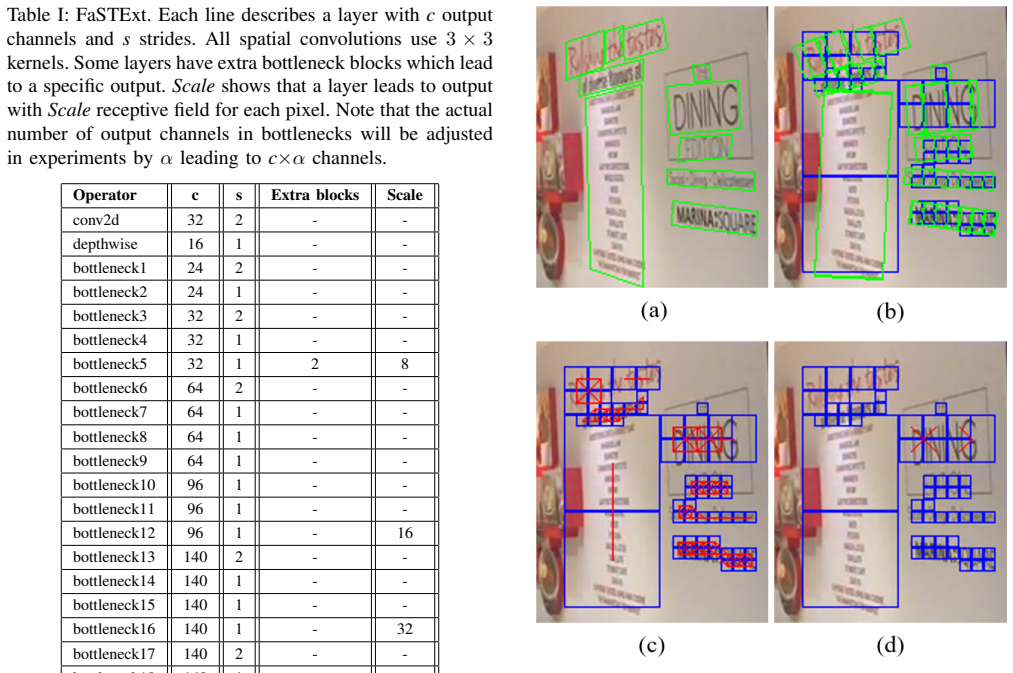
The architecture is a fully convolutional segment-and-link detector built from MobileNetV2 bottleneck blocks: depthwise separable convolutions, linear bottlenecks (no activations on the compressed channels), and inverted residuals with shortcuts. The network outputs, at five scales from 8x8 to 128x128 receptive fields, 31-channel predictions per scale: two text/non-text classes, five geometry values, sixteen within-scale links to eight neighbours, and eight cross-layer links to the finer scale; the first scale omits cross-layer links. Segments and links are assembled by depth-first search into word bounding boxes, following the SegLink postprocessing. The MobileNetV2 blocks are the key complexity-reduction mechanism, and the five-scale output is the mechanism claimed to prevent losing small and large symbols.
What would settle it
A reader could settle the claim by cropping ICDAR 2015 words so they are centred and as large as ICDAR 2013 text and rerunning the same FaSTExt checkpoint; the scale-range explanation predicts F-measure should recover to near 0.897, while a representation or data explanation predicts it stays near 0.5.
Extended reading notes
Core claim
The central claim is that replacing a heavy VGG backbone with MobileNetV2 bottleneck blocks, in a fully convolutional segment-and-link architecture, yields a text detector whose accuracy-versus-speed tradeoff beats larger single-scale networks on the dataset that matches its intended use. Concretely, with a width multiplier alpha=2 the network has 10.59 million parameters, runs at 18.2 FPS on a GTX 1080 Ti, and achieves 0.897 F-measure on ICDAR 2013, above the reported single-scale results of SegLink (0.853) and the authors' EAST implementation (0.787). With alpha=0.75, 1.58 million parameters still give 0.872 F-measure at 37.5 FPS. The same design does not transfer to ICDAR 2015 or MSRA-TD500, where text is small, rotated, or shadowed; there FaSTExt's F-measure drops to roughly 0.48-0.65, and the authors attribute this to the fixed five-scale detection range and the centred-text operating assumption.
Load-bearing premise
The load-bearing assumption is that five fixed output scales from 8x8 to 128x128 at roughly 0.3-megapixel input cover every text size in the camera-centred scenario, a choice the paper justifies only by experience and never tests by ablation.
Editorial extensions
If this is right
- If FaSTExt's claim holds, a 10.59-million-parameter detector can match or beat single-scale SegLink and EAST on ICDAR 2013, so model size alone need not cost accuracy on centred camera text.
- The 1.58-million-parameter variant gives 37.5 frames per second with F-measure 0.872, making real-time text extraction plausible on embedded GPUs.
- The segment-and-link formulation with cross-scale links removes the need for separate region proposal or character detection stages for moderate-size text.
- The fixed five-scale range sets a hard limit: small, rotated, or shadowed text, as in ICDAR 2015 and MSRA-TD500, is outside the method's effective operating conditions.
Reading between the lines
- The paper leaves implicit that its five-scale choice is also a claim about the deployment camera: as long as the user frames the text, the same architecture should generalise to other fixed-size objects such as barcodes, QR codes, or signage without architectural change.
- Because no ablation varies the number of scales or the input resolution, a direct follow-up would be to retrain with six or seven scales and larger inputs on ICDAR 2015; the paper's rational-tradeoff assertion predicts only marginal gains, which would separate a scale limitation from a representation limitation.
- The authors' observation that alpha=0.75 beats alpha=2 on harder datasets because larger models need more data suggests a testable prediction: with a much larger training set, the alpha=2 network should narrow the ICDAR 2015 gap, since the architecture, not the capacity, is the stated bottleneck.
Signed reviews
Editorial analysis
A structured set of objections, weighed in public.
Referee Report
Summary. The manuscript proposes FaSTExt, a fully convolutional scene-text detector built from MobileNetV2-style inverted residual blocks. It predicts per-pixel text segments, their geometry, within-scale links, and cross-scale links at five output scales (8x8 to 128x128) and reconstructs word boxes with a DFS-based post-processing step. The authors pretrain on SynthText and fine-tune on ICDAR 2013, ICDAR 2015, and MSRA-TD500; with width multipliers alpha=0.75, 1, and 2 they obtain 1.58, 2.87, and 10.59 million parameters and report F-measures of 0.8716, 0.8765, and 0.8970 on IC13, with 37.5, 35.2, and 18.2 FPS on a GTX 1080 Ti. They conclude that the method is suited to camera-captured images in which text is roughly centered and not too small, and they explicitly acknowledge that performance degrades on IC15 and TD500.
Significance. If the headline results are taken at face value, the paper makes a useful empirical contribution: it demonstrates that a compact MobileNetV2-style detector can reach competitive F-measure on a standard benchmark while using substantially fewer parameters than VGG- or ResNet-based competitors, and it reports speed measurements on identical hardware. The architecture is described in sufficient detail to reimplement, the parameter-count and timing tables are useful, and the paper honestly states its scope limitations. However, the strength of the significance claim depends on the validity of the IC13 comparison, the absence of variability estimates, and the support for the five-scale design choice. The manuscript would be strengthened by releasing evaluation code or per-image detections and by reporting official IC13 metrics.
major comments (3)
- [Section IV.B, Table V] The evaluation protocol described in Section IV.B, with one-to-one, one-to-many, and many-to-one matching and a footnote linking to the ICDAR 2015 challenge (ch=2), is not the official ICDAR 2013 evaluation protocol, which uses one-to-one matching. The single-scale comparison numbers in Table V (Shi et al. 0.853, Liu et al. 0.8823, Liao et al. 0.81) were reported by their authors with the official IC13 metric. Therefore the FaSTExt IC13 F-measures may not be directly comparable, and the claimed advantage over Liu et al. (0.8970 vs 0.8823) could be an artifact of the more permissive matching. The authors should re-evaluate FaSTExt with the official IC13 evaluation code or with the same code used for the cited baselines, and report both metrics, or remove the head-to-head comparisons.
- [Section IV.C, Tables V-VII] All reported F-measures come from a single training run per configuration. The differences between configurations are small (0.8716, 0.8765, and 0.8970 on IC13), and the margin over the closest cited single-scale baseline is 0.0147; without repeated runs or a variance estimate, the claims that alpha=2 'outperforms' and that smaller versions are 'on par with' state of the art are not statistically supported. At minimum, report means and standard deviations over multiple runs, or provide per-image scores and a matched-pair test.
- [Section III, Section IV.C] The five-scale design and the 512-pixel input resolution are load-bearing assumptions. Section III states that five scales at about 0.3 megapixels was 'a rational tradeoff' but reports no ablation of the number of scales, the scale range, or the input resolution; Section IV.C attributes the IC15 and TD500 failures to small or rotated text, which is precisely the regime these choices control. The authors should add an ablation (for example, remove the 8x8 or 128x128 scale, change the input resolution, or vary the scale count) to support the claim, or explicitly temper the claim about the generality of the tradeoff.
minor comments (6)
- [Section IV.B] The sentence 'The evaluation is done per ground truth quadrangle and detected one, not per image' is unclear; specify whether this means per-element matching in the official protocol and how the aggregate precision and recall are computed.
- [Table I] The 'Extra blocks' column is ambiguous; for example, the entry 'bottleneck5 32 1 2 8' should be explained in the caption as meaning two extra bottleneck blocks leading to the 8x8 output.
- [Section IV.A] There is a typo: 'pretraininig' should be 'pretraining'; also clarify whether the stated 20 days per alpha covers only SynthText pretraining or the full training pipeline.
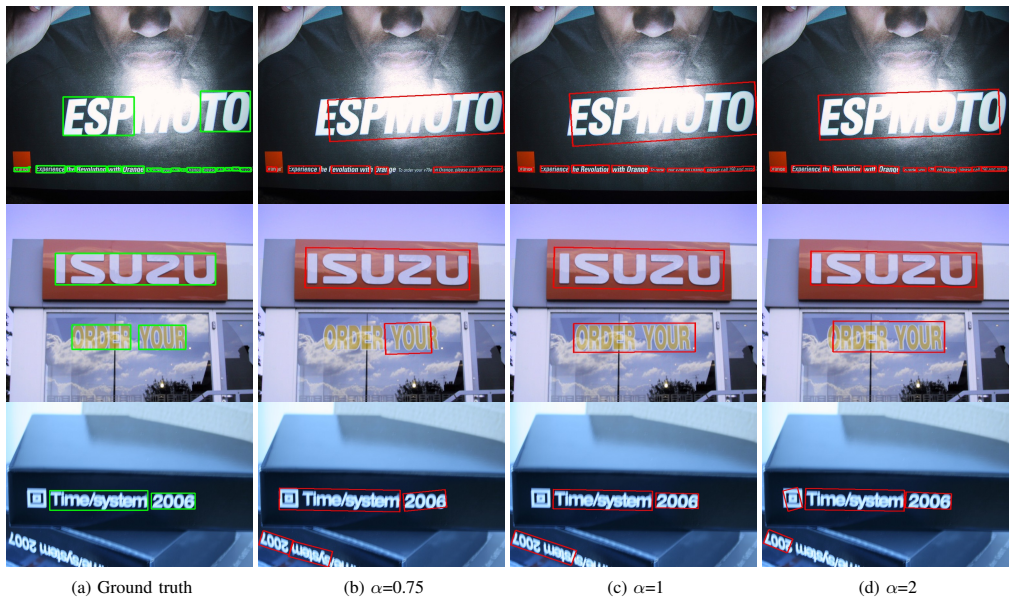
- [Figure 2] In the first row, the text says FaSTExt 'could successfully detect the full word' where the ground truth did not include the region; relative to the given ground truth this is an over-detection and should be phrased accordingly.
- [Equation (1)] The notation 2/3Nh is ambiguous; if the intended denominator is 3 times the number of hard negatives, write it as 2/(3N_h) explicitly.
- [Abstract] The abstract does not mention the centered-text and not-too-small-text limitation that the conclusion states; adding this caveat would make the scoped claim clearer to readers.
Circularity Check
No significant circularity; the paper's claims are empirical evaluations against public benchmarks and contain no derivation that reduces to its inputs.
full rationale
The paper makes no formal derivation claim that could reduce to its inputs. The central claim is that FaSTExt detects text with 1.58–10.59 million parameters and achieves competitive F-measure on ICDAR 2013; this is supported by training on SynthText and public benchmarks and by direct comparison to published results in Tables V–VII. No parameter is fitted to a target metric and then renamed as a prediction: thresholds are fixed at 0.5 based on SegLink's reported insensitivity, the five-scale choice is presented as an empirical tradeoff ('our experiments have shown that extracting text in five scales at approximately 0.3 megapixels was a rational tradeoff'), and the alpha multiplier only scales architectural width. Self-citations are not load-bearing; MobileNetV2, SegLink, and other prior works are cited as external architectural and algorithmic building blocks, not as justification that FaSTExt's own numbers are correct. The skeptic's concern about the ICDAR 2013 evaluation protocol (footnote references RRC challenge ch=2, which is ICDAR 2015) is a legitimate comparability/correctness risk, but it is not a circularity: the protocol choice does not make the reported F-measure equivalent, by construction, to a fitted parameter. Therefore the honest finding is no significant circularity, score 0.
Assumptions & free parameters
free parameters (2)
- Number of scales and scale range =
5 scales: 8, 16, 32, 64, 128
- Segment and link thresholds =
0.5
assumptions (3)
- domain assumption Text acquired by a camera in the target scenario appears close to the center of the image and is reasonably large.
- ad hoc to paper The five fixed scales from 8x8 to 128x128 at 0.3 megapixels cover the text sizes that appear in the intended camera scenario.
- domain assumption SegLink-style postprocessing with DFS and line fitting reconstructs final word boxes from predicted segments and links.
Cite this review
Pith. "Pith review of FaSTExt: Fast and Small Text Extractor." pith.science (2026). https://pith.science/paper/LWSFJAJN
@misc{pith2026190808994,
  author       = {Pith},
  title        = {Pith review of: FaSTExt: Fast and Small Text Extractor},
  year         = {2026},
  howpublished = {\url{https://pith.science/paper/LWSFJAJN}},
  note         = {Machine review of arXiv:1908.08994}
}
read the original abstract
Text detection in natural images is a challenging but necessary task for many applications. Existing approaches utilize large deep convolutional neural networks making it difficult to use them in real-world tasks. We propose a small yet relatively precise text extraction method. The basic component of it is a convolutional neural network which works in a fully-convolutional manner and produces results at multiple scales. Each scale output predicts whether a pixel is a part of some word, its geometry, and its relation to neighbors at the same scale and between scales. The key factor of reducing the complexity of the model was the utilization of depthwise separable convolution, linear bottlenecks, and inverted residuals. Experiments on public datasets show that the proposed network can effectively detect text while keeping the number of parameters in the range of 1.58 to 10.59 million in different configurations.
Figures
Reference graph
Works this paper leans on
-
[1]
Multi-oriented text detection with fully convolutional net- works,
Z. Zhang, C. Zhang, W. Shen, C. Yao, W. Liu, and X. Bai, “Multi-oriented text detection with fully convolutional net- works,” in 2016 IEEE Conference on Computer Vision and Pattern Recognition (CVPR), June 2016, pp. 4159–4167
work page 2016
-
[2]
Detecting oriented text in natural images by linking segments,
B. Shi, X. Bai, and S. Belongie, “Detecting oriented text in natural images by linking segments,” in 2017 IEEE Confer- ence on Computer Vision and Pattern Recognition (CVPR) , July 2017, pp. 3482–3490
work page 2017
-
[3]
East: An efficient and accurate scene text detector,
X. Zhou, C. Yao, H. Wen, Y . Wang, S. Zhou, W. He, and J. Liang, “East: An efficient and accurate scene text detector,” in 2017 IEEE Conference on Computer Vision and Pattern Recognition (CVPR), July 2017, pp. 2642–2651
work page 2017
-
[4]
U-net: Convolu- tional networks for biomedical image segmentation,
O. Ronneberger, P. Fischer, and T. Brox, “U-net: Convolu- tional networks for biomedical image segmentation,” in Med- ical Image Computing and Computer-Assisted Intervention – MICCAI 2015 , N. Navab, J. Hornegger, W. M. Wells, and A. F. Frangi, Eds. Cham: Springer International Publishing, 2015, pp. 234–241
work page 2015
-
[5]
ArbiText: Arbitrary-Oriented Text Detection in Unconstrained Scene
D. Xing, Z. Li, X. Chen, and Y . Fang, “Arbitext: Arbitrary-oriented text detection in unconstrained scene,” (a) Ground truth (b) α=0.75 (c) α=1 (d) α=2 Figure 2: Example of text extraction results. The first column contains ground truth which accompanied the dataset. Second to fourth columns show results with α values 0.75, 1, and 2 respectively. CoRR, vo...
work page Pith review arXiv 2017
-
[6]
Rotation- sensitive regression for oriented scene text detection,
M. Liao, Z. Zhu, B. Shi, G. Xia, and X. Bai, “Rotation- sensitive regression for oriented scene text detection,” in 2018 IEEE/CVF Conference on Computer Vision and Pattern Recognition, June 2018, pp. 5909–5918
work page 2018
-
[7]
Geometry- aware scene text detection with instance transformation net- work,
F. Wang, L. Zhao, X. Li, X. Wang, and D. Tao, “Geometry- aware scene text detection with instance transformation net- work,” in 2018 IEEE/CVF Conference on Computer Vision and Pattern Recognition, June 2018, pp. 1381–1389
work page 2018
-
[8]
Fots: Fast oriented text spotting with a unified network,
X. Liu, D. Liang, S. Yan, D. Chen, Y . Qiao, and J. Yan, “Fots: Fast oriented text spotting with a unified network,” in 2018 IEEE/CVF Conference on Computer Vision and Pattern Recognition, June 2018, pp. 5676–5685
work page 2018
Show all 16 references
-
[9]
Deep residual learning for image recognition,
K. He, X. Zhang, S. Ren, and J. Sun, “Deep residual learning for image recognition,” in 2016 IEEE Conference on Com- puter Vision and Pattern Recognition (CVPR), June 2016, pp. 770–778
2016
-
[10]
Mobilenetv2: Inverted residuals and linear bottlenecks,
M. Sandler, A. Howard, M. Zhu, A. Zhmoginov, and L. Chen, “Mobilenetv2: Inverted residuals and linear bottlenecks,” in 2018 IEEE/CVF Conference on Computer Vision and Pattern Recognition, June 2018, pp. 4510–4520
2018
-
[11]
Identity mappings in deep residual networks,
K. He, X. Zhang, S. Ren, and J. Sun, “Identity mappings in deep residual networks,” in Computer Vision – ECCV 2016 , B. Leibe, J. Matas, N. Sebe, and M. Welling, Eds. Cham: Springer International Publishing, 2016, pp. 630–645
2016
-
[12]
Synthetic data for text localisation in natural images,
A. Gupta, A. Vedaldi, and A. Zisserman, “Synthetic data for text localisation in natural images,” in 2016 IEEE Conference on Computer Vision and Pattern Recognition (CVPR) , June 2016, pp. 2315–2324
2016
-
[13]
Icdar 2013 robust reading competition,
D. Karatzas, F. Shafait, S. Uchida, M. Iwamura, L. G. i. Big- orda, S. R. Mestre, J. Mas, D. F. Mota, J. A. Almazn, and L. P. de las Heras, “Icdar 2013 robust reading competition,” in 2013 12th International Conference on Document Analysis and Recognition, Aug 2013, pp. 1484–1493
2013
-
[14]
Icdar 2015 competition on robust reading,
D. Karatzas, L. Gomez-Bigorda, A. Nicolaou, S. Ghosh, A. Bagdanov, M. Iwamura, J. Matas, L. Neumann, V . R. Chandrasekhar, S. Lu, F. Shafait, S. Uchida, and E. Valveny, “Icdar 2015 competition on robust reading,” in 2015 13th International Conference on Document Analysis and R...
2015
-
[15]
Detecting texts of arbitrary orientations in natural images,
C. Yao, X. Bai, W. Liu, Y . Ma, and Z. Tu, “Detecting texts of arbitrary orientations in natural images,” in 2012 IEEE Conference on Computer Vision and Pattern Recognition , June 2012, pp. 1083–1090
2012
-
[16]
On the convergence of adam and beyond,
S. J. Reddi, S. Kale, and S. Kumar, “On the convergence of adam and beyond,” in International Conference on Learning Representations , 2018. [Online]. Available: https: //openreview.net/forum?id=ryQu7f-RZ
2018
Reviewed August 14, 2026 · model on record in the stance chip above.
Discussion (0). Continue with ORCID to comment.