REVIEW 3 major objections 4 minor 49 references
Hyperentangled Time-bin and Polarization Quantum Key Distribution
T0 review · 3 major / 4 minor · reviewed 2026-08-14 · deepseek-v4-flash
Pith's one-line read A hyperentanglement-based QKD protocol using photons entangled in both polarization and time-bin generates secret keys at higher channel losses than polarization-only BBM92, including in geostationary orbit, after active Doppler-shift…
desk verdict Solid experimental demonstration of hyperentangled time-bin/polarization QKD with a genuinely new protocol, but the finite-key rates and GEO advantage rest on an unproven ququart squashing assumption. read the letter →
The pith
A machine-rendered reading of the paper's core claim, the machinery that carries it, and where it could break.
The reading
What carries the argument
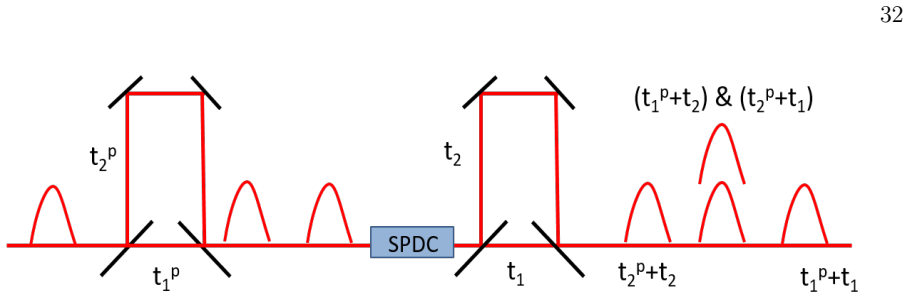
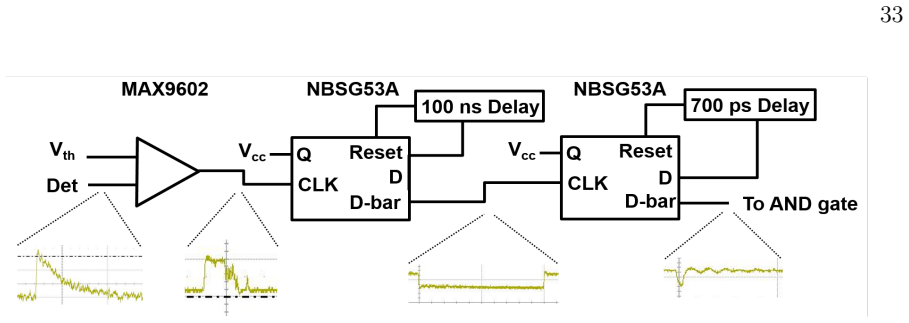
The load-bearing object is the hyperentangled photonic ququart, a four-dimensional quantum state in which each photon carries one bit of polarization entanglement and one bit of time-bin entanglement, written $|\Psi\rangle = \tfrac{1}{2}(|Ht_1\rangle|Ht_1\rangle + |Vt_2\rangle|Vt_2\rangle + |Vt_1\rangle|Vt_1\rangle + |Ht_2\rangle|Ht_2\rangle)$. The analyzer combines an interferometer that superposes time bins, polarization optics that address the four basis states, and a custom time-bin sorting circuit that assigns the three output time bins to the correct bases. The argument is carried by the finite-key security analysis: the quantum leftover hash lemma converts smooth min-entropy bounds from entropic uncertainty relations for mutually unbiased bases in dimension $d=4$ into an extractable key length $\ell_{4D}$, while the source model with background counts and detection efficiencies supplies the QBER estimates that enter those bounds.
What would settle it
Operate the same source and analyzers while increasing the mean pair number per pump pulse ($\mu$) above the simulated optimum, run full finite-key post-processing, and compare the measured secret key length with the $\ell_{4D}$ bound; a violation, or a QBER that grows faster with $\mu$ than the depolarizing-channel estimate predicts, would show that multi-pair emissions break the local four-dimensional squashing assumption.
Extended reading notes
Core claim
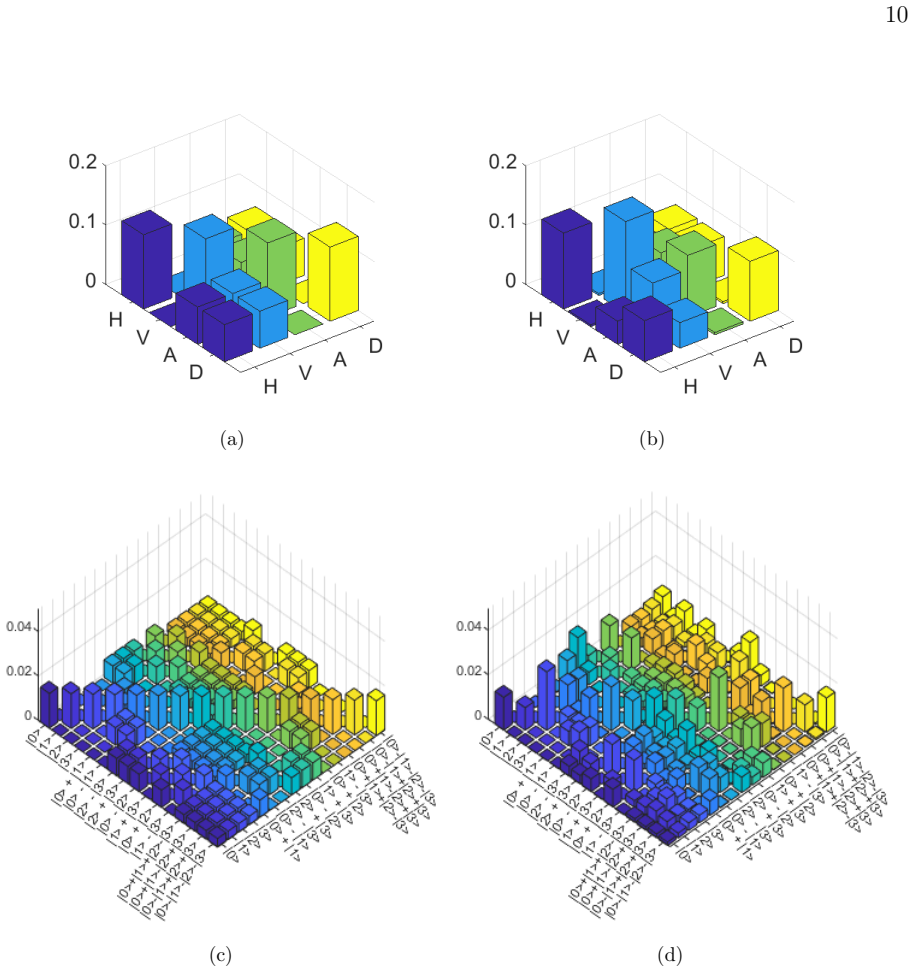
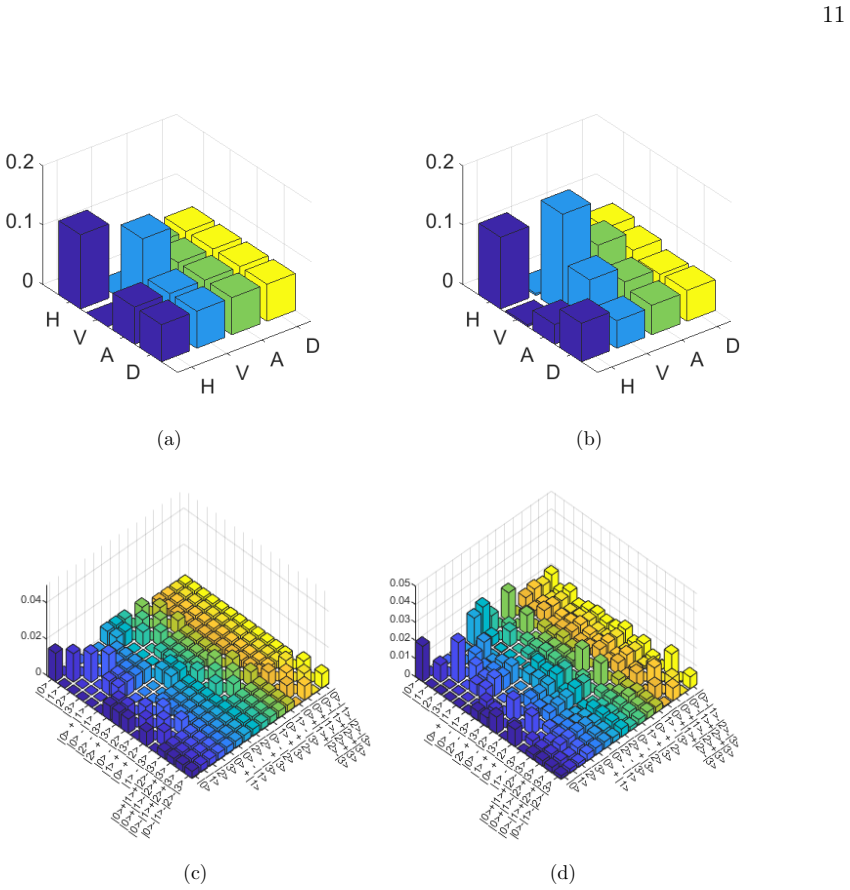
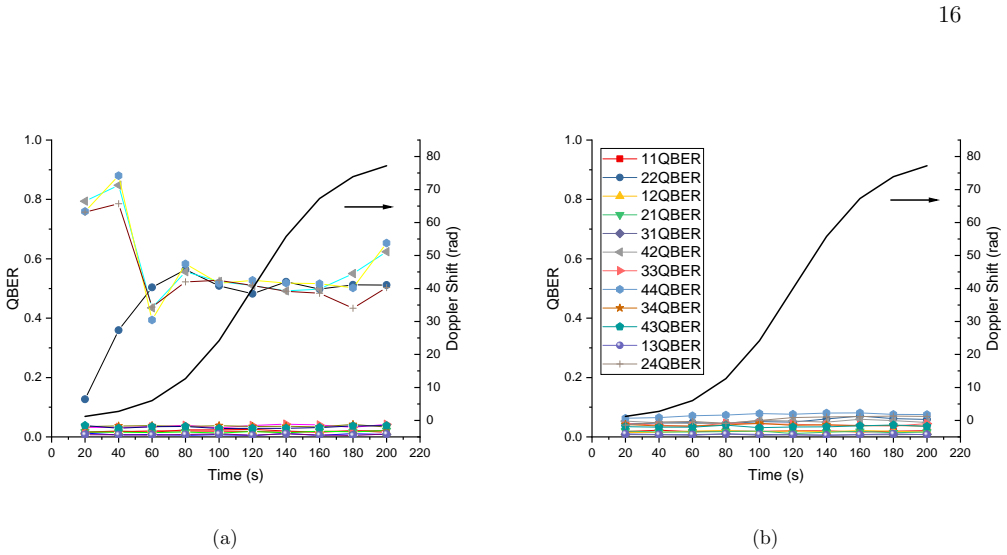
In the paper's own terms, the central discovery is that HEQKD, a $d=4$ protocol built from two pairs of mutually unbiased bases on polarization-and-time-bin ququarts, remains secure and key-generating at channel losses where BBM92 stops producing key. The lab system reached QBER below 2% for BBM92 and below 5.5% for all HEQKD basis combinations, showed the expected error signature when a birefringent crystal simulated an intercept-resend eavesdropper, and held QBER stable when the time-bin phase was swept to mimic a low-Earth-orbit pass. The finite-key simulation, optimizing mean pair number and basis probabilities, gives HEQKD about an order of magnitude more secret key than BBM92 per orbital pass and a non-zero rate (about 10 kb/hr) in geostationary orbit. The authors attribute the advantage to the higher error tolerance of four-dimensional encoding, which lets the source run at a higher mean pair number.
Load-bearing premise
The load-bearing premise is that every accepted detection can be treated as a measurement on one four-dimensional photon, even when the entangled source emits several pairs at once; if multi-pair emissions carry information outside that local four-dimensional model, the finite-key bound and the simulated key rates do not apply to the real implementation.
Editorial extensions
If this is right
- Under the authors' projected system parameters, a single low-Earth-orbit pass could yield a substantial secret key, with HEQKD outperforming BBM92 by about an order of magnitude for every maximum elevation angle from 20 to 90 degrees.
- In a geostationary-orbit link with a 3-m ground aperture, HEQKD is projected to produce roughly 10 kb/hr of secret key, while BBM92 produces none under the same assumptions.
- Any time-bin-based satellite QKD must actively compensate the Doppler shift of the time-bin spacing, and the demonstrated phase stabilization keeps HEQKD QBER stable within 1% standard deviation during a simulated pass.
- The optimal operating point shifts with loss: in the asymptotic regime the protocol favors key-generating bases, while in the finite-key regime it favors error-checking bases to tighten the error estimate.
Reading between the lines
- Beyond the paper, the same source and time-bin sorting hardware could be extended to additional degrees of freedom or to device-independent variants, since the phase-stabilization and sifting techniques are not specific to the four-dimensional protocol.
- The security analysis's assumption that measurements act locally on a four-dimensional Hilbert space could be checked directly with photon-number-resolving detectors: if the finite-key bound is violated as the mean pair number grows, the squashing model is the part that failed.
- The satellite key-rate projections depend on the assumed aperture sizes and losses; recomputing the Friis link budget for smaller ground terminals would reveal how the HEQKD advantage shrinks as loss approaches the 57-dB threshold.
Signed reviews
Editorial analysis
A structured set of objections, weighed in public.
Referee Report
Summary. The paper reports a fiber-and-free-space compatible entanglement-based QKD system using photons hyperentangled in polarization and time-bin. It presents lab implementations of BBM92 and of a four-dimensional HEQKD protocol, QBER measurements in all basis combinations, an in-lab demonstration of Doppler-shift compensation for time-bin interferometry, a finite-key security analysis, and secret-key-rate simulations for LEO and GEO links. The central performance claim is that, with feasible future system parameters, HEQKD yields secure keys at higher channel losses than BBM92, including a GEO scenario, and with roughly an order of magnitude more key per LEO pass.
Significance. The experimental work is careful: QBER values are reported with error bars, the crosstalk matrices are extensive, and the Doppler-compensation demonstration is directly relevant to satellite time-bin QKD. The paper also gives a concrete finite-key framework and compares two protocols with equal system parameters, which is useful. However, the headline claim of a 'rigorous finite-key analysis' for HEQKD rests on an unproven local-dimension/squashing assumption. Because the optimized source mean photon number increases with loss, the impact of the gap is largest in the high-loss regime where the claimed HEQKD advantage, including the GEO point, is located. The experimental contribution is solid; the security-theoretic part needs substantial repair before the performance projections can be accepted as rigorous.
major comments (3)
- [Appendix A.3, Eqs. (A24)-(A25) and (A29)] The HEQKD security bound assumes that the measurements act locally on a four-dimensional Hilbert space. The actual measurement is a Fock-space POVM with threshold detectors, three output time bins, and random assignment of multi-detection events (Appendix C), while the source model in Eq. (A1) explicitly contains multi-pair terms. For BBM92 the paper invokes a squashing model [42]; for HEQKD no analogous squashing theorem is provided or cited. Without such a map, the smooth-min-entropy bounds in Eqs. (A24)-(A25), and therefore the key length in Eq. (A29), do not follow for the implemented setup. This is not a cosmetic issue: the optimized mean photon number mu rises with loss (Fig. 8(a)), so multi-pair events are most frequent in exactly the regime where the paper claims HEQKD beats BBM92, including the GEO comparison in Fig. 8(c). The claim in the abstract that the protocol's security is verified by a rigorous finite-key analysis is therefore not supported as written.
- [Appendix A, Eq. (A13)] The paper states that the QBER estimate gives an upper bound on the error rate 'at least for the d=2 case' when compared with the exact formula of Ma et al. [27], but no proof is supplied for d=4. The simulated key rates in Sec. V.C use this QBER model as input, so if the model can under-estimate the true QBER for the four-dimensional HEQKD implementation, the projected rates in Fig. 8(c) are optimistic. The authors should either prove that Eq. (A13) is an upper bound for d=4 or use a conservative over-estimate in the simulations.
- [Appendix A.3, Eq. (A21)] The reduction from Eq. (A20) to Eq. (A21) assumes that the random variables X1 and X2 are independent. The stated justification, that Alice prepares independent entangled pairs, is not compatible with the SPDC source model of Eq. (A1), which includes multi-pair components, and the measurement procedure described in Appendix C does not enforce the independence. This is an additional unproven step in the derivation of the extractable key length and should be addressed explicitly, either by a proof or by a modified protocol that guarantees the required independence.
minor comments (4)
- [Appendix A.1, Eq. (A1)] In the definition of |psi_n>, the first tensor factor is written as |n-i,i>_A; this appears to be a typo and should read |n-k,k>_A to match the summation index k.
- [Appendix A.1, Eq. (A12)] In the expression for E_MPE, the second inner sum uses eta_A for both Alice's and Bob's detection terms; if the intent is to count detections on both sides, the second sum should use eta_B.
- [Appendix A.3, prelude to Eq. (A22)] The paper invokes 'a version of entropic uncertainty relations for two d=4 mutually unbiased bases' but does not give a precise citation; the authors should cite the specific theorem used and state its assumptions.
- [General] There are minor typographical issues in the text, including 'W' capitalization in the abstract and 'paremeter' in the captions of Figs. 8 and 9; these should be corrected in the final version.
Circularity Check
No circular derivation: key-rate simulations are forward projections from measured QBER and external uncertainty relations; the unproven ququart squashing assumption is a correctness gap, not a circular reduction.
full rationale
The derivation chain is not circular. The finite-key key-rate formulas in Eqs. (A18) and (A29) combine the quantum leftover-hash lemma and entropic uncertainty relations with observed or model-estimated QBER; the predicted HEQKD advantage in Fig. 8c is the output of a forward optimization over mu, p, and r, not a quantity fitted to enforce that advantage. The QBER values entering the simulation are measured data or are derived from the source model of Eq. (A1), and are not themselves presented as predictions. The paper's self-citations (e.g., refs. [13]-[15]) describe prior demonstrations and are not load-bearing; the load-bearing security theorems [26] and [29] are external, parameter-free results whose assumptions do not include the HEQKD key rate, so citing them is independent support rather than circularity. The main genuine weakness is correctness, not circularity: in Appendix A.3, after Eq. (A21), the d=4 bound is applied under the assumption that "the measurements are acting locally on a four-dimensional Hilbert space," with no squashing map supplied for the actual threshold-detector Fock-space POVM, so the finite-key bound may not apply to multi-pair emissions. That is an unsupported assumption, not an input-output reduction, and therefore does not raise the circularity score.
Assumptions & free parameters
free parameters (3)
- intrinsic error probability ed per basis =
inferred from measured basis visibilities (not explicitly tabulated)
- future system parameters for simulations =
400 MHz repetition, 1e-6 background, Alice transmission 0.3, aperture sizes, 6 dB AO loss, 4 dB analysis loss
- e0 =
0.5 (implicitly)
assumptions (7)
- standard math Entropic uncertainty relation for MUBs
- standard math Quantum leftover hash lemma
- standard math Squashing model for two-outcome measurements (BBM92)
- domain assumption Measurements on HEQKD act locally on a 4D Hilbert space
- domain assumption Independence of X1 and X2
- domain assumption Depolarizing-channel error model within each basis
- ad hoc to paper QBER model (Eq. A13) is an upper bound for d=4
Cite this review
Pith. "Pith review of Hyperentangled Time-bin and Polarization Quantum Key Distribution." pith.science (2026). https://pith.science/paper/HJ45XNMD
@misc{pith2026190809018,
  author       = {Pith},
  title        = {Pith review of: Hyperentangled Time-bin and Polarization Quantum Key Distribution},
  year         = {2026},
  howpublished = {\url{https://pith.science/paper/HJ45XNMD}},
  note         = {Machine review of arXiv:1908.09018}
}
abstract
Fiber-based quantum communication networks are currently limited without quantum repeaters. Satellite-based quantum links have been proposed to extend the network domain. We have developed a quantum communication system, suitable for realistic satellite-to-ground communication. With this system, we have executed an entanglement-based quantum key distribution (QKD) protocol developed by Bennett, Brassard, and Mermin in 1992 (BBM92), achieving quantum bit error rates (QBER) below 2$\%$ in all bases. More importantly, we demonstrate low QBER execution of a higher dimensional hyperentanglement-based QKD protocol, using photons simultaneously entangled in polarization and time-bin, leading to significantly higher secure key rates, at the cost of increased technical complexity and system size. We show that our protocol is suitable for a space-to-ground link, after incorporating Doppler shift compensation, and verify its security using a rigorous finite-key analysis. Additionally, We discuss system engineering considerations relevant to those and other quantum communication protocols, and their dependence on what photonic degrees of freedom are utilized.
Figures

Figures from the paper (8 more)




Reference graph
Works this paper leans on
-
[42]
Squashing models for optical measurements in quantum communication,
Normand J. Beaudry, Tobias Moroder, and Norbert L¨ utkenhaus, “Squashing models for optical measurements in quantum communication,” Phys. Rev. Lett. 101, 093601 (2008)
work page 2008
-
[27]
Fang-Xiang Wang, Wei Chen, Zhen-Qiang Yin, Shuang Wang, Guang-Can Guo, and Zheng- Fu Han, “Characterizing high-quality high-dimensional quantum key distribution by state mapping between different degrees of freedom,” Phys. Rev. Applied 11, 024070 (2019). 38
work page 2019
-
[1]
The security proof technique relies on the entropic uncertainty relation [26]
Preliminaries: Models In the following, we will analyze the finite-key security of entanglement-based BB84 (also called BBM92) and a high-dimensional QKD protocol using two sets of two mutually un- biased bases. The security proof technique relies on the entropic uncertainty relation [26]. In both of the above protocols, we assume that entanglement is gene...
-
[2]
Security Bound for BBM92 Having defined the quantum channel and source models, we can derive a bound on the extractable key length (denoted by 𝓁) for a given post-processing block size (the number of raw bits we collect in one execution of the protocol). To further model the security of the QKD protocol, we consider a ( d = 2) QKD protocol with two mutuall...
-
[3]
+ H.c., (A8) where H.c. means Hermitian conjugate, κ is the product of the pump amplitude and the coupling constant between the electromagnetic field and the crystal. The operators a† i, b† i and ai, bi are creation and annihilation operators for the 4 basis states in our measurement system, e.g., a† 0|0⟩ =|Ht1⟩, a† 1|0⟩ =|Vt 2⟩, a† 2|0⟩ =|Vt 1⟩, and a† 3|...
-
[4]
is tuned by tilting the quarter-wave plate before the Sagnac interferometer and/or actuating the liquid crystals after Alice’s analyzer interferometer. All half-wave plates just before the detectors were set at 22.5◦ from horizontal. The half-wave plate before the analyzer interferometer was set at 0 (22.5◦) from horizontal for measurements in bases 1,2 (...
-
[5]
Security Bound for HEQKD We consider an entanglement-based (d = 4) QKD protocol with four measurement bases. Alice’s and Bob’s bases are written as{Ai}4 i=1 and{Bi}4 i=1, respectively, and we suppose that their reference frames and measurements are aligned, i.e., Ai = Bi fori = 1, 2, 3, 4. Assuming Alice and Bob are each operating in a four-dimensional Hi...
-
[6]
Satellite-relayed intercontinental quantum network,
Sheng-Kai Liao, Wen-Qi Cai, Johannes Handsteiner, Bo Liu, Juan Yin, Liang Zhang, Do- minik Rauch, Matthias Fink, Ji-Gang Ren, et al., “Satellite-relayed intercontinental quantum network,” Phys. Rev. Lett. 120, 030501 (2018)
work page 2018
Show all 49 references
-
[7]
Quantum cryptography for secure satellite communica- tions,
Richard J Hughes, William T Buttler, Paul G Kwiat, SK Lamoreuax, GL Morgan, Jane E Nordholt, and Charles G Peterson, “Quantum cryptography for secure satellite communica- tions,” in 2000 IEEE Aerospace Conference. Proceedings (Cat. No. 00TH8484) , Vol. 1 (IEEE,
2000
-
[8]
Long-distance quantum communication with entangled photons using satellites,
Markus Aspelmeyer, Thomas Jennewein, Martin Pfennigbauer, Walter R Leeb, and Anton Zeilinger, “Long-distance quantum communication with entangled photons using satellites,” IEEE J. of Sel. Top. in Q. Elec. 9, 1541–1551 (2003)
2003
-
[9]
Towards a global quantum network,
Christoph Simon, “Towards a global quantum network,” Nat. Phot. 11, 678 (2017)
2017
-
[10]
Satellite-based entanglement distribution over 1200 kilometers,
Juan Yin et al., “Satellite-based entanglement distribution over 1200 kilometers,” Science356, 1140–1144 (2017)
2017
-
[11]
Satellite-to-ground quantum key distribution,
Sheng-Kai Liao et al., “Satellite-to-ground quantum key distribution,” Nature 549, 43 (2017)
2017
-
[12]
Distribution of high-dimensional entanglement via an intra-city free-space link,
Fabian Steinlechner, Sebastian Ecker, Matthias Fink, Bo Liu, Jessica Bavaresco, Marcus Hu- ber, Thomas Scheidl, and Rupert Ursin, “Distribution of high-dimensional entanglement via an intra-city free-space link,” Nat. Comm. 8, 15971 (2017)
2017
-
[13]
Quantum cryptography without Bell’s theorem,
C. H. Bennett, G. Brassard, and N. D. Mermin, “Quantum cryptography without Bell’s theorem,” Phys. Rev. Lett. 68, 557–559 (1992)
1992
-
[14]
Satellite-to-ground entanglement-based quantum key distribution,
Juan Yin, Yuan Cao, Yu-Huai Li, Ji-Gang Ren, Sheng-Kai Liao, Liang Zhang, Wen-Qi Cai, Wei-Yue Liu, Bo Li, Hui Dai, et al. , “Satellite-to-ground entanglement-based quantum key distribution,” Phys. Rev. Lett. 119, 200501 (2017)
2017
-
[15]
Spooqysats: Cubesats to demonstrate quantum key distribution technolo- gies,
James A Grieve, Robert Bedington, Zhongkan Tang, Rakhitha CMRB Chandrasekara, and Alexander Ling, “Spooqysats: Cubesats to demonstrate quantum key distribution technolo- gies,” Acta Astronautica 151, 103–106 (2018)
2018
-
[16]
Experimental satellite quantum communications,
Giuseppe Vallone, Davide Bacco, Daniele Dequal, Simone Gaiarin, Vincenza Luceri, Giuseppe Bianco, and Paolo Villoresi, “Experimental satellite quantum communications,” Phys. Rev. Lett. 115, 040502 (2015)
2015
-
[17]
Air- borne demonstration of a quantum key distribution receiver payload,
Christopher J Pugh, Sarah Kaiser, Jean-Philippe Bourgoin, Jeongwan Jin, Nigar Sultana, Sascha Agne, Elena Anisimova, Vadim Makarov, Eric Choi, Brendon L Higgins, et al. , “Air- borne demonstration of a quantum key distribution receiver payload,” Q. Sci. and Tech. 2, 024009 (2017). 37
2017
-
[18]
Towards high-dimensional quantum key distribution over long-distance free-space links (conference presentation),
Sebastian Ecker, Fabian Steinlechner, Matthias Fink, Bo Liu, Jessica Bavaresco, Marcus Hu- ber, Thomas Scheidl, and Rupert Ursin, “Towards high-dimensional quantum key distribution over long-distance free-space links (conference presentation),” inProc. SPIE 10799, Vol. 10799 (2018)
2018
-
[19]
Time-bin and polarization superdense teleportation for space applications,
Joseph C Chapman, Trent M Graham, Herbert J Bernstein, Christopher K Zeitler, and Paul G Kwiat, “Time-bin and polarization superdense teleportation for space applications,” arXiv preprint arXiv:1901.07181 (2019)
2019 arXiv
-
[20]
Progress towards implementing superdense teleportation in space,
J. C. Chapman, H. Bernstein, K. Meier, C. Zeitler, and P. G. Kwiat, “Progress towards implementing superdense teleportation in space,” in Proc. SPIE 10547 , Vol. 10547 (2018)
2018
-
[21]
Tests of nonlocality with hyperentangled photons,
Christopher K. Zeitler, Joseph C. Chapman, Eric Chitambar, and Paul G. Kwiat, “Tests of nonlocality with hyperentangled photons,” In Preparation
-
[22]
Generation of hyperentangled photon pairs,
Julio T. Barreiro, Nathan K. Langford, Nicholas A. Peters, and Paul G. Kwiat, “Generation of hyperentangled photon pairs,” Phys. Rev. Lett. 95, 260501 (2005)
2005
-
[23]
Provably secure and high-rate quantum key distribution with time-bin qudits,
Nurul T Islam, Charles Ci Wen Lim, Clinton Cahall, Jungsang Kim, and Daniel J Gauthier, “Provably secure and high-rate quantum key distribution with time-bin qudits,” Sci. Adv. 3, e1701491 (2017)
2017
-
[24]
Postselection- free energy-time entanglement,
D. V. Strekalov, T. B. Pittman, A. V. Sergienko, Y. H. Shih, and P. G. Kwiat, “Postselection- free energy-time entanglement,” Phys. Rev. A 54, R1–R4 (1996)
1996
-
[25]
High-dimensional quantum cryptography with twisted light,
Mohammad Mirhosseini, Omar S Maga˜ na-Loaiza, Malcolm N OSullivan, Brandon Rodenburg, Mehul Malik, Martin PJ Lavery, Miles J Padgett, Daniel J Gauthier, and Robert W Boyd, “High-dimensional quantum cryptography with twisted light,” New J. of Phys. 17, 033033 (2015)
2015
-
[26]
Experimental investiga- tion of high-dimensional quantum key distribution protocols with twisted photons,
Fr´ ed´ eric Bouchard, Khabat Heshami, Duncan England, Robert Fickler, Robert W Boyd, Berthold-Georg Englert, Luis L S´ anchez-Soto, and Ebrahim Karimi, “Experimental investiga- tion of high-dimensional quantum key distribution protocols with twisted photons,” Quantum 2, 111 (2018)
2018
-
[28]
Complete experimental toolbox for alignment-free quantum communication,
Vincenzo D’ambrosio, Eleonora Nagali, Stephen P Walborn, Leandro Aolita, Sergei Slus- sarenko, Lorenzo Marrucci, and Fabio Sciarrino, “Complete experimental toolbox for alignment-free quantum communication,” Nat. commun. 3, 961 (2012)
2012
-
[29]
Free-space quantum key distribution by rotation- invariant twisted photons,
Giuseppe Vallone, Vincenzo D’Ambrosio, Anna Sponselli, Sergei Slussarenko, Lorenzo Mar- rucci, Fabio Sciarrino, and Paolo Villoresi, “Free-space quantum key distribution by rotation- invariant twisted photons,” Phys. Rev. Lett. 113, 060503 (2014)
2014
-
[30]
Generation of a pulsed polarization entangled photon pair using a sagnac interferometer,
B. S. Shi and A. Tomita, “Generation of a pulsed polarization entangled photon pair using a sagnac interferometer,” Phys. Rev. A 69, 013803 (2004)
2004
-
[31]
50-ghz-spaced comb of high-dimensional frequency-bin entangled photons from an on-chip silicon nitride microresonator,
Poolad Imany, Jose A Jaramillo-Villegas, Ogaga D Odele, Kyunghun Han, Daniel E Leaird, Joseph M Lukens, Pavel Lougovski, Minghao Qi, and Andrew M Weiner, “50-ghz-spaced comb of high-dimensional frequency-bin entangled photons from an on-chip silicon nitride microresonator,” Op...
2018
-
[32]
Tight finite-key analysis for quantum cryptography,
M. Tomamichel, C. C. W. Lim, N. Gisan, and R. Renner, “Tight finite-key analysis for quantum cryptography,” Nat. comm. 3 (2012)
2012
-
[33]
Quantum key distribution with entangled photon sources,
Xiongfeng Ma, Chi-Hang Fred Fung, and Hoi-Kwong Lo, “Quantum key distribution with entangled photon sources,” Phys. Rev. A 76, 012307 (2007)
2007
-
[34]
Composability in quantum cryptography,
J. Mueller-Quade and R. Renner, “Composability in quantum cryptography,” New J. of Phys. 11 (2009)
2009
-
[35]
A hierarchy of information quantities for finite block length analysis of quantum tasks,
M. Tomamichel and M. Hayashi, “A hierarchy of information quantities for finite block length analysis of quantum tasks,” IEEE Trans. on Inf. Theory 59, 7693–7710 (2013)
2013
-
[36]
Security of quantum key distribution using d-level systems,
N. J. Cerf, M. Bourennane, A. Karlsson, and N. Gisin, “Security of quantum key distribution using d-level systems,” Phys. Rev. Lett. 88, 127902 (2002)
2002
-
[37]
Phase-stable source of polarization-entangled photons using a polarization sagnac interferometer
T. Kim, M. Fiorentino, and F. N. Wong, “Phase-stable source of polarization-entangled photons using a polarization sagnac interferometer.” Phys. Rev. A 73, 012316 (2006)
2006
-
[38]
Joint spectral characterization of photon-pair sources,
Kevin Zielnicki, Karina Garay-Palmett, Daniel Cruz-Delgado, Hector Cruz-Ramirez, Michael F OBoyle, Bin Fang, Virginia O Lorenz, Alfred B URen, and Paul G Kwiat, “Joint spectral characterization of photon-pair sources,” J. of Mod. Opt. 65, 1141–1160 (2018)
2018
-
[39]
T. M. Graham, Using Hyperentanglement for advanced quantum communication , Ph.D. thesis, University of Illinois at Urbana-Champaign (2016)
2016
-
[40]
Detecting single infrared photons with 93% system efficiency,
F Marsili et al. , “Detecting single infrared photons with 93% system efficiency,” Nat. Phot. 7, 210 (2013). 39
2013
-
[41]
Zur elektrodynamik bewegter k¨ orper,
A. Einstein, “Zur elektrodynamik bewegter k¨ orper,” Annalen der Physik322, 891–921 (1905)
1905
-
[43]
Introduction to radio and radio antennas,
H. T. Friis, “Introduction to radio and radio antennas,” IEEE Spectrum 8, 55–61 (1971)
1971
-
[44]
S. B. Alexander, Optical communication receiver design (SPIE Optical engineering press, Bellingham, Washington, USA, 1997)
1997
-
[45]
Quantum key distribution: theory for application,
Norbert L¨ utkenhaus, “Quantum key distribution: theory for application,” App. Phys. B 69, 395–400 (1999)
1999
-
[46]
Postselected versus nonpostselected quantum telepor- tation using parametric down-conversion,
Pieter Kok and Samuel L Braunstein, “Postselected versus nonpostselected quantum telepor- tation using parametric down-conversion,” Phys. Rev. A 61, 042304 (2000)
2000
-
[47]
The operational meaning of min- and max-entropy,
R. Koenig, R. Renner, and C. Schaffner, “The operational meaning of min- and max-entropy,” IEEE Trans. on Inf. Theory 55, 4337–4347 (2009)
2009
-
[49]
Directional stability of automatically steered bodies,
N. Minorsky, “Directional stability of automatically steered bodies,” J. Amer. Soc. Naval Eng. 34, 280–309 (1922)
1922
-
[6210]
This allowed the different time offsets of each time tagger to be measured accurately and subtracted out
through cables of the same length. This allowed the different time offsets of each time tagger to be measured accurately and subtracted out. The coincidence matrices for BBM92 and HEQKD are in Table III and Table IV, respectively, indicating what states are measured in a given t...
Reviewed August 14, 2026 · model on record in the stance chip above.
Discussion (0). Continue with ORCID to comment.