REVIEW 2 major objections 7 minor 51 references
Population switching under a time-varying environment
T0 review · 2 major / 7 minor · reviewed 2026-08-14 · deepseek-v4-flash
Pith's one-line read A changing environment exponentially alters the odds of population establishment.
desk verdict New WKB results for switching under time-varying environments, but the temporary-perturbation exponent rests on an unproved path ansatz that needs testing or proof. read the letter →
The pith
A machine-rendered reading of the paper's core claim, the machinery that carries it, and where it could break.
The reading
What carries the argument
The machinery is the WKB Hamilton–Jacobi formulation of the master equation, with Hamiltonian $H(q,p,t) = [\lambda(q,t)-\mu(q,t)e^{-p}](e^p-1)$, whose zero-energy heteroclinic trajectory between the fixed points $(q_1,0)$ and $(q_2,0)$ carries the optimal switching path, and the action $S = \int p\,dq - H\,dt$ sets the exponential rate. For the temporary perturbation, the new object is the constant-energy perturbed trajectory $p_p(q;E_p)$, whose energy is fixed by requiring the perturbed segment to last exactly the perturbation duration $T$, via Eq. (20). For the periodic case, the key step is expanding the action to first order in the amplitude and minimizing over the initial phase $t_0$, which yields the closed-form correction of Eq. (32).
What would settle it
Numerically minimize the action functional of Eq. (14) over all smooth heteroclinic paths for a temporary perturbation, without assuming the piecewise constant-energy form, and compare the minimizing action with Eq. (21); any discrepancy beyond the WKB accuracy would falsify the concatenation assumption and hence the predicted establishment probability.
Extended reading notes
Core claim
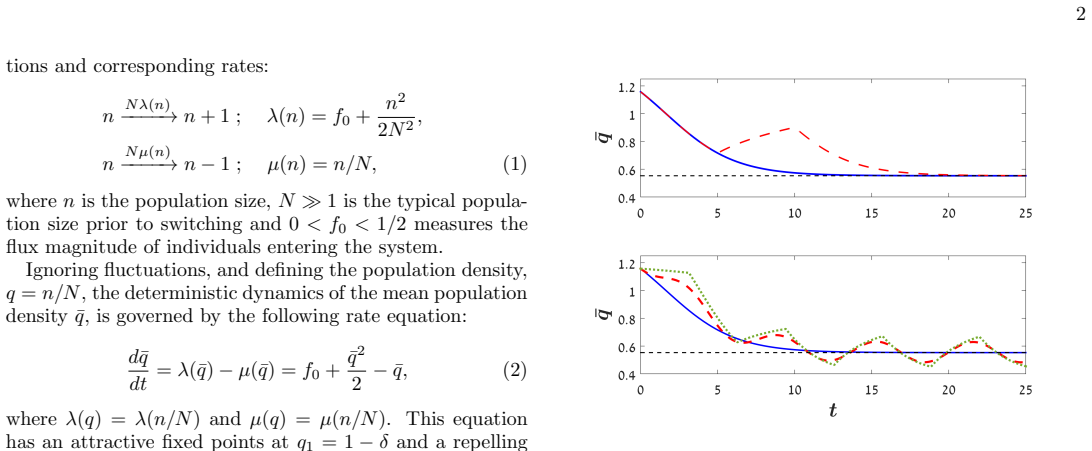
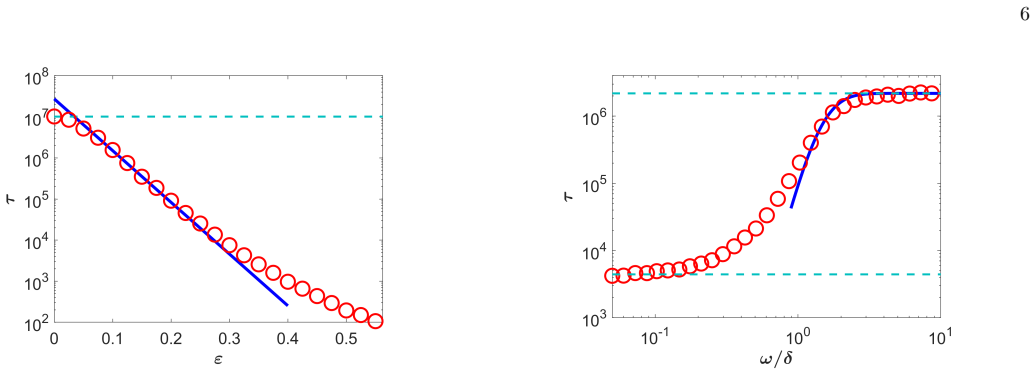
The central discovery is that the semi-classical WKB approach, previously used for extinction under time-modulated environments, extends to population switching, with the action computed along a heteroclinic path of an explicitly time-dependent Hamiltonian. For a temporary environmental change, the optimal path is the concatenation of the unperturbed zero-energy trajectory before and after the perturbation and a constant-energy trajectory of energy $E_p$ during it; the action is $S = S_0 - E_p T - \int_{q_p^1}^{q_p^2}[p_0(q) - p_p(q; E_p)]\,dq$, with $E_p$ fixed by the duration constraint of Eq. (20). For a weak sinusoidal perturbation, the leading correction to the action, after minimizing over the phase of the perturbation, is $\Delta S = -\varepsilon \pi \sqrt{1-\delta^2}\,\mathrm{csch}(\pi\omega/\delta)\,\sinh[(\omega/\delta)\arcsin(\delta)]$, so the establishment time decreases exponentially with the perturbation amplitude in a frequency-dependent way. The paper verifies the exponential scaling of both results numerically.
Load-bearing premise
The temporary-perturbation formula assumes that the optimal switching path is exactly the unperturbed zero-energy trajectory before and after the change joined to a constant-energy trajectory during the change, with the energy chosen only so that the path lasts the perturbation duration; the paper does not prove that no other path gives a smaller action.
Editorial extensions
If this is right
- A temporary favorable change of magnitude $F$ and duration $T$ exponentially raises the establishment probability, with the exponent given by Eq. (21); longer or stronger perturbations monotonically reduce the action.
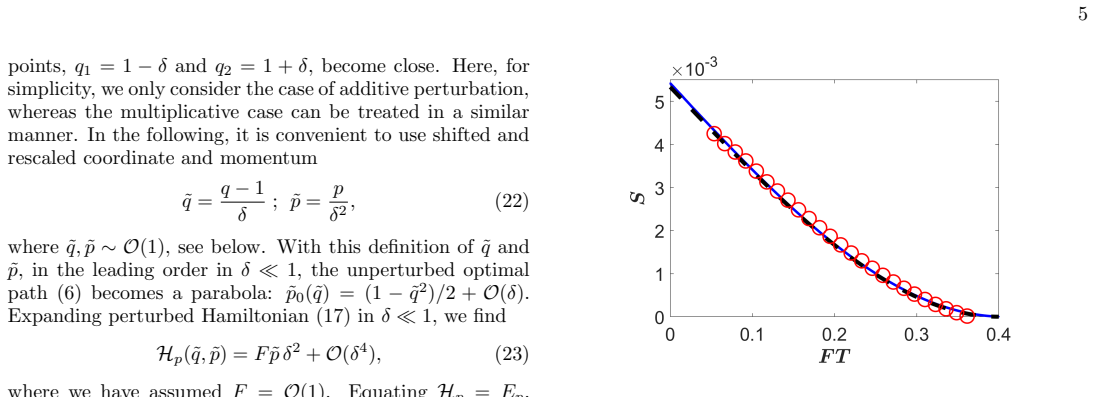
- Close to the bifurcation limit, the action depends only on the product $FT$ (as long as $FT < 2$), so pulses with the same duration–magnitude product have the same effect on the establishment probability.
- A weak periodic perturbation exponentially reduces the mean establishment time; the correction is linear in the amplitude and is largest when the perturbation is slow compared to the relaxation rate.
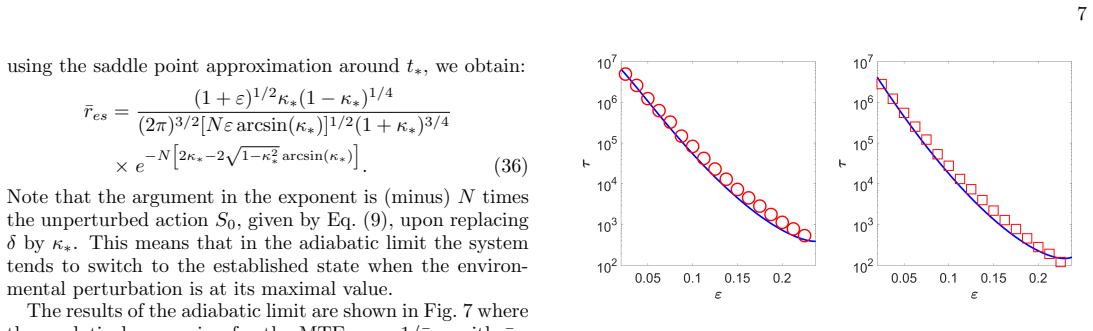
- In the adiabatic limit, the shape of the periodic perturbation, sinusoidal versus square wave, does not change the leading-order exponent; only the amplitude matters.
- The same theoretical framework applies to phenotypic switching in gene regulatory networks under extrinsic fluctuations, where switching times depend sensitively on the magnitude, frequency, and duration of environmental variations.
Reading between the lines
- I infer that the piecewise constant-energy ansatz generalizes to a sequence of temporary switches: the action would accumulate terms $-E_i T_i$ plus pairwise area corrections, providing a route to model randomly switching environments by averaging over switch protocols.
- Equation (32)'s factor $\mathrm{csch}(\pi\omega/\delta)$ suggests a cutoff frequency $\omega \sim \delta$ beyond which periodic forcing becomes exponentially ineffective; a microbial evolution experiment with controlled periodic stressors could test whether the measured switching rate saturates to the unperturbed rate at high frequency.
- The minimization over the initial phase $t_0$ in the periodic case is analogous to a stochastic-resonance condition: the optimal escape attempt locks to the phase of maximal perturbation, which may be observable in time-resolved switching statistics accumulated over many cycles.
- The near-bifurcation result that only the product $FT$ matters hints at a broader principle for weak-noise escape: the leading exponential effect of a temporary change may be governed by the time-integrated perturbation, a conjecture worth testing in other escape models.
Signed reviews
Editorial analysis
A structured set of objections, weighed in public.
Referee Report
Summary. This paper studies noise-induced establishment in a stochastic Verhulst-Allee model with immigration and a strong Allee threshold. In the WKB limit N≫1, it computes the leading-order action for switching from the metastable pre-established state to the established state. For a temporary environmental change, the authors propose a piecewise optimal path constructed from the unperturbed zero-energy trajectory before and after the perturbation and a constant-energy trajectory H_p=E_p during the perturbation; the energy is fixed by the duration condition Eq. (20), and the action is S=S0-E_pT-∫_{q_p1}^{q_p2}(p0-pp)dq (Eq. 21). Near bifurcation this reduces to Eq. (25), which depends only on the product FT. For a periodic perturbation they derive the linear-in-amplitude correction Eq. (32), an adiabatic expression with prefactor Eq. (36), and a square-wave analogue Eq. (39). The analytical exponents are compared with Gillespie simulations for time-dependent rates, using arbitrary prefactors for plotting.
Significance. If the temporary-perturbation ansatz is correct, the paper is a useful contribution: it gives explicit closed-form expressions for the exponential change of establishment probability and mean establishment time under two types of environmental variability, identifies scaling laws (FT dependence near bifurcation, amplitude-dominated adiabatic limit, exponential suppression with frequency), and extends earlier extinction work to switching. The derivation is self-contained from the master equation, the analytical exponents contain no fitted parameters, and the simulations independently implement a time-dependent Gillespie algorithm. The main caveat is that the central temporary-perturbation result rests on an unproved optimal-path ansatz; until that is justified, the significance of Eq. (21) is conditional.
major comments (2)
- [Sec. IV A, Eqs. (18)-(21)] The optimality of the piecewise path is asserted, not proved. The text says "It turns out that..." and then constructs the path by matching the H0=0 trajectory before and after the perturbation with a single Hp=Ep trajectory; continuity and conservation produce a candidate, not a minimizer of the action in Eq. (14). In particular, the paper never compares against paths that reach q2 during the favorable window, so that the post-perturbation segment is absent and the final time is free, nor against paths carrying nonzero H0 energy before the perturbation. Because Eq. (15) makes the EP exponentially sensitive to S, any lower-action competitor changes the predicted exponent, not just a prefactor. This is not a pedantic issue: at larger F or T, where the action reduction is large and S can approach O(1), the excluded alternatives are precisely the ones that might compete. Please add a variational or transversality argument, or a numerical minimization of Eq. (14) over path families, or state a regime in which such alternatives are provably subdominant.
- [Sec. IV A, Eqs. (19)-(20)] The manuscript does not state the domain of (F,T) for which the duration equation has a solution and for which q_p1 and q_p2 lie in the physical interval (q1,q2). The near-bifurcation limit gives the condition FT<2, but the full Eq. (20) is not analyzed. Since the central formula (21) is meaningful only when such an intersection exists, the domain of validity of the temporary-perturbation result is currently undefined; the numerical failures at large F,T are attributed to WKB breakdown without separating the two possible causes, namely absence of an admissible solution versus action becoming O(1). Please provide this analysis or at least an explicit statement of the assumed parameter range.
minor comments (7)
- [Eq. (8)] As written, σ(t)=1-δ tanh(δt/2) describes a trajectory that starts at q2=1+δ and ends at q1=1-δ, opposite to the stated boundary conditions in the same paragraph. The intended optimal path from q1 to q2 requires σ(t)=1+δ tanh(δt/2). The phase in Eq. (31) suggests the authors used the plus sign in the actual integration; please correct Eq. (8) and the time parameterization.
- [Sec. IV A.1, Eqs. (24)-(25)] The symbol T is used both for the actual perturbation duration and for the rescaled duration T/δ. Please use a distinct symbol, e.g. \mathcal T, in Eqs. (24)-(25) and in the caption of Fig. 4, because the condition FT<2 is easily misread as a condition on the physical duration.
- [Sec. IV B.2] In the paragraph introducing the adiabatic approximation, "w≪δ" should read "ω≪δ".
- [Fig. 2 caption] The word "crushed lines" should be "dashed lines" or another standard term.
- [Sec. IV A] The multiplicative temporary perturbation is dismissed with "similar results (not shown)", although the paper claims to treat both additive and multiplicative variability. Please include the analog of Eqs. (18)-(21) for the multiplicative case, or state explicitly that the calculation is identical in form with the corresponding λp and μp.
- [Abstract and Sec. IV A] For the temporary perturbation the paper computes only the change in EP; the MTE is asserted in footnote [46] to be almost unaffected. Please make this explicit in Sec. IV A when the temporary protocol is introduced, since the abstract mentions both EP and MTE.
- [Figs. 3-5] The comparisons use linear vertical scales together with arbitrary multiplicative prefactors. Since the analytical claims are for exponents only, plotting N^{-1}\log ΔP or \log τ would make the agreement and its limits more transparent, especially where the prefactor is not predicted.
Circularity Check
No circularity: the action and rate formulas are derived from the stated master equation and verified against Gillespie simulations, with no fitted parameter renamed as a prediction.
full rationale
The paper's central derivations are self-contained. The unperturbed action S0, the WKB action integral (14), and the rate formulas (10), (21), (32), (36), and (39) are obtained by starting from the explicit master equation, applying a WKB ansatz, and evaluating standard variational/perturbative integrals; no simulation data are used to fix any parameter that then appears as a prediction. The temporary-perturbation action (21) is constructed by integrating Eq. (14) along a piecewise path: the unperturbed zero-energy trajectory outside [t0,t0+T] and a perturbed constant-energy trajectory inside it, with Ep determined by the duration constraint (20). This is a consistency equation, not a fit to the establishment probability being predicted. The periodic-perturbation correction (32) is the closed-form evaluation of the first-order perturbation integral (30), and the adiabatic result (36) uses the independently derived unperturbed rate with an instantaneous parameter, as in the standard adiabatic approximation. The arbitrary multiplicative prefactors used in the figures are explicitly acknowledged as outside exponential accuracy and do not enter the analytical exponential predictions. The paper cites prior work, including the authors' own, for standard WKB and periodic-perturbation formulas, but the load-bearing derivations are reproduced in the manuscript, so these self-citations are not load-bearing reductions. The piecewise-optimality assumption for the temporary perturbation is asserted rather than proven, but that is a correctness/rigor limitation, not a circularity: the resulting action is not equivalent by construction to its inputs. Hence the appropriate circularity score is 0.
Assumptions & free parameters
assumptions (5)
- domain assumption The master equation can be solved asymptotically for N >> 1 using the WKB ansatz π(n) = A exp[-N S(q,t)], yielding a Hamilton-Jacobi equation (Sec. III).
- domain assumption The established state is taken at infinity; a finite established state would not affect the leading-order MTE (footnote 41).
- ad hoc to paper In the temporary perturbation, the optimal path is the concatenation of the unperturbed zero-energy trajectory and the perturbed constant-energy trajectory, with energy E_p determined by the duration constraint (Eqs. 19-21).
- domain assumption The system is in a quasi-stationary distribution before the perturbation, with exponentially small switching probability PBP ≈ t/τ (Sec. IV A).
- standard math For periodic perturbations, the action is minimized over the phase t0 of the perturbation (Sec. IV B).
Cite this review
Pith. "Pith review of Population switching under a time-varying environment." pith.science (2026). https://pith.science/paper/YV6GKBGE
@misc{pith2026190809028,
  author       = {Pith},
  title        = {Pith review of: Population switching under a time-varying environment},
  year         = {2026},
  howpublished = {\url{https://pith.science/paper/YV6GKBGE}},
  note         = {Machine review of arXiv:1908.09028}
}
read the original abstract
We examine the switching dynamics of a stochastic population subjected to a deterministically time-varying environment. Our approach is demonstrated in the realm of ecology on a problem of population establishment. Here, by assuming a constant immigration pressure along with a strong Allee effect, at the deterministic level one obtains a critical population size beyond which the system experiences establishment. Notably the latter has been shown to be strongly influenced by the interplay between demographic and environmental noise. We consider two prototypical examples for environmental variations: a temporary environmental change, and a periodically-varying environment. By employing a semi-classical approximation we compute, within exponential accuracy, the change in the establishment probability and mean establishment time of the population, due to the environmental variability. Our analytical results are verified by using a modified Gillespie algorithm which accounts for explicitly time-dependent reaction rates. Finally, our theoretical approach can also be useful in studying switching dynamics in gene regulatory networks under extrinsic variations.
Figures

Figures from the paper (3 more)

Reference graph
Works this paper leans on
-
[1]
Bifurcation Limit The above results drastically simplify close to the bifur- cation limit, for δ≪ 1, where the stable and unstable fixed 5 points, q1 = 1−δ and q2 = 1 +δ, become close. Here, for simplicity, we only consider the case of additive perturbation, whereas the multiplicative case can be treated in a similar manner. In the following, it is conveni...
-
[2]
Weak perturbation - Linear Theory Here we assume that the perturbation amplitude is small, ε≪ 1. In this limit, it can be shown that the action (29) satisfiesS(t0) =S0 + ∆S(t0) [22, 23, 31, 47], where S0 is the action along the unperturbed optimal path{q0(t−t0),p 0(t− 6 Figure 5. The MTE as function of the perturbation amplitude. Shown are Monte-Carlo simu...
-
[3]
Adiabatic Approximation We now compute the MTE in the adiabatic limit, w≪ δ, using a different approach, which allows finding the pre- exponential correction to the MTE as well. In this limit, the mean rate of establishment, ¯res, reads [31] ¯res = ω 2π 2π/ω∫ 0 res(t′)dt′, (34) where res(t) denotes the instantaneous establishment rate. Since in this limit t...
work page 2016
-
[4]
C. W. Gardiner et al., Handbook of stochastic methods, Vol. 3 (springer Berlin, 1985)
1985
-
[5]
N. G. Van Kampen, Stochastic processes in physics and chem- istry, Vol. 1 (Elsevier, 1992)
work page 1992
-
[6]
S. R. Beissinger and D. R. McCullough, Population viability analysis (University of Chicago Press, 2002)
work page 2002
-
[7]
M. S. Bartlett, Stochastic population models; in ecology and epidemiology, Tech. Rep. (1960)
work page 1960
-
[8]
I. A. Hanski, O. E. Gaggiotti, and O. F. Gaggiotti, Ecology, genetics and evolution of metapopulations (Academic Press, 2004)
work page 2004
Show all 51 references
-
[9]
Assaf and B
M. Assaf and B. Meerson, Physical review letters100, 058105 (2008)
2008
-
[10]
Meerson and P
B. Meerson and P. V. Sasorov, Physical Review E 78, 060103 (2008)
2008
-
[11]
Shahrezaei and P
V. Shahrezaei and P. S. Swain, Proceedings of the National Academy of Sciences 105, 17256 (2008)
2008
-
[12]
Escudero and A
C. Escudero and A. Kamenev, Physical Review E 79, 041149 (2009)
2009
-
[13]
Assaf, E
M. Assaf, E. Roberts, and Z. Luthey-Schulten, Physical re- view letters 106, 248102 (2011)
2011
-
[14]
Biancalani and M
T. Biancalani and M. Assaf, Physical review letters 115, 208101 (2015)
2015
-
[15]
Sagi and M
C. Sagi and M. Assaf, Journal of Statistical Mechanics: The- ory and Experiment 2019, 063403 (2019)
2019
-
[16]
Mehta, R
P. Mehta, R. Mukhopadhyay, and N. S. Wingreen, Physical biology 5, 026005 (2008)
2008
-
[17]
J. H. Brown and A. Kodric-Brown, Ecology 58, 445 (1977). 9
1977
-
[18]
Hanski, Metapopulation ecology (Oxford University Press, 1999)
I. Hanski, Metapopulation ecology (Oxford University Press, 1999)
1999
-
[19]
P. A. Stephens, W. J. Sutherland, and R. P. Freckleton, Oikos , 185 (1999)
1999
-
[20]
Courchamp, L
F. Courchamp, L. Berec, and J. Gascoigne, Allee effects in ecology and conservation (Oxford University Press, 2008)
2008
-
[21]
Meerson and O
B. Meerson and O. Ovaskainen, Physical Review E 88, 012124 (2013)
2013
-
[22]
Be’er, M
S. Be’er, M. Assaf, and B. Meerson, Physical Review E 91, 062126 (2015)
2015
-
[23]
M´ endez, M
V. M´ endez, M. Assaf, A. Mas´ o-Puigdellosas, D. Campos, and W. Horsthemke, Physical Review E 99, 022101 (2019)
2019
-
[24]
Assaf and B
M. Assaf and B. Meerson, Physical Review E 81, 021116 (2010)
2010
-
[25]
Dykman, H
M. Dykman, H. Rabitz, V. Smelyanskiy, and B. Vugmeister, Physical review letters 79, 1178 (1997)
1997
-
[26]
Dykman, B
M. Dykman, B. Golding, L. McCann, V. Smelyanskiy, D. Luchinsky, R. Mannella, and P. McClintock, Chaos 11, 587 (2001)
2001
-
[27]
M. B. Elowitz, A. J. Levine, E. D. Siggia, and P. S. Swain, Science 297, 1183 (2002)
2002
-
[28]
Taniguchi, P
Y. Taniguchi, P. J. Choi, G.-W. Li, H. Chen, M. Babu, J. Hearn, A. Emili, and X. S. Xie, Science 329, 533 (2010)
2010
-
[29]
Assaf, E
M. Assaf, E. Roberts, Z. Luthey-Schulten, and N. Golden- feld, Physical review letters 111, 058102 (2013)
2013
-
[30]
Roberts, S
E. Roberts, S. Be’er, C. Bohrer, R. Sharma, and M. Assaf, Physical Review E 92, 062717 (2015)
2015
-
[31]
Lande, The American Naturalist 142, 911 (1993)
R. Lande, The American Naturalist 142, 911 (1993)
1993
-
[32]
Kamenev, B
A. Kamenev, B. Meerson, and B. Shklovskii, Physical review letters 101, 268103 (2008)
2008
-
[33]
E. Y. Levine and B. Meerson, Physical Review E 87, 032127 (2013)
2013
-
[34]
Assaf, A
M. Assaf, A. Kamenev, and B. Meerson, Physical Review E 78, 041123 (2008)
2008
-
[35]
Assaf, A
M. Assaf, A. Kamenev, and B. Meerson, Physical Review E 79, 011127 (2009)
2009
-
[36]
Baca¨ eret al
N. Baca¨ eret al. , Journal of mathematical biology 68, 533 (2014)
2014
-
[37]
Billings and E
L. Billings and E. Forgoston, Ricerche di Matematica , 1 (2017)
2017
-
[38]
Vilk and M
O. Vilk and M. Assaf, Physical Review E 97, 062114 (2018)
2018
-
[39]
Be’er and M
S. Be’er and M. Assaf, Physical Review E 97, 020302 (2018)
2018
-
[40]
Dykman, E
M. Dykman, E. Mori, J. Ross, and P. Hunt, The Journal of chemical physics 100, 5735 (1994)
1994
-
[41]
D. A. Kessler and N. M. Shnerb, Journal of Statistical Physics 127, 861 (2007)
2007
-
[42]
D. T. Gillespie, Journal of computational physics 22, 403 (1976)
1976
-
[43]
D. F. Anderson, The Journal of chemical physics 127, 214107 (2007)
2007
-
[44]
However, if the pop- ulation size at the established state is sufficiently large [19], this term has no effect in the leading order on the MTE
In order to have a finite established state, a nonlinear cubic term has to be added to the death rate. However, if the pop- ulation size at the established state is sufficiently large [19], this term has no effect in the leading order on the MTE
-
[45]
Assaf and B
M. Assaf and B. Meerson, Journal of Physics A: Mathemat- ical and Theoretical 50, 263001 (2017)
2017
-
[46]
Dykman and M
M. Dykman and M. Krivoglaz, Sov. Phys. JETP 50, 30 (1979)
1979
-
[47]
Moss and P
F. Moss and P. V. McClintock, Noise in nonlinear dynamical systems, Vol. 2 (Cambridge University Press, 1989)
1989
-
[48]
M. I. Freidlin and A. D. Wentzell, in Random perturbations of dynamical systems (Springer, 1998) pp. 15–43
1998
-
[49]
In this scenario, while ∆ P turns out to be significant, the MTE is almost unaffected by the temporary perturbation, as its duration is finite, and much shorter than the MTE
-
[50]
Escudero and J
C. Escudero and J. ´A. Rodr´ ıguez, Physical Review E 77, 011130 (2008)
2008
-
[51]
Volfson, J
D. Volfson, J. Marciniak, W. J. Blake, N. Ostroff, L. S. Tsim- ring, and J. Hasty, Nature 439, 861 (2006)
2006
Reviewed August 14, 2026 · model on record in the stance chip above.
Discussion (0). Continue with ORCID to comment.