REVIEW 6 minor 10 references
Capturing Cosmic Ray Research and Researchers with Art
T0 review · 0 major / 6 minor · reviewed 2026-08-14 · deepseek-v4-flash
Pith's one-line read An IceCube outreach team created Messages, a two-part public art exhibition pairing cosmic ray research with portraits and immersive light and sound.
desk verdict An honest, non-quantitative report of an art-science outreach exhibit that doesn't overclaim; fine for a proceedings, thin for a journal. read the letter →
The pith
A machine-rendered reading of the paper's core claim, the machinery that carries it, and where it could break.
The reading
What carries the argument
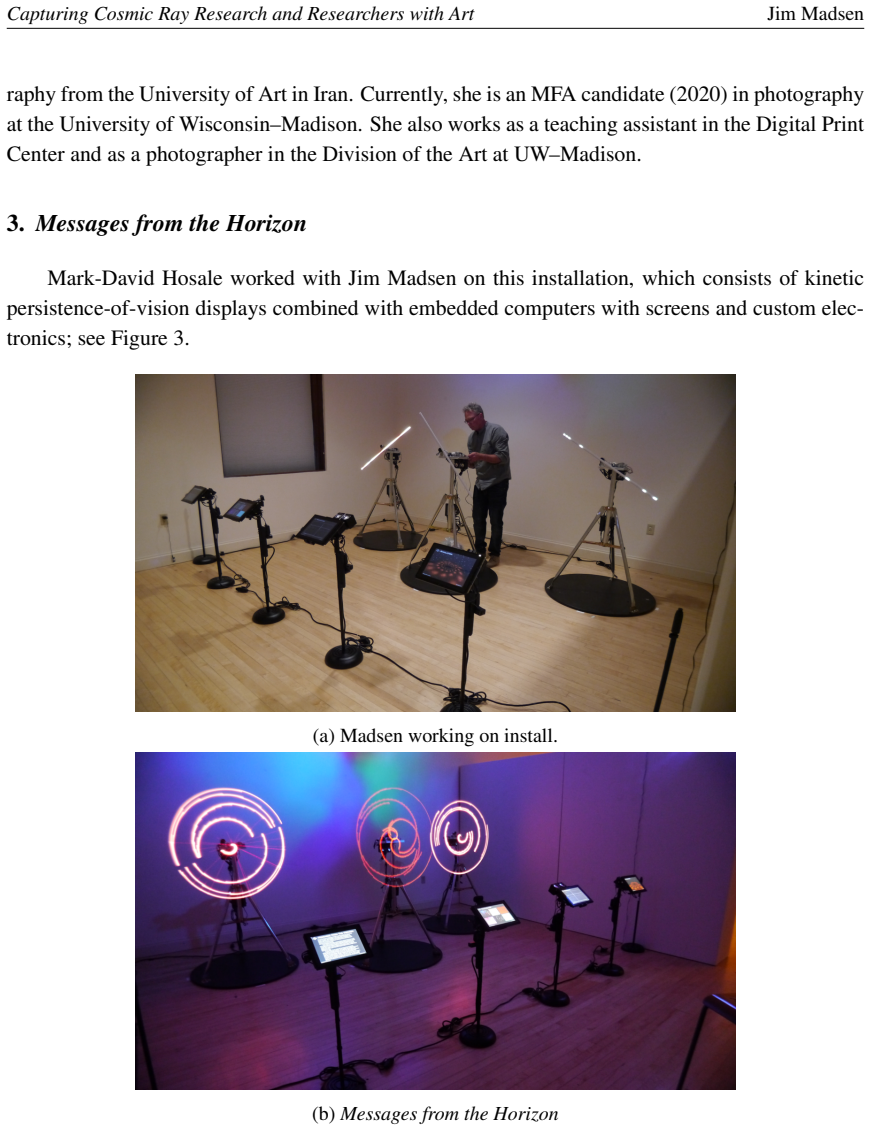
The mechanism carrying the argument is the exhibition itself, through two original installations. Event Horizon uses the portrait format—researchers photographed holding a self-selected artifact—to make the scientific community visible as people. Messages from the Horizon uses persistence-of-vision displays, in which a spinning string of LEDs draws images in the air, to stage the elusiveness of black holes and the transformation of instrument data into perception; four touch-screen monitors offer simulations, visualizations, and sonifications of the same virtual event. The collaboration structure—artists, scientists, teenagers, and a bilingual communicator working together—is the outreach mechanism the paper argues can attract diverse audiences.
What would settle it
Check the gallery's schedule and program records for June 14 through August 2, 2019: if Messages was not on display at the Memorial Union Gallery in that window, or if records show no student portrait training, the paper's account is false. Visitor and workshop logs would also let the untested outreach claim be evaluated.
Extended reading notes
Core claim
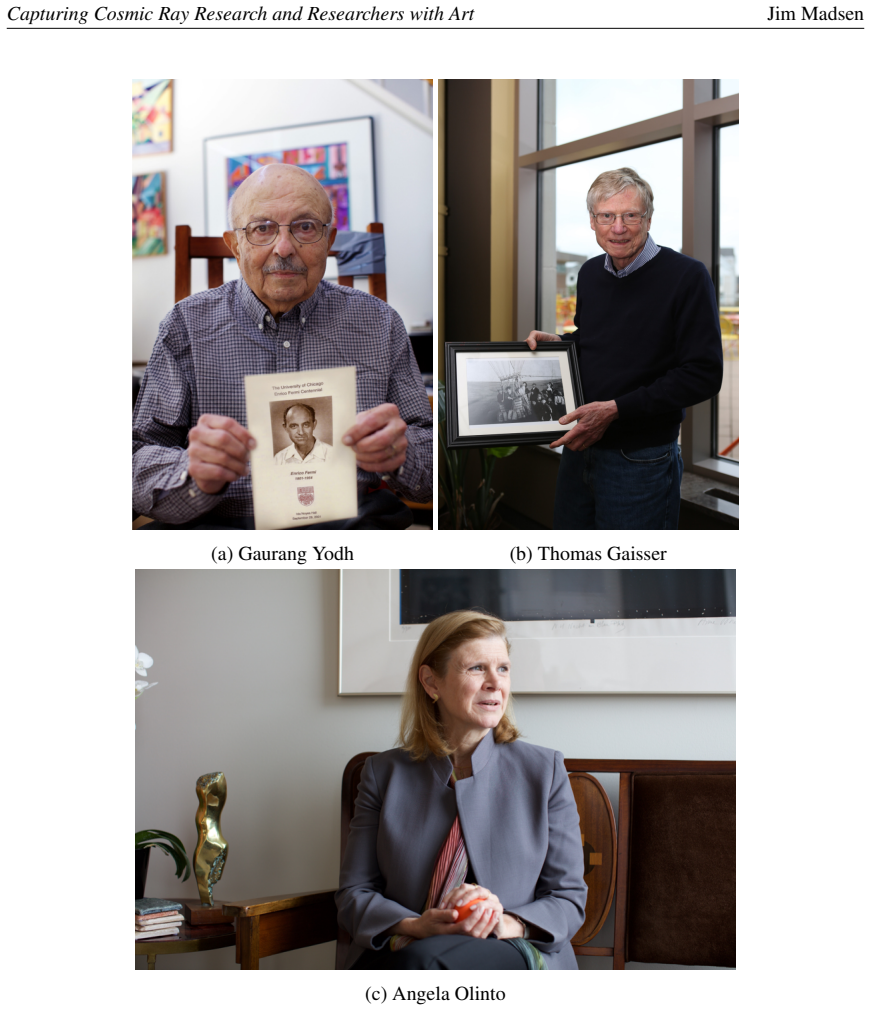
The central claim of the paper is descriptive: a collaboration among artists, scientists, a Spanish-language science communicator, and teenagers produced a public exhibition and displayed it at the UW-Madison Memorial Union Gallery from June 14 through August 2, 2019, during the International Cosmic Ray Conference. One installation, Event Horizon, consisted of large photographic portraits of established cosmic ray researchers, each holding an object they chose as meaningful; conference attendees and students were invited to add their own portraits. The other, Messages from the Horizon, used spinning LED displays, monitors, and sound to represent how raw astrophysical data become knowable. The paper presents this as a new way to explore both the science and the human community behind it, aimed at broadening who feels welcome in science spaces.
Load-bearing premise
The premise that bringing in artists, Spanish-language materials, and teenagers will actually attract diverse audiences and increase engagement with cosmic ray science is stated as a hope, not backed by data, so the project's value as outreach depends on that unmeasured assumption.
Editorial extensions
If this is right
- If the paper's account is accurate, the Messages exhibition ran for six weeks in summer 2019 and was seen by conference attendees and the public in Madison.
- Conference attendees could take part in Event Horizon by being photographed with an object of personal meaning, making the exhibit grow over time.
- High school students from underrepresented groups received camera training and had their work displayed, giving them a direct role in the event.
- All exhibit support materials were produced in English and Spanish, extending the project's reach to Spanish-speaking audiences.
Reading between the lines
- A testable extension the paper leaves implicit would be collecting attendance, demographic, and follow-up engagement data to see whether the exhibit actually drew the underrepresented audiences it targeted.
- The portrait-and-object format could transfer to other scientific communities as a low-cost way of putting a human face on a field, but that extension depends on evaluation evidence this paper does not provide.
- If the outreach goal is taken seriously, the paper's lack of outcome data leaves the strongest honest conclusion as: the project produced an exhibition, not a demonstrated change in participation in cosmic ray science.
Signed reviews
Editorial analysis
A structured set of objections, weighed in public.
Referee Report
Summary. The paper describes "Messages," an art-science installation produced by the IceCube education and outreach team, artists Faisal Abdu'Allah, Maryam Ladoni, and Mark-David Hosale, and collaborators, displayed at the UW–Madison Memorial Union Gallery from June 14 through August 2, 2019. The exhibit comprised two installations: "Event Horizon," a series of photographic portraits of cosmic-ray scientists holding self-selected meaningful artifacts, and "Messages from the Horizon," a kinetic persistence-of-vision display with interactive monitors presenting simulated astrophysical data. The paper details three outreach strategies: collaboration with internationally accomplished artists, translation of all materials into Spanish, and involvement of local high-school students from underrepresented groups in photographing ICRC 2019 attendees. The authors frame the project as an experiment in alternative science communication, but they explicitly present the outreach goals as aspirations rather than demonstrated outcomes, and they report no evaluation data.
Significance. As a descriptive project report, the paper is useful to the science-outreach community: it documents a concrete, reproducible collaboration model, provides artist statements and technical descriptions of the installations, and names the personnel and institutional partners involved. The manuscript is honest in its claims, avoiding any assertion that the exhibit actually achieved its diversity or engagement goals. This restraint is a strength given the absence of evaluation evidence, and the paper's value lies in being an archival record and a template for similar art-science collaborations. Nonetheless, because no attendance, demographic, or survey data are provided, the paper's contribution to knowledge about the effectiveness of such approaches is limited; readers should treat it as an implementation report rather than an effectiveness study.
minor comments (6)
- [Abstract] The abstract uses future tense ("will be displayed") to describe an exhibit that had already closed by the time the manuscript was submitted (August 24, 2019); the Introduction correctly uses past tense, so the abstract should be aligned for consistency.
- [Section 1] The phrase "createMessages" appears as a single word because of a missing space; it should read "create Messages."
- [Section 2] The artist Faisal Abdu'Allah is referred to as "Fasial Abdu'Allah" in the opening sentence of Section 2; this typo should be corrected.
- [Affiliations] The affiliation "Univeristy of Wisconsin-River Falls" contains a typo; it should be "University of Wisconsin-River Falls."
- [Section 4] The summary states that the project "leveraged existing partnerships" without specifying what these partnerships were; a sentence identifying the prior relationships (e.g., Hosale's previous collaboration with IceCube on Quasar 2.0) would help readers understand the project's origins.
- [Global] The paper would be strengthened by a brief statement about whether any evaluation data (attendance counts, audience demographics, participant feedback) were collected, or an explicit note that such data are not yet available; this would more clearly delimit the paper's scope.
Circularity Check
No circularity: the paper is a descriptive report of an art-science outreach exhibit with no derivation chain, fitted parameters, or prediction to reduce.
full rationale
The paper is a descriptive account of the IceCube education and outreach team's Messages gallery exhibit. It reports a sequence of historical and factual claims: artists and scientists planned the exhibit, two installations were created, the show ran at the UW–Madison Memorial Union Gallery from June 14 through August 2, 2019, and materials were translated into Spanish. There is no mathematical model, no fitted parameter, no predictive claim, and no derivation chain that could be circular. The stated goal in the abstract and Section 1—'to more widely promote cosmic ray research and attract diverse audiences'—is presented as an aspiration, not as a demonstrated outcome; the paper provides no attendance data, demographic surveys, or evaluation, and it never claims to have shown effectiveness. The artists' statements describe conceptual intentions for the installations, but those are descriptions of artistic meaning, not empirical derivations. Citations [1]–[4] are references to prior artworks, programs, and a science communicator's website; none of them supplies a load-bearing premise that is presupposed as the paper's conclusion. The descriptive claim could fail only if the exhibit did not occur as described, and nothing in the text suggests internal contradiction or fabrication. Therefore no circular step exists, and the appropriate score is 0.
Assumptions & free parameters
assumptions (3)
- domain assumption Art-based outreach can make cosmic ray science accessible to audiences without prior science exposure.
- domain assumption Teen participation in content creation fosters ownership and mentorship.
- domain assumption A spinning LED string creates a legible image through persistence of vision.
Cite this review
Pith. "Pith review of Capturing Cosmic Ray Research and Researchers with Art." pith.science (2026). https://pith.science/paper/FGA6KTPU
@misc{pith2026190809054,
  author       = {Pith},
  title        = {Pith review of: Capturing Cosmic Ray Research and Researchers with Art},
  year         = {2026},
  howpublished = {\url{https://pith.science/paper/FGA6KTPU}},
  note         = {Machine review of arXiv:1908.09054}
}
read the original abstract
We describe our experiment with an alternate approach to presenting cosmic ray research. The goal was to more widely promote cosmic ray research and attract diverse audiences, especially those from groups that are underrepresented in science or that do not have experience attending science outreach events. The IceCube Neutrino Observatory education and outreach team brought together local teenagers, internationally accomplished artists, science communicators, and scientists to produce an interactive gallery exhibit, Messages, that explores the cosmic ray community and science. The artists collaborated with the scientists and students to create two original installations that will be displayed at the UW-Madison Memorial Union Gallery for six weeks, from mid-June, 2019, through the end of the International Cosmic Ray Conference 2019. Event Horizon by Abdu'Allah with Ladoni features portraits of cosmic ray researchers and high school students who are learning more about the field. This installation will examine the science community as it is and as it could be. Messages from the Horizon by Hosale with Madsen is inspired by previous immersive works. It combines sound and light to explore what we know and how we know it.
Figures

Reference graph
Works this paper leans on
-
[1]
write newline
" write newline "" before.all 'output.state := FUNCTION blank.sep after.quote 'output.state := FUNCTION fin.entry output.state after.quoted.block = 'skip 'add.period if write newline FUNCTION new.block output.state before.all = 'skip output.state after.quote = after.quoted.block 'output.state := after.block 'output.state := if if FUNCTION new.sentence out...
-
[2]
M.-D. Hosale and J. M. Crettaz, ``Quasar 2.0: Star incubator.'' http://www.mdhosale.com/quasar2/, 2012
work page 2012
-
[3]
F. Abdu'Allah, ``Squad: The calling of the common hero.'' https://view.joomag.com/squad-the-calling-of-the-common-hero/0543730001437405460?short, 2015
-
[4]
M. P. Library, ``Teen bubbler.'' http://teenbubbler.org/news/teen-art-exhibitions, 2019
work page 2019
-
[5]
A. Posada-Swafford, ``Science, environment and exploration writer, lecturer and motivational speaker.'' https://www.angelaposadaswafford.com/en-home, 2019
work page 2019
-
[6]
IceCube Collaboration, PoS(ICRC2015)1099 (2016)
work page 2016
-
[7]
IceCube-Gen2 Collaboration, PoS(ICRC2017)1052 (2018)
work page 2018
-
[8]
IceCube Collaboration, PoS(ICRC2019)xyz (these proceedings)
Show all 10 references
-
[9]
IceCube Collaboration, M. G. Aartsen et al. , JINST 12 (2017) P03012
2017
-
[10]
Waxman and J
E. Waxman and J. N. Bahcall, Phys. Rev. D59 (1999) 023002
1999
Reviewed August 14, 2026 · model on record in the stance chip above.
Discussion (0). Continue with ORCID to comment.