REVIEW 3 major objections 6 minor 1 cited by
Integration of Blockchain and Cloud of Things: Architecture, Applications and Challenges
T0 review · 3 major / 6 minor · reviewed 2026-08-14 · deepseek-v4-flash
Pith's one-line read BCoT: blockchain and cloud IoT integration is a promising enabler
desk verdict Useful survey with honest limitation tables, but the abstract overstates BCoT's promise given most cited studies are conceptual or unvalidated. read the letter →
The pith
A machine-rendered reading of the paper's core claim, the machinery that carries it, and where it could break.
The reading
What carries the argument
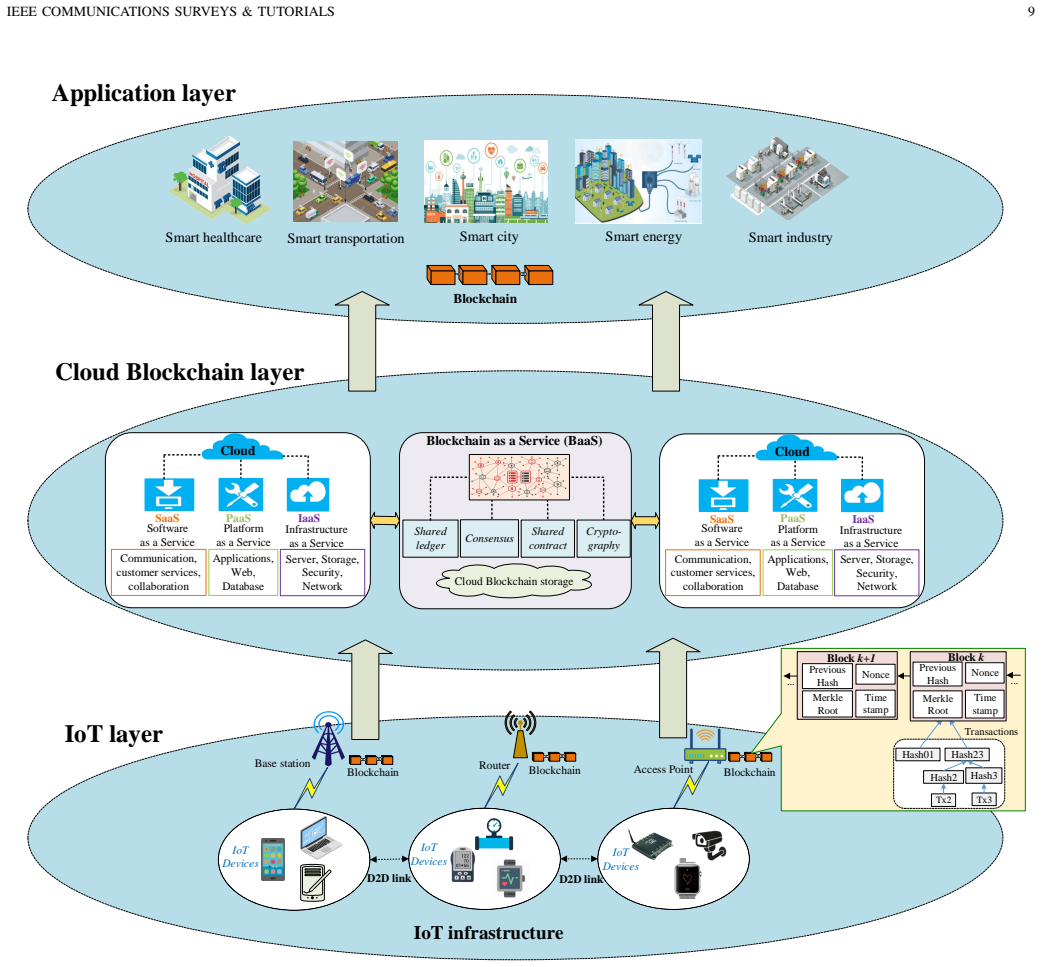
The central object is the conceptual BCoT architecture with three layers: an IoT layer of devices and gateways, a cloud blockchain layer in which blockchain services (shared ledger, consensus, smart contracts, cryptography, decentralized storage) are hosted as Blockchain-as-a-Service alongside cloud computing services (IaaS/PaaS/SaaS), and an application layer for healthcare, city, transportation, industry, and other domains. This architecture does the argument's work by showing where each technology compensates for the other: lightweight IoT devices delegate transactions and mining to gateways or cloud nodes, while blockchain governs cloud interactions, data provenance, and access control.
What would settle it
A head-to-head deployment of the same BCoT application against a centralized cloud IoT baseline—measuring end-to-end latency, energy per transaction, storage growth, and security incidents—would settle the claim; if the BCoT version is slower, more expensive, and no more secure under realistic conditions, the survey's central promise would be contradicted.
Extended reading notes
Core claim
On the paper's own terms, BCoT is an emerging and viable paradigm, not a single system but a family of designs in which blockchain runs as Blockchain-as-a-Service on cloud infrastructure and mediates IoT data sharing, access control, provenance, and resource trading. The central claim is that the two technologies are complementary: blockchain fixes CoT's centralization, privacy, and integrity weaknesses, while CoT fixes blockchain's scalability, energy, and storage limitations. The survey supports this claim by organizing dozens of proposed systems into a three-layer architecture—IoT layer, cloud blockchain layer, and application layer—and by reviewing application-domain evidence, commercial BaaS platforms, and decentralized storage options. It also identifies five open challenges: standardization, security vulnerability, privacy leakage, intelligence, and resource management.
Load-bearing premise
The survey's conclusion that BCoT is a promising enabler rests on the assumption that the primary studies it reviews accurately represent BCoT's feasibility, even though the paper's own tables note that many of those studies are conceptual and lack experimental validation.
Editorial extensions
If this is right
- BCoT would let resource-constrained IoT devices join blockchain networks through gateways, with cloud nodes carrying the heavy consensus and mining work.
- In smart healthcare, storing raw records off-chain and hashes on-chain could make electronic health records tamper-evident and auditable without bloating the ledger.
- Commercial Blockchain-as-a-Service offerings could become the standard deployment route, lowering the entry barrier for BCoT applications.
- Future BCoT development is expected to lean on machine learning for resource scheduling and security, big-data analytics for blockchain data, and blockchain-based security for 5G network slicing.
Reading between the lines
- The paper's own taxonomy tables show that many reviewed BCoT systems are conceptual or lack experiments, so the fair reading is that BCoT is a promising design space rather than a proven technology.
- If BCoT is to win in practice, the decisive tests will likely be consensus overhead and latency on resource-constrained data flows, not architecture alone.
- A natural extension of the survey's generic architecture would be to benchmark the same BCoT stack across healthcare, city, transportation, and industry cases, since the cited systems differ widely in consensus, storage, and trust assumptions.
Signed reviews
Editorial analysis
A structured set of objections, weighed in public.
Referee Report
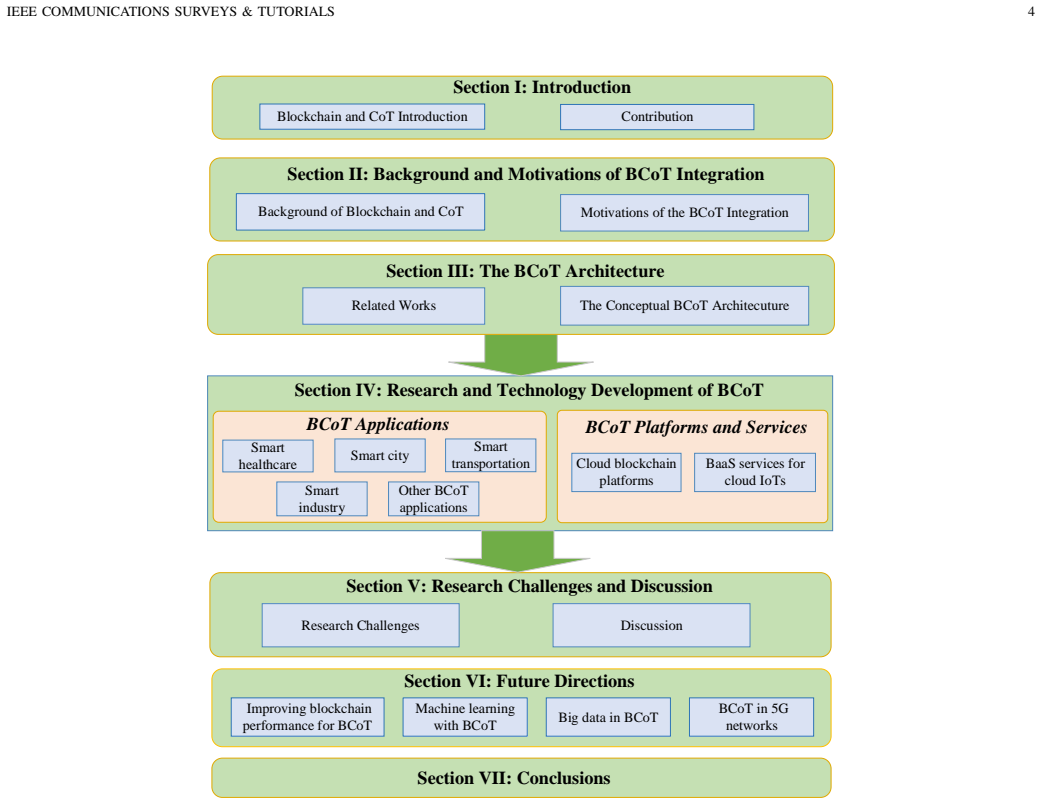
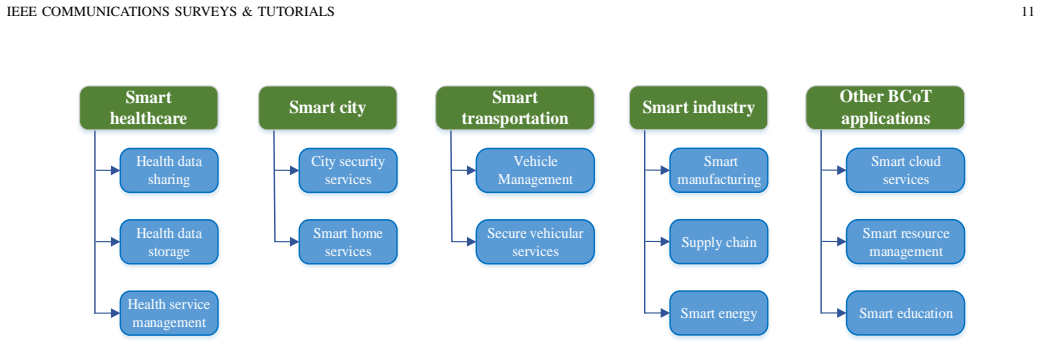
Summary. This paper is a survey of the integration of blockchain with Cloud of Things (BCoT). It introduces background on blockchain and CoT, motivates the integration through complementary capabilities, proposes a three-layer conceptual architecture (IoT layer, cloud blockchain layer, application layer), and reviews BCoT applications in smart healthcare, smart city, smart transportation, smart industry, cloud services, resource management, and education. It also surveys decentralized storage platforms and Blockchain-as-a-Service offerings, and it discusses research challenges and future directions including blockchain performance, machine learning, big data, and 5G. The central claim is that BCoT is widely regarded as a promising enabler for a wide range of application scenarios.
Significance. If the survey is accurate as a representation of the literature, it is a useful reference for researchers entering the BCoT area: it consolidates a fragmented literature, organizes it by application domain, and explicitly documents the limitations of each summarized study in Tables III and IV. The platform tables and the challenges/future-directions discussion are practical strengths. The main weakness is that the survey's narrative and abstract present BCoT as more established than the evidence it itself catalogues: many cited works are conceptual or lack implementation, and no selection protocol is documented. Because the value of the survey depends on the trustworthiness and representativeness of its primary sources, this calibration issue is the main point to address.
major comments (3)
- [§I-A, §IV, and abstract] The survey does not document a search or inclusion protocol; Section I-A only says the material was collected from 'respective websites, technical reports, academic articles and newspapers.' This makes the representativeness of the reviewed literature unverifiable, which matters because the abstract's headline claim that BCoT is a 'promising enabler' is grounded in that literature. The paper's own Tables III and IV repeatedly report that primary studies are conceptual or unvalidated (e.g., [84], [87], [88], [96], [98], [106], [109], [111], [114], [124], [137]), yet the narrative in Section IV and the lessons-learned passages assert that BCoT 'can achieve' security, privacy, and efficiency benefits. The authors should either provide the missing selection/validation audit or explicitly weaken the conclusion to 'proposed but largely unvalidated,' and should ensure that Section IV language matches the evidence tables.
- [§III-B, Fig. 6] The proposed three-layer architecture is introduced as a 'conceptual BCoT architecture' that 'would be applicable to various scenarios,' but no mapping or validation demonstrates that it covers the application domains surveyed in Section IV. For example, the IoT-layer description assumes gateways and lightweight/full nodes, which may not fit smart-energy or cloud-service scenarios where the IoT layer is less prominent. The authors should either provide a mapping from each application domain to the architecture or soften the generalizability claim.
- [§IV-A lessons learned] The 'Lessons learned' subsections (e.g., §IV-A1.4 and §IV-A4.4) draw general conclusions such as 'BCoT can achieve secure data sharing' and 'BCoT demonstrates its potentials' without hedging for the fact that, as Tables III and IV show, many of the supporting studies are not implemented or evaluated. This creates an internal inconsistency between the narrative and the authors' own limitation statements. Please add qualifying language such as 'in the reviewed proposals' and cite the corresponding limitation table entries when stating benefits.
minor comments (6)
- [References] Citations [206], [209], and [214] appear in §II-B4 and §III-B1, but the reference list in the provided version ends at [204]; these citations need to be matched to entries.
- [References] References [7] and [42] appear to be the same paper (Zhou et al., IEEE Communications Magazine, 2017), and [127] and [128] duplicate the same fair-payment work; the duplicate entries should be removed or consolidated.
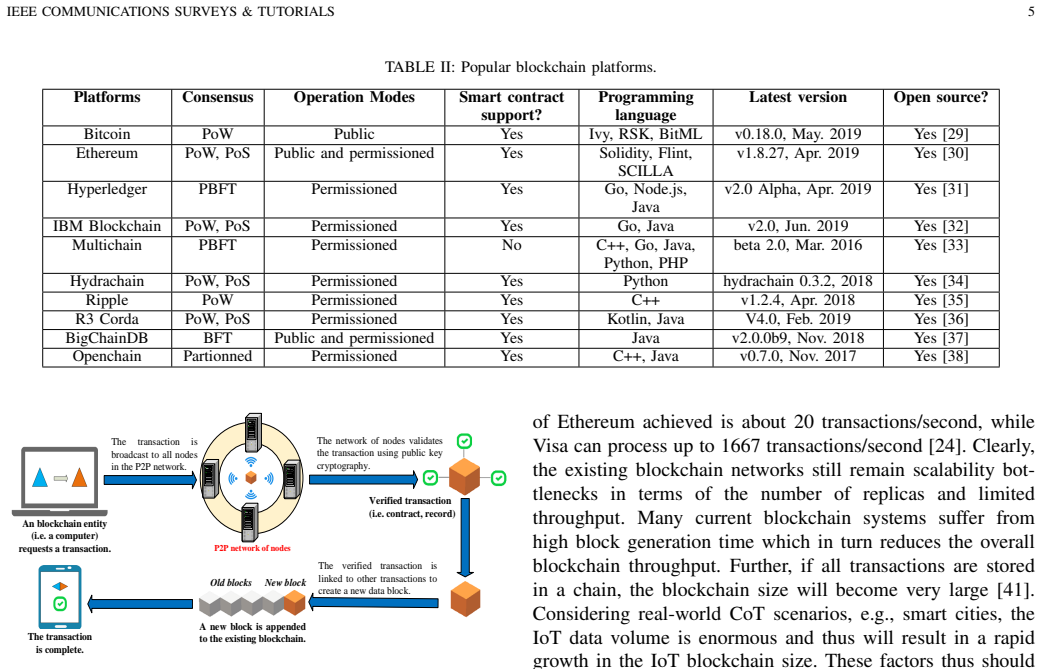
- [Table II and §II-A1] Table II lists Openchain's operation mode as 'Partionned' (should be 'Partitioned'), and Section II-A1 states Bitcoin processes at most four transactions per second, whereas the commonly cited figure is about seven; please verify the throughput value.
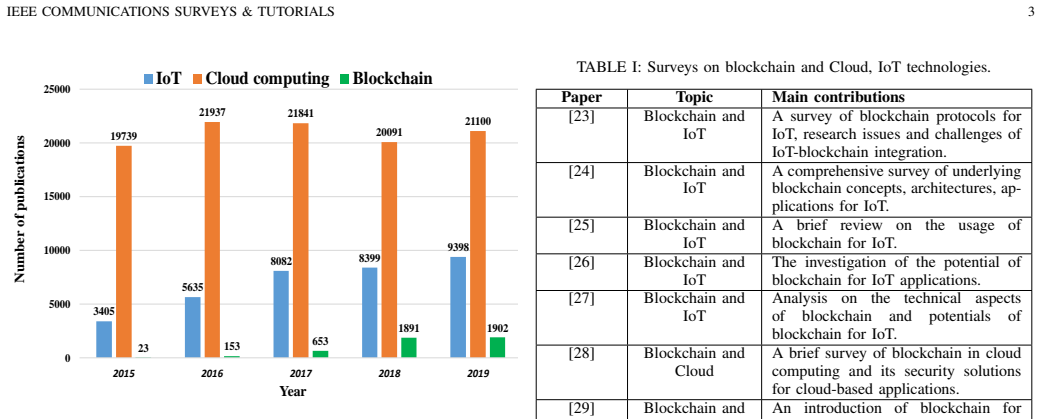
- [Fig. 2] Figure 2 reports publication trends 'from Web of Science' but does not specify the query terms or retrieval date, so the trend cannot be reproduced or updated; add that information in the caption or text.
- [Table IV] In Table IV, the entry for [129] says 'Data delection' in the use-case column; this should be 'data deletion.'
- [§IV-B1] The sentence 'These interesting integrations have the potentials to disrupt both blockchain and cloud computing worlds' is promotional; consider replacing it with a more neutral statement about possible impact.
Circularity Check
No significant circularity: BCoT survey is a literature synthesis whose claims rest on external studies; self-citations are illustrative, not load-bearing.
full rationale
This is a survey paper, not a derivation with fitted parameters or predicted quantities. The central claim—that BCoT is 'widely regarded as a promising enabler'—is supported by a broad set of external references across healthcare, city, transportation, industry, cloud services, platforms, and 5G, rather than by the authors' own prior work. The self-citations that appear ([50], [99], [187]) are used as examples of BCoT systems or research directions, not as the exclusive or load-bearing justification for the survey's conclusions. The conceptual BCoT architecture in Section III is explicitly presented as a synthesis 'motivated by extensive literature review' (Section III-B), not as a result derived from an axiom that already assumes BCoT's promise. The limitations recorded in Tables III and IV—e.g., 'the real prototype is not implemented' ([84]), 'Performance evaluation on the proposed scheme has not been done' ([98]), and 'Only conceptual analysis is provided and simulation to evaluate the proposal is lacked' ([124])—are evidence that many primary studies are conceptual, but this is a concern about the strength and representativeness of the underlying literature, not about circular reasoning within the paper. No equation, fitted parameter, or definition is shown to reduce to an input of the paper itself. Therefore the circularity score is 0.
Assumptions & free parameters
assumptions (2)
- domain assumption The surveyed literature accurately and comprehensively represents the state of the art in BCoT research.
- ad hoc to paper The conceptual three-layer BCoT architecture (IoT layer, cloud blockchain layer, application layer) is generalizable to all discussed application domains.
Cite this review
Pith. "Pith review of Integration of Blockchain and Cloud of Things: Architecture, Applications and Challenges." pith.science (2026). https://pith.science/paper/GNHQCDQO
@misc{pith2026190809058,
  author       = {Pith},
  title        = {Pith review of: Integration of Blockchain and Cloud of Things: Architecture, Applications and Challenges},
  year         = {2026},
  howpublished = {\url{https://pith.science/paper/GNHQCDQO}},
  note         = {Machine review of arXiv:1908.09058}
}
read the original abstract
The blockchain technology is taking the world by storm. Blockchain with its decentralized, transparent and secure nature has emerged as a disruptive technology for the next generation of numerous industrial applications. One of them is Cloud of Things enabled by the combination of cloud computing and Internet of Things. In this context, blockchain provides innovative solutions to address challenges in Cloud of Things in terms of decentralization, data privacy and network security, while Cloud of Things offer elasticity and scalability functionalities to improve the efficiency of blockchain operations. Therefore, a novel paradigm of blockchain and Cloud of Things integration, called BCoT, has been widely regarded as a promising enabler for a wide range of application scenarios. In this paper, we present a state-of-the-art review on the BCoT integration to provide general readers with an overview of the BCoT in various aspects, including background knowledge, motivation, and integrated architecture. Particularly, we also provide an in-depth survey of BCoT applications in different use-case domains such as smart healthcare, smart city, smart transportation and smart industry. Then, we review the recent BCoT developments with the emerging blockchain and cloud platforms, services, and research projects. Finally, some important research challenges and future directions are highlighted to spur further research in this promising area.
Figures

Figures from the paper (7 more)



Forward citations
Cited by 1 Pith paper
-
Privacy-Preserved Task Offloading in Mobile Blockchain with Deep Reinforcement Learning
A DQN-based offloading policy for mobile blockchain miners reduces simulated latency and energy costs and increases a formula-based privacy score compared with fixed offload/no-offload baselines.
Reference graph
Works this paper leans on
-
[84]
Bpds: A blockchain based privacy-preserving data sharing for electronic medical records,
J. Liu, X. Li, L. Ye, H. Zhang, X. Du, and M. Guizani, “Bpds: A blockchain based privacy-preserving data sharing for electronic medical records,” in 2018 IEEE Global Communications Conference (GLOBECOM), 2018, pp. 1–6
2018
-
[87]
Blockchain-based personal health data sharing system using cloud storage,
X. Zheng, R. R. Mukkamala, R. Vatrapu, and J. Ordieres-Mere, “Blockchain-based personal health data sharing system using cloud storage,” in 2018 IEEE 20th International Conference on e-Health Networking, Applications and Services (Healthcom) , 2018, pp. 1–6
2018
-
[88]
Medshare: Trust-less medical data sharing among cloud service providers via blockchain,
Q. Xia, E. B. Sifah, K. O. Asamoah, J. Gao, X. Du, and M. Guizani, “Medshare: Trust-less medical data sharing among cloud service providers via blockchain,” IEEE Access , vol. 5, pp. 14 757–14 767, 2017
2017
-
[96]
Corus: Blockchain-based trustworthy evaluation system for efficacy of healthcare remedies,
J. Park, S. Park, K. Kim, and D. Lee, “Corus: Blockchain-based trustworthy evaluation system for efficacy of healthcare remedies,” in 2018 IEEE International Conference on Cloud Computing Technology and Science (CloudCom) , 2018, pp. 181–184
2018
-
[98]
Recent patient health monitoring platforms incorporat- ing internet of things-enabled smart devices,
C. G. Number, “Recent patient health monitoring platforms incorporat- ing internet of things-enabled smart devices,” UROLOGY JOURNAL, vol. 19, no. 2, 2015
2015
-
[106]
Blockchain for IoT security and privacy: The case study of a smart home,
A. Dorri, S. S. Kanhere, R. Jurdak, and P. Gauravaram, “Blockchain for IoT security and privacy: The case study of a smart home,” in 2017 IEEE international conference on pervasive computing and communications workshops (PerCom workshops) , 2017, pp. 618–623
2017
-
[109]
Joint cloud collaboration mechanism between vehicle clouds based on blockchain,
B. Yin, L. Mei, Z. Jiang, and K. Wang, “Joint cloud collaboration mechanism between vehicle clouds based on blockchain,” in 2019 IEEE International Conference on Service-Oriented System Engineer- ing (SOSE), 2019, pp. 227–2275
2019
-
[111]
Securing cognitive radio vehicular ad hoc network with fog node based distributed blockchain cloud architecture,
S. Nadeem, M. Rizwan, F. Ahmad, and J. Manzoor, “Securing cognitive radio vehicular ad hoc network with fog node based distributed blockchain cloud architecture,” INTERNATIONAL JOURNAL OF AD- VANCED COMPUTER SCIENCE AND APPLICATIONS , vol. 10, no. 1, pp. 288–295, 2019
2019
-
[114]
Blockchain: A distributed solution to automotive security and privacy,
A. Dorri, M. Steger, S. S. Kanhere, and R. Jurdak, “Blockchain: A distributed solution to automotive security and privacy,” IEEE Communications Magazine, vol. 55, no. 12, pp. 119–125, 2017. IEEE COMMUNICATIONS SURVEYS & TUTORIALS 27
2017
-
[124]
Applying blockchain technology to decentralized operation in future energy internet,
T. Yang, Q. Guo, X. Tai, H. Sun, B. Zhang, W. Zhao, and C. Lin, “Applying blockchain technology to decentralized operation in future energy internet,” in 2017 IEEE Conference on Energy Internet and Energy System Integration (EI2) , 2017, pp. 1–5
work page 2017
-
[137]
Adaptive identity authentication of blockchain system-the collaborative cloud educational system,
M. Hori and M. Ohashi, “Adaptive identity authentication of blockchain system-the collaborative cloud educational system,” in EdMedia+ Innovate Learning. Association for the Advancement of Computing in Education (AACE), 2018, pp. 1339–1346
work page 2018
Show all 198 references
-
[1]
How the blockchain revolution will reshape the consumer electronics industry [future directions],
J.-H. Lee and M. Pilkington, “How the blockchain revolution will reshape the consumer electronics industry [future directions],” IEEE Consumer Electronics Magazine , vol. 6, no. 3, pp. 19–23, 2017
2017
-
[2]
Blockchain for 5G and beyond networks: A state of the art survey,
D. C. Nguyen, P. N. Pathirana, M. Ding, and A. Seneviratne, “Blockchain for 5G and beyond networks: A state of the art survey,” Journal of Network and Computer Applications , vol. 166, 2020
2020
-
[3]
Blockchain technology in finance,
P. Treleaven, R. G. Brown, and D. Yang, “Blockchain technology in finance,” Computer, vol. 50, no. 9, pp. 14–17, 2017
2017
-
[4]
Blockchain technology in the energy sector: A systematic review of challenges and opportunities,
M. Andoni, V . Robu, D. Flynn, S. Abram, D. Geach, D. Jenkins, P. Mc- Callum, and A. Peacock, “Blockchain technology in the energy sector: A systematic review of challenges and opportunities,” Renewable and Sustainable Energy Reviews , vol. 100, pp. 143–174, 2019
2019
-
[5]
Blockchain for government servicesuse cases, security benefits and challenges,
A. Alketbi, Q. Nasir, and M. A. Talib, “Blockchain for government servicesuse cases, security benefits and challenges,” in 2018 15th Learning and Technology Conference (L&T) , 2018, pp. 112–119
2018
-
[6]
Bitcoin: A peer-to-peer electronic cash system,
S. Nakamoto et al., “Bitcoin: A peer-to-peer electronic cash system,” 2008
2008
-
[7]
Bitcoin and beyond: A technical survey on decentralized digital currencies,
F. Tschorsch and B. Scheuermann, “Bitcoin and beyond: A technical survey on decentralized digital currencies,” IEEE Communications Surveys & Tutorials, vol. 18, no. 3, pp. 2084–2123, 2016
2016
-
[8]
A survey on internet of things: Architecture, enabling technologies, security and privacy, and applications,
J. Lin, W. Yu, N. Zhang, X. Yang, H. Zhang, and W. Zhao, “A survey on internet of things: Architecture, enabling technologies, security and privacy, and applications,” IEEE Internet of Things Journal , vol. 4, no. 5, pp. 1125–1142, 2017
2017
-
[9]
Internet of things: A survey on enabling technologies, protocols, and applications,
A. Al-Fuqaha, M. Guizani, M. Mohammadi, M. Aledhari, and M. Ayyash, “Internet of things: A survey on enabling technologies, protocols, and applications,”IEEE communications surveys & tutorials, vol. 17, no. 4, pp. 2347–2376, 2015
2015
-
[10]
Cloud of things: Integrating internet of things and cloud computing and the issues involved,
M. Aazam, I. Khan, A. A. Alsaffar, and E.-N. Huh, “Cloud of things: Integrating internet of things and cloud computing and the issues involved,” in Proceedings of 2014 11th International Bhurban Conference on Applied Sciences & Technology (IBCAST) Islamabad, Pakistan, 14th-18t...
2014
-
[12]
Sensing services in cloud-centric internet of things: A survey, taxonomy and challenges,
B. Kantarci and H. T. Mouftah, “Sensing services in cloud-centric internet of things: A survey, taxonomy and challenges,” in 2015 IEEE International Conference on Communication Workshop (ICCW) , 2015, pp. 1865–1870
2015
-
[13]
Integration of cloud computing with internet of things: challenges and open issues,
H. F. Atlam, A. Alenezi, A. Alharthi, R. J. Walters, and G. B. Wills, “Integration of cloud computing with internet of things: challenges and open issues,” in 2017 IEEE International Conference on Internet of Things (iThings) and IEEE Green Computing and Communications (GreenC...
2017
-
[16]
Blockchain-based smart contracts - applications and challenges,
A. S. e. a. Yining Hu, “Blockchain-based smart contracts - applications and challenges,” [Online]. Available: https://arxiv.org/abs/1810.04699
-
[18]
Cloudshare: Towards a cost-efficient and privacy-preserving alliance cloud using permissioned blockchains,
Y . Li, L. Zhu, M. Shen, F. Gao, B. Zheng, X. Du, S. Liu, and S. Yin, “Cloudshare: Towards a cost-efficient and privacy-preserving alliance cloud using permissioned blockchains,” in International Conference on Mobile Networks and Management . Springer, 2017, pp. 339–352
2017
-
[19]
Blockchain secure cloud: a new generation integrated cloud and blockchain platforms gen- eral concepts and challenges,
D. F.-C. JOANNA KOLODZIEJ, ANDRZEJ WILCZYNSKI and A. FERNNDEZ-MONTES, “Blockchain secure cloud: a new generation integrated cloud and blockchain platforms gen- eral concepts and challenges,” in https://www.awilczynski.me/wp- content/uploads/2018/09/ECJvol4issue2.pdf
2018
-
[20]
Cloud-based commissioning of constrained devices using permissioned blockchains,
T. Hardjono and N. Smith, “Cloud-based commissioning of constrained devices using permissioned blockchains,” in Proceedings of the 2nd ACM international workshop on IoT privacy, trust, and security. ACM, 2016, pp. 29–36
2016
-
[21]
Blockchain technologies for the internet of things: Research issues and challenges,
M. A. Ferrag, M. Derdour, M. Mukherjee, A. Derhab, L. Maglaras, and H. Janicke, “Blockchain technologies for the internet of things: Research issues and challenges,” IEEE Internet of Things Journal , vol. 6, no. 2, pp. 2188–2204, 2018
2018
-
[22]
Applications of blockchains in the internet of things: A comprehensive survey,
M. S. Ali, M. Vecchio, M. Pincheira, K. Dolui, F. Antonelli, and M. H. Rehmani, “Applications of blockchains in the internet of things: A comprehensive survey,” IEEE Communications Surveys & Tutorials , vol. 21, no. 2, pp. 1676–1717, 2018. IEEE COMMUNICATIONS SURVEYS & TUTORIALS 25
2018
-
[23]
A review on the use of blockchain for the internet of things,
T. M. Fern ´andez-Caram´es and P. Fraga-Lamas, “A review on the use of blockchain for the internet of things,” IEEE Access, vol. 6, pp. 32 979– 33 001, 2018
2018
-
[24]
Blockchain for internet of things: A survey,
H. Dai, Z. Zheng, and Y . Zhang, “Blockchain for internet of things: A survey,”IEEE Internet of Things Journal, vol. 6, no. 5, pp. 8076–8094, 2019
2019
-
[25]
A comprehensive survey of blockchain: From theory to IoT applications and beyond,
M. Wu, K. Wang, X. Cai, S. Guo, M. Guo, and C. Rong, “A comprehensive survey of blockchain: From theory to IoT applications and beyond,” IEEE Internet of Things Journal , vol. 6, no. 5, pp. 8114– 8154, 2019
2019
-
[26]
Blockchain security in cloud computing: Use cases, challenges, and solutions,
J. Park and J. Park, “Blockchain security in cloud computing: Use cases, challenges, and solutions,” Symmetry, vol. 9, no. 8, p. 164, 2017
2017
-
[27]
Blockchain-based decentralized cloud/fog solutions: Challenges, opportunities, and standards,
R. B. Uriarte and R. De Nicola, “Blockchain-based decentralized cloud/fog solutions: Challenges, opportunities, and standards,” IEEE Communications Standards Magazine , vol. 2, no. 3, pp. 22–28, 2018
2018
-
[28]
Integrated blockchain and edge computing systems: A survey, some research issues and challenges,
R. Yang, F. R. Yu, P. Si, Z. Yang, and Y . Zhang, “Integrated blockchain and edge computing systems: A survey, some research issues and challenges,” IEEE Communications Surveys & Tutorials, vol. 21, no. 2, pp. 1508–1532, 2019
2019
-
[29]
[Online]
Bitcoin Platform. [Online]. Available: https://bitcoin.org/en/release/v0.18.0
-
[30]
[Online]
Ethereum Platform. [Online]. Available: https://github.com/ethereum/go-ethereum/releases
-
[31]
[Online]
Hyperledger Platform. [Online]. Available: https://github.com/hyperledger
-
[32]
[Online]
IBM Blockchain Platform. [Online]. Available: https://github.com/IBM-Blockchain
-
[33]
[Online]
MultiChain Platform. [Online]. Available: https://github.com/MultiChain
-
[34]
[Online]
Hydrachain Platform. [Online]. Available: https://pypi.org/project/hydrachain/
-
[35]
[Online]
Ripple Blockchain Platform. [Online]. Available: https://github.com/ripple/rippled/releases/tag/1.2.4
-
[36]
[Online]
Corda Platform. [Online]. Available: https://docs.corda.net/head/release-notes.html
-
[37]
[Online]
Bigchain Platform. [Online]. Available: https://github.com/bigchaindb/bigchaindb/releases/tag/v2.0.0b9
-
[38]
[Online]
Openchain Platform. [Online]. Available: https://github.com/openchain
-
[39]
Un- tangling blockchain: A data processing view of blockchain systems,
T. T. A. Dinh, R. Liu, M. Zhang, G. Chen, B. C. Ooi, and J. Wang, “Un- tangling blockchain: A data processing view of blockchain systems,” IEEE Transactions on Knowledge and Data Engineering, vol. 30, no. 7, pp. 1366–1385, 2018
2018
-
[40]
A survey on security verification of blockchain smart contracts,
J. Liu and Z. Liu, “A survey on security verification of blockchain smart contracts,” IEEE Access, 2019
2019
-
[41]
The challenges of existence, status, and value for improving blockchain,
F. Lin and M. Qiang, “The challenges of existence, status, and value for improving blockchain,” IEEE Access, vol. 7, pp. 7747–7758, 2018
2018
-
[42]
Security and privacy for cloud-based IoT: Challenges,
J. Zhou, Z. Cao, X. Dong, and A. V . Vasilakos, “Security and privacy for cloud-based IoT: Challenges,” IEEE Communications Magazine , vol. 55, no. 1, pp. 26–33, 2017
2017
-
[43]
Blockchain’s adoption in IoT: The challenges, and a way forward,
I. Makhdoom, M. Abolhasan, H. Abbas, and W. Ni, “Blockchain’s adoption in IoT: The challenges, and a way forward,” Journal of Network and Computer Applications , 2018
2018
-
[44]
Block-secure: Blockchain based scheme for secure p2p cloud storage,
J. Li, J. Wu, and L. Chen, “Block-secure: Blockchain based scheme for secure p2p cloud storage,”Information Sciences, vol. 465, pp. 219–231, 2018
2018
-
[45]
Differentially private data sharing in a cloud federation with blockchain,
M. Yang, A. Margheri, R. Hu, and V . Sassone, “Differentially private data sharing in a cloud federation with blockchain,” IEEE Cloud Computing, vol. 5, no. 6, pp. 69–79, 2018
2018
-
[47]
[Online]
Blockchain-Based Decentralized Cloud Computing. [Online]. Avail- able: https://iex.ec/wp-content/uploads/pdf/iExec-WPv3.0-English.pdf
-
[48]
Blockchain-enabled reengineering of cloud datacenters,
K. Gai, K.-K. R. Choo, and L. Zhu, “Blockchain-enabled reengineering of cloud datacenters,” IEEE Cloud Computing, vol. 5, no. 6, pp. 21–25, 2018
2018
-
[49]
[Online]
AWS Blockchain. [Online]. Available: https://github.com/aws- samples/non-profit-blockchain
-
[50]
Blockchain for secure EHRs sharing of mobile cloud based e-health systems,
D. C. Nguyen, P. N. Pathirana, M. Ding, and A. Seneviratne, “Blockchain for secure EHRs sharing of mobile cloud based e-health systems,” IEEE Access, vol. 7, pp. 66 792–66 806, 2019
2019
-
[51]
[Online]
IBM Blockchain. [Online]. Available: https://github.com/IBM- Blockchain
-
[52]
[Online]
Oracle Blockchain. [Online]. Available: https://github.com/oracle
-
[53]
Provchain: A blockchain-based data provenance architecture in cloud environment with enhanced privacy and availability,
X. Liang, S. Shetty, D. Tosh, C. Kamhoua, K. Kwiat, and L. Njilla, “Provchain: A blockchain-based data provenance architecture in cloud environment with enhanced privacy and availability,” in Proceedings of the 17th IEEE/ACM international symposium on cluster, cloud and grid c...
2017
-
[54]
Blockchain-based security architecture for distributed cloud storage,
J. Li, Z. Liu, L. Chen, P. Chen, and J. Wu, “Blockchain-based security architecture for distributed cloud storage,” in 2017 IEEE International Symposium on Parallel and Distributed Processing with Applications and 2017 IEEE International Conference on Ubiquitous Computing and ...
2017
-
[55]
The impact of crypto-currency risks on the use of blockchain for cloud security and privacy,
Y . Zhao and B. Duncan, “The impact of crypto-currency risks on the use of blockchain for cloud security and privacy,” in2018 International Conference on High Performance Computing & Simulation (HPCS) , 2018, pp. 677–684
2018
-
[57]
A blockchain-based access control system for cloud storage,
I. Sukhodolskiy and S. Zapechnikov, “A blockchain-based access control system for cloud storage,” in 2018 IEEE Conference of Russian Young Researchers in Electrical and Electronic Engineering (EICon- Rus), 2018, pp. 1575–1578
2018
-
[58]
Secure data provenance in cloud-centric internet of things via blockchain smart contracts,
S. Ali, G. Wang, M. Z. A. Bhuiyan, and H. Jiang, “Secure data provenance in cloud-centric internet of things via blockchain smart contracts,” in 2018 IEEE SmartWorld, Ubiquitous Intel- ligence & Computing, Advanced & Trusted Computing, Scal- able Computing & Communications, Cl...
2018
-
[59]
Bads: Blockchain-based architecture for data sharing with abs and cp-abe in IoT,
Y . Zhang, D. He, and K.-K. R. Choo, “Bads: Blockchain-based architecture for data sharing with abs and cp-abe in IoT,” Wireless Communications and Mobile Computing , vol. 2018, 2018
2018
-
[60]
Privacy-oriented blockchain-based dis- tributed key management architecture for hierarchical access control in the IoT scenario,
M. Ma, G. Shi, and F. Li, “Privacy-oriented blockchain-based dis- tributed key management architecture for hierarchical access control in the IoT scenario,” IEEE Access, vol. 7, pp. 34 045–34 059, 2019
2019
-
[61]
Fif-IoT: A forensic investigation framework for IoT using a public digital ledger,
M. Hossain, Y . Karim, and R. Hasan, “Fif-IoT: A forensic investigation framework for IoT using a public digital ledger,” in 2018 IEEE International Congress on Internet of Things (ICIoT), 2018, pp. 33–40
2018
-
[62]
Improving identity management of cloud-based IoT applications using blockchain,
N. M. Ahmad, S. F. A. Razak, S. Kannan, I. Yusof, and A. H. M. Amin, “Improving identity management of cloud-based IoT applications using blockchain,” in 2018 International Conference on Intelligent and Advanced System (ICIAS) , 2018, pp. 1–6
2018
-
[63]
Wip: A novel blockchain-based trust model for cloud identity management,
K. Bendiab, N. Kolokotronis, S. Shiaeles, and S. Boucherkha, “Wip: A novel blockchain-based trust model for cloud identity management,” in 2018 IEEE 16th Intl Conf on Dependable, Autonomic and Secure Com- puting, 16th Intl Conf on Pervasive Intelligence and Computing, 4th Intl...
2018
-
[64]
Toward a secure vm migration control mechanism using blockchain technique for cloud computing environment,
T. Uchibayashi, B. Apduhan, T. Suganuma, and M. Hiji, “Toward a secure vm migration control mechanism using blockchain technique for cloud computing environment,” in International Conference on Computational Science and Its Applications. Springer, 2018, pp. 177– 186
2018
-
[65]
Mchain: a blockchain-based vm measure- ments secure storage approach in iaas cloud with enhanced integrity and controllability,
B. Zhao, P. Fan, and M. Ni, “Mchain: a blockchain-based vm measure- ments secure storage approach in iaas cloud with enhanced integrity and controllability,” IEEE Access, vol. 6, pp. 43 758–43 769, 2018
2018
-
[66]
Blockchain-based public integrity verification for cloud storage against procrastinating auditors,
Y . Zhang, C. Xu, X. Lin, and X. S. Shen, “Blockchain-based public integrity verification for cloud storage against procrastinating auditors,” IEEE Transactions on Cloud Computing , 2019
2019
-
[67]
Cloud computing assisted blockchain-enabled internet of things,
C. Qiu, H. Yao, C. Jiang, S. Guo, and F. Xu, “Cloud computing assisted blockchain-enabled internet of things,” IEEE Transactions on Cloud Computing, 2019
2019
-
[68]
Cooperative and distributed computation offloading for blockchain-empowered industrial internet of things,
W. Chen, Z. Zhang, Z. Hong, C. Chen, J. Wu, S. Maharjan, Z. Zheng, and Y . Zhang, “Cooperative and distributed computation offloading for blockchain-empowered industrial internet of things,” IEEE Internet of Things Journal, vol. 6, no. 5, pp. 8433–8446, 2019
2019
-
[69]
Online deep reinforcement learning for computation offloading in blockchain- empowered mobile edge computing,
X. Qiu, L. Liu, W. Chen, Z. Hong, and Z. Zheng, “Online deep reinforcement learning for computation offloading in blockchain- empowered mobile edge computing,” IEEE Transactions on Vehicular Technology, vol. 68, no. 8, pp. 8050–8062, 2019
2019
-
[70]
A blockchain- based model for cloud service quality monitoring,
M. Taghavi, J. Bentahar, H. Otrok, and K. Bakhtiyari, “A blockchain- based model for cloud service quality monitoring,” IEEE Transactions on Services Computing , 2019
2019
-
[71]
A cooperative computing strategy for blockchain-secured fog computing,
D. Wu and N. Ansari, “A cooperative computing strategy for blockchain-secured fog computing,” IEEE Internet of Things Journal , 2020
2020
-
[72]
Credit-based payments for fast computing resource trading in edge-assisted internet of things,
Z. Li, Z. Yang, S. Xie, W. Chen, and K. Liu, “Credit-based payments for fast computing resource trading in edge-assisted internet of things,” IEEE Internet of Things Journal , vol. 6, no. 4, pp. 6606–6617, 2019. IEEE COMMUNICATIONS SURVEYS & TUTORIALS 26
2019
-
[73]
Ethershare: Share information in jointcloud environment using blockchain-based smart contracts,
P. Zheng, Z. Zheng, W. Chen, J. Bian, and J. E. Yang, “Ethershare: Share information in jointcloud environment using blockchain-based smart contracts,” in 2019 IEEE International Conference on Service- Oriented System Engineering (SOSE) , 2019, pp. 233–2335
2019
-
[74]
Mobile intercloud system with blockchain,
Y . H. Ho, Z. Cheng, P. M. F. Ho, and H. C. Chan, “Mobile intercloud system with blockchain,” in Proceedings of the International Multi- Conference of Engineers and Computer Scientists , vol. 1, 2018
2018
-
[75]
IoT service based on jointcloud blockchain: The case study of smart traveling,
W. Chen, M. Ma, Y . Ye, Z. Zheng, and Y . Zhou, “IoT service based on jointcloud blockchain: The case study of smart traveling,” in2018 IEEE Symposium on Service-Oriented System Engineering (SOSE), 2018, pp. 216–221
2018
-
[76]
Next-generation cy- bersecurity through a blockchain-enabled federated cloud framework,
O. O. Malomo, D. B. Rawat, and M. Garuba, “Next-generation cy- bersecurity through a blockchain-enabled federated cloud framework,” The Journal of Supercomputing, vol. 74, no. 10, pp. 5099–5126, 2018
2018
-
[77]
On the collaborative governance of decentralized edge microclouds with blockchain-based distributed ledgers,
F. Freitag, “On the collaborative governance of decentralized edge microclouds with blockchain-based distributed ledgers,” in 2018 IEEE/WIC/ACM International Conference on Web Intelligence (WI) , 2018, pp. 709–712
2018
-
[78]
An improved p2p file system scheme based on ipfs and blockchain,
Y . Chen, H. Li, K. Li, and J. Zhang, “An improved p2p file system scheme based on ipfs and blockchain,” in 2017 IEEE International Conference on Big Data (Big Data) , 2017, pp. 2652–2657
2017
-
[79]
Blockchain technology in healthcare: A comprehensive review and directions for future research,
S. Khezr, M. Moniruzzaman, A. Yassine, and R. Benlamri, “Blockchain technology in healthcare: A comprehensive review and directions for future research,” Applied Sciences, vol. 9, no. 9, p. 1736, 2019
2019
-
[80]
A systematic review of the use of blockchain in healthcare,
M. H ¨olbl, M. Kompara, A. Kami ˇsali´c, and L. Nemec Zlatolas, “A systematic review of the use of blockchain in healthcare,” Symmetry, vol. 10, no. 10, p. 470, 2018
2018
-
[81]
Measurement and assessment of hand functionality via a cloud-based implementation,
H.-T. Pham and P. N. Pathirana, “Measurement and assessment of hand functionality via a cloud-based implementation,” in International Conference on Smart Homes and Health Telematics . Springer, 2015, pp. 289–294
2015
-
[82]
Cloud-based non-invasive tele-rehabilitation exercise monitoring,
S. Li and P. N. Pathirana, “Cloud-based non-invasive tele-rehabilitation exercise monitoring,” in 2014 IEEE Conference on Biomedical Engi- neering and Sciences (IECBES) , 2014, pp. 385–390
2014
-
[83]
A review of secure and privacy- preserving medical data sharing,
H. Jin, Y . Luo, P. Li, and J. Mathew, “A review of secure and privacy- preserving medical data sharing,” IEEE Access , vol. 7, pp. 61 656– 61 669, 2019
2019
-
[85]
Integrating blockchain for data sharing and collaboration in mobile healthcare applications,
X. Liang, J. Zhao, S. Shetty, J. Liu, and D. Li, “Integrating blockchain for data sharing and collaboration in mobile healthcare applications,” in 2017 IEEE 28th Annual International Symposium on Personal, Indoor, and Mobile Radio Communications (PIMRC) , 2017, pp. 1–5
2017
-
[86]
A blockchain-based framework for data sharing with fine-grained access control in decentralized storage systems,
S. Wang, Y . Zhang, and Y . Zhang, “A blockchain-based framework for data sharing with fine-grained access control in decentralized storage systems,” IEEE Access, vol. 6, pp. 38 437–38 450, 2018
2018
-
[89]
Bbds: Blockchain-based data sharing for electronic medical records in cloud environments,
Q. Xia, E. Sifah, A. Smahi, S. Amofa, and X. Zhang, “Bbds: Blockchain-based data sharing for electronic medical records in cloud environments,” Information, vol. 8, no. 2, p. 44, 2017
2017
-
[90]
A proposed solution and future direction for blockchain-based heteroge- neous medicare data in cloud environment,
H. Kaur, M. A. Alam, R. Jameel, A. K. Mourya, and V . Chang, “A proposed solution and future direction for blockchain-based heteroge- neous medicare data in cloud environment,”Journal of medical systems, vol. 42, no. 8, p. 156, 2018
2018
-
[91]
Privacy-friendly platform for healthcare data in cloud based on blockchain environment,
A. Al Omar, M. Z. A. Bhuiyan, A. Basu, S. Kiyomoto, and M. S. Rahman, “Privacy-friendly platform for healthcare data in cloud based on blockchain environment,” Future Generation Computer Systems , vol. 95, pp. 511–521, 2019
2019
-
[92]
Secure cloud-based EHR system using attribute-based cryptosystem and blockchain,
H. Wang and Y . Song, “Secure cloud-based EHR system using attribute-based cryptosystem and blockchain,” Journal of medical sys- tems, vol. 42, no. 8, p. 152, 2018
2018
-
[93]
A decentralized privacy-preserving healthcare blockchain for IoT,
A. D. Dwivedi, G. Srivastava, S. Dhar, and R. Singh, “A decentralized privacy-preserving healthcare blockchain for IoT,” Sensors, vol. 19, no. 2, p. 326, 2019
2019
-
[94]
A medical information service platform based on distributed cloud and blockchain,
Y . Du, J. Liu, Z. Guan, and H. Feng, “A medical information service platform based on distributed cloud and blockchain,” in 2018 IEEE International Conference on Smart Cloud (SmartCloud) , 2018, pp. 34– 39
2018
-
[95]
Cloud-assisted secure ehealth systems for tamper-proofing EHR via blockchain,
S. Cao, G. Zhang, P. Liu, X. Zhang, and F. Neri, “Cloud-assisted secure ehealth systems for tamper-proofing EHR via blockchain,” Information Sciences, vol. 485, pp. 427–440, 2019
2019
-
[97]
Cloud model for purchase management in health sector of peru based on IoT and blockchain,
R. C. Celiz, Y . E. De La Cruz, and D. M. Sanchez, “Cloud model for purchase management in health sector of peru based on IoT and blockchain,” in 2018 IEEE 9th Annual Information Technology, Electronics and Mobile Communication Conference (IEMCON) , 2018, pp. 328–334
2018
-
[99]
A mobile cloud based IoMT framework for automated health assessment and management,
D. C. Nguyen, K. D. Nguyen, and P. N. Pathirana, “A mobile cloud based IoMT framework for automated health assessment and management,” in 2019 41st Annual International Conference of the IEEE Engineering in Medicine and Biology Society (EMBC) , 2019, pp. 6517–6520
2019
-
[100]
Security and privacy of smart cities: a survey, research issues and challenges,
M. Sookhak, H. Tang, Y . He, and F. R. Yu, “Security and privacy of smart cities: a survey, research issues and challenges,” IEEE Commu- nications Surveys & Tutorials , vol. 21, no. 2, pp. 1718–1743, 2018
2018
-
[101]
Decentralized big data auditing for smart city environments leveraging blockchain technology,
H. Yu, Z. Yang, and R. O. Sinnott, “Decentralized big data auditing for smart city environments leveraging blockchain technology,” IEEE Access, vol. 7, pp. 6288–6296, 2018
2018
-
[102]
Blockchain-based IoT-cloud authorization and delegation,
N. Tapas, G. Merlino, and F. Longo, “Blockchain-based IoT-cloud authorization and delegation,” in 2018 IEEE International Conference on Smart Computing (SMARTCOMP) , 2018, pp. 411–416
2018
-
[103]
IoT based secure smart city architecture using blockchain,
R. Paul, P. Baidya, S. Sau, K. Maity, S. Maity, and S. B. Mandal, “IoT based secure smart city architecture using blockchain,” in 2018 2nd International Conference on Data Science and Business Analytics (ICDSBA), 2018, pp. 215–220
2018
-
[104]
Blockchain and IoT-based cognitive edge framework for sharing economy services in a smart city,
M. A. Rahman, M. M. Rashid, M. S. Hossain, E. Hassanain, M. F. Alhamid, and M. Guizani, “Blockchain and IoT-based cognitive edge framework for sharing economy services in a smart city,” IEEE Access, vol. 7, pp. 18 611–18 621, 2019
2019
-
[105]
Advanced survey of blockchain for the internet of things smart home,
M. AbuNaser and A. A. Alkhatib, “Advanced survey of blockchain for the internet of things smart home,” in 2019 IEEE Jordan Inter- national Joint Conference on Electrical Engineering and Information Technology (JEEIT), 2019, pp. 58–62
2019
-
[107]
Sh-blockcc: A secure and efficient internet of things smart home architecture based on cloud computing and blockchain technology,
S. Singh, I.-H. Ra, W. Meng, M. Kaur, and G. H. Cho, “Sh-blockcc: A secure and efficient internet of things smart home architecture based on cloud computing and blockchain technology,” International Journal of Distributed Sensor Networks , vol. 15, no. 4, p. 1550147719844159, 2019
2019
-
[108]
Private blockchain-based secure access control for smart home systems
J. Xue, C. Xu, and Y . Zhang, “Private blockchain-based secure access control for smart home systems.” KSII Transactions on Internet & Information Systems, vol. 12, no. 12, 2018
2018
-
[110]
Blockchain-enabled security in electric vehicles cloud and edge computing,
H. Liu, Y . Zhang, and T. Yang, “Blockchain-enabled security in electric vehicles cloud and edge computing,” IEEE Network, vol. 32, no. 3, pp. 78–83, 2018
2018
-
[112]
A security architecture of vanet based on blockchain and mobile edge computing,
X. Zhang, R. Li, and B. Cui, “A security architecture of vanet based on blockchain and mobile edge computing,” in 2018 1st IEEE Interna- tional Conference on Hot Information-Centric Networking (HotICN) , 2018, pp. 258–259
2018
-
[113]
Introduce reward-based intelligent vehicles communication using blockchain,
M. Singh and S. Kim, “Introduce reward-based intelligent vehicles communication using blockchain,” in 2017 International SoC Design Conference (ISOCC), 2017, pp. 15–16
2017
-
[115]
Efficient and privacy-preserving carpooling using blockchain-assisted vehicular fog computing,
M. Li, L. Zhu, and X. Lin, “Efficient and privacy-preserving carpooling using blockchain-assisted vehicular fog computing,” IEEE Internet of Things Journal, 2018
2018
-
[116]
Research on task scheduling strategy: Based on smart contract in vehicular cloud computing environment,
J. Fan, R. Li, and S. Li, “Research on task scheduling strategy: Based on smart contract in vehicular cloud computing environment,” in 2018 1st IEEE International Conference on Hot Information-Centric Networking (HotICN), 2018, pp. 248–249
2018
-
[117]
Blockchain and IoT data analytics for fine-grained transportation insurance,
Z. Li, Z. Xiao, Q. Xu, E. Sotthiwat, R. S. M. Goh, and X. Liang, “Blockchain and IoT data analytics for fine-grained transportation insurance,” in 2018 IEEE 24th International Conference on Parallel and Distributed Systems (ICPADS) , 2018, pp. 1022–1027
2018
-
[118]
Blockchain-based secure and trustworthy internet of things in SDN-enabled 5G -vanets,
L. Xie, Y . Ding, H. Yang, and X. Wang, “Blockchain-based secure and trustworthy internet of things in SDN-enabled 5G -vanets,” IEEE Access, vol. 7, pp. 56 656–56 666, 2019
2019
-
[119]
Toward a blockchain cloud manufacturing system as a peer to peer distributed network platform,
Z. Li, A. V . Barenji, and G. Q. Huang, “Toward a blockchain cloud manufacturing system as a peer to peer distributed network platform,” Robotics and Computer-Integrated Manufacturing , vol. 54, pp. 133– 144, 2018
2018
-
[120]
Leveraging the capabilities of industry 4.0 for improving energy efficiency in smart factories,
N. Mohamed, J. Al-Jaroodi, and S. Lazarova-Molnar, “Leveraging the capabilities of industry 4.0 for improving energy efficiency in smart factories,” IEEE Access, vol. 7, pp. 18 008–18 020, 2019
2019
-
[121]
Blockchain platform for industrial internet of things,
A. Bahga and V . K. Madisetti, “Blockchain platform for industrial internet of things,” Journal of Software Engineering and Applications , vol. 9, no. 10, p. 533, 2016
2016
-
[122]
Blockchain in logistics and supply chain: A lean approach for designing real-world use cases,
G. Perboli, S. Musso, and M. Rosano, “Blockchain in logistics and supply chain: A lean approach for designing real-world use cases,” IEEE Access, vol. 6, pp. 62 018–62 028, 2018
2018
-
[123]
Configuring blockchain architectures for transaction information in blockchain consortiums: The case of accounting and supply chain systems,
D. E. O’Leary, “Configuring blockchain architectures for transaction information in blockchain consortiums: The case of accounting and supply chain systems,” Intelligent Systems in Accounting, Finance and Management, vol. 24, no. 4, pp. 138–147, 2017
2017
-
[125]
Energy crowdsourcing and peer-to-peer energy trading in blockchain-enabled smart grids,
S. Wang, A. F. Taha, J. Wang, K. Kvaternik, and A. Hahn, “Energy crowdsourcing and peer-to-peer energy trading in blockchain-enabled smart grids,” arXiv preprint arXiv:1901.02390 , 2019
1901 arXiv
-
[126]
Intelligent resource management in blockchain-based cloud datacenters,
C. Xu, K. Wang, and M. Guo, “Intelligent resource management in blockchain-based cloud datacenters,” IEEE Cloud Computing , vol. 4, no. 6, pp. 50–59, 2017
2017
-
[127]
Blockchain based efficient and robust fair payment for outsourcing services in cloud computing,
Y . Zhang, R. H. Deng, X. Liu, and D. Zheng, “Blockchain based efficient and robust fair payment for outsourcing services in cloud computing,” Information Sciences, vol. 462, pp. 262–277, 2018
2018
-
[128]
Blockchain based efficient and robust fair payment for outsourcing services in cloud computing,
D. R. H. L.-X. Zhang, Yinghui and D. Zheng, “Blockchain based efficient and robust fair payment for outsourcing services in cloud computing,” Information Sciences, vol. 462, pp. 262–277, 2018
2018
-
[129]
Blockchain-based publicly verifiable data deletion scheme for cloud storage,
C. Yang, X. Chen, and Y . Xiang, “Blockchain-based publicly verifiable data deletion scheme for cloud storage,” Journal of Network and Computer Applications, vol. 103, pp. 185–193, 2018
2018
-
[130]
bcbim: A blockchain-based big data model for bim modification audit and provenance in mobile cloud,
R. Zheng, J. Jiang, X. Hao, W. Ren, F. Xiong, and Y . Ren, “bcbim: A blockchain-based big data model for bim modification audit and provenance in mobile cloud,” Mathematical Problems in Engineering , vol. 2019, 2019
2019
-
[131]
Blockchain-based distributed cloud storage digital forensics: Where’s the beef?
J. Ricci, I. Baggili, and F. Breitinger, “Blockchain-based distributed cloud storage digital forensics: Where’s the beef?” IEEE Security & Privacy, vol. 17, no. 1, pp. 34–42, 2019
2019
-
[132]
Blockchain-based trusted electronic records preservation in cloud storage,
Y . Ren, Y . Liu, X. Yin, Z. Shen, and H.-J. Kim, “Blockchain-based trusted electronic records preservation in cloud storage,” Computers, Materials & Continua , vol. 58, no. 1, pp. 135–151, 2019
2019
-
[133]
Computing resource trading for edge- cloud-assisted internet of things,
Z. Li, Z. Yang, and S. Xie, “Computing resource trading for edge- cloud-assisted internet of things,” IEEE Transactions on Industrial Informatics, 2019
2019
-
[135]
Saranyu: Using smart contracts and blockchain for cloud tenant management,
S. Nayak, N. C. Narendra, A. Shukla, and J. Kempf, “Saranyu: Using smart contracts and blockchain for cloud tenant management,” in 2018 IEEE 11th International Conference on Cloud Computing (CLOUD) , 2018, pp. 857–861
2018
-
[136]
Blockchain- based applications in education: A systematic review,
A. Alammary, S. Alhazmi, M. Almasri, and S. Gillani, “Blockchain- based applications in education: A systematic review,” Applied Sci- ences, vol. 9, no. 12, p. 2400, 2019
2019
-
[138]
to the cloud and its potential role in com- puter science education,
I. Purdon and E. Erturk, “to the cloud and its potential role in com- puter science education,” Engineering, Technology & Applied Science Research, vol. 7, no. 6, pp. 2340–2344, 2017
2017
-
[139]
[Online]
IPFS Storage Platform. [Online]. Available: https://github.com/ipfs/ipfs
-
[140]
[Online]
Storj Platform. [Online]. Available: https://github.com/Storj/
-
[141]
[Online]
Filecoin Platform. [Online]. Available: https://github.com/filecoin- project
-
[142]
[Online]
Sia Platform. [Online]. Available: https://github.com/NebulousLabs/Sia
-
[143]
[Online]
Swarm Platform. [Online]. Available: https://swarm.ethereum.org/
-
[144]
[Online]
Maidsafe Platform. [Online]. Available: https://maidsafe.net/
-
[145]
[Online]
BigchainDB Platform. [Online]. Available: https://github.com/bigchaindb/bigchaindb
-
[146]
[Online]
Datum Platform. [Online]. Available: https://github.com/Datum
-
[147]
Designing a blockchain-based IoT with ethereum, swarm, and lora: the software solution to create high availability with minimal security risks,
K. R. Ozyilmaz and A. Yurdakul, “Designing a blockchain-based IoT with ethereum, swarm, and lora: the software solution to create high availability with minimal security risks,” IEEE Consumer Electronics Magazine, vol. 8, no. 2, pp. 28–34, 2019
2019
-
[148]
[Online]
Microsoft Azure - IPFS. [Online]. Available: https://ipfs.io/ipfs/wiki/Microsoft Azure.html
-
[149]
[Online]
Azure Blockchain. [Online]. Available: https://github.com/Azure- Samples/blockchain
-
[150]
[Online]
Hewlett Packard Blockchain. [Online]. Available: https://github.com/HewlettPackard/catena/wiki/Ethereum
-
[151]
[Online]
Alibaba Blockchain. [Online]. Available: https://github.com/AliyunContainerService/solution-blockchain-demo
-
[152]
[Online]
Baidu Blockchain. [Online]. Available: https://github.com/baidu
-
[153]
[Online]
Huawei Blockchain. [Online]. Available: https://github.com/Huawei
-
[154]
[Online]
Google Blockchain. [Online]. Available: https://github.com/blockchain- etl/ethereum-etl-airflow
-
[155]
[Online]
SAP Blockchain. [Online]. Available: https://github.com/SAP/cloud- blockchain-odometer-example
-
[156]
[Online]
Use vehicle sensor data to execute smart transactions in Blockchain. [Online]. Available: https://developer.ibm.com/articles/cl-blockchain- for-cognitive-IoT-apps2/
-
[157]
[Online]
Oracle Blockchain Use Cases. [Online]. Available: https://blogs.oracle.com/blockchain/blockchain-use-cases
-
[158]
[Online]
HPE and Continental to launch blockchain plat- form for vehicle data sharing. [Online]. Available: https://www.cio.com.au/article/658229/hpe-continental- launch- blockchain-platform-vehicle-data-sharing/
-
[159]
A survey of security issues for cloud computing,
M. A. Khan, “A survey of security issues for cloud computing,” Journal of network and computer applications , vol. 71, pp. 11–29, 2016
2016
-
[160]
A survey on the security of blockchain systems,
X. Li, P. Jiang, T. Chen, X. Luo, and Q. Wen, “A survey on the security of blockchain systems,” Future Generation Computer Systems , 2017
2017
-
[161]
Security, performance, and applications of smart contracts: A systematic survey,
S. Rouhani and R. Deters, “Security, performance, and applications of smart contracts: A systematic survey,”IEEE Access, vol. 7, pp. 50 759– 50 779, 2019
2019
-
[162]
Smart contracts: security patterns in the ethereum ecosystem and solidity,
M. Wohrer and U. Zdun, “Smart contracts: security patterns in the ethereum ecosystem and solidity,” in 2018 International Workshop on Blockchain Oriented Software Engineering (IWBOSE) , 2018, pp. 2–8
2018
-
[163]
An empirical analysis of linkability in the monero blockchain.(2017),
A. Miller, M. M ¨oser, K. Lee, and A. Narayanan, “An empirical analysis of linkability in the monero blockchain.(2017),” 2017
2017
-
[164]
Resource management in cloud networking using economic analysis and pricing models: A survey,
N. C. Luong, P. Wang, D. Niyato, Y . Wen, and Z. Han, “Resource management in cloud networking using economic analysis and pricing models: A survey,”IEEE Communications Surveys & Tutorials, vol. 19, no. 2, pp. 954–1001, 2017
2017
-
[165]
Blockchain standard: Can we reach consensus?
V . Gramoli and M. Staples, “Blockchain standard: Can we reach consensus?” IEEE Communications Standards Magazine, vol. 2, no. 3, pp. 16–21, 2018
2018
-
[166]
Blockchain standards for com- pliance and trust,
A. Anjum, M. Sporny, and A. Sill, “Blockchain standards for com- pliance and trust,” IEEE Cloud Computing , vol. 4, no. 4, pp. 84–90, 2017
2017
-
[167]
Enhancing cloud-based IoT security through trustworthy cloud service: An inte- gration of security and reputation approach,
X. Li, Q. Wang, X. Lan, X. Chen, N. Zhang, and D. Chen, “Enhancing cloud-based IoT security through trustworthy cloud service: An inte- gration of security and reputation approach,” IEEE Access, vol. 7, pp. 9368–9383, 2019
2019
-
[168]
A secure IoT service architecture with an efficient balance dynamics based on cloud and edge computing,
T. Wang, G. Zhang, A. Liu, M. Z. A. Bhuiyan, and Q. Jin, “A secure IoT service architecture with an efficient balance dynamics based on cloud and edge computing,” IEEE Internet of Things Journal , 2018
2018
-
[169]
Smartpool: Practical decentralized pooled mining,
L. Luu, Y . Velner, J. Teutsch, and P. Saxena, “Smartpool: Practical decentralized pooled mining,” in 26th {USENIX} Security Symposium ({USENIX} Security 17), 2017, pp. 1409–1426
2017
-
[170]
Ekiden: A platform for confidentiality- preserving, trustworthy, and performant smart contracts,
R. Cheng, F. Zhang, J. Kos, W. He, N. Hynes, N. Johnson, A. Juels, A. Miller, and D. Song, “Ekiden: A platform for confidentiality- preserving, trustworthy, and performant smart contracts,” 2018. IEEE COMMUNICATIONS SURVEYS & TUTORIALS 28
2018
-
[171]
Securify: Practical security analysis of smart contracts,
P. Tsankov, A. Dan, D. Drachsler-Cohen, A. Gervais, F. Buenzli, and M. Vechev, “Securify: Practical security analysis of smart contracts,” in Proceedings of the 2018 ACM SIGSAC Conference on Computer and Communications Security . ACM, 2018, pp. 67–82
2018
-
[172]
Security, privacy & efficiency of sustainable cloud computing for big data & IoT,
C. Stergiou, K. E. Psannis, B. B. Gupta, and Y . Ishibashi, “Security, privacy & efficiency of sustainable cloud computing for big data & IoT,” Sustainable Computing: Informatics and Systems , vol. 19, pp. 174–184, 2018
2018
-
[173]
Privacy ensured ehealthcare for fog-enhanced IoT based applications,
R. Saha, G. Kumar, M. K. Rai, R. Thomas, and S.-J. Lim, “Privacy ensured ehealthcare for fog-enhanced IoT based applications,” IEEE Access, vol. 7, pp. 44 536–44 543, 2019
2019
-
[174]
Towards anonymous, un- linkable, and confidential transactions in blockchain,
K. Singh, N. Heulot, and E. B. Hamida, “Towards anonymous, un- linkable, and confidential transactions in blockchain,” in 2018 IEEE International Conference on Internet of Things (iThings) and IEEE Green Computing and Communications (GreenCom) and IEEE Cyber, Physical and Socia...
2018
-
[175]
Reportcoin: A novel blockchain-based incentive anonymous reporting system,
S. Zou, J. Xi, S. Wang, Y . Lu, and G. Xu, “Reportcoin: A novel blockchain-based incentive anonymous reporting system,” IEEE Ac- cess, vol. 7, pp. 65 544–65 559, 2019
2019
-
[176]
An instrumented measurement scheme for the assessment of upper limb function in individuals with friedreich ataxia,
D. N. Khoa, N. P. Pubudu, and et al., “An instrumented measurement scheme for the assessment of upper limb function in individuals with friedreich ataxia,” in Proc. 41th Annu. Int. Conf. IEEE Eng. Med. Biol. Soc., Berlin, Germany , 2019
2019
-
[177]
Remote monitoring system enabling cloud technology upon smart phones and inertial sensors for human kinematics,
M. S. Karunarathne, S. A. Jones, S. W. Ekanayake, and P. N. Pathirana, “Remote monitoring system enabling cloud technology upon smart phones and inertial sensors for human kinematics,” in 2014 IEEE Fourth International Conference on Big Data and Cloud Computing , 2014, pp. 137–142
2014
-
[178]
Cloud based big data analytics for smart future cities,
Z. Khan, A. Anjum, and S. L. Kiani, “Cloud based big data analytics for smart future cities,” in 2013 IEEE/ACM 6th International Conference on Utility and Cloud Computing , 2013, pp. 381–386
2013
-
[179]
Converging blockchain and machine learning for healthcare,
S. Vyas, M. Gupta, and R. Yadav, “Converging blockchain and machine learning for healthcare,” in 2019 Amity International Conference on Artificial Intelligence (AICAI) , 2019, pp. 709–711
2019
-
[180]
Cloud/fog computing resource management and pricing for blockchain networks,
Z. Xiong, S. Feng, W. Wang, D. Niyato, P. Wang, and Z. Han, “Cloud/fog computing resource management and pricing for blockchain networks,” IEEE Internet of Things Journal , 2018
2018
-
[181]
Scc: Storage compression consensus for blockchain in lightweight IoT network,
T. Kim, J. Noh, and S. Cho, “Scc: Storage compression consensus for blockchain in lightweight IoT network,” in 2019 IEEE International Conference on Consumer Electronics (ICCE) , 2019, pp. 1–4
2019
-
[182]
Lightchain: A lightweight blockchain system for industrial internet of things,
Y . Liu, K. Wang, Y . Lin, and W. Xu, “Lightchain: A lightweight blockchain system for industrial internet of things,” IEEE Transactions on Industrial Informatics , vol. 15, no. 6, pp. 3571–3581, 2019
2019
-
[183]
Chainfs: Blockchain-secured cloud storage,
Y . Tang, Q. Zou, J. Chen, K. Li, C. A. Kamhoua, K. Kwiat, and L. Njilla, “Chainfs: Blockchain-secured cloud storage,” in 2018 IEEE 11th International Conference on Cloud Computing (CLOUD) , 2018, pp. 987–990
2018
-
[184]
A parallel proof of work to improve transaction speed and scalability in blockchain systems,
S. S. Hazari and Q. H. Mahmoud, “A parallel proof of work to improve transaction speed and scalability in blockchain systems,” in 2019 IEEE 9th Annual Computing and Communication Workshop and Conference (CCWC), 2019, pp. 0916–0921
2019
-
[185]
Wireless AI: Enabling an AI-governed data life cycle,
D. C. Nguyen, P. Cheng, M. Ding, D. Lopez-Perez, P. N. Pathirana, J. Li, A. Seneviratne, Y . Li, and H. V . Poor, “Wireless AI: Enabling an AI-governed data life cycle,” arXiv preprint arXiv:2003.00866 , 2020
2003 arXiv
-
[186]
Privacy- preserved task offloading in mobile blockchain with deep reinforcement learning,
D. C. Nguyen, P. N. Pathirana, M. Ding, and A. Seneviratne, “Privacy- preserved task offloading in mobile blockchain with deep reinforcement learning,” [Online]. Available: https://arxiv.org/abs/1908.07467
1908 arXiv
-
[187]
Secure computation offloading in blockchain based IoT net- works with deep reinforcement learning,
D. C. Nguyen, P. Pathirana, M. Ding, and A. Seneviratne, “Secure computation offloading in blockchain based IoT net- works with deep reinforcement learning,” [Online]. Available: https://arxiv.org/abs/1908.07466
1908 arXiv
-
[188]
Big data for internet of things: a survey,
M. Ge, H. Bangui, and B. Buhnova, “Big data for internet of things: a survey,” Future Generation Computer Systems , vol. 87, pp. 601–614, 2018
2018
-
[189]
Nasraoui and C.-E
O. Nasraoui and C.-E. B. N’Cir, Clustering Methods for Big Data Analytics: Techniques, Toolboxes and Applications . Springer, 2018
2018
-
[190]
Blockchain solutions for big data challenges: A literature review,
E. Karafiloski and A. Mishev, “Blockchain solutions for big data challenges: A literature review,” in IEEE EUROCON 2017-17th In- ternational Conference on Smart Technologies , 2017, pp. 763–768
2017
-
[191]
Big data model of security sharing based on blockchain,
L. Yue, H. Junqin, Q. Shengzhi, and W. Ruijin, “Big data model of security sharing based on blockchain,” in 2017 3rd International Conference on Big Data Computing and Communications (BIGCOM) , 2017, pp. 117–121
2017
-
[192]
Data sharing and tracing scheme based on blockchain,
Z. Wang, Y . Tian, and J. Zhu, “Data sharing and tracing scheme based on blockchain,” in 2018 8th International Conference on Logistics, Informatics and Service Sciences (LISS) , 2018, pp. 1–6
2018
-
[193]
Security for 5G mobile wireless networks,
D. Fang, Y . Qian, and R. Q. Hu, “Security for 5G mobile wireless networks,” IEEE Access, vol. 6, pp. 4850–4874, 2017
2017
-
[194]
5G wireless security and privacy: Architec- ture and flexible mechanisms,
D. Fang and Y . Qian, “5G wireless security and privacy: Architec- ture and flexible mechanisms,” IEEE Vehicular Technology Magazine, vol. 15, no. 2, pp. 58–64, 2020
2020
-
[195]
A survey of network function virtualization security,
A. M. Alwakeel, A. K. Alnaim, and E. B. Fernandez, “A survey of network function virtualization security,” in SoutheastCon 2018, 2018, pp. 1–8
2018
-
[196]
Blocksdn: Blockchain-as-a-service for software defined networking in smart city applications,
G. S. Aujla, M. Singh, A. Bose, N. Kumar, G. Han, and R. Buyya, “Blocksdn: Blockchain-as-a-service for software defined networking in smart city applications,”IEEE Network, vol. 34, no. 2, pp. 83–91, 2020
2020
-
[197]
Blockchain-based decentralized applications for multiple administrative domain networking,
R. V . Rosa and C. E. Rothenberg, “Blockchain-based decentralized applications for multiple administrative domain networking,” IEEE Communications Standards Magazine , vol. 2, no. 3, pp. 29–37, 2018
2018
-
[198]
An overview of network slicing for 5G,
S. Zhang, “An overview of network slicing for 5G,” IEEE Wireless Communications, vol. 26, no. 3, pp. 111–117, 2019
2019
-
[199]
A blockchain-based network slice broker for 5G services,
B. Nour, A. Ksentini, N. Herbaut, P. A. Frangoudis, and H. Moungla, “A blockchain-based network slice broker for 5G services,” IEEE Networking Letters, vol. 1, no. 3, pp. 99–102, 2019
2019
-
[200]
Trusted D2D-based IoT resource access using smart contracts,
V . A. Siris, D. Dimopoulos, N. Fotiou, S. V oulgaris, and G. C. Polyzos, “Trusted D2D-based IoT resource access using smart contracts,” in 2019 IEEE 20th International Symposium on” A World of Wireless, Mobile and Multimedia Networks”(WoWMoM) , 2019, pp. 1–9
2019
-
[201]
Blockchain-driven contents sharing strategy for wireless cache-enabled D2D networks,
H. Cui, Z. Chen, N. Liu, and B. Xia, “Blockchain-driven contents sharing strategy for wireless cache-enabled D2D networks,” in 2019 IEEE International Conference on Communications Workshops (ICC Workshops), 2019, pp. 1–5
2019
-
[202]
On blockchain enhanced secure network coding for 5G deployments,
V . Adat, I. Politis, C. Tselios, P. GalIoTos, and S. Kotsopoulos, “On blockchain enhanced secure network coding for 5G deployments,” in 2018 IEEE Global Communications Conference (GLOBECOM) , 2018, pp. 1–7
2018
-
[203]
Trusted 5G vehicular net- works: Blockchains and content-centric networking,
V . Ortega, F. Bouchmal, and J. F. Monserrat, “Trusted 5G vehicular net- works: Blockchains and content-centric networking,” IEEE Vehicular Technology Magazine, vol. 13, no. 2, pp. 121–127, 2018
2018
-
[204]
A cloud-native approach to 5G network slicing,
S. Sharma, R. Miller, and A. Francini, “A cloud-native approach to 5G network slicing,” IEEE Communications Magazine , vol. 55, no. 8, pp. 120–127, 2017. Dinh C. Nguyen (Graduate Student Member, IEEE) is currently pursuing the Ph.D. degree at the School of Engineering, Deakin ...
2017
-
[2009]
IEEE COMMUNICATIONS SURVEYS & TUTORIALS 29 Ming Ding (Senior Member, IEEE) received the B.S
Currently, he is a full Professor and the Director of Networked Sensing and Control group at the School of Engineering, Deakin University, Geelong, Australia and his current research interests include Bio-Medical assistive device design, human motion capture, mobile/wireless n...
2004
Reviewed August 14, 2026 · model on record in the stance chip above.
Discussion (0). Continue with ORCID to comment.