REVIEW 3 major objections 6 minor 125 references
Robust Regression via Deep Negative Correlation Learning
T0 review · 3 major / 6 minor · reviewed 2026-08-14 · deepseek-v4-flash
Pith's one-line read A single convolutional network, trained with a negative-correlation penalty on K heads, can outperform both single-network and conventional-ensemble baselines on regression tasks while adding no parameters.
desk verdict Useful incremental extension of DNCL with real empirical gains on crowd counting and age estimation; Proposition 1 has a genuine proof gap and the evaluation needs code and seeds before the 'clear margin' claims hold. read the letter →
The pith
A machine-rendered reading of the paper's core claim, the machinery that carries it, and where it could break.
The reading
What carries the argument
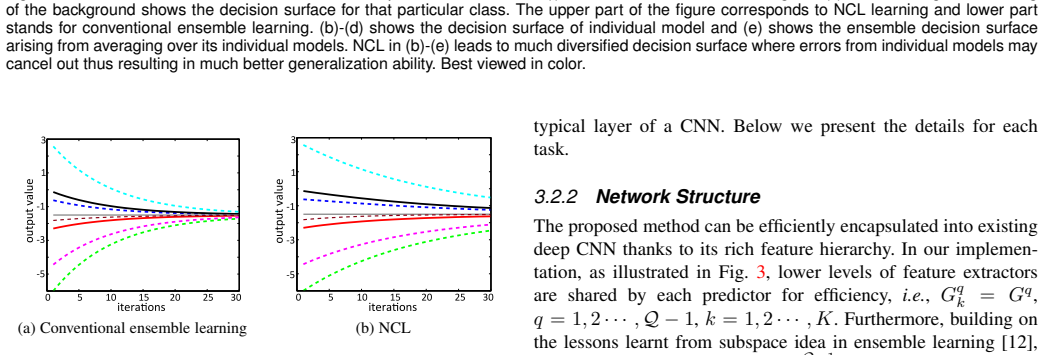
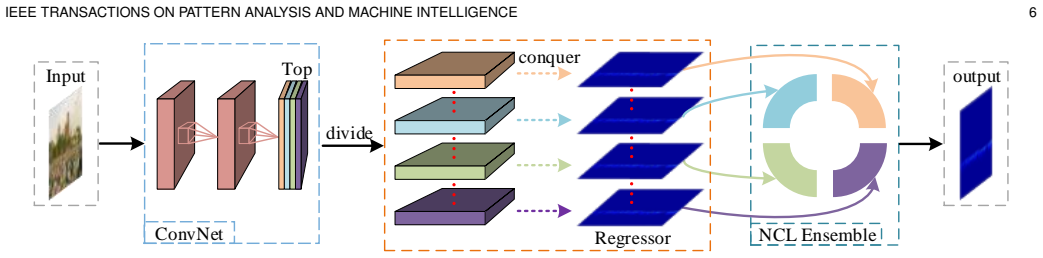
The load-bearing object is the amended loss $L_k = \frac12(G_k-Y)^2 - \lambda(G_k-\bar G)^2$ together with the bias-variance-covariance decomposition of ensemble error, $\mathbb{E}[(\bar G-Y)^2] = \frac{1}{K}\sum_k \mathbb{E}[(G_k-Y)^2] - \frac{1}{K}\sum_k \mathbb{E}[(G_k-\bar G)^2]$. The decomposition shows that penalizing each member's deviation from the ensemble average subtracts covariance from the total error, which is exactly the diversity mechanism. The implementation uses group convolution at the top layer to give each of the $K$ regressors a disjoint subset of the shared feature map, so the ensemble has no more parameters than a single network. The theoretical engine is Rademacher complexity: the paper proves Proposition 1, that the ensemble class has empirical Rademacher complexity $1/K$ times that of a conventional class, and uses it to argue that each subproblem fits random noise less easily.
What would settle it
Train the same backbone twice on one vision regression task, once with $\lambda=0$ (conventional ensemble) and once with $\lambda>0$, and also compute the empirical Rademacher complexity of the $K$-head group-convolution class on random labels; if the $\lambda>0$ ensemble does not beat the $\lambda=0$ ensemble on held-out error, or if the measured complexity ratio is not near $1/K$, the central claim fails.
Extended reading notes
Core claim
The central discovery is that negative correlation learning, previously used for shallow regression ensembles, transfers directly to deep convolutional regressors and yields a stronger ensemble without extra parameters. The authors define $K$ base regressors mounted on top of shared convolutional features, with the top feature map split into $K$ subsets by group convolution so each regressor sees a private slice. Each regressor minimizes its own squared error minus $\lambda$ times its squared deviation from the ensemble average; minimizing the deviation term drives the members to be negatively correlated on the training data, which through the bias-variance-covariance decomposition reduces the ensemble's mean squared error. The paper further claims that the empirical Rademacher complexity of the resulting ensemble class is $1/K$ that of a standard network, so each subproblem is easier to optimize, and supports the claim with experiments on four vision regression tasks.
Load-bearing premise
The theoretical guarantee rests on identifying the averaged ensemble of regressors with the single-network class inside the Rademacher complexity calculation; if that identification is not valid, the claim that each subproblem is $1/K$ as complex is unsupported, even if the trained method still works empirically.
Editorial extensions
If this is right
- Swapping the loss in an existing regression CNN is a drop-in change: the method adds no parameters, so training and inference cost stay close to that of a single network.
- The improvement should persist across regression tasks with continuous targets, since the loss is task-agnostic and the paper demonstrates it on density maps, trait scores, ages, and pixel-level residuals.
- The optimal ensemble size $K$ is bounded by the feature dimension, because each member needs a private slice of the top feature map; the paper reports degradation at very large $K$ on crowd counting.
- Combining NCL with other loss functions in the first term is possible, but the authors report it is usually weaker than using the squared-error first term, which guides how the loss should be deployed.
- Because the method only changes the loss and the top layer, it is complementary to task-specific backbones and to other regularization strategies.
Reading between the lines
- An extension the paper does not pursue: apply the same loss to other dense continuous regression tasks, such as monocular depth estimation or optical-flow prediction, where the top feature map naturally splits into $K$ groups.
- A corollary of the paper's complexity claim is that the relative gain should grow as the training set shrinks, because Rademacher-complexity control matters most when data are scarce; a controlled study that varies training-set size could test this.
- The paper does not measure the empirical Rademacher complexity of its actual trained models; computing it on random labels for the $K$-head group-convolution class would directly confirm or refute the claimed $1/K$ factor.
Signed reviews
Editorial analysis
A structured set of objections, weighed in public.
Referee Report
Summary. The paper proposes Deep Negative Correlation Learning (DNCL), a deep regression ensemble in which K regressors share the lower convolutional feature extractor and are separated only by a group-convolution layer at the top. Each regressor is trained with the amended loss L_k = 1/2(G_k - Y)^2 - lambda (G_k - \tilde G)^2 (Eq. 11), where \tilde G is the ensemble average. The authors claim that, without extra network parameters, the method controls the bias-variance-covariance trade-off, that the averaged ensemble class has empirical Rademacher complexity 1/K of a conventional network (Proposition 1), and that DNCL outperforms L2, SmoothL1, and Tukey losses as well as several task-specific state-of-the-art methods on crowd counting, personality analysis, age estimation, and image super-resolution.
Significance. If verified, DNCL is an attractive and simple mechanism for obtaining ensemble-like gains without multiplying parameters: it is end-to-end trainable, complementary to backbone architecture choices, and tested on four rather diverse regression tasks. The paper is also honest in attributing the loss to the negative correlation learning literature and in disclosing the relation to the authors' CVPR 2018 paper. The theoretical claim, once repaired, would be a concise formal statement about the complexity of the averaged ensemble class. However, the empirical core is not yet fully established: the super-resolution gains are mostly within 0.1 dB, no error bars or multiple-seed statistics are reported, no code is released, and the 'conventional ensemble' baseline used in Table 8 is not an independently trained deep ensemble. The significance for TPAMI therefore depends on the authors addressing these verification gaps.
major comments (3)
- [Sec. 3.2.3, Eq. (22)] The proof of Proposition 1 is incomplete as written and should be rewritten. The equality inside the supremum where the sum of group-convolution outputs is replaced by a single conventional convolution must be justified explicitly: each W_k^Q is nonzero only on its channel group, so the sum over k is exactly a 1x1 convolution with a concatenated weight vector; then the factor 1/K follows by homogeneity of the empirical Rademacher complexity under scaling of the function class. The proof also uses Lemma 1, whose N=1 derivation drops the absolute value that appears in Definition 1, and Lemmas 2-3 omit a clear statement of the boundedness assumptions. In addition, the abstract claims that each sub-problem has reduced Rademacher complexity, whereas Proposition 1 as stated concerns the averaged ensemble class \tilde G; the relation between the two claims should be reconciled.
- [Sec. 4.5, Table 8] The baseline called 'Conventional Ensemble' in Table 8 is the same shared-backbone architecture with lambda = 0, not an ensemble of independently trained networks. This is clear from the text in Section 3.2.2, where the authors state that setting lambda = 0 achieves conventional ensemble learning. The comparison therefore isolates the effect of the correlation penalty but does not test the claim of outperforming conventional deep ensembles, which typically cost K times more compute. The authors should either include an independently trained K-network ensemble baseline, matching total parameter/compute budget where possible, or qualify the claim to say that DNCL outperforms a shared-backbone multi-head ensemble trained independently.
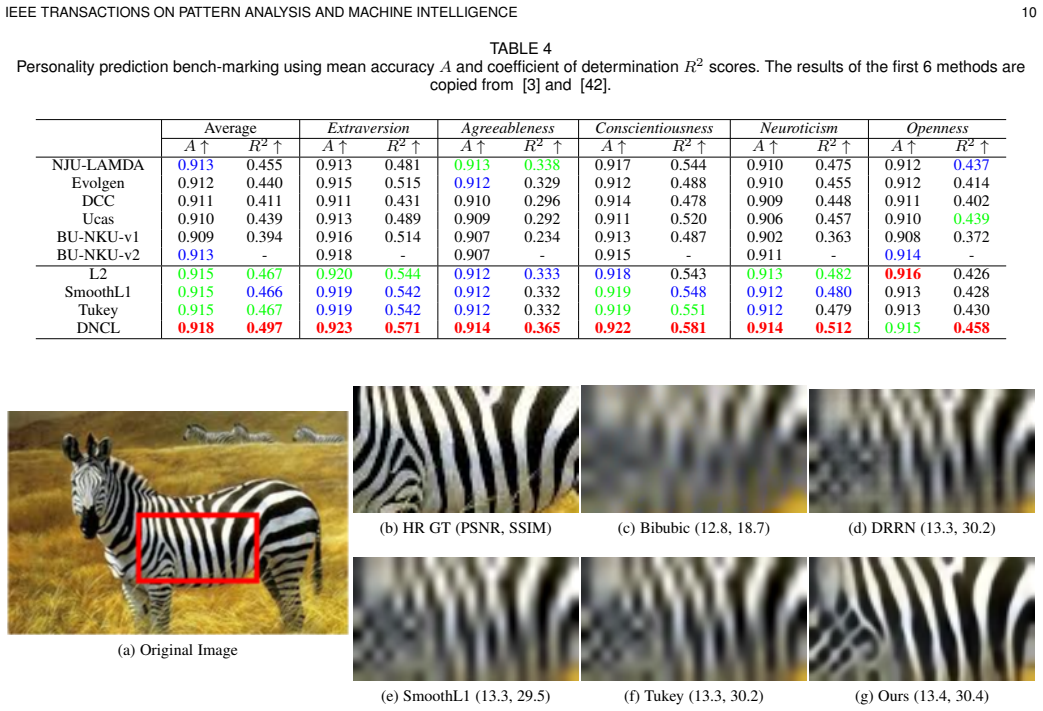
- [Sec. 4, Tables 1-7] The central empirical claim of universal superiority over L2, SmoothL1, Tukey, and task-specific baselines is not supported by significance information. No standard deviations, multiple-seed runs, or paired tests are reported; the only repeated-evaluation case, MORPH age estimation, averages five random partitions but still reports no variance. In Table 7 the DNCL gains over DRRN are at most 0.1 dB in every super-resolution row, and several entries are equal (e.g., Set5 x4: 31.7 vs 31.7; Set14 x2: 33.2 vs 33.2). Differences of this magnitude are within typical run-to-run variability in PSNR. The authors should report error bars over at least 3-5 seeds for the main comparisons, or perform paired significance tests, and ideally release code or per-run results to make the single-shot numbers reproducible.
minor comments (6)
- [Sec. 3.2.3, Definition 1] The word 'Radamacher' in Definition 1 is a typo and should read 'Rademacher'.
- [Sec. 3.2.1, Eq. (11)] In the first line of Eq. (11), the summation index j should run over j != k, not j != i, for consistency with the regressor index k.
- [Sec. 4.3] The text refers to the 'MPRPH' dataset; this should be MORPH, as in Table 6.
- [Sec. 2.2, Crowd Counting] The citation 'citewang2015deep' appears unresolved in the text and should be replaced with a proper reference.
- [Sec. 4.5, Effect of lambda and K] The authors state that lambda is set in [10^-3, 10^-2], but no ablation table or plot for lambda is reported; a sensitivity analysis for the central hyperparameter would strengthen the paper.
- [Table 7] The SSIM values in Table 7 appear to be scaled by 100, as noted in the text, but the table header simply says SSIM; the header should explicitly state the scaling factor.
Circularity Check
No circular derivation: the DNCL loss is constructed from an algebraic identity and evaluated on external benchmarks; the only self-citation is a disclosed preliminary version and is not load-bearing.
full rationale
The paper's central construction is not circular. Eqn. (10) is an algebraic identity for any K-predictor average, and the amended loss in Eqn. (11) is a per-sample objective designed to encourage negative correlation; it is not fitted to the benchmark results and no fitted constant is relabeled as a prediction. The bias-variance-covariance discussion and Eqn. (10) come from the external NCL literature [18], [19], not from the authors' own prior claims. Proposition 1's proof in Eqn. (22) contains a terse identification of the summed group-convolution class with the conventional convolution class; with unconstrained group kernel blocks and a shared backbone, the sum of K group-conv heads does span the full 1x1-conv class, so the 1/K Rademacher factor is defensible, though the boundedness assumption is omitted. This is a proof-completeness issue, not a self-referential reduction. The only self-citation is the disclosed CVPR 2018 preliminary version, which is used for provenance rather than as evidence for the theoretical or empirical claims. The 'Conventional Ensemble' baseline being a shared-backbone multi-head network with lambda=0 is a comparison-protocol concern, and the absence of code or error bars is a reproducibility concern; neither makes the derivation circular. Overall, no step in the paper reduces by construction to its own inputs.
Assumptions & free parameters
free parameters (2)
- lambda (correlation penalty) =
not fixed; recommended range 1e-3 to 1e-2
- K (ensemble size) =
64 for crowd counting, 8 for personality, 16 for super-resolution, 5 for age estimation
assumptions (5)
- standard math Bias-variance-covariance decomposition of ensemble error (Eqns. 6-10)
- standard math Lipschitz contraction property of Rademacher complexity (Lemma 1)
- domain assumption Boundedness assumption sup |G(x)-y| <= M (Lemmas 2 and 3)
- ad hoc to paper The ensemble class and the conventional class coincide under the supremum in Proposition 1 (Eqn. 22)
- domain assumption Group convolution partitions features into K subsets without losing information needed for the task
Cite this review
Pith. "Pith review of Robust Regression via Deep Negative Correlation Learning." pith.science (2026). https://pith.science/paper/6ULIGCCF
@misc{pith2026190809066,
  author       = {Pith},
  title        = {Pith review of: Robust Regression via Deep Negative Correlation Learning},
  year         = {2026},
  howpublished = {\url{https://pith.science/paper/6ULIGCCF}},
  note         = {Machine review of arXiv:1908.09066}
}
read the original abstract
Nonlinear regression has been extensively employed in many computer vision problems (e.g., crowd counting, age estimation, affective computing). Under the umbrella of deep learning, two common solutions exist i) transforming nonlinear regression to a robust loss function which is jointly optimizable with the deep convolutional network, and ii) utilizing ensemble of deep networks. Although some improved performance is achieved, the former may be lacking due to the intrinsic limitation of choosing a single hypothesis and the latter usually suffers from much larger computational complexity. To cope with those issues, we propose to regress via an efficient "divide and conquer" manner. The core of our approach is the generalization of negative correlation learning that has been shown, both theoretically and empirically, to work well for non-deep regression problems. Without extra parameters, the proposed method controls the bias-variance-covariance trade-off systematically and usually yields a deep regression ensemble where each base model is both "accurate" and "diversified". Moreover, we show that each sub-problem in the proposed method has less Rademacher Complexity and thus is easier to optimize. Extensive experiments on several diverse and challenging tasks including crowd counting, personality analysis, age estimation, and image super-resolution demonstrate the superiority over challenging baselines as well as the versatility of the proposed method.
Figures

Figures from the paper (3 more)


Reference graph
Works this paper leans on
-
[1]
Crowd counting with deep negative correlation learning,
Z. Shi, L. Zhang, Y . Liu, X. Cao, Y . Ye, M.-M. Cheng, and G. Zheng, “Crowd counting with deep negative correlation learning,” in IEEE Conf. Comput. Vis. Pattern Recog., 2018, pp. 5382–5390
2018
-
[2]
Deep age distribution learning for apparent age estimation,
Z. Huo, X. Yang, C. Xing, Y . Zhou, P. Hou, J. Lv, and X. Geng, “Deep age distribution learning for apparent age estimation,” in IEEE Conf. Comput. Vis. Pattern Recog. Worksh., 2016, pp. 17–24
2016
-
[3]
Chalearn LAP 2016: First round challenge on first impressions – dataset and results,
V . Ponce-L ´opez, B. Chen, M. Oliu, C. Corneanu, A. Clap ´es, I. Guyon, X. Bar ´o, H. J. Escalante, and S. Escalera, “Chalearn LAP 2016: First round challenge on first impressions – dataset and results,” inEur. Conf. Comput. Vis., 2016
2016
-
[4]
Image super-resolution via deep recursive residual network,
Y . Tai, J. Yang, and X. Liu, “Image super-resolution via deep recursive residual network,” in IEEE Conf. Comput. Vis. Pattern Recog. , vol. 1, no. 4, 2017
2017
-
[5]
Robust visual tracking using oblique random forests,
L. Zhang, J. Varadarajan, P. N. Suganthan, N. Ahuja, and P. Moulin, “Robust visual tracking using oblique random forests,” in IEEE Conf. Comput. Vis. Pattern Recog., 2017
2017
-
[6]
Fast R-CNN,
R. Girshick, “Fast R-CNN,” in Int. Conf. Comput. Vis., 2015, pp. 1440– 1448
2015
-
[7]
Robust estimation of a location parameter,
P. J. Huber et al. , “Robust estimation of a location parameter,” The annals of mathematical statistics, vol. 35, no. 1, pp. 73–101, 1964
1964
-
[8]
Robust optimization for deep regression,
V . Belagiannis, C. Rupprecht, G. Carneiro, and N. Navab, “Robust optimization for deep regression,” in IEEE Conf. Comput. Vis. Pattern Recog., 2015, pp. 2830–2838
2015
Show all 125 references
-
[9]
Robust statistics,
P. J. Huber, “Robust statistics,” in International Encyclopedia of Statis- tical Science. Springer, 2011, pp. 1248–1251. IEEE TRANSACTIONS ON PATTERN ANAL YSIS AND MACHINE INTELLIGENCE 14
2011
-
[10]
On the unification of line processes, outlier rejection, and robust statistics with applications in early vision,
M. J. Black and A. Rangarajan, “On the unification of line processes, outlier rejection, and robust statistics with applications in early vision,” Int. J. Comput. Vis., vol. 19, no. 1, pp. 57–91, 1996
1996
-
[11]
Ensemble methods in machine learning,
T. G. Dietterich et al. , “Ensemble methods in machine learning,” Multiple Classifier Systems, vol. 1857, pp. 1–15, 2000
2000
-
[12]
Random forests,
L. Breiman, “Random forests,” Machine Learning, vol. 45, no. 1, pp. 5–32, 2001
2001
-
[13]
Ensemble classification and regression-recent developments, applications and future directions,
Y . Ren, L. Zhang, and P. N. Suganthan, “Ensemble classification and regression-recent developments, applications and future directions,” IEEE Comput. Intell. Mag., vol. 11, no. 1, pp. 41–53, 2016
2016
-
[14]
Oblique random forest ensemble via least square estimation for time series forecasting,
X. Qiu, L. Zhang, P. N. Suganthan, and G. A. Amaratunga, “Oblique random forest ensemble via least square estimation for time series forecasting,” Information Sciences, vol. 420, pp. 249–262, 2017
2017
-
[15]
Learning to count with cnn boosting,
E. Walach and L. Wolf, “Learning to count with cnn boosting,” in Eur. Conf. Comput. Vis. Springer, 2016, pp. 660–676
2016
-
[16]
Incremental boosting convolutional neural network for facial action unit recognition,
S. Han, Z. Meng, A.-S. Khan, and Y . Tong, “Incremental boosting convolutional neural network for facial action unit recognition,” inConf. Neural Inf. Process. Syst., 2016, pp. 109–117
2016
-
[17]
Deep boosting,
C. Cortes, M. Mohri, and U. Syed, “Deep boosting,” in Int. Conf. Mach. Learn., 2014, pp. 1179–1187
2014
-
[18]
Evolutionary ensembles with negative correlation learning,
Y . Liu, X. Yao, and T. Higuchi, “Evolutionary ensembles with negative correlation learning,” IEEE Trans. Evol. Comput. , vol. 4, no. 4, pp. 380–387, 2000
2000
-
[19]
Managing diversity in regression ensembles,
G. Brown, J. L. Wyatt, and P. Ti ˇno, “Managing diversity in regression ensembles,” JMLR, vol. 6, no. Sep, pp. 1621–1650, 2005
2005
-
[20]
Faster r-cnn: Towards real-time object detection with region proposal networks,
S. Ren, K. He, R. Girshick, and J. Sun, “Faster r-cnn: Towards real-time object detection with region proposal networks,” in Conf. Neural Inf. Process. Syst., 2015, pp. 91–99
2015
-
[21]
Deep convolutional network cascade for facial point detection,
Y . Sun, X. Wang, and X. Tang, “Deep convolutional network cascade for facial point detection,” in IEEE Conf. Comput. Vis. Pattern Recog., 2013, pp. 3476–3483
2013
-
[22]
Deeppose: Human pose estimation via deep neural networks,
A. Toshev and C. Szegedy, “Deeppose: Human pose estimation via deep neural networks,” in IEEE Conf. Comput. Vis. Pattern Recog., 2014, pp. 1653–1660
2014
-
[23]
Facial landmark detection by deep multi-task learning,
Z. Zhang, P. Luo, C. C. Loy, and X. Tang, “Facial landmark detection by deep multi-task learning,” in Eur. Conf. Comput. Vis. Springer, 2014, pp. 94–108
2014
-
[24]
Deep joint task learning for generic object extraction,
X. Wang, L. Zhang, L. Lin, Z. Liang, and W. Zuo, “Deep joint task learning for generic object extraction,” in Conf. Neural Inf. Process. Syst., 2014, pp. 523–531
2014
-
[25]
The random subspace method for constructing decision forests,
I. Barandiaran, “The random subspace method for constructing decision forests,” IEEE Trans. Pattern Anal. Mach. Intell., vol. 20, no. 8, 1998
1998
-
[26]
Greedy function approximation: a gradient boosting machine,
J. H. Friedman, “Greedy function approximation: a gradient boosting machine,” Annals of statistics, pp. 1189–1232, 2001
2001
-
[27]
Deep regression forests for age estimation,
W. Shen, Y . Guo, Y . Wang, K. Zhao, B. Wang, and A. L. Yuille, “Deep regression forests for age estimation,” in IEEE Conf. Comput. Vis. Pattern Recog., June 2018
2018
-
[28]
Cross-scene crowd counting via deep convolutional neural networks,
C. Zhang, H. Li, X. Wang, and X. Yang, “Cross-scene crowd counting via deep convolutional neural networks,” in IEEE Conf. Comput. Vis. Pattern Recog., 2015, pp. 833–841
2015
-
[29]
Imagenet classification with deep convolutional neural networks,
A. Krizhevsky, I. Sutskever, and G. E. Hinton, “Imagenet classification with deep convolutional neural networks,” in Conf. Neural Inf. Process. Syst., 2012, pp. 1097–1105
2012
-
[30]
Crowdnet: a deep convolutional network for dense crowd counting,
L. Boominathan, S. S. Kruthiventi, and R. V . Babu, “Crowdnet: a deep convolutional network for dense crowd counting,” in ACM Int. Conf. Multimedia. ACM, 2016, pp. 640–644
2016
-
[31]
Multiscale multitask deep netvlad for crowd counting,
Z. Shi, L. Zhang, Y . Sun, and Y . Ye, “Multiscale multitask deep netvlad for crowd counting,” IEEE Trans Ind. Informat. , vol. 14, no. 11, pp. 4953–4962, 2018
2018
-
[32]
Single-image crowd counting via multi-column convolutional neural network,
Y . Zhang, D. Zhou, S. Chen, S. Gao, and Y . Ma, “Single-image crowd counting via multi-column convolutional neural network,” in IEEE Conf. Comput. Vis. Pattern Recog., 2016, pp. 589–597
2016
-
[33]
Towards perspective-free ob- ject counting with deep learning,
D. Onoro-Rubio and R. J. L ´opez-Sastre, “Towards perspective-free ob- ject counting with deep learning,” in Eur. Conf. Comput. Vis. Springer, 2016, pp. 615–629
2016
-
[34]
Switching convolutional neural network for crowd counting,
D. B. Sam, S. Surya, and R. V . Babu, “Switching convolutional neural network for crowd counting,” in IEEE Conf. Comput. Vis. Pattern Recog., vol. 1, no. 3, 2017, p. 6
2017
-
[35]
Counting in the wild,
C. Arteta, V . Lempitsky, and A. Zisserman, “Counting in the wild,” in ECCV. Springer, 2016, pp. 483–498
2016
-
[36]
Representation learning by learning to count,
M. Noroozi, H. Pirsiavash, and P. Favaro, “Representation learning by learning to count,” in ICCV, 2017, pp. 5898–5906
2017
-
[37]
Connecting meeting behavior with extraversion a systematic study,
B. Lepri, R. Subramanian, K. Kalimeri, J. Staiano, F. Pianesi, and N. Sebe, “Connecting meeting behavior with extraversion a systematic study,”IEEE Trans Aff. Comput., vol. 3, no. 4, pp. 443–455, 2012
2012
-
[38]
Facetube: pre- dicting personality from facial expressions of emotion in online con- versational video,
J.-I. Biel, L. Teijeiro-Mosquera, and D. Gatica-Perez, “Facetube: pre- dicting personality from facial expressions of emotion in online con- versational video,” in ACM Int. Conf. Multimodal Interaction . ACM, 2012, pp. 53–56
2012
-
[39]
Inferring mood in ubiquitous conversational video,
D. Sanchez-Cortes, J.-I. Biel, S. Kumano, J. Yamato, K. Otsuka, and D. Gatica-Perez, “Inferring mood in ubiquitous conversational video,” in International Conference on Mobile and Ubiquitous Multimedia . ACM, 2013, p. 22
2013
-
[40]
Inference of personality traits and affect schedule by analysis of spontaneous reactions to affective videos,
M. K. Abadi, J. A. M. Correa, J. Wache, H. Yang, I. Patras, and N. Sebe, “Inference of personality traits and affect schedule by analysis of spontaneous reactions to affective videos,” in IEEE Conf. Autom. Face. Gest. Recog., vol. 1. IEEE, 2015, pp. 1–8
2015
-
[41]
Please, tell me about yourself: automatic personality assessment using short self-presentations,
L. M. Batrinca, N. Mana, B. Lepri, F. Pianesi, and N. Sebe, “Please, tell me about yourself: automatic personality assessment using short self-presentations,” in ACM Int. Conf. Multimodal Interaction . ACM, 2011, pp. 255–262
2011
-
[42]
Deep bimodal regression for apparent personality analysis,
C.-L. Zhang, H. Zhang, X.-S. Wei, and J. Wu, “Deep bimodal regression for apparent personality analysis,” inEur. Conf. Comput. Vis. Springer, 2016, pp. 311–324
2016
-
[43]
Deep impression: Audiovisual deep residual networks for multimodal appar- ent personality trait recognition,
Y . G ¨uc ¸l¨ut¨urk, U. G ¨uc ¸l¨u, M. A. van Gerven, and R. van Lier, “Deep impression: Audiovisual deep residual networks for multimodal appar- ent personality trait recognition,” in Eur. Conf. Comput. Vis. Springer, 2016, pp. 349–358
2016
-
[44]
Bi-modal first impressions recognition using temporally ordered deep audio and stochastic visual features,
A. Subramaniam, V . Patel, A. Mishra, P. Balasubramanian, and A. Mit- tal, “Bi-modal first impressions recognition using temporally ordered deep audio and stochastic visual features,” in Eur. Conf. Comput. Vis. Springer, 2016, pp. 337–348
2016
-
[45]
Combining deep facial and ambient features for first impression estimation,
F. G ¨urpınar, H. Kaya, and A. A. Salah, “Combining deep facial and ambient features for first impression estimation,” in Eur. Conf. Comput. Vis. Springer, 2016, pp. 372–385
2016
-
[46]
First impressions: A survey on computer vision-based apparent personality trait analysis,
J. Junior, C. Jacques, Y . G ¨uc ¸l¨ut¨urk, M. P ´erez, U. G ¨uc ¸l¨u, C. Andujar, X. Bar ´o, H. J. Escalante, I. Guyon, M. A. van Gerven et al. , “First impressions: A survey on computer vision-based apparent personality trait analysis,” arXiv preprint arXiv:1804.08046, 2018
2018 arXiv
-
[47]
Explain- ing first impressions: Modeling, recognizing, and explaining apparent personality from videos,
H. J. Escalante, H. Kaya, A. A. Salah, S. Escalera, Y . Gucluturk, U. Guclu, X. Baro, I. Guyon, J. J. Junior, M. Madadi et al., “Explain- ing first impressions: Modeling, recognizing, and explaining apparent personality from videos,” arXiv preprint arXiv:1802.00745, 2018
2018 arXiv
-
[48]
Automatic age estimation based on facial aging patterns,
X. Geng, Z.-H. Zhou, and K. Smith-Miles, “Automatic age estimation based on facial aging patterns,”IEEE Trans. Pattern Anal. Mach. Intell., vol. 29, no. 12, pp. 2234–2240, 2007
2007
-
[49]
Human age estimation using bio-inspired features,
G. Guo, G. Mu, Y . Fu, and T. S. Huang, “Human age estimation using bio-inspired features,” in IEEE Conf. Comput. Vis. Pattern Recog. IEEE, 2009, pp. 112–119
2009
-
[50]
Simultaneous dimensionality reduction and human age estimation via kernel partial least squares regression,
G. Guo and G. Mu, “Simultaneous dimensionality reduction and human age estimation via kernel partial least squares regression,” inIEEE Conf. Comput. Vis. Pattern Recog. IEEE, 2011, pp. 657–664
2011
-
[51]
Demographic estimation from face images: Human vs. machine performance,
H. Han, C. Otto, X. Liu, and A. K. Jain, “Demographic estimation from face images: Human vs. machine performance,” IEEE Trans. Pattern Anal. Mach. Intell., no. 6, pp. 1148–1161, 2015
2015
-
[52]
Age regression from faces using random forests,
A. Montillo and H. Ling, “Age regression from faces using random forests,” in IEEE Int. Conf. Image Process. IEEE, 2009, pp. 2465– 2468
2009
-
[53]
Facial age estimation by learning from label distributions,
X. Geng, C. Yin, and Z.-H. Zhou, “Facial age estimation by learning from label distributions,” IEEE Trans. Pattern Anal. Mach. Intell. , vol. 35, no. 10, pp. 2401–2412, 2013
2013
-
[54]
Age estimation by multi-scale convolutional network,
D. Yi, Z. Lei, and S. Z. Li, “Age estimation by multi-scale convolutional network,” in Asian Conf. Comput. Vis. Springer, 2014, pp. 144–158
2014
-
[55]
Ordinal regression with multiple output cnn for age estimation,
Z. Niu, M. Zhou, L. Wang, X. Gao, and G. Hua, “Ordinal regression with multiple output cnn for age estimation,” in IEEE Conf. Comput. Vis. Pattern Recog., 2016, pp. 4920–4928
2016
-
[56]
Using ranking-cnn for age estimation,
S. Chen, C. Zhang, M. Dong, J. Le, and M. Rao, “Using ranking-cnn for age estimation,” in IEEE Conf. Comput. Vis. Pattern Recog., 2017
2017
-
[57]
Anchored regression networks applied to age estimation and super resolution,
E. Agustsson, R. Timofte, and L. Van Gool, “Anchored regression networks applied to age estimation and super resolution,” in Int. Conf. Comput. Vis. IEEE, 2017, pp. 1652–1661
2017
-
[58]
Deep cost- sensitive and order-preserving feature learning for cross-population age estimation,
K. Li, J. Xing, C. Su, W. Hu, Y . Zhang, and S. Maybank, “Deep cost- sensitive and order-preserving feature learning for cross-population age estimation,” in Int. Conf. Comput. Vis., 2018
2018
-
[59]
Deep expectation of real and apparent age from a single image without facial landmarks,
R. Rothe, R. Timofte, and L. Van Gool, “Deep expectation of real and apparent age from a single image without facial landmarks,” Int. J. Comput. Vis., vol. 126, no. 2-4, pp. 144–157, 2018
2018
-
[60]
Image super-resolution using deep convolutional networks,
C. Dong, C. C. Loy, K. He, and X. Tang, “Image super-resolution using deep convolutional networks,” IEEE Trans. Pattern Anal. Mach. Intell., vol. 38, no. 2, pp. 295–307, 2016
2016
-
[61]
Deep people counting in extremely dense crowds,
C. Wang, H. Zhang, L. Yang, S. Liu, and X. Cao, “Deep people counting in extremely dense crowds,” in ACM Int. Conf. Multimedia . ACM, 2015, pp. 1299–1302. IEEE TRANSACTIONS ON PATTERN ANAL YSIS AND MACHINE INTELLIGENCE 15
2015
-
[62]
Real-time single image and video super- resolution using an efficient sub-pixel convolutional neural network,
W. Shi, J. Caballero, F. Husz ´ar, J. Totz, A. P. Aitken, R. Bishop, D. Rueckert, and Z. Wang, “Real-time single image and video super- resolution using an efficient sub-pixel convolutional neural network,” in IEEE Conf. Comput. Vis. Pattern Recog., 2016, pp. 1874–1883
2016
-
[63]
Collaborative representation cascade for single-image super- resolution,
Y . Zhang, Y . Zhang, J. Zhang, D. Xu, Y . Fu, Y . Wang, X. Ji, and Q. Dai, “Collaborative representation cascade for single-image super- resolution,” IEEE Trans. Syst. Man Cy.-S., no. 99, pp. 1–16, 2017
2017
-
[64]
Residual dense network for image super-resolution,
Y . Zhang, Y . Tian, Y . Kong, B. Zhong, and Y . Fu, “Residual dense network for image super-resolution,” in IEEE Conf. Comput. Vis. Pattern Recog., 2018, pp. 2472–2481
2018
-
[65]
Deeply-recursive convolutional network for image super-resolution,
J. Kim, J. Kwon Lee, and K. Mu Lee, “Deeply-recursive convolutional network for image super-resolution,” in IEEE Conf. Comput. Vis. Pattern Recog., 2016, pp. 1637–1645
2016
-
[66]
Image restoration using very deep convolutional encoder-decoder networks with symmetric skip connec- tions,
X. Mao, C. Shen, and Y .-B. Yang, “Image restoration using very deep convolutional encoder-decoder networks with symmetric skip connec- tions,” in Conf. Neural Inf. Process. Syst., 2016, pp. 2802–2810
2016
-
[67]
Image super-resolution via dual-state recurrent networks,
W. Han, S. Chang, D. Liu, M. Yu, M. Witbrock, and T. S. Huang, “Image super-resolution via dual-state recurrent networks,” in IEEE Conf. Comput. Vis. Pattern Recog., 2018
2018
-
[68]
Deep backprojection networks for super-resolution,
M. Haris, G. Shakhnarovich, and N. Ukita, “Deep backprojection networks for super-resolution,” in IEEE Conf. Comput. Vis. Pattern Recog., 2018
2018
-
[69]
Image super- resolution using very deep residual channel attention networks,
Y . Zhang, K. Li, K. Li, L. Wang, B. Zhong, and Y . Fu, “Image super- resolution using very deep residual channel attention networks,” in ECCV, 2018, pp. 286–301
2018
-
[70]
Residual non-local attention networks for image restoration,
Y . Zhang, K. Li, K. Li, B. Zhong, and Y . Fu, “Residual non-local attention networks for image restoration,” in ICLR, 2019
2019
-
[71]
Ntire 2017 challenge on single image super-resolution: Methods and results,
R. Timofte, E. Agustsson, L. Van Gool, M.-H. Yang, and L. Zhang, “Ntire 2017 challenge on single image super-resolution: Methods and results,” inIEEE Conf. Comput. Vis. Pattern Recog., 2017, pp. 114–125
2017
-
[72]
Do we need hundreds of classifiers to solve real world classification problems,
M. Fern ´andez-Delgado, E. Cernadas, S. Barro, and D. Amorim, “Do we need hundreds of classifiers to solve real world classification problems,” JMLR, vol. 15, no. 1, pp. 3133–3181, 2014
2014
-
[73]
Benchmarking ensemble classifiers with novel co-trained kernal ridge regression and random vector functional link ensembles [research frontier],
L. Zhang and P. N. Suganthan, “Benchmarking ensemble classifiers with novel co-trained kernal ridge regression and random vector functional link ensembles [research frontier],” IEEE Comput. Intell. Mag., vol. 12, no. 4, pp. 61–72, 2017
2017
-
[74]
Bagging predictors,
L. Breiman, “Bagging predictors,” Machine learning, vol. 24, no. 2, pp. 123–140, 1996
1996
-
[75]
Multi-scale context aggregation by dilated convolutions,
F. Yu and V . Koltun, “Multi-scale context aggregation by dilated convolutions,”arXiv preprint arXiv:1511.07122, 2015
2015 arXiv
-
[76]
Sphereface: Deep hypersphere embedding for face recognition,
W. Liu, Y . Wen, Z. Yu, M. Li, B. Raj, and L. Song, “Sphereface: Deep hypersphere embedding for face recognition,” in IEEE Conf. Comput. Vis. Pattern Recog., vol. 1, 2017, p. 1
2017
-
[77]
Joint face detection and alignment using multitask cascaded convolutional networks,
K. Zhang, Z. Zhang, Z. Li, and Y . Qiao, “Joint face detection and alignment using multitask cascaded convolutional networks,” IEEE Signal Processing Letters, vol. 23, no. 10, pp. 1499–1503, 2016
2016
-
[78]
Temporal segment networks: Towards good practices for deep action recognition,
L. Wang, Y . Xiong, Z. Wang, Y . Qiao, D. Lin, X. Tang, and L. Van Gool, “Temporal segment networks: Towards good practices for deep action recognition,” in Eur. Conf. Comput. Vis. Springer, 2016, pp. 20–36
2016
-
[79]
Diversity creation methods: a survey and categorisation,
G. Brown, J. Wyatt, R. Harris, and X. Yao, “Diversity creation methods: a survey and categorisation,”Information Fusion, vol. 6, no. 1, pp. 5–20, 2005
2005
-
[80]
The impact of diversity on online ensemble learning in the presence of concept drift,
L. L. Minku, A. P. White, and X. Yao, “The impact of diversity on online ensemble learning in the presence of concept drift,”IEEE TKDE, vol. 22, no. 5, pp. 730–742, 2009
2009
-
[81]
Stochastic multiple choice learning for training diverse deep ensembles,
S. Lee, S. P. S. Prakash, M. Cogswell, V . Ranjan, D. Crandall, and D. Batra, “Stochastic multiple choice learning for training diverse deep ensembles,” in NeurIPS, 2016, pp. 2119–2127
2016
-
[82]
Fast decorrelated neural network ensembles with random weights,
M. Alhamdoosh and D. Wang, “Fast decorrelated neural network ensembles with random weights,” Information Sciences , vol. 264, pp. 104–117, 2014
2014
-
[83]
Ensembling neural networks: many could be better than all,
Z.-H. Zhou, J. Wu, and W. Tang, “Ensembling neural networks: many could be better than all,” Artificial Intelligence, vol. 137, no. 1-2, pp. 239–263, 2002
2002
-
[84]
Neural network ensembles,
L. K. Hansen and P. Salamon, “Neural network ensembles,” IEEE TPAMI, no. 10, pp. 993–1001, 1990
1990
-
[85]
Rademacher and gaussian complex- ities: Risk bounds and structural results,
P. L. Bartlett and S. Mendelson, “Rademacher and gaussian complex- ities: Risk bounds and structural results,” JMLR, vol. 3, no. Nov, pp. 463–482, 2002
2002
-
[86]
Empirical margin distributions and bounding the generalization error of combined classifiers,
V . Koltchinskii, D. Panchenko et al. , “Empirical margin distributions and bounding the generalization error of combined classifiers,” The Annals of Statistics, vol. 30, no. 1, pp. 1–50, 2002
2002
-
[87]
Caffe: Convolutional architecture for fast feature embedding,
Y . Jia, E. Shelhamer, J. Donahue, S. Karayev, J. Long, R. Girshick, S. Guadarrama, and T. Darrell, “Caffe: Convolutional architecture for fast feature embedding,” CoRR, vol. abs/1408.5093, 2014
2014 arXiv
-
[88]
Multi-source multi-scale counting in extremely dense crowd images,
H. Idrees, I. Saleemi, C. Seibert, and M. Shah, “Multi-source multi-scale counting in extremely dense crowd images,” inIEEE Conf. Comput. Vis. Pattern Recog., 2013, pp. 2547–2554
2013
-
[89]
Stct: Sequentially training convolutional networks for visual tracking,
L. Wang, W. Ouyang, X. Wang, and H. Lu, “Stct: Sequentially training convolutional networks for visual tracking,” inIEEE Conf. Comput. Vis. Pattern Recog., 2016, pp. 1373–1381
2016
-
[90]
Density-aware person detection and tracking in crowds,
M. Rodriguez, I. Laptev, J. Sivic, and J.-Y . Audibert, “Density-aware person detection and tracking in crowds,” in IEEE Conf. Comput. Vis. Pattern Recog. IEEE, 2011, pp. 2423–2430
2011
-
[91]
Learning to count objects in images,
V . Lempitsky and A. Zisserman, “Learning to count objects in images,” in Conf. Neural Inf. Process. Syst., 2010, pp. 1324–1332
2010
-
[92]
Multi-scale convolutional neural networks for crowd counting,
L. Zeng, X. Xu, B. Cai, S. Qiu, and T. Zhang, “Multi-scale convolutional neural networks for crowd counting,” arXiv preprint arXiv:1702.02359, 2017
2017 arXiv
-
[93]
Fully con- volutional crowd counting on highly congested scenes,
M. Marsden, K. McGuiness, S. Little, and N. E. O’Connor, “Fully con- volutional crowd counting on highly congested scenes,” arXiv preprint arXiv:1612.00220, 2016
2016 arXiv
-
[94]
Decidenet: counting varying density crowds through attention guided detection and density estimation,
J. Liu, C. Gao, D. Meng, and A. G. Hauptmann, “Decidenet: counting varying density crowds through attention guided detection and density estimation,” in IEEE Conf. Comput. Vis. Pattern Recog. , 2018, pp. 5197–5206
2018
-
[95]
Morph: A longitudinal image database of normal adult age-progression,
K. Ricanek and T. Tesafaye, “Morph: A longitudinal image database of normal adult age-progression,” in IEEE Conf. Autom. Face. Gest. Recog. IEEE, 2006, pp. 341–345
2006
-
[96]
Overview of research on facial ageing using the fg-net ageing database,
G. Panis, A. Lanitis, N. Tsapatsoulis, and T. F. Cootes, “Overview of research on facial ageing using the fg-net ageing database,” IET Biometrics, vol. 5, no. 2, pp. 37–46, 2016
2016
-
[97]
Multi-task warped gaussian process for personalized age estimation,
Y . Zhang and D.-Y . Yeung, “Multi-task warped gaussian process for personalized age estimation,” in IEEE Conf. Comput. Vis. Pattern Recog. IEEE, 2010, pp. 2622–2629
2010
-
[98]
Cumulative attribute space for age and crowd density estimation,
K. Chen, S. Gong, T. Xiang, and C. Change Loy, “Cumulative attribute space for age and crowd density estimation,” in IEEE Conf. Comput. Vis. Pattern Recog., 2013, pp. 2467–2474
2013
-
[99]
Image-based human age estimation by manifold learning and locally adjusted robust regression,
G. Guo, Y . Fu, C. R. Dyer, and T. S. Huang, “Image-based human age estimation by manifold learning and locally adjusted robust regression,” IEEE Trans. Image Process., vol. 17, no. 7, pp. 1178–1188, 2008
2008
-
[100]
Ordinal hyperplanes ranker with cost sensitivities for age estimation,
K.-Y . Chang, C.-S. Chen, and Y .-P. Hung, “Ordinal hyperplanes ranker with cost sensitivities for age estimation,” in IEEE Conf. Comput. Vis. Pattern Recog. IEEE, 2011, pp. 585–592
2011
-
[101]
Deeply-learned feature for age estimation,
X. Wang, R. Guo, and C. Kambhamettu, “Deeply-learned feature for age estimation,” in IEEE Winter Conference on Computer Vision . IEEE, 2015, pp. 534–541
2015
-
[102]
A ranking approach for human ages estimation based on face images,
K.-Y . Chang, C.-S. Chen, and Y .-P. Hung, “A ranking approach for human ages estimation based on face images,” in Int. Conf. Pattern Recog., 2010, pp. 3396–3399
2010
-
[103]
Con- tourlet appearance model for facial age estimation,
K. Luu, K. Seshadri, M. Savvides, T. D. Bui, and C. Y . Suen, “Con- tourlet appearance model for facial age estimation,” in International Joint Conference on Biometrics. IEEE, 2011
2011
-
[104]
Some like it hot-visual guidance for preference prediction,
R. Rothe, R. Timofte, and L. Van Gool, “Some like it hot-visual guidance for preference prediction,” inIEEE Conf. Comput. Vis. Pattern Recog., 2016, pp. 5553–5561
2016
-
[105]
Label distribution learning forests,
W. Shen, K. Zhao, Y . Guo, and A. L. Yuille, “Label distribution learning forests,” in Conf. Neural Inf. Process. Syst., 2017, pp. 834–843
2017
-
[106]
Single image super-resolution from transformed self-exemplars,
J.-B. Huang, A. Singh, and N. Ahuja, “Single image super-resolution from transformed self-exemplars,” in IEEE Conf. Comput. Vis. Pattern Recog., 2015, pp. 5197–5206
2015
-
[107]
Fast and accurate image upscaling with super-resolution forests,
S. Schulter, C. Leistner, and H. Bischof, “Fast and accurate image upscaling with super-resolution forests,” in IEEE Conf. Comput. Vis. Pattern Recog., 2015, pp. 3791–3799
2015
-
[108]
Accurate image super-resolution using very deep convolutional networks,
J. Kim, J. Kwon Lee, and K. Mu Lee, “Accurate image super-resolution using very deep convolutional networks,” in IEEE Conf. Comput. Vis. Pattern Recog., 2016, pp. 1646–1654
2016
-
[109]
Rapid object detection using a boosted cascade of simple features,
P. Viola and M. Jones, “Rapid object detection using a boosted cascade of simple features,” in IEEE Conf. Comput. Vis. Pattern Recog., vol. 1. IEEE, 2001, pp. I–I
2001
-
[110]
Active appearance models,
T. F. Cootes, G. J. Edwards, and C. J. Taylor, “Active appearance models,” IEEE Trans. Pattern Anal. Mach. Intell. , no. 6, pp. 681–685, 2001
2001
-
[111]
Image super-resolution via sparse representation,
J. Yang, J. Wright, T. S. Huang, and Y . Ma, “Image super-resolution via sparse representation,” IEEE Trans. Image Process., vol. 19, no. 11, pp. 2861–2873, 2010
2010
-
[112]
A database of human segmented natural images and its application to evaluating segmentation algorithms and measuring ecological statistics,
D. Martin, C. Fowlkes, D. Tal, and J. Malik, “A database of human segmented natural images and its application to evaluating segmentation algorithms and measuring ecological statistics,” in Int. Conf. Comput. Vis., vol. 2. IEEE, 2001, pp. 416–423. IEEE TRANSACTIONS ON PATTERN ...
2001
-
[113]
Low-complexity single-image super-resolution based on nonnegative neighbor embedding,
M. Bevilacqua, A. Roumy, C. Guillemot, and M. L. Alberi-Morel, “Low-complexity single-image super-resolution based on nonnegative neighbor embedding,” in Brit. Mach. Vis. Conf. BMV A press, 2012
2012
-
[114]
On single image scale-up using sparse-representations,
R. Zeyde, M. Elad, and M. Protter, “On single image scale-up using sparse-representations,” in International Conference on Curves and Surface. Springer, 2010, pp. 711–730
2010
-
[115]
Image quality assessment: from error visibility to structural similarity,
Z. Wang, A. C. Bovik, H. R. Sheikh, and E. P. Simoncelli, “Image quality assessment: from error visibility to structural similarity,” IEEE Trans. Image Process., vol. 13, no. 4, pp. 600–612, 2004
2004
-
[116]
An information fidelity criterion for image quality assessment using natural scene statistics,
H. R. Sheikh, A. C. Bovik, and G. De Veciana, “An information fidelity criterion for image quality assessment using natural scene statistics,” IEEE Trans. Image Process., vol. 14, no. 12, pp. 2117–2128, 2005
2005
-
[117]
An analysis of diversity measures,
E. K. Tang, P. N. Suganthan, and X. Yao, “An analysis of diversity measures,” Machine learning, vol. 65, no. 1, pp. 247–271, 2006
2006
-
[118]
Rotation forest: A new classifier ensemble method,
J. J. Rodriguez, L. I. Kuncheva, and C. J. Alonso, “Rotation forest: A new classifier ensemble method,” IEEE Trans. Pattern Anal. Mach. Intell., vol. 28, no. 10, pp. 1619–1630, 2006
2006
-
[119]
Deep residual learning for image recognition,
K. He, X. Zhang, S. Ren, and J. Sun, “Deep residual learning for image recognition,” in IEEE Conf. Comput. Vis. Pattern Recog. , 2016, pp. 770–778
2016
-
[120]
Wide Residual Networks,
S. Zagoruyko and N. Komodakis, “Wide Residual Networks,” in Brit. Mach. Vis. Conf., 2016
2016
-
[121]
Rank-based pooling for deep convolutional neural networks,
Z. Shi, Y . Ye, and Y . Wu, “Rank-based pooling for deep convolutional neural networks,” Neural Networks, vol. 83, pp. 21–31, 2016
2016
-
[122]
Richer convolutional features for edge detection,
Y . Liu, M. Cheng, X. Hu, J. Bian, L. Zhang, X. Bai, and J. Tang, “Richer convolutional features for edge detection,”IEEE Trans. Pattern Anal. Mach. Intell. doi=10.1109/TPAMI.2018.2878849, pp. 1–1, 2018
2018
-
[123]
Bag of tricks for convolutional neural network,
T. He, Z. Zhang, H. Zhang, Z. Zhang, J. Xie, and M. Li, “Bag of tricks for convolutional neural network,” arXiv preprint arXiv:1812.01187 , 2018
2018 arXiv
-
[124]
Very deep convolutional networks for large-scale image recognition,
K. Simonyan and A. Zisserman, “Very deep convolutional networks for large-scale image recognition,” CoRR, vol. abs/1409.1556, 2015. Le Zhang received the B.Eng degree from Uni- versity of Electronic Science and Technology Of China in 2011. He received his M.Sc and Ph.D.degree ...
2015 arXiv
-
[2016]
Jia-Wang Bian is a PhD student at the Uni- versity of Adelaide and an Associated PhD re- searcher with the Australian Centre for Robotic Vision (ACRV)
His research interests include computer vision and machine learning. Jia-Wang Bian is a PhD student at the Uni- versity of Adelaide and an Associated PhD re- searcher with the Australian Centre for Robotic Vision (ACRV). He is advised by Prof. Ian Reid and Prof. Chunhua Shen. ...
2015
Reviewed August 14, 2026 · model on record in the stance chip above.
Discussion (0). Continue with ORCID to comment.