REVIEW 4 major objections 4 minor 29 references
ADMM Enabled Hybrid Precoding in Wideband Distributed Phased Arrays Based MIMO Systems
T0 review · 4 major / 4 minor · reviewed 2026-08-14 · deepseek-v4-flash
Pith's one-line read The paper claims an ADMM-based hybrid precoder matches SDR performance with lower per-iteration complexity in wideband DPA-MIMO.
desk verdict A plausible but unproven ADMM-AltMin algorithm for wideband DPA-MIMO; the core update in Eq. (17) looks wrong as written, and the equivalence claim needs a fix before the paper is usable. read the letter →
The pith
A machine-rendered reading of the paper's core claim, the machinery that carries it, and where it could break.
The reading
What carries the argument
The central object is the scaled ADMM iteration used on the baseband precoder. After transforming the complex problem into real variables $\bar{x} = [\Re\{x\}^T, \Im\{x\}^T]^T$, the paper solves the sphere-constrained least-squares problem (15) by alternating between an $x$-update of the form (17) and a projection $y^{i+1} = \sqrt{c}\,(\bar{x}^{i+1}+\nu^i)/\|\bar{x}^{i+1}+\nu^i\|_2$ onto the sphere, with dual update $\nu^{i+1} = \nu^i + \bar{x}^{i+1} - y^{i+1}$. This is the computational engine that replaces semidefinite relaxation; the rest of the machinery is the closed-form phase update $\vartheta^\star_{il} = \angle(\sum_k [F_{\mathrm{opt}}[k]]_{i,:}[F_{\mathrm{BB}}[k]]^H_{l,:})$, which yields the RF precoder and can be quantized to a low number of bits. The block-diagonal structure of the RF precoder makes both steps decomposable across subarrays.
What would settle it
Compare equation (17) with the general scaled ADMM update (10a) term by term. If the printed update is taken literally, the dual variable never enters the $x$-update; running the printed iteration on a small random instance (e.g., $M_t=2$, $N_s=1$) and checking whether it converges to the known constrained least-squares optimum of (14) would show whether the equivalence claim is real.
Extended reading notes
Core claim
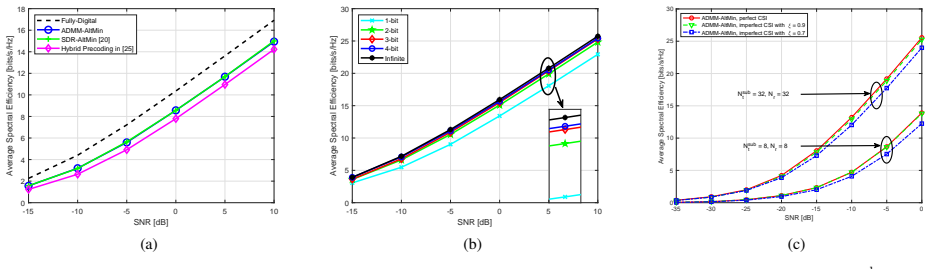
On the paper's own terms, the central discovery is that the hardest part of wideband hybrid precoding—the non-convex baseband subproblem that couples subcarriers through a single shared RF precoder and a per-subcarrier norm constraint—can be handled by a scaled ADMM update in the real domain (equations (17)–(18)) instead of a semidefinite relaxation. With that solver inside an alternating-minimization loop, the RF precoder has a closed-form phase update (21), optionally quantized to a few bits. The paper reports that the resulting ADMM-AltMin matches the average spectral efficiency of SDR-AltMin in simulation across SNR, and outperforms a fixed-subarray wideband hybrid precoder baseline. The claimed payoff is a per-iteration complexity of $O(M_t^2 N_s^4)$ against the much higher cost of solving an SDR each iteration.
Load-bearing premise
The load-bearing premise is that the update in equation (17) actually solves the constrained least-squares baseband problem (14)–(15); if the printed formula is wrong and the constraint-tracking term is missing, the claimed equivalence to SDR-AltMin does not follow.
Editorial extensions
If this is right
- If ADMM-AltMin is correct, wideband DPA-MIMO transmitters can get the same spectral efficiency as the SDR-based method with strictly cheaper per-iteration linear algebra.
- The algorithm's per-step cost $O(M_t^2 N_s^4)$ makes it feasible to run baseband precoding updates repeatedly, for example during channel tracking, rather than once per channel realization.
- Finite-resolution phase shifters, down to 4 bits in the simulations, appear sufficient to approach the infinite-resolution performance, so hardware cost can be reduced without leaving the DPA-MIMO architecture.
- Because the RF precoder has a block-diagonal structure, the ADMM updates can be computed locally at each subarray, which suits distributed implementations.
Reading between the lines
- The authors do not spell this out, but the same ADMM-style baseband solver generalizes beyond DPA-MIMO: any hybrid precoding formulation whose baseband subproblem is a norm-constrained least squares could substitute the SDR inner loop for this iteration, likely with a similar complexity saving.
- A testable extension is to use the complexity slack not for one-shot optimization but for per-block or per-slot adaptation to time-varying CSI, replacing the current batch computation over $K$ subcarriers with streaming updates.
- The 4-bit result hints that even coarser quantization or nonuniform phase-shifter bit allocation across subarrays might be acceptable; the paper does not optimize the bit allocation, so varying quantization levels per subarray is an open question.
Signed reviews
Editorial analysis
A structured set of objections, weighed in public.
Referee Report
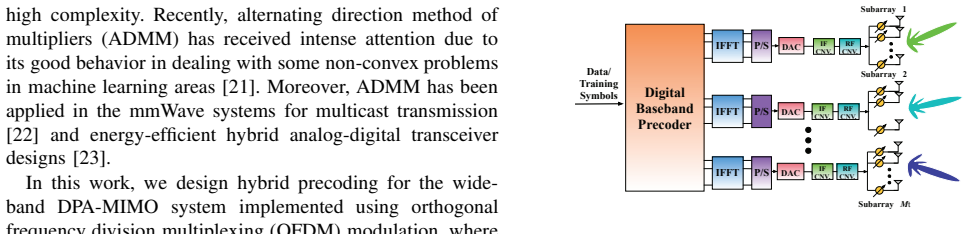
Summary. The paper proposes ADMM-AltMin, an alternating-optimization algorithm for wideband hybrid precoding in distributed phased-array MIMO (DPA-MIMO) systems with OFDM. For a fixed RF precoder, the per-subcarrier baseband precoder is obtained by ADMM on a sphere-constrained least-squares problem; for a fixed baseband precoder, the RF precoder is updated in closed form with quantized phase shifters. The paper claims that the proposed method matches the spectral efficiency of the SDR-AltMin baseline at lower complexity, and it reports simulations with infinite and finite-resolution phase shifters and imperfect CSI.
Significance. If the claims were sound, the paper would provide a useful lower-complexity alternative to SDR-based wideband hybrid precoding for DPA-MIMO, with practical attention to phase-shifter quantization and imperfect CSI. The numerical study is benchmarked against external algorithms [20] and [25], uses concrete system parameters, and does not appear to fit constants to force the advertised result. However, the central ADMM derivation in Eq. (17) is incorrect as written, and this error is load-bearing: the claimed algorithm is not the ADMM recursion stated in Eq. (10), so the equivalence and complexity claims in Section IV lack a sound basis until the update is corrected and the numerical behavior is re-examined.
major comments (4)
- [III-B1, Eq. (17)] The x-update is not the scaled-ADMM minimizer for problem (15). For g(x) = ||A1 x - Re{b}||^2 + ||A2 x - Im{b}||^2, the minimizer of g(x) + (rho/2)||x - y^i + nu^i||^2 is (2(A1^T A1 + A2^T A2) + rho I)^-1 (2A1^T Re{b} + 2A2^T Im{b} + rho(y^i - nu^i)). The printed scalar update corresponds to assuming A1^T A1 + A2^T A2 = I and to replacing the dual variable nu^i with x^i, neither of which is stated or justified. With A = I_Ns (tensor product) F_RF, the relevant Gram matrix is I_Ns (tensor product) F_RF^H F_RF, which is not identity under the constant-modulus constraint (6c). Consequently, Algorithm 1 as written is not the ADMM recursion described by Eq. (10), and the Section IV claim that it matches SDR-AltMin has no analytical basis.
- [III-B1, Eq. (12)] The power-constraint reduction ||F_RF F_BB[k]||_F^2 = ||F_BB[k]||_F^2 is valid only when F_RF^H F_RF = I_Mt. The block-diagonal RF precoder with constant-modulus entries need not have orthogonal columns, and two subarrays can use similar or even identical steering vectors. This simplification changes the feasible set of the per-subcarrier problem (11) and is later embedded in problem (14), so it must either be proved from the DPA-MIMO assumptions or removed.
- [Section IV, complexity comparison] The complexity comparison is incomplete and currently misleading. It compares a per-iteration cost O(M_t^2 N_s^4) for the proposed method with a SDR complexity expression that includes log(1/epsilon), without reporting the number of ADMM iterations required or the total complexity of the outer alternating loop. Moreover, if Eq. (17) is replaced by the correct matrix-inverse update, the per-iteration cost is no longer a scalar division; it requires solving a linear system of dimension 2 M_t N_s, so the stated complexity saving is not established.
- [III-A and Algorithm 1] The paper invokes ADMM for the non-convex sphere constraint but provides no convergence analysis. Standard ADMM convergence results such as those in [21] do not directly apply to the non-convex feasible set C in Eq. (8); the termination criteria in Eq. (19) are therefore not shown to guarantee convergence to a stationary point of problem (6). The equivalence claim in Section IV should be either supported by a convergence theorem for the corrected update or explicitly framed as an empirical observation.
minor comments (4)
- [Throughout] There are typographical errors that should be corrected, including 'hybird' in Section I, 'seperated' in Sections I and II, 'multi-dimentional' below Eq. (18), and 'combing' in Section II-C.
- [Section IV] The SDR complexity expression is described as 'per-iteration' but includes log(1/epsilon), which is characteristic of a total complexity estimate; please clarify what quantity is being compared with the ADMM per-iteration cost.
- [Section IV] The ADMM penalty parameter is fixed to rho = 1 and the stopping tolerances to 1e-6, but no sensitivity study is reported; a brief study of rho would make the empirical claims more robust.
- [Algorithm 1] The outer stopping criterion is left as 'until some termination criterion is satisfied', which makes the number of outer iterations and the reported simulation behavior difficult to reproduce.
Circularity Check
No significant circularity: the ADMM-AltMin result is benchmarked against external algorithms and no fitted quantity is relabeled as a prediction.
full rationale
The derivation chain starts from problem (6) and derives the baseband subproblem (11)-(14) and the RF subproblem (20)-(22); neither is defined in terms of the claimed spectral-efficiency result. The ADMM recursion (17)-(18) is presented as solving (15), and the performance claim is validated in Fig. 3 against fully-digital, SDR-AltMin [20], and dynamic-subarray [25] baselines, which are external sources. Simulation parameters (rho=1, tolerances) are fixed, not fitted to reproduce the comparison curves. Self-citations [12] and [13] supply the DPA-MIMO architecture and channel model context, but the ADMM-vs-SDR comparison and complexity O(M_t^2 N_s^4) claim do not rely on those citations for their validity. The printed update (17) appears not to be the exact minimizer of (15) unless A1^T A1 + A2^T A2 is a multiple of identity, and it omits the dual variable; that is a mathematical correctness concern about the algorithm's derivation, not a circularity in which an output is equivalent to an input by construction. No fitted parameter, self-citation chain, or renaming step forces the advertised conclusion.
Assumptions & free parameters
free parameters (2)
- ADMM penalty parameter rho =
1
- ADMM tolerances epsilon_p and epsilon_d =
1e-6
assumptions (5)
- domain assumption Geometric channel model with Ncl clusters, Nray rays, and Laplacian angle distributions
- domain assumption Channels of different TX subarrays are independent due to large spacing
- standard math RF precoder columns remain orthonormal under quantization
- ad hoc to paper Standard ADMM converges for the non-convex sphere constraint
- domain assumption Matrix approximation formulation using the SVD-based optimal precoder F_opt[k]
Cite this review
Pith. "Pith review of ADMM Enabled Hybrid Precoding in Wideband Distributed Phased Arrays Based MIMO Systems." pith.science (2026). https://pith.science/paper/DFMZJ2LR
@misc{pith2026190809090,
  author       = {Pith},
  title        = {Pith review of: ADMM Enabled Hybrid Precoding in Wideband Distributed Phased Arrays Based MIMO Systems},
  year         = {2026},
  howpublished = {\url{https://pith.science/paper/DFMZJ2LR}},
  note         = {Machine review of arXiv:1908.09090}
}
read the original abstract
Distributed phased arrays based multiple-input multiple-output (DPA-MIMO) is a recently proposed highly reconfigurable architecture enabling both spatial multiplexing and beamforming in millimeter-wave (mmWave) systems. In this work, we focus on coping with the hybrid precoding for the wideband DPA-MIMO system with orthogonal frequency division multiplexing (OFDM) modulation. More specifically, we propose an alternating direction method of multipliers (ADMM) enabled hybrid precoding approach based on an alternating optimization framework, abbreviated to ADMM-AltMin, for such cooperative array-of-subarrays structures. Simulation results show that the proposed ADMM-AltMin method achieves favourable performance with practical quantization of phase shifters taken into account.
Figures

Reference graph
Works this paper leans on
-
[20]
Alternat ing minimization algorithms for hybrid precoding in millimeter wave MIMO sys tems,
X. Y u, J.-C. Shen, J. Zhang, and K. B. Letaief, “Alternat ing minimization algorithms for hybrid precoding in millimeter wave MIMO sys tems,” IEEE J. Sel. Topics Signal Process. , vol. 10, no. 3, pp. 485–500, Apr. 2016
2016
-
[25]
Dynamic subarra ys for hybrid precoding in wideband mmWave MIMO systems,
S. Park, A. Alkhateeb, and R. W. Heath, “Dynamic subarra ys for hybrid precoding in wideband mmWave MIMO systems,” IEEE Trans. Wireless Commun. , vol. 16, no. 5, pp. 2907–2920, May 2017
work page 2017
-
[21]
S. Boyd, N. Parikh, E. Chu, B. Peleato, J. Eckstein et al. , “Distributed optimiza- tion and statistical learning via the alternating directio n method of multipliers,” Foundations and Trends in Machine learning , vol. 3, no. 1, pp. 1–122, 2011
work page 2011
-
[1]
An introduction to millimeter-wave mo bile broadband systems,
Z. Pi and F. Khan, “An introduction to millimeter-wave mo bile broadband systems,” IEEE Commun. Mag. , vol. 49, no. 6, Jun. 2011
work page 2011
-
[2]
G. Y ue, Z. Wang, L. Chen, L. Cheng, J. Tang, X. Zou, Y . Zeng, and L. Li, “Demonstration of 60 GHz millimeter-wave short-range wire less communication system at 3.5 Gbps over 5 m range,” Sci. China Inf. Sci. , vol. 60, no. 8, p. 080306, Aug. 2017
work page 2017
-
[3]
mmWave communications for 5G: Implementation c hallenges and advances,
L. Li, D. Wang, X. Niu, Y . Chai, L. Chen, L. He, X. Wu, F. Zhen g, T. Cui, and X. Y ou, “mmWave communications for 5G: Implementation c hallenges and advances,” Sci. China Inf. Sci. , vol. 61, no. 2, p. 021301, Feb. 2018
work page 2018
-
[4]
Y . Huo, X. Dong, and J. Bornemann, “A wideband artificial m agnetic conductor Y agi antenna for 60-GHz standard 0.13- µm CMOS applications,” in Proc. IEEE Int. Solid-State and Integrated Circuit Technology (ICSIC T), Guilin, China, Oct. 2014, pp. 1–3
work page 2014
-
[5]
Millimeter wave channel modeling and cellular ca pacity evaluation,
M. R. Akdeniz, Y . Liu, M. K. Samimi, S. Sun, S. Rangan, T. S. Rappaport, and E. Erkip, “Millimeter wave channel modeling and cellular ca pacity evaluation,” IEEE J. Sel. Areas Commun. , vol. 32, no. 6, pp. 1164–1179, Jun. 2014
work page 2014
Show all 29 references
-
[6]
A novel 3D GBSM for mmWave MIMO channels,
J. Huang, C.-X. Wang, Y . Liu, J. Sun, and W. Zhang, “A novel 3D GBSM for mmWave MIMO channels,” Sci. China Inf. Sci. , vol. 61, no. 10, p. 102305, 2018
2018
-
[7]
Scaling up MIMO: Opportunities and challeng es with very large arrays,
F. Rusek, D. Persson, B. K. Lau, E. G. Larsson, T. L. Marzet ta, O. Edfors, and F. Tufvesson, “Scaling up MIMO: Opportunities and challeng es with very large arrays,” IEEE Signal Process. Mag. , vol. 30, no. 1, pp. 40–60, Jan. 2013
2013
-
[8]
Low-complexity hybrid prec oding in massive multiuser MIMO systems,
L. Liang, W. Xu, and X. Dong, “Low-complexity hybrid prec oding in massive multiuser MIMO systems,” IEEE Wireless Commun. Lett. , vol. 3, no. 6, pp. 653– 656, Dec. 2014
2014
-
[9]
Spatially sparse precoding in millimeter wave MIMO systems,
O. El Ayach, S. Rajagopal, S. Abu-Surra, Z. Pi, and R. W. He ath, “Spatially sparse precoding in millimeter wave MIMO systems,” IEEE Trans. Wireless Commun. , vol. 13, no. 3, pp. 1499–1513, Mar. 2014
2014
-
[10]
Cellular and WiFi co- design for 5G user equipment,
Y . Huo, X. Dong, W. Xu, and M. Y uen, “Cellular and WiFi co- design for 5G user equipment,” in Proc. IEEE 5G World Forum (5GWF) , Santa Clara, California, USA, Jul. 2018, pp. 256–261
2018
-
[11]
On the feasibility of code book-based beamforming in millimeter wave systems with multiple antenna arrays,
J. Singh and S. Ramakrishna, “On the feasibility of code book-based beamforming in millimeter wave systems with multiple antenna arrays,” IEEE Trans. Wireless Commun., vol. 14, no. 5, pp. 2670–2683, May 2015
2015
-
[12]
5G cellular user equipment: F rom theory to practical hardware design,
Y . Huo, X. Dong, and W. Xu, “5G cellular user equipment: F rom theory to practical hardware design,” IEEE Access , vol. 5, pp. 13 992–14 010, Aug. 2017
2017
-
[13]
Channel estimation and hybrid precoding for distributed phased arr ays based MIMO wireless communications,
Y . Zhang, Y . Huo, D. Wang, X. Dong, and X. Y ou, “Channel estimation and hybrid precoding for distributed phased arr ays based MIMO wireless communications,” Mar 2019. [Online]. Availa ble: https://arxiv.org/abs/1903.05928
2019 arXiv
-
[14]
Millimeter-wave for unmanned aeria l vehicles networks: Enabling multi-beam multi-stream communications,
Y . Huo and X. Dong, “Millimeter-wave for unmanned aeria l vehicles networks: Enabling multi-beam multi-stream communications,” Oct. 2 018. [Online]. Available: https://arxiv.org/abs/1810.06923
-
[15]
Distributed an d multi-layer UA V networks for next-generation wireless communication a nd power transfer: A feasibility study,
Y . Huo, X. Dong, T. Lu, W. Xu, and M. Y uen, “Distributed an d multi-layer UA V networks for next-generation wireless communication a nd power transfer: A feasibility study,” IEEE Internet of Things Journal , May 2019
2019
-
[16]
Ener gy-efficient hybrid analog and digital precoding for mmWave MIMO systems with la rge antenna arrays,
X. Gao, L. Dai, S. Han, I. Chih-Lin, and R. W. Heath, “Ener gy-efficient hybrid analog and digital precoding for mmWave MIMO systems with la rge antenna arrays,” IEEE J. Sel. Areas Commun. , vol. 34, no. 4, pp. 998–1009, Apr. 2016
2016
-
[17]
5 G uniform linear arrays with beamforming and spatial multiplexing at 28, 37, 64, and 71 GHz for outdoor urban communication: A two-level approach,
J. Lota, S. Sun, T. S. Rappaport, and A. Demosthenous, “5 G uniform linear arrays with beamforming and spatial multiplexing at 28, 37, 64, and 71 GHz for outdoor urban communication: A two-level approach,” IEEE Trans. Veh. Technol., vol. 66, no. 11, pp. 9972–9985, Nov. 2017
2017
-
[18]
Frequency selective hybr id precoding for limited feedback millimeter wave systems,
A. Alkhateeb and R. W. Heath, “Frequency selective hybr id precoding for limited feedback millimeter wave systems,” IEEE Trans. Commun. , vol. 64, no. 5, pp. 1801–1818, May 2016
2016
-
[19]
Hybrid analog and digital beamfor ming for mmwave OFDM large-scale antenna arrays,
F. Sohrabi and W. Y u, “Hybrid analog and digital beamfor ming for mmwave OFDM large-scale antenna arrays,” IEEE J. Sel. Areas Commun. , vol. 35, no. 7, pp. 1432–1443, Jul. 2017
2017
-
[22]
Low-complexity hybrid analog/digital beamforming for multicast transmission in mmwave systems,
J. Huang, Z. Cheng, E. Chen, and M. Tao, “Low-complexity hybrid analog/digital beamforming for multicast transmission in mmwave systems, ” in Proc. IEEE International Conference on Communications (ICC) , Paris, France, May 2017, pp. 1–6
2017
-
[23]
On the energy- efficiency of hybrid analog–digital transceivers for singl e-and multi-carrier large antenna array systems,
C. G. Tsinos, S. Maleki, S. Chatzinotas, and B. Otterste n, “On the energy- efficiency of hybrid analog–digital transceivers for singl e-and multi-carrier large antenna array systems,” IEEE J. Sel. Areas Commun. , vol. 35, no. 9, pp. 1980– 1995, Sep. 2017
1980
-
[24]
Near-optimal hybrid proce ssing for massive MIMO systems via matrix decomposition,
W. Ni, X. Dong, and W.-S. Lu, “Near-optimal hybrid proce ssing for massive MIMO systems via matrix decomposition,” IEEE Trans. Signal Process. , vol. 65, no. 15, pp. 3922–3933, Aug. 2017
2017
-
[26]
Adaptive beamforming with resource allocation for distance- aware multi-user indoor terahertz communications,
C. Lin and G. Y . Li, “Adaptive beamforming with resource allocation for distance- aware multi-user indoor terahertz communications,” IEEE Trans. Commun. , vol. 63, no. 8, pp. 2985–2995, Aug. 2015
2015
-
[27]
AF relaying for millimeter wave com munication sys- tems with hybrid RF/baseband MIMO processing,
J. Lee and Y . H. Lee, “AF relaying for millimeter wave com munication sys- tems with hybrid RF/baseband MIMO processing,” in Proc. IEEE International Conference on Communications (ICC) , Sydney, NSW, Australia, Jun. 2014, pp. 5838–5842
2014
-
[28]
Lecture notes for ELEC 573 advanced engineering design by optimiza- tion,
W. Lu, “Lecture notes for ELEC 573 advanced engineering design by optimiza- tion,” University of Victoria, 2018
2018
-
[29]
Semidefinite r elaxation of quadratic optimization problems,
Z. Luo, W. Ma, A. M. So, Y . Y e, and S. Zhang, “Semidefinite r elaxation of quadratic optimization problems,” IEEE Signal Process. Mag. , vol. 27, no. 3, pp. 20–34, May 2010
2010
Reviewed August 14, 2026 · model on record in the stance chip above.
Discussion (0). Continue with ORCID to comment.