REVIEW 4 major objections 6 minor 40 references
Fairness Warnings and Fair-MAML: Learning Fairly with Minimal Data
T0 review · 4 major / 6 minor · reviewed 2026-08-14 · deepseek-v4-flash
Pith's one-line read The paper claims that fairness can be meta-learned: a MAML variant with a fairness regularizer fine-tunes from as few as ten labeled examples to beat fair-transfer baselines, and a SLIM-based warning system flags when a fair model will…
desk verdict A useful applied-fairness paper with a real gap in the empirical support; worth peer review, but the central K-shot claim needs error bars and same-regime baselines before it can be taken as established. read the letter →
The pith
A machine-rendered reading of the paper's core claim, the machinery that carries it, and where it could break.
The reading
What carries the argument
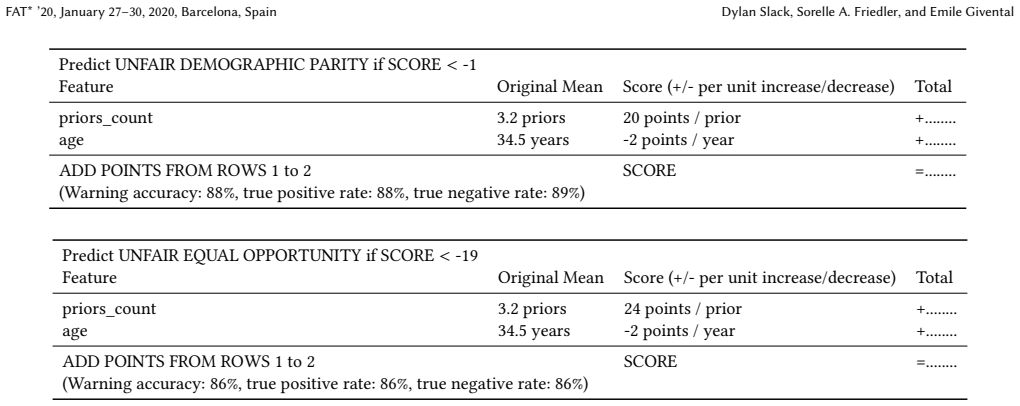
The argument runs through two mechanisms. Fair-MAML modifies MAML by adding a fairness regularizer $R$ to the inner-task loss, so the per-task update is $\theta' = \theta - \alpha \nabla[L + \gamma R]$; the regularizers $R_{dp}$ and $R_{eop}$ are one-sided approximations that raise the predicted positive rate (or true positive rate) of the protected group, and they are designed to be cheap because MAML's meta-gradient requires second derivatives. Fairness Warnings trains a Supersparse Linear Integer Model (SLIM), a small integer-coefficient scoring system, on a dataset of perturbed copies of the data, where each copy is a Gaussian mean shift of the features and the label is whether the fair model $f$ violates the fairness threshold on that copy; the resulting rule is a simple score inequality such as "predict unfair if score $< -1$".
What would settle it
Run Fair-MAML on the Communities and Crime benchmark with repeated fine-tuning draws: for a fixed held-out state, sample many different sets of 10 labeled communities, fit Fair-MAML each time, and record the demographic-parity ratio and accuracy. If the variance across draws is large enough that the mean advantage over the pre-trained network disappears for a substantial fraction of draws, the claim that Fair-MAML reliably learns fairly from minimal data would be disconfirmed.
Extended reading notes
Core claim
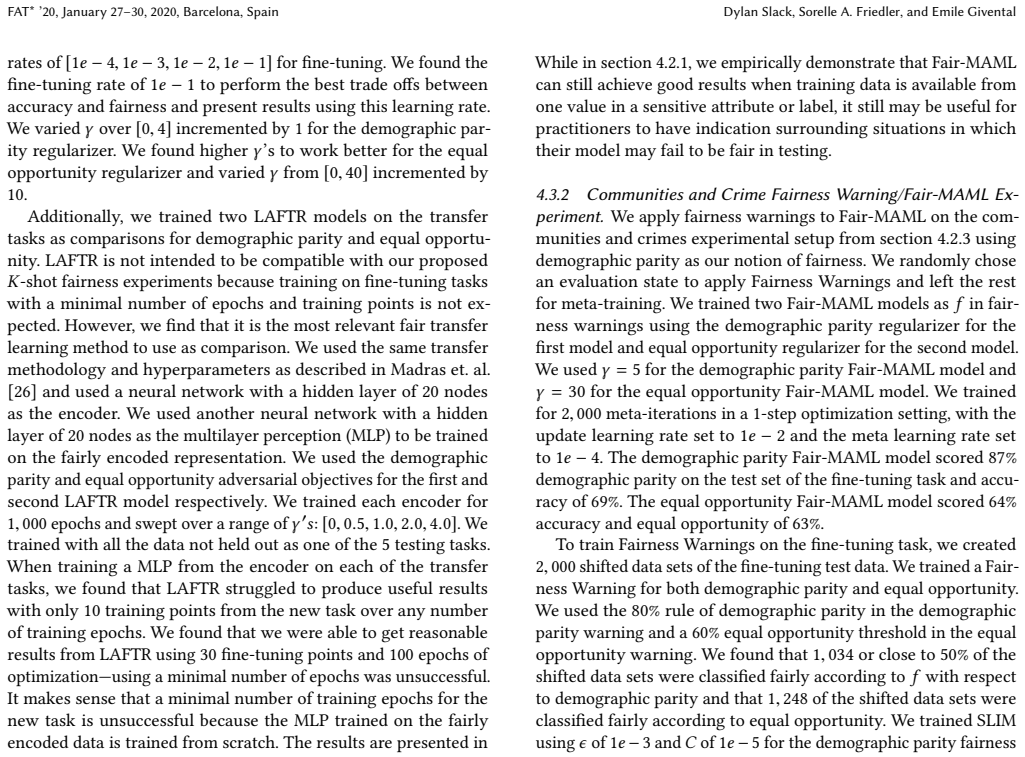
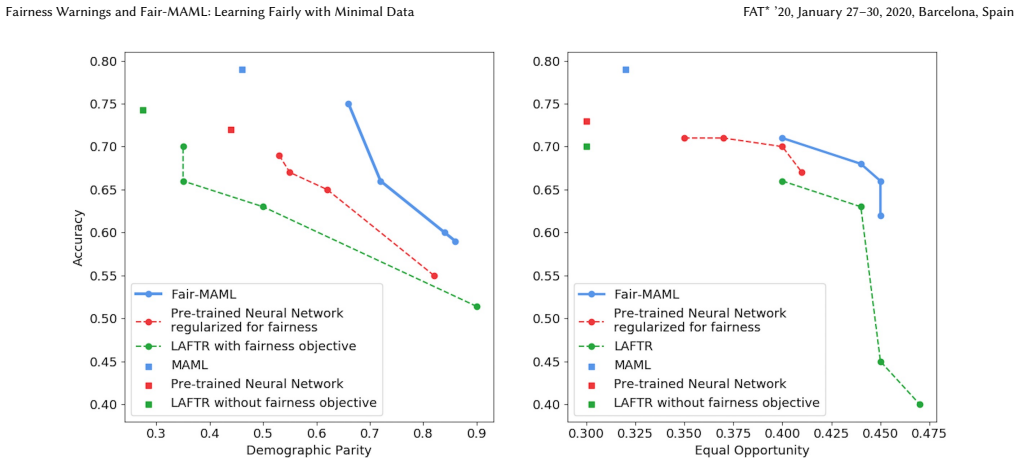
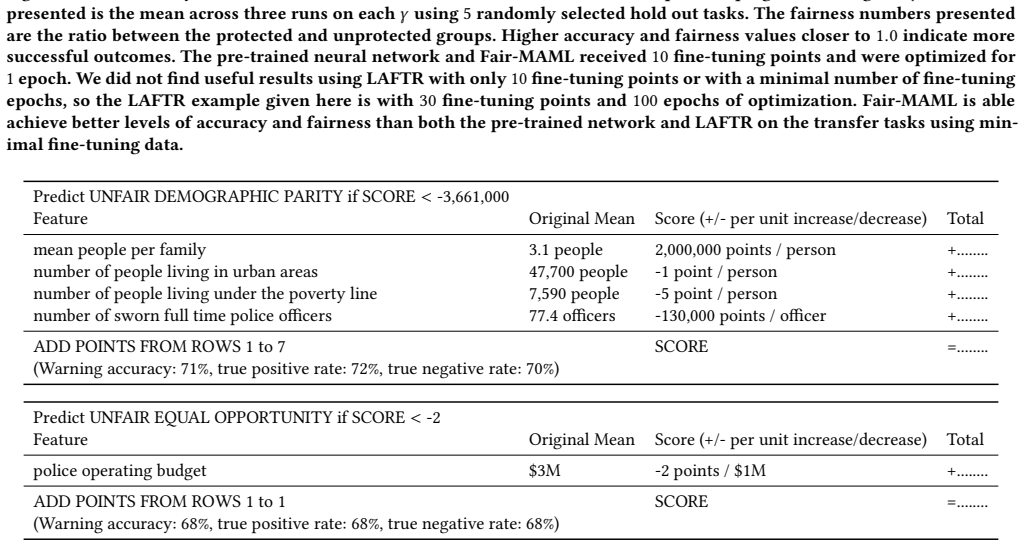
The paper claims that fairness itself can be meta-learned. Its central result is that a MAML model trained with a fairness regularizer inside the task loss—where the regularizer is a one-sided approximation of demographic parity or equal opportunity computed from the protected group in the $K$ training points—produces a representation that can be fine-tuned on a new task with minimal data to yield both high accuracy and high fairness. In the Communities and Crime transfer setting, Fair-MAML with 10 fine-tuning points outperforms both a pre-trained regularized neural network and LAFTR on the accuracy/fairness trade-off across a range of the fairness weight $\gamma$. For Fairness Warnings, the paper claims that a SLIM model trained on Gaussian mean-shifted copies of a dataset can classify which shifts will make a fair model unfair, with reported accuracies of 88% on COMPAS demographic parity, 86% on COMPAS equal opportunity, and 71% and 68% on the Communities and Crime fine-tuned Fair-MAML models.
Load-bearing premise
The load-bearing premise is that a one-sided fairness penalty computed from as few as five or ten labeled examples on a new task is stable enough and transferable enough that optimizing it during meta-training produces models that actually stay fair on held-out tasks.
Editorial extensions
If this is right
- Organizations deploying a fair model in a new territory can fine-tune it locally with around ten labeled cases instead of gathering a large representative dataset for that territory.
- A user of Fairness Warnings can attach a short integer-scoring checklist to any fair model, so auditors and judges can tell at a glance which small population shifts void the fairness guarantee.
- On a new task, a practitioner can sweep the single weight $\gamma$ with only $K$ labeled points to balance fairness and accuracy, rather than retraining the full model.
- Fair-MAML's representation, trained across many tasks, carries fairness information that transfers to tasks with different feature distributions and different strengths of protected-group correlation.
Reading between the lines
- Because Fair-MAML's regularizers are one-sided, the reported demographic parity ratios may be achieved by inflating protected-group positive predictions rather than balancing error rates; a symmetric regularizer version could be tested to see whether the trade-off holds when both groups' rates are constrained.
- The paper's mean-shift restriction for Fairness Warnings likely understates real distribution shifts; extending the shift-generating distribution to include variance and correlation changes (using the same SLIM training loop) would reveal whether the warnings remain accurate when more than the mean moves.
- Fair-MAML's strong performance with $K=10$ suggests an adaptive deployment loop: as a new site accumulates labeled cases, the model could be re-fine-tuned continuously, turning a one-shot transfer tool into a learning system that never requires a large batch.
- The fact that random forests predict warning labels more accurately than SLIM (94% vs 88% on COMPAS) suggests that interpretability, not learnability, is the bottleneck; a more expressive interpretable model would likely close that gap while keeping the integer-score interface.
Signed reviews
Editorial analysis
A structured set of objections, weighed in public.
Referee Report
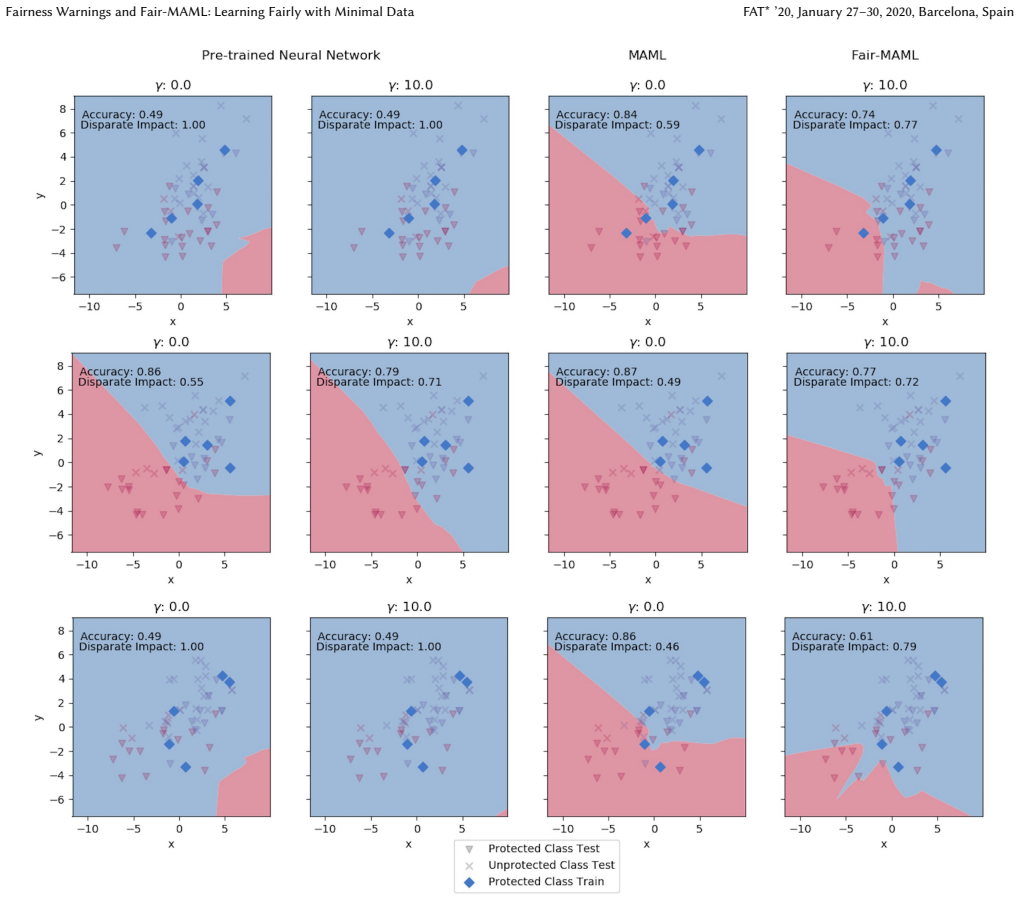
Summary. The paper proposes two tools for transferring fair classifiers to new tasks with little data: Fairness Warnings, which train an interpretable SLIM model on Gaussian mean-shifted copies of a dataset to predict when a given fair model will violate a binary fairness threshold, and Fair-MAML, which augments MAML's inner and outer losses with one-sided demographic-parity or equal-opportunity regularizers. Experiments on COMPAS, a synthetic Gaussian task, and the Communities and Crime dataset (with states as tasks) are used to argue that Fair-MAML achieves better accuracy/fairness trade-offs than a pre-trained fair network and LAFTR with K=10 fine-tuning points, and that Fairness Warnings provide usable boundary conditions. The paper also presents the first K-shot fairness experiment and combines the two methods.
Significance. If the empirical claims are established, the paper makes a useful contribution: it identifies a concrete practical problem (fair transfer with minimal data), provides an interpretable warning mechanism for a restricted but common class of shifts, and demonstrates a meta-learning route to few-shot fairness. The code is released, the regularizers are simple and differentiable, and the Communities-and-Crime experiment is a sensible natural testbed. The main contribution, however, is empirical, and the current evidence is not yet sufficient: the headline comparisons lack variance reporting, involve selection on test tasks, and compare against LAFTR in a different data/epoch regime. These issues are fixable, so the underlying ideas are worth pursuing.
major comments (4)
- [Section 4.2.3, Figure 3] The central claim that Fair-MAML achieves better accuracy/fairness trade-offs than the pre-trained network and LAFTR is supported only by mean values over three runs, with no error bars, confidence intervals, or per-state scatter. Because the fine-tuning data are random draws of 10 communities and the protected subset may be tiny, run-to-run variance is expected to be substantial; the paper should report variance and a significance test before this claim can be accepted.
- [Section 4.2.3] The baseline pre-trained network's fine-tuning learning rate (0.1) and the gamma values for both Fair-MAML and the baselines are selected using the held-out test states ("We found the fine-tuning rate of 1e-1 to perform the best trade offs between accuracy and fairness and present results using this learning rate"; "We varied gamma over [0,4]..."). This is selection on the evaluation set and makes the presented trade-off curves optimistically biased; a validation split or nested procedure is needed.
- [Section 4.2.3 and Appendix] The LAFTR comparison is not a same-regime comparison. LAFTR is evaluated with 30 fine-tuning points and 100 epochs, whereas Fair-MAML and the pre-trained network receive 10 points and 1 epoch; the appendix shows that at 50 points LAFTR becomes comparable. The text's claim that Fair-MAML beats LAFTR "using minimal fine-tuning data" conflates different data and compute regimes.
- [Section 3.3, Eqs. (5)-(6)] The one-sided regularizers are computed from the protected subset D0, which with K=5 or 10 total examples may contain only a handful of instances. The paper provides no analysis of the variance of the regularizer or its gradient, nor any bootstrap or repeated-sampling experiment, so the stability of the meta-training signal is unestablished. This is load-bearing for the K-shot fairness premise.
minor comments (6)
- [Section 4.3.2, Figure 4 caption] The caption says "ADD POINTS FROM ROWS 1 to 7" but only four features are listed; this should be corrected to "ROWS 1 to 4".
- [Section 1] The phrase "whether unfairly trained machine learning model may behave fairly" appears to be a typo; it should likely read "whether a fairly trained machine learning model may behave fairly."
- [Section 4.2.3] The sentence "Fair-MAML is able achieve better levels of accuracy and fairness" is missing the word "to" after "able".
- [References] Reference [29] spells the author name "Schumman" and reference [38] spells "Rogriguez"; both should be corrected to "Schumann" and "Rodriguez", respectively.
- [Section 5] The limitation that Fair-MAML was only assessed in many-task regimes should be stated in Section 4.2 as well, since it directly qualifies the central claim of the Communities and Crime experiment.
- [Section 4.2.3] The fairness evaluation uses the same group-fairness notion that the regularizers optimize; reporting additional metrics such as equalized odds or calibration would help show that the improvements are not entirely an artifact of optimizing the evaluation quantity.
Circularity Check
No significant circularity: held-out tasks and explicit scope limits keep both algorithms' claims independent of their inputs.
full rationale
Fair-MAML's central claim is evaluated on five held-out states not used in meta-training, and Figure 3's fairness metric is the protected/unprotected ratio, which is not the same expression as the one-sided regularizers in Eqs. 5-6; the regularizers are training surrogates, so measuring the ratio is an external check. The choice of gamma on test states and the unequal LAFTR comparison (30 points/100 epochs vs. 10 points/1 epoch) are methodological weaknesses, not circularity. Fairness Warnings are trained on labels produced by U_f on Gaussian mean-shifted copies and tested on held-out shifts from the same process; the paper explicitly limits warnings to mean shifts and says a non-unfair score does not certify fairness (Sections 3.1.2 and 5), so the reported accuracies are internal consistency of the surrogate, not a claim that reduces to its own inputs. The only self-citation, [30], supports the generic definition of interpretable models and is not load-bearing. No derivation in the paper reduces to its own inputs by construction.
Assumptions & free parameters
free parameters (5)
- gamma (fairness regularization weight) =
0-10 (synthetic), 0-4 DP and 0-40 EO (Communities), 5 DP / 30 EO (combined)
- alpha (inner-loop step size) =
0.3 (synthetic), 1e-2 (Communities)
- beta (meta learning rate) =
1e-3 (synthetic), 1e-4 (Communities)
- SLIM hyperparameters C and epsilon =
COMPAS: C=1e-3, epsilon=1e-3; Communities DP: C=1e-5, EO: C=1e-3
- baseline fine-tuning learning rate =
1e-1
assumptions (6)
- standard math The loss functions are differentiable and MAML's Hessian-vector products are computable.
- domain assumption Only mean shifts of the testing distribution are considered.
- domain assumption Mean shifts are generated by adding zero-mean Gaussian draws with the feature standard deviation to numeric features and by resampling one-hot categorical features from a binomial with p drawn from N(p,1).
- domain assumption A one-sided regularizer that only raises the protected group's positive rate is an adequate proxy for demographic parity and equal opportunity.
- domain assumption Fairness ratios can be thresholded into binary fair/unfair labels (80% rule, 60% rule).
- domain assumption The task distribution used for meta-training is representative of deployment tasks.
Cite this review
Pith. "Pith review of Fairness Warnings and Fair-MAML: Learning Fairly with Minimal Data." pith.science (2026). https://pith.science/paper/YCCBGGTB
@misc{pith2026190809092,
  author       = {Pith},
  title        = {Pith review of: Fairness Warnings and Fair-MAML: Learning Fairly with Minimal Data},
  year         = {2026},
  howpublished = {\url{https://pith.science/paper/YCCBGGTB}},
  note         = {Machine review of arXiv:1908.09092}
}
read the original abstract
Motivated by concerns surrounding the fairness effects of sharing and transferring fair machine learning tools, we propose two algorithms: Fairness Warnings and Fair-MAML. The first is a model-agnostic algorithm that provides interpretable boundary conditions for when a fairly trained model may not behave fairly on similar but slightly different tasks within a given domain. The second is a fair meta-learning approach to train models that can be quickly fine-tuned to specific tasks from only a few number of sample instances while balancing fairness and accuracy. We demonstrate experimentally the individual utility of each model using relevant baselines and provide the first experiment to our knowledge of K-shot fairness, i.e. training a fair model on a new task with only K data points. Then, we illustrate the usefulness of both algorithms as a combined method for training models from a few data points on new tasks while using Fairness Warnings as interpretable boundary conditions under which the newly trained model may not be fair.
Figures
Figures from the paper (3 more)

Reference graph
Works this paper leans on
-
[1]
2011. Acquisition, preservation, and exchange of identification records and information; appointment of officials. U.S. Code §534 (2011)
work page 2011
-
[2]
Developing a National Model for Pretrial Risk Assessment
2013. Developing a National Model for Pretrial Risk Assessment. LJAF Research Summary (2013)
work page 2013
-
[3]
Julia Angwin, Jeff Larson, Surya Mattu, and Lauren Kirchner. 2016. Machine bias. ProPublica (2016)
work page 2016
-
[4]
Solon Barocas, Moritz Hardt, and Arvind Narayanan. 2018. Fairness and Machine Learning. fairmlbook.org
work page 2018
-
[5]
Solon Barocas and Andrew D Selbst. 2016. Big data’s disparate impact. Calif. L. Rev. 104 (2016), 671
2016
-
[6]
Richard Berk, Hoda Heidari, Shahin Jabbari, Matthew Joseph, Michael Kearns, Jamie Morgenstern, Seth Neel, and Aaron Roth. 2017. A Convex Framework for Fair Regression. ArXiv (2017)
work page 2017
-
[7]
Steffen Bickel, Michael Brückner, and Tobias Scheffer. 2009. Discriminative Learning Under Covariate Shift. J. Mach. Learn. Res. 10 (2009), 2137–2155
work page 2009
-
[8]
Toon Calders and Sicco Verwer. 2010. Three naive Bayes approaches for discrimination-free classification. Data Mining and Knowledge Discovery 21, 2 (2010), 277–292
work page 2010
Show all 40 references
-
[9]
Alexandra Chouldechova. 2017. Fair prediction with disparate impact: A study of bias in recidivism prediction instruments. Big data 5, 2 (2017), 153–163
2017
-
[10]
Alexandra Chouldechova and Aaron Roth. 2018. The Frontiers of Fairness in Machine Learning. ArXiv (2018)
2018
-
[11]
Angèle Christin. 2017. Algorithms in practice: Comparing web journalism and criminal justice. Big Data & Society 4, 2 (2017)
2017
-
[12]
Amanda Coston, Karthikeyan Natesan Ramamurthy, Dennis Wei, Kush R Varsh- ney, Skyler Speakman, Zairah Mustahsan, and Supriyo Chakraborty. 2019. Fair transfer learning with missing protected attributes. In Proceedings of the AAAI/ACM Conference on Artificial Intelligence, Ethic...
2019
-
[13]
Cynthia Dwork, Moritz Hardt, Toniann Pitassi, Omer Reingold, and Richard Zemel. 2012. Fairness Through Awareness. In Proceedings of the 3rd Innovations in Theoretical Computer Science Conference (ITCS ’12) . ACM, New York, NY, USA, 214–226
2012
-
[14]
Cynthia Dwork, Nicole Immorlica, Adam Tauman Kalai, and Max Leiserson. 2018. Decoupled classifiers for group-fair and efficient machine learning. In Conference on Fairness, Accountability and Transparency . 119–133
2018
-
[15]
The U.S. EEOC. 1979. Uniform guidelines on employee selection procedures. (1979)
1979
-
[16]
Michael Feldman, Sorelle A Friedler, John Moeller, Carlos Scheidegger, and Suresh Venkatasubramanian. 2015. Certifying and removing disparate impact. InProceed- ings of the 21th ACM SIGKDD International Conference on Knowledge Discovery and Data Mining. ACM, 259–268
2015
-
[17]
Chelsea Finn, Pieter Abbeel, and Sergey Levine. 2017. Model-Agnostic Meta- Learning for Fast Adaptation of Deep Networks. In Proceedings of the 34th In- ternational Conference on Machine Learning (Proceedings of Machine Learning Research), Doina Precup and Yee Whye Teh (Eds.),...
2017
-
[18]
Friedler, Scheidegger, Venkatasubramanian, Choudhary, Hamilton, and Roth
-
[19]
Moritz Hardt, Eric Price, and Nathan Srebro. 2016. Equality of Opportunity in Supervised Learning. In Proceedings of the 30th International Conference on Neural Information Processing Systems (NIPS’16) . Curran Associates Inc., USA, 3323–3331
2016
-
[20]
Lingxiao Huang and Nisheeth Vishnoi. 2019. Stable and Fair Classification. In Proceedings of the 36th International Conference on Machine Learning (Proceedings of Machine Learning Research) , Kamalika Chaudhuri and Ruslan Salakhutdinov (Eds.), Vol. 97. PMLR, Long Beach, Califo...
2019
-
[21]
Nathan Kallus and Angela Zhou. 2018. Residual Unfairness in Fair Machine Learning from Prejudiced Data. InProceedings of the 35th International Conference on Machine Learning (Proceedings of Machine Learning Research) , Jennifer Dy and Andreas Krause (Eds.), Vol. 80. PMLR, Sto...
2018
-
[22]
Toshihiro Kamishima, Shotaro Akaho, and Jun Sakuma. 2012. Fairness-aware classifier with prejudice remover regularizer. In Joint European Conference on Machine Learning and Knowledge Discovery in Databases . Springer, 35–50
2012
-
[23]
Chao Lan and Jun Huan. 2017. Discriminatory Transfer. Workshop on Fairness, Accountability, and Transparency in Machine Learning (2017)
2017
-
[24]
Moshe Lichman. 2013. UCI machine learning repository. (2013)
2013
-
[25]
Lipton, Yu-Xiang Wang, and Alexander J
Zachary C. Lipton, Yu-Xiang Wang, and Alexander J. Smola. 2018. Detecting and Correcting for Label Shift with Black Box Predictors. ICML (2018)
2018
-
[26]
David Madras, Elliot Creager, Toniann Pitassi, and Richard Zemel. 2018. Learning Adversarially Fair and Transferable Representations. International Conference on Machine Learning (2018)
2018
-
[27]
Why Should I Trust You?
Marco Tulio Ribeiro, Sameer Singh, and Carlos Guestrin. 2016. "Why Should I Trust You?": Explaining the Predictions of Any Classifier. InProceedings of the 22nd ACM SIGKDD International Conference on Knowledge Discovery and Data Mining, San Francisco, CA, USA, August 13-17, 20...
2016
-
[28]
Andrea Romei and Salvatore Ruggieri. 2014. A multidisciplinary survey on discrimination analysis. The Knowledge Engineering Review 29, 5 (2014), 582–638
2014
-
[29]
Candice Schumann, Xuezhi Wang, Alex Beutel, Jilin Chen, Hai Qian, and Ed H. Chi. 2019. Transfer of Machine Learning Fairness across Domains. arXiv (2019)
2019
-
[30]
Friedler, Carlos Eduardo Scheidegger, and Chi- tradeep Dutta Roy
Dylan Slack, Sorelle A. Friedler, Carlos Eduardo Scheidegger, and Chi- tradeep Dutta Roy. 2019. Assessing the Local Interpretability of Machine Learning Models. Workshop on Human-Centric Machine Learning, NeurIPS (2019)
2019
-
[31]
Stevenson
Megan T. Stevenson. 2017. Assessing Risk Assessment in Action. 103 Minnesota Law Review 303 (2017)
2017
-
[32]
Schulam, and Suchi Saria
Adarsh Subbaswamy, Peter G. Schulam, and Suchi Saria. 2018. Preventing Failures Due to Dataset Shift: Learning Predictive Models That Transport. In AISTATS
2018
-
[33]
Berk Ustun and Cynthia Rudin. 2015. Supersparse linear integer models for optimized medical scoring systems. Machine Learning 102 (2015), 349–391
2015
-
[34]
Berk Ustun and Cynthia Rudin. 2019. Learning Optimized Risk Scores. Journal of Machine Learning Research 20, 150 (2019), 1–75
2019
-
[35]
Joaquin Vanschoren. 2019. Meta-Learning. Springer International Publishing, Cham, 35–61
2019
-
[36]
Lillicrap, Koray Kavukcuoglu, and Daan Wierstra
Oriol Vinyals, Charles Blundell, Timothy P. Lillicrap, Koray Kavukcuoglu, and Daan Wierstra. 2016. Matching Networks for One Shot Learning. In NeurIPS
2016
-
[37]
Muhammad Bilal Zafar, Isabel Valera, Manuel Gomez Rodriguez, and Krishna P Gummadi. 2017. Fairness beyond disparate treatment & disparate impact: Learn- ing classification without disparate mistreatment. In Proceedings of the 26th International Conference on World Wide Web. 1171–1180
2017
-
[38]
Muhammad Bilal Zafar, Isabel Valera, Manuel Gomez Rogriguez, and Krishna P Gummadi. 2017. Fairness Constraints: Mechanisms for Fair Classification. In Artificial Intelligence and Statistics. 962–970
2017
-
[39]
Indre Zliobaite. 2015. A survey on measuring indirect discrimination in machine learning. arXiv (2015). Fairness Warnings and Fair-MAML: Learning Fairly with Minimal Data FAT* ’20, January 27–30, 2020, Barcelona, Spain APPENDIX Figure 5: The accuracy/fairness trade off for the...
2015
-
[2019]
In ACM Conference on Fairness, Accountability and Transparency (FAT*)
A comparative study of fairness-enhancing interventions in machine learning. In ACM Conference on Fairness, Accountability and Transparency (FAT*) . ACM
Reviewed August 14, 2026 · model on record in the stance chip above.
Discussion (0). Continue with ORCID to comment.