REVIEW 4 major objections 4 minor 45 references
Computing ground states of Bose-Einstein Condensates with higher order interaction via a regularized density function formulation
T0 review · 4 major / 4 minor · reviewed 2026-08-14 · deepseek-v4-flash
Pith's one-line read This paper claims that ground states of the modified Gross-Pitaevskii equation can be computed by minimizing a regularized convex functional of the density, and that the resulting method is convergent and much faster than existing…
desk verdict A genuinely useful convex density formulation for MGPE ground states, with a real gap in the claimed FISTA O(1/k^2) rate because the extended objective is not C^1. read the letter →
The pith
A machine-rendered reading of the paper's core claim, the machinery that carries it, and where it could break.
The reading
What carries the argument
The central object is the regularized density functional $E_\varepsilon(\rho)=\int\big[\tfrac{|\nabla\rho|^2}{8(\rho+\varepsilon)}+V\rho+\tfrac{\beta}{2}\rho^2+\tfrac{\delta}{2}|\nabla\rho|^2\big]dx$ over the convex simplex $\{\rho\ge 0,\int\rho=1\}$. This functional replaces the non-convex wave-function energy with a convex problem in the density; the parameter $\varepsilon$ removes the singularity of $|\nabla\sqrt{\rho}|$ near $\rho=0$ and also keeps the gradient of the energy bounded. The discrete version uses the denominator $\rho_j+\rho_{j+1}+2\varepsilon$ in the finite-difference kinetic term, which preserves convexity on the simplex, and the optimization is carried out by the accelerated projected gradient method with projection onto the simplex, using an absolute-value extension of the discrete energy so that gradients are defined everywhere in $\mathbb{R}^{N-1}$.
What would settle it
Take a small 1D grid, fix $\varepsilon>0$, and test convexity of the extended energy $\tilde{E}^\varepsilon_h$ along the line segment from a feasible density to its negative reflection; a negative second directional derivative at any point with a negative coordinate would disprove the global convexity premise of the APG analysis. A second check is to record the energy decrease per iteration of Algorithm 4.1 for a very small $\varepsilon$ (e.g., $10^{-8}$) on a coarse grid and see whether the claimed $O(1/k^2)$ bound actually holds in that regime.
Extended reading notes
Core claim
For $\beta\ge 0$ and $\delta\ge 0$, the ground state of the modified Gross-Pitaevskii equation can be characterized as the minimizer $\rho_g$ of the convex energy functional $E(\rho)=\int_{\mathbb{R}^d}\big[\tfrac12|\nabla\sqrt{\rho}|^2+V(x)\rho+\tfrac{\beta}{2}\rho^2+\tfrac{\delta}{2}|\nabla\rho|^2\big]dx$ over densities with $\int\rho=1$ and $\rho\ge 0$. To make this tractable, the paper introduces the regularized functional $E_\varepsilon(\rho)=\int_{\mathbb{R}^d}\big[\tfrac{|\nabla\rho|^2}{8(\rho+\varepsilon)}+V\rho+\tfrac{\beta}{2}\rho^2+\tfrac{\delta}{2}|\nabla\rho|^2\big]dx$, proves that its minimizer $\rho^\varepsilon_g$ converges to $\rho_g$ in $H^1$ as $\varepsilon\to 0^+$, and derives an energy-difference bound that controls the $L^2$ and $H^1$ density errors. After a second-order finite-difference discretization on a bounded domain with homogeneous Dirichlet boundary conditions, the discrete minimizer converges to $\rho^\varepsilon_g$ with $O(h)$ error in the $H^1$-seminorm, and numerical results show second-order convergence in energy and $L^2$ density. The discrete problem is solved by the accelerated projected gradient method applied to an absolute-value extension of the discrete energy over all of $\mathbb{R}^{N-1}$, with the paper claiming an $O(1/k^2)$ energy convergence rate and demonstrating in experiments that the method outperforms the regularized Newton method, especially for large $\delta$.
Load-bearing premise
The rigorous $O(1/k^2)$ rate and the line-search guarantee require the absolute-value extension of the discrete energy to be convex with a Lipschitz continuous gradient over all of $\mathbb{R}^{N-1}$, a property the paper invokes but does not prove.
Editorial extensions
If this is right
- Ground-state densities of the modified Gross-Pitaevskii equation for $\beta,\delta\ge 0$ can be obtained by convex minimization, so global convergence guarantees from convex optimization apply directly.
- The regularization error can be made arbitrarily small by driving $\varepsilon\to 0$, and the numerical evidence indicates nearly linear convergence of the density in $\varepsilon$ for harmonic traps.
- The second-order finite-difference discretization gives first-order accuracy in the $H^1$-seminorm and second-order accuracy in energy and $L^2$ density, so the main numerical cost is solving a well-conditioned convex problem rather than handling non-convexity.
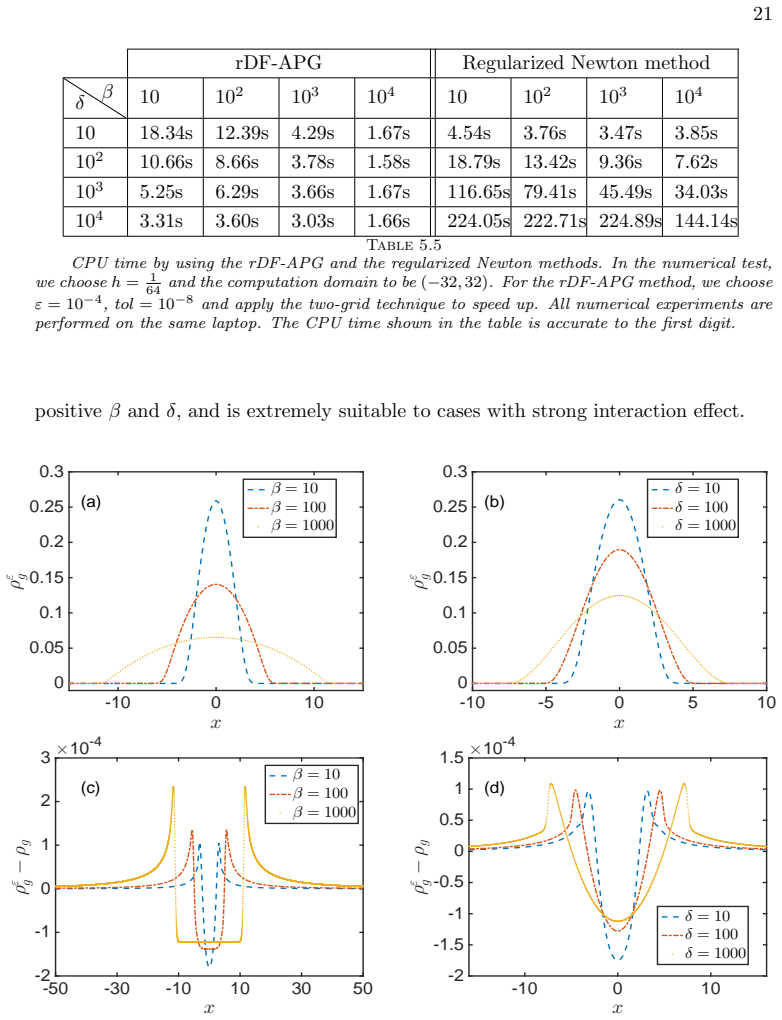
- In the strong-interaction regime, especially $\delta\gg 1$, the method's cost decreases as the interaction strength grows, unlike the regularized Newton method, making the density formulation attractive for strongly interacting condensates.
- The method extends naturally to two and three dimensions on tensor grids, since the gradient evaluation and the simplex projection are per-node operations with no dimension-specific coupling.
Reading between the lines
- The convexity of the density energy suggests a connection to Wasserstein gradient flows of $E_\varepsilon$, which could yield unconditionally stable time-splitting schemes for computing ground states or dynamics, a direction the paper does not explore.
- The observed nearly linear convergence in $\varepsilon$ hints that Richardson extrapolation across two small values of $\varepsilon$ could produce higher-order estimates of $\rho_g$ at negligible extra cost, since the error appears systematic in the tested harmonic-trap cases.
- The absolute-value extension of the discrete energy is the fragile part of the analysis; a natural repair would be to prove a restricted Lipschitz-gradient property on the simplex itself, or to replace the extension by a barrier/projection strategy that stays inside the feasible set.
- The density formulation could be adapted to compute excited states or rotating condensates by adding a phase or angular-momentum constraint, but such extensions would require a separate convexity analysis.
Signed reviews
Editorial analysis
A structured set of objections, weighed in public.
Referee Report
Summary. The paper proposes a numerical method, rDF-APG, for computing ground states of the modified Gross-Pitaevskii equation with higher-order interaction. The nonconvex minimization over wave functions is recast as a convex minimization over densities ρ=|φ|^2, the kinetic term is regularized with a small parameter ε, convergence of the regularized ground states as ε→0 is stated (Theorem 2.6), a finite-difference discretization is analyzed (Theorem 3.3), and an accelerated projected gradient method is adapted. Numerical experiments in 1D, 2D, and 3D compare the method with a regularized Newton method and show strong advantages in the large-δ regime.
Significance. If the stated results all hold, this would be a useful contribution: the density-function formulation turns a difficult nonconvex constrained problem into a convex one, and the numerical evidence indicates favorable scaling with interaction strength. The paper provides no fitted parameters, and the main mathematical claims are clearly formulated. The numerical tables support the predicted spatial orders and the ε→0 behavior. However, several load-bearing proof ingredients are either omitted or only asserted, most importantly the smoothness/convexity hypothesis needed for the claimed FISTA O(1/k^2) rate, and the fact that all numerical experiments use a modified functional whose convergence theory is deferred to an appendix without proof.
major comments (4)
- [Section 4, Eqs. (4.5)–(4.8) and Algorithm 4.1] The O(1/k^2) convergence of FISTA is invoked under the requirement that f in (4.1) be convex with C^{1,1} gradient on R^{N-1}. The proposed extension tilde_E_eps^h in (4.6) uses |ρ_j|, so it is not differentiable at points with ρ_j=0; the factor s_j=sign(ρ_j) in (4.8) is discontinuous, and direct computation of a single kinetic term (a-b)^2/(|a|+|b|+2ε) shows different one-sided derivatives at a=0. No restricted-domain version of the Beck–Teboulle proof with Lipschitz gradient only on the simplex W_h is provided, and convexity of the extension on all of R^{N-1} is not proved. Consequently the majorization Q_L in (4.11), the backtracking line search, and the claimed O(1/k^2) energy convergence are not justified by the cited theorem. The numerical experiments suggest practical convergence, but they do not substitute for the missing hypothesis.
- [Section 5 preamble and Appendix A, Eq. (A.1)] All reported numerical experiments are formulated with the modified functional hat_E_eps^h in (A.1), not with E_eps^h whose convergence theory is proved in Sections 2–3. The appendix states that Theorems 3.2, 3.3, and 3.5 'still hold true' for hat_E_eps^h and then omits the proofs. Thus the numerical verification of the O(h) H^1-seminorm error and of the ε→0 convergence is performed for a functional whose regularity and convergence properties are asserted rather than established. The paper should either provide the missing proofs for hat_E_eps^h or perform the numerical checks on the functional actually covered by the theorems.
- [Section 2.3, Theorem 2.6] The proof of Theorem 2.6 says the conclusion follows from Γ-convergence, but the text only shows monotonicity (Lemma 2.5) and lower semicontinuity of E_ε for a fixed ε. The Γ-convergence liminf inequality must treat sequences with ε_n→0 and ρ_n→ρ simultaneously, and Remark 2.7 concedes that the ε=0 case requires a more complicated argument. As written, the claimed H^1 convergence of ρ_ε^g to ρ_g is not fully demonstrated. The authors should supply the full Γ-convergence argument or give a precise reference that covers exactly this family of regularized functionals.
- [Section 3.2, Theorem 3.3] The proof of the spatial error estimate relies on estimates (3.31) and (3.32) with constants C2 and C3, but the bound for C3 depends on a uniform bound of ‖δ+ ρ_ε_g,h‖ whose derivation is omitted, and the claimed second-order consistency of the discretized singular kinetic term is only sketched. Since Theorem 3.3 is the central spatial-accuracy result used to justify the method, these omitted steps need to be supplied in a revised version.
minor comments (4)
- [Throughout] There are typographical errors that should be corrected, e.g. 'methd' on page 21 and 'tolerence' in Algorithm 4.1; also 'Gross-Pitaveskii' in the introduction should be 'Gross-Pitaevskii'.
- [Eqs. (4.6), (4.14), (A.1)] The notation tilde_E_eps^h and hat_E_eps^h is easy to confuse, especially because Section 5 uses hat_E_eps^h while referring to the results of Sections 2–3. A unified notation or an explicit table of the three functionals would improve readability.
- [Abstract and Section 5.3] The abstract claims the method is 'much more efficient than the existing methods in the literature', but the numerical comparison in Table 5.5 is against a single method (regularized Newton). The conclusion should be restricted to the compared method, or additional comparisons should be reported.
- [Section 3.1, Eq. (3.11)] The derivation of the gradient formula (3.11) is not shown; although the formula appears correct, a short derivation or reference would help readers verify the signs of the finite-difference terms.
Circularity Check
No circularity: the density reformulation, regularization convergence, and discretization error bounds are derived from stated energy inequalities rather than from fitted values or self-citation chains.
full rationale
The paper's derivation chain is not circular. The density formulation E(ρ) is an exact rewriting of the original energy using ρ=|φ|^2, with positivity supplied by independent existence/uniqueness results in [7] (Bao-Cai-Ruan), which are parameter-free mathematical statements about the model, not outputs of the new algorithm. Regularization convergence (Theorem 2.6) is proved by Γ-convergence, monotonicity, and lower semicontinuity; Theorem 2.8 derives a coercive energy-difference bound via the optimality condition f'(0)≥0. The finite-difference analysis (Theorems 3.2 and 3.3) uses only convexity and second-order consistency; no parameter is fitted to the target quantities and no predicted ratio is equal to an input by construction. The numerical comparisons with the regularized Newton method are benchmark experiments, not predictions extracted from fits. The paper's self-citations ([7], [40], [41], [42]) support model facts (existence, uniqueness, Thomas-Fermi limits) that are prior, independent results; they are not the only justification for the new convergence theorems. One substantive caveat, which is a proof gap rather than circularity: the O(1/k^2) rate is imported from [12], but the absolute-value extension (4.6) is not C^1 across density zeros, so the Lipschitz-gradient hypothesis of the FISTA theorem is not verified in the text; this affects rigor of the claimed rate, not the independence of the derivation.
Assumptions & free parameters
free parameters (1)
- regularization parameter epsilon =
10^-4 for most tests; swept from 10^-1 to 10^-8 in convergence tests
assumptions (5)
- domain assumption For beta >= 0 and delta >= 0, the density energy E(rho) in (2.1) is convex on W.
- domain assumption The MGPE ground state exists, is unique, is positive, and decays exponentially under a confining potential for beta >= 0 and delta >= 0.
- ad hoc to paper The regularized discrete objective (4.6) is convex and has a Lipschitz continuous gradient on R^(N-1).
- standard math Nash and Young inequalities and the Gamma-convergence framework apply as used in Theorems 2.4 and 2.6.
- domain assumption Ground state densities are smooth enough for the quadrature and interpolation error estimates in Theorem 3.3.
Cite this review
Pith. "Pith review of Computing ground states of Bose-Einstein Condensates with higher order interaction via a regularized density function formulation." pith.science (2026). https://pith.science/paper/E6WTH6KC
@misc{pith2026190809096,
  author       = {Pith},
  title        = {Pith review of: Computing ground states of Bose-Einstein Condensates with higher order interaction via a regularized density function formulation},
  year         = {2026},
  howpublished = {\url{https://pith.science/paper/E6WTH6KC}},
  note         = {Machine review of arXiv:1908.09096}
}
abstract
We propose and analyze a new numerical method for computing the ground state of the modified Gross-Pitaevskii equation for modeling the Bose-Einstein condensate with a higher order interaction by adapting the density function formulation and the accelerated projected gradient method. By reformulating the energy functional $E(\phi)$ with $\phi$, the wave function, in terms of the density $\rho=|\phi|^2$, the original non-convex minimization problem for defining the ground state is then reformulated to a convex minimization problem. In order to overcome the semi-smoothness of the function $\sqrt{\rho}$ in the kinetic energy part, a regularization is introduced with a small parameter $0<\varepsilon\ll1$. Convergence of the regularization is established when $\varepsilon\to0$. The regularized convex optimization problem is discretized by the second order finite difference method. The convergence rates in terms of the density and energy of the discretization are established. The accelerated projected gradient method is adapted for solving the discretized optimization problem. Numerical results are reported to demonstrate the efficiency and accuracy of the proposed numerical method. Our results show that the proposed method is much more efficient than the existing methods in the literature, especially in the strong interaction regime.
Figures


Figures from the paper (2 more)

Reference graph
Works this paper leans on
-
[1]
M. H. Anderson, J. R. Ensher, M. R. Matthews, C. E. Wieman, and E. A. Cornell , Observation of Bose-Einstein condensation in a dilute atomic vapor , Science, 269 (1995), pp. 198–201
work page 1995
-
[2]
X. Antoine, A. Levitt, and Q. Tang , Efficient spectral computation of the stationary states of rotating Bose-Einstein condensates by the preconditioned nonlinear conjugate gradient method, J. Comput. Phys., 343 (2017), pp. 92–109
work page 2017
-
[3]
X. Antoine, and R. Duboscq , Robust and efficient preconditioned Krylov spectral solvers for computing the ground states of fast rotating and strongly interacting Bose-Einstein condensates, J. Comput. Phys., 258 (2014), pp. 509-523
work page 2014
-
[4]
Bao, Ground states and dynamics of multicomponent Bose-Einstein condensates , Multi- scale Model
W. Bao, Ground states and dynamics of multicomponent Bose-Einstein condensates , Multi- scale Model. Sim., 2 (2004), pp. 210–236
work page 2004
-
[5]
W. Bao, Mathematical models and numerical methods for Bose-Einstein condensation , Pro- ceedings of the International Congress for Mathematicians, 4 (2014), pp. 971–996
work page 2014
- [6]
-
[7]
W. Bao, Y. Cai, and X. Ruan , Ground states and dynamics of Bose-Einstein condensation with higher order interactions , Physica D, (2017), 386-387 (2019), pp. 38–48
work page 2017
-
[8]
W. Bao, Y. Cai, and H. Wang, Efficient numerical methods for computing ground states and dynamics of dipolar Bose-Einstein condensates , J. Comput. Phys., 229 (2010), pp. 7874- 7892
work page 2010
Show all 45 references
-
[9]
Bao, I.L
W. Bao, I.L. Chern, and F.Y. Lim , Efficient and spectrally accurate numerical methods for computing ground and first excited states in Bose-Einstein condensates , J. Comput. Phys., 219 (2006), pp. 836–854
2006
-
[10]
Bao and Q
W. Bao and Q. Du , Computing the ground state solution of Bose-Einstein condensates by a normalized gradient flow, SIAM J. Sci. Comput., 25 (2004), pp. 1674–1697
2004
-
[11]
Bao and W
W. Bao and W. Tang , Ground-state solution of Bose-Einstein condensate by directly mini- mizing the energy functional , J. Comput. Phys., 187 (2003), pp. 230–254
2003
-
[12]
Beck and M
A. Beck and M. Teboulle, A fast iterative shrinkage-thresholding algorithm for linear inverse problems, SIAM J. Imaging Sci., 2 (2009), pp. 183–202
2009
-
[13]
Becker, E
S. Becker, E. J. Cand `es, and M. Grant , Templates for convex cone problems with applica- tions to sparse signal recovery , Math. Program. Comput. 3 (2011), pp. 165–218
2011
-
[14]
Benguria,H
R. Benguria,H. Brezis, E. H. Lieb, The Thomas-Fermi-von Weizs¨ acker theory of atoms and molecules, Comm. Math. Phys., 79 (1981), pp. 167–180
1981
-
[15]
C. C. Bradley, C. A. Sackett, J. J. Tollett, and R. G. Hulet, Evidence of Bose-Einstein condensation in an atomic gas with attractive interactions , Phys. Rev. Lett., 75 (1995), pp. 1687–1690
1995
-
[16]
Braides, A handbook of Γ-convegence, in M
A. Braides, A handbook of Γ-convegence, in M. Chipot and P. Quittner, editors, Handbook of differential equations: stationary partial differential equations , Volume 3, pp. 101213. Elsevier, 2006
2006
-
[17]
Brucker, An o(n) algorithm for quadratic knapsack problems , Oper
P. Brucker, An o(n) algorithm for quadratic knapsack problems , Oper. Res. Lett., 3 (1984), pp. 163–166
1984
-
[18]
Canc`es, G
E. Canc`es, G. Stoltz, and M. Lewin , The electronic ground-state energy problem: A new reduced density matrix approach, J. Chem. Phys., 125 (2006), 064101
2006
-
[19]
Catto, C
I. Catto, C. Le Bris, P.-L. Lions, Mathematical Theory of Thermodynamic limits: Thomas- Fermi Type Models, Oxford University Press, 1998
1998
-
[20]
Chang, W.-W
S.-M. Chang, W.-W. Lin, and S.-F. Shieh , Gauss-Seidel-type methods for energy states of a multi-component Bose-Einstein condensate, J. Comput. Phys., 202 (2005), pp. 367–390
2005
-
[21]
C. Chin, R. Grimm, P. Julienne, and E. Tiesinga , Feshbach resonances in ultracold gases , Rev. Mod. Phys., 82 (2010), pp. 1225–1286. 26
2010
-
[22]
M. L. Chiofalo, S. Succi, and M. P. Tosi, Ground state of trapped interacting Bose-Einstein condensates by an explicit imaginary-time algorithm , Phys. Rev. E, 62 (2000), pp. 7438– 7444
2000
-
[23]
Collin, P
A. Collin, P. Massignan, and C. J. Pethick , Energy-dependent effective interactions for dilute many-body systems, Phys. Rev. A, 75 (2007), 013615
2007
-
[24]
Danaila, and B
I. Danaila, and B. Protas, Computation of ground states of the Gross-Pitaevskii functional via Riemannian optimization , SIAM J. Sci. Comput., 39 (2017), pp. B1102–B1129
2017
-
[25]
K. B. Davis, M. O. Mewes, M. R. Andrews, N. J. van Druten, D. S. Durfee, D. M. Kurn, and W. Ketterle , Bose-Einstein condensation in a gas of sodium atoms , Phys. Rev. Lett., 75 (1995), pp. 3969–3973
1995
-
[26]
D’Errico, M
C. D’Errico, M. Zaccanti, M. Fattori, G. Roati, M. Inguscio, G. Modugno, and A. Si- moni, Feshbach resonances in ultracold 39K, New J. Phys., 9 (2007), 223
2007
-
[27]
Duchi, S
J. Duchi, S. Shalev-Shwartz, Y. Singer, and T. Chandra , Efficient projections onto the l1-ball for learning in high dimensions , in Proceedings of the 25th International Conference on Machine Learning, ICML ’08, New York, NY, USA, 2008, ACM, pp. 272–279
2008
-
[28]
B. D. Esry and C. H. Greene , Validity of the shape-independent approximation for Bose- Einstein condensates, Phys. Rev. A, 60 (1999), pp. 1451–1462
1999
-
[29]
H. Fu, Y. Wang, and B. Gao, Beyond the Fermi pseudopotential: A modified Gross-Pitaevskii equation, Phys. Rev. A, 67 (2003), 053612
2003
-
[30]
J. J. Garc´ıa-Ripoll, V. V. Konotop, B. Malomed, and V. M. P ´erez-Garc´ıa, A quasi- local Gross-Pitaevskii equation for attractive Bose-Einstein condensates , Math. Comput. Simulat., 62 (2003), pp. 21–30
2003
-
[31]
Kohn, and L.J
W. Kohn, and L.J. Sham, Self-consistent equations including exchange and correlation effects, Phys. Rev., 140 (1965), A1133
1965
-
[32]
E. H. Lieb, R. Seiringer, and J. Yngvason , Bosons in a trap: A rigorous derivation of the Gross-Pitaevskii energy functional, Phys. Rev. A, 61 (2000), 043602
2000
-
[33]
E. H. Lieb, R. Seiringer, J. Solovej, and J. Yngvason , The mathematics of the Bose gas and its condensation , Oberwolfach Seminars, Birkh¨ auser Basel, 2006
2006
-
[34]
E. H. Lieb, B. Simon , The Thomas-Fermi theory of atoms, molecules and solids , Adv. Math., 23 (1977), pp. 22–116
1977
-
[35]
Muruganandam and S
P. Muruganandam and S. K. Adhikari , Bose-Einstein condensation dynamics in three di- mensions by the pseudospectral and finite-difference methods , J. Phys. B: At. Mol. Opt. Phys., 36 (2003), pp. 2501–2513
2003
-
[36]
Nesterov , A method of solving a convex programming problem with convergence rate O(1/k2), Dokl
Y. Nesterov , A method of solving a convex programming problem with convergence rate O(1/k2), Dokl. Akad. Nauk. SSSR, 269 (1983), pp. 543–547
1983
-
[37]
P. M. Pardalos and N. Kovoor , An algorithm for a singly constrained class of quadratic programs subject to upper and lower bounds , Math. Program., 46 (1990), pp. 321–328
1990
-
[38]
Pitaevskii and S
L. Pitaevskii and S. Stringari , Bose-Einstein Condensation , International Series of Mono- graphs on Physics, Clarendon Press, 2003
2003
-
[39]
Roati, M
G. Roati, M. Zaccanti, C. D’Errico, J. Catani, M. Modugno, A. Simoni, M. Inguscio, and G. Modugno , 39K Bose-Einstein condensate with tunable interactions , Phys. Rev. Lett., 99 (2007), 010403
2007
-
[40]
Ruan, A normalized gradient flow method with attractive-repulsive splitting for comput- ing ground states of Bose-Einstein condensates with higher-order interaction , J
X. Ruan, A normalized gradient flow method with attractive-repulsive splitting for comput- ing ground states of Bose-Einstein condensates with higher-order interaction , J. Comput. Phys., 367 (2018), pp. 374–390
2018
-
[41]
Ruan, Mathematical theory and numerical methods for Bose-Einstein condensation with higher order interactions, PhD thesis, National University of Singapore, 2017
X. Ruan, Mathematical theory and numerical methods for Bose-Einstein condensation with higher order interactions, PhD thesis, National University of Singapore, 2017
2017
-
[42]
X. Ruan, Y. Cai, and W. Bao , Mean-field regime and Thomas-Fermi approximations of trapped Bose-Einstein condensates with higher-order interactions in one and two dimen- sions, J. Phys. B: At. Mol. Opt. Phys., 49 (2016), 125304
2016
-
[43]
Veksler, S
H. Veksler, S. Fishman, and W. Ketterle , Simple model for interactions and corrections to the Gross-Pitaevskii equation , Phys. Rev. A, 90 (2014), 023620
2014
-
[44]
X. Wu, Z. Wen, and W. Bao , A regularized Newton method for computing ground states of Bose–Einstein condensates, J. Sci. Comput., 73 (2017), pp. 303–329
2017
-
[45]
N. T. Zinner and M. Thøgersen , Stability of a Bose-Einstein condensate with higher-order interactions near a Feshbach resonance, Phys. Rev. A, 80 (2009), 023607
2009
Reviewed August 14, 2026 · model on record in the stance chip above.
Discussion (0). Continue with ORCID to comment.