REVIEW 3 major objections 6 minor 55 references
Improving Outfit Recommendation with Co-supervision of Fashion Generation
T0 review · 3 major / 6 minor · reviewed 2026-08-14 · deepseek-v4-flash
Pith's one-line read FARM co-trains a fashion generator with an outfit recommender, and the added supervision improves ranking on two large datasets.
desk verdict Genuinely new co-supervision architecture with systematic ablations, but the missing item-overlap analysis leaves the headline gains vulnerable to a memorization-based alternative explanation. read the letter →
The pith
A machine-rendered reading of the paper's core claim, the machinery that carries it, and where it could break.
The reading
What carries the argument
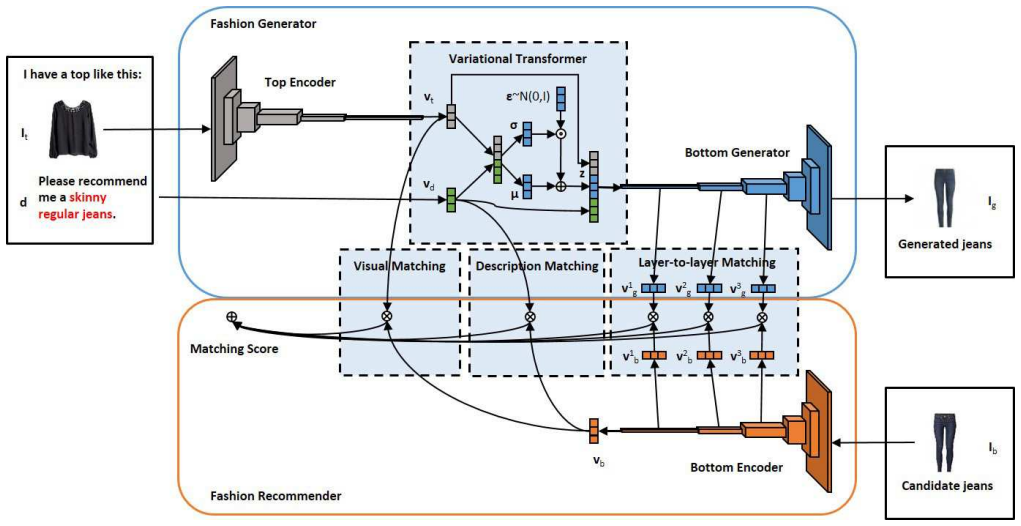
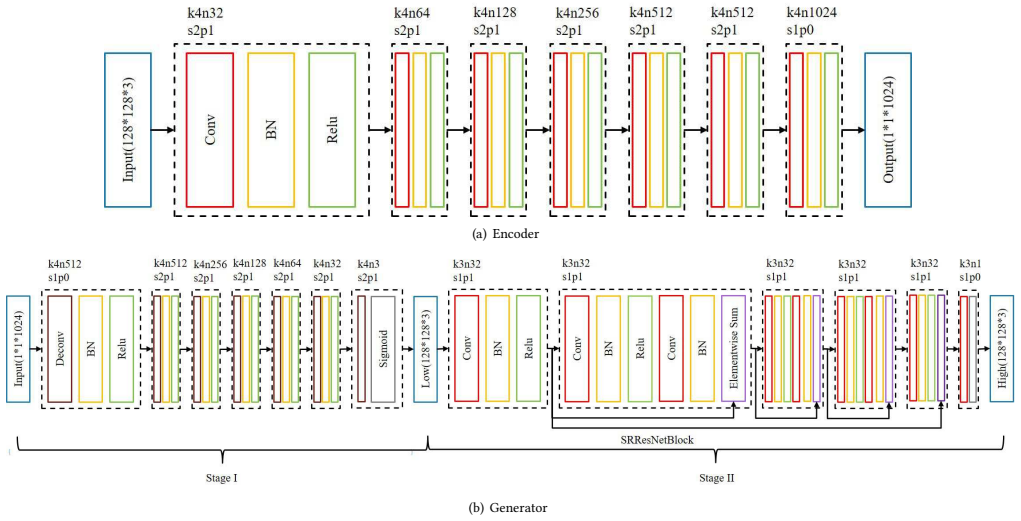
The key machinery is the co-supervision architecture plus the layer-to-layer matching mechanism. A variational transformer (an encoder CNN together with a deconvolutional generator) turns a top image and a bag-of-words description into a Gaussian latent code, from which a two-stage DCNN (including an SRResNet-style refinement stage) generates a bottom image; the generation loss forces the encoder to retain aesthetic information. The layer-to-layer matching mechanism then compares, at several selected layers, the feature maps of a candidate bottom with the feature maps of the generated bottom, summing these per-layer dot products into an additional matching score. This mechanism is what lets the recommendation part exploit the generated image without the model focusing only on generation quality.
What would settle it
Re-run FARM's experiments on a split in which no test-set positive bottom appears among the training generation targets; if the AUC and MRR gains over DVBPR$_{d}$ shrink to near zero, the reported improvement comes from memorizing seen items rather than from learning aesthetic compatibility.
Extended reading notes
Core claim
The central claim is that jointly training outfit recommendation with fashion generation improves recommendation accuracy. FARM consists of a variational-transformer-based generator that maps a top image and a bottom description into a generated bottom image, and a recommender that scores a candidate bottom by three matching signals: direct visual matching with the top, description matching with the text, and layer-to-layer matching between the candidate's CNN features and the generator's DCNN features at corresponding layers. The generator is trained to reconstruct the ground-truth positive bottom, while the recommender is trained with a Bayesian Personalized Ranking loss on positive and negative pairs; the two losses are optimized jointly. Experiments on FashionVC and ExpFashion show FARM outperforming strong baselines such as DVBPR$_{d}$, and ablations indicate that removing either the generation supervision or the layer-to-layer matching substantially reduces performance.
Load-bearing premise
The generation target during training is the actual positive bottom that will later be recommended, so the extra supervision only helps if the generator learns general compatibility rather than memorizing training images; the paper does not analyze whether test positive bottoms overlap with the generation targets seen during training.
Editorial extensions
If this is right
- If FARM's central claim is correct, then generation can serve as an auxiliary supervision signal for visual understanding in recommendation, not merely as a standalone generative task.
- The layer-to-layer matching design implies that the benefit of generation comes from intermediate visual abstractions, not from the final generated pixels alone.
- The reported gains on both top and bottom recommendation, on both FashionVC and ExpFashion, suggest the method transfers across dataset sizes and description lengths.
- Because the paper observes that poor generated images reduce recommendation quality, improving the generator should directly improve the recommender within this framework.
- The framework's ability to condition on text descriptions means that cold-start or sparse-annotation settings could still benefit, as long as descriptions are available.
Reading between the lines
- A direct test of the memorization concern would be to split the data so that no test-set positive bottom ever appears as a generation target during training; if the gain over DVBPR$_{d}$ vanishes, the reported improvement comes from reconstructing seen items rather than from learning general compatibility.
- One can extend FARM by replacing the pixel-reconstruction loss with a perceptual or adversarial loss; if the aesthetic-supervision hypothesis is right, such a change should preserve or increase the recommendation gain while improving generated-image quality.
- The layer-to-layer matching idea could transfer to other paired-image recommendation tasks where a generator can produce a plausible counterpart, such as shoes, bags, or whole outfits.
- The paper's failure cases hint that description quality is a bottleneck; a testable extension is to measure how recommendation AUC changes as description vocabulary is artificially degraded or enriched.
Signed reviews
Editorial analysis
A structured set of objections, weighed in public.
Referee Report
Summary. The paper proposes FARM (FAshion Recommendation Machine), an end-to-end framework for outfit recommendation. Given a top image and a free-text description of the desired bottom, a variational transformer encodes the pair into a latent distribution, and a DCNN generates a 'reference' bottom image. A recommender scores each candidate bottom by a sum of three terms: visual matching between top and bottom, description matching, and a layer-to-layer matching between the candidate and the generated reference at multiple CNN layers. The model is trained jointly with a generation loss (pixel-wise reconstruction of the ground-truth positive bottom plus a KL divergence) and a BPR recommendation loss. Experiments on FashionVC and ExpFashion report AUC and MRR improvements over several baselines, and ablations show that both the generation co-supervision and the layer-to-layer matching contribute.
Significance. Conditional on the results being free of memorization artifacts, FARM makes a useful contribution by demonstrating that a generation objective can act as a co-supervision signal for visual recommendation, and the layer-to-layer matching is a reasonable way to connect generation and recommendation. The authors ship code and data, and the evaluation is extensive, with paired t-tests and ablations (Tables 2-4). However, the central mechanism—that the generated reference is an independent aesthetic guide—requires that the generator generalizes rather than memorizes training positives, and this is not established. If the overlap threat is ruled out by additional experiments, the paper would provide a solid advance; without that evidence, the reported gains may be partly due to retrieval of seen images.
major comments (3)
- [Section 3.4, Eq. (20); Section 3.3.3, Eqs. (17)-(18); Section 4.1, Table 1] The reported improvements may be inflated by memorization of training positive bottoms. The generator is trained to minimize the pixel distance between the generated image and the ground-truth positive bottom Ip (Eq. 20), and at test time the reference is generated deterministically. The layer-to-layer matching (Eqs. 17-18) then scores candidates by their feature similarity to this reference. If a test positive bottom was used as a generation target during training—which is very likely given that ExpFashion contains 853,991 outfits but only 117,668 distinct bottoms, so a random outfit split will place the same bottom in both training and test—the generator can reproduce a memorized image and the matching term will favor it, raising AUC/MRR without adding compatibility knowledge. The paper provides no overlap statistics, no item-disjoint split, and no per-query analysis conditioned on whether the positive bottom was seen in training. The same issue affects the FARM-G comparison in Table 3, where generation-based retrieval would also benefit from memorized positives. I request: (i) report the fraction of test positives (and test queries) that appear in the training generation target set; (ii) run the main experiments under an item-disjoint split; and (iii) report results separately for seen versus unseen positives.
- [Section 5, Table 2] The significance claims are not fully supported by the reported statistics. The paper states that FARM significantly outperforms DVBPR_d using paired t-tests with p < 0.05, but it reports only point estimates with no standard deviations, confidence intervals, or number of runs. This makes it impossible to gauge the variability of the improvements or to verify that the t-test was conducted correctly. Please report mean ± standard deviation over multiple random seeds (or bootstrap confidence intervals) and state the number of runs used for the significance tests.
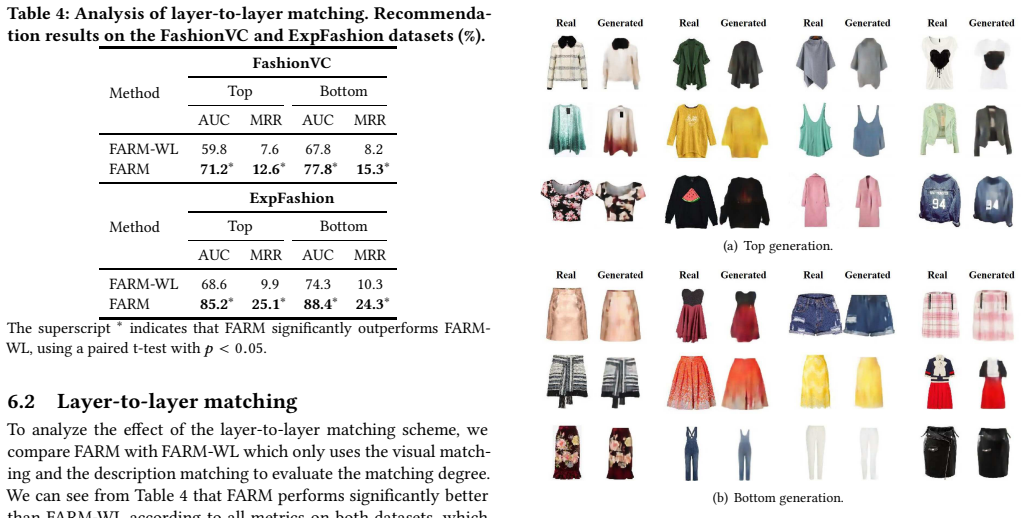
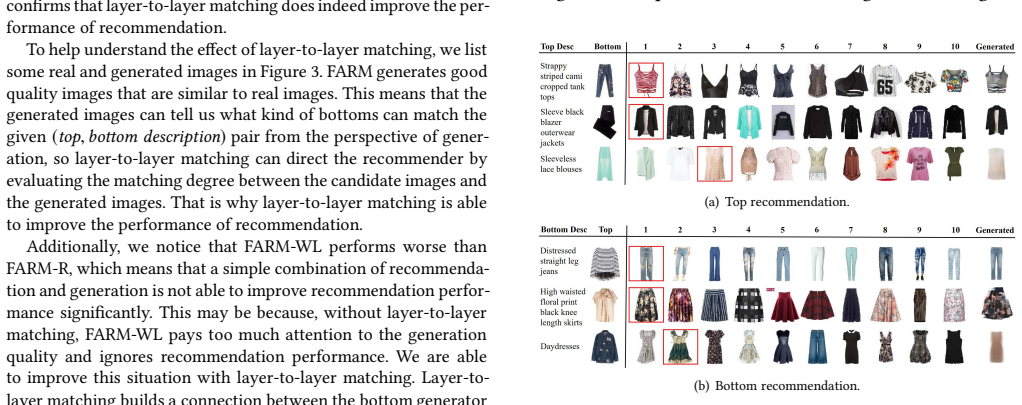
- [Abstract and Sections 6.3-6.4; Conclusion] The paper's claim that FARM 'generate[s] high quality images as references' and that generation quality affects recommendation is not quantitatively supported. Generation quality is only illustrated with a handful of qualitative examples (Figures 3-5), and no quantitative generation metrics (e.g., FID, IS, or human evaluation) or feature-level analyses are given. This is load-bearing because the proposed mechanism assumes the generated reference carries genuine aesthetic information; if the generator produces blurry or memorized images, the layer-to-layer matching gains could be an artifact of the reconstruction training. Please add quantitative generation-quality evaluation and, if possible, an analysis of how generation quality relates to recommendation performance.
minor comments (6)
- [Eq. (20)] The first term uses a squared L2 norm (with factor 1/2) while the second term uses a non-squared L2 norm; please clarify the intended loss (MSE versus L1) and whether this asymmetry is deliberate.
- [Section 4.2] The description of the layer-to-layer matching mapping is unclear: 'The 7th, the 6th and the 5th layers of the encoder CNN are adopted to compute the layer-to-layer matching with the input, the 1st and the 2nd layers of the generator DCNN.' Please specify exactly which encoder layer is paired with which DCNN layer.
- [Eq. (23)] The total loss sums Lgen, Lkl, and Lbpr without any weighting coefficients. Since the pixel-reconstruction term is likely to have a different scale than the BPR loss, please state whether these weights were tuned and what the final values are.
- [Section 4.1] Please clarify the train/validation/test split procedure (for example, by outfit or by query) and state the split ratio.
- [Eq. (30)] The AUC definition uses a strict indicator delta(s_p > s_n); ties are treated as failures. If ties occur, please define how they are handled.
- [Section 6.1, Table 3] The statement that FARM-G 'performs better than IBRd in most settings' is supported by Table 3, but the comparison is not like-for-like: FARM-G uses a different retrieval protocol (AlexNet features over generated images) than the trained end-to-end models. Please clarify the comparison protocol.
Circularity Check
The generation reference used in layer-to-layer matching is a reconstruction fitted to ground-truth positive images (Eq. 20), and the evaluation does not use an item-disjoint split, so the reported recommendation gains can partly reduce to matching against memorized training images.
-
fitted input called prediction
[Section 3.2 (Eq. 20), Section 3.3.3 (Eqs. 17-19), Section 4.1 (evaluation protocol)]
"During training, we regard the image Ip of a positive bottom p, which not only matches the given top It but also meets the given description d, as the generation target. ... Lgen(t,d,p) = 1/2 ||I1_hat − Ip||2_2 + ||I2_hat − Ip||. ... The generated image can be seen as a reference for recommendation. ... s_hat = Σ_{l∈L} s_l_hat ... s = sv + sd + s_hat."
The reference image scored in Eqs. 17-18 is not an independent aesthetic prior: it is produced by a generator trained with Eq. 20 to minimize pixel distance to the ground-truth positive bottom Ip of the same (t,d) query. The layer-to-layer term s_hat therefore measures candidate similarity to a reconstruction fitted on the label that the ranking is supposed to predict. When a test query's positive bottom also served as a generation target during training, ranking can be driven by retrieving that memorized image through s_hat rather than by generalizing compatibility. ExpFashion has 117,668 distinct bottoms but 853,991 outfits, so random outfit splits make such overlap very likely; the paper reports no item-disjoint split and no overlap analysis.
full rationale
FARM's architecture is not circular in the sense of a tautological derivation: the generator is a legitimate auxiliary network, the BPR loss is a standard external objective, and the baselines are implemented independently. The circularity is localized to the experimental support for the central claim. The generator's output is trained by Eq. 20 against the same positive bottom image that the recommender is asked to rank, and the layer-to-layer matching score of Eq. 19 then rewards candidates whose features resemble that fitted reconstruction. If train and test positives overlap, which the dataset statistics make very likely and which the paper neither prevents nor measures, the reported AUC/MRR improvements partly reduce to image retrieval of seen positives rather than to new compatibility knowledge. The paper's stated limitation, that recommendation performance is affected by generated image quality, does not address this train/test overlap issue. I do not find load-bearing self-citation: the self-created ExpFashion dataset is released and the method is implemented against external benchmarks, so the self-citation is not the mechanism forcing the result. The score of 6 reflects partial circularity in the evaluation chain: one prediction channel reduces to matching against a fitted reconstruction, while the overall framework retains independent content.
Assumptions & free parameters
free parameters (6)
- latent variable size k =
100
- representation size e =
100
- layer-to-layer layer set L =
Encoder layers 7, 6, 5 matched with generator input, 1st, and 2nd layers
- loss weights for Lgen, Lkl, Lbpr =
1.0 each
- candidate set size for evaluation =
100
- description vocabulary size Dd =
547
assumptions (5)
- standard math Variational inference ELBO and Gaussian posterior and prior assumptions are valid for the generative model.
- domain assumption Co-occurrence of items in Polyvore outfits is a sufficient proxy for fashion compatibility.
- ad hoc to paper A generated bottom image can serve as a meaningful reference for ranking real candidate bottoms.
- ad hoc to paper The pixel reconstruction loss on positive images transfers aesthetic knowledge to the recommendation encoder.
- domain assumption Randomly sampled negatives from B \ B_{t,d} provide a valid BPR training signal.
invented entities (1)
-
Generated reference image I_hat
Cite this review
Pith. "Pith review of Improving Outfit Recommendation with Co-supervision of Fashion Generation." pith.science (2026). https://pith.science/paper/GZS2MHT5
@misc{pith2026190809104,
  author       = {Pith},
  title        = {Pith review of: Improving Outfit Recommendation with Co-supervision of Fashion Generation},
  year         = {2026},
  howpublished = {\url{https://pith.science/paper/GZS2MHT5}},
  note         = {Machine review of arXiv:1908.09104}
}
read the original abstract
The task of fashion recommendation includes two main challenges: visual understanding and visual matching. Visual understanding aims to extract effective visual features. Visual matching aims to model a human notion of compatibility to compute a match between fashion items. Most previous studies rely on recommendation loss alone to guide visual understanding and matching. Although the features captured by these methods describe basic characteristics (e.g., color, texture, shape) of the input items, they are not directly related to the visual signals of the output items (to be recommended). This is problematic because the aesthetic characteristics (e.g., style, design), based on which we can directly infer the output items, are lacking. Features are learned under the recommendation loss alone, where the supervision signal is simply whether the given two items are matched or not. To address this problem, we propose a neural co-supervision learning framework, called the FAshion Recommendation Machine (FARM). FARM improves visual understanding by incorporating the supervision of generation loss, which we hypothesize to be able to better encode aesthetic information. FARM enhances visual matching by introducing a novel layer-to-layer matching mechanism to fuse aesthetic information more effectively, and meanwhile avoiding paying too much attention to the generation quality and ignoring the recommendation performance. Extensive experiments on two publicly available datasets show that FARM outperforms state-of-the-art models on outfit recommendation, in terms of AUC and MRR. Detailed analyses of generated and recommended items demonstrate that FARM can encode better features and generate high quality images as references to improve recommendation performance.
Figures
Figures from the paper (2 more)

Reference graph
Works this paper leans on
-
[1]
Timo Ahonen, Abdenour Hadid, and Matti Pietikainen. 200 6. Face Description with Local Binary Patterns: Application to Face Recognitio n. IEEE Trans on Pat- tern Analysis and Machine Intelligence (TPAMI) 28, 12 (2006)
work page 2006
- [2]
-
[3]
Jianmin Bao, Dong Chen, Fang Wen, Houqiang Li, and Gang Hu a. 2017. CV AE- GAN: Fine-Grained Image Generation through Asymmetric Tra ining. In Inter- national Conf. on Computer Vision (ICCV’17) . 2764–2773
work page 2017
-
[4]
Blei, Alp Kucukelbir, and Jon D
David M. Blei, Alp Kucukelbir, and Jon D. Mcauliffe. 2017. Variational Inference: A Review for Statisticians. Journal of the American Statistical Association (JASA) 112, 518 (2017)
work page 2017
-
[5]
Bourdev, Subhransu Maji, and Jitendra Malik
Lubomir D. Bourdev, Subhransu Maji, and Jitendra Malik. 2011. Describing peo- ple: A Poselet-based Approach to Attribute Classification. In International Conf. on Computer Vision (ICCV’11) . 1543–1550
work page 2011
-
[6]
Lei Cai, Hongyang Gao, and Shuiwang Ji. 2017. Multi-Stag e Variational Auto- Encoders for Coarse-to-Fine Image Generation. CoRR abs/1705.07202 (2017). http://arxiv.org/abs/1705.07202
work page Pith review arXiv 2017
-
[7]
Ken Chatfield, Karen Simonyan, Andrea Vedaldi, and Andre w Zisserman. 2014. Return of the Devil in the Details: Delving Deep into Convolu tional Nets. In British Machine Vision Conf. (BMVC’14)
work page 2014
-
[8]
Tianqi Chen, Mu Li, Yutian Li, Min Lin, Naiyan Wang, Minji e Wang, Tianjun Xiao, Bing Xu, Chiyuan Zhang, and Zheng Zhang. 2015. MXNet: A Flexible and Efficient Machine Learning Library for Heterogeneous Distri buted Systems. In Annual Conf. on Neural Information Processing Systems (NIPS’ 15)
work page 2015
Show all 55 references
-
[9]
Navneet Dalal and Bill Triggs. 2005. Histograms of Orien ted Gradients for Human Detection. In IEEE Conf. on Computer Vision and Pattern Recognition (CVPR’05). 886–893
2005
-
[10]
Xavier Glorot and Yoshua Bengio. 2010. Understanding t he Difficulty of Train- ing Deep Feedforward Neural Networks. Journal of Machine Learning Research (JMLR) 9 (2010), 249–256
2010
-
[11]
Xintong Han, Zuxuan Wu, Yu-Gang Jiang, and Larry S. Davi s. 2017. Learning Fashion Compatibility with Bidirectional LSTMs. In ACM International Conf. on Multimedia (MM’17). 1078–1086
2017
-
[12]
Kaiming He, Xiangyu Zhang, Shaoqing Ren, and Jian Sun. 2 016. Deep Residual Learning for Image Recognition. In IEEE Conf. on Computer Vision and Pattern Recognition (CVPR’16)
-
[13]
Wei Lin Hsiao and Kristen Grauman. 2018. Creating Capsu le Wardrobes from Fashion Images. In IEEE Conf. on Computer Vision and Pattern Recognition (CVPR’18)
2018
-
[14]
Yang Hu, Xi Yi, and Larry S. Davis. 2015. Collaborative F ashion Recommenda- tion: A Functional Tensor Factorization Approach. In ACM International Conf. on Multimedia (MM’15) . 129–138
2015
-
[15]
Tomoharu Iwata, Shinji Watanabe, and Hiroshi Sawada. 2 011. Fashion Coor- dinates Recommender System Using Photographs from Fashion Magazines. In International Joint Conf. on Artificial Intelligence (IJCA I’11). 2262–2267
-
[16]
Vignesh Jagadeesh, Robinson Piramuthu, Anurag Bhardw aj, Wei Di, and Neel Sundaresan. 2014. Large Scale Visual Recommendations from Street Fashion Images. In ACM Knowledge Discovery and Data Mining (KDD’14) . 1925–1934
2014
-
[17]
Gareth James, Daniela Witten, Trevor Hastie, and Rober t Tibshirani. 2013. An Introduction to Statistical Learning . Springer
2013
-
[18]
Shatha Jaradat. 2017. Deep Cross-Domain Fashion Recom mendation. In ACM Conf. on Recommender Systems (RecSys’17) . 407–410
2017
-
[19]
Yangqing Jia, Evan Shelhamer, Jeff Donahue, Sergey Kara yev, Jonathan Long, Ross Girshick, Sergio Guadarrama, and Trevor Darrell. 2014 . Caffe: Convolu- tional Architecture for Fast Feature Embedding. In ACM International Conf. on Multimedia (MM’14). 675–678
2014
-
[20]
Wang-Cheng Kang, Chen Fang, Zhaowen Wang, and Julian Mc Auley. 2017. Visually-Aware Fashion Recommendation and Design with Gen erative Image Models. In International Conf. on Data Mining (ICDM’17) . 207–216
2017
-
[21]
Hadi Kiapour, Xufeng Han, Svetlana Lazebnik, Alexan der C
M. Hadi Kiapour, Xufeng Han, Svetlana Lazebnik, Alexan der C. Berg, and Tamara L. Berg. 2015. Where to Buy It: Matching Street Clothi ng Photos in Online Shops. In International Conf. on Computer Vision (ICCV’15) . 3343–3351
2015
-
[22]
Kingma and Jimmy Ba
Diederik P. Kingma and Jimmy Ba. 2015. Adam: A Method for Stochas- tic Optimization. In International Conf. on Learning Representations (ICLR’15 ). http://arxiv.org/abs/1412.6980
2015 arXiv
-
[23]
Kingma and Max Welling
Diederik P. Kingma and Max Welling. 2014. Auto-encodin g Variational Bayes. In International Conf. on Learning Representations (ICLR’14 )
2014
-
[24]
Christian Ledig, Lucas Theis, Ferenc Huszár, Jose Caba llero, Andrew Cunning- ham, Alejandro Acosta, Andrew Aitken, Alykhan Tejani, Joha nnes Totz, and Zehan Wang. 2017. Photo-Realistic Single Image Super-Reso lution Using a Gen- erative Adversarial Network. InIEEE Conf. on Co...
2017
-
[25]
Jing Li, Pengjie Ren, Zhumin Chen, Zhaochun Ren, Tao Lia n, and Jun Ma. 2017. Neural Attentive Session-based Recommendation. In ACM International Conf. on Information and Knowledge Management (CIKM’17) . 1419–1428
2017
-
[26]
Yuncheng Li, Liangliang Cao, Jiang Zhu, and Jiebo Luo. 2 017. Mining Fashion Outfit Composition Using an End-to-End Deep Learning Approa ch on Set Data. IEEE Transactions on Multimedia (TMM) 19, 8 (2017), 1946–1955
2017
-
[27]
Kevin Lin, Huei Fang Yang, Jen Hao Hsiao, and Chu Song Che n. 2015. Deep Learning of Binary Hash Codes for Fast Image Retrieval. In IEEE Conf. on Com- puter Vision and Pattern Recognition (CVPR’15) . 27–35
2015
-
[28]
Ren, Zhumin Chen, Zhaochun Ren, Jun Ma, and Maarten de Rijke
Yujie Lin, Pengjie. Ren, Zhumin Chen, Zhaochun Ren, Jun Ma, and Maarten de Rijke. 2019. Explainable Outfit Recommendation with Joint Outfit Matching and Comment Generation. IEEE Transactions on Knowledge and Data Engineering (2019)
2019
-
[29]
Si Liu, Jiashi Feng, Zheng Song, Tianzhu Zhang, Hanqing Lu, Changsheng Xu, and Shuicheng Yan. 2012. Hi, Magic Closet, Tell Me What to Wea r!. In ACM International Conf. on Multimedia (MM’12) . 619–628
2012
-
[30]
Yihui Ma, Jia Jia, Suping Zhou, Jingtian Fu, Yejun Liu, a nd Zijian Tong. 2017. Towards Better Understanding the Clothing Fashion Styles: A Multimodal Deep Learning Approach. In AAAI Conf. on Artificial Intelligence (AAAI’17) . 38–44
2017
-
[31]
Julian McAuley, Christopher Targett, Qinfeng Shi, and Anton van den Hengel
-
[32]
Takuma Nakamura and Ryosuke Goto. 2018. Outfit Generati on and Style Extrac- tion via Bidirectional LSTM and Autoencoder. In ACM Knowledge Discovery and Data Mining (KDD’18)
2018
-
[33]
Jose Oramas and Tinne Tuytelaars. 2016. Modeling Visua l Com- patibility through Hierarchical Mid-level Elements. CoRR (2016). http://arxiv.org/abs/1604.00036
2016 arXiv
-
[34]
Razvan Pascanu, Tomas Mikolov, and Yoshua Bengio. 2013 . On the Difficulty of Training Recurrent Neural Networks. In International Conf. on Machine Learning (ICML’13). III–1310–III–1318
2013
-
[35]
Steffen Rendle, Christoph Freudenthaler, Zeno Gantner , and Lars Schmidt- Thieme. 2009. BPR: Bayesian Personalized Ranking from Impl icit Feedback. In International Conf. on Uncertaintyin Artificial Intellige nce (UAI’09). 452–461
2009
-
[36]
Steffen Rendle and Lars Schmidt-Thieme. 2010. Pairwise Interaction Tensor Fac- torization for Personalized Tag Recommendation. In ACM International Conf. on Web Search and Data Mining (WSDM’10) . 81–90
2010
-
[37]
Danilo Jimenez Rezende, Shakir Mohamed, and Daan Wiers tra. 2014. Stochas- tic Backpropagation and Approximate Inference in Deep Gene rative Models. In International Conf. on Machine Learning (ICML’14) . 1278–1286
2014
-
[38]
Edgar Simo-Serra, Sanja Fidler, Francesc Moreno-Nogu er, and Raquel Urtasun
-
[39]
Karen Simonyan and Andrew Zisserman. 2015. Very Deep Co nvolutional Net- works for Large-Scale Image Recognition. In International Conf. on Learning Rep- resentations (ICLR’15)
2015
-
[40]
Xuemeng Song, Fuli Feng, Xianjing Han, Xin Yang, Wei Liu , and Liqiang Nie
-
[41]
In IEEE Conf
Neuroaesthetics in fashion: Modeling the perception of fashionability. In IEEE Conf. on Computer Vision and Pattern Recognition (CVPR’1 5), Vol. 00. 869– 877
-
[42]
Nitish Srivastava, Geoffrey Hinton, Alex Krizhevsky, I lya Sutskever, and Ruslan Salakhutdinov. 2014. Dropout: A Simple Way to Prevent Neura l Networks from Overfitting. Journal of Machine Learning Research (JMLR) 15, 1 (2014), 1929– 1958
2014
-
[43]
Andreas Veit, Balazs Kovacs, Sean Bell, Julian Mcauley , Kavita Bala, and Serge Belongie. 2015. Learning Visual Clothing Style with Hetero geneous Dyadic Co- Occurrences. In International Conf. on Computer Vision (ICCV’15) . 4642–4650
2015
-
[44]
Kota Yamaguchi. 2012. Parsing Clothing in Fashion Phot ographs. In IEEE Conf. on Computer Vision and Pattern Recognition (CVPR’12) . 3570–3577
2012
-
[45]
Xuemeng Song, Fuli Feng, Jinhuan Liu, Zekun Li, Liqiang Nie, and Jun Ma. 2017. NeuroStylist: Neural Compatibility Modeling for Clothing Matching. In ACM International Conf. on Multimedia (MM’17) . 753–761
2017
-
[46]
Wenhui Yu, Huidi Zhang, Xiangnan He, Xu Chen, Li Xiong, a nd Zheng Qin
-
[47]
Zeiler and Rob Fergus
Matthew D. Zeiler and Rob Fergus. 2014. Visualizing and Understanding Convo- lutional Networks. In European Conf. on Computer Vision (ECCV’14) . 818–833
2014
-
[48]
Zeiler, Graham W
Matthew D. Zeiler, Graham W. Taylor, and Rob Fergus. 201 1. Adaptive Decon- volutional Networks for Mid and High Level Feature Learning . In International Conf. on Computer Vision (ICCV’11) . 2018–2025
2018
-
[49]
Hadi Kiapour, Luis E
Kota Yamaguchi, M. Hadi Kiapour, Luis E. Ortiz, and Tama ra L. Berg. 2015. Re- trieving Similar Styles to Parse Clothing. IEEE Trans on Pattern Analysis and Machine Intelligence (TPAMI) 37, 5 (2015), 1028–1040
2015
-
[50]
Hanwang Zhang, Zheng-Jun Zha, Yang Yang, Shuicheng Yan , Yue Gao, and Tat- Seng Chua. 2013. Attribute-augmented Semantic Hierarchy: Towards Bridging Semantic Gap and Intention Gap in Image Retrieval. In ACM International Conf. on Multimedia (MM’13) . 33–42
2013
-
[51]
In International World Wide Web Conferences (WWW’18)
Aesthetic-based Clothing Recommendation. In International World Wide Web Conferences (WWW’18). 649–658
-
[54]
Han Zhang, Tao Xu, Hongsheng Li, Shaoting Zhang, Xiaoga ng Wang, Xiaolei Huang, and Dimitris Metaxas. 2017. StackGAN: Text to Photo- Realistic Image Synthesis with Stacked Generative Adversarial Networks. I n International Conf. on Computer Vision (ICCV’17) . 5908–5916
2017
-
[2014]
In European Conf
Neural Codes for Image Retrieval. In European Conf. on Computer Vision (ECCV’14)
-
[2015]
In International Conf
Image-Based Recommendations on Styles and Substitut es. In International Conf. on Research on Development in Information Retrieval ( SIGIR’15). 43–52
-
[2018]
In International Conf
Neural Compatibility Modeling with Attentive Knowle dge Distillation. In International Conf. on Research on Development in Informat ion Retrieval (SI- GIR’18)
Reviewed August 14, 2026 · model on record in the stance chip above.
Discussion (0). Continue with ORCID to comment.