REVIEW 3 major objections 5 minor 85 references
Effect of overlap on spreading dynamics on multiplex networks
T0 review · 3 major / 5 minor · reviewed 2026-08-14 · deepseek-v4-flash
Pith's one-line read On two-layer networks, the AND-rule SIS model crosses a continuous phase transition only when every edge is shared; the moment any edge differs between layers, the outbreak becomes discontinuous and bistable, with a wider hysteresis…
desk verdict Solid mean-field and simulation study of an AND-rule SIS model on duplex networks, with a real overlap-controlled transition, but the paper overclaims: its own Eq. (18) gives continuous behavior for O ≥ ⟨k⟩/(⟨k⟩+1), not for all O < 1. read the letter →
The pith
A machine-rendered reading of the paper's core claim, the machinery that carries it, and where it could break.
The reading
What carries the argument
The machinery is the AND-rule infection rate of Eq. (2), which counts infectious contacts as $(n_i^1+n_i^2)/2$ but multiplies by step functions requiring $n_i^1\ge1$ and $n_i^2\ge1$. Averaging this rate over Poisson-binomial neighbor sets gives the individual-based mean-field equation (Eq. (13)), with $R_{\rm inf}$ written explicitly in Eq. (12). Linearizing near extinction leaves only the common-neighbor term, producing the overlapping adjacency matrix $\tilde{A}_{ij}=A^1_{ij}A^2_{ij}$ and the threshold $\beta_C=1/\Lambda_{\max}(\tilde{A})$. In the homogeneous reduction this becomes the scalar equation (Eq. (18)), whose extra term $-(1-O)(1-\rho)^{\langle k\rangle}$ is what creates the saddle-node bifurcation and the bistable region. This product adjacency matrix and the nonlinear term it induces carry the argument.
What would settle it
Solve Eq. (18) numerically for a homogeneous network with $\langle k\rangle=20$ and $O=0.95$, continuing the stable and unstable branches as functions of $\beta$. If the endemic branch grows continuously from $\beta_C=1/(20O)$ with no saddle-node and no hysteresis, the paper's claim of a discontinuous transition for every $O<1$ is refuted.
Extended reading notes
Core claim
The central claim is a dichotomy controlled by edge overlap. When all edges coincide ($O=1$), the AND-rule infection rate collapses to the usual SIS rate, so the endemic state emerges continuously at the threshold $\beta_C=1/\Lambda_{\max}(A)$. For any partial overlap, the homogeneous mean-field equation (Eq. (18)) is claimed to develop a saddle-node pair: below $\beta_F$ only the healthy state is stable, above $\beta_C=1/(\langle k\rangle O)$ only the endemic state is stable, and between them the two coexist, producing hysteresis. The paper reports this behavior in simulations on Poisson, scale-free, small-world, lattice, and real multiplex networks and finds that the individual-based mean-field theory reproduces the simulations. The threshold is set by the overlapping adjacency matrix $\tilde{A}_{ij}=A^1_{ij}A^2_{ij}$, so only edges common to both layers contribute to the onset of the outbreak.
Load-bearing premise
The dichotomy 'continuous only at $O=1$, discontinuous for every $O<1$' assumes that the homogeneous mean-field equation has three coexisting fixed points for all partial overlap; that condition actually holds only for $O<\langle k\rangle/(\langle k\rangle+1)$, so near-complete overlap may still show a continuous onset.
Editorial extensions
If this is right
- For any two layers that are not identical, an AND-rule SIS outbreak has a hysteresis window: low-seed outbreaks die while high-seed outbreaks persist at the same infection rate.
- The epidemic threshold depends only on the overlap matrix, so edges that are not shared between layers do not change $\beta_C$; only common edges matter for onset.
- In homogeneous networks $\beta_C=1/(\langle k\rangle O)$, so the threshold rises as overlap decreases and diverges as $O\to0$.
- At $O=1$ the model reduces to standard SIS, confirming that the discontinuity is generated by the non-additive AND condition rather than by multiplexity alone.
- Real multiplex datasets with partial overlap should exhibit the same bistable, discontinuous outbreak because the mechanism requires only common and distinct edges, not a specific network family.
Reading between the lines
- The paper's own Eq. (18) actually has a saddle-node only for $O<\langle k\rangle/(\langle k\rangle+1)$; testing $O$ near 1 would reveal whether the 'discontinuous for all $O<1$' statement needs a boundary in $O$ rather than a dichotomy.
- Because $\beta_C$ is governed solely by common edges, measuring overlap is as important as measuring degree; a layered contact network with tiny overlap could suppress a pathogen that would otherwise spread on either layer.
- The AND-rule is formally a two-body higher-order interaction, so the same saddle-node mechanism should appear in hypergraph or simplicial contagion models with pairwise-only interactions in each layer.
- In finite populations, the observed $\beta_F$ may be shifted by absorbing-state fluctuations, so a finite-size scaling test would show whether the bistable window survives in the thermodynamic limit.
Signed reviews
Editorial analysis
A structured set of objections, weighed in public.
Referee Report
Summary. The paper studies a susceptible-infected-susceptible epidemic model on duplex networks in which a susceptible node can be infected only when it has at least one infectious neighbor in each layer. The authors define an overlap parameter O for the fraction of edges common to both layers and claim that the nature of the epidemic phase transition is controlled by O: for O=1 the transition is continuous, while for every O<1 it is discontinuous and accompanied by a bistable region, which widens as O decreases. They derive an individual-based mean-field equation (Eq. 13), its homogeneous-network reduction (Eq. 18), and the epidemic threshold βC = 1/Λmax(Ã) (Eq. 16), and they support the claims with simulations on Erdős-Rényi, Barabási-Albert, Watts-Strogatz, lattice, three-layer, and real multiplex networks.
Significance. The model itself is a simple and natural extension of SIS dynamics to multiplex networks, and the observation that edge overlap can change the order of the transition is potentially interesting. The paper is commendably explicit: the mean-field equations are derived rather than fitted, the epidemic threshold is obtained by linear stability analysis, and the simulation protocol is described in enough detail to be reproduced. If the claims are corrected as described below, the paper would be a useful contribution to the literature on multilayer spreading dynamics. However, as written, the central statement that 'O<1 implies a discontinuous transition' is not supported by the paper's own mean-field equation, and the issue is load-bearing because the abstract, introduction, phase diagram, and conclusions all rest on this statement.
major comments (3)
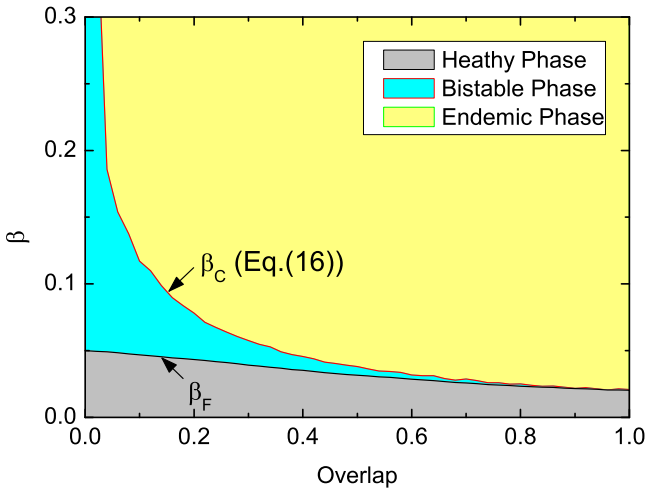
- [Abstract; Section IV.B, Eq. (18); Section VII] The central claim that every O<1 yields a discontinuous transition is contradicted by the paper's own homogeneous mean-field equation. Setting y=1-ρ in Eq. (18), nonzero stationary solutions satisfy 1 = β⟨k⟩ y [1 - (1-O) y^{⟨k⟩}], i.e. β = 1/(⟨k⟩ F(y)) with F(y)=y[1-(1-O)y^{⟨k⟩}]. A saddle-node bifurcation, and hence bistability, requires F to have an interior maximum on (0,1), which occurs only when O < ⟨k⟩/(⟨k⟩+1). For O ≥ ⟨k⟩/(⟨k⟩+1), F is monotonically increasing, so the endemic branch emerges continuously at βC=1/(⟨k⟩O) via a transcritical bifurcation. The abstract's 'Otherwise, a discontinuous phase transition is observed' is therefore false as a universal statement. For ⟨k⟩=20, the simulations in Figs. 2 and 3 and the mean-field plots in Fig. 7 use O≤0.8 < 20/21, so the regime O∈[20/21,1) is never probed. The text should replace the condition O<1 by O<⟨k⟩/(⟨k⟩+1) (or a corresponding network-specific condition) and should discuss the tricritical point at O=⟨k⟩/(⟨k⟩+1).
- [Section IV.B and Figs. 6 and 7(d)] The phase diagram in the β-O plane is misleading as drawn. It appears to show a bistable region for all O<1, but Eq. (18) implies that no closed bistable region exists for O ≥ ⟨k⟩/(⟨k⟩+1). The βF boundary should terminate at the tricritical value O=⟨k⟩/(⟨k⟩+1), and the phase diagram should clearly indicate that the discontinuous transition and hysteresis are confined to small O. The paper's claim that 'the bistable region is enlarged as O decreases' is consistent only within the regime O<⟨k⟩/(⟨k⟩+1), and the phase diagram should reflect this restriction.
- [Section VI, Fig. 9 (square lattice)] An additional concrete failure of the unqualified claim appears in the square-lattice example (Fig. 9). For a square lattice the degree is k=4, so the homogeneous mean-field criterion gives a tricritical point at O=4/5=0.8. The simulation in Fig. 9(b) uses O=0.8, which is exactly at this boundary, where Eq. (18) predicts no interior saddle-node and hence no bistable window. The paper presents this panel as an example of the discontinuous transition, without noting that the homogeneous theory places it at the transition of the transition-order boundary. This strengthens the need to state the parameter condition explicitly and to test values of O above the tricritical value.
minor comments (5)
- [Abstract] The first sentence contains a grammatical error: 'In spite of the study ... has received' should be 'Although the study ... has received' or 'Despite the attention that the study ... has received'.
- [Section VI] The figure numbering in the text is inconsistent with the captions: the Watts-Strogatz results are referenced as 'Fig. 7', but Fig. 7 is the homogeneous mean-field figure; the square-lattice results are referenced as 'Fig. 8', but the caption labels them as Fig. 9; and the three-layer results are referenced as 'Fig. 9', but the caption labels them as Fig. 10.
- [Section IV.B] The phrase 'they colloid and annihilate' should be 'they collide and annihilate'.
- [References] Reference [9] contains a typo, 'Strcuture' for 'Structure', and the text repeatedly spells the real network name 'SACCHCERE' where the standard name is 'Saccharomyces cerevisiae' (the multicode database entry).
- [Eq. (17)] The notation O1(2) is under-defined; the reader must infer that O1 and O2 denote the overlap fractions in the two layers. A sentence defining O1 and O2 explicitly before Eq. (17) would improve readability.
Circularity Check
No significant circularity; the derivation is a self-contained mean-field analysis with no fitted parameters.
full rationale
The paper's central results are the individual-based mean-field equation (Eq. 13) and its homogeneous reduction (Eq. 18), the epidemic threshold beta_C = 1/Lambda_max(A_tilde) (Eq. 16) and beta_C = 1/(<k>O) (Eq. 19), and the claim of a discontinuous transition for O<1. These are derived analytically from the model definition (Eq. 2) via probability arguments and linear stability analysis, with no parameters fitted to simulation data. The lower boundary beta_F is obtained by numerically solving the steady-state mean-field equation, independently of simulation outcomes. Simulation results are compared with the theory as a consistency check, which is the standard use of mean-field theory and does not make the prediction a renamed fit. No load-bearing self-citation is present: references to prior SIS threshold results are standard external results used only to check the O=1 limit. The manuscript itself contains an internal caveat about the difficulty of numerically accessing beta_C due to finite-size fluctuations, which further supports that the threshold is not tuned to the simulations. A possible limitation is that the unconditional statement 'O<1 gives a discontinuous transition' is not supported by the paper's own Eq. (18) for O >= <k>/(<k>+1), where the nonzero branch emerges continuously; however, this is an internal-consistency/correctness concern, not a circularity, because the claimed result is not equivalent to its inputs by construction.
Assumptions & free parameters
assumptions (4)
- domain assumption Distribution of infected neighbors in disjoint neighbor sets factorizes (Poisson-binomial independence, Eq. (3)).
- domain assumption Homogeneous mean-field assumes all nodes statistically equivalent (ρi=ρ, equal degrees in each layer) for Eqs. (17)-(18).
- ad hoc to paper The rewiring process yields a duplex network with the desired overlap O while preserving the statistical properties of the layers other than overlap.
- domain assumption Random sequential update with Δt=1/(kmax λ) accurately approximates the continuous-time Markov process.
Cite this review
Pith. "Pith review of Effect of overlap on spreading dynamics on multiplex networks." pith.science (2026). https://pith.science/paper/VVEBMRYW
@misc{pith2026190809105,
  author       = {Pith},
  title        = {Pith review of: Effect of overlap on spreading dynamics on multiplex networks},
  year         = {2026},
  howpublished = {\url{https://pith.science/paper/VVEBMRYW}},
  note         = {Machine review of arXiv:1908.09105}
}
abstract
In spite of the study of epidemic dynamics on single-layer networks has received considerable attention, the epidemic dynamics on multiplex networks is still limited and is facing many challenges. In this work, we consider the susceptible-infected-susceptible-type (SIS) epidemic model on multiplex networks and investigate the effect of overlap among layers on the spreading dynamics. To do so, we assume that the prerequisite of one $S$-node to be infected is that there is at least one infectious neighbor in each layer. A remarkable result is that the overlap can alter the nature of the phase transition for the onset of epidemic outbreak. Specifically speaking, the system undergoes a usual continuous phase transition when two layers are completely overlapped. Otherwise, a discontinuous phase transition is observed, accompanied by the occurrence of a bistable region in which a disease-free phase and an endemic phase are coexisting. As the degree of the overlap decreases, the bistable region is enlarged. The results are validated by both simulation and mean-field theory.
Figures


Figures from the paper (8 more)




Reference graph
Works this paper leans on
-
[1]
Newman, Networks (Oxford university press, 2018)
M. Newman, Networks (Oxford university press, 2018)
2018
-
[2]
M. E. J. Newman, SIAM Review 45, 167 (2003)
2003
-
[3]
S. Boccaletti, V. Latora, Y. Moreno, M. Chavez, and D.-U. Hwang, Phys. Rep. 424, 175 (2006)
work page 2006
-
[4]
Arenas, A
A. Arenas, A. D ´ ıaz-Guilera, J. Kurths, Y. Moreno, and C. Zhou, Phys. Rep. 469, 93 (2008)
2008
-
[5]
R. Pastor-Satorras, C. Castellano, P. Van Mieghem, and A . Vespignani, Rev. Mod. Phys. 87, 925 (2015). 22
work page 2015
-
[6]
M. Perc, J. J. Jordan, D. G. Rand, Z. Wang, S. Boccaletti, a nd A. Szolnoki, Phys. Rep. 687, 1 (2017)
work page 2017
-
[7]
S. N. Dorogovtsev, A. V. Goltseve, and J. F. F. Mendes, Rev . Mod. Phys. 80, 1275 (2008)
work page 2008
-
[8]
M. Kivel¨ a, A. Arenas, M. Barthelemy, J. P. Gleeson, Y. Moreno, and M. A. Porter, J. Complex Netw. 2, 203 (2014)
work page 2014
Show all 85 references
-
[9]
Bianconi, Multilayer networks: Strcuture and Function (Oxford University Press, 2018)
G. Bianconi, Multilayer networks: Strcuture and Function (Oxford University Press, 2018)
2018
-
[10]
Boccaletti, G
S. Boccaletti, G. Bianconi, R. Criado, C. del Genio, J. G ´ omez-Garde˜ nes, M. Romance, I. Sendi˜ na-Nadal, Z. Wang, and M. Zanin, Phys. Rep. 544, 1 (2014)
2014
-
[11]
S. V. Buldyrev, R. Parshani, G. Paul, H. E. Stanley, and S . Havlin, Nature 464, 1025 (2010)
2010
-
[12]
G. J. Baxter, S. N. Dorogovtsev, A. V. Goltsev, and J. F. F . Mendes, Phys. Rev. Lett. 109, 248701 (2012)
2012
-
[13]
G´ omez, A
S. G´ omez, A. D ´ ıaz-Guilera, J. G´ omez-Garde˜ nes, C. J. P´ erez-Vicente, Y. Moreno, and A. Are- nas, Phys. Rev. Lett. 110, 028701 (2013)
2013
-
[14]
Radicchi and A
F. Radicchi and A. Arenas, Nat. Phys. 9, 717 (2013)
2013
-
[15]
Z. Wang, L. Wang, A. .Szolnoki, and M. Perc, Eur. Phys. J. B 88, 124 (2015)
2015
-
[16]
Battiston, M
F. Battiston, M. Perc, and V. Latora, New J. Phys. 19, 073017 (2017)
2017
-
[17]
C. Xia, X. Li, Z. Wang, and M. Perc, New J. Phys. 20, 075005 (2018)
2018
-
[18]
Aguirre, R
J. Aguirre, R. Sevilla-Escoboza, R. Guti´ errez, D. Pap o, and J. M. Buld´ u, Phys. Rev. Lett. 112, 248701 (2014)
2014
-
[19]
Majhi, M
S. Majhi, M. Perc, and D. Ghosh, Sci. Rep. 6, 39033 (2016)
2016
-
[20]
C. I. del Genio, J. G´ omez-Garde˜ nes, I. Bonamassa, and S. Boccaletti, Sci. Adv. 2, e1601679 (2016)
2016
-
[21]
Diakonova, M
M. Diakonova, M. San Miguel, and V. M. Egu ´ ıluz, Phys. Re v. E 89, 062818 (2014)
2014
-
[22]
Diakonova, V
M. Diakonova, V. Nicosia, V. Latora, and M. S. Miguel, Ne w J. Phys. 18, 023010 (2016)
2016
-
[23]
Sol´ e-Ribalta, S
A. Sol´ e-Ribalta, S. G´ omez, and A. Arenas, Phys. Rev. L ett. 116, 108701 (2016)
2016
-
[24]
Manfredi, E
S. Manfredi, E. Di Tucci, and V. Latora, Phys. Rev. Lett. 120, 068301 (2018)
2018
-
[25]
Sol´ e-Ribalta, M
A. Sol´ e-Ribalta, M. De Domenico, N. E. Kouvaris, A. D ´ ıaz-Guilera, S. G´ omez, and A. Arenas, Phys. Rev. E 88, 032807 (2013)
2013
-
[26]
Cencetti and F
G. Cencetti and F. Battiston, New J. Phys. 21, 035006 (2019)
2019
-
[27]
Hinrichsen, Adv
H. Hinrichsen, Adv. Phys. 49, 815 (2000)
2000
-
[28]
Vespignani, Nat
A. Vespignani, Nat. Phys. 8, 32 (2012). 23
2012
-
[29]
Salehi, R
M. Salehi, R. Sharma, M. Marzolla, M. Magnani, P. Siyari , and D. Montesi, IEEE Transactions on Network Science and Engineering 2, 65 (2015)
2015
-
[30]
M. D. Domenico, C. Granell, M. A. Porter, and A. Arenas, N at. Phys. 2, 901 (2016)
2016
-
[31]
G. F. de Arruda, F. A. Rodrigues, and Y. Moreno, Phys. Rep . 756, 1 (2018)
2018
-
[32]
Cozzo, R
E. Cozzo, R. A. Ba˜ nos, S. Meloni, and Y. Moreno, Phys. Re v. E 88, 050801 (2013)
2013
-
[33]
H. Wang, Q. Li, G. D’Agostino, S. Havlin, H. E. Stanley, a nd P. Van Mieghem, Phys. Rev. E 88, 022801 (2013)
2013
-
[34]
Saumell-Mendiola, M
A. Saumell-Mendiola, M. A. Serrano, and M. Bogu˜ n´ a, Phys. Rev. E 86, 026106 (2012)
2012
-
[35]
Dickison, S
M. Dickison, S. Havlin, and H. E. Stanley, Phys. Rev. E 85, 066109 (2012)
2012
-
[36]
Bianconi, J
G. Bianconi, J. Stat. Mech. p. 034001 (2017)
2017
-
[37]
Soriano-Pa˜ nos, L
D. Soriano-Pa˜ nos, L. Lotero, A. Arenas, and J. G´ omez- Garde˜ nes, Phys. Rev. X 8, 031039 (2018)
2018
-
[38]
Q. Xuan, F. Du, L. Yu, and G. Chen, Phys. Rev. E 87, 032809 (2013)
2013
-
[39]
B. Wang, G. Tanaka, H. Suzuki, and K. Aihara, Phys. Rev. E 90, 032806 (2014)
2014
-
[40]
G. F. de Arruda, E. Cozzo, T. P. Peixoto, F. A. Rodrigues, and Y. Moreno, Phys. Rev. X 7, 011014 (2017)
2017
-
[41]
They showed, on the one hand, the existence of disease localization [42] and the emergence of two or more susceptibility peaks
to derive analytical expressions for the epidemic threshold of t he SIS and SIR model on multilayer networks. They showed, on the one hand, the existence of disease localization [42] and the emergence of two or more susceptibility peaks. On the othe r hand, they found that, wh...
-
[42]
A. V. Goltsev, S. N. Dorogovtsev, J. G. Oliveira, and J. F . F. Mendes, Phys. Rev. Lett. 109, 128702 (2012)
2012
-
[43]
Nicosia, P
V. Nicosia, P. S. Skardal, A. Arenas, and V. Latora, Phys . Rev. Lett. 118, 138302 (2017)
2017
-
[44]
De Domenico, A
M. De Domenico, A. Sol´ e-Ribalta, E. Cozzo, M. Kivel¨ a, Y. Moreno, M. A. Porter, S. G´ omez, and A. Arenas, Phys. Rev. X 3, 041022 (2013)
2013
-
[45]
Granell, S
C. Granell, S. G´ omez, and A. Arenas, Phys. Rev. Lett. 111, 128701 (2013)
2013
-
[46]
Kan and H.-F
J.-Q. Kan and H.-F. Zhang, Commun. Nonlinear Sci. 44, 193 (2017)
2017
-
[47]
Zhang, S
X. Zhang, S. Boccaletti, S. Guan, and Z. Liu, Phys. Rev. L ett. 114, 038701 (2015)
2015
-
[48]
Mishkovski, M
I. Mishkovski, M. Mirchev, S. Scepanovic, and L. Kocare v, IEEE Transactions on Circuits and Systems I: Regular Papers 64, 2761 (2017)
2017
-
[49]
N. An, H. Chen, C. Ma, and H. Zhang, New J. Phys. 20, 125006 (2018)
2018
-
[50]
W. Wang, M. Tang, H. Yang, Y. Do, Y.-C. Lai, and G. Lee, Sci . Rep. 4, 5097 (2014)
2014
-
[51]
M. A. Pires, A. L. Oestereich, and N. Crokidakis, J. Stat . Mech. p. 053407 (2018)
2018
-
[52]
Jiang and T
J. Jiang and T. Zhou, Sci. Rep. 8, 1629 (2018). 24
2018
-
[53]
Vel´ asquez-Rojas and F
F. Vel´ asquez-Rojas and F. Vazquez, Phys. Rev. E 95, 052315 (2017)
2017
-
[54]
studied the dynamics of the SIS model in social-contact multiplex networks when the 3 recovery of infected nodes depends on resources from healthy n eighbors in the social layer. They found that as the infection rate increases the infected dens ity varies smoothly from zero to...
-
[55]
Zhang, C
Z.-K. Zhang, C. Liu, X.-X. Zhan, X. Lu, C.-X. Zhang, and Y .-C. Zhang, Phys. Rep. 651, 1 (2016)
2016
-
[56]
Z. Su, W. Wang, L. Li, H. Stanley, and L. A. Braunstein, Ne w J. Phys. 20, 053053 (2018)
2018
-
[57]
X. Chen, R. Wang, M. Tang, S. Cai, H. Stanley, and L. A. Bra unstein, New J. Phys. 20, 013007 (2018)
2018
-
[58]
Centola, Science 329, 1194 (2010)
D. Centola, Science 329, 1194 (2010)
2010
-
[59]
Bianconi, Phys
G. Bianconi, Phys. Rev. E 87, 062806 (2013)
2013
-
[60]
Jalan and P
S. Jalan and P. Pradhan, Phys. Rev. E 97, 042314 (2018)
2018
-
[61]
Varghese and R
C. Varghese and R. Durrett, Phys. Rev. E 87, 062819 (2013)
2013
-
[62]
D. J. Watts, Proc. Nat. Acad. Sci. 99, 5766 (2002)
2002
-
[63]
Chae, S.-H
H. Chae, S.-H. Yook, and Y. Kim, New J. Phys. 17, 023039 (2015)
2015
-
[64]
Erd¨ os and A
P. Erd¨ os and A. R´ enyi, Publ. Math.6, 290 (1959)
1959
-
[65]
Chowdhury, A
D. Chowdhury, A. Schadschneider, and K. Nishinari, Phy s. Life Rev. 2, 318 (2005)
2005
-
[66]
In the next section, we will present a formulistic interpretation to th e discontinuous phase transition based on a mean-field theory
or due to negative intralayer coupling of the second lay er [67]. In the next section, we will present a formulistic interpretation to th e discontinuous phase transition based on a mean-field theory. 10 L1 L1 L1 ? L1 L1 ? FIG. 5. A schematic representation of neighborhood o...
-
[67]
D. T. Gillespie, J. Phys. Chem. 81, 2340 (1977)
1977
-
[68]
Barab´ asi and R
A.-L. Barab´ asi and R. Albert, Science 286, 509 (1999)
1999
-
[69]
Jalan, A
S. Jalan, A. Kumar, and I. Leyva, Chaos 29, 041102 (2019)
2019
-
[70]
Jalan, V
S. Jalan, V. Rathore, A. D. Kachhvah, and A. Yadav, Phys. Rev. E 99, 062305 (2019)
2019
-
[71]
Y. Wang, D. Chakrabarti, C. Wang, and C. Faloutsos, 22nd International Symposium on Reliable Distributed Systems (IEEE Computer Society), p. 2 5. (2003)
2003
-
[72]
P. V. Mieghem, J. Omic, and R. Kooij, IEEE ACM Trans. Netw . 17, 1 (2009)
2009
-
[73]
G´ omez, A
S. G´ omez, A. Arenas, J. Borge-Holthoefer, S. Meloni, a nd Y. Moreno, Europhys. Lett. 89, 38009 (2010)
2010
-
[74]
D. J. Watts and S. H. Strogatz, Nature 393, 440 (1998)
1998
-
[75]
B. L. Chen, D. H. Hall, and D. B. Chklovskii, Proc. Nat. Ac ad. Sci. 103, 4723 (2006)
2006
-
[76]
De Domenico, M
M. De Domenico, M. A. Porter, and A. Arenas, J. Complex Ne tworks 3, 159 (2015)
2015
-
[77]
Stark, B.-J
C. Stark, B.-J. Breitkreutz, T. Reguly, L. Boucher, A. B reitkreutz, and M. Tyers, Nucleic acids research 34, D535 (2006)
2006
-
[78]
De Domenico, V
M. De Domenico, V. Nicosia, A. Arenas, and V. Latora, Nat . Commun. 6, 6864 (2015)
2015
-
[79]
G´ omez-Garde˜ nes, A
J. G´ omez-Garde˜ nes, A. S. de Barros, S. T. Pinho, and R.F. Andrade, EPL 110, 58006 (2015)
2015
-
[80]
G´ omez-Garde˜ nes, L
J. G´ omez-Garde˜ nes, L. Lotero, S. Taraskin, and F. P´ erez-Reche, Scientific reports 6, 19767 (2016). 25
2016
-
[81]
L. Chen, F. Ghanbarnejad, W. Cai, and P. Grassberger, EP L 104, 50001 (2013)
2013
-
[82]
W. Cai, L. Chen, F. Ghanbarnejad, and P. Grassberger, Na t. Phys. 4, 2412 (2015)
2015
-
[83]
H´ ebert-Dufresnea and B
L. H´ ebert-Dufresnea and B. M. Althousea, Proc. Natl. A cad. Sci. USA 112, 10551 (2015)
2015
-
[84]
Iacopini, G
I. Iacopini, G. Petri, A. Barrat, and V. Latora, Nat. Com mun. 10, 2485 (2019)
2019
-
[85]
R. M. D’Souza, J. G´ omez-Garde˜ nes, J. Nagler, and A. Arenas, Adv. Phys. 68, 123 (2019). 26
2019
Reviewed August 14, 2026 · model on record in the stance chip above.
Discussion (0). Continue with ORCID to comment.