REVIEW 4 major objections 6 minor 31 references
Heat kernels with functional connectomes reveal atypical energy transport in peripheral subnetworks in autism
T0 review · 4 major / 6 minor · reviewed 2026-08-14 · deepseek-v4-flash
Pith's one-line read In autism, heat-kernel energy-transport features differ significantly in peripheral subnetworks while the hub subnetwork remains indistinguishable from controls.
desk verdict A clean, small extension of the authors' own heat-kernel and subnetwork methods to ABIDE autism data; the peripheral-layer result is new and plausible, but the control-derived hub mask and missing site covariates leave the main claim underdetermined. read the letter →
The pith
A machine-rendered reading of the paper's core claim, the machinery that carries it, and where it could break.
The reading
What carries the argument
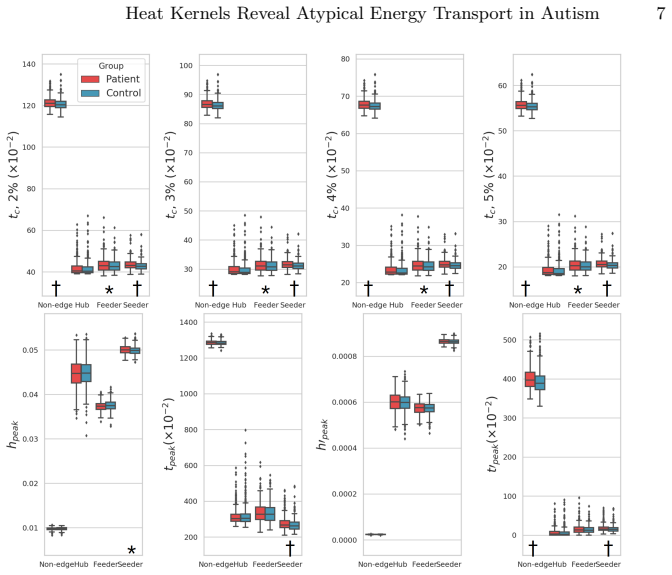
The heat kernel $H(t)=\exp(-t\hat L)$ is the fundamental solution to the diffusion equation $\partial H/\partial t = -\hat L H$ on the graph; entry $H_{u,v}(t)$ is the amount of energy transferred between regions $u$ and $v$ through all pathways after time $t$. From a sweep of $t$ values it yields eight edge features per connection: the intrinsic time constant $t_c$ (at several thresholds), the peak energy $h_{\mathrm{peak}}$, its time $t_{\mathrm{peak}}$, the maximal change $h'_{\mathrm{peak}}$, and its time $t'_{\mathrm{peak}}$. These features are averaged within subnetworks defined by each edge's relation to the top-ten strength hubs of the control group's binarized group-average connectome.
What would settle it
Recompute the top-ten hub nodes from the autism group's own average connectome and re-run the heat-kernel subnetwork comparisons. If the hub list differs substantially between groups, or if the autism-defined hub subnetwork shows significant group differences, then the claimed preservation of the hub is an artifact of the control-derived stratification.
Extended reading notes
Core claim
Using heat kernels $H(t)=\exp(-t\hat L)$ derived from the normalized Laplacian of each subject's functional connectivity matrix, the authors compute five types of edge-wise energy-transport features over time, average them within hub, feeder, seeder, and non-edge subnetworks, and compare groups. They find no significant group differences in the hub subnetwork, but significant differences in all three peripheral subnetworks, with the largest effects in the non-edge subnetwork. In autism, the time-related features $t_c$, $t_{\mathrm{peak}}$, and $t'_{\mathrm{peak}}$ are shifted later in peripheral subnetworks, indicating that peak energy transfer occurs later even though overall transport profiles look similar. The authors interpret this as a preserved functional core with atypical energy dispersion in peripheral regions.
Load-bearing premise
The central result assumes that hubs derived from the control group's average connectome are the correct hubs for both groups; if autism reorganizes the hub structure itself, then labeling both groups with control hubs could manufacture a 'preserved hub' and push all group differences to the periphery.
Editorial extensions
If this is right
- If peripheral subnetworks carry the autism-related signal, studies of autism should weight feeder, seeder, and non-edge connections at least as heavily as hub connections.
- Heat-kernel timing features, especially the later $t_c$ and $t_{\mathrm{peak}}$ values in autism, could serve as candidate biomarkers in functional-connectivity analyses.
- The non-edge subnetwork's strong group differences link energy-transport features to a network's small-world capacity, suggesting a direct test of small-world propensity in autism.
- The preserved hub result supports the view that developmental or compensatory changes in autism spare the functional core while altering flexible peripheral communication.
Reading between the lines
- Because hubs are defined from controls only, a separate analysis that recomputes hubs within the autism group would directly test whether the 'preserved hub' is real or a consequence of the stratification; this is my extension, not the paper's.
- A natural next step would be to test whether the later timing of peak energy transfer in peripheral subnetworks correlates with clinical severity or age, which the paper does not do.
- The same heat-kernel subnetwork pipeline could be applied to structural connectomes or to task-based fMRI to see whether the peripheral energy-transport signature is specific to resting-state functional organization.
Signed reviews
Editorial analysis
A structured set of objections, weighed in public.
Referee Report
Summary. The manuscript proposes an edge-centric analysis of resting-state fMRI functional connectomes in autism using heat kernels. The brain network of each subject is derived from a covariance matrix masked by a control-derived binary group network, Wgroup, and edges are classified into hub, feeder, seeder, and non-edge subnetworks. For each edge, the authors compute heat-kernel features (intrinsic time constant tc, peak heat hpeak, peak time tpeak, maximal heat change h'peak, and its time t'peak) over a range of diffusion times, average these features within each subnetwork, and test for group differences between autism and control subjects from ABIDE. The reported results show no significant hub-subnetwork differences but increasing significance in feeder, seeder, and especially non-edge subnetworks, which the authors interpret as a preserved central hub and atypical energy transport in peripheral subnetworks.
Significance. If the central claim is valid, the paper makes a useful methodological contribution by applying heat-kernel energy-transport features to hub-stratified subnetworks, and it adds to the growing literature on peripheral region involvement in autism. Strengths include the use of a large publicly available dataset (ABIDE), explicit correction for 32 multiple comparisons, acknowledgment of some limitations, and a theoretically motivated diffusion framework that, for nonnegative edge weights, captures indirect pathways. However, the central claim of a preserved hub and peripheral differences is currently undermined by the control-derived subnetwork definition, and the validity of the heat-kernel computation on the subject networks is not established because the covariance matrices can contain negative values. The lack of site and motion covariates in a multi-site dataset further weakens the group comparison. Because these issues affect the core results, the manuscript requires substantial revision and reanalysis before the findings can be considered reliable.
major comments (4)
- [§2.2–§2.3, Table 3, Discussion (final paragraph)] The hub and subnetwork labels are derived exclusively from the control group: Section 2.2 defines Wgroup from controls only, identifies the top-ten strength hubs from Wgroup, and labels edges relative to those hubs; Section 2.3 then masks every subject's covariance matrix with Wgroup. As a result, the hub subnetwork is, by construction, the set of edges that are reliably present in controls, and any autism-specific connections are forced to zero and assigned to the non-edge subnetwork. The reported 'preserved central hub' is therefore not evidence that the functional core is preserved in autism; it only shows that edges selected for being reliable control hubs do not differ between groups. If autism alters hub organization, this design misclassifies true hubs as peripheral and may manufacture the observed gradient of increasing significance toward peripheral subnetworks. I request a sensitivity analysis deriving hubs from the full sample or from each group separately, and a direct test of whether hub membership differs between groups.
- [§2.3, Eqs. (1)–(2)] The subject network W is computed by multiplying the subject's covariance matrix, which can contain negative values, with the binary mask Wgroup. For a graph Laplacian to produce a well-defined diffusion process, edge weights must be nonnegative. With signed edge weights, the normalized Laplacian \hat L = D^{-1/2}LD^{-1/2} is not guaranteed to be positive semidefinite, and exp(-t\hat L) may not be a contractive, positivity-preserving heat kernel. The 'energy transport' interpretation is therefore not justified without additional assumptions. The authors should either confirm that the absolute value of the covariance is used for W, or demonstrate that the heat kernel remains physically meaningful for signed weights; this is load-bearing because every reported feature is derived from this matrix exponential.
- [§2.1 and §2.4, Table 1] ABIDE is a multi-site dataset, yet the group comparisons in Section 2.4 do not include site or motion as covariates, and Table 1 reports only age. Differences in site composition or head motion between the autism and control groups could confound the reported subnetwork differences, especially given the modest effect sizes in Table 3 (e.g., non-edge tc at 2%: 1.207 vs 1.215). The authors should add site and motion parameters as covariates or perform within-site analyses to rule out these confounds.
- [Eq. (3), Table 3 (non-edge row)] The intrinsic time constant tc in Equation (3) is defined using a criterion that divides by H_{u,v}(t). For the non-edge subnetwork, heat kernel values are near zero because these pairs have no direct edge in Wgroup, as the authors note in Section 4 and Figure 1. The division makes tc numerically unstable for these edges, and the non-edge subnetwork is exactly where the most significant group differences are reported (tc p<0.0001). The authors should demonstrate numerical stability of tc, for example by imposing a minimum denominator threshold, and report the range of H_{u,v}(t) values for the non-edge subnetwork. Without this, the leading result may be an artifact of floating-point noise.
minor comments (6)
- [Abstract] The phrase 'it's hub' should be 'its hub'.
- [§2.2, Table 2] The text states that the top ten nodes with greatest strength are selected as hubs, but Table 2 lists only eight regions. Please clarify the discrepancy or add the missing entries.
- [Eq. (4)] Equation (4) appears to contain a typo: 'max|Hu,t(t)|' should read 'max|H_{u,v}(t)|'.
- [Table 3] In the seeder row for tc, 2%, the control standard deviation '0.023' is missing its opening parenthesis; it should be '(0.023)'.
- [References] Reference [17] spells the author name as 'Mller'; this should be 'Müller'.
- [Figure 1 caption] The caption says 'Plots of mean values in the heat kernel matrix by subnetwork'; it would be clearer to state that the plotted quantity is H_{u,v}(t) averaged over all edges in each subnetwork.
Circularity Check
No significant circularity; heat kernel features are derived from explicit equations, and control-derived hub labels are a selection-bias concern rather than a circular reduction.
full rationale
The paper's derivation chain is self-contained: the heat kernel is defined by the standard diffusion equation H(t)=exp(-tL), and all eight features (tc, hpeak, tpeak, h'peak, t'peak) are given as explicit formulas in Section 2.3. No parameter is fitted to the autism label, and no quantity is defined in terms of the group-difference outcome. The only potentially circular-looking design choice is that Wgroup, the binarized group-average network, is computed from controls only and is then used both to label subnetworks and to mask every subject's covariance matrix (W = covariance multiplied by Wgroup). This creates a selection bias: edges not present in at least 75% of controls are zeroed out and relegated to the non-edge subnetwork, so the 'preserved hub' claim applies to control-defined hub edges and could miss autism-specific hub reorganization. However, this is a stratification/validity limitation, not a circular reduction: the group comparisons on the labelled hub edges are empirical and could in principle show significant differences, as they did for other subnetworks. The cited prior work by the authors ([5], [6], [24], [3], [4]) supplies methods and context, but the equations and procedures are fully stated in the paper, so the results do not reduce to a self-citation chain. No step in the analysis equates an output to an input by definition, so no significant circularity is present.
Assumptions & free parameters
free parameters (4)
- Heat kernel time range and step =
t from 0 to 15, dt=0.01
- tc percentage thresholds =
2, 3, 4, 5%
- Number of hub nodes =
10
- Group-average threshold and edge retention =
0.05, 75%
assumptions (5)
- standard math Standard graph Laplacian and heat kernel solution H(t) = exp(-tL_hat)
- domain assumption rs-fMRI covariance matrices represent functional connectivity after ABIDE preprocessing
- domain assumption Pooling ABIDE multi-site data without site correction is valid for group comparison
- domain assumption Hubs derived from the control group generalize to the autism group
- domain assumption Thresholded group-average network (edges present in at least 75% of controls) captures meaningful connections
invented entities (1)
-
Non-edge subnetwork
Cite this review
Pith. "Pith review of Heat kernels with functional connectomes reveal atypical energy transport in peripheral subnetworks in autism." pith.science (2026). https://pith.science/paper/F42Z762O
@misc{pith2026190809117,
  author       = {Pith},
  title        = {Pith review of: Heat kernels with functional connectomes reveal atypical energy transport in peripheral subnetworks in autism},
  year         = {2026},
  howpublished = {\url{https://pith.science/paper/F42Z762O}},
  note         = {Machine review of arXiv:1908.09117}
}
read the original abstract
Autism is increasing in prevalence and is a neurodevelopmental disorder characterised by impairments in communication skills and social behaviour. Connectomes enable a systems-level representation of the brain with recent interests in understanding the distributed nature of higher order cognitive function using modules or subnetworks. By dividing the connectome according to a central component of the brain critical for its function (it's hub), we investigate network organisation in autism from hub through to peripheral subnetworks. We complement this analysis by extracting features of energy transport computed from heat kernels fitted with increasing time steps. This heat kernel framework is advantageous as it can capture the energy transported in all direct and indirect pathways between pair-wise regions over 'time', with features that have correspondence to small-world properties. We apply our framework to resting-state functional MRI connectomes from a large, publically available autism dataset, ABIDE. We show that energy propagating through the brain over time are different between subnetworks, and that heat kernel features significantly differ between autism and controls. Furthermore, the hub was functionally preserved and similar to controls, however, increasing statistical significance between groups was found in increasingly peripheral subnetworks. Our results support the increasing opinion of non-hub regions playing an important role in functional organisation. This work shows that analysing autism by subnetworks with the heat kernel reflects the atypical activations in peripheral regions as alterations in energy dispersion and may provide useful features towards understanding the distributed impact of this disorder on the functional connectome.
Figures

Reference graph
Works this paper leans on
-
[1]
Neuroim- age 90, 335–347 (2014)
Abdelnour, F., Voss, H.U., Raj, A.: Network diffusion accurately models the rela- tionship between structural and functional brain connectivity networks. Neuroim- age 90, 335–347 (2014)
work page 2014
-
[2]
Baio, J., Wiggins, L., Christensen, D.L., Maenner, M.J., Daniels, J., Warren, Z., Kurzius-Spencer, M., Zahorodny, W., Rosenberg, C.R., White, T.: Prevalence of autism spectrum disorder among children aged 8 years-autism and developmental disabilities monitoring network, 11 sites, United States, 2014. MMWR Surveill. Summ. 67(6), 1 (2018)
work page 2018
-
[3]
Chung, A.W., Ahtam, B., Grant, P.E., Im, K.: Rich club-based subnetworks in 16p11.2 deletion syndrome reveal differential structural alterations. p. 5204. Orga- nization of Human Brain Mapping, Rome, Italy (2019)
work page 2019
-
[4]
Chung, A.W., Mannix, R., Feldman, H.A., Grant, P.E., Im, K.: Longitudinal structural connectomic and rich-club analysis in adolescent mTBI reveals per- sistent, distributed brain alterations acutely through to one year post-injury. arXiv:1909.08071 [q-bio.NC], 1–22 (Sept, 2019)
work page Pith review arXiv 1909
-
[5]
In: 2016 International Workshop on Pattern Recog- nition in NeuroImaging (PRNI)
Chung, A.W., Pesce, E., Monti, R.P., Montana, G.: Classifying HCP task-fMRI networks using heat kernels. In: 2016 International Workshop on Pattern Recog- nition in NeuroImaging (PRNI). pp. 1–4. IEEE (2016)
work page 2016
-
[6]
Neuroimage 141, 490–501 (2016) 10 Schirmer and Chung
Chung, A.W., Schirmer, M.D., Krishnan, M.L., Ball, G., Aljabar, P., Edwards, A.D., Montana, G.: Characterising brain network topologies: a dynamic analysis approach using heat kernels. Neuroimage 141, 490–501 (2016) 10 Schirmer and Chung
work page 2016
-
[7]
Chung, F.R., Graham, F.C.: Spectral graph theory. No. 92, American Mathemat- ical Soc. (1997)
work page 1997
-
[8]
Schizophre- nia Bulletin 40(2), 438–448 (2013)
Collin, G., Kahn, R.S., de Reus, M.A., Cahn, W., van den Heuvel, M.P.: Impaired rich club connectivity in unaffected siblings of schizophrenia patients. Schizophre- nia Bulletin 40(2), 438–448 (2013)
work page 2013
Show all 31 references
-
[9]
Brain 137(8), 2382–2395 (2014)
Crossley, N.A., Mechelli, A., Scott, J., Carletti, F., Fox, P.T., McGuire, P., Bull- more, E.T.: The hubs of the human connectome are generally implicated in the anatomy of brain disorders. Brain 137(8), 2382–2395 (2014)
2014
-
[10]
Molecular psychiatry 19(6), 659 (2014)
Di Martino, A., Yan, C.G., Li, Q., Denio, E., Castellanos, F.X., Alaerts, K., An- derson, J.S., Assaf, M., Bookheimer, S.Y., Dapretto, M.: The autism brain imaging data exchange: towards a large-scale evaluation of the intrinsic brain architecture in autism. Molecular psychiat...
2014
-
[11]
Philosophical Transactions of the Royal Society B: Biological Sciences 370(1668), 20140165 (2015)
Gollo, L.L., Zalesky, A., Hutchison, R.M., van den Heuvel, M., Breakspear, M.: Dwelling quietly in the rich club: brain network determinants of slow cortical fluc- tuations. Philosophical Transactions of the Royal Society B: Biological Sciences 370(1668), 20140165 (2015)
2015
-
[12]
PloS one 9(2), e88297 (2014)
Grayson, D.S., Ray, S., Carpenter, S., Iyer, S., Dias, T.G.C., Stevens, C., Nigg, J.T., Fair, D.A.: Structural and functional rich club organization of the brain in children and adults. PloS one 9(2), e88297 (2014)
2014
-
[13]
Nature communications 6, 8414 (2015)
Gu, S., Pasqualetti, F., Cieslak, M., Telesford, Q.K., Alfred, B.Y., Kahn, A.E., Medaglia, J.D., Vettel, J.M., Miller, M.B., Grafton, S.T.: Controllability of struc- tural brain networks. Nature communications 6, 8414 (2015)
2015
-
[14]
Developmental cognitive neuroscience30, 108–115 (2018)
van den Heuvel, M.I., Turk, E., Manning, J.H., Hect, J., Hernandez-Andrade, E., Hassan, S.S., Romero, R., van den Heuvel, M.P., Thomason, M.E.: Hubs in the hu- man fetal brain network. Developmental cognitive neuroscience30, 108–115 (2018)
2018
-
[15]
Proceedings of the National Academy of Sciences 109(28), 11372–11377 (2012)
van den Heuvel, M.P., Kahn, R.S., Goi, J., Sporns, O.: High-cost, high-capacity backbone for global brain communication. Proceedings of the National Academy of Sciences 109(28), 11372–11377 (2012)
2012
-
[16]
Nature communications 10(1), 1022 (2019)
Hong, S.J., de Wael, R.V., Bethlehem, R.A., Lariviere, S., Paquola, C., Valk, S.L., Milham, M.P., Di Martino, A., Margulies, D.S., Smallwood, J.: Atypical functional connectome hierarchy in autism. Nature communications 10(1), 1022 (2019)
2019
-
[17]
Biological Psychiatry: Cognitive Neuroscience and Neuroimaging 2(1), 66–75 (2017)
Keown, C.L., Datko, M.C., Chen, C.P., Maximo, J.O., Jahedi, A., Mller, R.A.: Network organization is globally atypical in autism: a graph theory study of in- trinsic functional connectivity. Biological Psychiatry: Cognitive Neuroscience and Neuroimaging 2(1), 66–75 (2017)
2017
-
[18]
Stroke (published online ahead of print September 12, 2019)
Ktena, S.I., Schirmer, M.D., Etherton, M.R., Giese, A.K., Tuozzo, C., Mills, B.B., Rueckert, D., Wu, O., Rost, N.S.: Brain connectivity measures improve modeling of functional outcome after acute ischemic stroke. Stroke (published online ahead of print September 12, 2019). htt...
2019 doi
-
[19]
Trends in cognitive sciences (2018)
M¨ uller, R.A., Fishman, I.: Brain connectivity and neuroimaging of social networks in autism. Trends in cognitive sciences (2018)
2018
-
[20]
Neuron 79(4), 798–813 (2013)
Power, J.D., Schlaggar, B.L., Lessov-Schlaggar, C.N., Petersen, S.E.: Evidence for hubs in human functional brain networks. Neuron 79(4), 798–813 (2013)
2013
-
[21]
Cell reports 10(3), 359–369 (2015)
Raj, A., LoCastro, E., Kuceyeski, A., Tosun, D., Relkin, N., Weiner, M., Initia- tive (ADNI, A.D.N.: Network diffusion model of progression predicts longitudinal patterns of atrophy and metabolism in Alzheimers disease. Cell reports 10(3), 359–369 (2015)
2015
-
[22]
NeuroImage: clinical 2, 79–94 (2013) Heat Kernels Reveal Atypical Energy Transport in Autism 11
Rudie, J.D., Brown, J.A., Beck-Pancer, D., Hernandez, L.M., Dennis, E.L., Thomp- son, P.M., Bookheimer, S.Y., Dapretto, M.: Altered functional and structural brain network organization in autism. NeuroImage: clinical 2, 79–94 (2013) Heat Kernels Reveal Atypical Energy Transpor...
2013
-
[23]
Developmental cognitive neuroscience 20, 2–11 (2016)
Sato, J.R., Biazoli Jr, C.E., Salum, G.A., Gadelha, A., Crossley, N., Vieira, G., Zugman, A., Picon, F.A., Pan, P.M., Hoexter, M.Q.: Connectome hubs at resting state in children and adolescents: reproducibility and psychopathological correla- tion. Developmental cognitive neur...
2016
-
[24]
In: International Workshop on Connectomics in Neuroimaging
Schirmer, M.D., Chung, A.W.: Structural subnetwork evolution across the life- span: rich-club, feeder, seeder. In: International Workshop on Connectomics in Neuroimaging. pp. 136–145. LNCS, Springer (2018). https://doi.org/ 10.1007/ 978-3-030-00755-3_15
2018
-
[25]
Network Neuroscience pp
Schirmer, M.D., Chung, A.W., Grant, P.E., Rost, N.S.: Network structural depen- dency in the human connectome across the life span. Network Neuroscience pp. 1–15 (2018)
2018
-
[26]
Frontiers in Neurology 10, 956 (2019)
Schirmer, M.D., Ktena, S.I., Nardin, M.J., Donahue, K.L., Giese, A.K., Etherton, M.R., Wu, O., Rost, N.S.: Rich-Club Organization: An Important Determinant of Functional Outcome After Acute Ischemic Stroke. Frontiers in Neurology 10, 956 (2019). https://doi.org/10.3389/fneur.2...
2019
-
[27]
Journal of Neuroscience 31(44), 15775–15786 (2011)
Van Den Heuvel, M.P., Sporns, O.: Rich-club organization of the human connec- tome. Journal of Neuroscience 31(44), 15775–15786 (2011)
2011
-
[28]
Nature reviews
Van Den Heuvel, M.P., Sporns, O.: A cross-disorder connectome landscape of brain dysconnectivity. Nature reviews. Neuroscience 20(7), 435–446 (Jul 2019). https://doi.org/10.1038/s41583-019-0177-6
2019 doi
-
[29]
NeuroImage 80, 405–415 (2013)
Varoquaux, G., Craddock, R.C.: Learning and comparing functional connectomes across subjects. NeuroImage 80, 405–415 (2013)
2013
-
[30]
Verhelst, H., Vander Linden, C., De Pauw, T., Vingerhoets, G., Caeyenberghs, K.: Impaired rich club and increased local connectivity in children with traumatic brain injury: Local support for the rich? Human brain mapping 39(7), 2800–2811 (2018)
2018
-
[31]
Pattern Recognition 41(11), 3328–3342 (2008)
Zhang, F., Hancock, E.R.: Graph spectral image smoothing using the heat kernel. Pattern Recognition 41(11), 3328–3342 (2008)
2008
Reviewed August 14, 2026 · model on record in the stance chip above.
Discussion (0). Continue with ORCID to comment.