REVIEW 3 major objections 5 minor 31 references
Domain-Invariant Feature Distillation for Cross-Domain Sentiment Classification
T0 review · 3 major / 5 minor · reviewed 2026-08-14 · deepseek-v4-flash
Pith's one-line read An auxiliary aspect-detection task is claimed to distill purer domain-invariant sentiment features, lifting cross-domain accuracy by more than five points on average.
desk verdict The paper's central orthogonality claim is contradicted by its own equations, but the empirical architecture is worth a referee's time. read the letter →
The pith
A machine-rendered reading of the paper's core claim, the machinery that carries it, and where it could break.
The reading
What carries the argument
The mechanism that carries the argument is the context allocation (CA) module. For every token $i$, the BiLSTM hidden state $h_i$ is multiplied by two complementary softmax weights, $h^c_i = \beta^c_i h_i$ for sentiment and $h^d_i = \beta^d_i h_i$ for aspect detection, with $\beta^c_i + \beta^d_i = 1$. This split is meant to separate sentiment-dominant from aspect-dominant contexts; an aspect-opinion attention then compresses $h^c$ into the domain-invariant feature $f$, while the aspect detector labels each token from $h^d$ in BIO format. A domain classifier, trained adversarially with flipped labels under an alternating-minimization scheme, pushes $f$ to be domain-neutral. The full objective is a weighted sum of the sentiment loss, the adversarial loss, and the aspect-detection losses in both domains.
What would settle it
Compute the average cosine similarity between $h^c_i$ and $h^d_i$ across all tokens of a trained DIFD model. From Equations 2 and 3, $h^c_i = \beta^c_i h_i$ and $h^d_i = \beta^d_i h_i$, so the cosine similarity is 1 whenever both weights are positive; finding values near 1 would show that the claimed orthogonality $f \perp z_s$ and $f \perp z_t$ is not realized. A second check is to inspect the full objective in Equation 13: it contains no term that penalizes a nonzero inner product between the two contexts, so any orthogonality in the trained model would have to emerge from unconstrained weight behavior.
Extended reading notes
Core claim
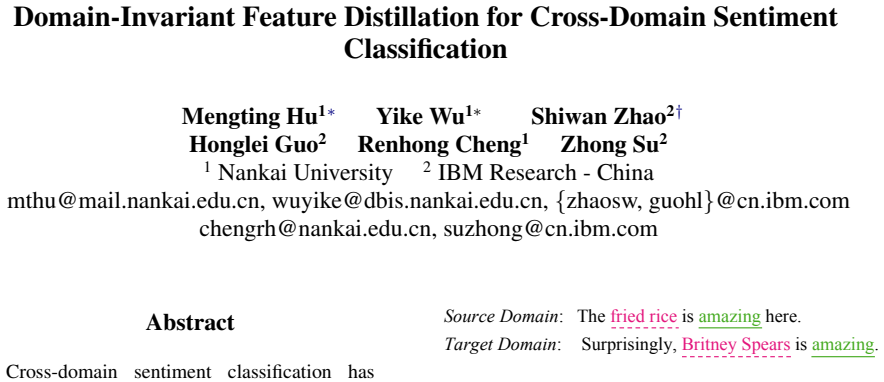
The paper's central claim is that the domain-specific signal in aspect-level sentiment — which aspect terms a sentence contains — can be used as an auxiliary task to purify the shared sentiment representation. DIFD trains a shared aspect-level sentiment classifier on the source domain together with separate aspect detectors for the source and target domains; because aspects differ sharply across domains, the detectors absorb domain-specific information, and the sentiment classifier is left with features that transfer. The paper asserts that the domain-invariant feature $f$ is orthogonal to the domain-dependent features $z_s$ and $z_t$, which would make the auxiliary task a clean distillation of transferable knowledge. In experiments across Restaurants, Laptops, and Twitters, DIFD outperforms the IATN transfer baseline by an average of +5.51 accuracy and +7.36 macro-F1, and the proxy-A-distance analysis shows the extracted invariant features are closer across domains than those from adversarial training alone.
Load-bearing premise
The paper's central bet is that multiplying a word's hidden vector by two complementary softmax weights separates transferable from domain-specific features; in the actual equations both outputs are scaled copies of the same vector, so they point in the same direction unless one weight is exactly zero, and no loss term enforces orthogonality.
Editorial extensions
If this is right
- Target-domain sentiment labels are not needed; only aspect annotations, which are cheaper to obtain, are required in the target domain.
- Because the context allocation produces two scores per token, the model can show which words it treats as sentiment-bearing and which as aspect- or domain-specific.
- The reported average gain of more than five accuracy points over the strongest transfer baseline implies that actively removing domain-specific features helps more than simply aligning invariant features.
- The proxy-A-distance results imply that the learned invariant features become more transferable and the domain-specific features more separable, which should benefit downstream tasks built on the shared representation.
Reading between the lines
- The claimed orthogonality is not guaranteed by the construction: since $h^c_i = \beta^c_i h_i$ and $h^d_i = \beta^d_i h_i$, the two vectors point in the same direction whenever both weights are positive, so a direct cosine-similarity check on a trained model would test whether the separation is actually present.
- Adding an explicit orthogonality penalty, such as minimizing the inner product between the sentiment-dominant and aspect-dominant contexts, would make the training objective match the paper's stated mechanism and could serve as a strict improvement test.
- The reported gains over adversarial-only training could come from the extra supervised signal of the aspect-detection task rather than from genuine orthogonalization; a control with the same loss but no context split would separate these explanations.
- The same distillation recipe could be tried with other high-variance, cheap annotations — negation scope or domain-specific entity recognition — to see whether the mechanism generalizes beyond aspect terms.
Signed reviews
Editorial analysis
A structured set of objections, weighed in public.
Referee Report
Summary. The paper proposes Domain-Invariant Feature Distillation (DIFD), a method for aspect-level cross-domain sentiment classification that jointly trains an aspect-level sentiment classifier on labeled source data and aspect detectors on both source and target domains. The key idea is that the aspect detection task is an 'orthogonal domain-dependent task' that strips domain-specific information from the input, producing domain-invariant sentiment features. The architecture uses a context allocation mechanism that splits each hidden state h_i into sentiment-dominant hc_i and aspect-dominant hd_i via complementary scalar weights, plus an adversarial domain classifier. Experiments on three datasets across six transfer directions report accuracy and macro-F1 improvements over baselines and ablation variants, with proxy A-distance analyses of feature transferability.
Significance. If the orthogonality mechanism worked as claimed, the paper would offer a clean and well-motivated approach to separating transferable and non-transferable features in aspect-level cross-domain sentiment classification. The empirical study is broad in scope: six transfer tasks, multiple baselines, several ablations, and a feature-distance analysis. The paper also ships concrete architectural details that are sufficient for reimplementation. However, the central formal claim—that the domain-invariant feature f and the domain-dependent features z_s, z_t are orthogonal—is contradicted by the paper's own equations, and the empirical results are reported without error bars or significance tests. Since the claimed mechanism is the paper's main conceptual contribution, the contradiction is load-bearing rather than a presentation issue.
major comments (3)
- [Section 3.1 and Section 3.3, Eqs. (2)–(4)] The assertion 'The domain-invariant and domain-dependent features are orthogonal, i.e., f⊥z_s and f⊥z_t' is not realized by the architecture. Equations (2) and (3) define hc_i = βc_i h_i and hd_i = βd_i h_i with βc_i + βd_i = 1, and β is softmax-normalized so βc_i and βd_i are nonnegative. For any token with both βc_i > 0 and βd_i > 0, the inner product hc_i · hd_i = βc_i βd_i ||h_i||^2 > 0, so the two contexts are collinear, not orthogonal. The total objective in Eq. (13) contains no orthogonality or decorrelation term, and the 'mutually exclusive' normalization in Eq. (4) only constrains the sum of the two weights, not the directions of the resulting representations. Therefore the central mechanism claimed in the abstract and Section 3.1 is not enforced by the model.
- [Section 3.4, Eq. (8), and Section 3.5, Eq. (12)] Even if the context allocation produced partly separated weight patterns, the final features f and z are both linear combinations of the same underlying direction set {h_i}: f is a weighted sum of hc_i (Eq. 8), while the AD feature is obtained by a linear transformation of hd (Section 3.5). Orthogonality of f and z would require a delicate cancellation between these combinations, and nothing in the loss encourages such a cancellation. The aspect detection loss may push βd_i to be large for aspect-like tokens and βc_i to be large for opinion tokens, but it does not constrain the subspace spanned by the two sets of features to be orthogonal. The paper's claim that aspect detection is an 'orthogonal domain-dependent task' is therefore an unsupported assumption about task independence, not a property enforced by the model.
- [Section 4.4 and Tables 2–3] The paper repeatedly uses the word 'significantly' to describe improvements (e.g., '+5.51% accuracy' over IATN, and DIFD outperforming ASC+AT 'on all metrics significantly'), but no error bars, standard deviations, or statistical significance tests are reported. Without these, the reader cannot determine whether the observed gaps are reliable or within run-to-run variance. This is especially important because some reported numbers are very close: for example, in Table 3 on R→L, DIFD has accuracy 64.86 vs. DIFD-CA 64.18, and on T→R, DIFD-AT has accuracy 59.76 vs. DIFD 57.60, which actually goes against the stated trend. The empirical claim of effectiveness would be substantially strengthened by repeated-run statistics.
minor comments (5)
- [Section 4.1] The paper calls the target domain data 'unlabeled' but the formulation in Section 3.1 includes aspect annotations a_t for the target domain, and Section 4.2 states that the training set contains 'all unlabeled data which only contain the aspect term information.' The terminology should be clarified: the target domain has no sentiment labels but does have aspect annotations, which is an important distinction for the reader.
- [Section 4.3 and Section 4.4] The naming of the variant 'DIFD(S)' is slightly confusing: it is described as containing 'components of the source domain from DIFD' and trained only on source data, but it is not clear whether it includes the aspect detection task on the source domain only. A sentence explaining exactly which components are kept and why would help.
- [Section 4.4, Table 3] The text states that 'DIFD outperforms DIFD-AT on most metrics,' but Table 3 shows that DIFD-AT is better on several metrics, e.g., R→T accuracy (40.76 vs. 40.13), T→R accuracy (59.76 vs. 57.60), and L→T F1 (45.91 vs. 47.31? Actually DIFD is higher on F1 for L→T; the exceptions should be listed explicitly). The current wording should be made precise about which transfer tasks and metrics support the claim.
- [Section 3.5, Eq. (12)] The symbol λ_l is used for the label weight in Eq. (12), while λ_d is used for the AD loss weight in Eq. (13). These two are different and the notation is easy to confuse; consider renaming one of them.
- [Throughout] There are several typos and grammatical issues, e.g., 'striping' in the introduction, 'choosed' in Section 4.2, and 'the enumerate number of the instance' before Eq. (9). A thorough language edit is needed.
Circularity Check
No circular reasoning found; the paper's orthogonality claim is a correctness concern, not a circularity concern.
full rationale
The paper is an empirical architecture paper and does not derive its results from its own assumptions in a circular way. The sentiment classifier is trained only on labeled source-domain data, the target domain supplies unlabeled data with aspect annotations, and performance is measured against held-out target-domain test sets and external baselines. No parameter is fitted to the reported test results and then renamed as a prediction; no target sentiment labels leak into training. The central claim that domain-invariant and domain-dependent features are orthogonal is asserted in Section 3.1 and used to motivate the architecture, but the actual construction in Equations 2-3 produces collinear scaled versions of the same hidden state, and the objective in Equation 13 contains no orthogonality constraint. That is a mismatch between claim and implementation, not circularity: the claim is not assumed into existence by the loss, it is simply unsupported by the equations. Citations to prior work are all external baselines and standard components (BiLSTM, positional encoding, adversarial training, MMD, CORAL) and none of the paper's load-bearing conclusions rest on a self-citation chain. Therefore the appropriate finding is no significant circularity, with a score of 0.
Assumptions & free parameters
free parameters (3)
- λa (domain adversarial loss weight) =
not reported
- λd (aspect detection loss weight) =
not reported
- λl (label weight for aspect detection) =
dynamically calculated in training, formula not specified
assumptions (3)
- ad hoc to paper Aspect detection is an orthogonal domain-dependent task with respect to sentiment classification.
- domain assumption Opinion words are shared across domains while aspect terms vary.
- ad hoc to paper Splitting hidden states by complementary scalar weights (βc + βd = 1) separates domain-invariant and domain-specific information.
Cite this review
Pith. "Pith review of Domain-Invariant Feature Distillation for Cross-Domain Sentiment Classification." pith.science (2026). https://pith.science/paper/X2NTLCH3
@misc{pith2026190809122,
  author       = {Pith},
  title        = {Pith review of: Domain-Invariant Feature Distillation for Cross-Domain Sentiment Classification},
  year         = {2026},
  howpublished = {\url{https://pith.science/paper/X2NTLCH3}},
  note         = {Machine review of arXiv:1908.09122}
}
read the original abstract
Cross-domain sentiment classification has drawn much attention in recent years. Most existing approaches focus on learning domain-invariant representations in both the source and target domains, while few of them pay attention to the domain-specific information. Despite the non-transferability of the domain-specific information, simultaneously learning domain-dependent representations can facilitate the learning of domain-invariant representations. In this paper, we focus on aspect-level cross-domain sentiment classification, and propose to distill the domain-invariant sentiment features with the help of an orthogonal domain-dependent task, i.e. aspect detection, which is built on the aspects varying widely in different domains. We conduct extensive experiments on three public datasets and the experimental results demonstrate the effectiveness of our method.
Figures


Figures from the paper (1 more)

Reference graph
Works this paper leans on
-
[1]
URL: " 'urlintro :=
ENTRY address author booktitle chapter edition editor howpublished institution journal key month note number organization pages publisher school series title type volume year eprint doi pubmed url lastchecked label extra.label sort.label short.list INTEGERS output.state before.all mid.sentence after.sentence after.block STRINGS urlintro eprinturl eprintpr...
-
[2]
write newline
" write newline "" before.all 'output.state := FUNCTION n.dashify 't := "" t empty not t #1 #1 substring "-" = t #1 #2 substring "--" = not "--" * t #2 global.max substring 't := t #1 #1 substring "-" = "-" * t #2 global.max substring 't := while if t #1 #1 substring * t #2 global.max substring 't := if while FUNCTION word.in bbl.in capitalize " " * FUNCT...
-
[3]
Shai Ben-David, John Blitzer, Koby Crammer, and Fernando Pereira. 2007. Analysis of representations for domain adaptation. In (NIPS), pages 137--144
work page 2007
-
[4]
John Blitzer, Ryan McDonald, and Fernando Pereira. 2006. Domain adaptation with structural correspondence learning. In (EMNLP), pages 120--128
work page 2006
-
[5]
Konstantinos Bousmalis, George Trigeorgis, Nathan Silberman, Dilip Krishnan, and Dumitru Erhan. 2016. Domain separation networks. In (NIPS), pages 343--351
work page 2016
-
[6]
Cen Chen, Yinfei Yang, Jun Zhou, Xiaolong Li, and Forrest Sheng Bao. 2018. Cross-domain review helpfulness prediction based on convolutional neural networks with auxiliary domain discriminators. In (NAACL), pages 602--607
work page 2018
-
[7]
Minmin Chen, Zhixiang Xu, Kilian Weinberger, and Fei Sha. 2012. Marginalized denoising autoencoders for domain adaptation. (ICML)
work page 2012
-
[8]
Peng Chen, Zhongqian Sun, Lidong Bing, and Wei Yang. 2017. Recurrent attention network on memory for aspect sentiment analysis. In (EMNLP), pages 452--461
work page 2017
Show all 31 references
-
[9]
Li Dong, Furu Wei, Chuanqi Tan, Duyu Tang, Ming Zhou, and Ke Xu. 2014. Adaptive recursive neural network for target-dependent twitter sentiment classification. In (ACL), volume 2, pages 49--54
2014
-
[10]
Yaroslav Ganin and Victor Lempitsky. 2015. Unsupervised domain adaptation by backpropagation. (ICML)
2015
-
[11]
Yaroslav Ganin, Evgeniya Ustinova, Hana Ajakan, Pascal Germain, Hugo Larochelle, Fran c ois Laviolette, Mario Marchand, and Victor Lempitsky. 2016. Domain-adversarial training of neural networks. The Journal of Machine Learning Research, 17(1):2096--2030
2016
-
[12]
Xavier Glorot, Antoine Bordes, and Yoshua Bengio. 2011. Domain adaptation for large-scale sentiment classification: A deep learning approach. In (ICML), pages 513--520
2011
-
[13]
Alex Graves, Abdel Rahman Mohamed, and Geoffrey Hinton. 2013. Speech recognition with deep recurrent neural networks. In (ICASSP), pages 6645--6649
2013
-
[14]
Zheng Li, Ying Wei, Yu Zhang, Xiang Zhang, Xin Li, and Qiang Yang. 2019. Exploiting coarse-to-fine task transfer for aspect-level sentiment classification. (AAAI)
2019
-
[15]
Zheng Li, Yun Zhang, Ying Wei, Yuxiang Wu, and Qiang Yang. 2017. End-to-end adversarial memory network for cross-domain sentiment classification. In (IJCAI), pages 2237--2243
2017
-
[16]
Pengfei Liu, Xipeng Qiu, and Xuanjing Huang. 2017. Adversarial multi-task learning for text classification
2017
-
[17]
Dehong Ma, Sujian Li, Xiaodong Zhang, and Houfeng Wang. 2017. Interactive attention networks for aspect-level sentiment classification. (IJCAI)
2017
-
[18]
Sinno Jialin Pan, Xiaochuan Ni, Jian-Tao Sun, Qiang Yang, and Zheng Chen. 2010. Cross-domain sentiment classification via spectral feature alignment. In (WWW)
2010
-
[19]
Minlong Peng, Qi Zhang, Yu-gang Jiang, and Xuanjing Huang. 2018. Cross-domain sentiment classification with target domain specific information. In (ACL), pages 2505--2513
2018
-
[20]
Jeffrey Pennington, Richard Socher, and Christopher Manning. 2014. Glove: Global vectors for word representation. In (EMNLP), pages 1532--1543
2014
-
[21]
Maria Pontiki, Dimitris Galanis, John Pavlopoulos, Harris Papageorgiou, Ion Androutsopoulos, and Suresh Manandhar. 2014. Semeval-2014 task 4: Aspect based sentiment analysis. SemEval, pages 27--35
2014
-
[22]
Rui Shu, Hung H Bui, Hirokazu Narui, and Stefano Ermon. 2018. A dirt-t approach to unsupervised domain adaptation. (ICLR)
2018
-
[23]
Baochen Sun, Jiashi Feng, and Kate Saenko. 2016. Return of frustratingly easy domain adaptation. In (AAAI)
2016
-
[24]
Duyu Tang, Bing Qin, and Ting Liu. 2016. Aspect level sentiment classification with deep memory network. (EMNLP)
2016
-
[25]
Eric Tzeng, Judy Hoffman, Ning Zhang, Kate Saenko, and Trevor Darrell. 2014. Deep domain confusion: Maximizing for domain invariance. arXiv preprint arXiv:1412.3474
2014 arXiv
-
[26]
Ashish Vaswani, Noam Shazeer, Niki Parmar, Jakob Uszkoreit, Llion Jones, Aidan N Gomez, ukasz Kaiser, and Illia Polosukhin. 2017. Attention is all you need. In (NIPS), pages 5998--6008
2017
-
[27]
Yequan Wang, Minlie Huang, Li Zhao, et al. 2016. Attention-based lstm for aspect-level sentiment classification. In (EMNLP), pages 606--615
2016
-
[28]
Wei Xue and Tao Li. 2018. Aspect based sentiment analysis with gated convolutional networks. (ACL)
2018
-
[29]
Jianfei Yu and Jing Jiang. 2016. Learning sentence embeddings with auxiliary tasks for cross-domain sentiment classification. In (EMNLP), pages 236--246
2016
-
[30]
Jianfei Yu and Jing Jiang. 2017. Leveraging auxiliary tasks for document-level cross-domain sentiment classification. ACL
2017
-
[31]
Kai Zhang, Hefu Zhang, Qi Liu, Hongke Zhao, Hengshu Zhu, and Enhong Chen. 2019. Interactive attention transfer network for cross-domain sentiment classification. In (AAAI)
2019
Reviewed August 14, 2026 · model on record in the stance chip above.
Discussion (0). Continue with ORCID to comment.