REVIEW 4 major objections 3 minor 9 references
On the existence of regular tetrahedral non-homothetic homographic solution
T0 review · 4 major / 3 minor · reviewed 2026-08-14 · deepseek-v4-flash
Pith's one-line read The paper argues that four arbitrary masses at the vertices of a regular tetrahedron have no non-homothetic homographic solution: the only shape-preserving motion is a uniform collapse or expansion about the center of mass.
desk verdict The paper gives a competent derivation of the Keplerian decoupling for a regular tetrahedral four-body configuration, but the claimed no-go theorem for non-homothetic solutions depends on an unreported numerical step and an unjustified dichotomy. read the letter →
The pith
A machine-rendered reading of the paper's core claim, the machinery that carries it, and where it could break.
The reading
What carries the argument
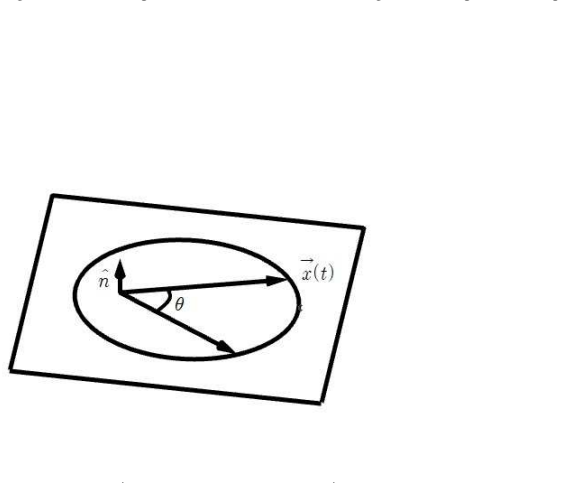
The central object is the relative-vector formulation together with the quaternion-style rotation formula $\vec v' = \vec v\times[\cos\theta+\sin\theta\,\hat n]$. The relative vectors decouple the tetrahedral equations into a two-body problem, and the rotation formula is what lets the paper parametrize every conceivable non-homothetic homographic orbit as synchronized rotations of fixed vectors $\vec r_i$ about plane normals $\hat n_i$. The load-bearing algebraic system is (23)–(24), expressing that the rotated vectors $\vec r_i'$ preserve the tetrahedral inner products; the asserted absence of real solutions for the angles $\theta_i$ is the entire mechanism by which the non-homothetic branch is excluded.
What would settle it
Run the numerical search over $\theta_1,\dots,\theta_4$ for equations (23)–(24) using the construction described after equation (22): choose any two arbitrary equal-length perpendicular vectors $\vec R_i$ and check whether any real solution has all $|\cos\theta_i|\le 1$ and $|\sin\theta_i|\le 1$. A single such real solution would exhibit a non-homothetic homographic branch and falsify the paper's conclusion; an exhaustive, reproducible computation that always finds a value outside $[-1,1]$ would verify the asserted rejection.
Extended reading notes
Core claim
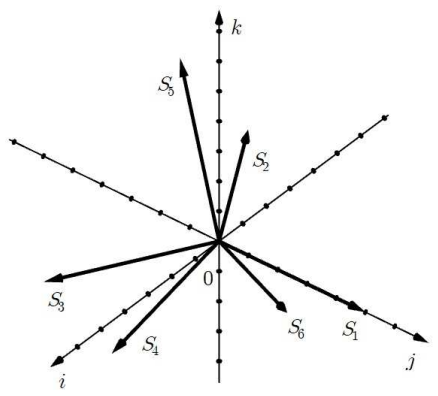
On the paper's own terms, the central discovery is a geometric nonexistence theorem: for four arbitrary masses that always form a regular tetrahedron, homographic motion is necessarily homothetic. Starting from six relative position vectors $S_n$ and the rotation representation $\vec v' = \vec v \times [\cos\theta + \sin\theta\,\hat n]$, the paper derives $\ddot S_n = -G\mu S_n/\|S_n\|^3$ and then $\ddot{\vec x}_i = -G\kappa_i^{3/2}\vec x_i/(\mu^2\|\vec x_i\|^3)$, so each vertex feels a Newtonian central force toward the barycenter. Postulating a non-homothetic homographic solution forces the alternative $\sum m_i(\vec r_i \times \hat n_i)=0$ or $\sin\theta(t)=0$; the first alternative would be a rotating tetrahedral branch. To test it, the paper writes the rotated position vectors $\vec r_i'$ as rotations of arbitrary perpendicular vectors $\vec R_i$ through angles $\theta_i$ and obtains equations (23)–(24). It then asserts, without displaying the computation, that the only possible solutions have a trigonometric value above 1, leaving $\sin\theta(t)=0$ as the only real branch.
Load-bearing premise
Everything hinges on the unreported numerical calculation in Section 5 that one of $\cos\theta_i$ or $\sin\theta_i$ must exceed 1; if that calculation is wrong or cannot be reproduced, the proof that only the homothetic solution exists collapses.
Editorial extensions
If this is right
- If the tetrahedral four-body system has any shape-preserving motion, that motion is a homothetic collapse or expansion: all four masses move radially toward or away from the barycenter with distances in fixed ratios.
- The relative-vector method that solves the triangular three-body problem carries over to four bodies, reducing the constrained equations to a two-body central-force problem.
- Every homographic solution of the regular tetrahedral four-body problem is either planar or homothetic, so a spinning, shape-preserving tetrahedral orbit is impossible.
- Numerical searches or analytic studies of tetrahedral four-body motion can be restricted to the homothetic family; the alleged non-homothetic branch is a dead end.
Reading between the lines
- Because the decisive numerical check is not reported, the paper's own argument leaves an explicit gap; a documented reproduction of that calculation would either complete the proof or reveal a counterexample.
- The same rotation-based construction could be tried on regular simplex configurations in more than four bodies; a generalization could sharpen or test the known nonexistence for $i>4$.
- One can turn the algebraic system (23)–(24) into a computational existence check independent of the paper's conclusion: search for real $\theta_i$ satisfying all inner-product equations, with the unit constraints, for random choices of $\vec R_i$.
Signed reviews
Editorial analysis
A structured set of objections, weighed in public.
Referee Report
Summary. The paper aims to prove that, for the four-body problem constrained to a regular tetrahedral configuration, the only homographic solution is the homothetic one. The author extends a relative-vector method of Broucke and Lass, derives a central-force equation for each mass, and then argues by contradiction that a non-homothetic homographic solution would require the real solvability of a trigonometric system (Eq. (23)). The paper claims that an unreported numerical calculation shows this system has no real solutions, forcing the homothetic branch. The conclusion agrees with the known result of Wintner (1941), article 371.
Significance. If the proof were complete, the paper would offer an elementary, self-contained derivation of a known result in celestial mechanics. It uses an interesting construction with relative vectors and a trigonometrization of the non-homothetic branch. However, the argument's decisive step is an unreported numerical calculation, and several analytical steps are either unjustified or stated with insufficient rigor. The manuscript in its current form does not provide a verifiable proof of the central claim.
major comments (4)
- [Section 5, after Eq. (26)] The decisive rejection of the non-homothetic branch rests entirely on an unreported numerical calculation. The text states that 'numerical calculation proved that minimun at one of cos θi and sin θi had to exceeded 1', but it gives no input data for the vectors R_i, no coefficients A_ij, B_ij, C_ij, D_ij, no algorithm, no output, and no discussion of the numerical method. A reader cannot verify the claim or assess whether the constraints (21) were enforced completely. Furthermore, the statement 'even a single numerical result proves or disproves the validity of (19)' is logically incorrect: Eq. (19) is an existence assertion, and a single failed choice of R_i does not rule out other choices. This missing calculation is load-bearing for the main conclusion, since all preceding steps only set up the system that this calculation is supposed to eliminate.
- [Section 4, Eqs. (9)-(11)] The derivation of the central-force equation (12) assumes that the rotation operators in (9) are time-independent ('Since they are independent from time t, the following relation ... are induced after differentiating (10) twice'). However, the paper explicitly considers tetrahedra that 'varies its size and orientation in three-dimensional space'. For a rotating configuration, the relative vectors S_n are related to S_1 by rotations that are not constant in the inertial frame, so the differentiation leading to (11) is unjustified. The final result (12) can be obtained directly from the equal-instantaneous-edge-length and center-of-mass conditions, but the proof as written has a logical gap at this point.
- [Section 5, Eq. (18)] The step from Eq. (18) to the dichotomy (19)/(20) is not justified as stated. The text says 'Trivially, the summation where cosine is multiplied becomes zero', but this is only true if all r_i(t) scale by the same time-dependent factor, i.e., if the configuration remains similar to the initial one. That condition is not established before the dichotomy is drawn. The later remark that the ratios of distances are conserved and the directions of r_i(t) are solid is stated after the reduction, so the logical ordering is unclear. This step is central to separating the homothetic and non-homothetic branches.
- [Section 3, Eqs. (2), (3), and (9)] There are several technical errors in the geometric setup. In Eq. (2), the fifth line repeats 'S_4' instead of defining S_3, and the loop relations in Eq. (3) are incorrect: for the given definitions, S1+S4+S5 = 2(x4-x1) ≠ 0 and S5+S2-S6 = 2(x4-x2) ≠ 0. In Eq. (9), the operator for S6 has vector-part norm sqrt(2/3+7/3)=sqrt(3), not 1, so it is not a rotation operator, and the coefficients for S4 and S5 similarly appear inconsistent with unit quaternion norms. These errors undermine the reliability of the subsequent algebra in Section 4.
minor comments (3)
- [General] The notation '×' is used ambiguously for both quaternion multiplication and vector cross product, and it is never defined rigorously; this makes Eqs. (9), (16), and (22) difficult to interpret.
- [References] The reference list contains incomplete entries (e.g., 'Montgomery, R., A new solution to the three-body problem, differential equations 1001'), and the text refers to Wintner (1941) in places but the reference list cites Wintner (1947).
- [Section 5, Eq. (25)] The formula for x_i(t) in Eq. (25) appears dimensionally inconsistent: the factor ||r_i(t)|| / ||r_i|| multiplies a vector, but the numerator and denominator are lengths, so the expression is a scalar times [r_i cos θ + r_i' sin θ]; the intended meaning should be clarified.
Circularity Check
No significant circularity: the conclusion is not equivalent to an input by construction, and the decisive step is an unreported numerical check rather than a circular reduction.
full rationale
The paper's central dichotomy (19)/(20) is derived from the barycentric constraint (18) plus the assumed homographic form (17), not imported from Wintner; Wintner (1941) is cited only to state agreement, not as the premise that rejects the non-homothetic branch. No parameter is fitted to data and renamed a prediction, and there are no self-citations. The proof's actual weak point is the sentence after Eq. (26): 'numerical calculation proved that minimun at one of cos θi and sin θi had to exceeded 1' — this computation is not reported, so the contradiction is asserted rather than demonstrated. That is a serious reproducibility/correctness gap, but it is not an instance of a result reducing to its own inputs: the numerical check is supposed to test equation (23), not to presuppose (20). A failed or missing calculation undermines support for the conclusion, yet does not make the derivation circular. Therefore the circularity score is 0.
Assumptions & free parameters
free parameters (1)
- unreported vector pairs R_i for the numerical check =
not reported
assumptions (4)
- domain assumption The relative vectors of a regular tetrahedron are obtained from S1 by fixed rotations about inertial axes i, j, k, as in Eq. (9).
- ad hoc to paper Equation (18) implies that either the weighted sum of r_i × n_i vanishes or sin θ(t) = 0, exhausting the non-homothetic and homothetic cases.
- ad hoc to paper The unshown numerical calculation of Eq. (23) yields no real solutions for all θ_i.
- standard math The quaternion rotation formula v' = v × [cosθ + sinθ·n] from Wintner (1947) is valid for the vectors in this paper.
Cite this review
Pith. "Pith review of On the existence of regular tetrahedral non-homothetic homographic solution." pith.science (2026). https://pith.science/paper/2JPS66VX
@misc{pith2026190809129,
  author       = {Pith},
  title        = {Pith review of: On the existence of regular tetrahedral non-homothetic homographic solution},
  year         = {2026},
  howpublished = {\url{https://pith.science/paper/2JPS66VX}},
  note         = {Machine review of arXiv:1908.09129}
}
read the original abstract
It is well known that the three-body problem has few analytical solutions in certain symmetrical constraints; the Lagrangian triangular solution is one of them. This triangular solution has been revisited by R.Broucke and H.Lass in 1971, concerning three relative position vectors pointing from one mass to another. This paper proposes a significant advance to the method, extended to four arbitrary masses on the vertices of a tetrahedron. The research provides a geometrical proof that under such constraint, only homothetic solution is possible which agrees with the conclusion brought by article 371 of Wintner (1941).
Figures

Figures from the paper (1 more)

Reference graph
Works this paper leans on
-
[1]
Bernat et al., On the planar central configurations of the 4-body problem with three equal masses, Mathematical Analysis, 16, 1-18 (2009)
work page 2009
-
[2]
Delgado, Joaquin and Vidal, Claudio, The tetrahedral 4- body problem, Journal of Dynamics and Di fferential Equa- tions, 11, 735-780 (1999)
work page 1999
-
[3]
Broucke, R. and Lass, H., A note on relative motion in the g eneral three-body problem, Celestial mechanics, 8, 5-10 (1973)
work page 1973
-
[4]
Montgomery, R., A new solution to the three-body problem , differential equations 1001 (2001)
work page 2001
-
[5]
Figure 3: ⃗x(t) is a set of vector rotations of ⃗r(t) which only varies in size through angle θ
Hsiang, Wu-Yi, and Straume, E., Global geometry of plana ry 3-body motions, Acta Applicandae Mathematicae, 101.1-3, 105-119 (2008) 8 Figure 2: All relative position vectors are shifted to the or igin and are expressed with quaternions in (9). Figure 3: ⃗x(t) is a set of vector rotations of ⃗r(t) which only varies in size through angle θ. 9 Figure 4: Both ...
work page 2008
-
[6]
Murnaghan, F. D., A symmetric reduction of the planar thr ee-body problem, American Journal of Mathematics, 58.4, 829-832 (1936)
work page 1936
-
[7]
Lehmann-Filhs, R., ber zwei Flle des Vielkrperproblems , Astronomische Nachrichten, 127, 137 (1891)
-
[8]
Princeton University Press, Princeton, N ew Jersey (1947)
Wintner, Aurel, The analytical foundations of celestia l mechanics, 304. Princeton University Press, Princeton, N ew Jersey (1947)
work page 1947
Show all 9 references
-
[9]
Springer Science, the Netherlands (1986) 10
Hestenes and David, New foundations for classical mecha nics, 398-406. Springer Science, the Netherlands (1986) 10
1986
Reviewed August 14, 2026 · model on record in the stance chip above.
Discussion (0). Continue with ORCID to comment.