REVIEW 4 major objections 5 minor 16 references
Silicon Photomultipliers for Orbital Ultra High Energy Cosmic Ray Observation
T0 review · 4 major / 5 minor · reviewed 2026-08-14 · deepseek-v4-flash
Pith's one-line read The paper claims that the 256-channel SiECA camera demonstrates silicon photomultipliers can replace photomultiplier tubes in orbital cosmic-ray fluorescence detectors.
desk verdict Useful engineering progress report on a 256-channel SiPM camera with credible lab single-photon evidence, but the abstract's 'proves viable' claim outruns the data. read the letter →
The pith
A machine-rendered reading of the paper's core claim, the machinery that carries it, and where it could break.
The reading
What carries the argument
The load-bearing object is the SiECA camera itself: four 64-channel multi-pixel photon counter arrays, giving 256 channels total, on a front board read out by eight Citiroc ASICs and controlled by an FPGA. The Citiroc is a mixed-signal readout chip that amplifies, shapes, and discriminates each channel's pulses, and here it runs in a peak-counting mode in which the FPGA records, once per 2.5 microsecond gate time, how many pulses on each channel pass threshold. The mechanism that produces the uniformity claim is per-channel biasing: each group of channels has its own bias voltage generator, and the ASIC's digital-to-analog converters can adjust gain and threshold channel by channel, so the camera can be flat-fielded on either signal amplitude or detection efficiency rather than relying on one global operating point as with photomultiplier tubes.
What would settle it
A decisive check would be a high-altitude or orbital run in which SiECA is triggered by a known ultraviolet source or an actual air-shower event: if the single-photon counting, flat-field uniformity, or gain stability achieved in the laboratory does not survive the temperature and pressure profile, the viability claim is falsified. In the lab, recovering the expected roughly 7.5 photons per 2.5 microsecond gate from the 3-photon, 1 MHz illumination after flat-fielding would test the camera's absolute calibration, since the paper reports a substantial signal loss before correction.
Extended reading notes
Core claim
The central claim is that a 256-channel camera built from silicon photomultiplier arrays and read out by Citiroc ASICs is a workable photon sensor for space-based ultra-high-energy cosmic-ray fluorescence detection. The camera, called SiECA, is designed to attach to existing fluorescence telescopes and share their optics, so it can be evaluated in parallel with the usual multi-anode photomultiplier tubes under identical measurement conditions. Laboratory scans over bias voltage, preamplifier gain, and discriminator threshold resolve single-photon peaks, and illuminated flat-field tests show that per-channel tuning can make the array uniform either in gain or in photon detection efficiency. The authors conclude from this that silicon photomultipliers are viable replacements for photomultiplier tubes in future non-terrestrial instruments, particularly where high-luminosity exposure could damage tube-based cameras.
Load-bearing premise
The claim that silicon photomultipliers are viable for orbital use assumes that laboratory measurements on the rebuilt camera represent what will happen in space; the only flight exposure lasted a few hours and produced no cosmic-ray signature with which to check that assumption.
Editorial extensions
If this is right
- A 256-channel silicon photomultiplier camera can be built to match the focal-plane geometry and 2.5 microsecond gate time of an orbital fluorescence detector while running from a 5 V supply.
- Channel-by-channel bias, gain, and threshold adjustment can flatten the focal surface in either gain or photon detection efficiency, a level of control uniform photomultiplier biasing does not offer.
- Single-photon counting is achievable with multi-pixel photon counter arrays read out through the Citiroc ASIC, giving the sensitivity needed for faint ultraviolet air-shower fluorescence.
- Because silicon photomultipliers are more robust, compact, and lower-voltage than photomultiplier tubes, future orbital detectors can use them in high-luminosity exposures that could damage tube-based systems.
- The calibration procedure described here, combining parameter scans, illuminated flat fields, and neighboring-channel noise checks, can be reapplied to later silicon photomultiplier cameras.
Reading between the lines
- An extension the paper leaves untested is that the camera's in-flight behavior, not its laboratory calibration, is what will decide whether silicon photomultipliers are truly viable in orbit.
- The paper notes that temperature sensors are present but not used for live bias regulation; using them to stabilize gain across orbital thermal swings is a direct next step.
- The stated 2.5 microsecond gate and slow charge-integration mode are matched to fluorescence-telescope timing, so applying the same camera concept to Cherenkov pulses would require a faster readout.
- If per-channel bias flat-fielding generalizes, any array camera with pixel-to-pixel response spread could adopt the same tuning procedure instead of correcting non-uniformity in software alone.
Signed reviews
Editorial analysis
A structured set of objections, weighed in public.
Referee Report
Summary. The paper describes SiECA, a 256-channel silicon photomultiplier (SiPM/MPPC) camera built as an add-on for orbital ultra-high-energy cosmic ray fluorescence detectors. It presents the mechanical and electrical design, the Citiroc ASIC and FPGA readout chain, the event-timing and trigger scheme, and laboratory calibration procedures, including single-channel parameter scans and illuminated flat-field tests. The abstract claims that SiECA 'proves SiPM are viable sensors to replace Multi-Anode PhotoMultiplier Tubes' and that channel-by-channel biasing yields 'substantial improvements in detector and signal uniformity.' The body, however, reports that the EUSO-SPB1 flight produced only a few hours of SiECA data and no cosmic-ray signatures, and the laboratory flat-field section gives only a qualitative uniformity statement, a dead channel, and an unexplained substantial loss of measured count rate relative to expectation.
Significance. If the central claims were fully supported, the paper would be a useful engineering contribution to the ongoing EUSO/POEMMA R&D effort: it documents a complete SiPM camera with ASIC readout, demonstrates resolvable single-photo-electron peaks in the parameter scans, and proposes a plausible per-channel bias-tuning flat-fielding method. These strengths are real and should be acknowledged. However, the paper's proof-level conclusion is not established by the presented evidence. The absence of in-flight validation is explicitly admitted in the introduction, and the laboratory data lack the quantitative error analysis and baseline comparisons needed to support the uniformity and single-photon-counting claims. The paper is better read as a hardware and calibration development report than as a demonstration of orbital viability, and the claims should be adjusted accordingly.
major comments (4)
- [Abstract; Section 1; Section 5] The abstract's sentence 'SiECA proves SiPM are viable sensors to replace Multi-Anode PhotoMultiplier Tubes' is not supported by the body. Section 1 states that 'search for cosmic ray and other interesting signatures with SiECA was not possible' and that the EUSO-SPB1 flight produced 'only few hours of SiECA measurements,' while Section 5 describes the next step as deployment to a facility 'which maximizes the possibility to achieve the scientific goals.' The laboratory results demonstrate hardware readiness, but orbital viability remains an extrapolation. Please temper the abstract to 'supports the viability' or present in-flight validation data.
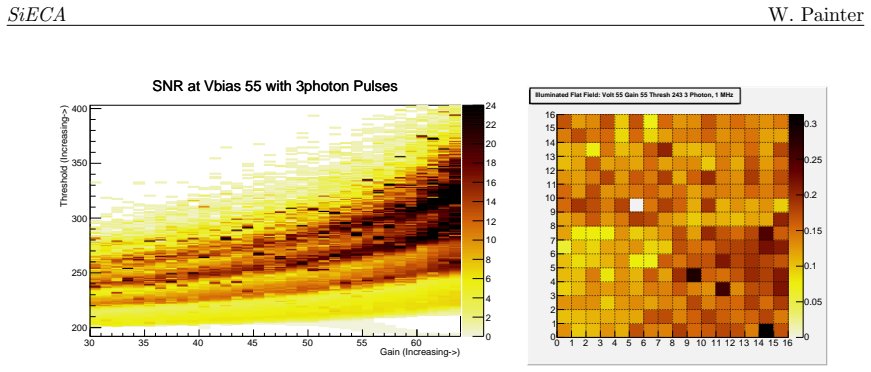
- [Section 4, 'Illuminated Flat Field test'] The uniformity claim of 'variation of less than one photon per GTU' is reported without an RMS value, per-channel error bars, or any comparison against uniform biasing or a MAPMT baseline. Since the abstract's comparative claim ('in comparison to uniform biasing with MAPMTs... substantial improvements') depends on this measurement, the flat-field result must be quantified as a distribution with uncertainties and placed against a defined baseline before the improvement claim is meaningful.
- [Section 4, 'Illuminated Flat Field test'] The text states that the expected rate is 7.5 photons/GTU and that 'the lower count rate indicates a substantial loss of signal in processing,' but it does not give the measured rate, the loss fraction, or any explanation or correction for the loss. Because the abstract's central claim rests on single-photon counting capability, this unexplained signal loss must be quantified and either corrected or explicitly bounded before the demonstrated capability can be assessed.
- [Figure 2, right panel; Section 4] Channel 3B3 is reported as having zero count rate, i.e., it is a dead channel, yet the text does not discuss the failure mode or its effect on the flat-field and uniformity conclusions. A single dead channel in 256 is small, but it should be explicitly acknowledged as a known defect and either excluded from the reported uniformity statistics or included with a documented dead-channel fraction.
minor comments (5)
- [Abstract; Section 3] The abstract states an integration time of 2.5 ms, while the body consistently uses a GTU of 2.5 µs (e.g., Section 3: '2.5 µs-GTU'); this is likely a typo and should be corrected.
- [Section 4] The phrase '7.5 MHz − photon signal' has inconsistent units; it should read '7.5 photons per GTU' or, equivalently, an incident photon rate of 3 MHz for a 2.5 µs gate.
- [Throughout] There are several typographical and formatting issues, including 'expereiences' in Section 5, 'F ront' in the Section 3 heading, and inconsistent use of 'Cerenkov' versus 'Cherenkov'; these should be cleaned up.
- [Figure 2] The right panel lacks a clear description of the color scale and axis units in the text or caption; please add a caption that defines the plotted quantity and its units, and indicate how the 16x16 channel layout maps to the four MPPC arrays.
- [Section 2.1] The text notes that temperature sensors were not used to regulate bias voltage during the EUSO-SPB1 deployment; it would be helpful to state explicitly how this affects the interpretation of the few hours of flight data, particularly regarding gain stability.
Circularity Check
No circularity: the SiECA paper is a hardware characterization report; its viability claim rests on laboratory measurements, not on a derivation from its own inputs.
full rationale
The paper does not derive a theoretical result or use fitted parameters to predict a quantity that was part of the fit. The central content is the construction and laboratory characterization of a 256-channel SiPM camera. The flat-fielding procedure tunes per-channel bias and ASIC settings and then evaluates uniformity under illumination, but this is an engineering calibration-verification loop, not a circular derivation: the authors explicitly describe the resulting improvement in conditional terms ('should result in much more uniform sensitivity') rather than presenting the measured uniformity as an independent prediction. The single-photon counting capability is supported by parameter scans showing separated photo-electron peaks, which is independent evidence. Self-citations to earlier SiECA R&D and a single-channel readout paper are background references and are not load-bearing: the paper's claims rest on the measurements reported here, not on an imported uniqueness theorem or ansatz. The abstract's 'proves SiPM are viable sensors' is stronger than the body's evidence, especially given the paper's own admission that no cosmic-ray signatures were obtained during the EUSO-SPB1 flight, but that is an evidentiary/correctness concern, not circularity. No specific reduction of a claimed result to its inputs can be exhibited, so the appropriate finding is no significant circularity, score 0.
Assumptions & free parameters
free parameters (2)
- Per-channel MPPC bias voltage =
not reported
- Per-channel ASIC gain and discriminator threshold =
not reported
assumptions (4)
- domain assumption MPPC gain scales linearly with overvoltage and PDE behavior is as specified by Hamamatsu for the S13361-3050AS-08.
- domain assumption The Citiroc 1A ASIC discriminator and peak-counting logic correctly convert MPPC pulses to per-GTU counts with negligible dead time.
- domain assumption The 3-photon-per-pulse, 1 MHz LED source provides a known absolute illumination for calibration.
- domain assumption The 2.5 µs GTU and JEM-EUSO geometry parameters are appropriate for detecting UHECR fluorescence tracks from orbit.
Cite this review
Pith. "Pith review of Silicon Photomultipliers for Orbital Ultra High Energy Cosmic Ray Observation." pith.science (2026). https://pith.science/paper/HTZNNVD6
@misc{pith2026190809136,
  author       = {Pith},
  title        = {Pith review of: Silicon Photomultipliers for Orbital Ultra High Energy Cosmic Ray Observation},
  year         = {2026},
  howpublished = {\url{https://pith.science/paper/HTZNNVD6}},
  note         = {Machine review of arXiv:1908.09136}
}
read the original abstract
Development of the Silicon photomultiplier Elementary Cell Add-on camera (SiECA) has provided extensive information regarding the use of SiPMs for future cosmic ray detection systems. We present the technical aspects of sensor readout development utilizing Citiroc ASIC chips from Weeroc controlled by a Xilinx FPGA to process and package events from four 64 channel Hamamatsu MPPC S13361 arrays generating 128 frame events with an integration time of 2.5ms (parameters are based on JEM-EUSO geometry but can be easily adjusted). With single photon counting capability, SiECA proves SiPM are viable sensors to replace Multi-Anode PhotoMultiplier Tubes in future devices, especially when high luminosity exposure is possible potentially damaging MAPMT based systems. Complementary to the technical aspects, computational and analysis methods for sensor array characterization and in depth device flat-fielding are presented. Provided channel by channel biasing, in comparison to uniform biasing with MAPMTs, fine tuning of operating parameters with MPPC arrays allows for substantial improvements in detector and signal uniformity.
Figures

Reference graph
Works this paper leans on
-
[7]
M. Renschler, W. Painter, F. Bisconti, A. Haungs, T. Huber, M. Karus, H. Schieler, A.Weindl, Nucl. Instrum. Meth. A888 (2018) 257
work page 2018
-
[5]
Painter et al., [JEM-EUSO Collaboration], PoS ICRC 2017 (2018) 442
W. Painter et al., [JEM-EUSO Collaboration], PoS ICRC 2017 (2018) 442
work page 2018
-
[1]
Ricci [JEM-EUSO Collaboration], J.\ Phys.\ Conf.\ Ser.\ 718 (2016) no.5, 052034
M. Ricci [JEM-EUSO Collaboration], J.\ Phys.\ Conf.\ Ser.\ 718 (2016) no.5, 052034
work page 2016
-
[2]
A. V. Olinto et al., PoS ICRC2017 (2018) 542
work page 2018
-
[3]
Otte et al., [JEM-EUSO, POEMMA Collaborations], PoS (ICRC2019) 977
N. Otte et al., [JEM-EUSO, POEMMA Collaborations], PoS (ICRC2019) 977
-
[4]
Osteria et al., [JEM-EUSO Collaboration], PoS (ICRC2019) 420
G. Osteria et al., [JEM-EUSO Collaboration], PoS (ICRC2019) 420
- [6]
-
[8]
Muon Counting using Silicon Photomultipliers in the AMIGA detector of the Pierre Auger Observatory
A. Aab et al. [Pierre Auger Collaboration], ``Muon counting using silicon photomultipliers in the AMIGA detector of the Pierre Auger observatory,'' JINST 12 (2017) no.03, P03002 doi:10.1088/1748-0221/12/03/P03002 [arXiv:1703.06193 [astro-ph.IM]]
work page Pith review arXiv 2017
Show all 16 references
-
[9]
Ambrosi et al
G. Ambrosi et al. [CTA Consortium], ``Silicon Photomultipliers and front-end electronics performance for Cherenkov Telescope Array camera development,'' Nucl.\ Instrum.\ Meth.\ A 845 (2017) 8. doi:10.1016/j.nima.2016.04.050
2017 doi
-
[10]
Niggemann et al
T. Niggemann et al. , ``Status of the Silicon Photomultiplier Telescope FAMOUS for the Fluorescence Detection of UHECRs,'' arXiv:1502.00792 [astro-ph.IM]
-
[11]
Kunwar, [IceCube Collaboration], ``The IceTop - Gen2 Scintillator Upgrade'', PoS (ICRC2017)
S. Kunwar, [IceCube Collaboration], ``The IceTop - Gen2 Scintillator Upgrade'', PoS (ICRC2017)
-
[12]
Karus, F
M. Karus, F. Bisconti, T. Huber, A. Ebersoldt, A. Haungs, H. Schieler and A. Weindl, ``Ground Calibration of MAPMT and SiPM for JEM-EUSO,'' PoS ICRC 2015 (2016) 612
2016
-
[13]
Renschler, ``SiPM + MPPC Calibration''
M. Renschler, ``SiPM + MPPC Calibration''. Thesis. KIT-IKP. 2016
2016
-
[14]
Epoxy Technology, ``EPO-TEK 301-2 Tech Data Sheet,``(April 2015)
2015
-
[15]
Fenu et al
F. Fenu et al. (JEM-EUSO Coll.), Proceedings 35 ^ th ICRC, Busan, \#... (2017)
2017
-
[16]
The Data Processor System of EUSO-SPB
G. Osteria et al. [JEM-EUSO Collaboration], "The Data Processor System of EUSO-SPB" Proceedings 35th ICRC, Busan, (2017)
2017
Reviewed August 14, 2026 · model on record in the stance chip above.
Discussion (0). Continue with ORCID to comment.