REVIEW 2 major objections 5 minor 21 references
Diffusiophoresis, Batchelor scale and effective P\'eclet numbers
T0 review · 2 major / 5 minor · reviewed 2026-08-14 · deepseek-v4-flash
Pith's one-line read Effective Péclet numbers collapse diffusiophoretic mixing times onto the salt-free law.
desk verdict The salt-attracting effective Péclet scaling is new and the numerical collapse is impressive, but the quasi-steady drift assumption deserves scrutiny because the salt gradients decay long before the colloids finish mixing. read the letter →
The pith
A machine-rendered reading of the paper's core claim, the machinery that carries it, and where it could break.
The reading
What carries the argument
The key object is the effective Péclet number $Pe_{\mathrm{eff}}$, defined by replacing the Batchelor scale in the standard relation $\ell_{c}/L \sim 1/\sqrt{Pe_c}$ with the diffusiophoretically modified scale, $\ell_{c,\mathrm{diff}}/L \sim 1/\sqrt{Pe_{\mathrm{eff}}}$. In the chaotic case the derivation runs through the equation for the gradient $\mathbf{G} = \nabla C$ of the colloid concentration, whose terms describe diffusion, stretching, and the drift $\mathbf{v}_{\mathrm{dp}} = D_{\mathrm{dp}} \nabla \ln S$. In the quasi-static regime, where production and dissipation balance, the dominant balance determines the scaling: for $D_{\mathrm{dp}}>0$ the drift term competes with diffusion, while for $D_{\mathrm{dp}}<0$ it competes with stretching. The order-of-magnitude estimate $V_{\mathrm{dp}} \sim D_{\mathrm{dp}}/\ell_s$ is what converts these balances into the two effective Péclet numbers.
What would settle it
Run the same random-phase sine-flow simulations and evaluate each of the six terms in the gradient equation (3.7) at the moment the colloid patch first reaches its Batchelor scale, for $D_{\mathrm{dp}}>0$ and $D_{\mathrm{dp}}<0$ with $D_{\mathrm{dp}}^2/(D_c D_s)$ just above 1; if terms (d), (e), or (f) are comparable to term (c), the dominant-balance assignment behind the effective Péclet numbers is wrong and the collapse should break.
Extended reading notes
Core claim
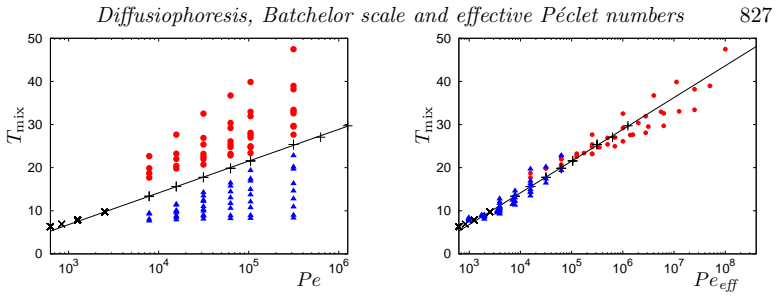
In a globally chaotic flow, the paper's central claim is that the colloid mixing time is the same function of an effective Péclet number as in the absence of diffusiophoresis, $T_{\mathrm{mix}} = f(Pe_{\mathrm{eff}})$, with $Pe_{\mathrm{eff}}$ built from the modified Batchelor scale. For salt-attracting colloids the effective number is $Pe_{\mathrm{eff}}^{\mathrm{attract}} = Pe_c \, D_{\mathrm{dp}}^2/(D_c D_s)$, which is much larger than $Pe_c$ and so delays mixing; for salt-repelling colloids it is $Pe_{\mathrm{eff}}^{\mathrm{repell}} = Pe_c \, D_c D_s/D_{\mathrm{dp}}^2$, much smaller than $Pe_c$ and so accelerates mixing. Both scalings follow from balancing the diffusive dissipation term against the diffusiophoretic gradient-production term (salt-attracting) or the stretching production term against the same drift term (salt-repelling), under the condition $D_{\mathrm{dp}}^2/(D_c D_s) \gg 1$. In the numerical sine flow with random phases the calculated mixing times collapse onto the no-salt curve $T_{\mathrm{mix}} = 3.2 \log(Pe_{\mathrm{eff}}/120)$ over five decades of effective Péclet number. For the pure-strain stagnation point the same idea works analytically, with $Pe_{\mathrm{eff}} = Pe_c(1 + D_{\mathrm{dp}}/D_s)$ and an exact Gaussian solution.
Load-bearing premise
The load-bearing premise is the order-of-magnitude balance in the gradient equation: the diffusiophoretic drift is estimated as $V_{\mathrm{dp}} \sim D_{\mathrm{dp}}/\ell_s$, and among the six gradient terms only the diffusion term and one drift or stretching term survive in the quasi-static regime, with terms (d), (e), and (f) negligible; if this ordering fails, equations (3.16) and (3.18) do not follow.
Editorial extensions
If this is right
- With $D_{\mathrm{dp}}>0$, the effective Péclet number is $Pe_c \, D_{\mathrm{dp}}^2/(D_c D_s)$, so salt-attracting colloids are predicted to mix much more slowly than the same colloids without salt.
- With $D_{\mathrm{dp}}<0$, the effective Péclet number is $Pe_c \, D_c D_s/D_{\mathrm{dp}}^2$, so salt-repelling colloids mix faster, and the theory is equivalent to an effective diffusivity $D_{\mathrm{eff}} \sim D_{\mathrm{dp}}^2/D_s$ independent of $D_c$.
- In a globally chaotic flow the mixing time is the same logarithmic function of $Pe_{\mathrm{eff}}$ as without diffusiophoresis, so existing no-salt correlations or fits can be reused once $Pe_{\mathrm{eff}}$ is known.
- Large scales in the dilating direction remain essentially unaffected by diffusiophoresis; the action of the salt gradient is confined to the Batchelor scale, which is what the effective Péclet number encodes.
- The paper's regime of validity is $D_{\mathrm{dp}}^2/(D_c D_s) \gg 1$, and numerical data with $D_{\mathrm{dp}}^2/(D_c D_s) \gtrsim 10$ already show the predicted plateau in the salt-repelling case.
Reading between the lines
- Because the gradient-balance argument depends on the flow only through a characteristic stretching rate, the same two effective Péclet numbers should collapse mixing-time data in other globally chaotic laminar flows, such as deterministic blinking-vortex flows, provided the stretching rate is taken from the relevant Lyapunov exponent.
- Near the crossover $D_{\mathrm{dp}}^2 \approx D_c D_s$ neither balance is dominant; an interpolation formula combining the three leading terms of the gradient equation is a natural testable extension.
- The authors' closing suggestion can be made concrete: for patches much larger than the flow scale, homogenization with imposed mean salt and colloid gradients should produce effective diffusivities whose dependence on $D_c$ matches the reciprocal factors $D_c D_s/D_{\mathrm{dp}}^2$ and $D_{\mathrm{dp}}^2/(D_c D_s)$ seen here.
Signed reviews
Editorial analysis
A structured set of objections, weighed in public.
Referee Report
Summary. This paper studies the joint mixing of colloids and salt in a linear strain flow and in a globally chaotic flow, in the presence of diffusiophoresis. The authors show that for a Gaussian patch in pure strain, the mixing time is rescaled by an effective Péclet number Pe_eff = Pe_c(1 + Ddp/Ds) built from the modified Batchelor scale. For chaotic advection, they derive effective Péclet numbers by balancing terms in the equation for concentration gradients: Pe_eff ~ Pe_c Ddp^2/(Dc Ds) for salt-attracting (Ddp > 0) and Pe_eff ~ Pe_c Dc Ds/Ddp^2 for salt-repelling (Ddp < 0), valid when Ddp^2/(Dc Ds) >> 1. Numerical simulations of a sine flow with random phase show that the colloid mixing time collapses onto the no-salt curve when plotted against these effective Péclet numbers over five orders of magnitude.
Significance. If the proposed rescaling is correct, it provides a simple predictive tool for colloidal mixing times in microfluidic and environmental flows, and it extends earlier work by Deseigne et al. (2014) to the salt-attracting configuration. The pure-strain part is supported by the analytical solution of Raynal et al. (2018) and shows an impressive collapse over eight decades. The chaotic-advection part is supported by a numerical parameter sweep with Ddp, Dc, and Ds varied independently, and the collapse over five orders of magnitude is a strong empirical indication that the effective Péclet number is the right control parameter. The gradient-equation derivation is elegant and connects the result to the classical Batchelor-scale theory.
major comments (2)
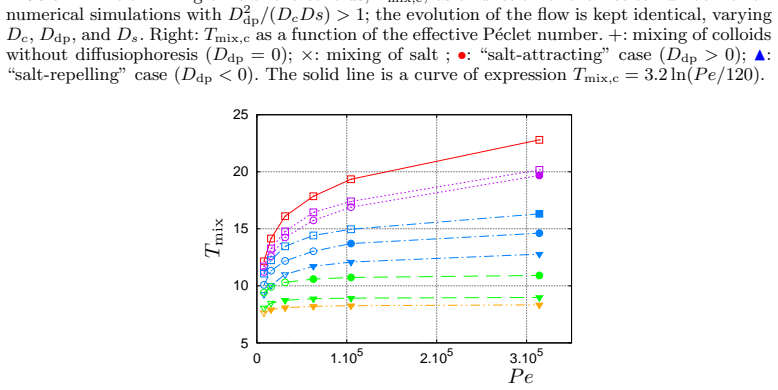
- [§3.2–§3.4] In §3.2–§3.4, the derivation of the effective Péclet numbers assumes that the diffusiophoretic drift Vdp ∼ Ddp/ℓs is present in the quasi-static regime when the colloids reach their modified Batchelor scale. This requires the salt gradients to survive at least as long as the colloid compression. In the simulations of §3.5, Pe_s ∈ [600, 2500], so the salt mixing time estimated from Eq. (3.19) is τ_s ≈ 3.2 ln(Pe_s/120) ≈ 5–9, while the reported colloid mixing times for large Pe_eff reach ≈ 30–40. The salt field that drives Vdp therefore decays substantially before the colloids attain the scales described by Pe_eff, and Eqs. (3.16) and (3.18) are not derived for the parameter regime simulated. The paper does not test the time dependence of Vdp (for instance, by measuring |∇ ln S| or the actual drift velocity during the runs). Without this check, the collapse in Fig. 2(right) is consistent with, but does not uniquely support, the quasi-static mechanism; an early-time compression followed by ordinary diffusion of the resulting fine structures could produce a similar rescaling. The authors should either demonstrate that Vdp remains of order Ddp/ℓs throughout the relevant phase or restate Eqs. (3.16) and (3.18) as empirical scalings.
- [§3.3] In §3.3, the condition Ddp^2/(Dc Ds) >> 1 is stated as the validity condition for the attracting case, but this is not sufficient. The quasi-static balance (a)∼(c) in Eq. (3.7) can only hold if the salt is still present when the colloids approach their modified Batchelor scale, i.e., if τ_s ≳ τ_c,eff, which in terms of Péclet numbers requires Pe_s ≳ Pe_eff. In the simulations, Pe_eff^attract can exceed Pe_s by orders of magnitude (Pe_eff up to 10^8 versus Pe_s ≈ 600–2500), so the derivation's premise is violated exactly for the points that most strongly test the collapse. Please state the full validity condition, verify it against the numerical parameters, or modify the theoretical claim accordingly.
minor comments (5)
- [Eqs. (3.16), (3.18)] Equations (3.16) and (3.18) write 'Pe' without a subscript; the symbol should be Pe_c to distinguish the colloid Péclet number from Pe_s and from the effective Péclet number.
- [p. 822] Page 822 contains the typo 'height decades'; it should read 'eight decades'.
- [References] The reference to 'Frish (1995)' should be 'Frisch (1995)' as in the standard turbulence textbook.
- [Abstract, §4] The condition Ddp^2/DsDc should be written with parentheses, e.g., Ddp^2/(Dc Ds), to avoid ambiguity.
- [§3.5] The numerical method section states that the same code as in Volk et al. (2014) is used, but it does not report the grid resolution or any convergence test; a sentence on the resolution and validation would strengthen reproducibility.
Circularity Check
No significant circularity: the effective Péclet numbers are derived from gradient-balance estimates and then tested against simulations, not fitted from the mixing times.
full rationale
The central derivation of the chaotic-advection effective Péclet numbers is self-contained. The paper starts from the scalar-gradient variance equation (3.7), estimates the magnitude of the diffusiophoretic drift as Vdp ~ Ddp/ℓs (3.8), and balances the dominant terms to obtain Pe_eff = Pe_c Ddp^2/(DcDs) for Ddp>0 (3.16) and Pe_eff = Pe_c DcDs/Ddp^2 for Ddp<0 (3.18). These formulas are then compared with numerical simulations in which Pe_eff is computed from the physical parameters Dc, Ds, Ddp, and Pe_c, so the comparison is a genuine test rather than a fit. The no-diffusiophoresis curve Tmix = 3.2 ln(Pe/120) is fitted to runs without salt/diffusiophoresis and used as a prediction for the diffusiophoretic data, not fitted to them. The self-citations (Raynal & Gence 1997 for the gradient method, Raynal et al. 2018 for the linear-strain analytical solution, Volk et al. 2014 for the numerical code) are prior published tools whose assumptions are restated and which do not already contain the target Pe_eff scalings. The stagnation-point effective Péclet number is indeed defined through the modified Batchelor scale, Pe_eff = ℓ0^2/ℓc,diff^2, but the collapse shown in figure 1 is a nontrivial numerical observation obtained from the exact analytical solution, not a logical consequence of the definition alone. The quasi-steady assumption underlying Vdp and the ordering of gradient terms is a physical approximation that could fail, but that is a correctness risk rather than a circularity: the derivation does not assume the conclusion it claims to test.
Assumptions & free parameters
free parameters (2)
- Mixing time fit constant A =
3.2 (dimensionless)
- Mixing time fit offset B =
120 (dimensionless)
assumptions (5)
- domain assumption The colloid velocity is v_col = v + Ddp ∇ ln S (diffusiophoretic drift model).
- domain assumption The salt diffusivity is much larger than the colloid diffusivity, Dc << Ds.
- domain assumption In chaotic advection, a quasi-static balance is reached between production and dissipation of scalar gradients.
- domain assumption Terms (d), (e), (f) in eq. (3.7) are negligible compared with term (c) when ℓ_{c,diff} << ℓ_s.
- domain assumption The random-phase sine flow is globally chaotic, so the mixing time follows a logarithmic scaling with Péclet number.
Cite this review
Pith. "Pith review of Diffusiophoresis, Batchelor scale and effective P\'eclet numbers." pith.science (2026). https://pith.science/paper/QTDCMPSJ
@misc{pith2026190809147,
  author       = {Pith},
  title        = {Pith review of: Diffusiophoresis, Batchelor scale and effective P\'eclet numbers},
  year         = {2026},
  howpublished = {\url{https://pith.science/paper/QTDCMPSJ}},
  note         = {Machine review of arXiv:1908.09147}
}
abstract
We study the joint mixing of colloids and salt released together in a stagnation point or in a globally chaotic flow. In the presence of salt inhomogeneities, the mixing time is strongly modified depending on the sign of the diffusiophoretic coefficient $D_\mathrm{dp}$. Mixing is delayed when $D_\mathrm{dp}>0$ (salt-attracting configuration), or faster when $D_\mathrm{dp}<0$ (salt-repelling configuration). In both configurations, as for molecular diffusion alone, large scales are barely affected in the dilating direction while the Batchelor scale for the colloids, $\ell_{c,\mathrm{diff}}$, is strongly modified by diffusiophoresis. We propose here to measure a global effect of diffusiophoresis in the mixing process through an effective P\'eclet number built on this modified Batchelor scale. Whilst this small scale is obtained analytically for the stagnation point, in the case of chaotic advection, we derive it using the equation of gradients of concentration, following Raynal \& Gence (\textit{Intl J. Heat Mass Transfer}, vol. 40 (14), 1997, pp. 3267--3273). Comparing to numerical simulations, we show that the mixing time can be predicted by using the same function as in absence of salt, but as a function of the effective P\'eclet numbers computed for each configuration. The approach is shown to be valid when the ratio $D_\mathrm{dp}^2/D_s D_c \gg 1$, where $D_c$ and $D_s$ are the diffusivities of the colloids and salt.
Figures

Reference graph
Works this paper leans on
-
[1]
Ab\'ecassis, B. , Cottin-Bizonne, C. , Ybert, C. , Ajdari, A. & Bocquet, L. 2009 Osmotic manipulation of particles for microfluidic applications . New Journal of Physics 11 (7), 075022
work page 2009
-
[2]
Anderson, J. L. 1989 Colloid transport by interfacial forces . Annu. Rev. Fluid. Mech. 21 , 61--99
work page 1989
-
[3]
1956 On the dispersion of a solute in a fluid flowing through a tube
Aris, R. 1956 On the dispersion of a solute in a fluid flowing through a tube . Proceedings of the Royal Society of London A: Mathematical, Physical and Engineering Sciences 235 (1200), 67--77 , arXiv:arXiv: http://rspa.royalsocietypublishing.org/content/235/1200/67.full.pdf
work page 1956
-
[4]
Bakunin, Oleg G. , ed. 2011 Chaotic Flows\/ . Springer
work page 2011
-
[5]
Banerjee, Anirudha , Williams, Ian , Azevedo, Rodrigo Nery , Helgeson, Matthew E. & Squires, Todd M. 2016 Soluto-inertial phenomena: Designing long-range, long-lasting, surface-specific interactions in suspensions . Proceedings of the National Academy of Sciences 113 (31), 8612--8617
work page 2016
-
[6]
Biferale, L. , Crisanti, A. , Vergassola, M. & Vulpiani, A. 1995 Eddy diffusivities in scalar transport . Physics of Fluids 7 (11), 2725--2734
work page 1995
-
[7]
Birch, D.A. , Young, W.R. & Franks, P.J.S. 2008 Thin layers of plankton: Formation by shear and death by diffusion . Deep Sea Research Part I: Oceanographic Research Papers 55 (3), 277 -- 295
work page 2008
-
[8]
Deseigne, J. , Cottin-Bizonne, C. , Stroock, A. D. , Bocquet, L. & Ybert, C. 2014 How a " pinch of salt " can tune chaotic mixing of colloidal suspensions . Soft Matter 10 , 4795--4799
work page 2014
Show all 21 references
-
[9]
1995 Turbulence-The Legacy of A
Frish, U. 1995 Turbulence-The Legacy of A. N. Kolmogorov.\/ . Cambridge university press
1995
-
[10]
el , Bourgoin, Micha\
Mauger, Cyril , Volk, Romain , Machicoane, Nathana\"el , Bourgoin, Micha\"el , Cottin-Bizonne, C\'ecile , Ybert, Christophe & Raynal, Florence 2016 Diffusiophoresis at the macroscale . Phys. Rev. Fluids 1 , 034001
2016
-
[11]
In Advances in Applied Mechanics\/ , , vol
Metcalfe, Guy , Speetjens, MFM , Lester, DR & Clercx, HJH 2012 Beyond passive: chaotic transport in stirred fluids . In Advances in Applied Mechanics\/ , , vol. 45 , pp. 109--188 . Elsevier
2012
-
[12]
Pierrehumbert, R. T. 1994 Tracer microstructure in the large-eddy dominated regime . Chaos, Solitons & Fractals 4 (6), 1091--1110
1994
-
[13]
Pierrehumbert, R. T. 2000 Lattice models of advection-diffusion . Chaos 10 (1), 61--74
2000
-
[14]
Ranz, W. E. 1979 Applications of a stretch model to mixing, diffusion, and reaction in laminar and turbulent flows . AIChE Journal 25 (41), 075022
1979
-
[15]
Journal of Fluid Mechanics 847 , 228–243
Raynal, Florence , Bourgoin, Mickael , Cottin-Bizonne, Cécile , Ybert, Christophe & Volk, Romain 2018 Advection and diffusion in a chemically induced compressible flow . Journal of Fluid Mechanics 847 , 228–243
2018
-
[16]
& Gence, J.-N
Raynal, F. & Gence, J.-N. 1997 Energy saving in chaotic laminar mixing . Int. J. Heat Mass Transfer 40 (14), 3267--3273
1997
-
[17]
Schmidt, Lukas , Fouxon, Itzhak , Krug, Dominik , van Reeuwijk, Maarten & Holzner, Markus 2016 Clustering of particles in turbulence due to phoresis . Phys. Rev. E 93 , 063110
2016
-
[18]
New Journal of Physics 19 (12), 123030
Shukla, Vishwanath , Volk, Romain , Bourgoin, Mickaël & Pumir, Alain 2017 Phoresis in turbulent flows . New Journal of Physics 19 (12), 123030
2017
-
[19]
& Stroock, A
Sundararajan, P. & Stroock, A. D. 2012 Transport phenomena in chaotic laminar flows . Annual Review of Fluid Mechanics 3 , 473--493
2012
-
[20]
2019 Mixing versus stirring
Villermaux, E. 2019 Mixing versus stirring . Annual Review of Fluid Mechanics 51 , 245--273
2019
-
[21]
, Mauger, C
Volk, R. , Mauger, C. , Bourgoin, M. , Cottin-Bizonne, C. , Ybert, C. & Raynal, F. 2014 Chaotic mixing in effective compressible flows . Phys. Rev. E 90 , 013027
2014
Reviewed August 14, 2026 · model on record in the stance chip above.
Discussion (0). Continue with ORCID to comment.