REVIEW 4 major objections 5 minor 19 references
Universal Policies to Learn Them All
T0 review · 4 major / 5 minor · reviewed 2026-08-14 · deepseek-v4-flash
Pith's one-line read The paper claims that a team of reinforcement-learning bodyguards trained with scenario-conditioned universal value functions can protect a VIP across four distinct crowd scenarios as well as policies trained separately on each scenario.
desk verdict A useful new benchmark and a clear extension of MADDPG to multi-scenario MARL, but the hindsight replay mechanism is theoretically shaky and the empirical evidence lacks variance reporting. read the letter →
The pith
A machine-rendered reading of the paper's core claim, the machinery that carries it, and where it could break.
The reading
What carries the argument
The load-bearing object is the universal value function approximator, a value function $V_i(s, g; \phi) \approx V_{ig}^*(s)$ or $Q_i(s, a, g; \phi) \approx Q_{ig}^*(s, a)$ that takes a scenario descriptor alongside state and actions. Combined with the MADDPG centralized critic and deterministic policy gradient update, it produces universal policies $\pi_\theta(o_i, g)$. The hindsight replay step in Algorithm 1 (lines 14--15) stores each transition twice: once under the scenario that generated it and once under an extra sampled scenario $k$ with the reward recomputed as $r_k^i(o_t^i, a_t^i)$. That double storage is what gives the critic training signal from more than one scenario per physical transition.
What would settle it
Run the ablation with hindsight replay disabled but with double the replay samples, or replace relabeled transitions with true rollouts from the target scenario; if the gain disappears, the benefit comes from extra updates rather than from sound cross-scenario replay. A more direct check is to compare the next-state distribution of a Shopping Mall transition relabeled for the Street scenario against actual Street transitions: the Street scenario uses crowd-motion dynamics, so if the distributions differ, the relabeled transition is not a valid sample of Street dynamics.
Extended reading notes
Core claim
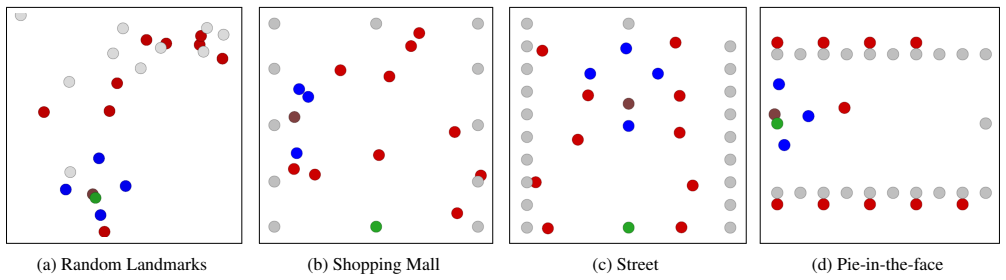
The central discovery is a way to condition multi-agent policies on a scenario without losing the benefits of centralized training. MAUPG augments each actor and each centralized critic with a scenario embedding $g$; the actor chooses $a_i = \pi_i(o_i, g)$ and the critic estimates $Q_i^\pi(s, a_1, \dots, a_N, g)$. The gradient in equation (1) is then taken over state, action, and scenario, so a single shared parameter set can represent different per-scenario behaviors. The paper additionally relabels replay transitions from scenario $g$ as transitions from another scenario $k$ by recomputing the reward under $k$ (Algorithm 1, lines 14--15), a form of hindsight replay. On their VIP-protection benchmark, the authors report that MADDPG policies trained on one scenario degrade sharply on others, while MAUPG attains residual-threat scores comparable to or better than scenario-dependent MADDPG policies on all four scenarios.
Load-bearing premise
The hindsight replay step assumes a transition $(o_t, a_t, o_{t+1})$ collected in one scenario can be relabeled as experience for another scenario $k$ by recomputing the reward, even though the scenarios differ in bystander movement dynamics and therefore in transition probabilities.
Editorial extensions
If this is right
- If MAUPG is correct, deploying a trained bodyguard team in any of the four known scenarios reduces to switching the scenario embedding $g$ at execution time, with no per-scenario retraining needed.
- The paper's comparison indicates that standard MARL algorithms (MADDPG being the only one that reliably learns) do not transfer a single task across scenarios, so scenario-conditioned training appears necessary for multi-scenario deployment.
- The ablation results imply that both the universal critic and the hindsight replay step contribute to MAUPG's advantage; simply sampling different scenarios during MADDPG training is not sufficient.
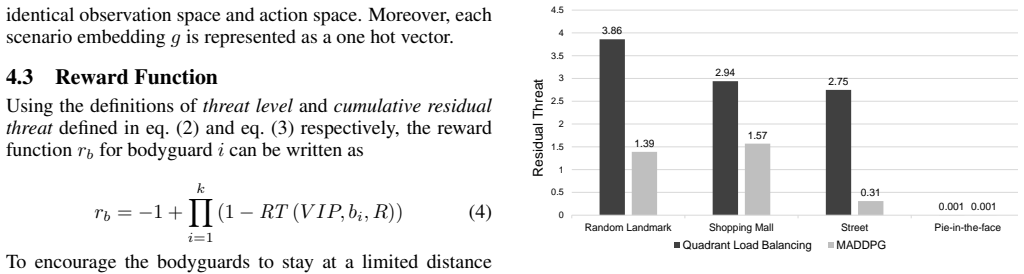
- The learned policies improve substantially on quadrant load balancing in the harder scenarios, which the authors take as evidence that multi-agent reinforcement learning can beat a hand-engineered baseline for this task.
- The paper claims MAUPG performs better than MADDPG policies trained on each scenario individually, measured by average cumulative residual threat over 100 episodes.
Reading between the lines
- One extension the authors do not test: replacing one-hot scenario tags with continuous or learned embeddings, which would allow interpolation between known scenarios and possibly graceful handling of unseen variants.
- The centralized universal critic could be reused as a transfer diagnostic: comparing $Q_i^\pi(s, a_1, \dots, a_N, g)$ across scenario embeddings may predict which policies transfer best and where new data is needed.
- A practical consequence: multi-scenario training may reduce the number of training runs needed for robot teams deployed in similar crowd settings, but only when scenario labels are available at execution time.
Signed reviews
Editorial analysis
A structured set of objections, weighed in public.
Referee Report
Summary. The paper proposes Multi-Agent Universal Policy Gradient (MAUPG), a multi-agent reinforcement learning algorithm that conditions each agent's policy and centralized critic on a scenario embedding g, building on MADDPG and universal value function approximators. The authors introduce a VIP-protection benchmark in the Multi-Agent Particle Environment with four scenarios that differ in bystander movement dynamics, and report that MADDPG policies trained on one scenario generalize poorly to others, while MAUPG achieves residual-threat values comparable to or better than scenario-dependent MADDPG policies. The paper also includes an ablation study that attributes part of MAUPG's benefit to a hindsight-replay step that relabels episodes with rewards from other scenarios.
Significance. If the empirical claims are substantiated, the paper would make a useful contribution by demonstrating that a single scenario-conditioned policy can solve one cooperative task across multiple known scenarios, a form of multi-scenario generalization that standard MARL algorithms are not designed to provide. The proposed environment is also a plausible benchmark for cooperative multi-agent behavior under different crowd dynamics. The ablation structure is a good idea, and the authors are explicit about the components they are testing. However, the load-bearing evidence is currently not rigorous enough: the headline quantitative comparisons lack error bars and seed counts, the per-scenario reward weights are unreported, and the hindsight-replay mechanism is used in a way that is not valid under differing transition dynamics. Because these issues affect the central claims, the paper needs a major revision before the conclusions can be accepted.
major comments (4)
- [Algorithm 1, lines 14-15; Section 6] The hindsight-replay step stores the transition (o_t, a_t, r^k_t, o_{t+1}, k), where o_{t+1} was produced under scenario g. In the VIP environment the four scenarios differ in bystander movement dynamics (random waypoints, shop visits, Vicsek flocking, rule-abiding versus unruly bystanders), so the same (o_t, a_t) under scenario k would generally lead to a different o_{t+1}. The Q-target in Algorithm 1, line 23, then evaluates the critic at a next state that is not a sample from scenario k's transition distribution, which biases the critics for all relabeled transitions. The ablation in Section 6 attributes the improvement of MAUPG with hindsight replay to 'replaying trajectories from one scenario in other scenarios,' but this mechanism is not sound for the reported environment. The authors should either restrict relabeling to scenarios that share transition dynamics, use a dynamics model for relabeling, or provide an analysis showing why the bias does not materially affect the result.
- [Section 5.2, Figures 4-6] The central quantitative claim that MAUPG 'performs better than' MADDPG and QLB is supported only by bar charts of average cumulative residual threat without error bars, standard deviations, or information about the number of random seeds. With no measure of variance, differences such as 1.39 versus 1.01 in Figure 6 cannot be assessed for statistical significance, and the claim of equal performance on the Pie-in-the-face scenario is likewise unquantified. The paper should report mean and standard deviation across multiple independent runs and, where appropriate, a significance test or effect-size measure.
- [Section 4.3, Eq. (6)] The reward function in Eq. (6) uses scenario-dependent weights alpha and beta, but the text says only that 'depending upon on the scenario g, different values of alpha, and beta were chosen for the optimal performance' without reporting those values. Because these weights change the reward signal per scenario, the comparison between universal policies and scenario-dependent MADDPG policies is potentially confounded by per-scenario reward tuning. The exact values of alpha and beta for each scenario must be reported, and the authors should justify that this tuning is not equivalent to providing the universal policy with scenario-specific reward shaping that is unavailable in a fair comparison.
- [Section 5.2, Figure 5; Abstract] The abstract and conclusion state that 'state-of-the-art MARL algorithms fail to generalize' a single task over multiple scenarios, but the generalization experiment in Section 5.2 only tests MADDPG. The other algorithms (Q-Mix, VDN, IQL, COMA) are not evaluated for cross-scenario transfer because they fail to learn even in the single-scenario training of Section 5.1. The claim should be restricted to the algorithms actually tested, or the authors should provide cross-scenario generalization results for the other methods that are able to learn the task.
minor comments (5)
- [Section 4.1, Eq. (3)] The display of Eq. (3) has an unusual 'T∫0' formatting and should be written as an integral from 0 to T for readability.
- [Figures 3, 7, 8] Several figure captions and axis labels contain typos, such as 'Number f Epis des', 'Average Cu ulative Reward', and 'start-of-the-art'; these should be corrected.
- [Section 4.2] The paper says the scenario embedding g is represented as a one-hot vector but does not specify how this vector is fed into the actor and critic networks; a sentence describing the input concatenation or embedding layer would improve reproducibility.
- [Section 2] The notation for the partially observable Markov game is introduced loosely ('characterized by S, N agents with partial observations O = {O1,...,ON}...'), and the transition and observation functions are not formally defined; this could be tightened.
- [Algorithm 1] Line 1 samples a scenario g outside the episode loop, while line 8 samples an additional scenario k and line 18 sets g = k; this is understandable but could be presented more clearly by stating that the episode scenario is updated once per episode.
Circularity Check
No circularity: the results are empirical comparisons against external baselines, and the proposed algorithm is a direct policy-gradient construction rather than a restatement of its inputs.
full rationale
The paper's central claim is an empirical one: MAUPG, a scenario-conditioned multi-agent policy-gradient method, matches or outperforms scenario-dependent MADDPG and the hand-engineered QLB baseline on a VIP-protection benchmark. The derivation chain starts from standard external frameworks (MADDPG and UVFAs), extends the policy gradient to condition actors and critics on a scenario embedding g (Eq. (1), Algorithm 1), and then reports measurements of cumulative residual threat in Figs. 4-6 with an ablation in Figs. 7-8. These are not 'predictions' derived from fitted parameters: the α and β in Eq. (6) are hand-chosen reward-shaping coefficients per scenario, not parameters fit to the CRT evaluation metric, so there is no fitted-input-called-prediction pattern. The self-citations to [Sheikh and Bölöni 2018a,b] and [Bhatia et al. 2016] point to the environment and to a prior hand-crafted baseline; they are not invoked as a uniqueness theorem or as the justification for the core generalization claim. The paper explicitly limits scope to known scenarios ('Here, we are not dealing with unknown scenarios'), so it does not claim extrapolation to unseen scenarios. The hindsight-replay concern identified in the manuscript's ablation discussion is a question about whether relabeled transitions are valid samples under different dynamics; even if that mechanism is questionable, it is a correctness issue, not a circularity issue, because the reported benefit is measured empirically and is not made true by definition. No load-bearing step reduces to its own inputs, so the correct score is 0.
Assumptions & free parameters
free parameters (3)
- alpha_g (scenario-dependent reward weight) =
not reported
- beta_g (scenario-dependent distance regularizer weight) =
not reported
- optimizer and network hyperparameters (learning rates, batch size S, target update tau) =
not reported
assumptions (4)
- standard math Deterministic policy gradient theorem (Silver et al., 2014) and MADDPG centralized critic with decentralized execution stabilize multi-agent training.
- domain assumption A value function parameterized with a goal or scenario embedding can generalize over goals/scenarios (UVFA premise).
- ad hoc to paper A transition (o_t, a_t, o_{t+1}) collected under scenario g can be relabeled as a valid transition for scenario k by recomputing the reward under k.
- domain assumption All bodyguards have identical observation and action spaces and the scenario is identifiable from a one-hot vector g.
Cite this review
Pith. "Pith review of Universal Policies to Learn Them All." pith.science (2026). https://pith.science/paper/6JLZ64JB
@misc{pith2026190809184,
  author       = {Pith},
  title        = {Pith review of: Universal Policies to Learn Them All},
  year         = {2026},
  howpublished = {\url{https://pith.science/paper/6JLZ64JB}},
  note         = {Machine review of arXiv:1908.09184}
}
read the original abstract
We explore a collaborative and cooperative multi-agent reinforcement learning setting where a team of reinforcement learning agents attempt to solve a single cooperative task in a multi-scenario setting. We propose a novel multi-agent reinforcement learning algorithm inspired by universal value function approximators that not only generalizes over state space but also over a set of different scenarios. Additionally, to prove our claim, we are introducing a challenging 2D multi-agent urban security environment where the learning agents are trying to protect a person from nearby bystanders in a variety of scenarios. Our study shows that state-of-the-art multi-agent reinforcement learning algorithms fail to generalize a single task over multiple scenarios while our proposed solution works equally well as scenario-dependent policies.
Figures


Figures from the paper (3 more)


Reference graph
Works this paper leans on
- [1]
-
[7]
Multi-agent actor-critic for mixed cooperative-competitive environ- ments
[Lowe et al., 2017] Ryan Lowe, Yi Wu, Aviv Tamar, Jean Harb, Pieter Abbeel, and Igor Mordatch. Multi-agent actor-critic for mixed cooperative-competitive environ- ments. In Advances in Neural Information Processing Sys- tems 30, pages 6379–6390,
work page 2017
-
[9]
[Mnih et al., 2015] V olodymyr Mnih, Koray Kavukcuoglu, David Silver, Andrei A. Rusu, Joel Veness, Marc G. Belle- mare, Alex Graves, Martin Riedmiller, Andreas K. Fid- jeland, Georg Ostrovski, Stig Petersen, Charles Beattie, Amir Sadik, Ioannis Antonoglou, Helen King, Dharshan Kumaran, Daan Wierstra, Shane Legg, and Demis Has- sabis. Human-level control t...
work page 2015
-
[10]
Emergence of grounded compositional lan- guage in multi-agent populations
[Mordatch and Abbeel, 2017] Igor Mordatch and Pieter Abbeel. Emergence of grounded compositional lan- guage in multi-agent populations. arXiv preprint arXiv:1703.04908,
arXiv 2017
-
[11]
[Omidshafiei et al., 2017] Shayegan Omidshafiei, Jason Pazis, Christopher Amato, Jonathan P. How, and John Vian. Deep decentralized multi-task multi-agent rein- forcement learning under partial observability. In Proc. of the 34th Int’l Conf. on Machine Learning(ICML) , pages 2681–2690,
work page 2017
- [12]
-
[13]
https://blog. openai.com/openai-five/. [Schaul et al., 2015] Tom Schaul, Daniel Horgan, Karol Gregor, and David Silver. Universal value function ap- proximators. In Proc. of the 32st Int’l Conf. on Machine Learning(ICML), pages 1312–1320,
work page 2015
-
[14]
[Sheikh and B¨ol¨oni, 2018a] H. U. Sheikh and L. B ¨ol¨oni. Designing a multi-objective reward function for creat- ing teams of robotic bodyguards using deep reinforce- ment learning. In Prof. of 1st Workshop on Goal Spec- ifications for Reinforcement Learning (GoalsRL-2018) at ICML 2018, July
work page 2018
Show all 19 references
-
[15]
[Sheikh and B¨ol¨oni, 2018b] H. U. Sheikh and L. B¨ol¨oni. The emergence of complex bodyguard behavior through multi- agent reinforcement learning. In Proc. of Autonomy in Teams (AIT-2018) workshop at ICML-2018, July
2018
-
[16]
Deterministic policy gradient algorithms
[Silver et al., 2014] David Silver, Guy Lever, Nicolas Heess, Thomas Degris, Daan Wierstra, and Martin Riedmiller. Deterministic policy gradient algorithms. In Proc. of the 31st Int’l Conf. on Machine Learning(ICML), pages 387– 395,
2014
-
[18]
Czar- necki, John Quan, James Kirkpatrick, Raia Hadsell, Nico- las Heess, and Razvan Pascanu
[Teh et al., 2017] Yee Teh, Victor Bapst, Wojciech M. Czar- necki, John Quan, James Kirkpatrick, Raia Hadsell, Nico- las Heess, and Razvan Pascanu. Distral: Robust multitask reinforcement learning. In Advances in Neural Informa- tion Processing Systems 30, pages 4496–4506
2017
-
[19]
Novel type of phase transition in a system of self-driven particles
[Vicsek et al., 1995] Tam´as Vicsek, Andr ´as Czir ´ok, Eshel Ben-Jacob, Inon Cohen, and Ofer Shochet. Novel type of phase transition in a system of self-driven particles. Phys- ical review letters, 75(6):1226, 1995
1995
-
[1994]
Emer- gent coordination through competition
[Liu et al., 2019] Siqi Liu, Guy Lever, Nicholas Heess, Josh Merel, Saran Tunyasuvunakool, and Thore Graepel. Emer- gent coordination through competition. In International Conference on Learning Representations,
2019
-
[2014]
[Silver et al., 2016] David Silver, Aja Huang, Christopher J. Maddison, Arthur Guez, Laurent Sifre, George van den Driessche, Julian Schrittwieser, Ioannis Antonoglou, Veda Panneershelvam, Marc Lanctot, Sander Dieleman, Do- minik Grewe, John Nham, Nal Kalchbrenner, Ilya Sutske...
2016
-
[2015]
[Littman, 1994] Michael L. Littman. Markov games as a framework for multi-agent reinforcement learning. In Proc. of the 11th Int’l Conf. on Machine Learning(ICML), pages 157–163. Morgan Kaufmann,
1994
-
[2016]
Mankowitz, Hado van Hasselt, Remi Munos, David Silver, and Tom Schaul
[Borsa et al., 2019] Diana Borsa, Andre Barreto, John Quan, Daniel J. Mankowitz, Hado van Hasselt, Remi Munos, David Silver, and Tom Schaul. Universal successor fea- tures approximators. In International Conference on Learning Representations,
2019
-
[2017]
Hindsight experience replay
[Marcin et al., 2017] Andrychowicz Marcin, Wolsk Filip, Ray Alex, Schneider Jonas, Fong Rachel, Welinde Peter, McGrew Bob, Tobin Josh, Pieter Abbeel, and Zaremba Wojciech. Hindsight experience replay. In Advances in Neural Information Processing Systems 30 , pages 5048– 5058,
2017
-
[2018]
Lillicrap, Jonathan J
[Lillicrap et al., 2015] Timothy P. Lillicrap, Jonathan J. Hunt, Alexander Pritzel, Nicolas Heess, Tom Erez, Yuval Tassa, David Silver, and Daan Wierstra. Continuous con- trol with deep reinforcement learning. In Proc. of the 3rd Int’l Conf. on Learning Representations (ICLR),
2015
-
[2019]
Czar- necki, Iain Dunning, Luke Marris, Guy Lever, Anto- nio Garcia Castaneda, Charles Beattie, Neil C
[Jaderberg et al., 2018] Max Jaderberg, Wojciech M. Czar- necki, Iain Dunning, Luke Marris, Guy Lever, Anto- nio Garcia Castaneda, Charles Beattie, Neil C. Rabi- nowitz, Ari S. Morcos, Avraham Ruderman, Nicolas Son- nerat, Tim Green, Louise Deason, Joel Z. Leibo, David Silver,...
2018 arXiv
Reviewed August 14, 2026 · model on record in the stance chip above.
Discussion (0). Continue with ORCID to comment.