REVIEW 3 major objections 4 minor 104 references
Kappa-Maxwellian electrons and Bi-Maxwellian protons in a two-fluid model for fast solar wind
T0 review · 3 major / 4 minor · reviewed 2026-08-14 · deepseek-v4-flash
Pith's one-line read This paper claims that swapping Maxwellian electrons for Kappa-Maxwellian electrons in a two-fluid fast-solar-wind model produces the observed several-million-kelvin coronal electron temperatures and faster wind at 1 AU, with the kappa…
desk verdict The kappa-dependent heat-flux closure is real, but the headline kappa=2 result rests on a divergent fourth moment and needs a major revision. read the letter →
The pith
A machine-rendered reading of the paper's core claim, the machinery that carries it, and where it could break.
The reading
What carries the argument
The load-bearing object is the Kappa-Maxwellian electron distribution function (Equation 20), which combines a Maxwellian in the perpendicular velocity component with a kappa power law in the parallel component; the kappa index measures the size of the suprathermal tail, with $\kappa \to \infty$ recovering a Maxwellian. Its role in the argument is to supply the fourth-order parallel velocity moment $r_{\parallel\parallel}$ (Equation 19) that closes the heat-flux hierarchy. That moment enters the parallel electron heat flux equation (Equation 26), where factors like $(2\kappa-1)/(5-2\kappa)$ and $1/(5-2\kappa)$ make the $\kappa$ dependence explicit, in contrast to the proton heat flux equations, which are the Bi-Maxwellian forms. The rest of the machinery is the eleven coupled equations (23)-(33) obtained by taking zeroth- to fourth-order moments of the Vlasov equation, together with the Alfv\'en-wave turbulent heating rates (45)-(49) that distribute dissipated wave energy among parallel and perpendicular electron and proton temperatures.
What would settle it
Evaluate the fourth parallel velocity moment $\int_{-\infty}^{\infty} (v_\parallel - U_\parallel)^4 f_e\, dv_\parallel$ for the Kappa-Maxwellian distribution at $\kappa = 2$; it diverges, so Equation (26) is not defined there. A concrete test is to rerun the model at $\kappa = 2.6$: if the near-Sun electron temperatures no longer reach several million kelvin, the headline claim rests on an undefined closure rather than on the physics of suprathermal electrons.
Extended reading notes
Core claim
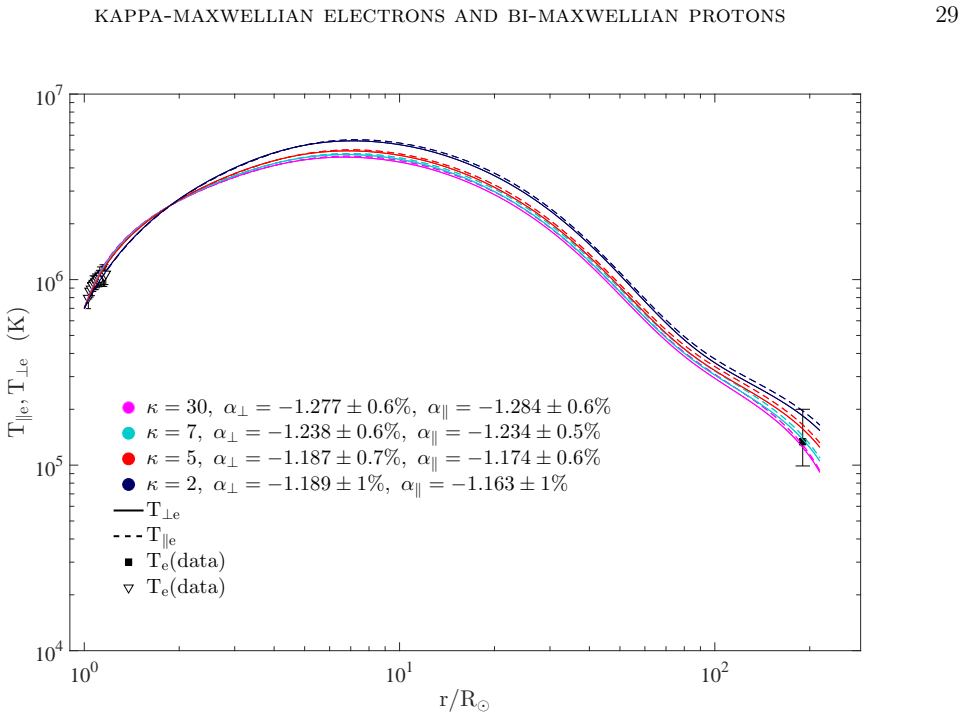
The central discovery, on the paper's own terms, is that the Kappa-Maxwellian electron closure changes the physics of the fast solar wind. The electron distribution is taken as a kappa power law in parallel velocity times a Maxwellian in perpendicular velocity, Equation (20), while protons remain Bi-Maxwellian. From the zeroth- through fourth-order moments of the Vlasov equation the authors obtain eleven coupled equations; the new element is the parallel electron heat flux equation, Equation (26), whose coefficients carry factors of $\kappa$ and which reduces to the Maxwellian form, Equation (37), in the limit $\kappa \to \infty$. Numerically solving these equations with an iterated Crank-Nicolson scheme, they find that for small $\kappa$ the electron temperature near the Sun reaches several million kelvin, in line with coronal observations, the electron-to-proton heating partition shifts toward parallel electron heating, and the near-Earth flow speed increases as $\kappa$ decreases.
Load-bearing premise
The equations that produce the million-kelvin electron temperatures assume the Kappa-Maxwellian electron distribution has a well-defined fourth parallel velocity moment, a condition that holds only for $\kappa > 2.5$; the paper's headline result uses $\kappa = 2$, where that moment diverges.
Editorial extensions
If this is right
- If the claim is right, coronal electron heating in the fast solar wind can be attributed to suprathermal electron tails, since small $\kappa$ yields the observed million-kelvin electron temperatures without adding an electron-specific heating term.
- The model contains the earlier Maxwellian-electron two-fluid model as the $\kappa \to \infty$ limit, so any disagreement with that baseline at large $\kappa$ would indicate a coding or closure error rather than new physics.
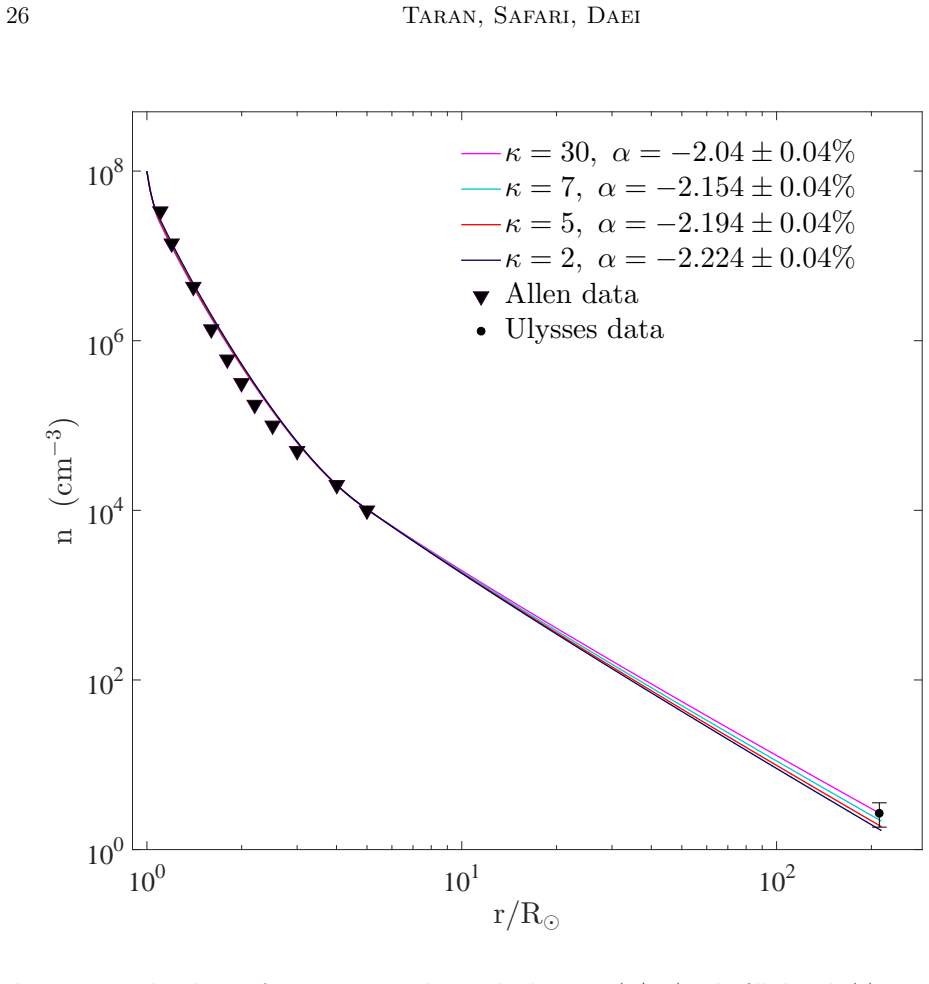
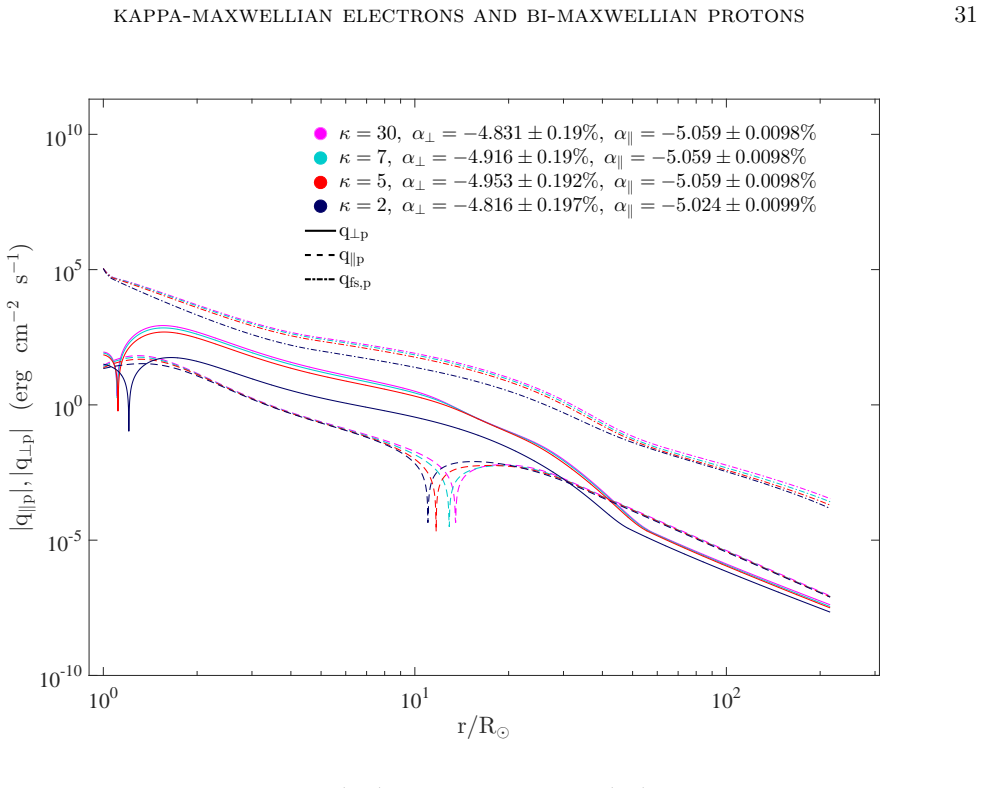
- The power-law exponents for density, temperature components, and heat-flux components between $0.3$ and $1$ AU depend on $\kappa$, giving quantitative predictions that can be checked against in-situ measurements of fast-wind streams.
- The predicted near-Earth flow speeds of roughly $805$-$823$ km/s, increasing as $\kappa$ decreases, tie the shape of the electron distribution to the acceleration efficiency of the fast wind.
- The shift of turbulent heating toward parallel electron heating near the Sun for small $\kappa$ predicts that electron temperature anisotropy and heat flux should both increase with stronger suprathermal tails, a correlation that can be tested with solar wind particle data.
Reading between the lines
- The same heat-flux closure could be applied to other collisionless astrophysical outflows, such as stellar winds or accretion flows, where kappa-distributed electrons are observed; the temperature-gradient term in Equation (26) would then introduce a $\kappa$-dependent effective thermal conductivity that kinetic simulations could verify.
- Because the fourth parallel moment converges only for $\kappa > 2.5$, the headline runs at $\kappa = 2$ sit outside the regime where the heat-flux equation is defined; rerunning the model at $\kappa = 2.6$ would show whether the million-kelvin electron temperatures survive the closure being well-posed.
- The paper's own multi-kappa suggestion, large $\kappa$ near the Sun and small $\kappa$ near Earth, implies a spatially varying effective $\kappa$; implementing a simple heliocentric-distance-dependent closure and comparing it with the single-$\kappa$ runs would show which choice matches coronal and 1 AU data simultaneously.
Signed reviews
Editorial analysis
A structured set of objections, weighed in public.
Referee Report
Summary. The paper presents a two-fluid model of the fast solar wind in which electrons are described by a Kappa-Maxwellian distribution and protons by a Bi-Maxwellian distribution. Eleven coupled equations for density, flow speed, temperatures, heat fluxes, and Alfvén-wave energy are derived from moments of the Vlasov equation up to fourth order, with turbulent heating adapted from Chandran et al. (2011). The equations are integrated from 1 R☉ to 1 AU with the iterated Crank–Nicolson method for κ = 2, 5, 7, and 30. The authors report power-law density, temperature, and heat-flux profiles and claim that the κ = 2 (small-κ) solution reproduces million-kelvin coronal electron temperatures, interpreting this as evidence that non-Maxwellian electrons capture a key property of the solar atmosphere.
Significance. If the result were valid, this paper would offer a comparatively simple fluid model connecting non-Maxwellian electron distributions to fast-solar-wind heating and acceleration, and the explicit κ dependence in the electron heat-flux closure would be a useful extension of Chandran et al. (2011). The paper has genuine strengths: the moment hierarchy is presented in enough detail to check, the large-κ limit in Eq. (37) correctly reduces the electron parallel heat-flux equation to the Maxwellian/Bi-Maxwellian form, and the comparisons with Helios/Ulysses data and Spitzer/free-streaming heat-flux limits are concrete. These strengths do not, however, compensate for the fact that the headline κ = 2 solution is obtained from a closure whose fourth-order velocity moment does not exist.
major comments (3)
- [Section 2, Eqs. (19), (20), (26); Section 6; Abstract] The electron parallel heat-flux closure is undefined for κ = 2. For the Kappa-Maxwellian distribution in Eq. (20), the fourth parallel velocity moment in Eq. (19) behaves at large v‖ as ∫ v‖^4 (1 + v‖^2/(κθ‖^2))^{-κ} dv‖, which converges only for κ > 2.5. The paper nevertheless states that κ ranges from 1.5 to infinity, solves the model for κ = 2, and uses that run in Section 6 and the abstract/conclusion to claim that small κ produces million-kelvin electrons. Equation (26) contains factors of (5 − 2κ) in the denominator, i.e., a pole at κ = 2.5; using these factors for κ = 2 is an analytic continuation of a divergent integral, not a kinetic closure. The central claim therefore rests on an equation that has no valid derivation for the parameter value at which it is applied.
- [Section 7; Table 1; Section 5] The conclusion that the model "captures" the solar atmosphere is further weakened by the post hoc selection of κ. Different observables are matched by different κ values: κ ≈ 7 is favored for proton and electron temperatures (§7, item 3), while a small κ is used for the electron temperature ratio, and the final paragraph explicitly proposes a multi-κ model. Because κ is scanned as a free parameter, and because the heating rate contains additional adjustable inputs such as c_d and δv_⊙ in Eq. (49) and the empirically chosen diffusion constants D in §5, the agreement in Figures 2–8 is a fit rather than a parameter-free prediction. The paper should fix κ, supply a fitting procedure with uncertainties, or clearly present the runs as a sensitivity study rather than as evidence that non-Maxwellian electrons capture coronal heating.
- [Section 5; Table 1] The numerical results are not reproducible as reported. The artificial diffusion term −D∂²ψ/∂x² is added to stabilize the ICN scheme, but the exact values of D for each of the eleven equations are not given; the authors only state that 0 ≤ D ≤ 5 and that the values need not be equal across equations. Since the solutions in Section 6 and Table 1 may depend on these diffusion constants, a table of the D values used and a resolution/convergence study are necessary. No code is provided either.
minor comments (4)
- [Section 7] The equation references for the electron and proton parallel heat fluxes are reversed in the conclusion: Eq. (26) is the electron parallel heat-flux equation and Eq. (28) is the proton one, but the text says the opposite.
- [Equations (29)–(32)] The symbols T_p and T_e are used in the temperature equations but are not defined; the authors should state explicitly how these total temperatures are computed from T⊥ and T‖.
- [Figures 2–8] The power-law exponents are quoted with very small uncertainties (e.g., ±0.04%), but no goodness-of-fit statistic is provided; the fits should be quantified with R² or reduced χ².
- [Throughout] There are numerous typographical and grammatical errors (e.g., "F AST" in the title, "reminder" for "remainder" in Section 2, "cures" for "curves" in Section 6) that should be corrected in a revised manuscript.
Circularity Check
No circularity found: the moment-closure derivation is independent of its inputs; the kappa=2 issue is a mathematical validity problem, not a circular reduction.
full rationale
The paper's derivation chain is a standard moment hierarchy: the Kappa-Maxwellian electron distribution is stated as an ansatz (Eq. 20), and the electron heat-flux closures (Eqs. 25-26) are obtained by evaluating fourth-order moments of that distribution. The predicted electron temperatures are then obtained by integrating these PDEs, not by imposing or fitting those temperatures back into the equations. The kappa index is explicitly treated as a free parameter and scanned over κ=2,5,7,30; the conclusion that small κ gives high electron temperatures is a sensitivity result, not a self-definitional reduction, because no term in Equations 23-33 contains the million-kelvin temperature as an input. The heating rate Q (Eq. 49) is imported from Chandran et al. (2011) with the stated constants cd=0.75 and δv_sun=41.4 km/s; this is an external empirical input, not a self-citation, and it is not equivalent to the electron temperature or heat-flux outputs claimed as results. Self-citations by the authors appear only in contextual or analogical passages (e.g., the Alfvénic-black-hole analogy in the conclusion) and are not load-bearing for the central derivation. The most serious flaw in the paper is not circularity: Eq. 26 contains the factor (5-2κ) from a fourth parallel moment r_∥ that converges only for κ>2.5, yet the model is integrated at κ=2. That means the headline kappa=2 branch uses a closure that is not defined by the stated kinetic derivation; however, this is an internal consistency/validity error, not a case of the output being identical to an input by construction.
Assumptions & free parameters
free parameters (6)
- kappa (Kappa spectral index) =
2, 5, 7, 30
- delta-v_sun (rms Alfvenic fluctuation amplitude at Sun) =
41.4 km/s
- c_d (turbulent heating constant) =
0.75
- nu_0 (instability rate constant) =
0.02 sqrt(GM_sun/R_sun^3)
- Artificial diffusion constants D =
0 to 5 (not individually reported)
- Time step and grid parameters =
N=2000, logarithmic grid, time step not given
assumptions (6)
- standard math Vlasov equation and moment hierarchy provide a valid closure for collisionless plasma
- domain assumption The Kappa-Maxwellian distribution (Eq. 20) represents solar wind electrons
- ad hoc to paper Fourth-order moments are finite and computed from the assumed distribution
- domain assumption Turbulent heating rates from Chandran et al. (2011) apply to Kappa-Maxwellian electrons
- ad hoc to paper Artificial diffusion does not alter the physical solution
- domain assumption One-dimensional flux-tube geometry with no rotation captures fast solar wind
Cite this review
Pith. "Pith review of Kappa-Maxwellian electrons and Bi-Maxwellian protons in a two-fluid model for fast solar wind." pith.science (2026). https://pith.science/paper/72NPLQ2S
@misc{pith2026190809198,
  author       = {Pith},
  title        = {Pith review of: Kappa-Maxwellian electrons and Bi-Maxwellian protons in a two-fluid model for fast solar wind},
  year         = {2026},
  howpublished = {\url{https://pith.science/paper/72NPLQ2S}},
  note         = {Machine review of arXiv:1908.09198}
}
abstract
Modeling fast solar wind based on the kinetic theory is an important task for scientists. In this paper, we present a two-fluid model for fast solar wind with anisotropic Kappa-Maxwellian electrons and Bi-Maxwellian protons. In the simulation, the energy exchange between the plasma particles and low-frequency Alfv\'en waves is considered. A set of eleven coupled equations is derived by applying the zeroth- to fourth-order moments of the Vlasov equation and the modified electromagnetic Maxwell equations. A characteristic of the Kappa distribution (indicated by $\kappa$ index) is explicit in the equation for the parallel component of the electron heat flux (parallel to the ambient magnetic field line) and differs from the equation derived for the proton heat flux due to the different nature of the distributions. Within the large $\kappa$ index, the equations for the two-fluid model tend to the equations obtained by the Maxwellian distribution. Using an iterated Crank-Nicolson method, the coupled equations are numerically solved for the fast solar wind conditions. We show that at (0.3 - 1) AU from the Sun, the electron density, components of temperature, and components of heat flux follow the power-law behavior. We also showed that near the Earth, the flow speed (electron or proton) increases with decreasing $\kappa$. We concluded that applying the small $\kappa$ index (the non-Maxwellian distribution), the extraordinary nature of the solar atmosphere, with its temperature of several million kelvin temperature for electrons, has been captured.
Figures


Figures from the paper (5 more)



Reference graph
Works this paper leans on
-
[1]
1947, Monthly Notices of the Royal Astronomical Society, 107, 211
Alfv´ en, H., & Lindblad, B. 1947, Monthly Notices of the Royal Astronomical Society, 107, 211
1947
-
[2]
2019, The Astrophysical Journal Supplement Series, 243, 20
Alipour, N., Mohammadi, F., & Safari, H. 2019, The Astrophysical Journal Supplement Series, 243, 20
2019
-
[3]
W., & Cox, A
Allen, C. W., & Cox, A. N. 2000, Allen’s astrophysical quantities (4th ed.;New York: Springer)
2000
-
[4]
1986, Physical review letters, 57, 2807
Amagishi, Y. 1986, Physical review letters, 57, 2807
1986
-
[5]
2009, Physical review letters, 103, 211101
Bale, S., Kasper, J., Howes, G., et al. 2009, Physical review letters, 103, 211101
2009
-
[6]
1993, Geophysical research letters, 20, 2323
Bame, S., Goldstein, B., Gosling, J., et al. 1993, Geophysical research letters, 20, 2323
1993
-
[7]
2009, Physics of Plasmas, 16, 052106
Basu, B. 2009, Physics of Plasmas, 16, 052106
2009
-
[8]
Bittencourt, J. A. 2004, Fundamentals of Plasma Physics (Springer-Verlag)
2004
Show all 104 references
-
[9]
E., & Funsten, H
Borovsky, J. E., & Funsten, H. O. 2003, Journal of Geophysical Research (Space Physics), 108, 1246
2003
-
[10]
2005, Living Reviews in Solar Physics, 2, 4
Bruno, R., & Carbone, V. 2005, Living Reviews in Solar Physics, 2, 4
2005
-
[11]
A., & Mace, R
Cattaert, T., Hellberg, M. A., & Mace, R. L. 2007, Physics of Plasmas, 14, 082111
2007
-
[12]
Chandran, B. D. G. 2018, Journal of Plasma Physics, 84, 905840106
2018
-
[13]
Chandran, B. D. G., Dennis, T. J., Quataert, E., & Bale, S. D. 2011, ApJ, 743, 197 Chan´ e, E., Raeder, J., Saur, J., et al. 2015, Journal of Geophysical Research: Space Physics, 120, 8517
2011
-
[14]
1929, MNRAS, 89, 456
Chapman, S. 1929, MNRAS, 89, 456
1929
-
[15]
R., Moore, T
Chappell, C. R., Moore, T. E., & Waite, Jr., J. H. 1987, J. Geophys. Res., 92, 5896 34 Taran, Safari, Daei
1987
-
[16]
2010, Physical review letters, 104, 255002
Chen, C., Horbury, T., Schekochihin, A., et al. 2010, Physical review letters, 104, 255002
2010
-
[17]
Cho, J., & Vishniac, E. T. 2000, ApJ, 539, 273
2000
-
[18]
Coleman, Jr., P. J. 1968, ApJ, 153, 371
1968
-
[19]
Cramer, N. F. 2011, The physics of Alfv´ en waves (John Wiley & Sons)
2011
-
[20]
R., Gibson, S
Cranmer, S. R., Gibson, S. E., & Riley, P. 2017, SSRv, 212, 1345
2017
-
[21]
1990, Planetary and Space Science, 38, 1091
Demars, H., & Schunk, R. 1990, Planetary and Space Science, 38, 1091
1990
-
[22]
G., & Schunk, R
Demars, H. G., & Schunk, R. W. 1991, Planet. Space Sci., 39, 435
1991
-
[23]
Dewar, R. L. 1970, Physics of Fluids, 13, 2710
1970
-
[24]
1971, ApJ, 166, 669
Durney, B. 1971, ApJ, 166, 669
1971
-
[25]
R., & Roberts, P
Durney, B. R., & Roberts, P. H. 1971, ApJ, 170, 319
1971
-
[26]
Erickson, W. C. 1964, ApJ, 139, 1290
1964
-
[27]
2016, Journal of Geophysical Research (Space Physics), 121, 9340
Esmaeili, S., Nasiri, M., Dadashi, N., & Safari, H. 2016, Journal of Geophysical Research (Space Physics), 121, 9340
2016
-
[28]
Farhang, N., Safari, H., & Wheatland, M. S. 2018, The Astrophysical Journal, 859, 41
2018
-
[29]
Feldman, U., Landi, E., & Schwadron, N. A. 2005, Journal of Geophysical Research (Space Physics), 110, A07109
2005
-
[30]
D., & Gary, S
Montgomery, M. D., & Gary, S. P. 1975, J. Geophys. Res., 80, 4181
1975
-
[31]
Frank, L. A. 1971, J. Geophys. Res., 76, 5202
1971
-
[32]
P., & Karimabadi, H
Gary, S. P., & Karimabadi, H. 2006, Journal of Geophysical Research (Space Physics), 111, A11224
2006
-
[33]
P., & Wang, J
Gary, S. P., & Wang, J. 1996, Journal of Geophysical Research: Space Physics, 101, 10749
1996
-
[34]
1995, SSRv, 72, 49
Geiss, J., Gloeckler, G., & von Steiger, R. 1995, SSRv, 72, 49
1995
-
[35]
J., Adolfo, F., Dorelli, J
Gershman, D. J., Adolfo, F., Dorelli, J. C., et al. 2017, Nature communications, 8, 14719
2017
-
[36]
Gheibi, A., Safari, H., & Innes, D. E. 2018, European Physical Journal C, 78, 662
2018
-
[37]
H., Goedbloed, J., & Poedts, S
Goedbloed, J. H., Goedbloed, J., & Poedts, S. 2004, Principles of magnetohydrodynamics: with applications to laboratory and astrophysical plasmas (Cambridge university press)
2004
-
[38]
1995, ApJ, 438, 763
Goldreich, P., & Sridhar, S. 1995, ApJ, 438, 763
1995
-
[39]
Bame, S. J. 1991, J. Geophys. Res., 96, 7831
1991
-
[40]
J., Beer, J., Geller, M., et al
Gray, L. J., Beer, J., Geller, M., et al. 2010, Reviews of Geophysics, 48, RG4001
2010
-
[41]
E., & Sturrock, P
Hartle, R. E., & Sturrock, P. A. 1968, ApJ, 151, 1155
1968
-
[42]
Lazarus, A. J. 2006, Geophys. Res. Lett., 33, L09101
2006
-
[43]
Hollweg, J. V. 1981, Solar Physics, 70, 25
1981
-
[44]
Howes, G. G. 2008, Physics of Plasmas, 15, 055904 —. 2015, Kinetic Turbulence, ed. A. Lazarian, E. M. de Gouveia Dal Pino, & C. Melioli (Berlin, Heidelberg: Springer Berlin Heidelberg), 123–152
2008
-
[45]
G., TenBarge, J
Howes, G. G., TenBarge, J. M., Dorland, W., et al. 2011, Physical review letters, 107, 035004 kappa-maxwellian electrons and bi-maxwellian protons 35
2011
-
[46]
Q., Esser, R., & Habbal, S
Hu, Y. Q., Esser, R., & Habbal, S. R. 1997, J. Geophys. Res., 102, 14661
1997
-
[47]
W., Liu, S., & Petrosian, V
Jiang, Y. W., Liu, S., & Petrosian, V. 2009, The Astrophysical Journal, 698, 163
2009
-
[48]
1968, The Physics of Fluids, 11, 1797
Kalman, G., Montes, C., & Qu´ emada, D. 1968, The Physics of Fluids, 11, 1797
1968
-
[49]
C., Lazarus, A
Kasper, J. C., Lazarus, A. J., & Gary, S. P. 2002, Geophysical research letters, 29, 20
2002
-
[50]
W., & Szabo, A
Ogilvie, K. W., & Szabo, A. 2006, Journal of Geophysical Research (Space Physics), 111, A03105
2006
-
[51]
A., & Holzer, T
Kopp, R. A., & Holzer, T. E. 1976, SoPh, 49, 43
1976
-
[52]
Kulsrud, R. M. 1983, Handbook of plasma physics, 1, 115
1983
-
[53]
2008, ApJ, 685, 1270 Le Chat, G., Issautier, K., & Meyer-Vernet, N
Landi, E. 2008, ApJ, 685, 1270 Le Chat, G., Issautier, K., & Meyer-Vernet, N. 2012, Solar Physics, 279, 197
2008
-
[54]
2006, PhRvD, 73, 044001 Lie-Svendsen, Ø., Leer, E., & Hansteen, V
Leiler, G., & Rezzolla, L. 2006, PhRvD, 73, 044001 Lie-Svendsen, Ø., Leer, E., & Hansteen, V. H. 2001, Journal of Geophysical Research: Space Physics, 106, 8217
2006
-
[55]
Lin, R. P. 1980, SoPh, 67, 393
1980
-
[56]
2017, Kappa distributions: theory and applications in plasmas (Elsevier)
Livadiotis, G. 2017, Kappa distributions: theory and applications in plasmas (Elsevier)
2017
-
[57]
2013, Space Science Reviews, 175, 183
Livadiotis, G., & McComas, D. 2013, Space Science Reviews, 175, 183
2013
-
[58]
L., & Lotko, W
Lysak, R. L., & Lotko, W. 1996, J. Geophys. Res., 101, 5085
1996
-
[59]
2001, ApJ, 554, 1175
Maron, J., & Goldreich, P. 2001, ApJ, 554, 1175
2001
-
[60]
2006, Living Reviews in Solar Physics, 3, 1
Marsch, E. 2006, Living Reviews in Solar Physics, 3, 1
2006
-
[61]
Muehlhaeuser, K.-H., & Neubauer, F. M. 1982, J. Geophys. Res., 87, 35
1982
-
[62]
J., Ebert, R
McComas, D. J., Ebert, R. W., Elliott, H. A., et al. 2008, Geophys. Res. Lett., 35, L18103
2008
-
[63]
J., Barraclough, B
McComas, D. J., Barraclough, B. L., Funsten, H. O., et al. 2000, J. Geophys. Res., 105, 10419
2000
-
[64]
2012, Numerical solution of partial differential equations, Vol
Meis, T., & Marcowitz, U. 2012, Numerical solution of partial differential equations, Vol. 32 (Springer)
2012
-
[65]
Gombosi, T. I. 2015, MNRAS, 454, 3697
2015
-
[66]
2007, Basics of the solar wind (Cambridge University Press)
Meyer-Vernet, N. 2007, Basics of the solar wind (Cambridge University Press)
2007
-
[67]
J., Tomczyk, S., & Pinto, R
Morton, R. J., Tomczyk, S., & Pinto, R. 2015, Nature Communications, 6, 7813
2015
-
[68]
1998, Journal of Geophysical Research: Space Physics, 103, 9553
Newbury, J., Russell, C., Phillips, J., & Gary, S. 1998, Journal of Geophysical Research: Space Physics, 103, 9553
1998
-
[69]
1968, in Physics of the Magnetosphere (Springer), 641–659
Olbert, S. 1968, in Physics of the Magnetosphere (Springer), 641–659
1968
-
[70]
1958, The Physics of Fluids, 1, 171
Parker, E. 1958, The Physics of Fluids, 1, 171
1958
-
[71]
Parker, E. N. 1965, SSRv, 4, 666
1965
-
[72]
1978, Geophysical Journal, 54, 547
Perreault, P., & Akasofu, S.-I. 1978, Geophysical Journal, 54, 547
1978
-
[73]
2010, SoPh, 267, 153
Pierrard, V., & Lazar, M. 2010, SoPh, 267, 153
2010
-
[74]
2016, SoPh, 291, 2165
Pierrard, V., Lazar, M., Poedts, S., et al. 2016, SoPh, 291, 2165
2016
-
[75]
2001, Ap&SS, 277, 195
Pierrard, V., Maksimovic, M., & Lemaire, J. 2001, Ap&SS, 277, 195
2001
-
[76]
G., Miggenrieder, H., M¨ uhlha¨ user, K.-H., et al
Pilipp, W. G., Miggenrieder, H., M¨ uhlha¨ user, K.-H., et al. 1987, J. Geophys. Res., 92, 1103 36 Taran, Safari, Daei
1987
-
[77]
2014, Magnetohydrodynamics of the Sun (Cambridge University Press)
Priest, E. 2014, Magnetohydrodynamics of the Sun (Cambridge University Press)
2014
-
[78]
1998, ApJ, 500, 978
Quataert, E. 1998, ApJ, 500, 978
1998
-
[79]
Qureshi, M. N. S., Sehar, S., & Shah, H. A. 2014, Journal of Physics: Conference Series, 516, 012013
2014
-
[80]
Wheatland, M. S. 2017, ApJ, 834, 11
2017
-
[81]
Recktenwald, G. W. 2004, Mechanical Engineering, 10, 1
2004
-
[82]
Matthaeus, W. H. 1987, J. Geophys. Res., 92, 11021
1987
-
[83]
H., & Soward, A
Roberts, P. H., & Soward, A. M. 1972, Proceedings of the Royal Society of London Series A, 328, 185
1972
-
[84]
2011, Physics of Plasmas, 18, 012307
Crabtree, C. 2011, Physics of Plasmas, 18, 012307
2011
-
[85]
S., Howes, G
Salem, C. S., Howes, G. G., Sundkvist, D., et al. 2012, ApJL, 745, L9
2012
-
[86]
2017, The Astrophysical Journal, 835, 133
Schreiner, A., & Saur, J. 2017, The Astrophysical Journal, 835, 133
2017
-
[87]
Schunk, R. W. 1975, Planet. Space Sci., 23, 437
1975
-
[88]
2017, Ap&SS, 362, 13
Elhanbaly, A. 2017, Ap&SS, 362, 13
2017
-
[89]
Stone, J. M. 2006, ApJ, 637, 952
2006
-
[90]
P., Goyal, R., Gaur, N., & Scime, E
Sharma, R. P., Goyal, R., Gaur, N., & Scime, E. E. 2016, EPL (Europhysics Letters), 113, 25001
2016
-
[91]
B., Hammett, G
Snyder, P. B., Hammett, G. W., & Dorland, W. 1997, Physics of Plasmas, 4, 3974 Spitzer Jr, L., & H¨ arm, R. 1953, Physical Review, 89, 977
1997
-
[92]
Stix, T. H. 1992, Waves in plasmas (New York: SpringerVerlag) ˇStver´ ak,ˇS., Tr´ avn ´ ıˇ cek, P. M., & Hellinger, P. 2015, Journal of Geophysical Research: Space Physics, 120, 8177
1992
-
[93]
M., & Howes, G
TenBarge, J. M., & Howes, G. G. 2012, Physics of Plasmas, 19, 055901
2012
-
[94]
M., Howes, G
TenBarge, J. M., Howes, G. G., & Dorland, W. 2013, ApJ, 774, 139
2013
-
[95]
Teukolsky, S. A. 2000, PhRvD, 61, 087501
2000
-
[96]
Thomas, J. W. 2013, Numerical partial differential equations: finite difference methods, Vol. 22 (Springer) ˇStver´ aK,ˇS., Tr´ avn ´ ıˇ cek, P., Maksimovic, M., et al. 2008, Journal of Geophysical Research (Space Physics), 113, A03103
2013
-
[97]
Vasyliunas, V. M. 1968, Journal of Geophysical Research, 73, 2839
1968
-
[98]
2010, The Astrophysical Journal, 719, 1335
Vranjes, J., & Poedts, S. 2010, The Astrophysical Journal, 719, 1335
2010
-
[99]
C., & Chang, C
Whang, Y. C., & Chang, C. C. 1965, J. Geophys. Res., 70, 4175
1965
-
[100]
Wheatland, M. S. 2005, PASA, 22, 153 kappa-maxwellian electrons and bi-maxwellian protons 37
2005
-
[101]
J., Feng, H
Wu, D. J., Feng, H. Q., Li, B., & He, J. S. 2016, Journal of Geophysical Research (Space Physics), 121, 7349
2016
-
[102]
T., Balsiger, H., & Geiss, J
Young, D. T., Balsiger, H., & Geiss, J. 1982, J. Geophys. Res., 87, 9077
1982
-
[103]
2011, The Astrophysical Journal, 735, 114
Zhao, J., Wu, D., & Lu, J. 2011, The Astrophysical Journal, 735, 114
2011
-
[104]
2004, The Astrophysical Journal, 606, 542
Lamy, H., & Issautier, K. 2004, The Astrophysical Journal, 606, 542
2004
Reviewed August 14, 2026 · model on record in the stance chip above.
Discussion (0). Continue with ORCID to comment.