REVIEW 4 major objections 7 minor 9 references
EPP: interpretable score of model predictive power
T0 review · 4 major / 7 minor · reviewed 2026-08-14 · deepseek-v4-flash
Pith's one-line read This paper introduces EPP, a model-rating score whose differences are logits of win probabilities, and argues it makes performance comparisons interpretable and comparable across data sets.
desk verdict A reasonable Bradley-Terry proposal for model scoring whose main selling point—cross-dataset comparability—is undone by the estimation protocol. read the letter →
The pith
A machine-rendered reading of the paper's core claim, the machinery that carries it, and where it could break.
The reading
What carries the argument
The central machinery is an Elo-style rating estimated by logistic regression on pairwise match results. A match is a comparison of two models on the same data set and a train/test split, and the winner is the model with higher AUC. The design uses indicators $x_{M_a}$ equal to $1$ for the first model, $-1$ for the second, and $0$ otherwise, so the logistic model $\operatorname{logit}(p_{i,j}) = \beta_{M_1} x_{M_1} + \cdots + \beta_{M_n} x_{M_n}$ reduces to $\operatorname{logit}(p_{i,j}) = \beta_{M_i} - \beta_{M_j}$. The fitted coefficients are the EPP scores, and the identity between rating differences and log odds is what turns every reported comparison into a probability.
What would settle it
Fit EPP scores separately on two data sets that share a pair of algorithms and add a constant to every score on one data set; all within-data-set win probabilities are unchanged while the cross-data-set score difference shifts, so the claimed cross-data-set comparability collapses unless a calibration constraint is imposed. Running the procedure with a shared reference model on both data sets and checking whether the same probability is recovered would settle the claim directly.
Extended reading notes
Core claim
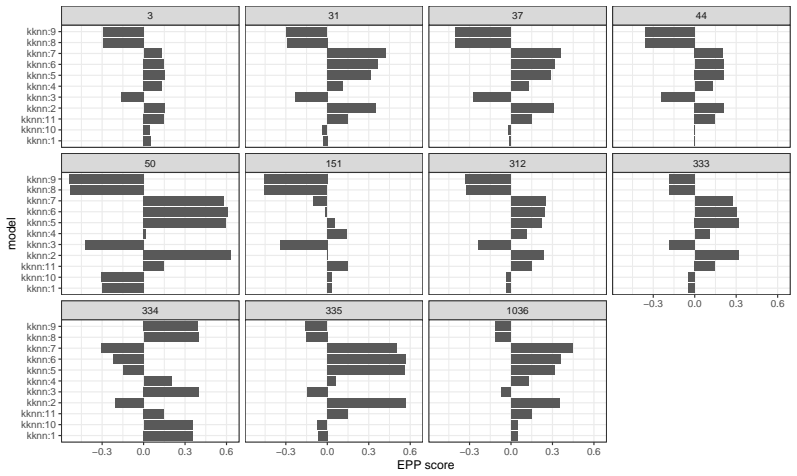
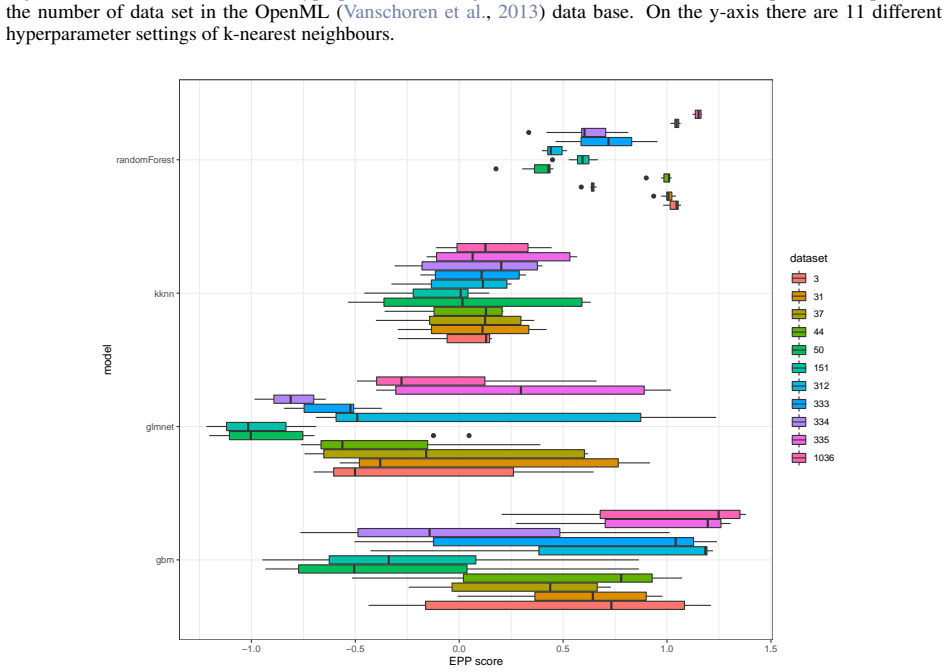
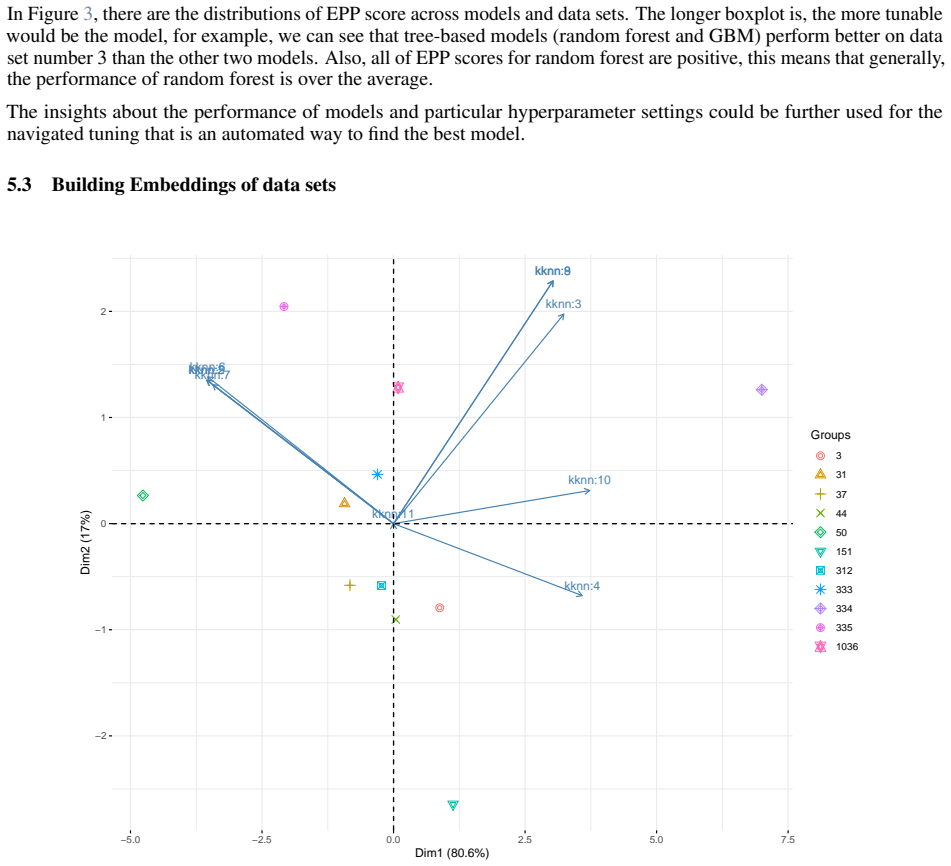
On the paper's own terms, the discovery is a rating system for predictive models with an interpretable scale. Instead of summarizing a model by an average metric, EPP estimates one score per model from pairwise comparisons across many train/test splits, using the identification $\operatorname{logit}(p_{i,j}) = \beta_{M_i} - \beta_{M_j}$, where $p_{i,j}$ is the probability that model $M_i$ outperforms model $M_j$. The EPP difference is therefore the log odds of better performance, and the paper claims this gives every difference the same probabilistic meaning regardless of data set, while also reflecting how often a model wins across folds rather than just its average. The authors apply the score to eleven data sets, four algorithms, and eleven hyperparameter settings each, and use the resulting rankings to discuss tunability and to embed data sets in a low-dimensional space.
Load-bearing premise
The load-bearing assumption is that a fixed difference between two EPP scores means the same thing on every data set; the fitting procedure itself only plays matches within a data set, so an arbitrary constant can be added to all scores on one data set without changing any fitted probability, and nothing in the method fixes these constants across data sets.
Editorial extensions
If this is right
- A practitioner can read an EPP difference as a win probability: if model A is two logits above model B, then A is expected to beat B with probability $\operatorname{invlogit}(2)$, giving a concrete significance statement.
- EPP can support hyperparameter tuning by showing which settings consistently beat others and which data sets reverse the usual ordering, signalling that tuning effort should be spent differently.
- Fold stability is incorporated: a model that wins more folds receives a higher EPP score than a model with a higher average but inconsistent per-fold performance.
- The claimed cross-data-set comparability lets EPP scores be pooled across benchmarks; the same score gap on different data sets is asserted to carry the same probabilistic meaning, enabling data set embeddings and meta-analysis of model performance.
Reading between the lines
- Because all matches are played within a data set, the EPP scale on each data set is identified only up to an additive constant; a strict reading of the method leaves cross-data-set comparisons underdetermined unless an anchor or calibration constraint is added.
- The logit identity places EPP in the family of paired-comparison rating models, so established techniques for handling ties, varying match strengths, and uncertainty in ratings could be imported to give confidence intervals for EPP differences.
- A natural testable extension is to restrict comparisons to identical train/test splits (the paper notes this alternative); this would remove split-induced noise and make the win probabilities sharper.
- Data set embeddings built from EPP vectors could serve as transfer-learning features: for a new data set, locate its nearest neighbours in embedding space and use their best hyperparameter settings as a starting point.
Signed reviews
Editorial analysis
A structured set of objections, weighed in public.
Referee Report
Summary. The paper proposes EPP (Elo-Based Predictive Power), a rating score for predictive models inspired by the Elo chess rating system. The authors define the logit of the probability that model i outperforms model j as the difference of their EPP scores and estimate these scores by logistic regression on pairwise comparisons derived from AUC values. They claim that differences in EPP scores have a direct probabilistic interpretation, that EPP scores are directly comparable across datasets, that EPP accounts for cross-validation fold stability, and that EPP can support hyperparameter tuning and dataset embeddings. The experimental section applies the method to 11 OpenML datasets, 4 algorithms, and 11 hyperparameter settings, presenting plots of EPP scores and a PCA biplot of dataset embeddings.
Significance. The paper identifies genuine limitations of standard metrics, notably the lack of an interval-scale interpretation and the neglect of fold-level stability. The idea of casting model comparison as a Bradley-Terry / Elo-style rating problem is reasonable and could be useful for ranking and tuning. If the cross-dataset comparability claim were supported, the proposal would be a meaningful contribution. However, the central probabilistic interpretation is established by definition rather than by evidence, and the cross-dataset comparability claim is not supported by the estimation procedure because the experimental design creates no comparisons across datasets. The paper also provides no validation of predicted win probabilities, no uncertainty quantification for the significance claim, and no comparison with existing model-comparison methods. The contribution is therefore an interesting idea with a clear presentation, but the advertised advantages are not demonstrated.
major comments (4)
- [Section 4, Eq. (2) and Section 4.1, Ad 2.1] The claimed probabilistic interpretation is a tautology, not an empirical finding. Equation (2) defines the model as logit(p_ij) = beta_Mi - beta_Mj, so the statement in Ad 2.1 that "the EPP difference ... is the logit of the probability" is true by construction. To make this a substantive advantage, the paper would need to show that the logistic model actually fits the observed pairwise outcomes, for example by evaluating the calibration of predicted win probabilities against empirical frequencies, or by comparing the model's estimates with a nonparametric estimate of P(Mi beats Mj). No such validation is provided.
- [Section 5.1 and Section 4.1, Ad 2.3] The cross-dataset comparability claim is not identifiable from the described estimation procedure. In Section 5.1, matches are constructed only "on the same data set, yet not necessary on the same train/test split." Because no match involves models from different datasets, the likelihood in Equations (2)-(3) is invariant to adding an arbitrary constant c_d to every EPP score within each dataset d. The paper describes no anchor, normalization, cross-dataset match, or calibration step that would fix these per-dataset constants. Consequently, statements such as "random forest has higher EPP on dataset 3 than GBM on dataset 151" have no empirical content, and Ad 2.3's claim that EPP differences have the same meaning across datasets is unsupported.
- [Section 5.1 and Section 4.1, Ad 2.2 and Ad 2.4] The experimental protocol is underspecified and does not support the fold-stability and significance claims. The paper does not state how many pairwise observations are created, how the design matrix is constructed when train/test splits differ, or whether the comparisons are paired. Ad 2.4 says EPP "takes into consideration how many times one model beat another," but comparing model performances on different splits does not constitute a paired comparison; one model may appear better simply because it was evaluated on an easier split. Additionally, no standard errors or confidence intervals are reported for the estimated beta coefficients, so the claim in Ad 2.2 that EPP "allows to assess the significance via probability of better performance" is not substantiated.
- [Section 5.2, Figure 2] The statement that "Models with EPP equals 0 have average performances" is not justified. The logistic regression likelihood is invariant to adding a constant to all EPP scores within a dataset, so the zero point is arbitrary and depends on the identifiability constraint chosen by the software (e.g., sum-to-zero or a reference model). Without specifying this constraint, the interpretation of zero as "average performance" is not meaningful, and this affects the qualitative conclusions drawn from Figures 2 and 3.
minor comments (7)
- [Abstract] The abstract contains grammatical and spelling errors: "First is, that they are not on an interval scale" should be "First, they are not on an interval scale," and "Forth" should be "Fourth."
- [Section 2.3] "There at least three points of view" is missing the verb "are": it should read "There are at least three points of view."
- [Section 3] "Elo scores can be interpret in terms of probability" should be "can be interpreted."
- [Section 4] There are typographical errors: "wining" should be "winning," and the extension in Equation (3) appears to contain a typo, as the final term reads "... + beta_Mk x_Mn" instead of using the correct index for the model.
- [Section 5.1] "As a single round, we consider comparison of performances" should read "we consider the comparison of performances." More importantly, the description of how rounds and matches are defined is too vague to reproduce the experiments; the paper should specify the exact pairing scheme and the number of observations used in the logistic regression.
- [Section 6] There are several typos: "extentions" should be "extensions," "The idea od EPP" should be "The idea of EPP," and "may by extended" should be "may be extended."
- [Figures 2 and 3] The figures would be clearer with labeled axes and a description of the identifiability constraint used to set the zero of the EPP scale; as noted in the major comments, the current "0 equals average" interpretation is not established.
Circularity Check
EPP's probabilistic interpretation is its defining equation; Section 4.1 restates Eq. 2 as an advantage rather than deriving it.
-
self definitional
[Section 4, Eq. 1-2; Section 4.1, Ad 2.1]
"The desired property is that log(odds(i,j)) = βMi − βMj. (1)... The following procedure satisfies Property 1. ... logit(pi,j) = βMi − βMj. (2)... The EPP difference for models Mi and Mj is the logit of the probability that Mi achieves better performance than Mj (see Formula 2 and Formula 5)."
The advertised interpretation of EPP differences is not derived from independent evidence; it is imposed as the defining equation. Equation 2 is proposed specifically to satisfy the 'desired property' in Equation 1, so saying that the EPP difference is the logit of a win probability is a restatement of the model assumption. The subsequent advantages in Section 4.1 (significance testing, cross-dataset comparability, fold-stability) all inherit this same definitional property, making the 'demonstration' of advantages a validation by construction rather than by empirical or mathematical derivation.
full rationale
The paper is transparent that Equation 1 is a 'desired property' and Equation 2 is a proposed procedure satisfying it, so this is not a hidden data-driven circularity of the kind where a fitted parameter is relabeled as a prediction. However, the claimed central advantage, that EPP differences are logits of win probabilities, is exactly the defining logistic-regression equation; presenting this as an 'advantage' in Ad 2.1 is self-definitional. The later advantages (Ad 2.2, Ad 2.3, Ad 2.4) are all restatements of this same definition, so the paper's validation of the score's properties reduces to its own postulate. Separately, the experimental protocol in Section 5.1 only compares models 'on the same data set', so the cross-dataset comparability claim (Ad 2.3) is not identified by the described estimation procedure; that is an identifiability/correctness concern rather than a circularity, so it is not scored as a separate circular step. Overall, the central interpretive claim is true by construction, but the paper does not overclaim an empirical derivation; thus the circularity is partial rather than total.
Assumptions & free parameters
assumptions (3)
- ad hoc to paper The probability that model Mi beats model Mj follows a Bradley-Terry model: logit(p_ij) = beta_Mi - beta_Mj.
- domain assumption A 'match' between two models can be defined by comparing their AUC on the same dataset but on possibly different train/test splits.
- domain assumption AUC is a valid underlying performance measure for defining wins and losses.
Cite this review
Pith. "Pith review of EPP: interpretable score of model predictive power." pith.science (2026). https://pith.science/paper/TXBJY7NK
@misc{pith2026190809213,
  author       = {Pith},
  title        = {Pith review of: EPP: interpretable score of model predictive power},
  year         = {2026},
  howpublished = {\url{https://pith.science/paper/TXBJY7NK}},
  note         = {Machine review of arXiv:1908.09213}
}
read the original abstract
The most important part of model selection and hyperparameter tuning is the evaluation of model performance. The most popular measures, such as AUC, F1, ACC for binary classification, or RMSE, MAD for regression, or cross-entropy for multilabel classification share two common weaknesses. First is, that they are not on an interval scale. It means that the difference in performance for the two models has no direct interpretation. It makes no sense to compare such differences between datasets. Second is, that for k-fold cross-validation, the model performance is in most cases calculated as an average performance from particular folds, which neglects the information how stable is the performance for different folds. In this talk, we introduce a new EPP rating system for predictive models. We also demonstrate numerous advantages for this system, First, differences in EPP scores have probabilistic interpretation. Based on it we can assess the probability that one model will achieve better performance than another. Second, EPP scores can be directly compared between datasets. Third, they can be used for navigated hyperparameter tuning and model selection. Forth, we can create embeddings for datasets based on EPP scores.
Figures

Figures from the paper (1 more)
Reference graph
Works this paper leans on
-
[1]
P. Biecek. DALEX: Explainers for Complex Predictive Models in R . 2018. URL http://jmlr.org/papers/v19/18-416.html
work page 2018
- [2]
- [3]
-
[4]
C. Goutte and E. Gaussier. A probabilistic interpretation of precision, recall and F-score, with implication for evaluation . In European Conference on Information Retrieval, 2005
work page 2005
-
[5]
R. Herbrich, T. Minka, and T. Graepel. TrueSkill(TM): A Bayesian Skill Rating System . In Advances in Neural Information Processing Systems 20, 2007. URL https://www.microsoft.com/en-us/research/publication/trueskilltm-a-bayesian-skill-rating-system/
work page 2007
-
[6]
Tunability: Importance of hyperparameters of machine learning algorithms
Philipp Probst and Anne-Laure Boulesteix and Bernd Bischl . Tunability: Importance of hyperparameters of machine learning algorithms. 2019. URL http://jmlr.org/papers/v20/18-444.html
work page 2019
-
[7]
D. Powers. Evaluation: From Precision, Recall and F-Factor to ROC, Informedness, Markedness & Correlation . 2008
work page 2008
-
[8]
M. Sokolova and G. Lapalme. A systematic analysis of performance measures for classification tasks. Information Processing & Management, 2009. URL http://www.sciencedirect.com/science/article/pii/S0306457309000259
work page 2009
Show all 9 references
-
[9]
Vanschoren, J
J. Vanschoren, J. N. van Rijn, B. Bischl, and L. Torgo. OpenML: Networked Science in Machine Learning . SIGKDD Explorations, 2013. URL http://doi.acm.org/10.1145/2641190.2641198
2013
Reviewed August 14, 2026 · model on record in the stance chip above.
Discussion (0). Continue with ORCID to comment.