REVIEW 3 major objections 5 minor 33 references
Dynamic Kernel Distillation for Efficient Pose Estimation in Videos
T0 review · 3 major / 5 minor · reviewed 2026-08-14 · deepseek-v4-flash
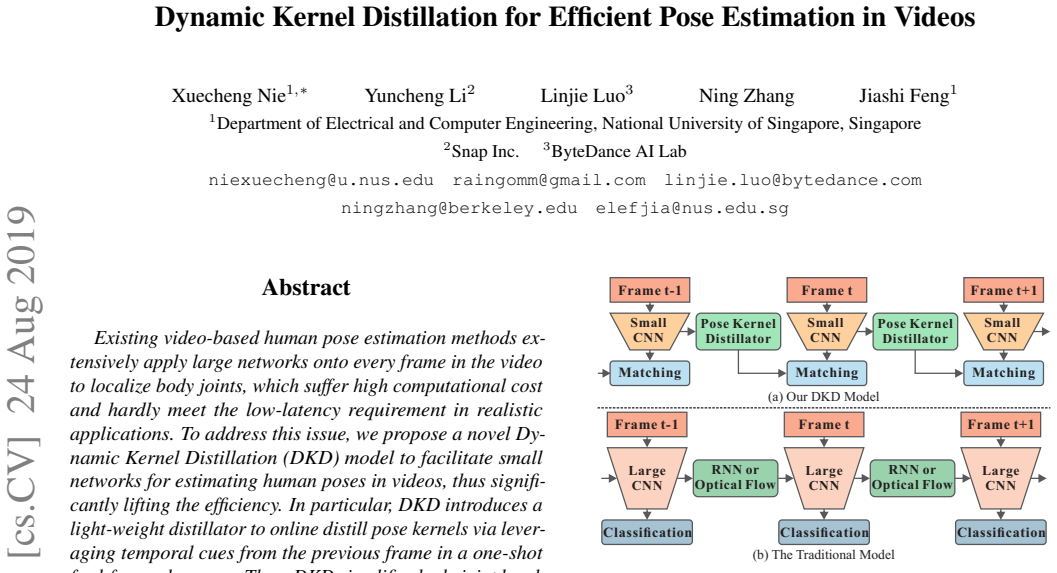
Pith's one-line read Video pose estimation can run at roughly one-tenth the compute by distilling pose kernels from the previous frame and matching them against a small network's features in the current frame.
desk verdict A genuinely useful efficiency method for video pose estimation, with a headline FLOPs claim that overreaches by about 20%—but the core contribution stands after you fix the accounting. read the letter →
The pith
A machine-rendered reading of the paper's core claim, the machinery that carries it, and where it could break.
The reading
What carries the argument
The central object is the pose kernel $k_t \in \mathbb{R}^{S\times S\times C\times K}$, distilled by a light-weight CNN $\Phi(\cdot)$ from the previous frame's feature maps $f_t$ and confidence maps $h_t$. These kernels encode what a joint looks like near its previous location, and the current frame's confidence map is produced by convolving them with the small encoder's features. To keep the distillator cheap, the paper factorizes the kernels as $k_t = U \otimes k'_t \otimes_C V$, where $U$ and $V$ are small $1\times1$ coefficient convolutions over shared kernel bases, so the distillator only outputs the reduced kernel bases $k'_t$. A temporally adversarial discriminator on the change $h_{t+1} - h_t$ supplies training supervision and is removed at inference.
What would settle it
Recompute total computation for clips of lengths 2, 5, 10, and 100 frames, including the large first-frame initializer plus the small encoder and distillator on every later frame, and compare against the 70.98 GFLOPs reported for LSTM Pose Machines; if the per-frame average is not 10x lower on short clips, the headline efficiency claim does not generalize to short videos.
Extended reading notes
Core claim
The central claim is that temporal consistency lets a video pose estimator reuse pose knowledge from one frame instead of re-recognizing the body in every frame. DKD's light-weight distillator takes the previous frame's feature maps $f_t$ and confidence maps $h_t$ and produces pose kernels $k_t$ in one feed-forward pass; the current frame's small encoder extracts features $f_{t+1}$, and the confidence map for each joint is obtained by convolving the corresponding kernel with those features, $h^j_{t+1} = k^j_t \otimes f_{t+1}$. This recasts joint localization as a matching procedure rather than per-pixel classification, which is what allows a small network to replace a large one. A temporally adversarial discriminator, trained to distinguish ground-truth changes in confidence maps from predicted changes between neighboring frames, regularizes the training and is discarded at inference. The paper reports that the best DKD model reduces FLOPs from 70.98G to 8.65G and per-image time from 25 ms to 11 ms compared with LSTM Pose Machines on Penn Action, while slightly improving torso-normalized PCK, and reaches 94.0% PCK on Sub-JHMDB.
Load-bearing premise
The headline '10x fewer FLOPs' assumes the reported FLOPs are an average over a clip long enough that the expensive first-frame pose initializer is amortized; the paper never states how FLOPs are counted or over what sequence length.
Editorial extensions
If this is right
- A per-frame video pose estimator can run at roughly 11 ms per image with a ResNet50 encoder, or 6.5 ms with a ResNet18 encoder, while staying at or above the accuracy of the 25 ms LSTM Pose Machines baseline, which makes low-latency deployments more practical.
- The large pose initializer is used only for the first frame; all later frames are handled by the small frame encoder plus distilled kernels, so long videos amortize the initialization cost and approach the small-network per-frame cost.
- When evaluated with the stricter torso-normalized PCK, DKD(ResNet50) beats LSTM Pose Machines by about 0.3 points on Penn Action and by more than 3.5 points on Sub-JHMDB, and it performs better at every threshold from $\alpha=0$ to $\alpha=0.2$.
- Because the discriminator is removed at test time, temporal coherence is obtained entirely during training and adds zero inference cost.
Reading between the lines
- The paper does not test this, but the same one-shot distillation trick may transfer to other video tasks that currently run a large network per frame, such as object detection or semantic segmentation: a keyframe initializer plus light kernels distilled from temporal cues could carry the intervening frames.
- The paper does not test this, but because distillation is one-shot and convolution-based, DKD is a natural fit for streaming settings where optical flow or RNN decoding would add latency; a useful experiment would run it on untrimmed video of arbitrary length with no fixed clip boundaries.
- A harder version of the temporal discriminator could enforce consistency over longer windows, such as second-order smoothness of joint trajectories, rather than only adjacent-frame changes; the paper's own ablation shows hard joints like ankles benefit most from temporal regularization, so higher-order constraints may push accuracy further.
Signed reviews
Editorial analysis
A structured set of objections, weighed in public.
Referee Report
Summary. The paper proposes Dynamic Kernel Distillation (DKD), a method for video-based human pose estimation that uses a lightweight pose kernel distillator to transfer pose knowledge from one frame to the next. The distilled pose kernels are applied to features from a small frame encoder via convolution, turning joint localization into a matching procedure. A temporally adversarial discriminator is used during training to encourage temporally coherent heatmap changes. Experiments on Penn Action and Sub-JHMDB report accuracy comparable to or better than previous state-of-the-art methods, with large reductions in FLOPs and runtime. The central efficiency claim is that DKD achieves '10x FLOPs reduction and 2x speedup' over the LSTM Pose Machines baseline [20] while maintaining state-of-the-art accuracy.
Significance. If the efficiency claims were fully supported, the paper would make a practical contribution: it shows that a small frame encoder plus a learned per-frame kernel distillator can match the accuracy of large per-frame networks, and the ablations isolating the pose kernel distillator and the temporally adversarial training are informative. The method is evaluated on two standard benchmarks with consistent results, and the comparison against a Convolutional LSTM alternative strengthens the claim that the proposed propagation mechanism is both faster and more accurate. The technical core is plausible and not circular, though the headline efficiency numbers are overstated in the current manuscript.
major comments (3)
- [Abstract, Section 4.3, Conclusion] The headline claim of '10x flops reduction' over Luo et al. [20] is contradicted by the paper's own Table 3: 70.98G / 8.65G = 8.2x, not 10x. The Conclusion's '1/10 flops' is likewise 8.65/70.98 ≈ 0.12, not 0.10. This is a factual inconsistency in a central claim and must be corrected in the abstract, the Section 4.3 discussion, and the conclusion.
- [Section 3.1, Section 3.3, Table 3] The reported FLOPs and runtime appear to count only the steady-state per-frame cost (frame encoder plus distillator plus matching) and to exclude the pose initializer P(·), a ResNet101, which is run on the first frame of every video. Since P(·) costs about 11.02G (Table 1), the per-frame average over a video of length L is at least 8.65G + 11.02G/L when the initializer is included. For L=5 this is about 10.9G, i.e., a 6.5x reduction; for L=35 it is about 9.0G, i.e., 7.9x; and even as L approaches infinity the ratio is 8.2x. Thus the '10x' claim cannot hold under any amortization, and the '2x speedup' is likewise unsupported if the first-frame initializer cost is excluded from the reported 11 ms/image runtime. Please state the measurement assumptions explicitly and adjust the efficiency claims accordingly.
- [Table 3 and Section 5] The joint claim of 'state-of-the-art accuracy and 10x FLOPs reduction' is not supported by any single model in Table 3. The best-accuracy model DKD(ResNet50) gives 8.2x FLOPs reduction, not 10x; DKD(ResNet18) could approach a 10x reduction on very long clips only if the initializer were ignored, but its torso-normalized PCK of 90.6 is below Luo et al.'s 92.6, so it is not state-of-the-art. The efficiency and accuracy claims need to be decoupled and qualified.
minor comments (5)
- [Section 4.2] The sentence 'the pose kernel distillator improves frame-level performance ... by 4.3% in average' is arithmetically inconsistent with Table 1; the average gain over the corresponding baselines is about 4.5 percentage points.
- [Section 4.2] The phrase 'By comparing the time cost of the DKD(ResNetx)-w/o-PKDs and the Baseline(ResNetx)s' refers to FLOPs, not measured time; please use 'computational cost' to avoid confusion.
- [Section 3.2, Eq. (6)] The symbol ⊗ is used both for general convolution and for channel-wise convolution, which can confuse the reader; please distinguish the two operations notationally.
- [Figure 4 caption] 'more critic metrics' should read 'more critical metrics'.
- [Section 4.1] Please state whether all reported FLOPs are measured at the same input resolution (256x256) and whether seven-scale testing affects the reported computational cost, since multi-scale testing is a standard source of ambiguity in efficiency comparisons.
Circularity Check
No circular derivation: the DKD pipeline is an empirical feed-forward architecture whose gains are validated by external benchmarks and ablations, not by defining the outputs in terms of the fitted inputs.
full rationale
The proposed DKD model is a concrete feed-forward pipeline: the pose kernel distillator maps previous-frame features and confidence maps to kernels (Eq. 1), and the next confidence map is produced by convolving those kernels with current-frame features (Eq. 2). This is an architectural choice, not a definitional identity: h_{t+1} is not defined as k_t or as any fitted value from the same frame; it is learned against annotated heatmaps through the external MSE loss (Eq. 3) and evaluated on Penn Action and Sub-JHMDB. The temporally adversarial term (Eqs. 4-5) is an auxiliary training regularizer removed at inference, so it does not enter the efficiency claim by construction. The only self-citation is [21] for the 'dynamic convolution layer' used to apply the distilled kernels; this is a component-level implementation choice, its contribution is isolated by the w/o-PKD ablation in Table 1, and no result is asserted solely on the authority of that citation. The '10x FLOPs reduction' statement is arithmetically inconsistent with the paper's own Table 3 (70.98/8.65 ≈ 8.2, not 10) and the FLOPs accounting may omit the first-frame ResNet101 initializer cost, but that is a measurement/comparison correctness concern, not circularity: the reported FLOPs are measured quantities, not outputs defined in terms of the paper's inputs. No equation or fitted parameter is renamed as a prediction, so the derivation chain is self-contained rather than circular.
Assumptions & free parameters
free parameters (5)
- eta =
0.1
- gamma =
0.1
- C (channel number of pose kernels) =
256
- S (kernel size of pose kernels) =
7
- lambda initialization and bound =
0, bounded in [0,1]
assumptions (4)
- domain assumption Ground-truth heatmaps are a valid supervision signal for joint localization.
- domain assumption The previous frame's feature maps and confidence maps contain sufficient temporal cues to predict the current frame's joint positions.
- domain assumption The temporal discriminator's ability to distinguish real from fake heatmap changes improves long-range coherence.
- domain assumption The PCK evaluation protocol and datasets are used consistently across compared methods.
invented entities (2)
-
Pose kernel distillator (Phi)
independent evidence
-
Pose kernels (k_t)
independent evidence
Cite this review
Pith. "Pith review of Dynamic Kernel Distillation for Efficient Pose Estimation in Videos." pith.science (2026). https://pith.science/paper/3LPRQITU
@misc{pith2026190809216,
  author       = {Pith},
  title        = {Pith review of: Dynamic Kernel Distillation for Efficient Pose Estimation in Videos},
  year         = {2026},
  howpublished = {\url{https://pith.science/paper/3LPRQITU}},
  note         = {Machine review of arXiv:1908.09216}
}
read the original abstract
Existing video-based human pose estimation methods extensively apply large networks onto every frame in the video to localize body joints, which suffer high computational cost and hardly meet the low-latency requirement in realistic applications. To address this issue, we propose a novel Dynamic Kernel Distillation (DKD) model to facilitate small networks for estimating human poses in videos, thus significantly lifting the efficiency. In particular, DKD introduces a light-weight distillator to online distill pose kernels via leveraging temporal cues from the previous frame in a one-shot feed-forward manner. Then, DKD simplifies body joint localization into a matching procedure between the pose kernels and the current frame, which can be efficiently computed via simple convolution. In this way, DKD fast transfers pose knowledge from one frame to provide compact guidance for body joint localization in the following frame, which enables utilization of small networks in video-based pose estimation. To facilitate the training process, DKD exploits a temporally adversarial training strategy that introduces a temporal discriminator to help generate temporally coherent pose kernels and pose estimation results within a long range. Experiments on Penn Action and Sub-JHMDB benchmarks demonstrate outperforming efficiency of DKD, specifically, 10x flops reduction and 2x speedup over previous best model, and its state-of-the-art accuracy.
Figures


Figures from the paper (2 more)


Reference graph
Works this paper leans on
-
[21]
Mutual learning to adapt for joint human parsing and pose estimation
Xuecheng Nie, Jiashi Feng, and Shuicheng Yan. Mutual learning to adapt for joint human parsing and pose estimation. In ECCV, 2018
work page 2018
-
[20]
Yue Luo, Jimmy Ren, Zhouxia Wang, Wenxiu Sun, Jinshan Pan, Jianbo Liu, Jiahao Pang, and Liang Lin. Lstm pose machines. In CVPR, 2018
work page 2018
-
[1]
2d human pose estimation: New benchmark and state of the art analysis
Mykhaylo Andriluka, Leonid Pishchulin, Peter Gehler, and Bernt Schiele. 2d human pose estimation: New benchmark and state of the art analysis. In CVPR, 2014
2014
-
[2]
Be- gan: boundary equilibrium generative adversarial networks
David Berthelot, Thomas Schumm, and Luke Metz. Be- gan: boundary equilibrium generative adversarial networks. arXiv:1703.10717, 2017
arXiv 2017
-
[3]
Learning feed-forward one-shot learners
Luca Bertinetto, Jo ˜ao F Henriques, Jack Valmadre, Philip Torr, and Andrea Vedaldi. Learning feed-forward one-shot learners. In NIPS, 2016
work page 2016
-
[4]
Fully-convolutional siamese networks for object tracking
Luca Bertinetto, Jack Valmadre, Joao F Henriques, Andrea Vedaldi, and Philip HS Torr. Fully-convolutional siamese networks for object tracking. In ECCV Workshop, 2016
work page 2016
-
[5]
Adversarial posenet: A structure-aware convolu- tional network for human pose estimation
Yu Chen, Chunhua Shen, Xiu-Shen Wei, Lingqiao Liu, and Jian Yang. Adversarial posenet: A structure-aware convolu- tional network for human pose estimation. In ICCV, 2017
work page 2017
-
[6]
Self adversarial training for human pose estimation
Chia-Jung Chou, Jui-Ting Chien, and Hwann-Tzong Chen. Self adversarial training for human pose estimation. In CVPR Workshop, 2017
work page 2017
Show all 33 references
-
[7]
Structured feature learning for pose estimation
Xiao Chu, Wanli Ouyang, Hongsheng Li, and Xiaogang Wang. Structured feature learning for pose estimation. In CVPR, 2016
2016
-
[8]
Human behavior analysis in video surveil- lance: A social signal processing perspective
Marco Cristani, Ramya Raghavendra, Alessio Del Bue, and Vittorio Murino. Human behavior analysis in video surveil- lance: A social signal processing perspective. Neurocomput- ing, 100:86–97, 2013
2013
-
[9]
Flownet: Learning optical flow with convolutional networks
Alexey Dosovitskiy, Philipp Fischer, Eddy Ilg, Philip Hausser, Caner Hazirbas, Vladimir Golkov, Patrick Van Der Smagt, Daniel Cremers, and Thomas Brox. Flownet: Learning optical flow with convolutional networks. In ICCV, 2015
2015
-
[10]
Detect-and-track: Efficient pose estimation in videos
Rohit Girdhar, Georgia Gkioxari, Lorenzo Torresani, Manohar Paluri, and Du Tran. Detect-and-track: Efficient pose estimation in videos. In CVPR, 2018
2018
-
[11]
Chained predictions using convolutional neural networks
Georgia Gkioxari, Alexander Toshev, and Navdeep Jaitly. Chained predictions using convolutional neural networks. In ECCV, 2016
2016
-
[12]
Human pose estimation in space and time using 3d cnn
Agne Grinciunaite, Amogh Gudi, Emrah Tasli, and Marten den Uyl. Human pose estimation in space and time using 3d cnn. In ECCV Workshops, 2016
2016
-
[13]
Deep residual learning for image recognition
Kaiming He, Xiangyu Zhang, Shaoqing Ren, and Jian Sun. Deep residual learning for image recognition. In CVPR, 2016
2016
-
[14]
Pose for action-action for pose
Umar Iqbal, Martin Garbade, and Juergen Gall. Pose for action-action for pose. In FG, 2017
2017
-
[15]
Towards understanding action recogni- tion
Hueihan Jhuang, Juergen Gall, Silvia Zuffi, Cordelia Schmid, and Michael J Black. Towards understanding action recogni- tion. In ICCV, 2013
2013
-
[16]
3d convolu- tional neural networks for human action recognition
Shuiwang Ji, Wei Xu, Ming Yang, and Kai Yu. 3d convolu- tional neural networks for human action recognition. IEEE Trans. on Pattern Anal. Mach. Intell., 35(1):221–231, 2013
2013
-
[17]
Learning effective hu- man pose estimation from inaccurate annotation
Sam Johnson and Mark Everingham. Learning effective hu- man pose estimation from inaccurate annotation. In CVPR, 2011
2011
-
[18]
Interactive control of avatars animated with human motion data
Jehee Lee, Jinxiang Chai, Paul SA Reitsma, Jessica K Hod- gins, and Nancy S Pollard. Interactive control of avatars animated with human motion data. In ACM Trans. on Graph- ics, volume 21, pages 491–500, 2002
2002
-
[19]
Augmented reality with human body interaction based on monocular 3d pose estima- tion
Huei-Yung Lin and Ting-Wen Chen. Augmented reality with human body interaction based on monocular 3d pose estima- tion. In ACIVS, 2010
2010
-
[22]
Joint action recognition and pose estimation from video
Xiaohan Nie, Caiming Xiong, and Song-Chun Zhu. Joint action recognition and pose estimation from video. In CVPR, 2015
2015
-
[23]
N-best maximal decoders for part models
Dennis Park and Deva Ramanan. N-best maximal decoders for part models. In ICCV, 2011
2011
-
[24]
Pytorch, 2017
Adam Paszke, Sam Gross, and Soumith Chintala. Pytorch, 2017
2017
-
[25]
Thin-slicing network: A deep structured model for pose esti- mation in videos
Jie Song, Limin Wang, Luc Van Gool, and Otmar Hilliges. Thin-slicing network: A deep structured model for pose esti- mation in videos. In CVPR, 2017
2017
-
[26]
Tieleman and G
T. Tieleman and G. Hinton. Lecture 6.5-rmsprop: Divide the gradient by a running average of its recent magnitude. COURSERA: Neural Networks for Machine Learning, 2012
2012
-
[27]
End-to-end representation learn- ing for correlation filter based tracking
Jack Valmadre, Luca Bertinetto, Jo ˜ao Henriques, Andrea Vedaldi, and Philip HS Torr. End-to-end representation learn- ing for correlation filter based tracking. In CVPR, 2017
2017
-
[28]
Convolutional pose machines
Shih-En Wei, Varun Ramakrishna, Takeo Kanade, and Yaser Sheikh. Convolutional pose machines. In CVPR, 2016
2016
-
[29]
Simple baselines for human pose estimation and tracking
Bin Xiao, Haiping Wu, and Yichen Wei. Simple baselines for human pose estimation and tracking. In ECCV, 2018
2018
-
[30]
Convolutional lstm network: A machine learning approach for precipitation now- casting
SHI Xingjian, Zhourong Chen, Hao Wang, Dit-Yan Yeung, Wai-Kin Wong, and Wang-chun Woo. Convolutional lstm network: A machine learning approach for precipitation now- casting. In NIPS, 2015
2015
-
[31]
End-to-end learning of deformable mixture of parts and deep convolutional neural networks for human pose esti- mation
Wei Yang, Wanli Ouyang, Hongsheng Li, and Xiaogang Wang. End-to-end learning of deformable mixture of parts and deep convolutional neural networks for human pose esti- mation. In CVPR, 2016
2016
-
[32]
Articulated human detection with flexible mixtures of parts
Yi Yang and Deva Ramanan. Articulated human detection with flexible mixtures of parts. IEEE Trans. on Pattern Anal. Mach. Intell., 35(12):2878–2890, 2013
2013
-
[33]
From actemes to action: A strongly-supervised representation for detailed action understanding
Weiyu Zhang, Menglong Zhu, and Konstantinos G Derpanis. From actemes to action: A strongly-supervised representation for detailed action understanding. In ICCV, 2013
2013
Reviewed August 14, 2026 · model on record in the stance chip above.
Discussion (0). Continue with ORCID to comment.