REVIEW 2 major objections 4 minor 38 references
Single-Stage Multi-Person Pose Machines
T0 review · 2 major / 4 minor · reviewed 2026-08-14 · deepseek-v4-flash
Pith's one-line read SPM predicts all people's poses in one pass by encoding each person as a root joint plus joint displacements.
desk verdict Root-relative structured representation is a genuinely clean single-stage idea, but the paper muddies its headline claim by folding a separate single-person refinement stage into the reported accuracy while excluding it from the speed numbers. read the letter →
The pith
A machine-rendered reading of the paper's core claim, the machinery that carries it, and where it could break.
The reading
What carries the argument
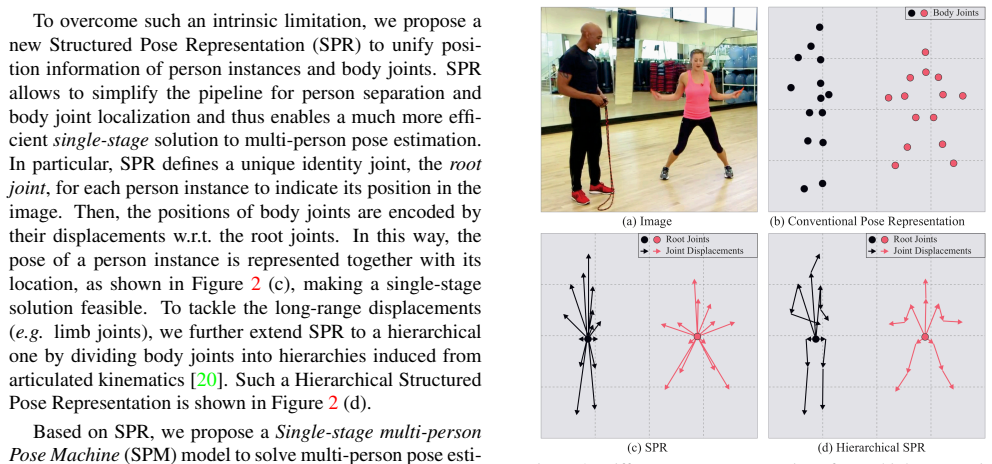
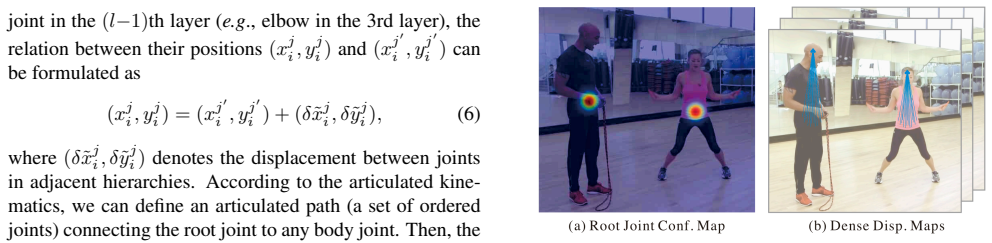
The central object is the Structured Pose Representation (SPR): a human pose is stored as a root joint position plus a displacement vector from that root to each body joint, with the root placed at the person's centroid. Its hierarchical extension divides joints into four articulated-kinematics layers so that far-away joints such as wrists and ankles are reached by accumulating short displacements along a kinematic path instead of one long vector. This representation carries the argument because it unifies person-instance location and joint positions into a single regression target, making the mapping from image to all poses a single feed-forward function; the network is trained with a Gaussian confidence map for roots and normalized dense displacement maps inside a small neighborhood of the root.
What would settle it
Take a set of crowded images, cover the torso-center of selected people with a patch large enough to hide the centroid while leaving their limbs visible, and run SPM: the central claim predicts the covered person's joints disappear almost entirely, because displacement vectors are only read at the root location; if the model still recovers most joints from limb-level cues, the root-anchored single-vector assumption is not what carries the method.
Extended reading notes
Core claim
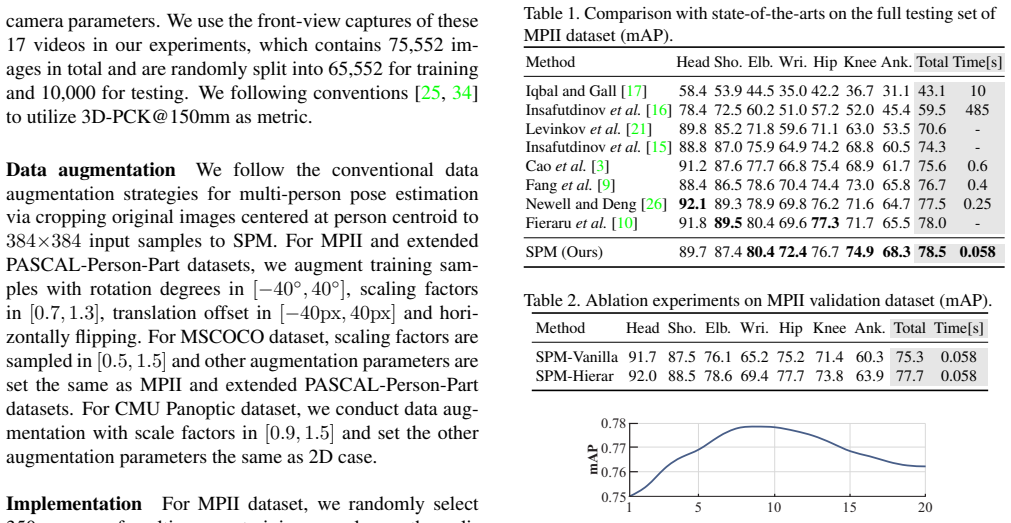
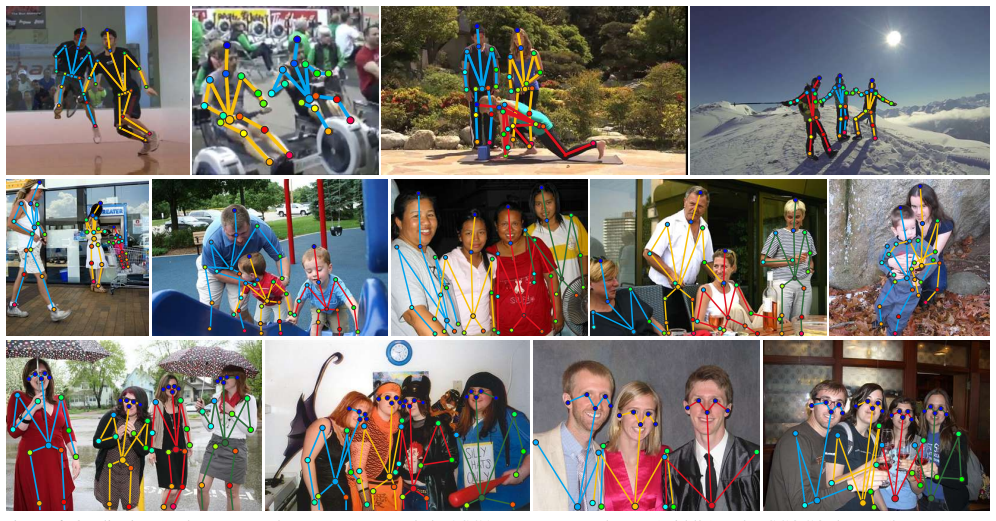
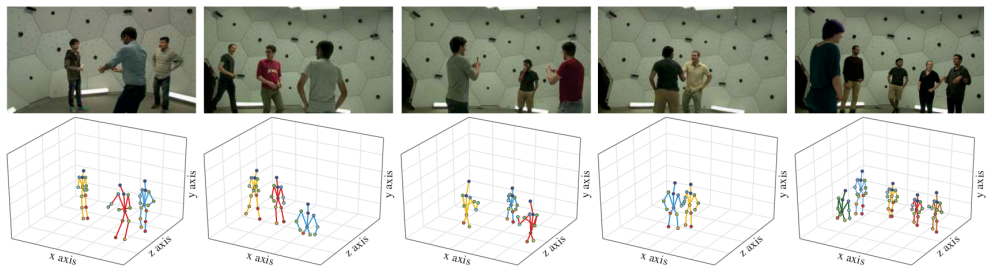
The central claim is that multi-person pose estimation can be solved in one stage by predicting, from an image, confidence peaks for per-person root joints together with dense displacement maps from each root to every body joint; hierarchical SPR splits long root-to-wrist and root-to-ankle displacements into short adjacent-joint steps along a kinematic path. The Single-stage Pose Machine implements this with a fully convolutional backbone that has one branch for root confidence and one for displacement maps, then applies non-maximum suppression to the root peaks, reads each joint's displacement at the root location, and reconstructs all poses. The paper reports a new state of the art on MPII at 78.5% mAP and 0.058 seconds per image, a new state of the art on the extended PASCAL-Person-Part benchmark at 46.1% mAP, competitive performance on MSCOCO test-dev at 0.669 AP while running about eight times faster than the leading bottom-up system, and 77.8% 3D-PCK for multi-person 3D pose on the Panoptic benchmark.
Load-bearing premise
The method assumes that a person's centroid, the root joint, is visible and detectable in the image, and that a joint's position can be recovered by reading a single displacement vector at that centroid; a missed or occluded root loses the whole person.
Editorial extensions
If this is right
- Multi-person 2D and 3D pose estimation reduce to one forward pass: find root peaks and read displacement vectors, with no per-person detection or joint-grouping postprocess.
- The hierarchical factorization specifically raises accuracy on far-from-root joints without extra runtime; the paper's MPII ablation reports wrist accuracy rising from 65.2 to 69.4 mAP and ankle accuracy from 60.3 to 63.9 mAP.
- The one-pass design removes the per-instance cost of running a separate pose network for each detected person, which is what gives the reported speed advantage over top-down and bottom-up pipelines.
- The same architecture transfers to 3D by replacing 2D displacements with 3D ones, giving multi-person 3D poses without intermediate 2D pose estimation or multi-view reconstruction.
- On MPII and the extended PASCAL-Person-Part benchmark the model sets a new state of the art; on MSCOCO it trails the best two-stage system in accuracy but claims a large speed advantage.
- If the central claim holds, future pose-estimation systems can trade a two-stage pipeline for a single compact network, simplifying deployment on latency-sensitive platforms.
- Open questions the paper leaves implicit include whether the root-anchored displacement scheme degrades gracefully when people overlap or are heavily occluded, since a missed root currently loses the whole person.
- A natural extension is to use the same structured representation for other instance-part tasks, such as face landmark detection or animal pose estimation, where a stable anchor point can play the role of the root joint.
Reading between the lines
- The root-anchored representation is a general design pattern: any instance whose parts can be expressed relative to a stable anchor, such as face landmarks, hands, or animal bodies, could get a single-stage predictor; the paper only demonstrates it for human bodies.
- The paper's own ablation suggests the method's ceiling in crowded scenes is set by root detection: when two people's centroids overlap or an occluding object covers a centroid, the displacement map at that location blends or vanishes, so a future extension could add a second read-out point or a learned aggregation over a small root neighborhood.
- One testable extension is replacing the fixed four-level kinematic hierarchy with data-driven articulated paths or with multi-hop displacement readouts, which could improve accuracy on extreme poses without changing the single-stage structure.
- The reported speed comparison is on different hardware and settings for different baselines, so the practical speed advantage in a common evaluation harness remains to be confirmed; the paper's own numbers should be read as indicative rather than controlled.
Signed reviews
Editorial analysis
A structured set of objections, weighed in public.
Referee Report
Summary. This paper proposes SPM, a single-stage multi-person pose estimation model based on a Structured Pose Representation (SPR) that encodes each person's joints as displacements from a root joint, optionally in a hierarchical form. The model is implemented with a stacked hourglass network that simultaneously predicts root confidence maps and dense displacement maps, and is evaluated on MPII, PASCAL-Person-Part, MSCOCO, and CMU Panoptic datasets.
Significance. The core idea of unifying person instance and joint positions into a root-relative representation is clean and has clear potential to simplify the multi-person pose estimation pipeline. The hierarchical extension is a sensible way to handle long-range displacements, and the paper includes useful ablations showing its benefit and the effect of the displacement neighborhood radius. If the evaluation issues are resolved, the approach could be a valuable contribution to efficient multi-person pose estimation.
major comments (2)
- [5.1, Table 1, Table 4] The reported accuracy numbers on MPII (78.5 mAP) and MSCOCO (0.669 AP) are obtained after refining SPM outputs with a separate single-person pose model, as stated in the setup text ('we follow previous works [3, 26] to refine estimation results with a single-person model trained on the same dataset on MPII and MSCOCO'), while the reported latency (0.058s) explicitly excludes this refinement time (Table 1 note). This means the headline accuracy is not produced by the single-stage SPM alone, and the speed comparison with two-stage baselines is asymmetric. The manuscript should report SPM-alone accuracy and end-to-end latency (or clearly separate refinement time), and should not claim 'first single-stage' without an evaluation of the single-stage model.
- [5.1 and Tables 1/4] The speed measurement of 0.058s uses single-scale testing, whereas the accuracy results are obtained with six-scale image pyramids and flipping. Consequently, the reported speed does not correspond to the configuration that produces the reported accuracy. The authors should measure latency under the same inference settings used for accuracy, or explicitly state the different configurations and provide both single-scale and multi-scale accuracy-latency trade-offs.
minor comments (4)
- [5.1] The word 'Specially' should be 'Specifically', and the sentence structure in the paragraph about refinement is awkward; consider revising for clarity.
- [4.1] The dense displacement map D^j is constructed by averaging over persons, but the paper does not discuss the behavior when two persons' root neighborhoods overlap; a short discussion of this ambiguity would be helpful.
- [Figure 5] The horizontal axis labels for the hyperparameter tau are not clearly labeled; adding an axis title such as 'tau' would improve readability.
- [5.5] The claim of a 'promising result' on CMU Panoptic is hard to interpret without any baselines; adapting or comparing with prior multi-person 3D methods, even under the same evaluation protocol, would strengthen the 3D experiments.
Circularity Check
No circularity found: the paper's contributions are empirical design choices tested on external benchmarks; no claimed derivation reduces to its inputs.
full rationale
SPM is an empirical CNN system rather than a paper with a first-principles derivation chain. The Structured Pose Representation is a coding choice, not a result derived from itself: Eq. (4) defines joint positions as root plus displacement, and Eq. (7) is a telescoping path identity; these are representations whose accuracy is then measured against external MPII/PASCAL/MSCOCO/Panoptic ground truth. The model is trained end-to-end on those benchmarks, and the reported accuracy is not constructed from the representation's definition. The hierarchical split is justified by an external kinematics reference [20]. No load-bearing step relies on a self-citation by the authors; the cited Hourglass/associative embedding works [26, 27] are independent prior architecture baselines. The only caveat is reporting: Section 5.1 says results on MPII and MSCOCO are refined with a separately trained single-person model, and Table 1's 0.058s excludes that refinement, so the 'single-stage' and efficiency claims are partly qualified. That is a validity/overclaim concern, not circularity, because the numbers are still external empirical measurements and no parameter was fitted to the test set to force a prediction. Hyperparameters tau and sigma are tuned on validation with an ablation (Fig. 5), which is standard practice. No circular step can be quoted from the paper's equations or citation chain.
Assumptions & free parameters
free parameters (4)
- sigma (Gaussian spread for root confidence map) =
7
- tau (neighborhood radius for displacement regression) =
7
- beta (loss weight for displacement branch) =
0.01
- T (number of stacked hourglass modules) =
8
assumptions (4)
- domain assumption The person centroid is a stable and discriminative root joint for separating instances.
- domain assumption Body joints can be partitioned into four kinematic hierarchies such that accumulating adjacent displacements recovers long-range joints.
- ad hoc to paper Supervising displacement maps only within a tau-neighborhood of the root is sufficient for inference to read displacements at the root location.
- standard math An hourglass network with intermediate supervision can jointly regress confidence maps and displacement maps in one forward pass.
Cite this review
Pith. "Pith review of Single-Stage Multi-Person Pose Machines." pith.science (2026). https://pith.science/paper/L7SXCTCF
@misc{pith2026190809220,
  author       = {Pith},
  title        = {Pith review of: Single-Stage Multi-Person Pose Machines},
  year         = {2026},
  howpublished = {\url{https://pith.science/paper/L7SXCTCF}},
  note         = {Machine review of arXiv:1908.09220}
}
read the original abstract
Multi-person pose estimation is a challenging problem. Existing methods are mostly two-stage based--one stage for proposal generation and the other for allocating poses to corresponding persons. However, such two-stage methods generally suffer low efficiency. In this work, we present the first single-stage model, Single-stage multi-person Pose Machine (SPM), to simplify the pipeline and lift the efficiency for multi-person pose estimation. To achieve this, we propose a novel Structured Pose Representation (SPR) that unifies person instance and body joint position representations. Based on SPR, we develop the SPM model that can directly predict structured poses for multiple persons in a single stage, and thus offer a more compact pipeline and attractive efficiency advantage over two-stage methods. In particular, SPR introduces the root joints to indicate different person instances and human body joint positions are encoded into their displacements w.r.t. the roots. To better predict long-range displacements for some joints, SPR is further extended to hierarchical representations. Based on SPR, SPM can efficiently perform multi-person poses estimation by simultaneously predicting root joints (location of instances) and body joint displacements via CNNs. Moreover, to demonstrate the generality of SPM, we also apply it to multi-person 3D pose estimation. Comprehensive experiments on benchmarks MPII, extended PASCAL-Person-Part, MSCOCO and CMU Panoptic clearly demonstrate the state-of-the-art efficiency of SPM for multi-person 2D/3D pose estimation, together with outstanding accuracy.
Figures

Figures from the paper (4 more)

Reference graph
Works this paper leans on
-
[3]
Realtime multi-person 2d pose estimation using part affinity fields
Zhe Cao, Tomas Simon, Shih-En Wei, and Yaser Sheikh. Realtime multi-person 2d pose estimation using part affinity fields. In CVPR, 2017
work page 2017
-
[26]
Associative embedding: End-to-end learning for joint detection and grouping
Alejandro Newell and Jia Deng. Associative embedding: End-to-end learning for joint detection and grouping. In NIPS, 2017
work page 2017
-
[1]
2d human pose estimation: New benchmark and state of the art analysis
Mykhaylo Andriluka, Leonid Pishchulin, Peter Gehler, and Bernt Schiele. 2d human pose estimation: New benchmark and state of the art analysis. In CVPR, 2014
work page 2014
-
[2]
Monocular 3d pose estimation and tracking by detection
Mykhaylo Andriluka, Stefan Roth, and Bernt Schiele. Monocular 3d pose estimation and tracking by detection. In CVPR, 2010
work page 2010
-
[4]
Human pose estimation with iterative error feedback
Joao Carreira, Pulkit Agrawal, Katerina Fragkiadaki, and Ji- tendra Malik. Human pose estimation with iterative error feedback. In CVPR, 2016
work page 2016
-
[5]
Detect what you can: Detecting and representing objects using holistic models and body parts
Xianjie Chen, Roozbeh Mottaghi, Xiaobai Liu, Sanja Fidler, Raquel Urtasun, and Alan L Yuille. Detect what you can: Detecting and representing objects using holistic models and body parts. In CVPR, 2014
work page 2014
-
[6]
Parsing occluded people by flexible compositions
Xianjie Chen and Alan L Yuille. Parsing occluded people by flexible compositions. In CVPR, 2015
work page 2015
-
[7]
P-cnn: Pose-based cnn features for action recognition
Guilhem Ch ´eron, Ivan Laptev, and Cordelia Schmid. P-cnn: Pose-based cnn features for action recognition. In ICCV, 2015
work page 2015
Show all 38 references
-
[8]
Fast and robust multi-person 3d pose estima- tion from multiple views
Junting Dong, Wen Jiang, Qixing Huang, Hujun Bao, and Xiaowei Zhou. Fast and robust multi-person 3d pose estima- tion from multiple views. arXiv, 2019
2019
-
[9]
RMPE: Regional multi-person pose estimation
Haoshu Fang, Shuqin Xie, Yuwing Tai, and Cewu Lu. RMPE: Regional multi-person pose estimation. In ICCV, 2017
2017
-
[10]
Learning to refine human pose estimation
Mihai Fieraru, Anna Khoreva, Leonid Pishchulin, and Bernt Schiele. Learning to refine human pose estimation. In CVPRw, 2018
2018
-
[11]
Fast r-cnn
Ross Girshick. Fast r-cnn. In ICCV, 2015
2015
-
[12]
Using k-poselets for detecting people and lo- calizing their keypoints
Georgia Gkioxari, Bharath Hariharan, Ross Girshick, and Ji- tendra Malik. Using k-poselets for detecting people and lo- calizing their keypoints. In CVPR, 2014
2014
-
[13]
Mask r-cnn
Kaiming He, Georgia Gkioxari, Piotr Doll ´ar, and Ross Gir- shick. Mask r-cnn. In ICCV, 2017
2017
-
[14]
Deep residual learning for image recognition
Kaiming He, Xiangyu Zhang, Shaoqing Ren, and Jian Sun. Deep residual learning for image recognition. In CVPR, 2016
2016
-
[15]
Articulated multi-person tracking in the wild
Eldar Insafutdinov, Mykhaylo Andriluka, Leonid Pishchulin, Siyu Tang, Bjoern Andres, and Bernt Schiele. Articulated multi-person tracking in the wild. In CVPR, 2017
2017
-
[16]
Insafutdinov, L
E. Insafutdinov, L. Pishchulin, B. Andres, M. Andriluka, and B. Schiele. Deepercut: A deeper, stronger, and faster multi- person pose estimation model. In ECCV, 2016
2016
-
[17]
Multi-person pose estimation with local joint-to-person associations
Umar Iqbal and Juergen Gall. Multi-person pose estimation with local joint-to-person associations. In ECCV, 2016
2016
-
[18]
Spatial transformer networks
Max Jaderberg, Karen Simonyan, Andrew Zisserman, et al. Spatial transformer networks. In NIPS, 2015
2015
-
[19]
Panoptic studio: A massively multiview sys- tem for social interaction capture
Hanbyul Joo, Tomas Simon, Xulong Li, Hao Liu, Lei Tan, Lin Gui, Sean Banerjee, Timothy Scott Godisart, Bart Nabbe, Iain Matthews, Takeo Kanade, Shohei Nobuhara, and Yaser Sheikh. Panoptic studio: A massively multiview sys- tem for social interaction capture. IEEE Trans. on Pat...
2017
-
[20]
Kinematics of human motion
Kathleen M Knutzen. Kinematics of human motion . Wiley Online Library, 1998
1998
-
[21]
Joint graph decomposition & node labeling: Problem, algorithms, appli- cations
Evgeny Levinkov, Jonas Uhrig, Siyu Tang, Mohamed Om- ran, Eldar Insafutdinov, Alexander Kirillov, Carsten Rother, Thomas Brox, Bernt Schiele, and Bjoern Andres. Joint graph decomposition & node labeling: Problem, algorithms, appli- cations. In CVPR, 2017
2017
-
[22]
Feature pyramid networks for object detection
Tsung-Yi Lin, Piotr Doll ´ar, Ross Girshick, Kaiming He, Bharath Hariharan, and Serge Belongie. Feature pyramid networks for object detection. In CVPR, 2017
2017
-
[23]
Microsoft coco: Common objects in context
Tsung-Yi Lin, Michael Maire, Serge Belongie, James Hays, Pietro Perona, Deva Ramanan, Piotr Doll´ar, and C Lawrence Zitnick. Microsoft coco: Common objects in context. In ECCV, 2014
2014
-
[24]
Fully convolutional networks for semantic segmentation
Jonathan Long, Evan Shelhamer, and Trevor Darrell. Fully convolutional networks for semantic segmentation. In CVPR, 2015
2015
-
[25]
Single-shot multi-person 3d pose estimation from monocular rgb
Dushyant Mehta, Oleksandr Sotnychenko, Franziska Mueller, Weipeng Xu, Srinath Sridhar, Gerard Pons-Moll, and Christian Theobalt. Single-shot multi-person 3d pose estimation from monocular rgb. In 3DV, 2018
2018
-
[27]
Newell, K
A. Newell, K. Yang, and J. Deng. Stacked hourglass net- works for human pose estimation. In ECCV, 2016
2016
-
[28]
Person- lab: Person pose estimation and instance segmentation with a bottom-up, part-based, geometric embedding model
George Papandreou, Tyler Zhu, Liang-Chieh Chen, Spyros Gidaris, Jonathan Tompson, and Kevin Murphy. Person- lab: Person pose estimation and instance segmentation with a bottom-up, part-based, geometric embedding model. In ECCV, 2018
2018
-
[29]
Towards accurate multi-person pose estimation in the wild
George Papandreou, Tyler Zhu, Nori Kanazawa, Alexander Toshev, Jonathan Tompson, Chris Bregler, and Kevin Mur- phy. Towards accurate multi-person pose estimation in the wild. In CVPR, 2017
2017
-
[30]
Pytorch, 2017
Adam Paszke, Sam Gross, and Soumith Chintala. Pytorch, 2017
2017
-
[31]
Pishchulin, E
L. Pishchulin, E. Insafutdinov, S. Tang, B. Andres, M. An- driluka, P. Gehler, and B. Schiele. Deepcut: Joint subset partition and labeling for multi person pose estimation. In CVPR, 2016
2016
-
[32]
Pose-normalized image generation for person re-identification
Xuelin Qian, Yanwei Fu, Wenxuan Wang, Tao Xiang, Yang Wu, Yu-Gang Jiang, and Xiangyang Xue. Pose-normalized image generation for person re-identification. In CVPR, 2018
2018
-
[33]
Faster r-cnn: Towards real-time object detection with region proposal networks
Shaoqing Ren, Kaiming He, Ross Girshick, and Jian Sun. Faster r-cnn: Towards real-time object detection with region proposal networks. In NIPS, 2015
2015
-
[34]
Lcr-net++: Multi-person 2d and 3d pose detection in natu- ral images
Gregory Rogez, Philippe Weinzaepfel, and Cordelia Schmid. Lcr-net++: Multi-person 2d and 3d pose detection in natu- ral images. IEEE Trans. on Pattern Anal. and Mach. Intell., 2019
2019
-
[35]
Articulated part-based model for joint object detection and pose estimation
Min Sun and Silvio Savarese. Articulated part-based model for joint object detection and pose estimation. In ICCV, 2011
2011
-
[36]
Tieleman and G
T. Tieleman and G. Hinton. Lecture 6.5-rmsprop: Divide the gradient by a running average of its recent magnitude. COURSERA, 2012
2012
-
[37]
S.-E. Wei, V . Ramakrishna, T. Kanade, and Y . Sheikh. Con- volutional pose machines. In CVPR, 2016
2016
-
[38]
Joint multi-person pose estimation and semantic part seg- mentation
Fangting Xia, Peng Wang, Xianjie Chen, and Alan L Yuille. Joint multi-person pose estimation and semantic part seg- mentation. In CVPR, 2017
2017
Reviewed August 14, 2026 · model on record in the stance chip above.
Discussion (0). Continue with ORCID to comment.