REVIEW 4 major objections 6 minor 62 references
Towards Unconstrained End-to-End Text Spotting
T0 review · 4 major / 6 minor · reviewed 2026-08-14 · deepseek-v4-flash
Pith's one-line read End-to-end OCR reads curved and straight text in a single forward pass, without rectification.
desk verdict RoI masking is a genuine, well-ablated idea and the public-only Total-Text result stands on its own, but the headline SOTA margins are confounded by 1M proprietary OCR labels and missing public-only ICDAR15 numbers. read the letter →
The pith
A machine-rendered reading of the paper's core claim, the machinery that carries it, and where it could break.
The reading
What carries the argument
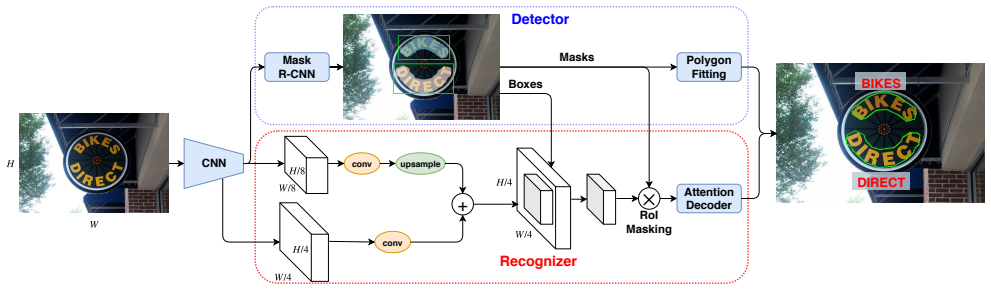
The central mechanism is RoI masking: for each detected text region, features cropped from the image-level feature map are multiplied by the corresponding instance segmentation mask, suppressing neighboring text and background so the attention decoder sees only the target text instance. The recognizer is a Bahdanau-style seq2seq attention decoder that generates one character per step, with attention weights that shift along the text path. The training machinery also includes a partially labeled data branch: on machine-annotated images only the recognizer is trained, using outputs from an existing multi-step OCR engine as ground truth.
What would settle it
A controlled experiment that trains the same architecture on the same fully labeled data with and without the machine-label branch, but replaces the teacher's transcriptions on a random subset of the million images with human corrections; if end-to-end performance on benchmarks does not drop when teacher labels are replaced by corrected labels, the partially labeled data effect is robust. Conversely, if performance collapses when the teacher is swapped for a different OCR engine, the results depend on the specific teacher rather than the architecture.
Extended reading notes
Core claim
The central claim is that feature rectification is not required for end-to-end text recognition: an attention decoder can learn to follow arbitrary text paths when it is given cropped features multiplied by the predicted instance segmentation mask. The paper demonstrates this by building a model that uses Mask R-CNN for detection (predicting boxes and masks) and a sequence-to-sequence attention decoder for recognition, trained jointly on fully labeled data plus large-scale partially labeled machine-annotated data. The reported results show large gains over prior end-to-end systems on both straight and curved benchmarks, with the curved-text margin being especially large.
Load-bearing premise
The reported improvements from partially labeled data assume that the automatic OCR engine's outputs are accurate enough to serve as training ground truth for the recognizer, and that text regions labeled only with oriented rectangles, without instance masks, still provide a valid training signal through the RoI masking pipeline; if the teacher's errors are systematic and align with benchmark content, the gains could overstate the architecture's contribution.
Editorial extensions
If this is right
- End-to-end text spotting architectures can be simplified by removing rectification modules while gaining the ability to read curved and arbitrarily shaped text.
- Training the recognizer provides a learning signal that improves the shared feature extractor, which can boost detection performance even when detection is not directly trained on that branch.
- Large-scale automatically labeled data from existing OCR engines can be used to train end-to-end models, reducing the need for fully annotated scene text images.
- The same single-pass model works on both straight and curved text, suggesting a unified approach for diverse scene text reading applications.
- Attention weight visualization gives a direct way to see and debug where the model is reading, which can help identify failure modes.
Reading between the lines
- RoI masking may generalize to other tasks that attach a recognition head to an instance segmentation detector, such as reading labels on objects or reading text on irregular surfaces.
- The success of unrectified attention decoding suggests that prior end-to-end models were held back mainly by rectification; adding a rectification module to this model would likely hurt performance, which would further support the claim.
- The partially labeled data approach could be turned into a self-improving loop, where the model's own predictions regenerate labels for new images, though teacher bias would need to be monitored.
- The reported failure on upside-down text suggests that explicit orientation augmentation or a rotation-aware decoder might be needed to handle rare reading directions.
Editorial analysis
A structured set of objections, weighed in public.
Referee Report
Summary. The paper proposes an end-to-end text spotting model based on Mask R-CNN as the detector and a seq2seq attention decoder as the recognizer. Instead of rectifying detected text regions before recognition, the model applies a proposed RoI masking step that multiplies cropped features by the predicted instance segmentation mask, allowing the attention decoder to attend to arbitrarily shaped text. To address the shortage of fully annotated training images, the authors add partially labeled data produced by the Google Cloud Vision API OCR engine on one million web images, training only the recognizer branch on such samples. The model is evaluated on ICDAR15 and Total-Text, where it reports state-of-the-art end-to-end F-scores (4.6% and 16.7% relative improvements over prior work, respectively). Ablations indicate consistent gains from RoI masking and from partial labels.
Significance. If the reported results hold, the paper makes a useful contribution to scene text spotting by showing that feature rectification can be avoided: RoI masking plus an attention decoder directly handles curved and rotated text. The internal ablations support the value of RoI masking and partially labeled data, and the public-data-only Inception-ResNet model still improves on previous Total-Text results, giving some independent evidence for the architecture. The main caveat is attribution: the headline benchmark claims rest on 30k private web images and one million machine-labeled images, so the reported margins may overstate the architectural contribution. Still, the paper is an important datapoint for the community, provided the data-dependence is clarified through additional experiments.
major comments (4)
- [Section 4.1, Tables 1 and 3] The headline ICDAR15 result (4.6% improvement over FOTS MS in Table 1) is reported for models trained with 30k private web images and one million machine-labeled images (Section 3.6), while the public-data-only comparison is given only for Total-Text in Table 2. Without a comparable public-only ICDAR15 number, the reported gain cannot be separated from the effect of additional training data. Please report the 'Inc-Res public' configuration on ICDAR15 under the same end-to-end metrics used in Table 1.
- [Section 3.5 and Eq. (5)] The partially labeled branch updates only the recognizer according to Eq. (5), yet the recognizer receives features produced by the RoI masking operation of Section 3.3, which requires per-instance segmentation masks. The machine labels are described as oriented rectangles in Section 3.6, and the paper does not specify how these rectangles are converted to masks for the RoI masking step. Please clarify whether masks are used for machine-labeled regions, and if so, how they are synthesized from oriented rectangles.
- [Section 3.5] The only quality control described for teacher labels is a vague 'increase the confidence threshold,' with no threshold value, no measurement of teacher accuracy, and no analysis of error modes. Given that Table 3 attributes large gains to partial labels (e.g., Inc-Res E2E AP from 53.1 to 58.7 when adding PD), the reported improvements could be an artifact of the teacher OCR engine's label distribution rather than a property of the architecture. Please provide a label-noise analysis, a sensitivity study over confidence thresholds, and a comparison against recognizer training on human labels for a held-out subset.
- [Section 3.6] The paper collects 30k manually labeled web images and one million automatically labeled web images but does not check whether any of these images overlap with the ICDAR15 or Total-Text test sets. Even a small number of duplicated or near-duplicate test images could inflate the benchmark numbers. Please report an overlap check (e.g., exact or near-duplicate image search) or explain why leakage is implausible.
minor comments (6)
- [Section 1] The phrase 'due to the short of fully annotated images' should be 'due to the shortage of fully annotated images.'
- [Section 3.1] The reference to 'the conv4 12 layer' should be written as 'the conv4_12 layer' (or 'the 12th convolutional block of stage conv4') for clarity.
- [Section 3.5] There is a missing space in 'label smoothing set to0.9'; it should read 'set to 0.9.'
- [Section 4.1] The citation '(Heet al.)' should read '(He et al.)' with a space after 'He.'
- [Section 3.3] The description of RoI masking says features are resized 'so that the shorter dimension is equal to 14 while maintaining the overall aspect ratio,' but the paper does not state the exact output tensor dimensions or how the mask is resampled; please give these details for reproducibility.
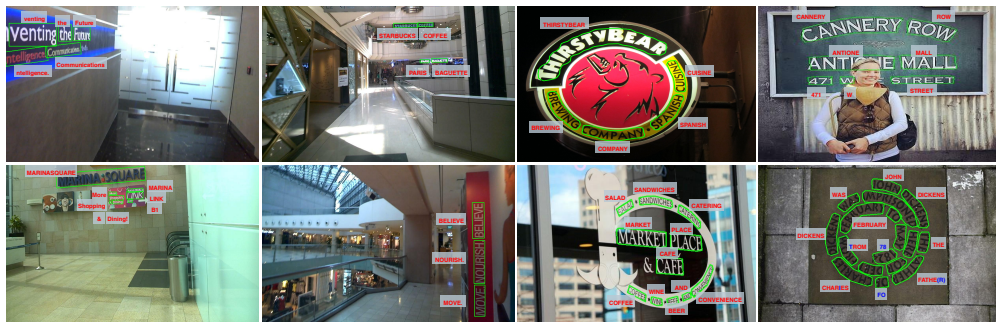
- [Figure 4 caption] The sentence 'In the bottom right image, prediction errors are shown in blue, some predictions are skipped for better visualization. All the skipped predictions are correctly predicted by our method' is confusing; please reword to explain why correct predictions are skipped.
Circularity Check
No significant circularity: the central claims are benchmarked externally and the partial-label branch is evaluated by ablation rather than derived from its own inputs.
full rationale
The paper's derivation chain is: (1) a Mask R-CNN detector plus an attention decoder with RoI masking and no rectification; (2) joint training on fully labeled and partially labeled data bootstrapped from an existing OCR engine; and (3) evaluation on ICDAR15 and Total-Text. Each load-bearing component is supported by independent evidence. RoI masking is defined as multiplying cropped features by the instance mask (Section 3.3) and its benefit is measured by direct ablation in Table 3, not assumed. The partially labeled data branch is grounded by the ablation rows in Table 3 showing AP gains when partial data is added, and the OCR engine used for labeling, PhotoOCR [4], is an external pre-existing system rather than the model being proposed; the fact that one of this paper's authors co-authored that engine is a self-citation, but it is not load-bearing because the paper does not rely on its authority to establish the result. The headline numbers are measured against public benchmarks with standard protocols, so they are not entailed by the model definitions. Reproducibility concerns about the 1M proprietary OCR-labeled images, teacher label noise, or missing mask details for machine-labeled rectangles are legitimate attribution/verification issues, but they are not circularity: no equation, metric, or prediction reduces by construction to a fitted parameter or to a self-citation. Under the stated review rule that self-citation becomes circularity only when the load-bearing argument reduces to it, this paper does not exhibit that pattern.
Assumptions & free parameters
free parameters (5)
- Loss weights alpha, beta, gamma =
1.0, 1.0, 1.0
- RoI feature resize dimension =
14x14
- Output feature stride =
8 with fusion of stride 4
- Training iterations =
8M
- Learning rate schedule =
1e-3 (Inc-Res) / 3e-4 (ResNet-50), decay factor 3 every 2M iterations
assumptions (4)
- domain assumption Mask R-CNN, as described in [20], provides reliable instance masks and boxes for text after fine-tuning.
- domain assumption The Google Cloud Vision API / PhotoOCR [4] produces bounding boxes and transcriptions accurate enough for recognizer training.
- ad hoc to paper An attention-based seq2seq decoder can learn to follow arbitrary text shapes from unrectified, masked features.
- domain assumption Public benchmark annotations for ICDAR15 and Total-Text are correct and used consistently with prior work.
Cite this review
Pith. "Pith review of Towards Unconstrained End-to-End Text Spotting." pith.science (2026). https://pith.science/paper/UQ5SWGOY
@misc{pith2026190809231,
  author       = {Pith},
  title        = {Pith review of: Towards Unconstrained End-to-End Text Spotting},
  year         = {2026},
  howpublished = {\url{https://pith.science/paper/UQ5SWGOY}},
  note         = {Machine review of arXiv:1908.09231}
}
read the original abstract
We propose an end-to-end trainable network that can simultaneously detect and recognize text of arbitrary shape, making substantial progress on the open problem of reading scene text of irregular shape. We formulate arbitrary shape text detection as an instance segmentation problem; an attention model is then used to decode the textual content of each irregularly shaped text region without rectification. To extract useful irregularly shaped text instance features from image scale features, we propose a simple yet effective RoI masking step. Additionally, we show that predictions from an existing multi-step OCR engine can be leveraged as partially labeled training data, which leads to significant improvements in both the detection and recognition accuracy of our model. Our method surpasses the state-of-the-art for end-to-end recognition tasks on the ICDAR15 (straight) benchmark by 4.6%, and on the Total-Text (curved) benchmark by more than 16%.
Figures


Figures from the paper (2 more)

Reference graph
Works this paper leans on
-
[1]
Tensorflow: A system for large-scale machine learning
Mart ´ın Abadi, Paul Barham, Jianmin Chen, Zhifeng Chen, Andy Davis, Jeffrey Dean, Matthieu Devin, Sanjay Ghe- mawat, Geoffrey Irving, Michael Isard, et al. Tensorflow: A system for large-scale machine learning. In 12th {USENIX} Symposium on Operating Systems Design and Implementa- tion ({OSDI} 16), pages 265–283, 2016. 5
work page 2016
-
[2]
Jimmy Lei Ba, Jamie Ryan Kiros, and Geoffrey E Hin- ton. Layer normalization. arXiv preprint arXiv:1607.06450,
-
[3]
Neural machine translation by jointly learning to align and translate
Dzmitry Bahdanau, Kyunghyun Cho, and Yoshua Bengio. Neural machine translation by jointly learning to align and translate. arXiv preprint arXiv:1409.0473, 2014. 1, 4
arXiv 2014
-
[4]
Photoocr: Reading text in uncontrolled con- ditions
Alessandro Bissacco, Mark Cummins, Yuval Netzer, and Hartmut Neven. Photoocr: Reading text in uncontrolled con- ditions. In Proceedings of the IEEE International Confer- ence on Computer Vision, pages 785–792, 2013. 2
work page 2013
-
[5]
Fastext: Effi- cient unconstrained scene text detector
Michal Busta, Lukas Neumann, and Jiri Matas. Fastext: Effi- cient unconstrained scene text detector. InProceedings of the IEEE International Conference on Computer Vision , pages 1206–1214, 2015. 2
work page 2015
-
[6]
E2E-MLT - an Unconstrained End-to-End Method for Multi-Language Scene Text
Michal Bu ˇsta, Yash Patel, and Jiri Matas. E2e-mlt-an uncon- strained end-to-end method for multi-language scene text. arXiv preprint arXiv:1801.09919, 2018. 6
work page Pith review arXiv 2018
-
[7]
Liang-Chieh Chen, George Papandreou, Iasonas Kokkinos, Kevin Murphy, and Alan L Yuille. Deeplab: Semantic image segmentation with deep convolutional nets, atrous convolu- tion, and fully connected crfs. IEEE transactions on pattern analysis and machine intelligence, 40(4):834–848, 2018. 2
work page 2018
-
[8]
Detecting and read- ing text in natural scenes
Xiangrong Chen and Alan L Yuille. Detecting and read- ing text in natural scenes. In Proceedings of the 2004 IEEE Computer Society Conference on Computer Vision and Pat- tern Recognition, 2004. CVPR 2004., volume 2, pages II–II. IEEE, 2004. 2
work page 2004
Show all 62 references
-
[9]
Focusing attention: Towards accu- rate text recognition in natural images
Zhanzhan Cheng, Fan Bai, Yunlu Xu, Gang Zheng, Shiliang Pu, and Shuigeng Zhou. Focusing attention: Towards accu- rate text recognition in natural images. In Proceedings of the IEEE International Conference on Computer Vision , pages 5076–5084, 2017. 2
2017
-
[10]
Aon: Towards arbitrarily-oriented text recognition
Zhanzhan Cheng, Yangliu Xu, Fan Bai, Yi Niu, Shiliang Pu, and Shuigeng Zhou. Aon: Towards arbitrarily-oriented text recognition. In Proceedings of the IEEE Conference on Computer Vision and Pattern Recognition , pages 5571– 5579, 2018. 2
2018
-
[11]
Total-text: A com- prehensive dataset for scene text detection and recognition
Chee Kheng Ch’ng and Chee Seng Chan. Total-text: A com- prehensive dataset for scene text detection and recognition. In 2017 14th IAPR International Conference on Document Analysis and Recognition (ICDAR) , volume 1, pages 935–
2017
-
[12]
Fused text segmenta- tion networks for multi-oriented scene text detection
Yuchen Dai, Zheng Huang, Yuting Gao, Youxuan Xu, Kai Chen, Jie Guo, and Weidong Qiu. Fused text segmenta- tion networks for multi-oriented scene text detection. In 2018 24th International Conference on Pattern Recognition (ICPR), pages 3604–3609. IEEE, 2018. 2, 6
2018
-
[13]
Detecting text in natural scenes with stroke width transform
Boris Epshtein, Eyal Ofek, and Yonatan Wexler. Detecting text in natural scenes with stroke width transform. In 2010 IEEE Computer Society Conference on Computer Vision and Pattern Recognition, pages 2963–2970. IEEE, 2010. 2
2010
-
[14]
Sequence-to-label script identification for multilingual ocr
Yasuhisa Fujii, Karel Driesen, Jonathan Baccash, Ash Hurst, and Ashok C Popat. Sequence-to-label script identification for multilingual ocr. In 2017 14th IAPR International Con- ference on Document Analysis and Recognition (ICDAR) , volume 1, pages 161–168. IEEE, 2017. 2
2017
-
[15]
A theoretically grounded application of dropout in recurrent neural networks
Yarin Gal and Zoubin Ghahramani. A theoretically grounded application of dropout in recurrent neural networks. In Advances in neural information processing systems , pages 1019–1027, 2016. 5
2016
-
[16]
Visual attention models for scene text recognition
Suman K Ghosh, Ernest Valveny, and Andrew D Bagdanov. Visual attention models for scene text recognition. In 2017 14th IAPR International Conference on Document Analysis and Recognition (ICDAR), volume 1, pages 943–948. IEEE,
2017
-
[17]
Fast r-cnn
Ross Girshick. Fast r-cnn. In Proceedings of the IEEE inter- national conference on computer vision , pages 1440–1448,
-
[18]
Textproposals: a text-specific selective search algorithm for word spotting in the wild
Llu ´ıs G´omez and Dimosthenis Karatzas. Textproposals: a text-specific selective search algorithm for word spotting in the wild. Pattern Recognition, 70:60–74, 2017. 6
2017
-
[19]
Connectionist temporal classification: labelling unsegmented sequence data with recurrent neural networks
Alex Graves, Santiago Fern ´andez, Faustino Gomez, and J¨urgen Schmidhuber. Connectionist temporal classification: labelling unsegmented sequence data with recurrent neural networks. In Proceedings of the 23rd international confer- ence on Machine learning, pages 369–376. ACM, 2006. 2
2006
-
[20]
Mask r-cnn
Kaiming He, Georgia Gkioxari, Piotr Doll ´ar, and Ross Gir- shick. Mask r-cnn. In Proceedings of the IEEE international conference on computer vision, pages 2961–2969, 2017. 5
2017
-
[21]
Deep residual learning for image recognition
Kaiming He, Xiangyu Zhang, Shaoqing Ren, and Jian Sun. Deep residual learning for image recognition. In Proceed- ings of the IEEE conference on computer vision and pattern recognition, pages 770–778, 2016. 3
2016
-
[22]
Single shot text detector with regional attention
Pan He, Weilin Huang, Tong He, Qile Zhu, Yu Qiao, and Xi- aolin Li. Single shot text detector with regional attention. In Proceedings of the IEEE International Conference on Com- puter Vision, pages 3047–3055, 2017. 2, 6
2017
-
[23]
Reading scene text in deep convolutional se- quences
Pan He, Weilin Huang, Yu Qiao, Chen Change Loy, and Xi- aoou Tang. Reading scene text in deep convolutional se- quences. In Thirtieth AAAI Conference on Artificial Intel- ligence, 2016. 2
2016
-
[24]
An end-to-end textspotter with explicit alignment and attention
Tong He, Zhi Tian, Weilin Huang, Chunhua Shen, Yu Qiao, and Changming Sun. An end-to-end textspotter with explicit alignment and attention. In Proceedings of the IEEE Con- ference on Computer Vision and Pattern Recognition, pages 5020–5029, 2018. 1, 2, 6
2018
-
[25]
Speed/accuracy trade-offs for modern convolutional object detectors
Jonathan Huang, Vivek Rathod, Chen Sun, Menglong Zhu, Anoop Korattikara, Alireza Fathi, Ian Fischer, Zbigniew Wo- jna, Yang Song, Sergio Guadarrama, et al. Speed/accuracy trade-offs for modern convolutional object detectors. InPro- ceedings of the IEEE conference on computer v...
2017
-
[26]
Text localization in natural images using stroke feature transform and text covariance descriptors
Weilin Huang, Zhe Lin, Jianchao Yang, and Jue Wang. Text localization in natural images using stroke feature transform and text covariance descriptors. In Proceedings of the IEEE International Conference on Computer Vision, pages 1241– 1248, 2013. 2
2013
-
[27]
Synthetic data and artificial neural net- works for natural scene text recognition
Max Jaderberg, Karen Simonyan, Andrea Vedaldi, and An- drew Zisserman. Synthetic data and artificial neural net- works for natural scene text recognition. arXiv preprint arXiv:1406.2227, 2014. 6
2014 arXiv
-
[28]
Deep features for text spotting
Max Jaderberg, Andrea Vedaldi, and Andrew Zisserman. Deep features for text spotting. In European conference on computer vision, pages 512–528. Springer, 2014. 2
2014
-
[29]
R2cnn: rota- tional region cnn for orientation robust scene text detection
Yingying Jiang, Xiangyu Zhu, Xiaobing Wang, Shuli Yang, Wei Li, Hua Wang, Pei Fu, and Zhenbo Luo. R2cnn: rota- tional region cnn for orientation robust scene text detection. arXiv preprint arXiv:1706.09579, 2017. 2
2017 arXiv
-
[30]
Icdar 2015 competition on robust reading
Dimosthenis Karatzas, Lluis Gomez-Bigorda, Anguelos Nicolaou, Suman Ghosh, Andrew Bagdanov, Masakazu Iwa- mura, Jiri Matas, Lukas Neumann, Vijay Ramaseshan Chan- drasekhar, Shijian Lu, et al. Icdar 2015 competition on robust reading. In 2015 13th International Conference on Do...
2015
-
[31]
Recursive recurrent nets with attention modeling for ocr in the wild
Chen-Yu Lee and Simon Osindero. Recursive recurrent nets with attention modeling for ocr in the wild. In Proceed- ings of the IEEE Conference on Computer Vision and Pattern Recognition, pages 2231–2239, 2016. 2
2016
-
[32]
Towards end-to- end text spotting with convolutional recurrent neural net- works
Hui Li, Peng Wang, and Chunhua Shen. Towards end-to- end text spotting with convolutional recurrent neural net- works. In Proceedings of the IEEE International Conference on Computer Vision, pages 5238–5246, 2017. 1, 2
2017
-
[33]
Textboxes: A fast text detector with a single deep neural network
Minghui Liao, Baoguang Shi, Xiang Bai, Xinggang Wang, and Wenyu Liu. Textboxes: A fast text detector with a single deep neural network. In Thirty-First AAAI Conference on Artificial Intelligence, 2017. 2, 6
2017
-
[34]
Rotation-sensitive regression for oriented scene text detection
Minghui Liao, Zhen Zhu, Baoguang Shi, Gui-song Xia, and Xiang Bai. Rotation-sensitive regression for oriented scene text detection. In Proceedings of the IEEE Conference on Computer Vision and Pattern Recognition , pages 5909– 5918, 2018. 2, 6
2018
-
[35]
Feature pyramid networks for object detection
Tsung-Yi Lin, Piotr Doll ´ar, Ross Girshick, Kaiming He, Bharath Hariharan, and Serge Belongie. Feature pyramid networks for object detection. In Proceedings of the IEEE Conference on Computer Vision and Pattern Recognition , pages 2117–2125, 2017. 4
2017
-
[36]
Ssd: Single shot multibox detector
Wei Liu, Dragomir Anguelov, Dumitru Erhan, Christian Szegedy, Scott Reed, Cheng-Yang Fu, and Alexander C Berg. Ssd: Single shot multibox detector. In European con- ference on computer vision, pages 21–37. Springer, 2016. 2
2016
-
[37]
Fots: Fast oriented text spotting with a uni- fied network
Xuebo Liu, Ding Liang, Shi Yan, Dagui Chen, Yu Qiao, and Junjie Yan. Fots: Fast oriented text spotting with a uni- fied network. In Proceedings of the IEEE conference on computer vision and pattern recognition, pages 5676–5685,
-
[38]
Deep matching prior network: Toward tighter multi-oriented text detection
Yuliang Liu and Lianwen Jin. Deep matching prior network: Toward tighter multi-oriented text detection. In Proceed- ings of the IEEE Conference on Computer Vision and Pattern Recognition, pages 1962–1969, 2017. 2
1962
-
[39]
Fully convolutional networks for semantic segmentation
Jonathan Long, Evan Shelhamer, and Trevor Darrell. Fully convolutional networks for semantic segmentation. In Pro- ceedings of the IEEE conference on computer vision and pat- tern recognition, pages 3431–3440, 2015. 2
2015
-
[40]
Scene text detec- tion and recognition: The deep learning era
Shangbang Long, Xin He, and Cong Ya. Scene text detec- tion and recognition: The deep learning era. arXiv preprint arXiv:1811.04256, 2018. 2
2018 arXiv
-
[41]
Textsnake: A flexible represen- tation for detecting text of arbitrary shapes
Shangbang Long, Jiaqiang Ruan, Wenjie Zhang, Xin He, Wenhao Wu, and Cong Yao. Textsnake: A flexible represen- tation for detecting text of arbitrary shapes. In Proceedings of the European Conference on Computer Vision (ECCV) , pages 20–36, 2018. 2, 6
2018
-
[42]
Mask textspotter: An end-to-end trainable neu- ral network for spotting text with arbitrary shapes
Pengyuan Lyu, Minghui Liao, Cong Yao, Wenhao Wu, and Xiang Bai. Mask textspotter: An end-to-end trainable neu- ral network for spotting text with arbitrary shapes. In Pro- ceedings of the European Conference on Computer Vision (ECCV), pages 67–83, 2018. 1, 3, 6
2018
-
[43]
Arbitrary-oriented scene text detection via rotation proposals
Jianqi Ma, Weiyuan Shao, Hao Ye, Li Wang, Hong Wang, Yingbin Zheng, and Xiangyang Xue. Arbitrary-oriented scene text detection via rotation proposals. IEEE Transac- tions on Multimedia, 20(11):3111–3122, 2018. 2
2018
-
[44]
Scene text access: A comparison of mobile ocr modalities for blind users
Leo Neat, Ren Peng, Siyang Qin, and Roberto Manduchi. Scene text access: A comparison of mobile ocr modalities for blind users. 2019. 1
2019
-
[45]
Real-time scene text local- ization and recognition
Luk ´aˇs Neumann and Jiˇr´ı Matas. Real-time scene text local- ization and recognition. In 2012 IEEE Conference on Com- puter Vision and Pattern Recognition , pages 3538–3545. IEEE, 2012. 2
2012
-
[46]
Scene text localization and recognition with oriented stroke detection
Lukas Neumann and Jiri Matas. Scene text localization and recognition with oriented stroke detection. In Proceedings of the IEEE International Conference on Computer Vision , pages 97–104, 2013. 2
2013
-
[47]
A fast and robust text spotter
Siyang Qin and Roberto Manduchi. A fast and robust text spotter. In 2016 IEEE Winter Conference on Applications of Computer Vision (WACV), pages 1–8. IEEE, 2016. 2
2016
-
[48]
Cascaded segmentation- detection networks for word-level text spotting
Siyang Qin and Roberto Manduchi. Cascaded segmentation- detection networks for word-level text spotting. In2017 14th IAPR International Conference on Document Analysis and Recognition (ICDAR), volume 1, pages 1275–1282. IEEE,
-
[49]
You only look once: Unified, real-time object de- tection
Joseph Redmon, Santosh Divvala, Ross Girshick, and Ali Farhadi. You only look once: Unified, real-time object de- tection. In Proceedings of the IEEE conference on computer vision and pattern recognition, pages 779–788, 2016. 2
2016
-
[50]
Faster r-cnn: Towards real-time object detection with region proposal networks
Shaoqing Ren, Kaiming He, Ross Girshick, and Jian Sun. Faster r-cnn: Towards real-time object detection with region proposal networks. In Advances in neural information pro- cessing systems, pages 91–99, 2015. 2
2015
-
[51]
Detecting oriented text in natural images by linking segments
Baoguang Shi, Xiang Bai, and Serge Belongie. Detecting oriented text in natural images by linking segments. In Pro- ceedings of the IEEE Conference on Computer Vision and Pattern Recognition, pages 2550–2558, 2017. 6
2017
-
[52]
An end-to-end trainable neural network for image-based sequence recog- nition and its application to scene text recognition
Baoguang Shi, Xiang Bai, and Cong Yao. An end-to-end trainable neural network for image-based sequence recog- nition and its application to scene text recognition. IEEE transactions on pattern analysis and machine intelligence , 39(11):2298–2304, 2017. 2, 6
2017
-
[53]
Robust scene text recognition with auto- matic rectification
Baoguang Shi, Xinggang Wang, Pengyuan Lyu, Cong Yao, and Xiang Bai. Robust scene text recognition with auto- matic rectification. In Proceedings of the IEEE Conference on Computer Vision and Pattern Recognition , pages 4168– 4176, 2016. 2
2016
-
[54]
Textnet: Irregular text read- ing from images with an end-to-end trainable network.arXiv preprint arXiv:1812.09900, 2018
Yipeng Sun, Chengquan Zhang, Zuming Huang, Jiaming Liu, Junyu Han, and Errui Ding. Textnet: Irregular text read- ing from images with an end-to-end trainable network.arXiv preprint arXiv:1812.09900, 2018. 1, 2, 3, 4, 6
2018 arXiv
-
[55]
Inception-v4, inception-resnet and the impact of residual connections on learning
Christian Szegedy, Sergey Ioffe, Vincent Vanhoucke, and Alexander A Alemi. Inception-v4, inception-resnet and the impact of residual connections on learning. In Thirty-First AAAI Conference on Artificial Intelligence, 2017. 3
2017
-
[56]
A web- based ocr service for documents
Jake Walker, Yasuhisa Fujii, and Ashok C Popat. A web- based ocr service for documents. In Proceedings of the 13th IAPR International Workshop on Document Analysis Sys- tems (DAS), Vienna, Austria, 2018. 1
2018
-
[57]
Attention-based extraction of structured information from street view imagery
Zbigniew Wojna, Alexander N Gorban, Dar-Shyang Lee, Kevin Murphy, Qian Yu, Yeqing Li, and Julian Ibarz. Attention-based extraction of structured information from street view imagery. In 2017 14th IAPR International Con- ference on Document Analysis and Recognition (ICDAR) , vo...
2017
-
[58]
Object count/area graphs for the evaluation of object detection and segmenta- tion algorithms
Christian Wolf and Jean-Michel Jolion. Object count/area graphs for the evaluation of object detection and segmenta- tion algorithms. International Journal of Document Analysis and Recognition (IJDAR), 8(4):280–296, 2006. 6
2006
-
[59]
Textfield: Learning a deep di- rection field for irregular scene text detection
Yongchao Xu, Yukang Wang, Wei Zhou, Yongpan Wang, Zhibo Yang, and Xiang Bai. Textfield: Learning a deep di- rection field for irregular scene text detection. IEEE Trans- actions on Image Processing, 2019. 6
2019
-
[60]
Msr: Multi-scale shape regression for scene text detection
Chuhui Xue, Shijian Lu, and Wei Zhang. Msr: Multi-scale shape regression for scene text detection. arXiv preprint arXiv:1901.02596, 2019. 6
1901 arXiv
-
[61]
East: an efficient and accurate scene text detector
Xinyu Zhou, Cong Yao, He Wen, Yuzhi Wang, Shuchang Zhou, Weiran He, and Jiajun Liang. East: an efficient and accurate scene text detector. InProceedings of the IEEE con- ference on Computer Vision and Pattern Recognition, pages 5551–5560, 2017. 2, 6
2017
-
[62]
A text detection system for natural scenes with convolutional feature learning and cas- caded classification
Siyu Zhu and Richard Zanibbi. A text detection system for natural scenes with convolutional feature learning and cas- caded classification. In Proceedings of the IEEE Conference on Computer Vision and Pattern Recognition , pages 625– 632, 2016. 2
2016
Reviewed August 14, 2026 · model on record in the stance chip above.
Discussion (0). Continue with ORCID to comment.