REVIEW 3 major objections 5 minor 77 references
Thermal Components in Gamma-ray Bursts. II. Constraining the Hybrid Jet Model
T0 review · 3 major / 5 minor · reviewed 2026-08-14 · deepseek-v4-flash
Pith's one-line read Hybrid jets, carrying both a hot fireball and a cold magnetic outflow, can explain the photosphere emission of most, probably all, of a sample of eight gamma-ray bursts.
desk verdict A useful first sample application of the hybrid jet diagnostic to eight Fermi GRBs, with honest caveats but a real unaddressed consistency check from the paper's own appendix. read the letter →
The pith
A machine-rendered reading of the paper's core claim, the machinery that carries it, and where it could break.
The reading
What carries the argument
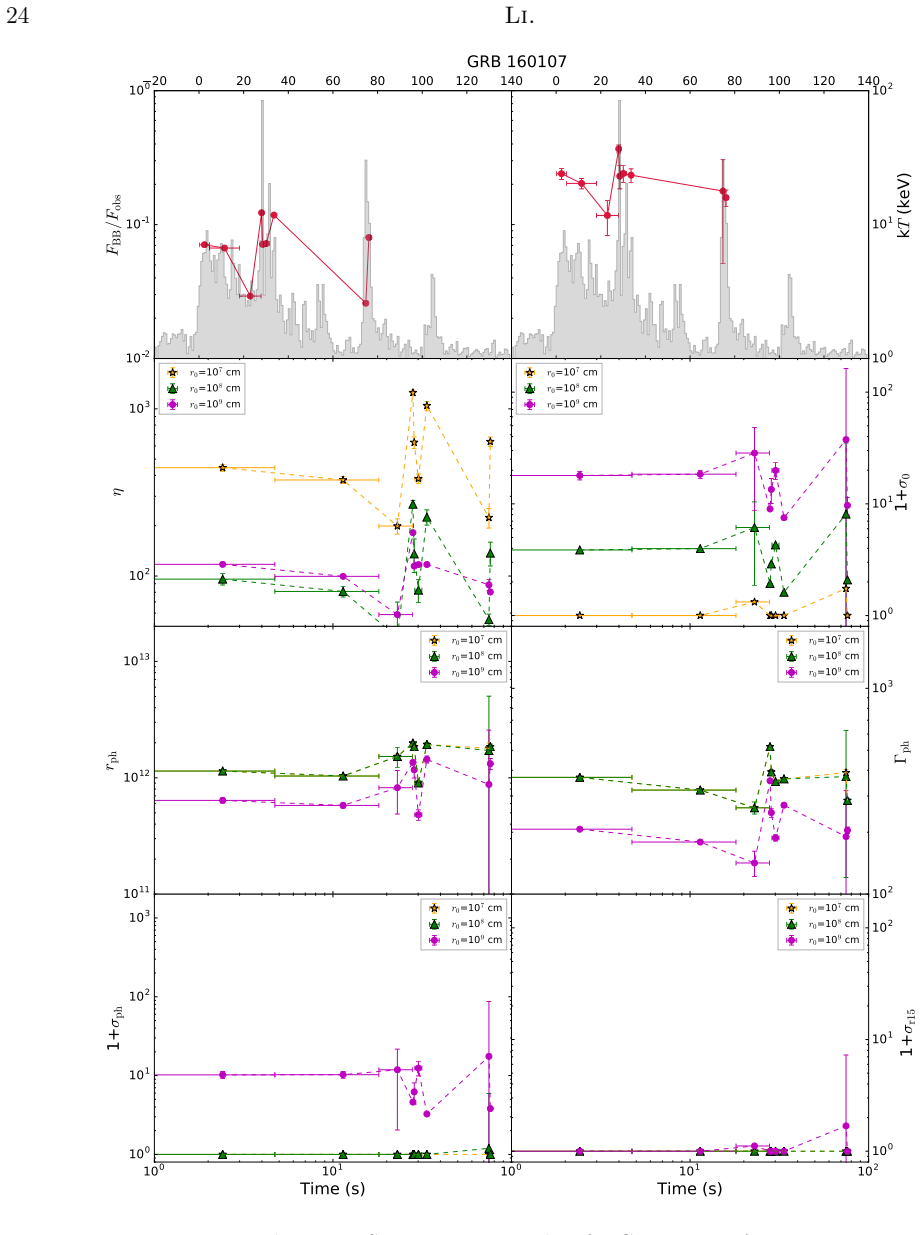
The load-bearing object is the hybrid jet model with its 'top-down' photosphere inversion. For a fixed jet-base radius $r_0$, the observed blackbody temperature, blackbody flux, and total flux are fed into analytic scaling relations for one of six dynamical regimes of a hybrid relativistic outflow; these return the dimensionless entropy $\eta$, the magnetization $1+\sigma_0$ at the engine, the photosphere radius $r_{\rm ph}$, the Lorentz factor $\Gamma_{\rm ph}$, and the magnetizations $1+\sigma_{\rm ph}$ and $1+\sigma_{r15}$. Here $\sigma_0$ is the ratio of cold Poynting-flux luminosity to hot fireball luminosity, and $\sigma_{r15}$ is the magnetization at $10^{15}$ cm, the scale where internal shocks would compete with magnetic reconnection. The regime judgment decides which formula applies, and the assumed values $r_0 = 10^7, 10^8, 10^9$ cm and a fixed radiative efficiency $f_\gamma = 0.5$ enter every scaling.
What would settle it
Recompute the magnetization at $10^{15}$ cm for GRB 110721A from the published blackbody fits assuming $r_0 = 10^7$ cm; Table 1 lists zero time bins with $1+\sigma_{r15} > 1$ at that radius, while the abstract claims a few time bins exceed unity for all $r_0$. A direct calculation from the fitted parameters settles whether the ICMART interpretation survives for every assumed base radius.
Extended reading notes
Core claim
The central claim is that the observed photosphere emission of the eight bursts can be reproduced by the hybrid jet model, whose two free engine parameters are the dimensionless entropy $\eta$ and the magnetization $\sigma_0$. For every time bin of every burst, the inversion returns $\eta \gg 1$, so a hot fireball is always present. For GRB 081224, GRB 110721A, GRB 090719, GRB 100707, and GRB 100724, the value $(1+\sigma_0)$ is larger than unity for all three assumed base radii, indicating a real Poynting-flux component; for GRB 190114C, GRB 090902B, and GRB 160107A, that conclusion is radius-dependent. In GRB 081224 and GRB 110721A, some time bins also give $(1+\sigma_{r15}) > 1$ at $10^{15}$ cm, which the paper reads as evidence for internal-collision-induced magnetic reconnection and turbulence (ICMART) rather than internal shocks. The author therefore concludes that most, and probably all, of the bursts fit the hybrid jet problem.
Load-bearing premise
The analysis assumes the jet-base radius $r_0$ is a constant and tries only three fixed values, but no independent measurement fixes the true value; all conclusions about whether an individual burst contains a Poynting-flux component shift with this choice.
Editorial extensions
If this is right
- For the five bursts with $(1+\sigma_0) > 1$, the central engine must launch a magnetized component together with the hot fireball, so pure fireball models are incomplete for those objects.
- In GRB 081224 and GRB 110721A, the magnetization at $10^{15}$ cm exceeds unity in some time bins, making ICMART magnetic reconnection a more likely nonthermal mechanism than internal shocks.
- The thermal flux ratio is positively correlated with $\eta$ and negatively correlated with $1+\sigma_0$, giving a spectral diagnostic for the engine's composition.
- For the three bursts whose inferred $(1+\sigma_0)$ flips around unity, the presence of a Poynting-flux component is not settled: a large true $r_0$ supports the hybrid interpretation, while a small one supports a nearly pure fireball.
- Because $\eta \gg 1$ in every time bin, even magnetized bursts retain a hot fireball component at the base of the outflow.
Reading between the lines
- If hybrid composition is routine, the reported distributions of $\eta$ and $1+\sigma_0$ can serve as quantitative priors for numerical central-engine simulations; the paper reports the distributions but does not build such an engine model.
- The $r_0$ degeneracy could be broken by independent estimates of the jet-base size, for instance from sub-millimeter variability or scintillation of the early afterglow; that would convert the paper's radius-dependent conclusions into a direct test.
- A targeted testable extension is to compare polarization or spectral-lag properties of the bursts assigned to ICMART with those assigned to internal shocks; different mechanisms should leave different observable signatures.
- Because the photosphere diagnostic needs only blackbody temperature, blackbody flux, and total flux, it can be applied to fainter bursts and to later time bins as long as a thermal component is detected, extending the sample beyond eight bright bursts.
Signed reviews
Editorial analysis
A structured set of objections, weighed in public.
Referee Report
Summary. The paper applies the 'top-down' photosphere inversion formalism of Gao & Zhang (2015) to eight Fermi-GBM GRBs with a detected thermal component, using the time-resolved spectral fits from Paper I. Assuming a constant jet base radius r0 (1e7, 1e8, 1e9 cm), a gamma-ray efficiency f_gamma = 0.5, and z = 2 for bursts without measured redshift, it infers the dimensionless entropy eta, the magnetization parameter 1+sigma0 at the engine, and the related quantities rph, Gamma_ph, 1+sigma_ph, and 1+sigma_r15. The paper reports eta >> 1 for all bursts, (1+sigma0) > 1 for five bursts, and (1+sigma_r15) > 1 in some time bins for GRB 081224 and GRB 110721A, concluding that the majority of bursts (probably all) can be explained by a hybrid fireball + Poynting-flux jet and that ICMART, rather than internal shocks, may power the nonthermal emission in the latter two bursts.
Significance. If the inferred parameters are reliable, this is the first systematic application of the hybrid jet model to a multi-burst Fermi sample, and it would provide evidence for a two-component jet composition in a majority of bursts. The paper uses publicly available spectral-fitting tools and reproduces the Gao & Zhang (2015) test case for GRB 110721A, which is a useful validation step. However, the inferred quantities are deterministic transforms of the fitted temperature and fluxes combined with assumed constants, so the central 'explanation' claim is a consistency check rather than an independent, falsifiable prediction. The scientific value therefore rests on whether the inversion is internally consistent and whether the stated parameter claims survive scrutiny of the r0 dependence.
major comments (3)
- [Appendix A3 / Figure A1] The paper explicitly states in the Figure A1 caption that 'eta is less that Gamma_ph in some time bins, which is impossible' and attributes this to applying coasting-phase formulas while the jet is still in the acceleration phase. The main analysis uses the same top-down formulas (Eqs. A6-A8) with only the rph > rra regime judgment, and never verifies the physical consistency condition eta >= Gamma_ph for the bins reported in Table 1. Because the derived (1+sigma0) and (1+sigma_r15) values are the basis for the claims of a Poynting-flux component in five bursts and of ICMART in GRB 081224 and GRB 110721A, the paper should check eta >= Gamma_ph for every bin used, exclude or re-derive invalid bins using the appropriate acceleration-phase formulas, and rerun the affected conclusions.
- [Abstract and Section 5 vs. Table 1] The claim that '(1+sigma_r15) is greater than unity in a few time bins for all r0 in GRB 081224 and GRB 110721A' is contradicted by Table 1: GRB 081224 at r0 = 1e9 cm has zero time bins passing the regime judgment (column 4 shows '0(5)'), and GRB 110721A at r0 = 1e7 cm has zero time bins with (1+sigma_r15) > 1 (column 10 shows '0'). The ICMART inference therefore cannot be stated 'for all r0'; the abstract and Section 5 should be revised to specify the r0 values and time bins for which (1+sigma_r15) > 1 actually holds.
- [Section 4 / Section 5 / Table 1] The derived parameters, especially (1+sigma0) and (1+sigma_r15), depend strongly on the assumed r0, as the paper acknowledges ('our results significantly vary with different r0 values' and 'this leads us to make some not very confident explanations in some cases'). Yet the abstract states without qualification that five bursts have (1+sigma0) > 1; Table 1 shows, for example, that GRB 090902B has zero time bins with (1+sigma0) > 1 at r0 = 1e7 cm and GRB 081224 cannot be evaluated at r0 = 1e9 cm. The main claims should be restated explicitly as conditional on the assumed r0 (and f_gamma = 0.5), and the r0 sensitivity should be quantified in the abstract and conclusions.
minor comments (5)
- [Figure A1 caption] 'less that' should be 'less than'.
- [Section 4, GRB 110721A and GRB 081224 paragraphs] 'ICMRAT' is a typo for 'ICMART'.
- [Figure 9, middle-right panel] The label 'Gamma_ph (cm)' should read 'Gamma_ph', since the bulk Lorentz factor is dimensionless.
- [Table 1 note and Section 4] The burst is referred to inconsistently as both 'GRB 100707' and 'GRB 100707A'; use one name throughout.
- [Section 5] The concluding sentence 'at least a majority of Fermi bursts (probably all) can be well interpreted' is too strong for a procedure that infers the model parameters from the same data; rephrase as a statement about the inferred hybrid-jet parameter ranges and their consistency.
Circularity Check
One built-in correlation is presented as a model prediction; the central sigma0 inference retains conditional empirical content.
-
self definitional
[Section 5 (Conclusion and Discussion), first paragraph after Figure 10 correlations; also Section 4 final paragraph]
"Temporal properties of the physical parameter show that basically, the thermal flux ratio is directly proportional to η, but inversely proportional to (1+σ0), which is the natural expectation predicted by the hybrid problem. Since a high thermal flux ratio indicates a strong thermal component and a weak cold Poynting-flux component, η should be large and (1+σ0) should be small."
This 'predicted expectation' is not an independent test: η and (1+σ0) are solved from the same observed quantities (kT, FBB, Fobs) via the Gao & Zhang inversion formulas in Appendix A2, where fth=FBB/Fobs enters the formulas explicitly (e.g., A6 and A7 give (1+σ0) ∝ fth^{-1}, and A8 gives η ∝ fth^{1/2}). Saying that a high thermal-flux ratio implies large η and small (1+σ0) is a restatement of the definitions of η and σ0 rather than a model prediction confronted with new data. The sentence 'thermal flux ratio and η track each other since both denote the strength of the thermal component' makes the tautology explicit. Thus the correlation presented as consistency with the hybrid model reduces, at least in part, to the construction of the inversion formulas.
full rationale
The central inference is not wholly circular: the paper uses an external theoretical framework (Gao & Zhang 2015) and a spectral catalog from Paper I (Li 2019a); the derived (1+σ0)>1 results are data-dependent and vary nontrivially with the assumed r0, so the σ0>1 claim has independent empirical content conditional on r0 and fγ=0.5. However, the paper presents correlations between derived parameters and the observed FBB/Fobs as 'predicted by the hybrid problem,' when these correlations are partly algebraic consequences of the inversion formulas (fth appears explicitly in Eqs. A6–A8). This is the one built-in circular step. A separate validity caveat is flagged by the paper itself in Appendix A3 (Figure A1 caption): 'η is less that Γph in some time bins, which is impossible. The reason is that the jet is still in the acceleration phase; however, we use the coasting phase to derive physical parameters.' The main sample never reports a check that η≥Γph, so some inferred values may be invalid; this weakens the central claim but is a consistency/validity issue rather than a further circularity. Balanced score reflects one definitional correlation inside an otherwise data-driven inference.
Assumptions & free parameters
free parameters (3)
- Jet base radius r0 =
assumed 10^7, 10^8, 10^9 cm
- Gamma-ray efficiency fγ =
0.5
- Redshift z for bursts without measurement =
2
assumptions (4)
- domain assumption Hybrid jet dynamical model of Gao and Zhang (2015): two-component outflow with phases separated by rra and rs, with the top-down equations for regimes II, III, V, VI.
- domain assumption The observed blackbody component originates from the non-dissipative photosphere of the hybrid outflow.
- ad hoc to paper Regime judgment requires rph > rra; time bins not satisfying this are excluded.
- standard math Standard ΛCDM cosmology with H0=67.4, ΩM=0.315, ΩΛ=0.685.
Cite this review
Pith. "Pith review of Thermal Components in Gamma-ray Bursts. II. Constraining the Hybrid Jet Model." pith.science (2026). https://pith.science/paper/SJLZI3HI
@misc{pith2026190809240,
  author       = {Pith},
  title        = {Pith review of: Thermal Components in Gamma-ray Bursts. II. Constraining the Hybrid Jet Model},
  year         = {2026},
  howpublished = {\url{https://pith.science/paper/SJLZI3HI}},
  note         = {Machine review of arXiv:1908.09240}
}
abstract
In explaining the physical origin of the jet composition of gamma-ray bursts (GRBs), a more general picture, i.e. the hybrid jet model (which introduced another magnetization parameter $\sigma_{0}$ on the basis of the traditional fireball model), has been well studied in Gao \& Zhang. However, it still has not yet been applied to a large GRB sample. Here, we first employ the "top-down" approach of Gao \& Zhang to diagnose the photosphere properties at the central engine to see how the hybrid model can account for the observed data as well, through applying a {\it Fermi} GRB sample (eight bursts) with the detected photosphere component, as presented in Li (our Paper I). We infer all physical parameters of a hybrid problem with three typical values of the radius of the jet base ($r_{0}$ = 10$^{7}$, 10$^{8}$, and 10$^{9}$ cm). We find that the dimensionless entropy for all the bursts shows $\eta\gg$ 1 while the derived (1+$\sigma_{0}$) for five bursts (GRB 081224, GRB 110721A, GRB 090719, GRB 100707, and GRB 100724) is larger than unity, indicating that in addition to a hot fireball component, another cold Poynting-flux component may also play an important role. Our analysis also shows that in a few time bins for all $r_{0}$ in GRB 081224 and GRB 110721A, the magnetization parameter at $\sim$ 10$^{15}$cm (1+$\sigma_{\rm r15}$) is greater than unity, which implies that internal-collision-induced magnetic reconnection and turbulence may be the mechanism to power the nonthermal emission, rather than internal shocks. We conclude that the majority of bursts (probably all) can be well explained by the hybrid jet problem.
Figures


Figures from the paper (7 more)




Reference graph
Works this paper leans on
-
[1]
, " * write output.state after.block = add.period write newline
ENTRY address archivePrefix author booktitle chapter doi edition editor eprint howpublished institution journal key month number organization pages publisher school series title misctitle type volume year version url label extra.label sort.label short.list INTEGERS output.state before.all mid.sentence after.sentence after.block FUNCTION init.state.consts ...
-
[2]
write newline
" write newline "" before.all 'output.state := FUNCTION format.url url empty "" new.block "" url * "" * if FUNCTION format.eprint eprint empty "" archivePrefix empty "" archivePrefix "arXiv" = new.block " " eprint * " " * new.block " " eprint * " " * if if if FUNCTION format.doi doi empty "" " " doi * " " * if FUNCTION format.pid doi empty eprint empty ""...
-
[3]
8 J 0hFDChF? 3E Es:x 8 = B& x Y ؛)`mmJ? I G !g 2 F> . h
thebibliography [1] 20pt to REFERENCES 6pt =0pt 10pt plus 3pt =0pt =0pt =1pt plus 1pt =0pt =0pt -12pt =13pt plus 1pt =20pt =13pt plus 1pt \@M =10000 =-1.0em =0pt =0pt 0pt =0pt =1.0em @enumiv\@empty 10000 10000 `\.\@m \@noitemerr \@latex@warning Empty `thebibliography' environment \@ifnextchar \@reference \@latexerr Missing key on reference command Each re...
2017
-
[4]
A., Ackermann , M., Ajello , M., et al
Abdo , A. A., Ackermann , M., Ajello , M., et al. 2009, , 706, L138, 10.1088/0004-637X/706/1/L138
-
[5]
2018, , 475, 1708, 10.1093/mnras/stx3106
Acuner , Z., & Ryde , F. 2018, , 475, 1708, 10.1093/mnras/stx3106
-
[6]
2019, , 487, 5508, 10.1093/mnras/stz1356
Acuner , Z., Ryde , F., & Yu , H.-F. 2019, , 487, 5508, 10.1093/mnras/stz1356
-
[7]
Andrae , R., Schulze-Hartung , T., & Melchior , P. 2010, arXiv e-prints. 1012.3754
arXiv 2010
-
[8]
2012, , 757, L31, 10.1088/2041-8205/757/2/L31
Axelsson , M., Baldini , L., Barbiellini , G., et al. 2012, , 757, L31, 10.1088/2041-8205/757/2/L31
Show all 77 references
-
[9]
1993, , 413, 281, 10.1086/172995
Band , D., Matteson , J., Ford , L., et al. 1993, , 413, 281, 10.1086/172995
1993 doi
-
[10]
2015, , 802, 134, 10.1088/0004-637X/802/2/134
B \'e gu \'e , D., & Pe'er , A. 2015, , 802, 134, 10.1088/0004-637X/802/2/134
2015 doi
-
[11]
2011, GRB Coordinates Network, 12193, 1
Berger , E. 2011, GRB Coordinates Network, 12193, 1
2011
-
[12]
M., Greiner , J., B \'e gu \'e , D., & Berlato , F
Burgess , J. M., Greiner , J., B \'e gu \'e , D., & Berlato , F. 2019, , 490, 927, 10.1093/mnras/stz2589
2019 doi
-
[13]
M., Preece , R
Burgess , J. M., Preece , R. D., Connaughton , V., et al. 2014, , 784, 17, 10.1088/0004-637X/784/1/17
2014 doi
- [14]
-
[15]
B., Tanvir , N., & Berger , E
Cucchiara , A., Fox , D. B., Tanvir , N., & Berger , E. 2009, GRB Coordinates Network, 9873, 1
2009
-
[16]
Drenkhahn , G., & Spruit , H. C. 2002, , 391, 1141, 10.1051/0004-6361:20020839
2002 doi
-
[17]
Feroz , F., & Hobson , M. P. 2008, , 384, 449, 10.1111/j.1365-2966.2007.12353.x
2008
-
[19]
P., Cameron , E., & Pettitt , A
Feroz , F., Hobson , M. P., Cameron , E., & Pettitt , A. N. 2019, The Open Journal of Astrophysics, 2, 10, 10.21105/astro.1306.2144
2019 arXiv
-
[20]
W., Lang , D., & Goodman , J
Foreman-Mackey , D., Hogg , D. W., Lang , D., & Goodman , J. 2013, , 125, 306, 10.1086/670067
2013 doi
-
[21]
2015, , 801, 103, 10.1088/0004-637X/801/2/103
Gao , H., & Zhang , B. 2015, , 801, 103, 10.1088/0004-637X/801/2/103
2015 doi
-
[22]
2013, , 432, 3237, 10.1093/mnras/stt681
Ghirlanda , G., Pescalli , A., & Ghisellini , G. 2013, , 432, 3237, 10.1093/mnras/stt681
2013 doi
-
[23]
2008, , 480, 305, 10.1051/0004-6361:20079085
Giannios , D. 2008, , 480, 305, 10.1051/0004-6361:20079085
2008 doi
-
[24]
M., Preece , R
Goldstein , A., Burgess , J. M., Preece , R. D., et al. 2012, , 199, 19, 10.1088/0067-0049/199/1/19
2012 doi
- [25]
-
[26]
2010, Communications in Applied Mathematics and Computational Science, 5, 65, 10.2140/camcos.2010.5.65
Goodman , J., & Weare , J. 2010, Communications in Applied Mathematics and Computational Science, 5, 65, 10.2140/camcos.2010.5.65
2010 doi
-
[27]
S., & Spitkovsky , A
Granot , J., Komissarov , S. S., & Spitkovsky , A. 2011, , 411, 1323, 10.1111/j.1365-2966.2010.17770.x
2011
-
[28]
M., Savchenko , V., & Yu , H.-F
Greiner , J., Burgess , J. M., Savchenko , V., & Yu , H.-F. 2016, , 827, L38, 10.3847/2041-8205/827/2/L38
2016 doi
-
[29]
S., et al
Guiriec , S., Connaughton , V., Briggs , M. S., et al. 2011, , 727, L33, 10.1088/2041-8205/727/2/L33
2011 doi
-
[30]
Hunter , J. D. 2007, Computing in Science and Engineering, 9, 90, 10.1109/MCSE.2007.55
2007 doi
-
[31]
2013, , 433, 2739, 10.1093/mnras/stt863
Iyyani , S., Ryde , F., Axelsson , M., et al. 2013, , 433, 2739, 10.1093/mnras/stt863
2013 doi
-
[32]
2015, , 450, 1651, 10.1093/mnras/stv636
Iyyani , S., Ryde , F., Ahlgren , B., et al. 2015, , 450, 1651, 10.1093/mnras/stv636
2015 doi
-
[33]
2018, , 70, 6, 10.1093/pasj/psx152
Kawakubo , Y., Sakamoto , T., Nakahira , S., et al. 2018, , 70, 6, 10.1093/pasj/psx152
2018 doi
-
[34]
S., Vlahakis , N., K \"o nigl , A., & Barkov , M
Komissarov , S. S., Vlahakis , N., K \"o nigl , A., & Barkov , M. V. 2009, , 394, 1182, 10.1111/j.1365-2966.2009.14410.x
2009
-
[35]
2013, , 765, 125, 10.1088/0004-637X/765/2/125
Lei , W.-H., Zhang , B., & Liang , E.-W. 2013, , 765, 125, 10.1088/0004-637X/765/2/125
2013 doi
-
[36]
2019 a , , 245, 7, 10.3847/1538-4365/ab42de (Paper I)
Li , L. 2019 a , , 245, 7, 10.3847/1538-4365/ab42de (Paper I)
2019 doi
-
[37]
2019 b , , 242, 16, 10.3847/1538-4365/ab1b78
---. 2019 b , , 242, 16, 10.3847/1538-4365/ab1b78
2019 doi
-
[38]
A., et al
Liang , L., Ruffini , R., Rueda , J. A., et al. 2019, arXiv e-prints, arXiv:1910.12615. 1910.12615
2019 arXiv
-
[39]
N., et al
Meegan , C., Lichti , G., Bhat , P. N., et al. 2009, , 702, 791, 10.1088/0004-637X/702/1/791
2009 doi
-
[40]
Meszaros , P., & Rees , M. J. 1993, , 405, 278, 10.1086/172360
1993 doi
-
[41]
M \'e sz \'a ros , P., & Rees , M. J. 1997, , 482, L29, 10.1086/310692
1997 doi
- [42]
-
[43]
2011, , 733, L40, 10.1088/2041-8205/733/2/L40
---. 2011, , 733, L40, 10.1088/2041-8205/733/2/L40
2011 doi
-
[45]
A., von Kienlin , A., et al
Narayana Bhat , P., Meegan , C. A., von Kienlin , A., et al. 2016, , 223, 28, 10.3847/0067-0049/223/2/28
2016 doi
- [46]
- [47]
-
[48]
1994, , 427, 708, 10.1086/174178
Paczynski , B., & Xu , G. 1994, , 427, 708, 10.1086/174178
1994 doi
-
[49]
2017, International Journal of Modern Physics D, 26, 1730018, 10.1142/S021827181730018X
Pe'Er , A., & Ryde , F. 2017, International Journal of Modern Physics D, 26, 1730018, 10.1142/S021827181730018X
2017 doi
-
[50]
Pe'er , A., Ryde , F., Wijers , R. A. M. J., M \'e sz \'a ros , P., & Rees , M. J. 2007, , 664, L1, 10.1086/520534
2007 doi
-
[51]
2012, , 420, 468, 10.1111/j.1365-2966.2011.20052.x
Pe'Er , A., Zhang , B.-B., Ryde , F., et al. 2012, , 420, 468, 10.1111/j.1365-2966.2011.20052.x
2012
-
[52]
1993, , 263, 861, 10.1093/mnras/263.4.861
Piran , T., Shemi , A., & Narayan , R. 1993, , 263, 861, 10.1093/mnras/263.4.861
1993 doi
-
[53]
2018, arXiv e-prints, arXiv:1807.06209
Planck Collaboration , Aghanim , N., Akrami , Y., et al. 2018, arXiv e-prints, arXiv:1807.06209. 1807.06209
2018 arXiv
- [54]
-
[55]
J., & M \'e sz \'a ros , P
Rees , M. J., & M \'e sz \'a ros , P. 2005, , 628, 847, 10.1086/430818
2005 doi
-
[56]
A., & Ruffini , R
Rueda , J. A., & Ruffini , R. 2020, European Physical Journal C, 80, 300, 10.1140/epjc/s10052-020-7868-z
2020 doi
-
[57]
D., Wilson , J
Ruffini , R., Salmonson , J. D., Wilson , J. R., & Xue , S.-S. 1999, , 350, 334
1999
-
[58]
2000, , 359, 855
---. 2000, , 359, 855
2000
-
[59]
A., & Vereshchagin , G
Ruffini , R., Siutsou , I. A., & Vereshchagin , G. V. 2013, , 772, 11, 10.1088/0004-637X/772/1/11
2013 doi
-
[60]
2019 a , arXiv e-prints, arXiv:1904.04162
Ruffini , R., Li , L., Moradi , R., et al. 2019 a , arXiv e-prints, arXiv:1904.04162. 1904.04162
2019 arXiv
-
[61]
A., et al
Ruffini , R., Moradi , R., Rueda , J. A., et al. 2019 b , , 886, 82, 10.3847/1538-4357/ab4ce6
2019 doi
- [62]
-
[63]
2009, , 702, 1211, 10.1088/0004-637X/702/2/1211
Ryde , F., & Pe'er , A. 2009, , 702, 1211, 10.1088/0004-637X/702/2/1211
2009 doi
-
[64]
2019, , 484, 1912, 10.1093/mnras/stz083
Ryde , F., Yu , H.-F., Dereli-B \'e gu \'e , H., et al. 2019, , 484, 1912, 10.1093/mnras/stz083
2019 doi
-
[65]
B., et al
Ryde , F., Axelsson , M., Zhang , B. B., et al. 2010, , 709, L172, 10.1088/2041-8205/709/2/L172
2010 doi
-
[66]
D., Norris , J
Scargle , J. D., Norris , J. P., Jackson , B., & Chiang , J. 2013, , 764, 167, 10.1088/0004-637X/764/2/167
2013 doi
-
[67]
Selsing , J., Fynbo , J. P. U., Heintz , K. E., & Watson , D. 2019, GRB Coordinates Network, 23695, 1
2019
- [68]
- [69]
-
[70]
2012, , 755, 12, 10.1088/0004-637X/755/1/12
Veres , P., & M \'e sz \'a ros , P. 2012, , 755, 12, 10.1088/0004-637X/755/1/12
2012 doi
-
[71]
2018, , 236, 17, 10.3847/1538-4365/aab780
Vianello , G. 2018, , 236, 17, 10.3847/1538-4365/aab780
2018 doi
-
[72]
J., Younk , P., et al
Vianello , G., Lauer , R. J., Younk , P., et al. 2015, arXiv e-prints. 1507.08343
2015 arXiv
-
[73]
2003, , 596, 1104, 10.1086/378227
Vlahakis , N., & K \"o nigl , A. 2003, , 596, 1104, 10.1086/378227
2003 doi
-
[74]
2019, arXiv e-prints
Wang , Y., Li , L., Moradi , R., & Ruffini , R. 2019, arXiv e-prints. 1901.07505
2019 arXiv
-
[75]
2019, , 886, 20, 10.3847/1538-4357/ab488a
Yu , H.-F., Dereli-B \'e gu \'e , H., & Ryde , F. 2019, , 886, 20, 10.3847/1538-4357/ab488a
2019 doi
-
[76]
2014, International Journal of Modern Physics D, 23, 1430002, 10.1142/S021827181430002X
Zhang , B. 2014, International Journal of Modern Physics D, 23, 1430002, 10.1142/S021827181430002X
2014 doi
-
[77]
2018, The Physics of Gamma-Ray Bursts , 10.1017/9781139226530
---. 2018, The Physics of Gamma-Ray Bursts , 10.1017/9781139226530
2018 doi
-
[78]
2011, , 726, 90, 10.1088/0004-637X/726/2/90
Zhang , B., & Yan , H. 2011, , 726, 90, 10.1088/0004-637X/726/2/90
2011 doi
-
[79]
J., et al
Zhang , B.-B., Zhang , B., Castro-Tirado , A. J., et al. 2018, Nature Astronomy, 2, 69, 10.1038/s41550-017-0309-8
2018 doi
Reviewed August 14, 2026 · model on record in the stance chip above.
Discussion (0). Continue with ORCID to comment.