REVIEW 4 major objections 5 minor 14 references
Two High-Performance Amplitude Beamforming Schemes for Secure Precise Communication and Jamming with Phase Alignment
T0 review · 4 major / 5 minor · reviewed 2026-08-14 · deepseek-v4-flash
Pith's one-line read Decoupling phase and amplitude in beamforming yields two amplitude-only rules that beat equal-amplitude baselines in secrecy rate and bit-error rate at medium and high SNR.
desk verdict The decoupling idea is a reasonable extension of the SPWT framework, but the paper's derivations describe complex vectors that are never actually transmitted, so the simulation claims are not supported by the math as written. read the letter →
The pith
A machine-rendered reading of the paper's core claim, the machinery that carries it, and where it could break.
The reading
What carries the argument
The load-bearing objects are the phase-aligned diagonal matrices $\mathbf{P}$ and $\mathbf{Q}$: $\mathbf{P}$ carries the phases of the steering vector to Bob and $\mathbf{Q}$ the phases to Eve, so the message vector is $\mathbf{v}_{\mathrm{CM}} = \mathbf{P}\mathbf{a}$ and the artificial-noise vector is $\mathbf{v}_{\mathrm{AN}} = \mathbf{Q}\mathbf{b}$. Once these phases are fixed, $\mathbf{a}$ and $\mathbf{b}$ are the only free amplitude weights. Leakage AB solves a maximum signal-to-leakage-noise-ratio problem whose solution is the dominant generalized eigenvector of a matrix pairing the desired channel with the eavesdropper channel plus noise. Max-RP AB uses the singular-value decomposition of the eavesdropper's phase-aligned channel to build a null-space projector, then picks the dominant eigenvector of the projected desired channel. These objects carry the argument because they turn a two-vector joint design into two one-vector amplitude designs with closed-form solutions.
What would settle it
Repeat the paper's 32-antenna, QPSK simulations with a controlled phase error added to the transmitter's steering phases — for example, uniformly distributed errors growing from a few degrees to tens of degrees. If the leakage and Max-RP secrecy-rate and bit-error-rate curves fall to or below the equal-amplitude curves for modest phase errors, the claim that these amplitude rules outperform EAB for precise jamming under phase alignment would be falsified.
Extended reading notes
Core claim
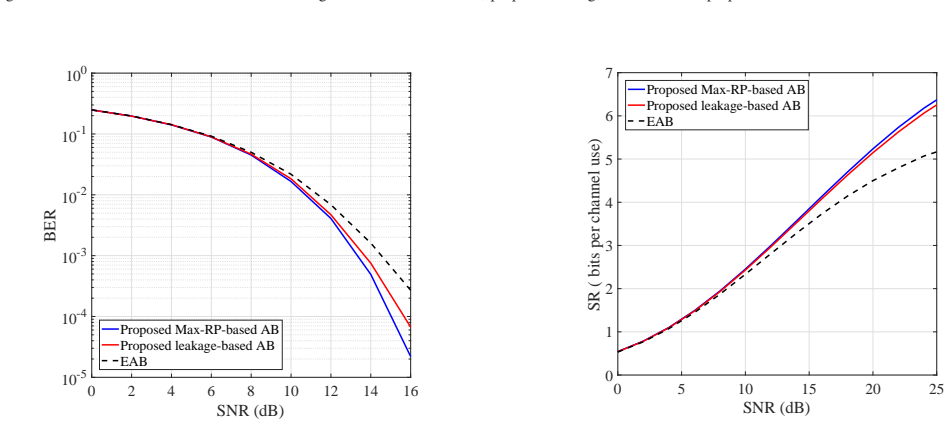
The central discovery is that the joint optimization of beamforming phase and amplitude can be decomposed without loss: for secure precise wireless transmission with precise jamming, phase alignment is mandatory, so the amplitude part alone remains free. The paper derives two amplitude rules. The leakage rule maximizes signal-to-leakage-plus-noise ratio, giving an eigenvector of a generalized matrix pencil. The Max-RP rule maximizes the desired receiver's power while forcing the signal onto the null space of the eavesdropper's channel, again via an eigenvector after a singular-value decomposition. Simulation results then show that both proposed rules outperform equal-amplitude beamforming in bit-error rate and secrecy rate at medium and high SNR, while all three behave similarly at low SNR. The paper also reports that all three rules create two distinct main peaks — CM around Bob and AN around Eve — which is its definition of precise communication and precise jamming.
Load-bearing premise
The entire scheme assumes the transmitter knows the exact phase responses to both Bob and Eve — line-of-sight channels (printed as 'LoP') with high-resolution direction-of-arrival estimates — so that phase alignment is perfect; if these phases contain error, the focused peaks and the stated advantage over equal-amplitude beamforming degrade.
Editorial extensions
If this is right
- A transmitter can approximate precise jamming without iterative joint optimization: fix the phases, then compute one eigenvector for the message and one for the noise.
- The medium/high-SNR secrecy-rate gain means the proposed amplitude rules are most valuable precisely when the eavesdropper's channel is strong enough to threaten interception.
- Because EAB, leakage, and Max-RP all form CM and AN peaks around Bob and Eve, even equal amplitudes already achieve the spatial focusing; the amplitude rules mainly sharpen those peaks.
- At low SNR the three schemes coincide, which follows from the noise term dominating the amplitude-dependent terms in the optimization.
- The near-identical performance of leakage and Max-RP suggests either criterion can be chosen on implementation grounds without sacrificing the stated gain.
Reading between the lines
- A natural extension the paper leaves implicit is a sensitivity analysis: because the entire scheme rests on exact phase alignment, adding direction-of-arrival estimation error would be expected to shrink the claimed advantage over EAB, and the crossover error level is the quantity to measure.
- Since the leakage rule contains an explicit noise-regularization term while Max-RP does not, the near-equality of the two schemes at the simulated SNRs suggests that term is negligible there; simulations at lower SNR or with unequal noise powers would reveal when the two rules genuinely differ.
- The Max-RP null-space construction leaves $N-1$ degrees of freedom; in a scenario with several colluding eavesdroppers, the same construction could be applied to the joint null space of all their phase-aligned channels, at the cost of reduced array gain for the message.
Signed reviews
Editorial analysis
A structured set of objections, weighed in public.
Referee Report
Summary. The paper proposes a secure precise wireless transmission/precise jamming scheme, RSS-PJ-AN, in which the transmit beamforming vectors for the confidential message (CM) and artificial noise (AN) are designed by separating phase alignment from amplitude beamforming. The phase parts are fixed to align, respectively, with the legitimate receiver Bob and the eavesdropper Eve, and the amplitude parts are optimized by two proposed rules: a leakage-based rule (maximizing SLNR) and a Max-RP rule (maximizing received power at the desired receiver subject to a null constraint at the other receiver). The paper claims, on the basis of Monte-Carlo-style simulations in Section IV, that both proposed amplitude beamforming schemes outperform the equal-amplitude baseline EAB in bit-error-rate and secrecy-rate at medium and high SNR, while performing similarly at low SNR. The central claimed contribution is the ability to reduce the joint phase-and-amplitude design to a much simpler amplitude-only problem under phase alignment.
Significance. If the claim were fully substantiated, the decoupling of phase alignment and amplitude optimization would be a useful and low-complexity design principle for secure precise wireless transmission, extending SPWT ideas to precise jamming. The optimization objectives used in Section III (SLNR and null-space receive power) are not the same as the reported evaluation metrics (BER and secrecy rate), so the paper is not circularly fitting its targets. The proposed solutions are closed-form (generalized eigenvectors and SVD-based null-space projections), which is an attractive feature for implementation. However, in its current form the paper does not deliver a sound derivation of the simulated transmit vectors: the amplitude-only vectors obtained after magnitude projection are not feasible points of the complex optimization problems solved in Section III, and the exact nulls promised by the Max-RP rule are generally destroyed by that projection. The paper also contains an apparent swapping of Bob/Eve steering vectors in Eq. (9).
major comments (4)
- [Eq. (9)] The optimization is performed over complex vectors a and b, but the final transmit vectors are P|a| and Q|b|. This is stated explicitly in Section II and again after Eqs. (7), (10), (12), and (14): the element magnitudes of vCM and vAN are set to |a(n)| and |b(n)|. The received-signal models in Eqs. (3)–(4) and the objectives in Eqs. (6), (9), (11)–(14), however, all use the full complex vectors Pa and Qb. Magnitude projection is not a feasible point of these optimization problems. In particular, for Max-RP the constraint h_E^H P a = 0 in Eq. (11) does not imply h_E^H P|a| = 0; the residual 1/sqrt(N) sum_n exp(j(Psi_n(theta_B,R_B)-Psi_n(theta_E,R_E))) |a_n| is generally nonzero, so the claimed null toward Eve is lost. The same issue invalidates the AN null toward Bob in Eq. (13). For the leakage-based scheme, the generalized eigenvector in Eqs. (7) and (10) does not maximize the stated SLNR after its phases are discarded; the amplitude-only optimum is a different vector. The derivation in Section III must be redone for the actual simulated vectors, either by optimizing directly over real nonnegative amplitude vectors or by analyzing the projected vectors; as written, the received-signal models used in the simulation are not those derived.
- [Section IV, Figs. 2–4] The SLNR objective for the AN vector b is internally inconsistent as printed. Since the AN is intended as the useful signal at Eve, the numerator should be proportional to |h_E^H Q b|^2, and the leakage term in the denominator should be proportional to |h_B^H Q b|^2; instead, Eq. (9) places h(theta_B,R_B) in the numerator and h(theta_E,R_E) in the denominator. The noise term also uses beta P_s although the AN power is (1-beta) P_s, so the generalized eigenproblem in Eq. (10) does not solve the SLNR problem described in the text. This must be corrected before the leakage-based scheme can be evaluated, since the optimal b is currently obtained from a different objective than the stated one.
- [Section II, after Eq. (1)] The central performance claim rests entirely on the simulation figures, but the manuscript gives no code, no data tables, no number of Monte-Carlo trials, and no confidence intervals or error bars. Given the mismatch between the derived vectors and the simulated transmit vectors identified above, it is not possible to verify that the BER and SR curves in Figs. 3 and 4 correspond to the systems analyzed in Section III. The authors should provide either reproducible code, numerical tables, or at least a precise statistical description of the simulations, including the number of independent channel/symbol realizations, so that the claimed one-order-of-magnitude BER improvement can be independently checked.
- [Section II, after Eq. (1)] The schemes require exact knowledge of the steering phases to both Bob and Eve, as stated in the assumption of LoP channels and high-resolution DOA estimation, but no sensitivity analysis is provided. Since phase alignment is mandatory for the entire design and the amplitude rules are derived under perfect phase alignment, the practical value of the proposed methods is not established for any phase error. At minimum, the authors should add a robustness study with mismatched angles or ranges, or explicitly state that perfect CSI/DOA is assumed and discuss the expected degradation qualitatively.
minor comments (5)
- [Eq. (2)] The notation P = diag[arg(vCM(0)), ..., arg(vCM(N-1))] is formally incorrect: the diagonal entries must be the complex unit-modulus phase factors exp(j arg(vCM(n))), not the real scalar phases. As written, P a would have scalar phase angles as coefficients rather than phase rotations, and the received-signal equations would not follow.
- [Throughout] The term 'LoP' appears to be a typo for 'LoS' (line-of-sight); please correct this in the text and in the notation description.
- [Abstract and Section V] The conclusion and abstract use 'EA' once instead of 'EAB' (equal amplitude beamforming); please make the abbreviation consistent throughout.
- [Section II, Eq. (2)] It would help to define explicitly that vCM and vAN are normalized to unit norm, since the optimization constraints a^H a = 1 and b^H b = 1 are used in Section III but the relation between these constraints and the normalization of vCM and vAN is not stated.
- [Section IV] The text says the proposed methods outperform EAB 'particularly in the high SNR region' and describes Fig. 2 as showing performance surfaces, but the figure caption and the amount of detail in the curves are difficult to follow; labeling the curves or providing numerical markers would improve clarity.
Circularity Check
No significant circularity: the proposed amplitude rules optimize independent objectives, and the reported BER/SR advantages are simulation results rather than fitted or self-defined predictions.
full rationale
The derivation chain is self-contained for circularity purposes. The paper explicitly relaxes the amplitude vectors a and b as complex optimization variables and then takes their magnitudes as the amplitude beamforming vectors: 'a and b are relaxed as complex optimization variables, and the corresponding element magnitudes of vectors vCM and vAN are set to be the element magnitudes of optimal a and b in terms of some rules' (Section III). The two optimization rules are independent of the reported evaluation metrics: leakage maximizes a signal-to-leakage-plus-noise ratio, and Max-RP maximizes receive power at the intended receiver subject to a null-space constraint at the unintended receiver. Neither objective is defined in terms of BER or secrecy rate, and no parameter is fitted to those metrics; the claimed performance advantage over EAB is presented as simulation results in Figs. 3 and 4, not as an algebraic consequence of forcing outputs to equal inputs. The paper does cite the authors' prior SPWT work for the phase-alignment and random-subcarrier-selection framework, but those citations supply the system model and motivation, not the amplitude-optimization result, so they are not load-bearing in a circular sense. A separate internal validity gap exists—the simulated transmit vectors are P|a| and Q|b| after complex optimization, so Eqs. (5)-(14) do not describe the projected vectors, and Eq. (9) has the Bob/Eve steering terms swapped—but that is a correctness or reproducibility concern, not circularity: the claimed derivation does not reduce by construction to its own assumptions or to a fitted target.
Assumptions & free parameters
free parameters (1)
- power allocation beta =
0.5
assumptions (4)
- standard math The maximum of a Rayleigh quotient over a unit-norm vector is attained by the dominant eigenvector, and the generalized quotient by the dominant generalized eigenvector.
- standard math For a rank-one constraint h^H P a = 0, the feasible set is the right null space of h^H P, obtainable by SVD as a = Fe u.
- domain assumption Channels from Alice to Bob and Eve are deterministic line-of-sight steering vectors whose phases depend on both angle and distance through Psi_n(theta, R).
- ad hoc to paper Phase alignment is mandatory for both CM and AN, and the joint phase-amplitude optimization can be separated into independent phase and amplitude optimization problems.
Cite this review
Pith. "Pith review of Two High-Performance Amplitude Beamforming Schemes for Secure Precise Communication and Jamming with Phase Alignment." pith.science (2026). https://pith.science/paper/7LCIS4S2
@misc{pith2026190809244,
  author       = {Pith},
  title        = {Pith review of: Two High-Performance Amplitude Beamforming Schemes for Secure Precise Communication and Jamming with Phase Alignment},
  year         = {2026},
  howpublished = {\url{https://pith.science/paper/7LCIS4S2}},
  note         = {Machine review of arXiv:1908.09244}
}
read the original abstract
To severely weaken the eavesdropper's ability to intercept confidential message (CM), a precise jamming (PJ) idea is proposed by making use of the concept of secure precise wireless transmission (SPWT). Its basic idea is to focus the transmit energy of artificial noise (AN) onto the neighborhood of eavesdropper (Eve) by using random subcarrier selection (RSS), directional modulation, phase alignment (PA), and amplitude beamforming (AB). By doing so, Eve will be seriously interfered with AN. Here, the conventional joint optimization of phase and amplitude is converted into two independent phase and amplitude optimization problems. Considering PJ and SPWT require PA, the joint optimization problem reduces to an amplitude optimization problem. Then, two efficient AB schemes are proposed: leakage and maximizing receive power(Max-RP). With existing equal AB (EAB) as a performance reference, simulation results show that the proposed Max-RP and leakage AB methods perform much better than conventional method in terms of both bit-error-rate (BER) and secrecy rate (SR) at medium and high signal-to-noise ratio regions. The performance difference between the two proposed leakage and Max-RP amplitude beamformers is trivial. Additionally, we also find the fact that all three AB schemes EA, Max-RP, and leakage can form two main peaks of AN and CM around Eve and the desired receiver (Bob), respectively. This is what we call PJ and SPWT.
Figures


Reference graph
Works this paper leans on
-
[1]
The wire-tap channel,
A. D. Wyner, “The wire-tap channel,” Bell. Syst. Tech. J. , vol. 54, no. 8, pp. 1355–1387, Oct. 1975
1975
-
[2]
Secure tr ansmission with large numbers of antennas and finite alphabet inputs,
Y . Wu, J. Wang, J. Wang, R. Schober, and C. Xiao, “Secure tr ansmission with large numbers of antennas and finite alphabet inputs,” IEEE Trans. Commun., vol. 65, no. 8, pp. 3614–3628, Aug. 2017
2017
-
[3]
J. Ma, S. Zhang, H. Li, N. Zhao, and V . C. M. Leung, “Interfe rence- alignment and soft-space-reuse based cooperative transmi ssion for multi- cell massive MIMO networks,” IEEE Trans. Wireless Commun., vol. 17, no. 3, pp. 1907–1922, Mar. 2018
work page 1907
-
[4]
A vector approach for the analysi s and synthesis of directional modulation transmitters,
Y . Ding and V . F. Fusco, “A vector approach for the analysi s and synthesis of directional modulation transmitters,” IEEE Trans. Antennas Propag., vol. 62, no. 1, pp. 361–370, Jan. 2014
work page 2014
-
[5]
Robust synthesis method for secu re direc- tional modulation with imperfect direction angle,
J. Hu, F. Shu, and J. Li, “Robust synthesis method for secu re direc- tional modulation with imperfect direction angle,” IEEE Commun. Lett. , vol. 20, no. 6, pp. 1084–1087, 2016
work page 2016
-
[6]
Robust synth esis scheme for secure multi-beam directional modulation in broadcast ing systems,
F. Shu, X. Wu, J. Li, R. Chen, and B. Vucetic, “Robust synth esis scheme for secure multi-beam directional modulation in broadcast ing systems,” IEEE Access , vol. 4, pp. 6614–6623, 2016. 0 5 10 15 20 25 SNR (dB) 0 1 2 3 4 5 6 7SR ( bits per channel use) Proposed Max-RP-based AB Proposed leakage-based AB EAB Fig. 4. Curves of SR with EAB, proposed leakage...
work page 2016
-
[7]
J. Hu, S. Y an, F. Shu, J. Wang, J. Li, and Y . Zhang, “Artifici al-noise- aided secure transmission with directional modulation bas ed on random frequency diverse arrays,” IEEE Access , vol. 5, pp. 1658–1667, 2017
work page 2017
-
[8]
Secure and precise wireless transmission for random-subcarrier-selection- based directional modulation transmit antenna array,
F. Shu, X. Wu, J. Hu, J. Li, R. Chen, and J. Wang, “Secure and precise wireless transmission for random-subcarrier-selection- based directional modulation transmit antenna array,” IEEE J. Sel. Areas Commun. , vol. 36, no. 4, pp. 890–904, Apr. 2018
2018
Show all 14 references
-
[9]
F requency diverse array radars,
P . Antonik, M. C. Wicks, H. D. Griffiths, and C. J. Baker, “F requency diverse array radars,” in 2006 IEEE Radar Conf. , Apr. 2006, pp. 3 pp.–
2006
-
[10]
Physical-la yer security for proximal legitimate user and eavesdropper: A frequency div erse array beamforming approach,
J. Lin, Q. Li, J. Y ang, H. Shao, and W. Wang, “Physical-la yer security for proximal legitimate user and eavesdropper: A frequency div erse array beamforming approach,” IEEE Trans. Inf. F orensics Security , vol. 13, no. 3, pp. 671–684, Mar. 2018
2018
-
[11]
Artificial-noise-a ided secure transmission for proximal legitimate user and eavesdroppe r based on frequency diverse arrays,
B. Qiu, J. Xie, L. Wang, and Y . Wang, “Artificial-noise-a ided secure transmission for proximal legitimate user and eavesdroppe r based on frequency diverse arrays,” IEEE Access, vol. 6, pp. 52 531–52 543, 2018
2018
-
[12]
Two practical random-subcarrier-selection methods for secure precise w ireless trans- missions,
T. Shen, S. Zhang, J. Wang, J. Hu, F. Shu, and J. Wang, “Two practical random-subcarrier-selection methods for secure precise w ireless trans- missions,” IEEE Trans. V eh. Technol., pp. 1–1, 2019
2019
-
[13]
SVD-aided multi- beam directional modulation scheme based on frequency dive rse array,
Q. Cheng, V . Fusco, J. Zhu, S. Wang, and C. Gu, “SVD-aided multi- beam directional modulation scheme based on frequency dive rse array,” IEEE Wireless Commun. Lett. , pp. 1–1, 2019
2019
-
[14]
Low- complexity and high-resolution DOA estimation for hybrid a nalog and digital massive MIMO receive array,
F. Shu, Y . Qin, T. Liu, L. Gui, Y . Zhang, J. Li, and Z. Han, “ Low- complexity and high-resolution DOA estimation for hybrid a nalog and digital massive MIMO receive array,” IEEE Trans. Commun. , vol. 66, no. 6, pp. 2487–2501, Jun. 2018
2018
Reviewed August 14, 2026 · model on record in the stance chip above.
Discussion (0). Continue with ORCID to comment.