REVIEW 6 minor 44 references
Viscosity solutions and hyperbolic motions: a new PDE method for the $N$-body problem
T0 review · 0 major / 6 minor · reviewed 2026-08-14 · deepseek-v4-flash
Pith's one-line read This paper proves that hyperbolic escape in the Newtonian N-body problem can realize any collision-free limit shape from any initial configuration at any prescribed positive energy, via viscosity solutions of the Hamilton-Jacobi equation.
desk verdict A genuinely new existence theorem for hyperbolic N-body motions with prescribed limit shape, backed by a substantial PDE method whose proof chain holds up on inspection. read the letter →
The pith
A machine-rendered reading of the paper's core claim, the machinery that carries it, and where it could break.
The reading
What carries the argument
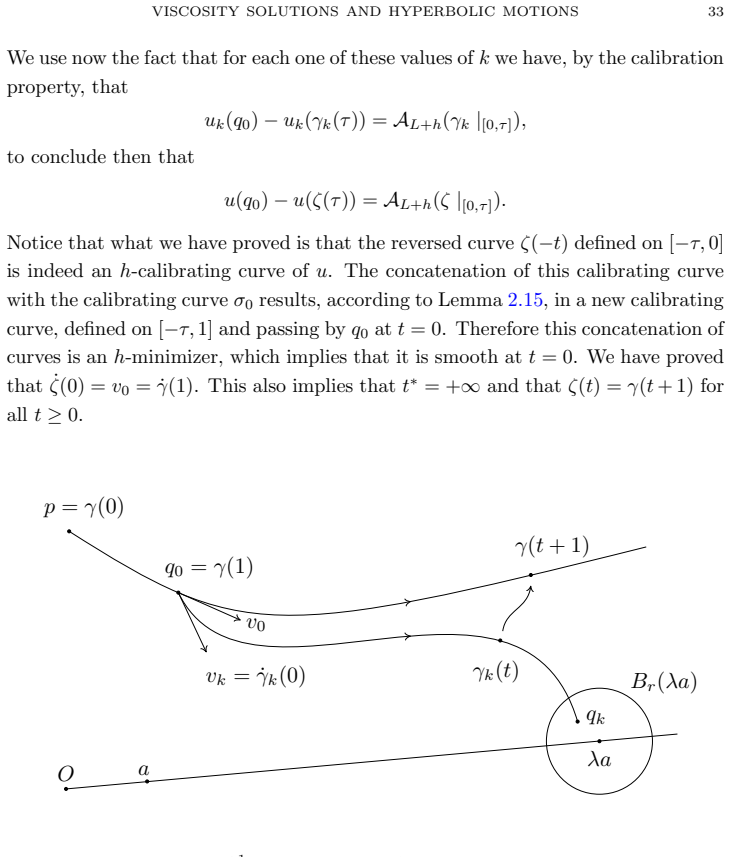
The carrying object is the supercritical action potential $\varphi_h(x,y)=\inf_{\tau>0}\bigl(\varphi(x,y,\tau)+h\tau\bigr)$, which the paper identifies with the length distance of the Jacobi-Maupertuis metric on the completed configuration space. The load-bearing estimate is $\varphi_h(x,y)\le\bigl(\alpha\|x-y\|+h\beta\|x-y\|^2\bigr)^{1/2}$; it makes the family of normalized viscosity subsolutions equicontinuous, so the classical compactness criterion for equicontinuous families applies and produces horofunctions as limits of $\varphi_h(\cdot,p_n)-\varphi_h(0,p_n)$ with $p_n$ escaping along a prescribed direction. The Lax-Oleinik semigroup---the dynamic-programming operator that evolves a subsolution by minimizing action over paths of fixed duration---is then used to show that these horofunctions are fixed points up to a linear drift, which yields complete calibrating curves. Finally, the principle that interior action minimizers avoid collisions, the classical exclusion of pseudocollision singularities, and the final-evolution classification of expansive motions successively force those calibrating curves to be genuine hyperbolic motions with the prescribed limit shape.
What would settle it
Compute the free-time action potential $\varphi_h(x,y)$ between a total-collision configuration and a far-away configuration for a three-body system by solving the convex minimization over travel times; if the minimal value ever exceeds $\bigl(\alpha\|x-y\|+h\beta\|x-y\|^2\bigr)^{1/2}$ with the uniform constants asserted in Theorem 2.11, the equicontinuity step---and with it the proof of Theorem 1.1---collapses.
Extended reading notes
Core claim
The paper's central claim is Theorem 1.1: for the Newtonian $N$-body problem in a Euclidean space of dimension at least two, given any initial configuration $x_0\in E^N$ (collisions allowed), any normalized collision-free configuration $a\in\Omega$, and any energy $h>0$, there is a hyperbolic motion $x:[0,+\infty)\to E^N$ with $x(0)=x_0$ and $x(t)=\sqrt{2h}\,t\,a+o(t)$ as $t\to+\infty$. In particular, total-collision configurations eject hyperbolically with an arbitrarily prescribed limit shape, and Corollary 1.2 adds that such motions can be chosen with zero angular momentum. The proof proceeds by solving the Hamilton-Jacobi equation $H(x,d_xu)=h$ in the viscosity sense: the solution is obtained as a directed horofunction, it is shown to be a fixed point of the Lax-Oleinik semigroup, and its calibrating curves are then proved, by ruling out superhyperbolic growth and collisions in the limit shape, to be hyperbolic motions with exactly the prescribed direction. In geometric terms, every positive-energy Jacobi-Maupertuis metric on the configuration space admits geodesic rays with every prescribed asymptotic direction issuing from every point.
Load-bearing premise
The proof depends on a quantitative bound, taken from earlier work, on the minimal action needed to travel between any two configurations; if that bound fails for even one pair of configurations, the compactness that produces the limiting solutions breaks down.
Editorial extensions
If this is right
- For any collision-free shape and any positive energy, hyperbolic motions realizing that shape exist from every starting configuration, including configurations with one or more collisions at $t=0$.
- Total-collision ejections are possible with prescribed positive energy and prescribed limit shape, and can be chosen with zero angular momentum.
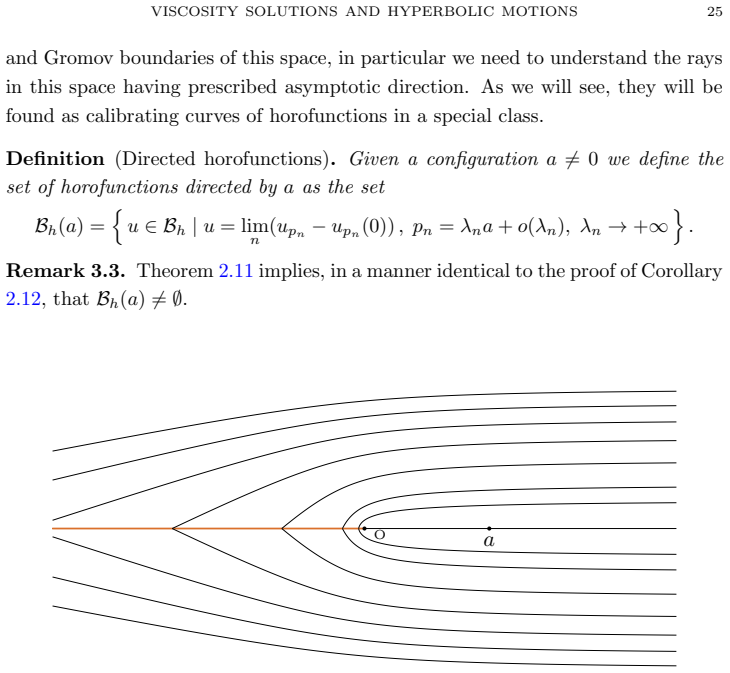
- Geometrically, the completed Jacobi-Maupertuis space of positive energy has geodesic rays in every direction at every point, and each collision-free shape class defines a point in its Gromov boundary.
- All calibrating curves of a directed horofunction share the same asymptotic shape, so the constructed motions are not isolated examples but the full family of rays associated with a boundary point.
Reading between the lines
- A natural next step, suggested but not undertaken in the paper, would be to build bi-hyperbolic motions by minimizing sums of two Busemann functions, one for a prescribed past shape and one for a prescribed future shape; whether such critical points exist depends on the differentiability structure of these viscosity solutions.
- If the constants in the quantitative action-potential bound were made explicit, the proof would become an effective algorithm: minimizing the action between a starting configuration and a far-away configuration placed along the desired shape would approximate the hyperbolic trajectory, giving numerical predictions for gravitational scattering shapes.
- The 'any initial configuration' statement hints at a controllability-at-infinity property of Newtonian systems that may extend to other homogeneous potentials of degree $-1$, but should not be expected for softer singularities, where collision dynamics differ qualitatively.
Signed reviews
Editorial analysis
A structured set of objections, weighed in public.
Referee Report
Summary. The paper proves Theorem 1.1: for the Newtonian N-body problem in a Euclidean space of dimension at least two, for every initial configuration x0, every collision-free limit shape a normalized by ||a||=1, and every positive energy h, there exists a hyperbolic motion x:[0,∞)→E^N with x(t)=√(2h)t a+o(t). The method is a new one for this problem: it constructs global viscosity solutions of the Hamilton-Jacobi equation H(x,d_xu)=h through supercritical action potentials, Lax-Oleinik semigroup fixed points, and horofunctions on the ideal boundary. The proof chain uses Marchal's theorem to guarantee that minimizing curves avoid collisions and uses the first author's earlier action-potential estimates [25] to obtain the key supercritical Hölder bound (Theorem 2.11). The paper also derives a geometric reformulation in terms of geodesic rays of the Jacobi-Maupertuis metric and closes with open questions on bi-hyperbolic motions.
Significance. If the result is correct, it is a major advance: it shows that every collision-free configuration can be realized as the exact limit shape of a hyperbolic motion, from an arbitrary initial configuration and at an arbitrary positive energy, including total-collision ejections. The proof is remarkably coherent: the derivation of Theorem 2.11 from the published estimates of [25] is elementary, the compactness argument for subsolutions is clean, and the delicate collision-free limit-shape argument in Theorem 3.4 is internally consistent. The dimension restriction is explicitly tied to Marchal's theorem. The paper introduces a new PDE/viscosity-solution technique to the N-body problem, which is likely to be influential. The main external dependency, the estimate from [25], is a published result and is used in a non-circular way.
minor comments (6)
- [§4.3 (Theorem 3.4, Claim 1)] The proof states that 'by Theorem 2.11 we know that the action potential φ_h is continuous'; Theorem 2.11 is only an upper bound. The needed boundedness of A_{L+h}(δ_k) follows instead from the local boundedness of φ_h given by Theorem 2.11 together with Lemma 4.4, so the wording should be corrected.
- [§4.3] The minimizer δ_k is said to exist by 'Theorem 4.2'; this should be Lemma 4.2.
- [§4.3, Claim 2] The formula for the integral contains a typo: '∫_{T0}^{Tk} ρ^{-1}_k dt (µ(γk(t))− 2µ(a)) dt' should be '∫_{T0}^{Tk} ρ^{-1}_k (µ(γk(t))− 2µ(a)) dt'.
- [§3.2 (Corollary 1.8 proof)] In the Chazy expansion after equation (⋆⋆), the term should be written with parentheses: x(t)=2hta−(log t/(4h^2))∇U(a)+O(1), since ∇U is evaluated at a.
- [References] The entry [18] contains the instruction 'Update the reference if possible'; this should be completed before publication.
- [§2.1 (Proposition 2.8)] Lemma 4.2 is invoked before its statement; a forward reference or a note that the proof is given in §4.2 would improve readability.
Circularity Check
No significant circularity: the construction uses prescribed data as input, and the external estimate [25] is independent support.
full rationale
The paper's derivation chain is self-contained in the relevant sense. The only author-overlap input is the zero-energy action-potential estimate (*) from [25], which is used in Section 2.1.2 to prove the supercritical Holder bound Theorem 2.11. That cited result is a parameter-free published theorem whose assumptions do not include the target hyperbolic-motion theorem, so under the stated rules it counts as independent support and does not create circularity. The subsequent steps -- compactness of normalized subsolutions (Corollary 2.12), existence of horofunctions in the ideal boundary (Section 3.1), the fixed-point/calibrating-curve property (Theorem 3.2), and the limit-shape identification (Theorem 3.4) -- are proved from the displayed equations rather than assumed. In particular, the directed horofunction set B_h(a) is defined by taking p_n = lambda_n a + o(lambda_n), but the conclusion that a calibrating curve has asymptotic direction a is not contained in that definition; Theorem 3.4 proves it through the non-superhyperbolic bound, the collision-free limit-shape argument, and the cone contradiction using Chazy's Lemma. Thus the prescribed direction a enters as a construction parameter of an existence proof, not as a fitted quantity or a self-fulfilling prediction. No load-bearing self-citation chain, imported uniqueness theorem, or ansatz-smuggling is present.
Assumptions & free parameters
assumptions (7)
- domain assumption Marchal's Theorem: any curve minimizing the Lagrangian action between fixed endpoints at fixed time avoids collisions in its interior.
- domain assumption Supercritical action-potential estimate of Theorem 2.11, inherited from Maderna's critical-action estimates [25].
- domain assumption Chazy's Lemma on openness and continuity of the limit shape, and Chazy's asymptotic expansion for hyperbolic motions.
- domain assumption Marchal-Saari final-evolution theorem: either R(t)/t→+∞ or x(t)=ta+O(t^{2/3}).
- domain assumption von Zeipel's theorem: a bounded configuration near a finite-time singularity implies the singularity is due to collisions.
- standard math Tonelli lower semicontinuity, Fatou's lemma, Ascoli-Arzelà, Rademacher's theorem, and Zorn's lemma.
- domain assumption Lagrange-Jacobi identity and the relation 2h=‖a‖² for hyperbolic motions.
Cite this review
Pith. "Pith review of Viscosity solutions and hyperbolic motions: a new PDE method for the $N$-body problem." pith.science (2026). https://pith.science/paper/YXF3JASZ
@misc{pith2026190809252,
  author       = {Pith},
  title        = {Pith review of: Viscosity solutions and hyperbolic motions: a new PDE method for the $N$-body problem},
  year         = {2026},
  howpublished = {\url{https://pith.science/paper/YXF3JASZ}},
  note         = {Machine review of arXiv:1908.09252}
}
abstract
We prove for the $N$-body problem the existence of hyperbolic motions for any prescribed limit shape and any given initial configuration of the bodies. The energy level $h>0$ of the motion can also be chosen arbitrarily. Our approach is based on the construction of global viscosity solutions for the Hamilton-Jacobi equation $H(x,d_xu)=h$. We prove that these solutions are fixed points of the associated Lax-Oleinik semigroup. The presented results can also be viewed as a new application of Marchal's theorem, whose main use in recent literature has been to prove the existence of periodic orbits.
Figures

Figures from the paper (2 more)


Reference graph
Works this paper leans on
-
[25]
Maderna, On weak KAM theory for N-body problems, Ergod
E. Maderna, On weak KAM theory for N-body problems, Ergod. Th. & Dynam. Sys. 32 n.3 (2012), 1019–1041
work page 2012
-
[18]
Chazy-Type Asymptotics and Hyperbolic Scattering for the $n$-Body Problem
N. Duignan, R. Moeckel, R. Montgomery and G. Yu, Chazy-type asymptotics and hyper- bolic scattering for the n-body problem, preprint available on the arXiv:1910.05871. Update the reference if possible
work page Pith review arXiv 1910
-
[1]
Albouy , Lectures on the Two-Body Problem, Classical and Celestial Mechanics, The Recife Lectures, H
A. Albouy , Lectures on the Two-Body Problem, Classical and Celestial Mechanics, The Recife Lectures, H. Cabral, F. Diacu editors, Princeton University Press (2001). VISCOSITY SOLUTIONS AND HYPERBOLIC MOTIONS 43
work page 2001
-
[2]
A. Albouy and V. Kaloshin, Finiteness of central configurations of five bodies in the plane, Ann. of Math. (2) 176 (2012), 535–588
work page 2012
-
[3]
Arredondo, J.A. , P´erez-Chavela, E. and Stoica, C. , Dynamics in the Schwarzschild isosceles three body problem, J. Nonlinear Sci. 24 (2014), 997–1032
work page 2014
-
[4]
W. Ballmann, M. Gromov and V. Schroeder, Manifolds of nonpositive curvature,Progress in Mathematics, vol.61, Birkh¨ auser, Boston, 1985
work page 1985
-
[5]
M. Bardi and I. Capuzzo-Dolcetta, Optimal control and viscosity solutions of Hamilton- Jacobi-Bellman equations, Systems & Control: Foundations & Applications , Birkha¨ user, Boston, 1997
work page 1997
-
[6]
G. Barles Solutions de viscosit´ e des ´ equations de Hamilton-Jacobi,Math´ ematiques et Ap- plications, vol. 17, Springer-Verlag, Paris, 1994
work page 1994
Show all 44 references
-
[7]
Bernard The Lax–Oleinik semi-group: a Hamiltonian point of view, Proceedings of the Royal Society of Edinburgh , Section: A Mathematics, 142 (6) (2012), 1131–1177
P. Bernard The Lax–Oleinik semi-group: a Hamiltonian point of view, Proceedings of the Royal Society of Edinburgh , Section: A Mathematics, 142 (6) (2012), 1131–1177
2012
-
[8]
Chazy , Sur certaines trajectoires du probl` eme des n corps, Bull
J. Chazy , Sur certaines trajectoires du probl` eme des n corps, Bull. astronom. 35 (1918), 321–389
1918
-
[9]
Chazy, Sur l’allure du mouvement dans le probl` eme des trois corps quand le temps croˆ ıt ind´ efiniment,Ann
J. Chazy, Sur l’allure du mouvement dans le probl` eme des trois corps quand le temps croˆ ıt ind´ efiniment,Ann. Sci. E.N.S. (3-` eme s´ erie)39 (1922), 29–130
1922
-
[10]
Chenciner, `A l’infini en temps fini, S´ eminaire Bourbaki n
A. Chenciner, `A l’infini en temps fini, S´ eminaire Bourbaki n. 832, Ast´ erisque, 245 (1997), 323–353
1997
-
[11]
Chenciner, Collisions totales, mouvements compl` etement paraboliques et r´ eduction des homoth´ eties dans le probl` eme desn corps, Regul
A. Chenciner, Collisions totales, mouvements compl` etement paraboliques et r´ eduction des homoth´ eties dans le probl` eme desn corps, Regul. Chaotic Dyn., 3 (1998), 93–106
1998
-
[12]
Chenciner, Action minimizing solutions of the Newtonian n-body problem: from homol- ogy to symmetry, Proceedings of the International Congress of Mathematicians Beijing 2002, vol
A. Chenciner, Action minimizing solutions of the Newtonian n-body problem: from homol- ogy to symmetry, Proceedings of the International Congress of Mathematicians Beijing 2002, vol. III, 279–294, Higher Ed. Press, Beijing, 2002
2002
-
[13]
Chenciner and R
A. Chenciner and R. Montgomery, A remarkable periodic solution of the three-body prob- lem in the case of equal masses, Ann. of Math. (2) 152 (2000), 881–901
2000
-
[14]
Crandall and P.-L
M.G. Crandall and P.-L. Lions, Viscosity Solutions of Hamilton-Jacobi equations, Trans. Amer. Math. Soc. 277 (1983), 1–42
1983
-
[15]
Crandall , L.C
M.G. Crandall , L.C. Evans and P.-L. Lions , Some properties of viscosity solutions of Hamilton-Jacobi equations, Trans. Amer. Math. Soc. 282 (1984), 487–502
1984
-
[16]
da Luz and E
A. da Luz and E. Maderna, On the free time minimizers of the Newtonian N-body problem, Math. Proc. Cambridge Philos. Soc. 156 n.2 (2014), 209–227
2014
-
[17]
Diacu , Singularities of the N-body problem, in Classical and celestial mechanics: the Recife lectures, edited by H
F. Diacu , Singularities of the N-body problem, in Classical and celestial mechanics: the Recife lectures, edited by H. Cabral and F. Diacu , Princeton University Press, 2002
2002
-
[19]
Evans, Partial Differential Equations, second edition,Graduate Studies in Mathematics, vol
L.C. Evans, Partial Differential Equations, second edition,Graduate Studies in Mathematics, vol. 19, American Mathematical Society, 2010
2010
-
[20]
Evans, Weak KAM theory and partial differential equations, in Calculus of Variations and Non-Linear Partial Differential Equations (B
L.C. Evans, Weak KAM theory and partial differential equations, in Calculus of Variations and Non-Linear Partial Differential Equations (B. Dacorogna and P. Marcellini, editors) Lecture Notes in Mathematics , vol. 1927, 2005
1927
-
[21]
A. Fathi, Weak KAM Theory: the connection between Aubry-Mather theory and viscos- ity solutions of the Hamilton-Jacobi equation, Proceedings of the International Congress of Mathematicians Seoul 2014 , vol. III, 597–621
2014
-
[22]
Ferrario and S
D. Ferrario and S. Terracini, On the existence of collisionless equivariant minimizers for the classical n-body problem, Invent. Math. 155 n.2 (2004), 305–362
2004
-
[23]
Gromov, Hyperbolic manifolds, groups and actions, in Riemann surfaces and related topics, Stonybrook conference, Ann
M. Gromov, Hyperbolic manifolds, groups and actions, in Riemann surfaces and related topics, Stonybrook conference, Ann. of Math. Studies 97, Princeton University Press, (1980)
1980
-
[24]
Hampton and R
M. Hampton and R. Moeckel, Finiteness of relative equilibria of the four-body problem, Invent. Math. 163 (2006), 289–312. 44 EZEQUIEL MADERNA AND ANDREA VENTURELLI
2006
-
[26]
Maderna, Minimizing configurations and Hamilton-Jacobi equations of homogeneous N- body problems, Regul
E. Maderna, Minimizing configurations and Hamilton-Jacobi equations of homogeneous N- body problems, Regul. Chaotic Dyn. 18 n.6 (2013), 656–673
2013
-
[27]
Maderna and A
E. Maderna and A. Venturelli, Globally minimizing parabolic motions in the Newtonian n-body problem, Arch. Ration. Mech. Anal. 194 n.1 (2009), 283–313
2009
-
[28]
Marchal, How the method of minimization of action avoids singularities,Celestial Mech
Ch. Marchal, How the method of minimization of action avoids singularities,Celestial Mech. Dynam. Astronom. 83 n.1-4 (2002), 325–353
2002
-
[29]
Marchal and D
Ch. Marchal and D. Saari, On the final evolution of the n-body problem, J. Differential Equations 20 n.1 (1976), 150–186
1976
-
[30]
McGehee , Von Zeipel’s theorem on singularities in celestial mecanics, Expo
R. McGehee , Von Zeipel’s theorem on singularities in celestial mecanics, Expo. Math. 4 (1986), 335–345
1986
-
[31]
Moeckel , R
R. Moeckel , R. Montgomery and H. S ´anchez-Morgado, Free time minimizers for the three-body problem., Celestial Mech. Dynam. Astronom. 130 n.3 (2018)
2018
-
[32]
Moser, Stable and Random Motion in Dynamical Systems, Ann
J. Moser, Stable and Random Motion in Dynamical Systems, Ann. of Math. Stud. volume 77 (1973)
1973
-
[33]
Palmore, Measure of degenerate relative equilibria I, Ann
J. Palmore, Measure of degenerate relative equilibria I, Ann. of Math. (2) 104 n.3 (1976), 421–429
1976
-
[34]
Percino-Figueroa, Null angular momentum and weak KAM solutions of the Newtonian N-body problem, SIGMA Symmetry Integrability Geom
B. Percino-Figueroa, Null angular momentum and weak KAM solutions of the Newtonian N-body problem, SIGMA Symmetry Integrability Geom. Methods Appl. 13 (2017), paper n. 068, 8 pp
2017
-
[35]
Percino-Figueroa and H
B. Percino-Figueroa and H. S ´anchez-Morgado, Busemann functions for the N-body problem, Arch. Ration. Mech. Anal. 213 no.3 (2014), 981–991
2014
-
[36]
Poincar ´e, Sur les solutions p´ eriodiques et le principe de moindre action, C
H. Poincar ´e, Sur les solutions p´ eriodiques et le principe de moindre action, C. R. Acad. Sci., Paris, S´ er. I, Math123 (1896), 915–918
-
[37]
Pollard, The behavior of gravitational systems, J
H. Pollard, The behavior of gravitational systems, J. Math. Mech. 17 n.6 (1967), 601–611
1967
-
[38]
Saari and Z
D. Saari and Z. Xia, The existence of oscillatory and superhyperbolic motions in Newtonian systems, J. Differential Equations 82 n.2 (1989), 342–355
1989
-
[39]
M. Shub. Appendix to Smale’s paper: Diagonals and relative equilibria, in Manifolds – Amsterdam 1970 (Proc. Nuffic Summer School) Lect. Notes Math. 197 (1971),199–201
1971
-
[40]
Sitnikov, The existence of oscillatory motions in the three-body problem, Dokl
K. Sitnikov, The existence of oscillatory motions in the three-body problem, Dokl. Akad. Nauk SSSR 133 (1960), 303–306
1960
-
[41]
Wintner, The Analytical Foundations of Celestial Mechanics, Princeton Mathematical Series, vol
A. Wintner, The Analytical Foundations of Celestial Mechanics, Princeton Mathematical Series, vol. 5 Princeton University Press, Princeton, N. J., 1941
1941
-
[42]
Xia, The existence of noncollision singularities in Newtonian systems, Ann
Z. Xia, The existence of noncollision singularities in Newtonian systems, Ann. of Math. (2) 135 no. 3 (1992), 411–468
1992
-
[43]
Yu and S
X. Yu and S. Q. Zhang, Action-minimizing solutions of the one-dimensional N-body prob- lem, Celestial Mech. Dynam. Astronom. 130 no. 5 (2018), Art. 37
2018
-
[44]
von Zeipel , Sur les singularit´ es du probl` eme des n corps, Ark
H. von Zeipel , Sur les singularit´ es du probl` eme des n corps, Ark. Math. Astr. Fys. , n.4 (1908), 1–4. IMERL & CMAT, Universidad de la Rep ´ublica, Uruguay E-mail address: eze@fing.edu.uy Laboratoire de Math´ematiques d’Avignon , France E-mail address: andrea.venturelli@un...
1908
Reviewed August 14, 2026 · model on record in the stance chip above.
Discussion (0). Continue with ORCID to comment.