REVIEW 3 major objections 6 minor 58 references
Phononic entanglement concentration via optomechanical interactions
T0 review · 3 major / 6 minor · reviewed 2026-08-14 · deepseek-v4-flash
Pith's one-line read The paper proposes the first protocol that converts weak nonlocal phonon entanglement into ideal Bell and GHZ states using optomechanical cross-Kerr interactions.
desk verdict A sound but idealized 'first' protocol for phononic entanglement concentration; the standard Schmidt projection rehosted in optomechanics, with real gaps in the anti-Stokes swap and missing mechanical decoherence. read the letter →
The pith
A machine-rendered reading of the paper's core claim, the machinery that carries it, and where it could break.
The reading
What carries the argument
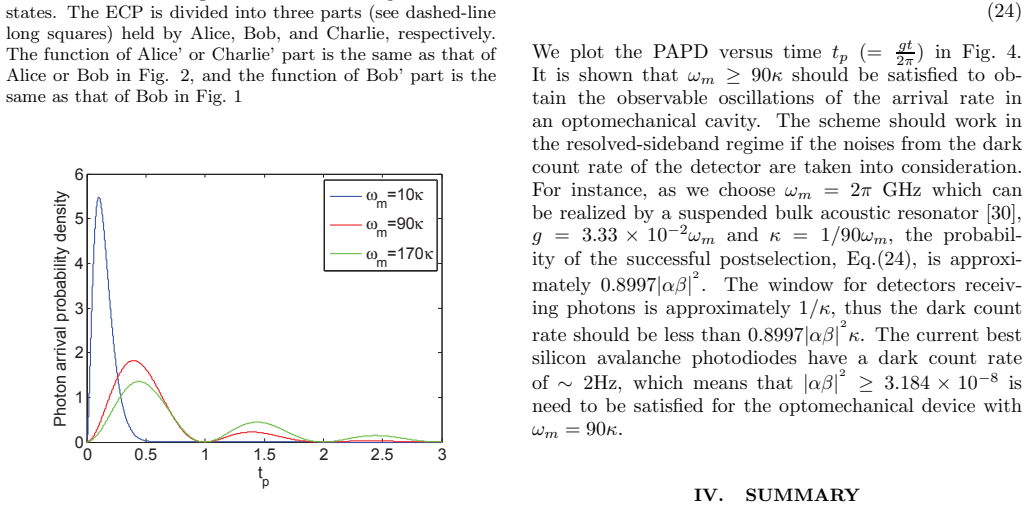
The load-bearing mechanism is the optomechanical cross-Kerr interaction $H=\Delta\hat{c}^{\dagger}\hat{c}+\omega_m\hat{b}^{\dagger}\hat{b}-g\hat{c}^{\dagger}\hat{c}\hat{b}^{\dagger}\hat{b}$, in which the presence of a cavity photon shifts the mechanical resonator's phase by $gt$. Combined with a Mach-Zehnder interferometer, this interaction makes the cross terms $\alpha\beta$ acquire a relative phase while the $\alpha^2$ and $\beta^2$ terms do not, so detecting a photon at the dark port postselects exactly the antisymmetric component $(|1001\rangle-|0110\rangle)/\sqrt{2}$ and discards the unentangled terms. The second engine is the anti-Stokes interaction $H_{\rm as}=G(\hat{c}\hat{v}^{\dagger}+\hat{c}^{\dagger}\hat{v})$, which transfers each selected mechanical excitation into a cavity photon and turns a phononic Bell-state measurement into a photonic one. The photon-arrival probability density formula $2|\alpha\beta|^2\sin^2(gt/2)\kappa\exp(-\kappa t)/P_{\rm tot}$ is used to estimate the postselection rate and the required sideband resolution.
What would settle it
Include cavity decay, mechanical damping, and thermal phonon occupancy in a master-equation description of the protocol and compute the state conditioned on dark-port detection and photon counts: if the fidelity to the ideal Bell or GHZ state drops below 1 for any nonzero loss or temperature, the claim of ideal entanglement concentration fails.
Extended reading notes
Core claim
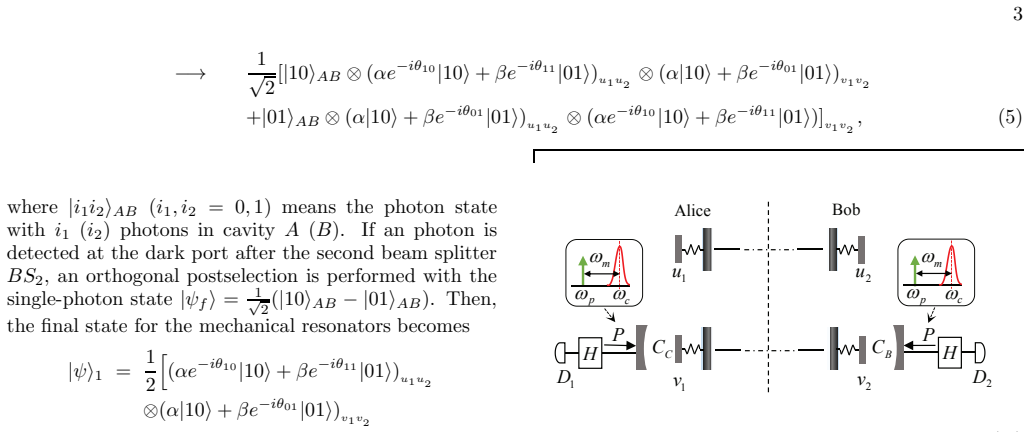
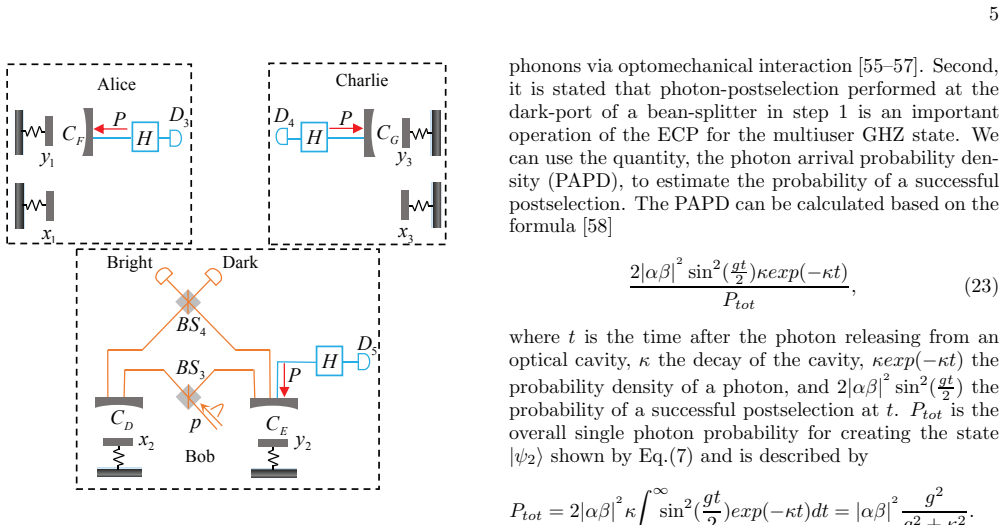
The paper's central claim is that a partially entangled two-phonon state $\alpha|10\rangle+\beta|01\rangle$ shared by two remote mechanical resonators can be converted into a maximally entangled Bell state by combining two copies of the state and applying an optomechanical cross-Kerr interaction inside a Mach-Zehnder interferometer. Detecting a photon at the interferometer's dark port projects the four resonators onto the maximally entangled state $(|1001\rangle-|0110\rangle)/\sqrt{2}$, with success probability $2|\alpha\beta|^2\sin^2(gt/2)$, maximized to $2|\alpha\beta|^2$ at $gt=\pi$. A subsequent anti-Stokes interaction maps two of the phonon modes to photons, and Hadamard operations plus photodetection leave Alice and Bob sharing either $(|10\rangle+|01\rangle)/\sqrt{2}$ or $(|10\rangle-|01\rangle)/\sqrt{2}$, with the latter convertible to the former by a $\pi$-phase operation. The same construction with three users concentrates a partially entangled phonon GHZ state $\alpha|000\rangle+\beta|111\rangle$ into a maximally entangled phonon GHZ state. The paper also gives a resolved-sideband feasibility estimate for the dark-port postselection.
Load-bearing premise
The protocol yields a perfectly maximally entangled state only if each phonon-to-photon conversion step is lossless and the mechanical vibrations stay completely free of decoherence and thermal noise; the paper assumes all of this without deriving or quantifying it.
Editorial extensions
If this is right
- Nonlocal phonon pairs can be purified to a standard Bell state using only photonic operations, since the phonons are handled indirectly through optomechanical interactions.
- The same protocol, with one additional user, concentrates a partially entangled three-phonon GHZ state into a maximally entangled phonon GHZ state at the same maximum success probability $2|\alpha\beta|^2$.
- The success probability is nonzero for every non-maximally entangled input with $0<|\alpha\beta|<1$, and reaches its maximum at interaction time $gt=\pi$.
- In the resolved-sideband regime the total postselection probability is approximately $0.8997|\alpha\beta|^2$ for the paper's example parameters, which sets the allowed detector dark-count rate.
- Because phonons propagate slowly and have low dissipation, the concentrated Bell and GHZ states are suited to short-distance storage and transfer in phonon-based quantum information processing.
Reading between the lines
- Because the protocol consumes two copies with the same known amplitudes $\alpha$ and $\beta$, it is a two-copy concentration scheme; extending it to unknown or mixed states would require an additional estimation or purification layer that the paper does not address.
- The dark-port postselection idea should extend to higher-dimensional or continuous-variable phonon states if single-photon detection is replaced by photon-number-resolving measurement; the paper treats only qubit-like Fock states.
- The maximum success probability $2|\alpha\beta|^2$ matches the standard bound for two-copy qubit entanglement concentration, so the scheme may already be optimal in conversion rate, although the paper does not make that optimality claim.
- Combining the appendix's Stokes-based Bell-state preparation with this concentration protocol gives the building blocks of a phonon-based quantum repeater segment: generate, distill, and store remote phonon entanglement.
Signed reviews
Editorial analysis
A structured set of objections, weighed in public.
Referee Report
Summary. The paper proposes a protocol for entanglement concentration of nonlocal phonons in partially entangled Bell and GHZ states. Two copies of the same pure partially entangled state are combined through an optomechanical cross-Kerr interaction inside a Mach-Zehnder interferometer; postselecting a photon at the dark port performs a Schmidt projection and yields a maximally entangled multi-phonon state. A subsequent anti-Stokes optomechanical interaction maps the phonons to photons, Hadamard gates and photon detection then herald a Bell or GHZ state of the remaining mechanical modes. The claimed success probability for the Bell case is 2|αβ|^2, and the derivation is self-contained under ideal unitary operations.
Significance. If the ideal-unitaries claim holds, this is a conceptually useful adaptation of the standard Schmidt-projection entanglement concentration to phononic systems, and it identifies optomechanical cross-Kerr interactions and anti-Stokes conversion as the needed phonon-photon interface. The core postselection algebra is essentially correct: the success probability in Eq. (8) is derived rather than imposed, and the Bell-state analysis in Eqs. (12)-(14) is internally consistent. However, the practical significance is conditional, because the protocol assumes a lossless, noiseless anti-Stokes swap and neglects mechanical decoherence and thermal noise; these assumptions are not quantified. The paper is therefore a reasonable proposal for an ideal protocol, but its 'ideal' claim needs qualification and supporting parameter conditions.
major comments (3)
- [Sec. II, Eqs. (4)-(6)] Equation (5) does not follow from Eq. (4) as written. In the first branch (photon in cavity A), the uncoupled pair v1v2 is written as α|10>+βe^{-iθ01}|01>, assigning a relative phase only to the |01> component; under the Hamiltonian of Eq. (3), both components of an uncoupled pair should acquire the same free-evolution phase e^{-iω_m t} unless a rotating frame is explicitly defined and used consistently. The same issue appears in the u1u2 factor in the second branch. This inconsistency propagates into Eq. (6), so the displayed derivation should be corrected by either specifying the interaction picture or recomputing the phases for all mechanical modes. The final success probability in Eq. (8) appears robust to such a correction, but the printed intermediate step is not.
- [Sec. II, Step 2, Eqs. (10)-(11)] The anti-Stokes mapping is asserted as a unit-efficiency phonon-to-photon swap without specifying the conditions under which this is exact. For H_as = G c v† + H.c., full transfer requires a pulse area Gτ=π/2, and the conversion is only valid in the resolved-sideband regime with negligible thermal occupancy and mechanical decoherence during the protocol. None of these requirements is stated, and the feasibility analysis in Eqs. (23)-(24) models only cavity decay and detector dark counts, not mechanical damping, thermal phonon noise, or conversion efficiency. The central claim that the final state is the ideal Bell or GHZ state therefore lacks an error budget; the authors should either derive the mapping with explicit parameter conditions or qualify the 'ideal' claim.
- [Sec. III, after Eq. (18)] The timing statement 'At time t = 2(n1+1)π/g, the successful probability becomes maximal' is inconsistent with Eq. (8), since sin²(gt/2)=0 at that time. The maximum occurs at t=(2n1+1)π/g, as in the Bell case of Eq. (9). This appears to be a typo, but it directly affects the experimental prescription for the GHZ protocol and should be corrected.
minor comments (6)
- [Sec. II, Eq. (5)] The first line of Eq. (5) reads '1/√2(|01>_AB + |01>_AB)', which should presumably be '1/√2(|10>_AB + |01>_AB)'.
- [Sec. II, Eq. (13)] Equation (13) writes the target Bell state as '1/√2(|10>_{u1u2} + |10>_{u1u2})'; the second term should be |01>_{u1u2}.
- [Sec. III, Eq. (16)] In Eq. (16), the input photon state is denoted '|ϕ>_i' in the first line but '|ϕ>_in' above; please use consistent notation.
- [Sec. III, final paragraph] The text refers to 'the less-entangled GHE state Eq. (15)'; this should be 'GHZ state'.
- [Fig. 4 caption] The caption lists ω_m = 30κ, 90κ, 150κ while the figure text shows ω_m = 10κ, 90κ, 170κ; the values should be reconciled, and 'ω_m1' appears to be a typo.
- [Appendix, Eqs. (A2)-(A3)] The expansion in Eq. (A3) drops the two-phonon term and also writes the vacuum term with a factor √p_p that does not match the expansion of Eq. (A2); please correct the normalization or state the approximation explicitly.
Circularity Check
No significant circularity: standard Schmidt projection with independent Hamiltonian inputs; success probabilities are derived, not imposed.
full rationale
The derivation is self-contained in the sense required by the circularity test. The only inputs are the two-copy partially entangled phonon states (Eqs. 1-2), the optomechanical cross-Kerr Hamiltonian (Eq. 3), and the linearized anti-Stokes Hamiltonian (Eq. 10). The postselected four-phonon state (Eq. 6) and the success probability (Eq. 8) are computed from these inputs; no parameter is fitted to the Bell or GHZ output, and the target maximally entangled state is not used to define any Hamiltonian or postselection rule. The citations [55-57] supply the cross-Kerr Hamiltonian and [58] the photon-arrival formula, and none of these sources is authored by the present authors or assumes the target result. The self-citations in the reference list (e.g., refs [21,22,43]) concern other entanglement-concentration contexts and are not load-bearing for the phononic protocol. The idealizing assumption that the anti-Stokes step maps Eq. (7) to Eq. (11) as a perfect lossless phonon-to-photon swap is an unquantified feasibility assumption, but it is an assumption about physical fidelity, not a circular identification of the output with the input. No step reduces, by construction or by self-citation, to its own input.
Assumptions & free parameters
assumptions (5)
- domain assumption The cross-Kerr optomechanical Hamiltonian (Eq.(3)) and its Fock-state phase evolution (Eq.(4)) are valid and experimentally realizable at single-photon level.
- domain assumption The anti-Stokes interaction (Eq.(10)) maps each phonon mode to a photon deterministically and without loss.
- domain assumption Alice and Bob share two copies of exactly the same partially entangled state with known coefficients alpha and beta.
- domain assumption Photon detectors are ideal: unit efficiency, no dark counts, and photon-number resolution sufficient to distinguish 0, 1, or 2 clicks.
- domain assumption Mechanical decoherence, thermal phonon occupation, and losses in the cavities are negligible during the protocol.
Cite this review
Pith. "Pith review of Phononic entanglement concentration via optomechanical interactions." pith.science (2026). https://pith.science/paper/6J6D5SJ3
@misc{pith2026190809266,
  author       = {Pith},
  title        = {Pith review of: Phononic entanglement concentration via optomechanical interactions},
  year         = {2026},
  howpublished = {\url{https://pith.science/paper/6J6D5SJ3}},
  note         = {Machine review of arXiv:1908.09266}
}
read the original abstract
Low dissipation, tunable coupling to other quantum systems, and unique features of phonons in the aspects of propagation, detection and others suggest the applications of quantized mechanical resonators in phonon-based quantum information processing (QIP) in a way different from their photonic counterpart. In this paper, we propose the first protocol of entanglement concentration for nonlocal phonons from quantized mechanical vibration. We combine the optomechanical cross-Kerr interaction with the Mach-Zehnder interferometer and, by means of twice optomechanical interactions and the photon analysis with respect to the output of the interferometer, achieve ideal entanglement concentration about less-entangled nonlocal phonon Bell and Greenberger-Horne-Zeilinger states. Our protocol is useful for preserving the entangled phonons for the use of high quality phonon-based QIP in future.
Figures

Figures from the paper (2 more)

Reference graph
Works this paper leans on
-
[1]
A. K. Ekert, Phys. Rev. Lett. 67, 661 (1991)
1991
-
[2]
C. H. Bennett, G. Brassard, and N. D. Mermin, Phys. Rev. Lett. 68, 557 (1992)
1992
-
[3]
X. H. Li, F. G. Deng, and H. Y. Zhou, Phys. Rev. A 78, 022321 (2008)
work page 2008
-
[4]
C. H. Bennett, G. Brassard, C. Crepeau, R. Jozsa, A. Peres, and W. K. Wootters, Phys. Rev. Lett. 70, 1895 (1993)
1993
-
[5]
G. L. Long and X. S. Liu, Phys. Rev. A 65, 032302 (2002)
2002
-
[6]
F. G. Deng, G. L. Long, and X. S. Liu, Phys. Rev. A 68, 042317 (2003)
2003
-
[7]
C. Wang, F. G. Deng, Y. S. Li, X. S. Liu, and G. L. Long, Phys. Rev.A 71, 044305 (2005)
work page 2005
- [8]
Show all 58 references
-
[9]
C. H. Bennett and S. J. Wiesner, Phys. Rev. Lett. 69, 2881 (1992)
1992
-
[10]
X. S. Liu, G. L. Long, D. M. Tong, and Feng. Li, Phys. Rev. A 65, 022304 (2002)
2002
-
[11]
C. H. Bennett, H. J. Bernstein, S. Popescu, and B. Schu- macher, Phys. Rev. A 53, 2046 (1996)
1996
-
[12]
Yamamoto, M
T. Yamamoto, M. Koashi, and N. Imoto, Phys. Rev.A 64, 012304 (2001)
2001
-
[13]
Z. Zhao, J. W. Pan, and M. S. Zhan, Phys. Rev. A 64, 014301 (2001)
2001
-
[14]
Y. B. Sheng, F. G. Deng, and H. Y. Zhou, Phys. Rev. A 77, 062325 (2008)
2008
-
[15]
X. H. Li and S. Ghose, Phys. Rev. A 91, 062302 (2015)
2015
-
[16]
Botero and J
A. Botero and J. Mej ´ ıa, Phys. Rev. A98, 032326 (2018). 7
2018
-
[17]
B. C. Ren, F. F. Du, and F. G. Deng, Phys. Rev. A 88, 012302 (2013)
2013
-
[18]
Y. B. Sheng, L. Zhou, S. M. Zhao, and B. Y. Zheng, Phys. Rev. A 85, 012307 (2012)
2012
-
[19]
F. G. Deng, Phys. Rev. A 85, 022311 (2012)
2012
-
[20]
Wang, Phys
C. Wang, Phys. Rev. A 86, 012323 (2012)
2012
-
[21]
Zhang and H
H. Zhang and H. Wang, Phys. Rev. A 95, 052314 (2017)
2017
-
[22]
Zhang, A
H. Zhang, A. Alsaedi, T. Hayat, and F. G. Deng, Ann. Phys. 391, 112C119 (2018)
2018
-
[23]
C. Y. Li and Y. Shen, Opt. Express 27, 13172 (2019)
2019
-
[24]
H. Xu, L. Y. Jiang, A. A. Clerk, and J. G. E. Harris, Nature (London) 568, 65 (2019)
2019
-
[25]
H. Xu, D. Mason, L. Jiang, and J. G. E. Harris, Nature (London) 537, 80 (2016)
2016
-
[26]
Flayac and V
H. Flayac and V. Savona, Phys. Rev. Lett. 113, 143603 (2014)
2014
-
[27]
M. J. Woolley and A. A. Clerk, Phys. Rev. A 89, 063805 (2014)
2014
-
[28]
J. Li, I. M. Haghighi, N. Malossi, S. Zippilli, and D. Vitali, New J. Phys. 17, 103037 (2015)
2015
-
[29]
C. F. Ockeloen-Korppi, E. Damsk¨ agg, J.-M. Pirkkalainen, M. Asjad, A. A. Clerk, F. Massel, M. J. Woolley, and M. A. Sillanp¨ a¨ a, Nature (London) 556, 478 (2018)
2018
-
[30]
Riedinger, A
R. Riedinger, A. Wallucks, I. Marinkovi´ c, C. L¨ oschnauer, M. Aspelmeyer, S. Hong, and S. Gr¨ oblacher, Nature (London) 556, 473 (2018)
2018
-
[31]
Aspelmeyer, T
M. Aspelmeyer, T. J. Kippenberg, and F. Marquardt, Rev. Mod. Phys. 86, 1391 (2014)
2014
-
[32]
Ludwig, A
M. Ludwig, A. H. Safavi-Naeini, O. Painter, and F. Mar- quardt, Phys. Rev. Lett. 109, 063601 (2012)
2012
-
[33]
P. L. Yu, K. Cicak, N. S. Kampel, Y. Tsaturyan, T. P. Purdy, R. W. Simmonds, and C. A. Regal, Appl. Phys. Lett. 104, 023510 (2014)
2014
-
[34]
Tsaturyan, A
Y. Tsaturyan, A. Barg, E. S. Polzik, and A. Schliesser, Nat. Nanotechnol. 12, 776 (2017)
2017
-
[35]
R. N. Patel, Z.Wang,W. Jiang, C. J. Sarabalis, J. T. Hill , and A. H. Safavi-Naeini, Phys. Rev. Lett. 121, 040501 (2018)
2018
-
[36]
S. M. Meenehan, J. D. Cohen, G. S. MacCabe, F. Marsili, M. D. Shaw, and O. Painter, Phys. Rev. X 5, 041002 (2015)
2015
-
[37]
Stannigel, P
K. Stannigel, P. Komar, S. J. M. Habraken, S. D. Ben- nett, M. D. Lukin, P. Zoller, and P. Rabl, Phys. Rev. Lett. 109, 013603 (2012)
2012
-
[38]
Y. D. Wang and A. A. Clerk, Phys. Rev. Lett. 108, 153603 (2012)
2012
-
[39]
Tian, Phys
L. Tian, Phys. Rev. Lett. 108, 153604 (2012)
2012
-
[40]
J. Chan, T. P. M. Alegre, A. H. Safavi-Naeini, J. T. Hill, A. Krause, S. Gr¨ oblacher, A. Markus, and O. Painter, Nature (London) 478, 89 (2011)
2011
-
[41]
Y. C. Liu, Y. F. Xiao, X. Luan, C. W. Wong, Phys. Rev. Lett. 110, 153606 (2013)
2013
-
[42]
F. C. Lei, M. Gao, C. G. Du, Q. L. Jing, and G. L. Long, Opt. Express 23, 11508 (2015)
2015
-
[43]
Zhang, X.-K
H. Zhang, X.-K. Song, Q. Ai, H. Wang, G.-J. Yang, and F.-G. Deng, Opt. Express 27, 7384 (2019)
2019
-
[44]
E. R. MacQuarrie, T. A. Gosavi, N. R. Jungwirth, S. A. Bhave, and G. D. Fuchs, Phys. Rev. Lett. 111, 227602 (2013)
2013
-
[45]
Ovartchaiyapong, K
P. Ovartchaiyapong, K. W. Lee, B. A. Myers, and A. C. B. Jayich, Nat. Commun. 5, 4429 (2014)
2014
-
[46]
D. A. Golter, T. Oo, M. Amezcua, K. A. Stewart, and H. L. Wang, Phys. Rev. Lett. 116, 143602 (2016)
2016
-
[47]
D. A. Golter, T. Oo, M. Amezcua, I. Lekavicius, K. A. Stewart, and H. L. Wang, Phys. Rev. X 6, 041060 (2016)
2016
-
[48]
E. R. MacQuarrie, M. Otten, S. K. Gray, and G. D. Fuchs, Nat. Commun. 8, 14358 (2017)
2017
-
[49]
M. V. Gustafsson, T. Aref, A. F. Kockum, M. K. Ek- strom, G. Johansson, and P. Delsing, Science 346, 207 (2014)
2014
-
[50]
M. J. A. Schuetz, E. M. Kessler, G. Giedke, L. M. K. Vandersypen, M. D. Lukin, and J. I. Cirac, Phys. Rev. X 5, 031031 (2015)
2015
-
[51]
A. H. Safavi-Naeini and O. Painter, New J. Phys. 13, 013017 (2011)
2011
-
[52]
Okamoto, A
H. Okamoto, A. Gourgout, C.-Y. Chang, K. Onomitsu, I. Mahboob, E. Y. Chang, and H. Yamaguchi, Nat. Phys. 9, 480-484 (2013)
2013
-
[53]
M. C. Kuzyk and H. Wang, Phys. Rev. X 8, 041027 (2018)
2018
-
[54]
M. A. Lemonde, S. Meesala, A. Sipahigil, M. J. A. Schuetz, M. D. Lukin, M. Loncar, and P. Rabl, Phys. Rev. Lett. 120, 213603 (2018)
2018
-
[55]
Chen, W.-Z
T.-Y. Chen, W.-Z. Zhang, R.-Z. Fang, C.-Z. Hang, and L. Zhou, Opt. Express 25, 10779 (2017)
2017
-
[56]
T. S. Yin, X. Y. L¨ u, L. L. Wan, S. W. Bin, and Y. Wu, Opt. Lett. 43, 2050 (2018)
2018
-
[57]
J. Q. Liao, J. F. Huang, L. Tian, L. M. Kuang, and C. P. Sun, arXiv: 1802.09254
-
[58]
Pepper, R
B. Pepper, R. Ghobadi, E. Jeffrey, C. Simon, and D. Bouwmeester, Phys. Rev. Lett. 109, 023601 (2012)
2012
Reviewed August 14, 2026 · model on record in the stance chip above.
Discussion (0). Continue with ORCID to comment.