REVIEW 3 major objections 5 minor 33 references
Babel Storage: Uncoordinated Content Delivery from Multiple Coded Storage Systems
T0 review · 3 major / 5 minor · reviewed 2026-08-14 · deepseek-v4-flash
Pith's one-line read Mixing codes cuts uncoordinated download waste to 3 extra symbols
desk verdict Solid new characterization of the multi-server coupon collector tradeoff; the empirical code-diversity claim rests on an under-documented simulation with an unproven LDPC block-alignment assumption. read the letter →
The pith
A machine-rendered reading of the paper's core claim, the machinery that carries it, and where it could break.
The reading
What carries the argument
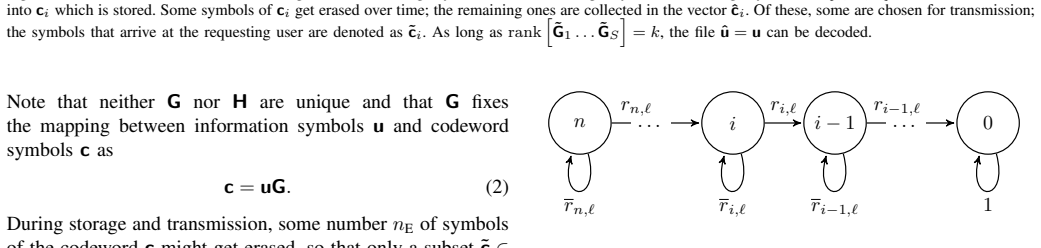
The load-bearing object of Section III is a time-varying Markov chain tracking $U_\ell$, the number of codeword symbols the user has not yet seen after $\ell$ transmissions. At round $\ell$ the active storage system samples uniformly from the $n - \lfloor \ell/S \rfloor$ symbols it has not previously transmitted, so when $i$ symbols are unknown the probability that the next symbol is new is $r_{i,\ell} = i/(n - \lfloor\ell/S\rfloor)$; the chain either moves to $i-1$ or stays at $i$. The argument uses the exact mean recursion and a variance bound of order $O(n)$ to prove convergence in probability to the deterministic curve $u_S(\tau) = (1-\tau/S)^S$. For the diversity result, the machinery is a field-lifting construction: parity-check equations over $\mathbb{F}_{256}$ are expanded over $\mathbb{F}_2$ by replacing multiplication by $\alpha$ with the matrix $m(\alpha)$, and erasures are applied in aligned blocks of eight binary columns so that the $\mathbb{F}_{256}$-symbol structure is preserved. This lifting is what lets the three different code families be decoded jointly by Gaussian elimination on the stacked generator matrix.
What would settle it
Run the Section III protocol with $S=2$ servers holding the same MDS code of large block length $n$ and rate $R=1/2$, and measure the fraction of unseen symbols after $\tau n$ transmissions for several $\tau$; if the values deviate from $(1-\tau/2)^2$ beyond the variance bound, the theorem is wrong. For the diversity claim, repeat many trials of downloading exactly 131 $\mathbb{F}_{256}$ symbols in a one-third mix of RS, RLN, and LDPC symbols from $[160,128]_{256}$-equivalent codes and check whether decoding succeeds in at least $99.9\%$ of trials regardless of mix order.
Extended reading notes
Core claim
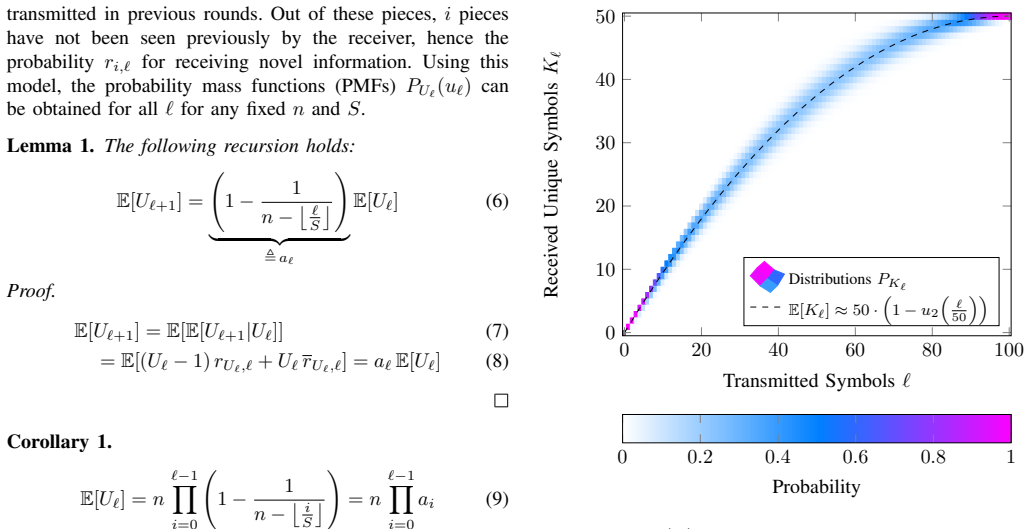
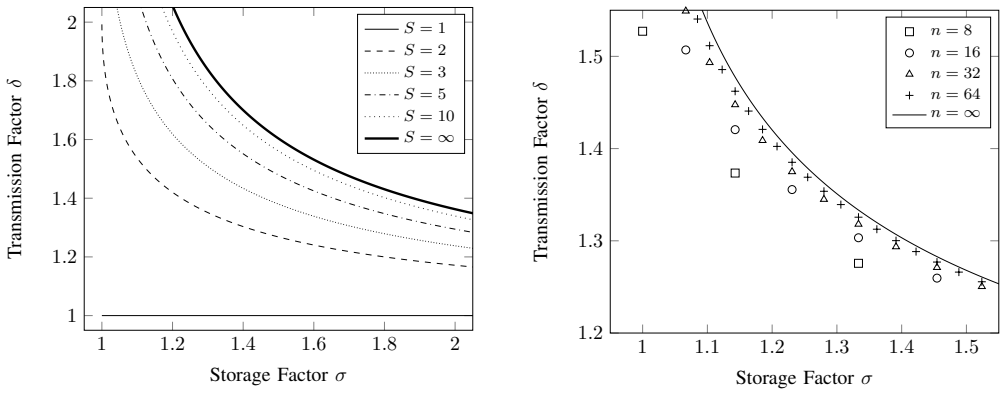
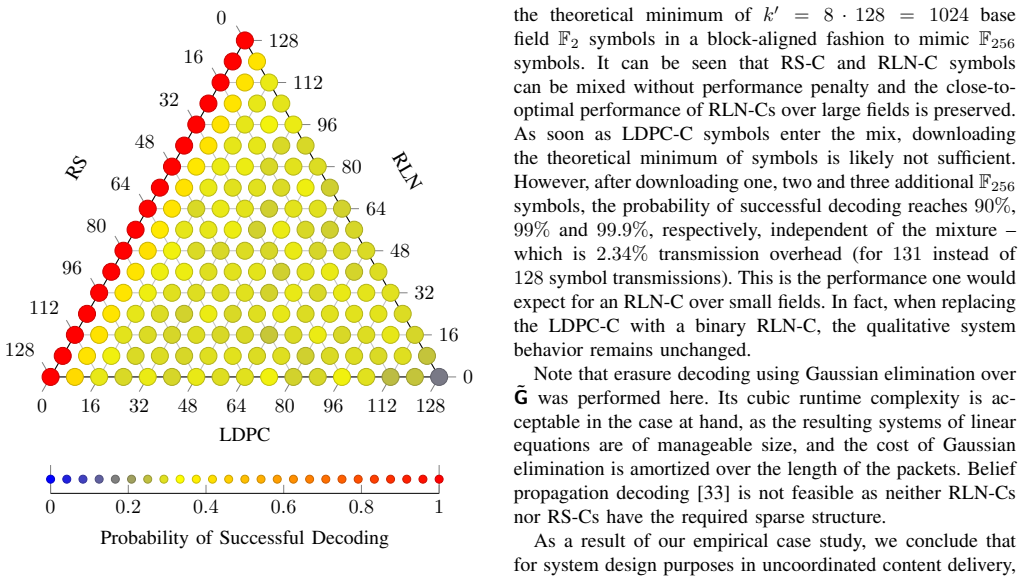
The paper's central claim is a closed-form description of the coupon collector's problem that arises when $S$ storage systems all use the same $[n,k]_q$ MDS code and alternately transmit a uniformly random codeword symbol they have not previously sent. The number of unseen symbols $U_\ell$ after $\ell$ transmissions obeys the recursion $\mathbb{E}[U_{\ell+1}] = (1 - 1/(n - \lfloor\ell/S\rfloor)) \, \mathbb{E}[U_\ell]$, and in the large-block limit the fraction of unseen symbols is $u_S(\tau) = (1-\tau/S)^S$. Inverting this for rate $R$ gives the transmission factor $\delta = S(1-(1-R)^{1/S})/R$, the multiplicative penalty for uncoordinated same-code delivery. The paper's second claim is empirical: if the storage systems instead use different codes, specifically a Reed-Solomon code, a random linear network code over $\mathbb{F}_{256}$, and a binary AR4JA LDPC code, then after downloading only $k+3$ $\mathbb{F}_{256}$-symbols the user can decode with probability $99.9\%$, essentially independently of how the three code families are mixed. The interpretation is that maximum code diversity makes the collection of received symbols behave like a small-field random linear network code, which is close to the optimal rate of information per transmitted symbol.
Load-bearing premise
The tradeoff curve in Theorem 1 assumes that every storage system, in a fixed round-robin order, sends a uniformly random symbol among those it has not yet transmitted, with no user feedback and no coordination between systems; if real systems schedule symbols, allow repeats, or miss stored symbols, the curve does not describe the download.
Editorial extensions
If this is right
- For any fixed storage factor $\sigma = 1/R > 1$, the transmission factor remains finite as $S\to\infty$, so a user can pull from arbitrarily many same-code servers with bounded uncoordinated overhead.
- The curve $\delta = S(1-(1-R)^{1/S})/R$ gives operators a quantitative tradeoff: extra storage buys a directly computable reduction in transmission overhead, and vice versa.
- With diverse codes, no duplicate-suppression or scheduling feedback is needed; downloading $k+3$ symbols suffices for $99.9\%$ success, so a digital-fountain style 'send until I stop you' protocol is nearly optimal.
- The field-lifting construction plus Gaussian elimination means the mixed-code scheme can be decoded with standard erasure-decoding software, without belief propagation.
- Operators can emulate near-optimal performance even without designing new codes by randomly recoding stored symbols before transmission, effectively converting any code into a random linear code at the transport layer.
Reading between the lines
- The formula $u_S(\tau)=(1-\tau/S)^S$ has a reading the paper does not spell out: for a fixed symbol, it is the probability that none of the $S$ servers has picked it by normalized time $\tau$, i.e., the fraction unseen is the survivor function of a coupon collector seen from the symbol's point of view. That symmetry suggests a direct connection to order statistics of independent geometric draws.
- The $k+3$ result is demonstrated for $[160,128]_{256}$ and $[1280,1024]_2$ parameters and for the specific LDPC code AR4JA; a natural extension, not pursued in the paper, is to test whether the 'three extra symbols' constant persists for other rates, field sizes, and LDPC ensembles.
- If storage systems transmit at different rates or hold different numbers of symbols, the symmetric round-robin assumption breaks; an obvious extension is a weighted or heterogeneous version of the Markov chain, which would tell operators whether the same-code penalty worsens when one server is much faster than the others.
- The block-aligned erasure assumption is natural for RS and RLN symbols but is an approximation for LDPC: a testable extension is to randomize the alignment or use LDPC codes over $\mathbb{F}_{256}$ directly, and check whether the near-optimal decoding threshold survives.
Signed reviews
Editorial analysis
A structured set of objections, weighed in public.
Referee Report
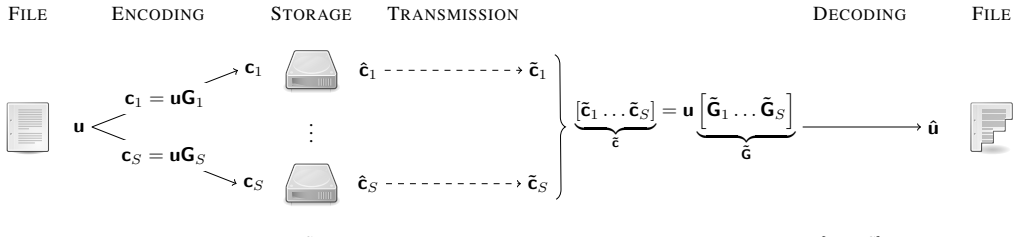
Summary. The paper analyzes uncoordinated content delivery from S storage systems that use the same MDS code, modeling the number of unseen codeword symbols as a time-inhomogeneous Markov chain and deriving the asymptotic fraction u_S(τ) = (1 − τ/S)^S of unseen symbols after τn received transmissions (Theorem 1, Eq. (11)). From this it obtains a storage–transmission tradeoff via the relation R = 1 − (1 − τ̃/S)^S in Eq. (26). The paper then presents an empirical case study (Section IV) in which a mixture of an RLN code, an RS code, and an AR4JA LDPC code is downloaded without coordination, claiming that decoding succeeds with 99.9% probability after k + 3 F256 symbols regardless of the mixture, and concluding that binary LDPC codes can be treated as binary RLN codes for this purpose.
Significance. The Section III result is a clean, self-contained characterization of a natural coupon-collector tradeoff and appears to be correct; if the empirical Section IV claim were fully substantiated, the paper would provide a practically relevant design principle for content-centric storage systems. However, the central 'code diversity' message currently rests on an unreported simulation with an unproven modeling assumption, so the paper's overall significance is contingent on that evidence being supplied.
major comments (3)
- [Section IV, Fig. 6 and the paragraph 'Fig. 6 shows ...'] The claim that after downloading one, two, and three additional F256 symbols the probability of successful decoding reaches 90%, 99%, and 99.9%, 'independent of the mixture,' is not reproducible from the manuscript: there is no description of the number of simulation trials, the random seeds, the exact generator-matrix constructions (e.g., the specific RS evaluation points, the RLN coefficient distribution, and the AR4JA parity-check matrix), or the procedure for mixing symbol types. Without these details, a reader cannot verify the load-bearing empirical result; the authors should provide the code and data or a complete experimental protocol with confidence intervals.
- [Section IV, paragraph beginning 'We thus get ...'] The statement 'while the LDPC-C's performance is unaffected' by block-aligned erasures is asserted without proof or supporting data. For a binary LDPC code there is no inherent F256 symbol structure, and grouping eight F2 coordinates into a block can materially change the rank distribution of the reduced generator matrix; the MDS properties of RS and RLN codes do not imply anything about the AR4JA code's behavior under this grouping. The paper needs either a formal argument that the AR4JA rank profile over block-aligned subsets matches that of a binary random linear code, or a systematic empirical study of the grouping's effect on the decoding probability.
- [Section IV, concluding paragraph 'As a result of our empirical case study ...'] The conclusion that 'binary LDPC-Cs can be treated as binary RLN-Cs' is an extrapolation far beyond the single AR4JA code and the single parameter set (n = 1280, k = 1024) studied. Even if the simulation were fully reproducible, the paper provides no reason to expect this equivalence to hold for other LDPC codes, other rates, or other block sizes; if this is intended as a general design rule, it requires supporting analysis, and otherwise the claim should be explicitly restricted to the studied code and parameters.
minor comments (5)
- [Theorem 1 statement] The phrase 'F orn→∞' contains a typo and should read 'For n→∞'.
- [Eq. (26)] The expression for τ̃ writes the S-th root as 'S√ 1−R', which is ambiguous; it should be typeset as (1−R)^{1/S} or \(\sqrt[S]{1-R}\).
- [Section II system model vs. Section III analysis] The system model introduces storage erasures (the \(\hat{c}_i\) vectors), but the Markov-chain analysis in Section III assumes all n codeword symbols are available for transmission. The paper should state explicitly that the tradeoff characterization ignores storage erasures, or incorporate them into the model.
- [Fig. 6 caption and surrounding text] The caption says 'minimum number of k = 128 symbols' but the text refers to k′ = 1024 base-field F2 symbols; please clarify consistently that the 128 symbols are F256 symbols, which correspond to 128 blocks of 8 F2 symbols.
- [Theorem 1 proof] The limit argument uses the informal approximations labeled (a), (b), and (c) without rigorous error bounds; providing explicit bounds on the approximation errors would make the proof of convergence of the expectation fully rigorous, although the concentration part is standard.
Circularity Check
No significant circularity: the main analytic result is derived from an explicit Markov model, and the code-diversity claim is empirical rather than constructed.
full rationale
Theorem 1 and Eq. (26) follow from a self-contained Markov-chain model (Eqs. (3)-(5)) of round-robin sampling without replacement. The transition probabilities are direct consequences of the stated protocol; Lemma 1 and Corollary 1 give the exact expectation recursion, and the variance bound (Eqs. (17)-(23)) yields concentration. No fitted parameter enters the asymptotic expression u_S(τ) = (1 - τ/S)^S, and Eq. (26) is just inversion of that expression, so the storage-transmission tradeoff is not an input restated as an output. Section IV is an empirical case study: it simulates mixed RS/RLN/LDPC delivery and reports observed decoding probabilities; the claim that k+3 symbols suffice with 99.9% probability is an experimental observation, not derived from the model, so it cannot be circular in the equation-identity sense. The only self-citation, [26] (Hellge and Médard), is invoked for the lifting-to-base-field technique, but the needed equivalence is re-derived in the paper (Eqs. (27)-(30)) and also attributed to independent reference [32]; no central conclusion depends on [26] as unverified authority. The block-aligned erasure assumption for LDPC is an unproven modeling choice, and the simulation details are unreported, but those are correctness and reproducibility concerns, not circularity. Thus no circular step is identifiable with quoted evidence.
Assumptions & free parameters
assumptions (7)
- domain assumption Each storage system transmits uniformly at random without replacement from its stored n codeword symbols, in a fixed round-robin order, with no coordination.
- domain assumption All S storage systems use the same [n,k] MDS code, so any k distinct received codeword symbols permit decoding.
- domain assumption Storage erasures are ignored in the transmission analysis: each server has all n symbols available for transmission.
- standard math Multiplication in F_{2^8} can be represented as a linear map over F_2, allowing all codes to be lifted to a common binary field.
- domain assumption Block-aligned erasures of 8 binary coordinates 'mimic' F256-symbol erasures for all three codes.
- domain assumption The AR4JA LDPC code is representative of binary LDPC codes for the purpose of drawing general conclusions.
- domain assumption The user decodes by Gaussian elimination over the received generator matrix (maximum likelihood decoding).
Cite this review
Pith. "Pith review of Babel Storage: Uncoordinated Content Delivery from Multiple Coded Storage Systems." pith.science (2026). https://pith.science/paper/WDWPMXSR
@misc{pith2026190809271,
  author       = {Pith},
  title        = {Pith review of: Babel Storage: Uncoordinated Content Delivery from Multiple Coded Storage Systems},
  year         = {2026},
  howpublished = {\url{https://pith.science/paper/WDWPMXSR}},
  note         = {Machine review of arXiv:1908.09271}
}
read the original abstract
In future content-centric networks, content is identified independently of its location. From an end-user's perspective, individual storage systems dissolve into a seemingly omnipresent structureless `storage fog'. Content should be delivered oblivious of the network topology, using multiple storage systems simultaneously, and at minimal coordination overhead. Prior works have addressed the advantages of error correction coding for distributed storage and content delivery separately. This work takes a comprehensive approach to highlighting the tradeoff between storage overhead and transmission overhead in uncoordinated content delivery from multiple coded storage systems. Our contribution is twofold. First, we characterize the tradeoff between storage and transmission overhead when all participating storage systems employ the same code. Second, we show that the resulting stark inefficiencies can be avoided when storage systems use diverse codes. What is more, such code diversity is not just technically desirable, but presumably will be the reality in the increasingly heterogeneous networks of the future. To this end, we show that a mix of Reed-Solomon, low-density parity-check and random linear network codes achieves close-to-optimal performance at minimal coordination and operational overhead.
Figures
Figures from the paper (2 more)
Reference graph
Works this paper leans on
-
[1]
P. L. Dordal, An Introduction to Computer Networks , 2018, release 1.9.16. [Online]. Available: http://intronetworks.cs.luc.edu/
work page 2018
-
[2]
A data-oriented (and beyond) network architecture,
T. Koponen et al., “A data-oriented (and beyond) network architecture,” in Proc. ACM SIGCOMM Conf. Appl., Technol., Architectures, and Protocols for Comput. Commun. , 2007, pp. 181–192
work page 2007
-
[3]
Bossert, Channel Coding for Telecommunications
M. Bossert, Channel Coding for Telecommunications . Wiley, 1999
work page 1999
-
[4]
Towards an archival intermemory,
A. V . Goldberg and P. N. Yianilos, “Towards an archival intermemory,” in Proc. IEEE F orum Res. and Technol. Advances in Digit. Libraries (ADL), 1998, pp. 147–156
work page 1998
-
[5]
OceanStore: An architecture for global-scale per- sistent storage,
J. Kubiatowicz et al., “OceanStore: An architecture for global-scale per- sistent storage,” in Proc. Int. Conf. Architectural Support for Program. Lang. and Operating Syst. (ASPLOS) , 2000, pp. 190–201
work page 2000
-
[6]
K. V . Rashmi et al. , “A solution to the network challenges of data recovery in erasure-coded distributed storage systems: A study on the Facebook warehouse cluster,” in Proc. USENIX Workshop Hot Topics in Storage and File Syst. (HotStorage) , 2013
work page 2013
-
[7]
How good is random linear coding based distributed networked storage?
S. Acedanski et al., “How good is random linear coding based distributed networked storage?” in Workshop Network Coding, Theory and Applicat. (NETCOD), Riva del Garda, Italy, 2005
work page 2005
-
[8]
On the practical use of LDPC erasure codes for distributed storage applications,
J. S. Plank and M. G. Thomason, “On the practical use of LDPC erasure codes for distributed storage applications,” University of Tennessee, Tech. Rep. CS-03-510, September 2003
work page 2003
Show all 33 references
-
[9]
LDPC code design for distributed storage: Balancing repair bandwidth, reliability, and storage overhead,
H. Park, D. Lee, and J. Moon, “LDPC code design for distributed storage: Balancing repair bandwidth, reliability, and storage overhead,” IEEE Trans. Commun. , vol. 66, no. 2, pp. 507–520, 2018
2018
-
[10]
Liquid cloud storage,
M. G. Luby et al. , “Liquid cloud storage,” arXiv:1705.07983v1, 2017
2017 arXiv
-
[11]
Capacity bounds for distributed storage,
M. Luby, “Capacity bounds for distributed storage,” arXiv:1610.03541v5, 2018
2018 arXiv
-
[12]
XORing elephants: Novel erasure codes for big data,
M. Sathiamoorthy et al. , “XORing elephants: Novel erasure codes for big data,” Proc. VLDB Endowment , vol. 6, no. 5, pp. 325–336, 2013
2013
-
[13]
Locally repairable codes,
D. S. Papailiopoulos and A. G. Dimakis, “Locally repairable codes,” IEEE Trans. Inf. Theory , vol. 60, no. 10, pp. 5843–5855, 2014
2014
-
[14]
Erasure coding in Windows Azure storage,
C. Huang et al. , “Erasure coding in Windows Azure storage,” in Proc. USENIX Annu. Tech. Conf. , 2012, pp. 15–26
2012
-
[15]
A survey on network codes for distributed storage,
A. G. Dimakis et al. , “A survey on network codes for distributed storage,” Proc. IEEE, vol. 99, no. 3, pp. 476–489, 2011
2011
-
[16]
Raptor codes,
M. A. Shokrollahi and M. Luby, “Raptor codes,” F oundations and Trends in Commun. and Inf. Theory , vol. 6, no. 3-4, pp. 213–322, 2009
2009
-
[17]
STAIR codes: A general family of erasure codes for tolerating device and sector failures,
M. Li and P. P. C. Lee, “STAIR codes: A general family of erasure codes for tolerating device and sector failures,” ACM Trans. Storage (TOS), vol. 10, no. 4, pp. 14:1–14:30, Oct. 2014
2014
-
[18]
Optimizing the error recovery capabilities of LDPC-staircase codes featuring a Gaussian elimination decoding scheme,
M. Cunche and V . Roca, “Optimizing the error recovery capabilities of LDPC-staircase codes featuring a Gaussian elimination decoding scheme,” in Proc. IEEE Int. Workshop Signal Process. for Space Commun. (SPSC) , 2008, pp. 1–7
2008
-
[19]
Performance versus overhead for fountain codes over Fq,
G. Liva, E. Paolini, and M. Chiani, “Performance versus overhead for fountain codes over Fq,” IEEE Commun. Lett. , vol. 14, no. 2, pp. 178– 180, 2010
2010
-
[20]
Cache-aided interference channels,
M. A. Maddah-Ali and U. Niesen, “Cache-aided interference channels,” IEEE Trans. Inf. Theory , vol. 65, no. 3, pp. 1714–1724, 2019
2019
-
[21]
Erasure coding for decentralized coded caching,
H. Reisizadeh, M. A. Maddah-Ali, and S. Mohajer, “Erasure coding for decentralized coded caching,” in Proc. IEEE Int. Symp. Inf. Theory (ISIT), 2018, pp. 1715–1719
2018
-
[22]
MDS-coded distributed caching for low delay wireless content delivery,
A. Piemontese and A. Graell i Amat, “MDS-coded distributed caching for low delay wireless content delivery,” IEEE Trans. Commun., vol. 67, no. 2, pp. 1600–1612, 2019
2019
-
[23]
Algebraic gossip: A network coding approach to optimal multiple rumor mongering,
S. Deb, M. M ´edard, and C. Choute, “Algebraic gossip: A network coding approach to optimal multiple rumor mongering,” IEEE Trans. Inf. Theory , vol. 52, no. 6, pp. 2486–2507, 2006
2006
-
[24]
Analyzing network coding (gossip) made easy,
B. Haeupler, “Analyzing network coding (gossip) made easy,” J. ACM, vol. 63, no. 3, pp. 26:1–26:22, 2016
2016
-
[25]
A digital fountain approach to reliable distribution of bulk data,
J. W. Byers et al. , “A digital fountain approach to reliable distribution of bulk data,” in Proc. ACM SIGCOMM Conf. Appl., Technol., Archi- tectures, and Protocols for Comput. Commun. , 1998, pp. 56–67
1998
-
[26]
Multi-code distributed storage,
C. Hellge and M. M ´edard, “Multi-code distributed storage,” in Proc. IEEE Int. Conf. Cloud Comput. (CLOUD) , 2016, pp. 839–842
2016
-
[27]
A random linear network coding approach to multicast,
T. Ho et al. , “A random linear network coding approach to multicast,” IEEE Trans. Inf. Theory , vol. 52, no. 10, pp. 4413–4430, 2006
2006
-
[28]
Polynomial codes over certain finite fields,
I. S. Reed and G. Solomon, “Polynomial codes over certain finite fields,” J. SIAM, vol. 8, no. 2, pp. 300–304, 1960
1960
-
[29]
A new class of rateless codes based on Reed-Solomon codes,
R. R. Borujeny and M. Ardakani, “A new class of rateless codes based on Reed-Solomon codes,” IEEE Trans. Commun. , vol. 64, no. 1, pp. 49–58, 2016
2016
-
[30]
Protograph based LDPC codes with minimum distance linearly growing with block size,
D. Divsalar et al. , “Protograph based LDPC codes with minimum distance linearly growing with block size,” in Proc. IEEE Global Commun. Conf. (GLOBECOM) , 2005, pp. 1152–1156
2005
-
[31]
TM synchronization and channel coding – summary of concept and rationale,
“TM synchronization and channel coding – summary of concept and rationale,” CCSDS SLS-C&S Working Group, Tech. Rep. 130.1-G-2, November 2012
2012
-
[32]
An XOR-based erasure-resilient coding scheme,
J. Blmer et al. , “An XOR-based erasure-resilient coding scheme,” Int. Comput. Sci. Inst. (ICSI) Berkeley, Tech. Rep. TR-95-048, August 1995
1995
-
[33]
T. J. Richardson and R. L. Urbanke, Modern Coding Theory. Cambridge University Press, 2008
2008
Reviewed August 14, 2026 · model on record in the stance chip above.
Discussion (0). Continue with ORCID to comment.